Symbols
The
searcher behind symbols of meaning becomes himself a symbol.
“What takes place
between light and darkness, what unites the opposites, always has a share in
both sides and can be judged just as well from the left as from the right… the
only thing that helps us here is the symbol….with its paradoxical nature it
represents the ‘third thing” --Jung, CW 13, pp. 134.
Jung
discusses the union or coincidence of opposites (coniunctio oppositorum), the
tension of opposites, compensation, complimentarity, enantriodromia and psychic
balance. He is not systematic in his use of these terms.The coincidence of
opposites (coincidentia oppositorum) is one of the fundamental organizing
principles in Jung’s thought. Key concepts such as the self, the god image, the
collective unconscious, wholeness and synchronicity are said to be instances of
the coincidence of opposites. They unify by converging, superseding, or
transcending. A return to Tao means deliverance from the cosmic opposites. It
still means living with and enduring Shadow awareness. Jung
refers to a
''mysterium coniunctionis'' - an alignment, a joining -- the ability to hold
the tension of
the opposites.
Psyche tries to resolve the tension with balance, wholeness, and connection.
‘Whoever protects himself
against what is new an strange and regresses to the past falls into the same
neurotic condition as the man who identifies himself with the new and runs away
from the past. The only difference is the one has estranged himself from the
past and the other from the future. In principle both are doing the same thing:
they are reinforcing their narrow range of consciousness instead of shattering
it in the tension of opposites and building up a state of wider and higher
consciousness.’--Portable
Jung
The process of coming
to terms with the unconscious is a true labor, a work which involves both
action and suffering. It has been named the "transcendent function"
because it represents a function based on real and "imaginary," or
irrational and rational, data, thus bridging the yawning gulf between conscious
and unconscious. It is a natural process, a manifestation of the energy that
springs from the tension of opposites, and it consists in a series of
fantasy-occurrences which appear spontaneously in dreams and visions (Jung, CW,
p.100).
Synthesis is the
product of this violent war "between the spirit and the flesh." The
transcendent function, through a dialectical synthesis, brings together
opposites in a reconciling attempt, coniunctio or conjunction, to regulate
the psyche, or the self.
When a person can hold
the tension between the conflicting opposites, eventually something will happen
in the psyche to resolve the conflict. The outer circumstances may in fact
remain the same, but a change takes place in the individual. This change,
essentially irrational and unforeseeable, appears as a new attitude to both
oneself and others; energy previously locked up in a state of indecision is
released and movement becomes possible. Jung calls this the transcendent function,
because what happens transcends the conflicting opposites (p.38).
[We must] “stand the tension of the opposites”
in
order to transcend them... “The apparently unendurable conflict is proof of the
rightness of your life. A life without inner contradiction is either only half
a life or else a life in the Beyond... The self is made manifest in the
opposites and in the conflict between them.” --C.G. Jung
Nature indeed was not
originally regarded as merely material but was fully as much spirit as matter.
Nature was permeated with spirit for man in antiquity and the countenance of
God still shines forth from nature in the "Theologia naturalis". If
we subject the psychical nature of man to a careful analysis, we discover not
only physical natural urges in the unconscious, but also spiritual
determinants. And as the natural urges are not purely of evil, neither are the
spiritual.
This thought then - that
the means to higher development is enclosed in the essence of nature itself,
and cannot therefore be forced on nature by the will and its rational formulas
- is the basis of a spiritual movement in the West, which is of a totally
different kind from that with which we became acquainted in the Ignatian
exercises.
It is also an exercise in
meditation, but of a quite particular kind, which was not usually even
recognized as such. For it was a secret, and successfully concealed itself
behind a number of misleading designations; it called itself philosophy"
quite as often as "alchemy" or the "art of making gold". In
its historical outcome it did not flow back into a recognized form of religion
but into natural science, which all too often app eared in opposition to faith,
and set knowledge and experience against belief. The essence of science is
knowledge, it does not know the piety of faith, but that of investigation and
of knowledge.
~Carl Jung, Modern
Psychology, Pages 11-18.
The ego changes all the
time, it has every kind of illusion, but the Self is as it is, there is nothing
we can alter in it.
~Carl Jung, ETH Lecture, Pages 175.
The ego changes all the
time, it has every kind of illusion, but the Self is as it is, there is nothing
we can alter in it.
~Carl Jung, ETH Lecture, Pages 175.
In the East the Void
represents a psychic emptying of all conscious contents through the practice of
Yoga. In the western series the chaos, or nigredo, is not thought of as a
psychic condition but as a condition of the materia. This is the great
difference between the East and the West.
~Carl Jung, ETH
Lecture, Pages 175.

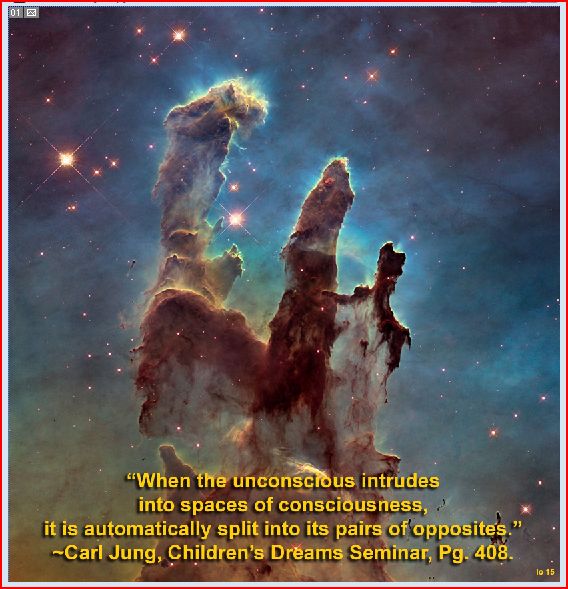
OPPOSITES
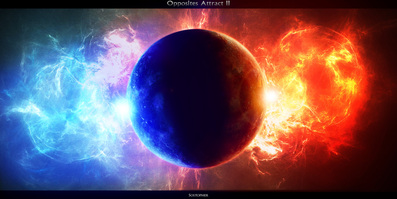
Polarity Underlies the
Dynamics of Psyche
A series of
complementary pairs: Light/Dark, Good/Evil, Life/Death, Love/Hate, Body/Spirit,
Sun/Moon, Gold/Silver, Sulphur/Mercury, King/Queen, Male/Female, Husband/Bride,
Christ/Man, Grief/Joy, etc. Masculine-feminine opposition is personified as King and Queen underlying unified
reality --
heaven and earth.
Throughout Jung's
writing there is continual tension of opposites and integration of opposites.
Two ideas are represented a dualistic opposing pair in the conscious mind, and
the integration of the opposites occurs through archetypal representations.
Jung thought mental energy is produced by the tension or conflict of opposites,
so there is no energy or libido without it. Thus, individuation with its
conflicts creates psychic energy. Great energy comes from a correspondingly
great tension of opposites.
The king and queen in
hermaproditic union symbolize the union of opposites, anima/animus, unconscious
and conscious. We suffer authentically when we endure a tension of opposites
until the way becomes clear. If we can hold the tension long enough, without
succumbing to the urge to identify with one side or the other, a third, unique position can arise. Success
comes from enduring the tension without giving up on the process even when
there are no apparent results. Eventually, the transcendent function emerges
from the tension of opposites.
The work of wholeness
is involved in alchemical symbolism as shown by the constant conjunction of
opposites in its imagery: the marriage of sun and moon, of fire and water, of
king and queen. In simplest terms, the King and Queen represent the raw materials of our
psyche. As wisdom figures, the Ruler is the top of the tree, the King or Queen. The King and Queen are the second
generation of the gods. The king or queen could rule absolutely because they were essentially
'god on earth.' Their union produces the radiant sovereign self.
It is a psychic fact
that the opposites arising from the dark matter of the birth-agonies of the
human soul confront each other in the alchemical vessel of spiritual
transformation (in Chinese alchemy frequently envisioned as the human body) and
after many battles, woundings, and indeed deaths, ultimately come to unite in
an indestructible state in the reconciliation of the binaries. Thus the lunar
Queen and solar King (represented in China by the symbols of the Yin and Yang)
are living presences within us, heralding the promise of the Philosophers'
Stone or the Golden Flower which we are destined to become ourselves.
Alchemy also speaks of
a "secret fire", which is often compared to a serpent or
dragon. Here again, we find the correspondence to Kundalini, the
serpent-power. Alchemy is performed by the aid of Mercury, the
illuminative principle, and the powers of the sun and moon. Both alchemists
and Tantrics practice with the essential aid, sometimes sexual, of a mystical
sister, the alchemist's soror
mystica or
yogi's yogini, complement of King/Queen, Shiva-Shakti, God/Goddess joined
together in the miracle marriage.
A new being is born
which is the promised fruit of love, the transformed consciousness of the
lovers, formed of the opposites, which are now welded into an inseparable
imperishable wholeness. The alchemy of love reaches its true and triumphant
culmination.
As a grand union of
opposites, it symbolizes the unification of king and queen, man and wife,
conscious and unconscious, personality and society, etc. in a royal union
called the Marriage of the Sun and Moon in alchemy Alchemy is a means of
understanding our unconscious projections of archetypes into the world. The
human figures are father and son, mother and daughter, king and queen, god and goddess. Individuation is
the union of a sun and moon, a circle and square, or a marriage of a king and queen. In alchemy, the king and queen are
brother and sister.
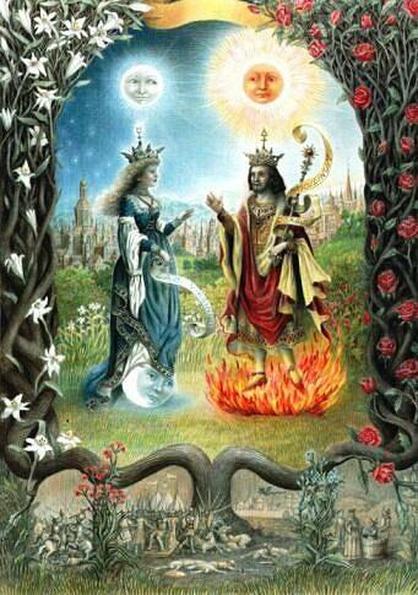
The Sun King and Moon
Queen, have to be recognized by the alchemist as archetypal polarities within
his soul and they must be brought into a new relationship. These polarities
meet and touch, though at this initial stage, their encounter is very
restrained and distant. As Jung points out in his commentary to these
illustrations, they give each other their left hands in union. The left
(sinister) being the dark or unconscious side of their being. Thus they are
united in the unconscious aspect, in the depths of the lower soul. Their right
hands, the more conscious side of their being, proffer two-blossomed flowers to
each other, and this meeting in consciousness is thus more restrained and
distant.
http://www.levity.com/alchemy/roscom.html
Jung's Mysterium Coniunctionis, 1955, examines the nature of the
opposites in the human psyche and the alchemical tradition. The uniting of the
alchemical King and Queen, the male and female components of the psyche, is
exhaustively investigated though various alchemical ideas, symbols and source
texts. The magnum opus is accomplished by the alchemical marriage of the king and queen. When we come to terms with the
Shadow and the Soul, we encounter the enchanted castle with its King and Queen.
They contain the Royal Secret of the [solar] King and [lunar]
Queen,
who were none other than
the animus and anima, or Deus and Dea.
~Carl
Jung, Letters Vol. 1, Page 248.
In former times, the
worldly Queen was also a priest, warrior and mother – sometimes even the
ultimate archetype, the Self or goddess. The image of a Queen serves as a
center for the mature ordering of things includes and transcends the other
archetypes of the Feminine. Indeed the most powerful embodiment of this
archetype is the Great Goddess—The Great Mother. This cosmic image is the equal
to that of an all powerful God, the source of complete cosmic power, but at the
same time is more accessible, less menacing.
The separation of the
"King" and "Queen" was understood by the Kabbalists to
symbolize a split between the masculine and feminine elements of the deity,
which itself reflects the disorder and chaos of a broken world. For the
Kabbalists, the disharmony of the world is reflected in a separation between
male and female, and the world¹s restoration and repair is symbolized by a
wedding between Tifereth and Malchuth, the masculine and feminine Sefirot,
known in the Kabbalah as the Holy One and his Bride. Jung, of course,
interpreted these ideas psychologically, and saw them as symbols of the union
between animus and anima which in the individual psyche is a pre-requisite for
individuation and psychological growth. Jung explored the Kabbalistic symbols of
the divine marriage extensively (Jung, 1955-6/1963, pp. 23, 24, 396, 432-445,
esp. 442; Jung, 1973, Vol. 1, p. 356, Vol. 2, p. 292)
http://www.newkabbalah.com/Jung2.html
The
king of the country marries “the land” – in the form of a high priestess –
to rejuvenate it.
At its core, the
sacred marriage [hierosgamos] is more of a sacrament than a ritual. It is a
marriage between husband and wife, but is of a sacred nature -- a marriage
blessed by the gods, with active participation of those deities, present in the
act of lovemaking between the two humans. The king was equally a high priest,
and the queen… a high priestess.
The rose is one of the
fundamental symbols of alchemy and became the philosophical basis of
Rosicrucian alchemy. It was so important to alchemists that there are many
texts called “Rosarium” (Rosary), and all these texts deal with the
relationship between the archetypal King and Queen. In alchemy, the rose is
primarily a symbol of the operation of Conjunction, the Mystical Marriage of opposites.
It represents the regeneration of separated essences and their resurrection on
a new level.
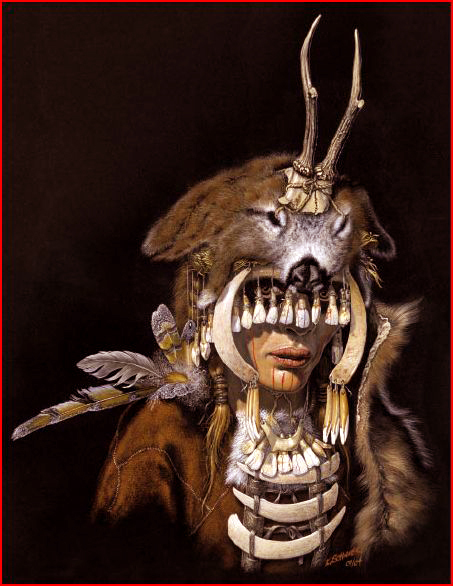
The shaman as a holistic archetype has the King’s capacity to lead, the Mother’s capacity to care and the Lover’s capacity to value someone or something enough to fight.
The self in its divinity (i.e., the archetype) is unconscious of
itself It can be come conscious only within our consciousness. And it can do
that only if the ego stands firm. ~Carl Jung, Letters Vol. 1, Pages 335-337.
The self must become as
small as and yet smaller than the ego although it is the ocean of divinity:
“God is as small as me,” says Angelus Silesius. ~Carl Jung, Letters Vol. 1, Pages
335-337.
The
motif of the net is the attribute of wisdom, it represents the logos and is the
net of understanding in which the Mother can be caught. ~Carl Jung, Modern
Psychology, Vol. 2, Page 148.
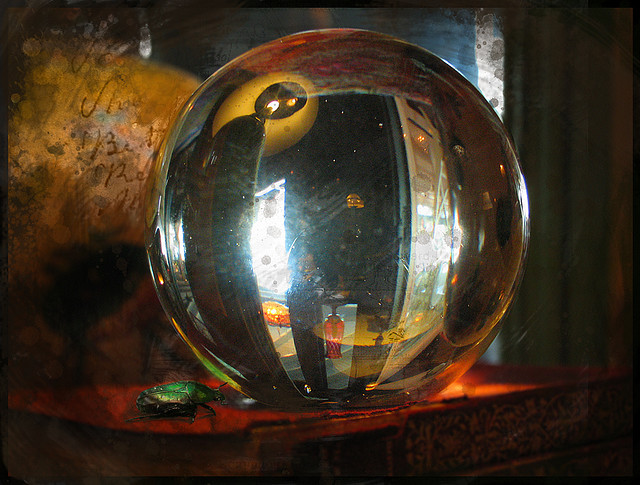
The
soul has its own peculiar world. Only the self enters in there, or the man who
has completely become his self, he who is neither in events, nor in men, nor in
his thoughts. ~Carl Jung, The Red Book, 240.
Your individuality, your
Self, appears in the objective facts of your life. An event can seem
incredible, unacceptable, but if it happens to you, then it means that it is
you. ~C.
G. Jung, Emma Jung and Toni Wolff - A Collection of Remembrances; Pages 51-70.
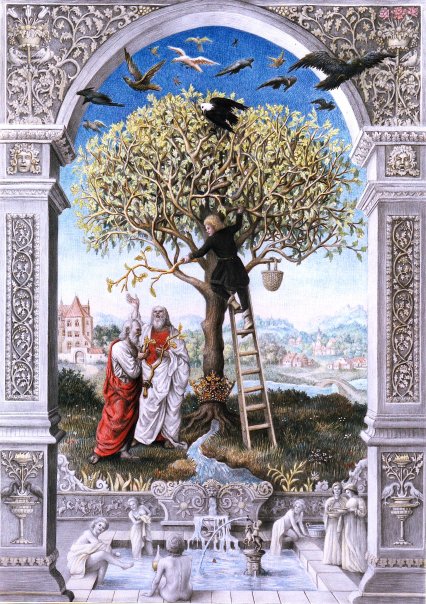
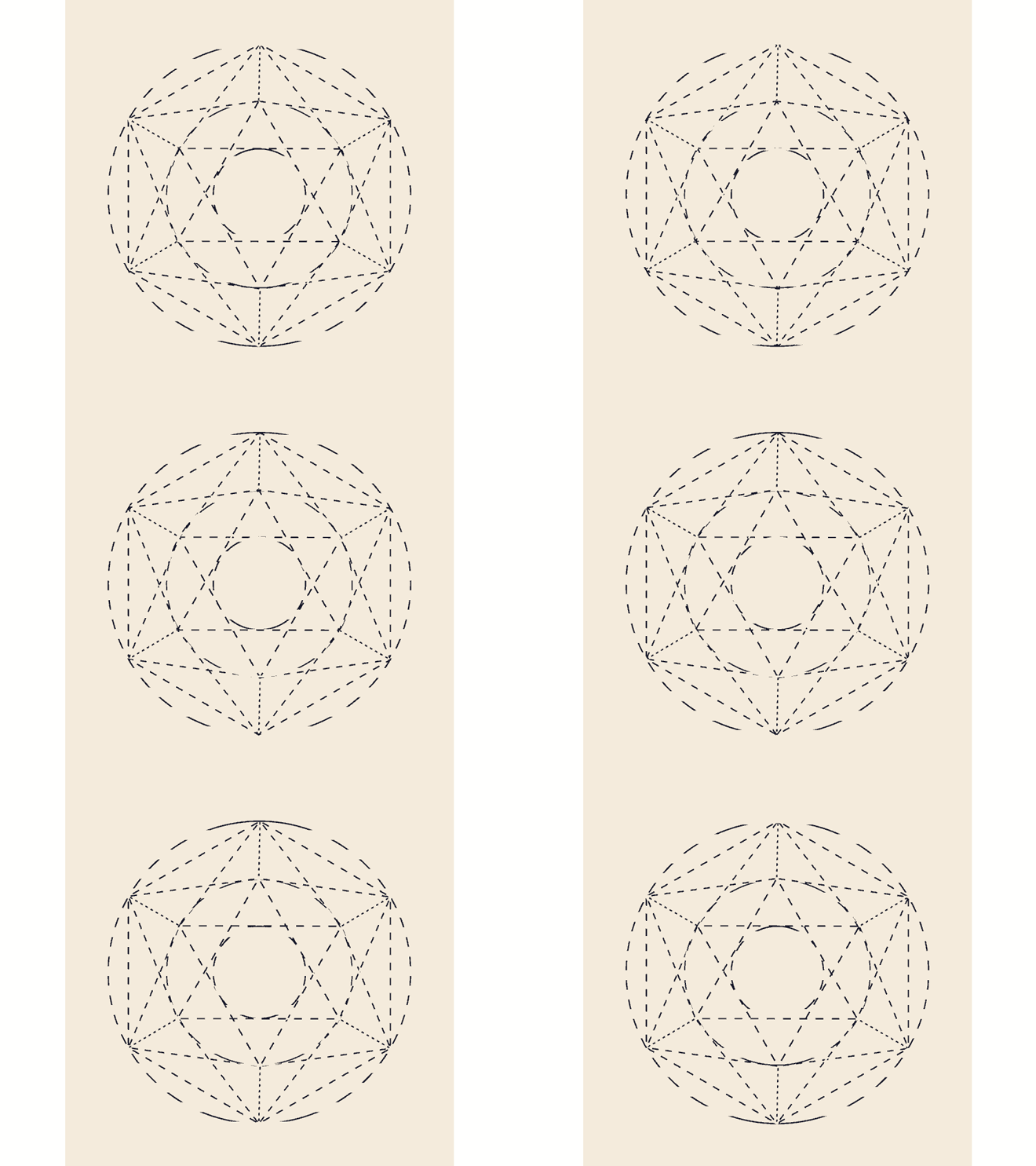
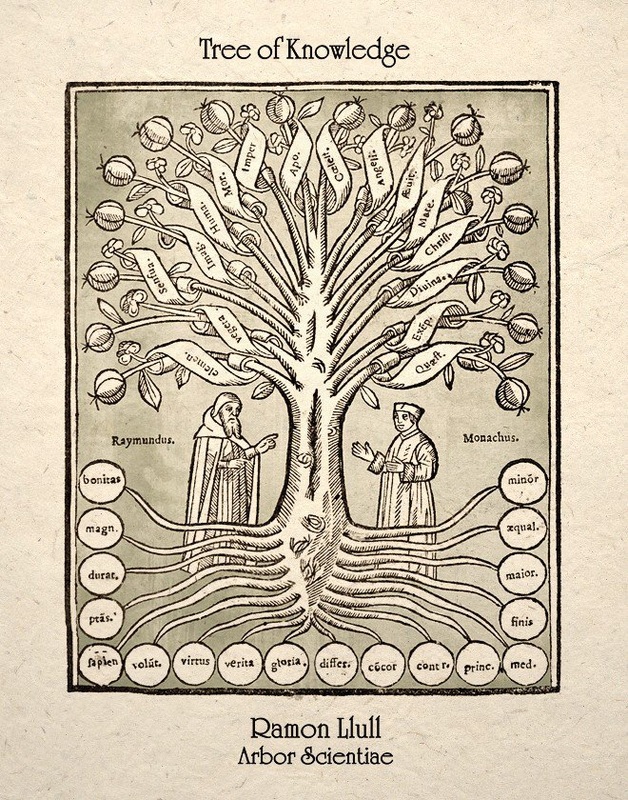
He sees the tree of
life, whose roots reach into Hell and whose top touches Heaven. He also no
longer knows differences: Who is right? What is holy? What is genuine? What is
good? What is correct? He knows only one difference: the difference between
below and above. For he sees that the tree of life grows from below to above,
and that it has its crown at the top, clearly differentiated from the roots. To
him this is unquestionable. Hence he knows the way to salvation.
To unlearn all
distinctions save that concerning direction is part of your salvation. Hence
you free yourself from the old curse of the knowledge of good and evil. Because
you separated good from evil according to your best appraisal and aspired only
to the good and denied the evil that you committed nevertheless and ailed to
accept, your roots no longer suckled the dark nourishment of the depths and
your tree became sick and withered.
Therefore the ancients
said that after Adam had eaten the apple, the tree of paradise withered. Your
life needs the dark. But if you know that it is evil, you can no longer accept
it and you suffer anguish and you do not know why: Nor can you accept it as
evil, else your good will reject you. Nor can you deny it since you know good
and evil. Because of this the knowledge of good and evil was an insurmountable
curse.
But if you return to
primal chaos and if you feel and recognize that which hangs stretched between
the two unbearable poles of fire, you will notice that you can no longer
separate good and evil conclusively, neither through feeling nor through
knowledge, but that you can discern the direction of growth only from below to
above. You thus forget the distinction between good and evil, and you no longer
know it as long as your tree grows from below to above. But as soon as growth
stops, what was united in growth falls apart and once more you recognize good
and evil.
You can never deny your
knowledge of good and evil to yourself so that you could betray your good in
order to live evil. For as soon as you separate good and evil, you recognize
them. They are united only in growth. But you grow if you stand still in the
greatest doubt, and therefore steadfastness in great doubt is' a veritable
flower of life.
He who cannot bear doubt
does not bear himself. Such a one is doubtful; he does not grow and hence he
does not live. Doubt is the sign of the strongest and the weakest. The strong
have doubt, but doubt has the weak. Therefore the weakest is close to the
strongest, and if he can say to his doubt: "I have you," then he is
the strongest. But no one can say yes to his doubt, unless he endures wide-open
chaos. Because there are so many among us who can talk about anything, pay heed
to what they live. What someone says can be very much or very little. Thus
examine his life.
My speech is neither
light nor dark, since it is the speech of someone who is growing. ~Carl Jung,
Red Book, Page 301
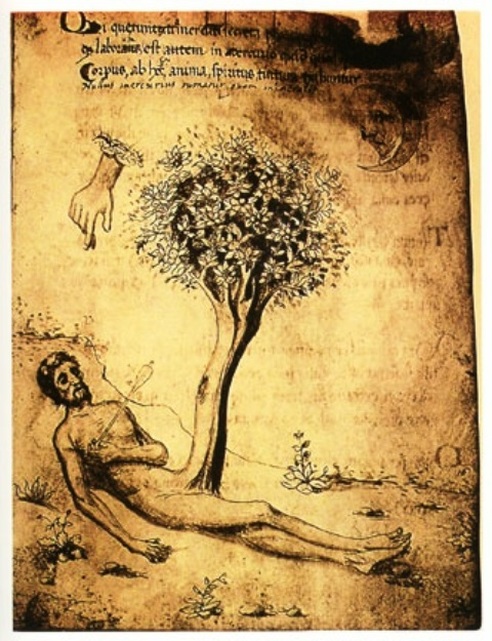
"The
symbol is the genome of the soul."
If one honors God, the
sun or the fire, then one honors one’s own vital force, the libido. It is as
Seneca says: ” God is near you, he is with you, in you.” God is our own longing
to which we pay divine honors. ~Carl Jung.
It is the psyche which, by
the divine creative power inherent in it, makes the metaphysical assertion; it
posits the distinctions between metaphysical entities. Not only is it the
condition of all metaphysical reality, it is that reality.
~Carl Jung, Psychology
and Religion, Page 512, Para 856.
We know of no
consciousness that is not the relation between images and an ego.
There are, and always
have been, those who cannot help but see that the world and its experiences are
in the nature of a symbol, and that it really reflects something that lies
hidden in the subject himself, in his own transubjective reality. ~Carl Jung, Psychology and
Religion, Page 521, Para 859.
The symbol becomes my lord
and unfailing commander. It will fortify its reign and change itself into a
starry and riddling image, whose meaning turns completely inward, and whose
pleasure radiates outward like blazing fire, a Buddha in the flames. ~Carl Jung, The Red Book, Page 249.
If forethinking and
pleasure unite in me, a third arises from them, the divine son, who is the
supreme meaning, the symbol, the passing over into a new creation.
I do not myself become the
supreme meaning or the symbol, but the symbol becomes in me such that it has
its substance, and I mine. ~Carl Jung, The Red Book, Page 249.
You see, man is in need of
a symbolic life - badly in need. We only live banal, ordinary, rational, or
irrational things . . . but we have no symbolic life. Where do we live
symbolically? Nowhere except where we participate in the ritual of life. . . .
These things go pretty
deep, and no wonder people get neurotic. Life is too rational; there is no
symbolic existence in which I am something else, in which I am fulfilling my
role, my role as one of the actors in the divine drama of life.--Jung, Symbolic Life
“There
is a thinking in primordial images, in symbols which are older than the
historical man, which are inborn in him from the earliest times, eternally
living, outlasting all generations, still make up the groundwork of the human psyche.
It is only possible to live the fullest life when we are in harmony with these
symbols; wisdom is a return to them.”
― C.G. Jung
God-Image
The imago Dei
imprinted on the soul, not on the body, is an image of an image, “for my soul
is not directly the image of God, but is made after the likeness of the former
image. Christ, on the other hand, is the true image of God, after whose
likeness our inner man is made, invisible, incorporeal, incorrupt, and
immortal. The God-image in us reveals itself through “prudential, iustitia,
moderatio, virtus, sapientia et disciplina.” AION 38
The God-image is not
something invented; it is an experience that comes upon man spontaneously – as
anyone can see for himself unless he is blinded to the truth by theories and
prejudices. The unconscious God-image can therefore alter the state of
consciousness, just as the later modify the God-image once it has become
conscious. Aion 194
The God-image thrown
up by a spontaneous act of creation is a living figure, a being that exists in
its own right and there-fore confronts its ostensible creator autonomously… As
proof of this it may be mentioned that the relation between the creator and the
created is a dialectical. ~Carl Jung; CW8, para. 95-96.
It is exceedingly
difficult to explain the nature of the archetypal to somebody who does not know
about the empirical material we are dealing with in psychology.
The only parallel I
can point to outside the psychological field is the so-called mythological
motif in myths, legends, folklore, and religions.
If you study such a
motif you will find that it is by no means outright, but a living structure
representing something that could be called an image. Inasmuch as legends etc.
are transmitted by
tradition, the archetypes are consciously acquired, but inasmuch as archetypes
are found in the mind of the insane as well as in normal dreams quite outside
all tradition, archetypes appear also to be contents of the collective
unconscious and their existence in the individual mind can only be explained by
inl1eritance.
("Psychological Approach to the Dogma of the Trinity," CW 1 1 , par.
322 & n. 2).
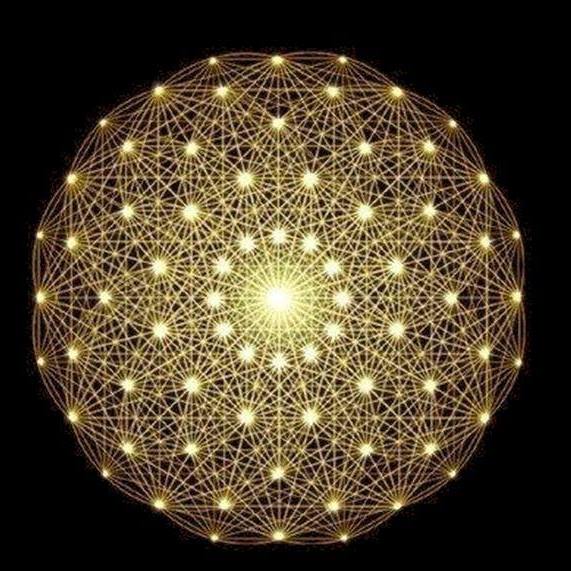
This
third phenomenon, the circle or mandala, is one of the most remarkable in
existence. Unfortunately it is very little known, although it is a fundamental
expression of the human psyche.
Up till the present, this
phenomenon has been given very little consideration, and yet mandalas occur all
over the world.
Since man has existed, the
circle has had its symbolic and magic meaning, we meet it everywhere, from the
sand paintings of the Pueblos to the mandalas of the Chinese and the same basic
elements are always present.
It is really necessary
that we should realise that such things exist, even if we know nothing of them.
I have purposely used a
case of Kerner's and not one of my own in bringing this phenomenon to your
notice, so that there could be no question of influence or suggestion.
When I was a student, I
came across a girl of fifteen who was a somnambulist, gifted with second sight
and she produced a circle very similar to the Clairvoyante's.
She spoke of the central
point as full of energy and radiant light and of the second ring as cold.
Whereas the Clairvoyante
of Prevorst looked up on her circle as a wall, protecting her from the darts of
the outer world, the magic circle has, from time immemorial, been used as a
protection against the inner world, the world of spirits. ~Carl Jung, Modern Psychology, Vol.
1, Page 42.
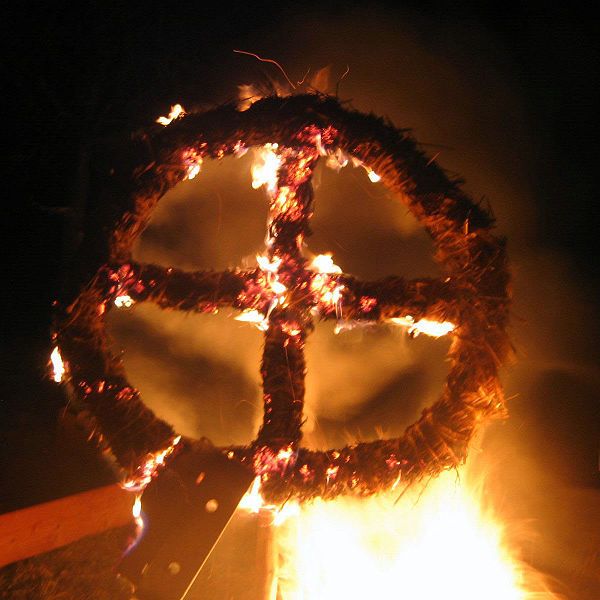
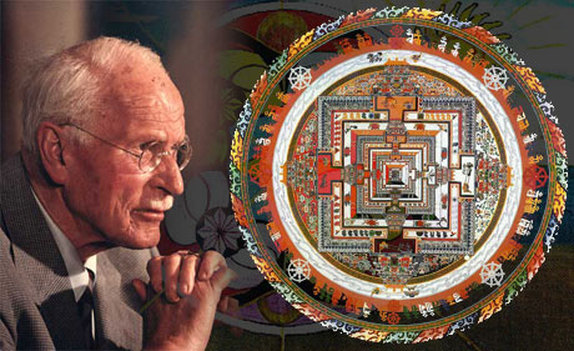
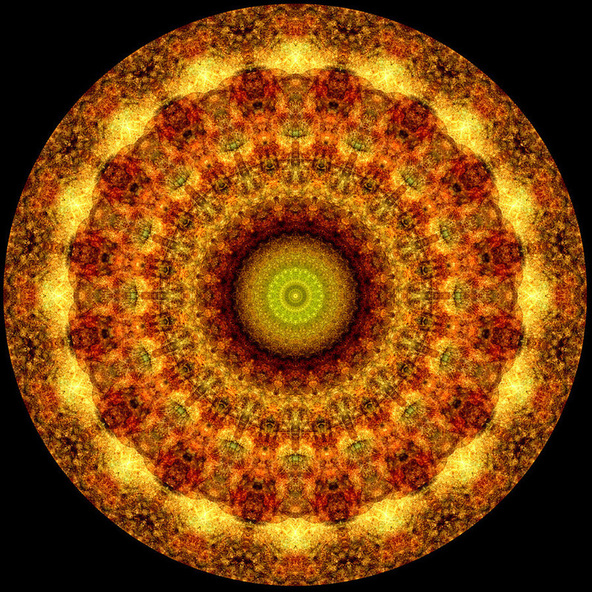
"I
knew that in finding the mandala as an expression of the Self I had attained
what was for me the ultimate. Perhaps someone else knows more, but not I."
~Carl Jung; Memories Dreams and Reflections,
~Carl Jung; Memories Dreams and Reflections, Page 197.
"Knowledge of symbols
is a network with which you can at least grope to capture the ineffable mystery
of an immediate experience of the unconscious."
--Marie-Louise von
Franz
Water is the commonest
symbol for the unconscious. The lake in the valley is the unconscious, which
lies, as it were, underneath consciousness, so that it is often referred to as
the ‘subconscious,’ usually with the pejorative connotation of an inferior
consciousness. Water is the ‘valley spirit,’ the water dragon of Tao, whose
nature resembles water- a yang in the yin, therefore, water means spirit that
has become unconscious.”
(Carl Jung, CW 9i, para 40)
We have, therefore, two
kinds of thinking: directed thinking, and dreaming or fantasy-thinking. The
former operates with speech elements for the purpose of communication, and is
difficult and exhausting; the latter is effortless, working as it were
spontaneously, with the contents ready to hand, and guided by unconscious
motives. The one produces innovations and adaptation, copies reality, and tries
to act upon it; the other turns away from reality, sets free subjective
tendencies, and, as regards adaptation, is unproductive
~Carl Jung; Two Kinds
of Thinking; para. 20.
The
Self
http://www.american-buddha.com/lit.jungaion.4.htm
I conjecture that the treasure is also the
"companion," the one who goes through life at our side—in all
probability a close analogy to the lonely ego who finds a mate in the self, for
at first the self is the strange non-ego. ~Carl Jung, Psychology and Alchemy, Page 117.
God & Psyche
http://pathofsoul.org/2010/05/26/jung-on-god-2/
It
is only through the psyche that we can establish that God acts upon us, but we
are unable to distinguish whether these actions emanate from God or from the
unconscious.
We cannot tell whether
God and the unconscious are two different entities. Both are border-line
concepts for transcendental contents.
But empirically it can
be established, with a sufficient degree of probability, that there is in the
unconscious an archetype of wholeness which manifests itself spontaneously in
dreams, etc., and a tendency, independent of the conscious will, to relate
other archetypes to its center.
Consequently, it does
not seem improbable that the archetype produces a symbolism which has always
characterized and expressed the Deity . . .
The God-image does not
coincide with the unconscious as such, but with a special content of it, namely
the archetype of the self. It is this archetype from which we can no longer
distinguish the God image empirically." ~Carl Jung; Memories Dreams and
Reflections; Page 395 and Psychology and Religion; West and East, CW 11, Page
468.
Carl Jung points out
that in modern times we have lost connection to the idea of God within; we
denigrate this idea by calling it ‘mystical.’ Jung adds: “And even if they do
cherish a certain belief in God, they would be deterred from the idea of a God
within by their religious education, which has always depreciated this idea as
“mystical.” (ibid. para. 101)
Carl Jung’s own
imaginal experience, as well as his clinical work with individuals, led him to
see the immanent truth of a spontaneous appearance of the deity within psychic
life. Jung says, “It is precisely this ‘mystical’ idea which is forced upon the
conscious mind by dreams and visions. I myself, as well as my colleagues, have
seen so many cases developing the same kind of symbolism that we cannot doubt
its existence any longer.” (para. 101)
For life comes to a man
through the anima, in spite of the fact that he thinks it comes to him through
the mind. He masters life through the mind but life lives in him through the
anima. ~Carl
Jung, Zarathustra Seminar, Page 1105.

Bruneel, Myriad of Angels
More especially the threat to one’s inmost self from dragons and
serpents points to the danger of the newly acquired consciousness being
swallowed up again by the instinctive psyche, the unconscious. ~Carl Jung; CW
9i; para. 282.
The consensus of opinion interpreted the Redeemer equally as a
fish and a serpent; he is a fish because he rose from the unknown depths, and a
serpent because he came mysteriously out of the darkness.
Fishes and snakes are
favorite symbols for describing psychic happenings or experiences that suddenly
dart out of the unconscious and have a frightening or redeeming
effect.
That is why they are
so often expressed by the motif of helpful animals. The comparison of Christ
with the serpent is more authentic than that with the fish, but, for all that,
it was not so popular in primitive Christianity.
The Gnostics favoured
it because it was an old-established symbol for the "good" genius
loci, the Agathodaimon, and also for their beloved Nous. Both symbols are of
inestimable value when it comes to the natural, instinctive interpretation of
the Christ-figure.
Theriomorphic symbols
are very common in dreams and other manifestations of the unconscious. They
express the psychic level of the content in question; that is to say, such
contents are at a stage of unconsciousness that is as far from human
consciousness as the psyche of an animal.
Warm-blooded or
cold-blooded vertebrates of all kinds, or even invertebrates, thus indicate the
degree of unconsciousness. It is important for psychopathologists to know this,
because these contents can produce, at all levels, symptoms that are localized
to the corresponding organic or physiological functions.
For instance, the
symptoms may be distinctly correlated with the cerebrospinal and the
sympathetic nervous system. The Sethians may have guessed something of this
sort, for Hippolytus mentions, in connection with the serpent, that they
compared the "Father" with the cerebrum and the
"Son" with
the cerebellum and spinal cord.
The snake does in fact
symbolize "cold-blooded” inhuman contents and tendencies of an abstractly
intellectual as well as a concretely animal nature: in a word, the extra-human quality
in man. ~Carl Jung; Aion; Page 186; Para 292.
Whoever speaks in
primordial images speaks with a thousand voices; they enthral and
overpower.....
they transmute our
personal destiny into the destiny of mankind, and evoke in us all those
beneficent forces that ever and anon have enabled humanity to find a refuge
from every peril and to outlive the longest night. --CW 15
SELF-Knowledge
"The more we
become conscious of ourselves through [S]elf-knowledge, and act accordingly,
the more [...] there arises a consciousness which is no longer imprisoned in
the petty, oversensitive, personal world of the ego, but participates freely in
the wider world of objective interests.
This widened
consciousness is no longer that touchy, egotistical bundle of personal wishes,
fears, hopes, and ambitions which always has to be compensated or corrected by
unconscious counter-tendencies; instead, it is a function of relationship to
the world of objects [it might be better to say here "a world of
subjects"], bringing the individual into absolute, binding, and
indissoluble communion with the world at large." ~Carl Jung
The hypothesis that ego
consciousness is surrounded by a multitude of luminosities rests partly on the
quasi conscious state of the unconscious and partly on the high incidence of
light imagery in descriptions of consciousness. Various alchemic,
Hindu, and Christian
writings are examined for their use of light imagery in describing the nature
of consciousness, man, and their metaphysics.
The alchemists Khunrath,
Dorn, and Paracelsus wrote of a lumen naturae that illuminates consciousness,
and of scintillae, sparks, that are the germinal luminosities shining forth
from the darkness of the unconscious. Ignatius Loyola wrote of a recurrent
vision he had of a bright light that took the shape of a multieyed serpent.
Multiple eyes also
characterize Purusha, the Hindu cosmic man.
These metaphysical systems
and visions are interpreted as introspective intuitions that capture the nature
of the unconscious. Since consciousness has always been described in terms
derived from the behavior of light, it is concluded that these multiple
luminosities correspond to tiny conscious phenomena, many of which reside in
the unconscious.
~Carl Jung; CW 8; On
the nature of the psyche.
The
Symbolic Life
You see, man is in
need of a symbolic life - badly in need. We only live banal, ordinary,
rational, or irrational things . . . but we have no symbolic life. Where do we
live symbolically? Nowhere except where we participate in the ritual of life. .
. .
Have you got a corner
somewhere in your house where you perform the rites, as you can see in India?
Even the very simple houses there have at least a curtained corner where the
members of the household can perform the symbolic life, where they can make
their new vows or their meditation. We don't have it; we have no such corner.
We have our own room, of course, - but there is a telephone that can ring us up
at any time, and we always must be ready. We have no time, no place.
We have no symbolic
life, and we are all badly in need of the symbolic life. Only the symbolic life
can express the need of the soul - the daily need of the soul, mind you! And
because people have no such thing, they can never step out of this mill - this
awful, banal, grinding life in which they are "nothing but." . . .
Everything is banal; everything is "nothing but," and that is the
reason why people are neurotic. They are simply sick of the whole thing, sick
of that banal life, and therefore they want sensation. They even want a war;
they all want a war; they are all glad when there is a war; they say,
"Thank heaven, now something is going to happen - something bigger than
ourselves!"
These things go pretty
deep, and no wonder people get neurotic. Life is too rational; there is no
symbolic existence in which I am something else, in which I am fulfilling my
role, my role as one of the actors in the divine drama of life.
I once had a talk with
the master of ceremonies of a tribe of Pueblo Indians, and he told me something
very interesting. He said, "Yes, we are a small tribe, and these
Americans, they want to interfere with our religion. They should not do
it," he said, "because we are the sons of the Father, the Sun. He who
goes there" (pointing to the sun) -- "that is our Father. We must
help him daily to rise over the horizon and to walk over heaven. And we don't
do it for ourselves only; we do it for America; we do it for the whole world.
And if these Americans interfere with our religion through their missions, they
will see something. In ten years Father Sun won't rise anymore because we can't
help him any more."
Now, you may say, that
is just a sort of mild madness. Not at all! These people have no problems. They
have their daily life, their symbolic life. They get up in the morning with a
feeling of their great and divine responsibility; they are the sons of the Sun,
the Father, and their daily duty is to help the Father over the horizon - not
for themselves alone, but for the whole world. You should see these fellows;
they have a natural fulfilled dignity. And I quite understand when he said to
me, "Now look at these Americans; they are always seeking something. They
are always full of unrest, always looking for something. What are they looking
for? There is nothing to be looked for!" That's perfectly true. You can
see them, these traveling tourists, always looking for something, always in
thee vain hope of finding something. On my many travels I have found people who
were on their third trip around the world - uninterruptedly. Just traveling,
traveling; seeking, seeking.
I met a woman in
central Africa who had come up alone in a car from Cape Town and wanted to go
to Cairo. "What for?" I asked. "What are you trying to do that
for?" And I was amazed when I looked into her eyes -- the eyes of a
hunted, a cornered animal -- seeking, seeking, always in the hope of something.
I said, "What in the world are you seeking? What are you waiting for? What
are you hunting after?" She is nearly possessed; she is possessed by so many
devils that chase her around. And why is she possessed? Because she does not
live the life that makes sense. Hers is a life utterly, grotesquely banal,
utterly poor, meaningless, with no point in it at all. If she is killed today,
nothing has happened, nothing has vanished - because she was nothing! But if
she could say, "I am the daughter of the Moon. Every night I must help the
moon, my Mother, over the horizon" - ah, that is something else! Then she
lives; then her life makes sense, and makes sense in all continuity, and for
the whole of humanity. That gives peace, when people feel that they are living
the symbolic life, that they are actors in the divine drama. That gives the
only meaning to human life; everything else is banal and you can dismiss it. A
career, producing of children, are all maya compared with that one thing, that
your life is meaningful
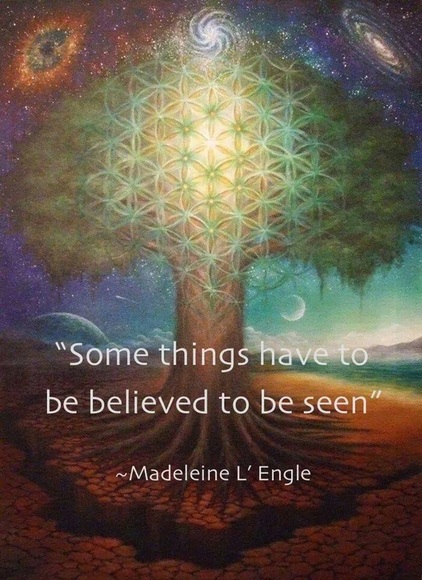
How are we to explain religious processes, for instance, whose nature is essentially symbolical? In abstract form, symbols are religious ideas; in the form of action, they are rites or ceremonies. They are the manifestation and expression of excess libido. At the same time they are stepping-stones to new activities, which must be called cultural in order to distinguish them from the instinctual functions that run their regular course according to natural law. ~Carl Jung; On Psychic Energy; CW 8, par. 91.
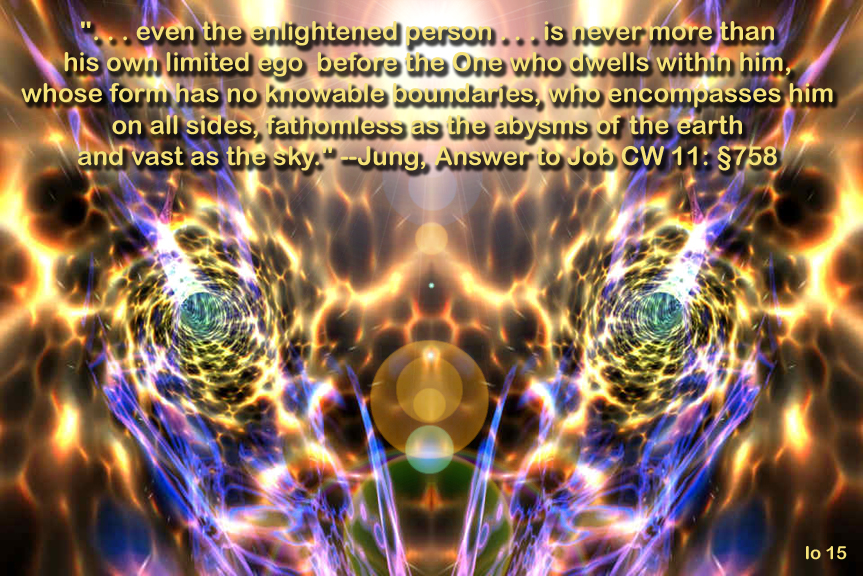
Symbols
are Parables (Not to Conceal But to Teach)
SYMBOL: A name, term,
picture which is familiar in daily life, yet has other connotations besides its
conventional and obvious meaning. Implies something vague and partially unknown
or hidden, and is never precisely defined. Dream symbols carry messages from
the unconscious to the rational mind. Symbols appear in dynamic networks of
images.
“{Signs} do no more
than denote the objects to which they are attached…A word or an image is
symbolic when it implies something more than its immediate and obvious meaning.
{There is} a wider unconscious
that
is never precisely defined or explained. Nor can one hope to define or explain
it.” --Jung
“…a symbol is a sign that points past
itself to a ground of meaning and being that is one with the consciousness of
the beholder.” “Man uses the spoken or written word to express the
meaning of what he wants to convey,” said Jung. Language is a universal
manifestation of symbolism. While a particular written or spoken
language--Aramaic, French, or Sanskrit—is a man made artifact, there is a
biological drive that inspired these innovations."
--Joseph Campbell
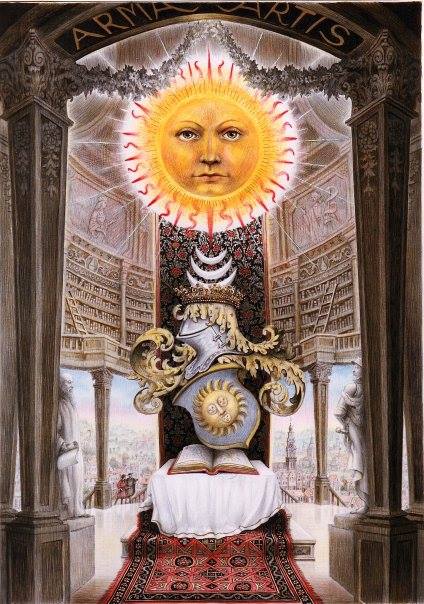
“There is a thinking in primordial images, in symbols which are
older than the historical man, which are inborn in him from the earliest times,
eternally living, outlasting all generations, still make up the groundwork of
the human psyche. It is only possible to live the fullest life when we are in
harmony with these symbols; wisdom is a return to them.” ―Jung
Theory
of Symbols
Jung believed that
symbol creation was a key in understanding human nature. Symbol is the best
possible expression for something essentially unknown. He investigated the
similarity of symbols that are located in different religious, mythological,
and magical systems which occur in many cultures and time periods. To account
for these similar symbols occurring across different cultures and time periods
he suggested the existence of two layers of the unconscious psyche. 1).
the personal unconscious. It contains what the individual has acquired in his
or her life, but has been forgotten or repressed. 2). the collective
unconscious which contains the memory traces common to all humankind. These
experiences form archetypes. These are innate predispositions to experience and
symbolize certain situations in a distinct way.
There are many
archetypes such as having parents, finding a mate, having children, and
confronting death. Very complex archetypes are found in all mythological and
religious systems. Near the end of his life Jung added that the deepest layers
of the unconscious function independently of the laws of space, time and
causality. This is what gives rise to paranormal phenomena. The introvert and
the extrovert are the main components of personality according to Jung. The
introvert is quiet, internal, withdrawn and interested in ideas rather than
people. While the extrovert is outgoing and socially oriented. For Jung a
person that had a healthy personality can realize these opposite tendencies
within himself/herself and can express each. Dreams compensate neglected parts
of the personality - source of new thoughts and creative ideals, and produces
meaningful individual
and collective symbols.
Symbols - Three
reoccurring symbols are stones, animals, and the circle according to Jung. We
find these in the arts and literature across the ages. Symbols can, and usually
do, reflect a multitude of meanings.
Stones - The Old
Testament (Torah) speak of stones in many places. Often as sacred stones or
sacred places. As Jacob traveled toward Haran and used the stones in a certain
place along the was as a pillow. God appeared to him in a dream telling him of
the land he would give Jacob and his descendants. A stone was an integral part
of his dream.
The human being is as
different as possible from a stone, yet man's innermost center is in a strange
and special way akin to it (perhaps because the stone symbolizes mere existence
at the farthest remove from emotions, feelings, fantasies, and reasoning by the
ego-consciousness).
In this sense the
stone symbolizes what is perhaps the deepest experience - the experience of
something that is eternal that man can have in those moments when he feels
immortal and unalterable.
Animals - Animal
symbols are found in the earliest of cave drawings. Not only were they hunted,
they were revered, if not worshiped. Each animal symbolizes something in terms
of its strength--and weakness. The weakness is its shadow.
Animal symbols
characterize our nations, our sports teams, our schools and colleges, and many
other things even in today's world. Rome's and the US's symbol is the Eagle.
The profusion of
animal symbols in the arts point to the importance of integrating our
instinctual parts of ourselves with the conscious part of ourselves. This
process Jung referred to as individuation. Animal symbols are also
archetypes. As stated above, each archetype has a shadow side.
Animals also symbolize
our instinctual sides. In itself a particular animal is neither good nor bad.
It is part of nature, just as our instincts are part of our nature. As such,
they often symbolize our shadow sides.
Man uses the spoken or
written word to express the meaning of what he wants to convey. His language is
full of symbols. . . What we call a symbol is a term, a name, or even a picture
that may be familiar in daily life, yet that possesses specific connotations in
addition to its conventional and obvious meaning.
The Collective Unconscious and Its Archetypes by Philippe L. De Coster,
D.D.
. . . eagles, lions,
and oxen in old churches. . . symbols . . . derived from the vision of Ezekiel,
and that this . . . has an analogy to the Egyptian sun god Horus and his four
sons. P3
When, with all our
intellectual limitations, we call something "divine", we have merely
given it a name, which may be based on a creed, but never on factual evidence.
P.4
. . . we constantly
use symbolic terms to represent concepts that we cannot define or fully
comprehend. This is one of the reasons why all religions employ symbolic
language or images. P. 4
Man . . . never
perceives anything fully or comprehends anything completely. He can see, hear,
touch, and taste; but how far he sees, how well he hears, what his touch tells
him, and what he tastes depend upon the number and quality of his senses. These
limit his perception of the world around him. P. 4
Man has developed
consciousness slowly and laboriously, in a process that took untold ages to
reach the civilized state (which is arbitrarily dated from the invention of
script in about 4000 B. C.). And this evolution is far from complete, for large
areas of the human mind are still shrouded in darkness. P. 6
Whoever denies the
existence of the unconscious is in fact assuming that our present knowledge of
the psyche is total. P. 6
Consciousness is a very
recent acquisition of nature, and it is still in an "experimental"
state. It is frail . . . and easily injured. P. 6
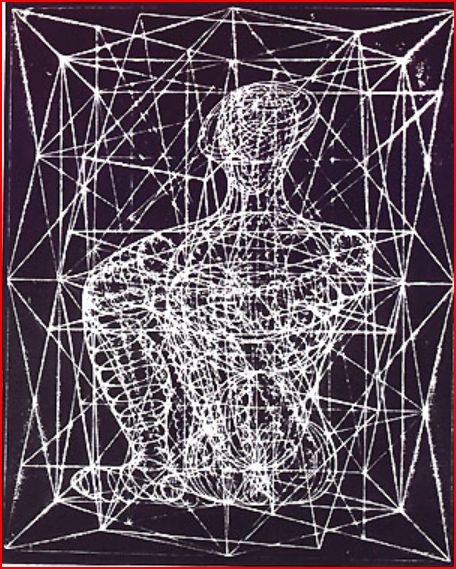
“Hermaphrodite.”]
It is a curious fact
that these images also appear in a place where I wouldn’t have suspected them,
that is, in alchemy.
The basic symbol is
the dragon biting into its own tail, the Ouroboros.
The alchemists knew
that the “tail eater” is a sexual symbol: Ouroboros fertilizes itself.
Similarly, Ptah is the creator of his own egg that he also hatches.
He is the one who
creates himself.
The phoenix rises
again from his own, or from his father’s, ashes.
All these are images
of a being that recreates itself again and again.
It is the dragon that
impregnates itself, with the phallic tail that he takes into the mouth, “se
ipsum impregnat.”
Ra, the sun god,
fertilized himself through the mouth with his own semen, and then vomited the
world.
The inside of his body
would thus have been the uterus that he fertilized.
He reproduced the
world as a creature.
As a consequence, most
of the cosmogonic archaic beings are hermaphrodite.
This is connected with
the fact that man, from the dawn of history, has had a notion of his double
gender.
As a matter of fact
and truth, we are of double gender, because only the greater part of the male
genes decides whether the embryo becomes a male.
The female genes do
not die away in the male, but are there in his structure, and function
according to their femaleness.
This accounts for the
peculiar fact that in certain men we can perceive certain female traits that
correspond to the feminine ideal (and vice versa, male traits in women).
There are persons who
boast of their bisexuality because it is an archetype:
“I carry Eve in me, so
I am a god.”
God has His wife in
him. In India, goddesses are only the feminine form of a masculine god: Shiva
is a point or a phallus, and it is enveloped by Shakti:
The active existence
of these and similar archetypes in the unconscious of the child can, under
special circumstances, give rise to “perversities.”
The children then do
strange, disgusting things that, however, carry a symbolic meaning.
For they display a too
orderly behavior on the one hand, and a too dirty one on the other.
A nine year-old boy,
for example, eats a toad, because it disgusts him; a four year-old child from
the city eats excrement on a meadow.
A child from the
countryside would never do that.
Only very well brought
up city kids do such things.
The motive for such
activities is the unconscious search for the original unity.
One should rather not
call them perversities, but educational mistakes that often balance out later.
This archaic image,
therefore, leads not only to the most strange, painful, disgusting forms of
satisfaction, but also acts as protection, for instance in persons who pick
their noses, or who “copulate” with a fountain pen in the mouth.
These things are only
used as protection: one makes a ring with oneself.
In fertilizing oneself
one proves that one is absolutely round, the perfect round archaic being (the
sphairos of Empedocles).
Nothing can touch it
any longer.
The archaic being was
once cut in two by the Demiurge.
The two parts are,
however, one and the same being (Plato, Timaeus).
~Carl Jung, Children’s
Dream Seminar, Pages 37-38.
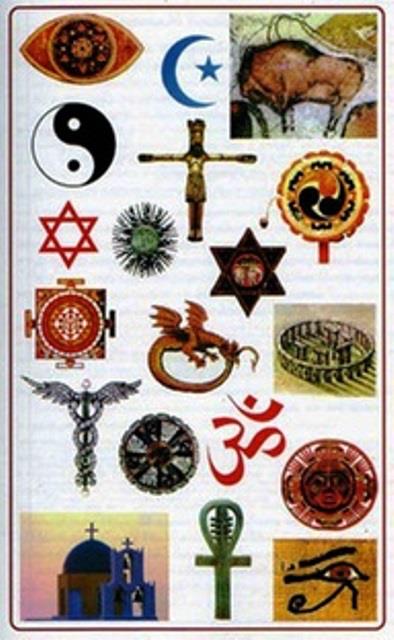
The
Role of Symbols
When the medical
psychologist takes an interest in symbols, he is primarily concerned with
"natural" symbols, as distinct from "cultural" symbols. The
former are derived from the unconscious . . . the cultural on the other hand .
. . used to express "eternal truths", and . . . still used in many
religions. P. 83 . . . cultural symbols . . . retain much of their
"spell". One is aware that they can evoke a deep emotional response .
. . function the same way as prejudices. P. 83
Such tendencies form
an ever-present "shadow" to our conscious mind. This is why
well-meaning people are understandably afraid of the unconscious, and
incidentally of psychology. P. 83
Modern man does not
understand how much his "rationalism . . . has put him at the mercy of the
psychic "underworld". He has freed himself from
"superstition" (or so he believes), but in the process he has lost
his spiritual values to a positively dangerous degree. His moral and spiritual
tradition has been disintegrated, and he is now paying the price for this
break-up in world-wide disorientation and dissociation. P. 84
Anthropologists have
often described what happens to a primitive society when its spiritual values
are exposed to the impact of modern civilization. Its people lose the meaning
of their lives, their social organization disintegrates, and they themselves
morally decay. We are now in the same condition. P. 84
As scientific
understanding has grown, so our world has become dehumanized. Man feels himself
isolated in the cosmos, because he is no longer involved with nature and has
lost his emotional "unconscious identity" with natural phenomena. P.
85
To be more accurate,
the surface of our world seems to be cleansed of all superstitious and
irrational elements. P. 86
Because a child is . .
. small and its conscious thoughts scarce and simple, we do not realize the
far-reaching complications of the infantile mind that are based on its original
identity with the prehistoric psyche. That original mind is just as much
present and still functioning in the child as the evolutionary stages of
mankind are in its embryonic body. P. 89
Psychology is the only
science that has to take the factor of value (feelings) into account.
Psychology is often accused of not being scientific on this account; but its
critics fail to understand the scientific and practical necessity of giving due
consideration to feeling. P. 90
How does psychology
define this inner dynamic which guides the process of individuation, leading
toward the goal of wholeness? In Jungian Psychology, this symbol-forming power
of the psyche is called the transcendent function. Before the transforming
power of the higher Self is perceived in imagination (personified through one's
Angel, Guide, or Guru), it is known as a symbol-forming function.
Its purpose is to
mediate between that which is unknown and that which is manifest. It performs
its function by creating unifying symbols from pairs of opposites. In this
manner, it gradually unites the fragments of psychic life. It creates a series
of symbols which transfer consciousness to a higher perspective or awareness by
reconciling opposites.
By synthesizing pairs
of opposites into a symbol, the transcendent mode creates a method of
transition from one set of attitudes to the next. An individual ego may work
more effectively with subconscious processes by consciously attaching value to
these symbols presented by the transcendent function.
Our task is to
discover these transpersonal meanings, whether they are presented to us through
dreams, attitudes, or behavior patterns. If the meaning were consciously
understood, it would not be presented as a symbol. Therefore, once its meaning
is realized over a period of time, another symbol appears to take its place,
reflecting the new situation.
The transcendent
function (seen as one's Inner Guide, Angel, or Guru), embodies the transmuting
power of the symbol. The personification of the higher Self allows us to take
up a relationship with the inner Self, and encourages dialogue and the
development of feelings of loving devotion for this inner friend.
All the symbols and
archetypal figures in which the transformative process is embodied are vehicles
of the transcendent function. It is the union of different pairs of
psychological opposites (like male/female, good/evil, Sol/Luna) in a synthesis
which transcends them both.
The uniting symbol
only appears when the inner psychic life is experienced as just as valid,
effective, and psychologically "real" as the world of daily life.
Fantasy animates both our inner and outer "realities." This is why
mystics call time, space, and the ego three great illusions.
The transcendent
function, or Inner Guide, restores the balance between the ego and the
unconscious. It belongs to neither, yet possesses access to each. It forms a
bridge for the soul to ascend, by lying in-between and participating in both
inner and outer life. By relating to each independently, it unites ego and the
unconscious. --Iona
Miller, Modern Alchemist
Quaternity: An image with a
four-fold structure, usually square or circular and symmetrical;
psychologically, it points to the idea of wholeness, and the primacy of
orientation to the four cardinal directions, as well as the 'four elements'.
The quaternity is one of
the most widespread archetypes and has also proved to be one of the most useful
schemata for representing the arrangement of the functions by which the
conscious mind takes its bearings.[See typology.] It is like the crossed
threads in the telescope of our understanding. The cross formed by the points
of the quaternity is no less universal and has in addition the highest possible
moral and religious significance for Western man. Similarly the circle, as the
symbol of completeness and perfect being, is a widespread expression for
heaven, sun, and God; it also expresses the primordial image of man and the
soul.["The Psychology of the Transference," CW 16, par. 405.]
From the circle and
quaternity motif is derived the symbol of the geometrically formed crystal and
the wonder-working stone. From here analogy formation leads on to the city,
castle, church, house, and vessel. Another variant is the wheel (rota). The
former motif emphasizes the ego’s containment in the greater dimension of the
self; the latter emphasizes the rotation which also appears as a ritual
circumambulation. Psychologically, it denotes concentration on and
preoccupation with a centre.["The Structure and Dynamics of the Self,"
CW 9ii, par. 352.]
Jung believed that the
spontaneous production of quaternary images (including mandalas), whether
consciously or in dreams and fantasies, can indicate the ego’s capacity to
assimilate unconscious material. But they may also be essentially apotropaic,
an attempt by the psyche to prevent itself from disintegrating.
These images are naturally
only anticipations of a wholeness which is, in principle, always just beyond
our reach. Also, they do not invariably indicate a subliminal readiness on the
part of the patient to realize that wholeness consciously, at a later stage;
often they mean no more than a temporary compensation of chaotic confusion.["The Psychology of the
Transference," CW 16, par. 536.] http://www.nyaap.org/jung-lexicon/q
The "squaring of the
circle" is one of the many archetypal motifs which form the basic patterns
of our dreams and fantasies. But it is distinguished by the fact that it is one
of the most important of them from the functional point of view. Indeed, it
could even be called the archetype of wholeness. -Jung from Mandalas. trans. from Du
(Zurich, 1955.)
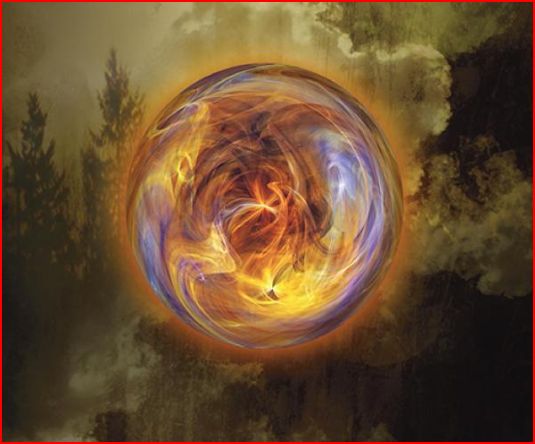
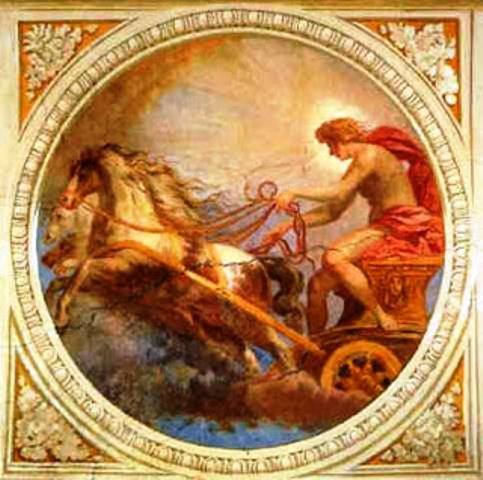
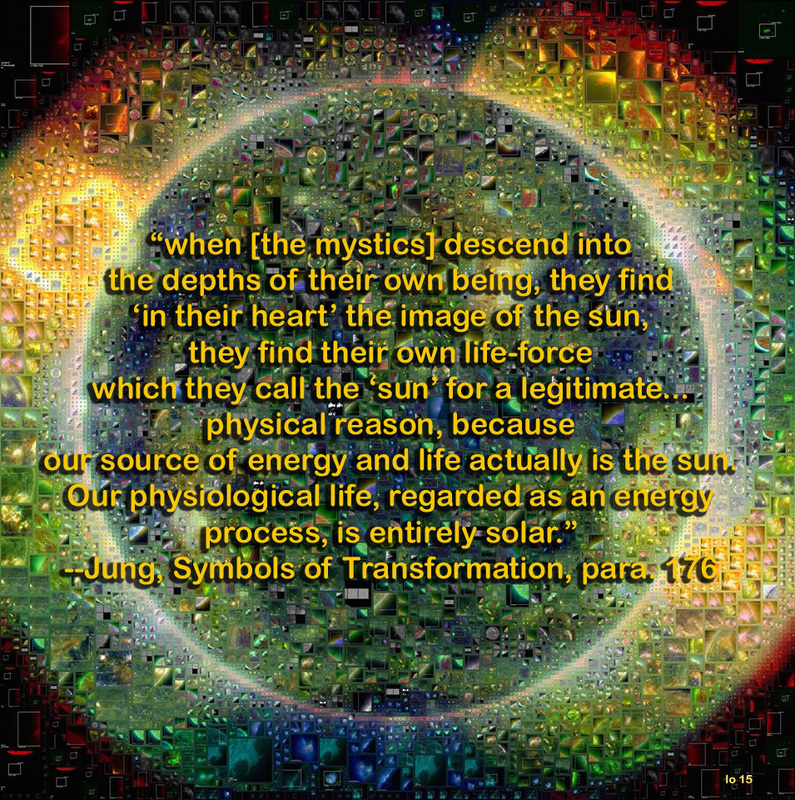
The sun… is the only truly ‘rational’ image of God, whether we
adopt the standpoint of the primitive savage or of modern science. In either
case the sun is the father-god from whom all living things draw life; he is the
fructifier and creator, the source of energy for our world.
The discord into which the
human soul has fallen can be harmoniously resolved through the sun as a natural
object which knows no inner conflict.
~Carl Jung; CW 5;
Symbols of Transformation; Para 176.
|
|
|
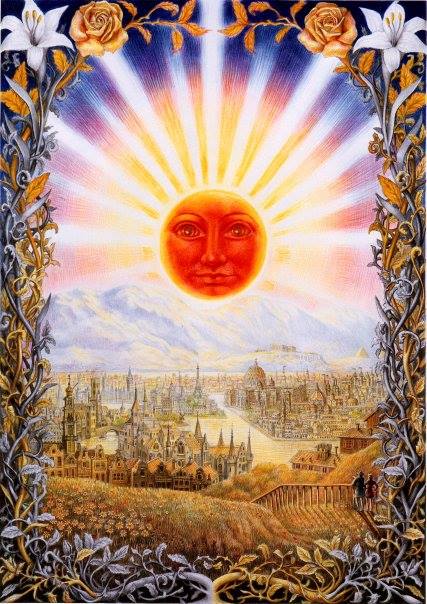
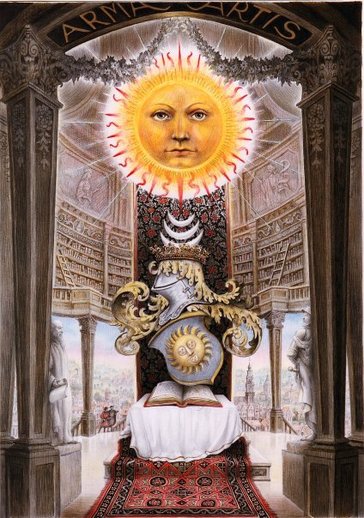
Sun as God
The sun is, as Renan
remarked, really the only rational representation of God, whether we take the
point of view of the barbarians of other ages or that of the modern physical
sciences.
In both cases the sun
is the parent God, mythologically predominantly the Father God, from whom all
living things draw life; He is the fructifier and creator of all that lives,
the source of energy of our world.
The discord into which
the soul of man has fallen through the action of moral laws can be resolved
into complete harmony through the sun as the natural
object which obeys no
human moral law.
The sun is not only
beneficial, but also destructive; therefore the zodiacal representation of the
August heat is the herd-devouring lion whom the Jewish hero Samson killed in
order to free the parched earth from this plague.
Yet it is the
harmonious and inherent nature of the sun to scorch, and its scorching power
seems natural to men It shines equally on the just and on the unjust, and
allows useful living objects to flourish as well as harmful ones.
Therefore, the sun is
adapted as is nothing else to represent the visible God of this world.
That is to say, that
driving strength of our own soul, which we call libido, and whose nature it is
to allow the useful and injurious, the good and the bad to proceed.
That this comparison is
no mere play of words is taught us by the mystics.
When by looking
inwards (introversion) and going down into the depths of their own being they
find “in their heart" the image of the Sun, they find their own love or
libido, which with reason, I might say with physical reason, is called the Sun,
for our source of energy and life is the Sun.
Thus our life
substance, as an energic process, is entirely Sun.
Of what special sort
this "Sun energy" seen inwardly by the mystic is, is shown by an
example taken from the Hindu mythology.
From the explanation
of Part III of the "Shvetashvataropanishad" we take the following
quotation, which relates to the Rudra :
(2) "Yea, the one
Rudra who all these worlds with ruling power doth rule, stands not for any
second. Behind those that are born he stands, at ending time ingathers all the
worlds he hath evolved, protector (he).
(3) "He hath eyes
on all sides, on all sides surely hath faces, arms surely on all sides, on all
sides feet. With arms, with wings he tricks them out, creating heaven and
earth, the only God.
(4) "Who of the
gods is both the source and growth, the Lord of all, the Rudra Mighty seer; who
brought the shining germ of old into existence may he with reason pure conjoin
us."
These attributes allow
us clearly to discern the all-creator and in him the Sun, which has wings and
with a thousand eyes scans the world. ~Carl Jung, Psychology of the
Unconscious, Pages 127-129.
[Carl Jung on the Sun
and God.]
The sun is, as Renan
remarked, really the only rational representation of God, whether we take the
point of view of the barbarians of other ages or that of the modern physical
sciences.
In both cases the sun
is the parent God, mythologically predominantly the Father God, from whom all
living things draw life; He is the fructifier and creator of all that lives,
the source of energy of our world.
The discord into which
the soul of man has fallen through the action of moral laws can be resolved
into complete harmony through the sun as the natural
object which obeys no
human moral law.
The sun is not only
beneficial, but also destructive; therefore the zodiacal representation of the
August heat is the herd-devouring lion whom the Jewish hero Samson killed in
order to free the parched earth from this plague.
Yet it is the
harmonious and inherent nature of the sun to scorch, and its scorching power
seems natural to men It shines equally on the just and on the unjust, and
allows useful living objects to flourish as well as harmful ones.
Therefore, the sun is
adapted as is nothing else to represent the visible God of this world.
That is to say, that
driving strength of our own soul, which we call libido, and whose nature it is
to allow the useful and injurious, the good and the bad to proceed.
That this comparison
is no mere play of words is taught us by the mystics.
When by looking
inwards (introversion) and going down into the depths of their own being they
find “in their heart" the image of the Sun, they find their own love or
libido, which with reason, I might say with physical reason, is called the Sun,
for our source of energy and life is the Sun.
Thus our life
substance, as an energic process, is entirely Sun.
Of what special sort
this "Sun energy" seen inwardly by the mystic is, is shown by an
example taken from the Hindu mythology.
From the explanation
of Part III of the "Shvetashvataropanishad" we take the following
quotation, which relates to the Rudra :
(2) "Yea, the one
Rudra who all these worlds with ruling power doth rule, stands not for any second.
Behind those that are born he stands, at ending time ingathers all the worlds
he hath evolved, protector (he).
(3) "He hath eyes
on all sides, on all sides surely hath faces, arms surely on all sides, on all
sides feet. With arms, with wings he tricks them out, creating heaven and
earth, the only God.
(4) "Who of the
gods is both the source and growth, the Lord of all, the Rudra Mighty seer; who
brought the shining germ of old into existence may he with reason pure conjoin
us."
These attributes allow
us clearly to discern the all-creator and in him the Sun, which has wings and
with a thousand eyes scans the world.
~Carl Jung, Psychology
of the Unconscious, Pages 127-129.
A sampling of the many views of the Sun collected by AIA.
credit: NASA Solar
Dynamics Observatory (Little SDO)
This
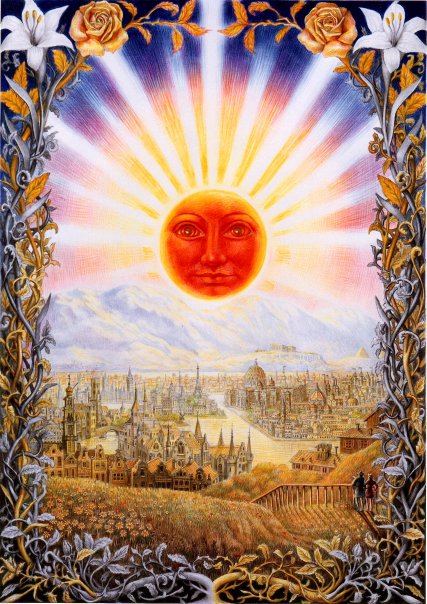
sun motif appears in many places and times and the meaning is always the same -
that a new consciousness has been born. It is the light of illumination which
is projected into space.
This is a psychological
event; the medical term "hallucination" makes no sense in psychology. ~Carl Jung, Modern Psychology, Page
231.
The self, the very
centre of an individual, is of a conglomerate nature. It is, as it were, a
group. It is a collectivity in itself and therefore always, when it works most
positively, creates a group. ~Carl Jung, Letters Vol. 1, Page 508.
Apart
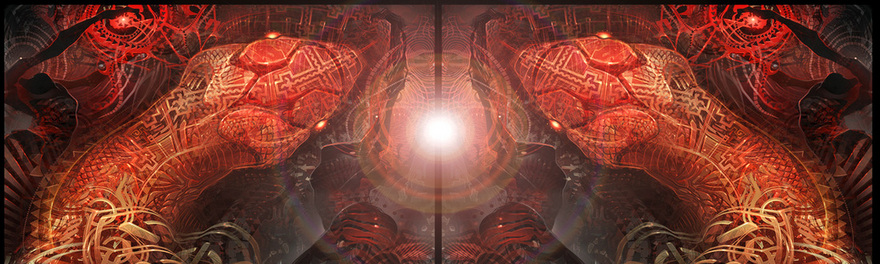
from Elijah and Salome I found the serpent as a third principle.
It is a stranger to
both principles although it is associated with both.
The serpent taught me
the unconditional difference in essence between the two principles in me.
If I look across from
forethinking to pleasure, I first see the deterrent
poisonous serpent.
If I feel from pleasure
across to forethinking, likewise I feel first the cold cruel serpent.
The serpent is the
earthly essence of man of which he is not conscious.
Its character changes
according to peoples and lands, since it is the mystery that flows to him from
the nourishing earth-mother. ~Carl Jung, The Red Book.
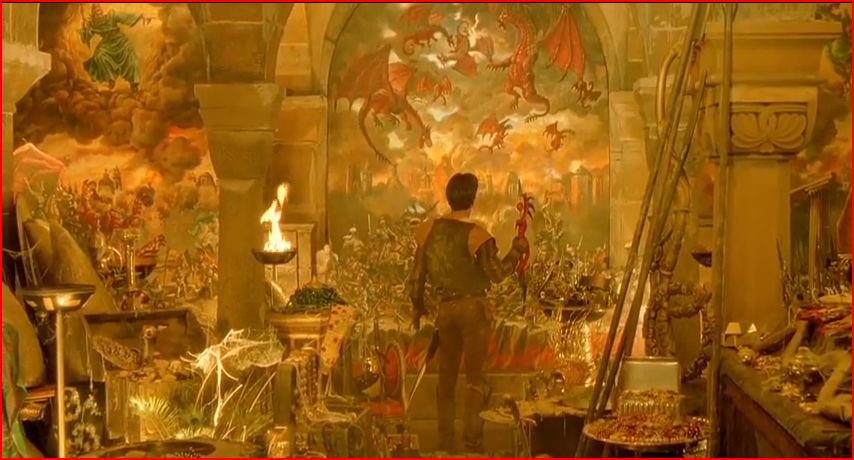
As
there is an ' Apollonian ' medicine, so there is an ' Hermetic ' medicine which
sees Hermes ( Mercury) as the symbolic mediator , whose emergence through the
" symbol " operates within the healing process. This medicine is an
Archetypal Medicine.
Many are the paths by
which this ' Hermetic Medicine ' has manifested itself in the course of the
human history ... Losing touch with the "Symbol" and then our
symbolic consciousness , it means losing contact with our soul and then with
our ' History ' .
The symbol should not
be ' interpreted ' in a reductive sense of the word, The symbol should be
"experienced" , and always appears in a 'transpersonal ' vision of
our existence ... Deo Concedente. If we open ourselves to a symbolic
'sensitivity' means to open us to the possibility of ' show-through ' , a sort
of seeing ' through the eyes ' in the words of souls as Blake , Jung , Hillman
,Elemire Zolla (he called ' brillantanza ' ) etc. . We are continuously inside
symbolic processes and ourselves are a symbolic process in constant evolution
...
"The
great problems of life—sexuality, of course, among others—are always related to
the primordial images of the collective unconscious.
These images are
really balancing or compensating factors which correspond with the problems
life presents in actuality.
This is not to be
marveled at, since these images are deposits representing the accumulated
experience of thousands of years of struggle for adaptation and existence.”
~Carl Jung,
Psychological Types, 1923
"The real mystery
does not behave mysteriously or secretively; it speaks a secret language, it
adumbrates itself by a variety of images which all indicate its true nature. I
am not speaking of a secret personally guarded by someone, with a content known
to its possessor, but of a mystery, a matter or circumstance which is “secret,”
i.e., known only through vague hints but essentially unknown.
The real nature of matter
was unknown to the alchemist: he knew it only in hints. In seeking to explore
it he projected the unconscious into the darkness of matter in order to
illuminate it. In order to explain the mystery of matter he projected yet
another mystery – his own psychic background -into what was to be explained: Obscurum
per obscurius, ignotum per ignotius! This procedure was not, of course,
intentional; it was an involuntary occurrence.”
― C.G. Jung,
Psychology and Alchemy
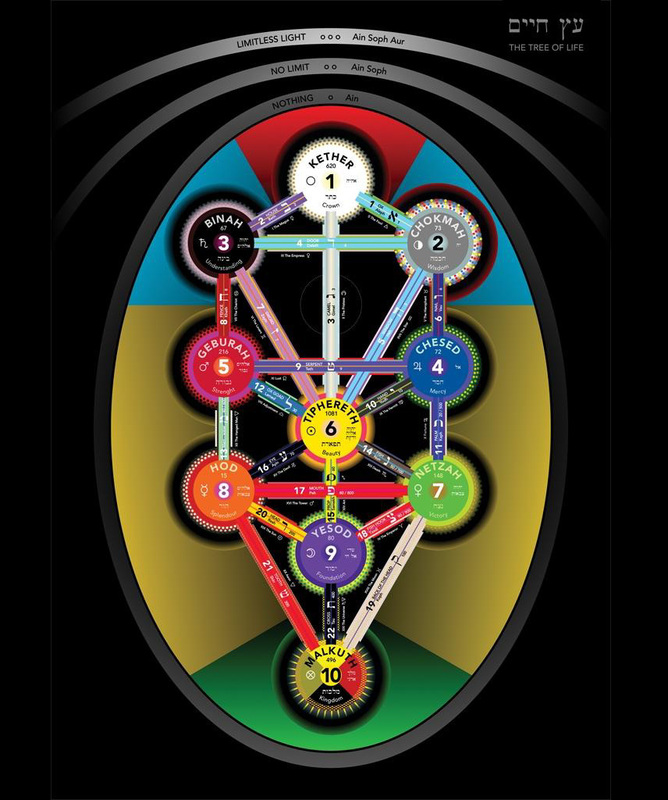
Tree of Life
http://sacredgeometryinternational.com/the-meaning-of-sacred-geometry-part-3-the-womb-of-sacred-geometry
Kabbalistic Tree of
Life. The tree represents a map of Creation, unfolding from the primordial
Unity to the infinite diversity of manifested reality, expressed according to a
certain mathematical progression based upon the square root of three, the holy
Trinity
Mrs. Baumann: I
thought it was very interesting that in the prehistoric mythology of the island
of Crete, of which practically nothing is known, there is another example of a
world-tree. In a picture on a gold seal ring called the "Ring of
Nestor," the tree is depicted in connection with scenes in the underworld.
The trunk of the tree
and two large branches divide the picture into four scenes.
In the first, there
are two butterflies and two chrysalises over the head of the Mother Goddess,
and they seem to represent the souls of a man and a woman who are shown
greeting each other with surprise.
In the lower part of
the picture is a judgment scene, and the Mother Goddess is standing behind a
table on which a griffin is seated, as the souls are brought before her by
strange bird-headed beings.
Another point is, that
in some of the graves, miniature scales made of gold have been found.
They are so small that
they must be symbolic, and a butterfly is engraved on each of the golden discs
which form the balance, so it looks as if the souls were weighed as
butterflies, not as hearts as in Egypt.
The highest
development of the Minoan civilization in Crete was contemporary with that of
Egypt, its earliest beginnings dating as far back as 3000 B.C.
Prof Jung: That is a
remarkable contribution to the tree and the butterfly symbolism.
You remember Nietzsche
applies that symbol of the butterfly to himself-quite aptly, because nobody
gets beyond the world, outside the field of gravity, where he might see the
world as an apple, unless he has become a soul. One must be a sort of ghost to
get to such distances.
To step out of the
body and become the spirit or the soul itself, denotes a kind of ekstasis.
Now, we have a number
of associations about that tree, and we should try to understand what it means
practically when Nietzsche reaches the promontory, the end of his
world, the end of his
consciousness, and meets there the tree.
You have heard that
the tree is always the symbol of the end as well as of the beginning, of the
state before man and the state after man.
Mr. Bash: Would the
tree not be the symbol of the collectivum out of which man is differentiated
and into which his elements dissolve?
Prof Jung: That is
certainly so, and why is that collectivum symbolized by the tree?
Mrs. Sachs: The tree
means vegetative life.
Prof Jung: Yes. It
might be the snake or any other animal or the earth, but no, it is the tree,
and the tree means something specific; that is a peculiar symbol.
It is the tree that
nourishes all the stars and planets; and it is the tree out of which come the
first parents, the primordial parents of humanity, and in which the last
couple, also representing the whole of humanity, are buried.
That of course means that
consciousness comes from the tree and dissolves into the tree again-the
consciousness of human life.
And that surely points to
the collective unconscious and to a collectivum.
So the tree stands for a
particular kind of life of the collective unconscious, namely, vegetative life,
as Mrs. Sachs rightly said.
Now what is the difference
between the life of the plant and the life of the animal?
Miss Wolff: Two things.
The plant is rooted to the spot and able to move in growth only, and then the
respiratory system of the plant is different from that of the warm-blooded
animals.
Prof Jung: Yes, a tree is
unable to move in space except for the moment of growth, whereas the animal can
move about. And all animals are parasites on plants, while the tree lives on
the elements.
Or one can say that the
plant is the kind of life which is nearest to the elements, a transition as it
were, or the bridge, between the animal and inorganic nature. Carl Jung,
Zarathustra Seminar, Pages 1432-1434.
http://www.biroz.net/words/minoan-epiphany/review-part-nine.htm
“Trees depicts the
living structure of our inner self. It’s roots show our connection with our
physical body and the earth; its trunk the way we would direct the energies of
our being–varied and yet all connected in the common life process of our being.
The tree can also symbolize new growth, stages of life and death, with its
springs leaves and blossoms, then the falling leaves. The top of the tree, by
the end of the branches, are our aspirations, the growing bendable tip of our
personal growth and spiritual realization. The leaves may represent our
personal life which may fall off the tree of life (die) but what gave it life
continues to exist. The tree is our whole life, the evolutionary urge which
pushes us in two being and grow it depicts the forces are processes which is
behind all other life forms–but seen as it expresses interpersonal existence.”
“To begin at the
beginning . . . the Qabalists postulated the AIN or NO-THING as the Zero From
which, in a mysterious manner, the Universe arose. Next, they say, the AIN
SUPH, or Limitless Space, became the Nature of the AIN, and this conception was
followed by that of AIN SUPH AUR or the Limitless Light of Chaos. It was
not until this Limitless Light had concentrated Itself to a Centre that the
First Positive Idea arose, and this was called
Kether and attributed to
the Number One . . .”
“Let us accept the term
AIN as representing That of which Nothing is known, nor can be known, except through
the positive manifestations which arise from it. When we attempt to imagine AIN
SUPH—Limitless Space—our minds tend to rush on and on, only to fall back before
the Profundity of the Great Deep; yet we have to admit the possibility of
Infinite extension in space . . . When the AIN SUPH AUR became concentrated
upon a Single Centre, it compressed the Light into Substance of Light, which is
Life. Or, in other words, the Concentrated Light became an inconceivably
powerful Force or Energy in the centre of Kether. This Pure Being, or Living
Substance, owing to its reaction from the Invisible Centre, tends to expand
towards Infinity. This gives us the idea of the Substance of the Universe ever
expanding, ever occupying more and more of the Limitless Space of AIN SUPH,
while the Primal Centralizing Urge still continues to contract upon the
Infinitely Small, or the AIN . . . Kether is then the junction of these Two
Infinites, but particularly represents the concentration of the Light to a
Point on its way to the Infinitely Small . . .”1
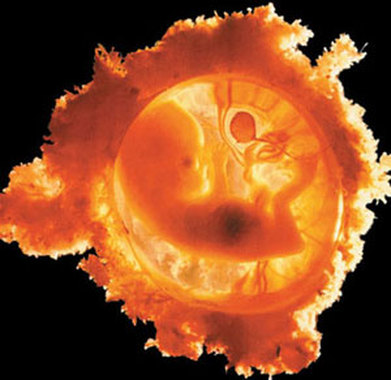
The
Creation of a Human Being From a Cell
http://harunyahya.com/en/Books/988/the-miracle-of-human-creation/chapter/381
“In the manifold
phenomenology of the “child” we have to distinguish between the unity and
plurality of its respective manifestations. Where, for instance, numerous
homunculi, dwarfs, boys, etc., appear, having no individual characteristics at
all, there is the probability of a dissociation. … ” (Carl Jung CW 9i, para.
279)
The
fact that the symbolism connected with the mandala traces its near relatives
back to pagan sources casts a peculiar light upon these apparently modern
psychological occurrences. They seem to continue a Gnostic trend of thought
without being supported by direct tradition. If lam right in supposing that
every religion is a spontaneous expression of a certain predominant
psychological condition, then Christianity was the formulation of a condition
that predominated at the beginning of our era and lasted for several centuries.
But a particular
psychological condition which predominates for a certain length of time does
not exclude the existence of other psychological conditions at other times, and
these are equally capable of religious expression.
Christianity had at one
time to fight for its life against Gnosticism, which corresponded to another
psychological condition.
Gnosticism was stamped out
completely and its remnants are so badly mangled that special study is needed
to get any insight at all into its inner meaning. But if the historical roots
of our symbols extend beyond the Middle Ages they are certainly to be found in
Gnosticism.
It would not seem to me
illogical if a psychological condition, previously suppressed, should reassert
itself when the main ideas of the suppressive condition begin to lose their
influence. In spite of the suppression of the Gnostic heresy, it continued to
flourish throughout the Middle Ages under the disguise of alchemy.
It is a well-known fact
that alchemy consisted of two parts which complement one another on the one
hand chemical research proper and on the other the "theoria" or
"philosophia."
As is clear from the
writings of Pseudo-Democritus in the first century, (See Alchemy of the Greeks
by Berthelot), the two aspects already belonged together at the beginning of
our era. The same holds true of the Leiden papyri and the writings of Zosimos
in the third century. The religious or philosophical views of ancient alchemy
were clearly Gnostic. ~Carl
Jung, Psychology and Religion, Paragraph 160.
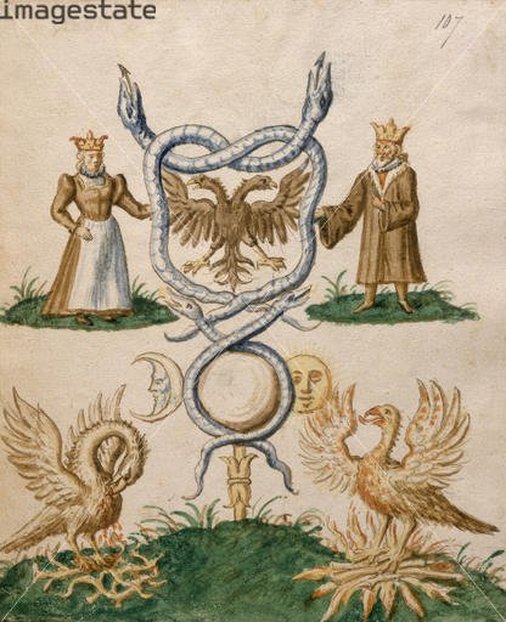
A king and queen with symbolic attributes. Two monarchs, possibly the recipients of the manuscript, with various symbols of longevity. The phoenix is shown on the left moulting and pecking at its breast and on the right rising from the flames triumphantly. The sun and moon, ever present, represent eternity as do the intertwined snakes. This image represents the opening of the manuscript. From a collection of treatises and poems on alchemy and the philosopher's stone, which was believed to bestow on its possessor the power of eternal life. Credit: © The British Library / Heritage-Images / Imagestate
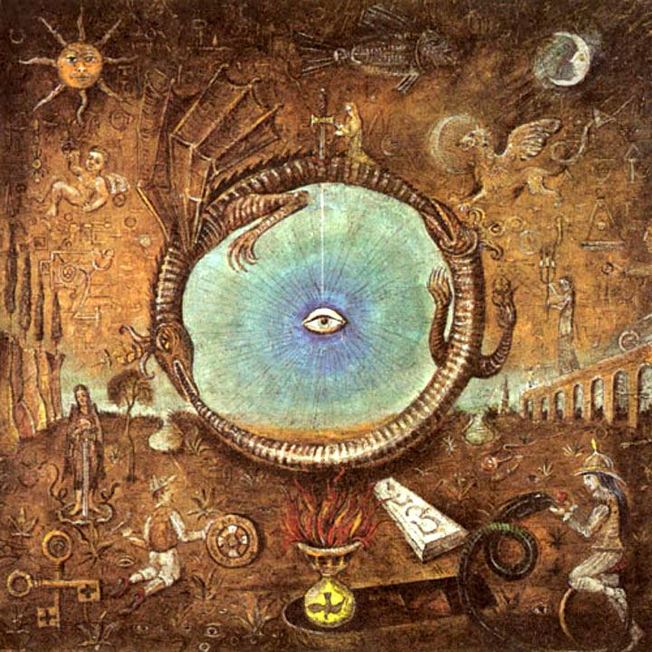
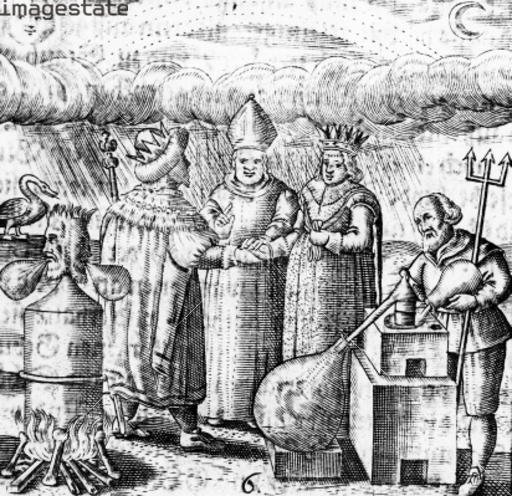
Credit: Ann Ronan
Picture Library / Heritage-Images The Sixth Key of Basil Valentine, legendary
15th century German monk and alchemist, 1651. The marriage of the alchemical
king (gold) and queen (silver) and the process of distillation in a furnace
using an alembic in a water bath or bain marie. From Von dem grossen Stein
Uhralten by Basil Valentine. (Strasbourg, 1651).
As
the story of the Grail is about its quest, for when thy thirst is quenched???
Ye thirst no more. The
magic of the Philosopher' s Stone is in the Seeking after it.
The Philosopher' s
Stone declares, "My light, exceeds every light, and my good things are
better than all other good things. I give freely and reward the intelligent
with joy and gladness, glory, riches, delights; and them that "seek"
after me I make to know and understand, and to posses divine things." ___
Golden Tractates of Hermes__
The Stone forms
itself. "Seek ye the Kingdom of Heaven first,
and all else shall be
added on to you".
In the search for the
stone, it is the work that counts. One should not worry too much about the right
way. The right way with the wrong man will never succeed. The wrong way with
the right man will eventually right itself, for the stone is found at the
crossroads of Heaven and Earth. Those who seek the Stone with true heart, shall
be found by the Stone itself.
This means an eternal
body, or the subtle body, which is designated in alchemy as the philosopher's
stone, the lapis aethereus or invisibilis. ~Carl Jung, ETH Lectures, Pages 159.
“My mandalas were cryptograms
concerning the state of the self which was presented to me anew each day…I guarded them like precious
pearls….
It became increasingly
plain to me that the mandala is the center. It is the exponent of all paths. It
is the path to the center, to individuation. ”
~Carl Jung, Memories
Dreams and Reflections.
“In such cases it is
easy to see how the severe pattern imposed by a circular image of this kind
compensates the disorder of the psychic state– namely through a the
construction of a central point to which everything is related, or by a concentric
arrangement of the disordered multiplicity of contradictory and irreconcilable
elements.
This is evidently an
attempt at self-healing on the part of Nature, which does not spring from
conscious reflection but from an instinctive impulse.” ~Carl Jung, Archetypes
of the Collective Unconscious. Page 388.
“The mandala
symbolizes, by its central point, the ultimate unity of all archetypes as well
as the multiplicity of the phenomenal world, and is therefore the empirical
equivalent of the metaphysical concept of a unus mundus. The alchemical
equivalent is the lapis and its synonyms, in particular the Microcosm.”
~Carl Jung, Mysterium
Coniunctionis, Page 463,Paragraph 661.
Yggdrasil's
Core by chickot
“ The mandala is an
archetypal image whose occurrence is attested throughout the ages. It signifies
the wholeness of the Self. This circular image represents the wholeness of the
psychic ground or, to put it in mythic terms, the divinity incarnate in man.”
~Carl Jung; Memories, Dreams and Reflections; Pages 334-335
The symbol is a living body, corpus
et anima; hence the "child" is such an apt formula for the symbol.
The uniqueness of the
psyche can never enter wholly into reality; it can only be realized
approximately, though it still remains the absolute basis of all consciousness.
The deeper
"layers" of the psyche lose their individual uniqueness as they
retreat farther and farther into darkness. "Lower down," that is to
say as they approach the autonomous functional systems, they become
increasingly collective until they are universalized and extinguished in the
body's materiality, i.e., in chemical substances.
The body's carbon is
simply carbon. Hence "at bottom" the psyche is simply
"world."
In this sense I hold
Kerenyi to be absolutely right when he says that in the symbol the world itself
is speaking. The more archaic and "deeper," that is the more
physiological, the symbol is, the more collective and universal, the more
"material" it is.
The more abstract,
differentiated, and specified it is, and the more its nature approximates to
conscious uniqueness and individuality, the more it sloughs off its universal
character.
Having finally
attained full consciousness, it runs the risk of becoming a mere allegory which
nowhere oversteps the bounds of conscious comprehension, and is then exposed to
all sorts of attempts at rationalistic and therefore inadequate explanation.
~"The Psychology of the Child Archetype" (1940). In CW 9, Part I: The
Archetypes and the Collective Unconscious. P.291.
http://psikoloji.fisek.com.tr/jung/shadow.htm
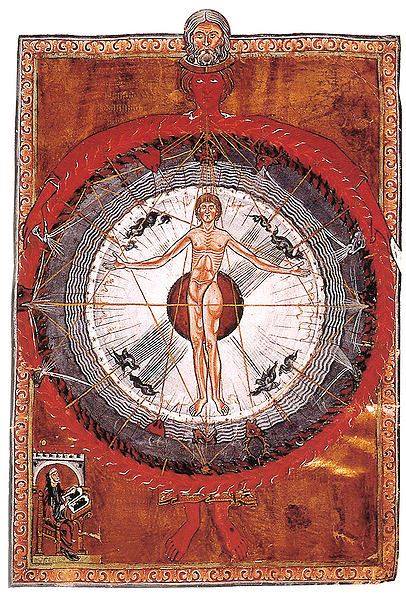
Image: Liber Divinorum Operum by Hildegard von Bingen.
The Tree of Life has been a symbol
both of this world and the Divine.
It represents the
theme of rebirth, along with the union of opposites’.
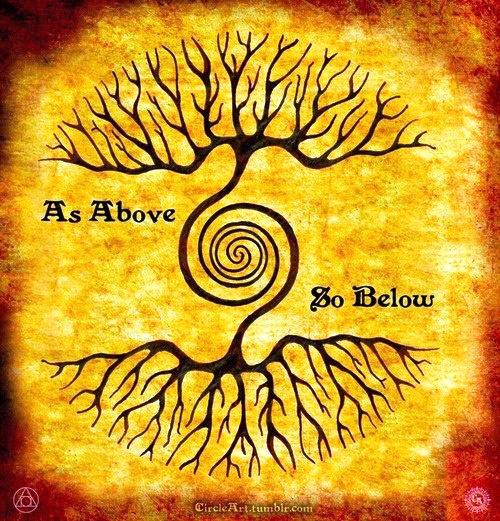
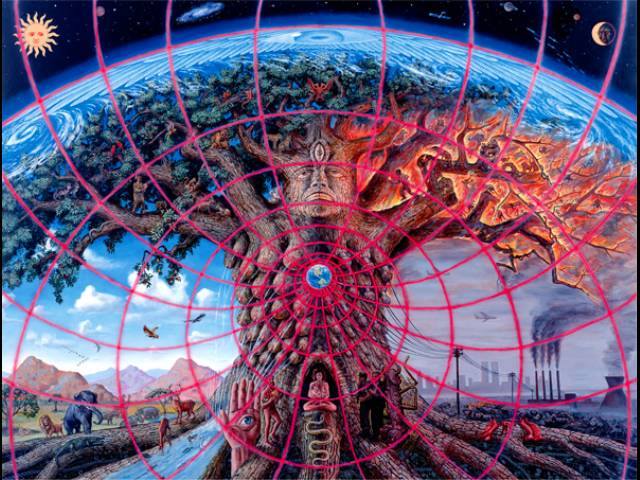
Alex Grey
Considered from the
standpoint of realism, the symbol is not of course an external truth,
but it is
psychologically true.
Psychological truth by no
means excludes metaphysical truth, though psychology, as a science, has to hold
aloof from all metaphysical assertions. Its subject is the psyche and its
contents. Both are realities, because they work. Though we do not possess a
physics of the soul, and are not even able to observe it and judge it from some
Archimedean point “outside’ ourselves, and can therefore know nothing objective
about it since all knowledge of the psyche is itself psychic, in spite of all
this the soul is the only experient of life and existence.
It is, in fact, the only
immediate experience we can have and the sine qua non of the subjective reality
of the world. The symbols it creates are always grounded in the unconscious
archetype, but their manifest forms are molded by the ideas acquired by the
conscious mind. The archetypes are the numinous, structural elements of the
psyche and possess a certain autonomy and specific energy which enables them to
attract, out of the conscious mind, those contents which are best suited to
themselves.
The symbols act as transformers,
their function being to convert libido from a “lower” into a “higher” form.
This function is so important that feeling accords it the highest values. The
symbol works by suggestion; that is to say, it carries conviction and at the
same time expresses the content of that conviction. It is able to do this
because of the numen, the specific energy stored up in the archetype.
Experience of the archetype is not only impressive, it seizes and possesses the
whole personality, and is naturally productive of faith. ~Carl Jung, Symbols of
Transformation; Symbols of the Mother and of Rebirth; Pages 231-232; Paragraphs
343-344.
CIRCLE, MANDALA
The circle or sphere is another
universal symbol. It symbolizes the self, completeness, or the whole. The
circle has no beginning or end. It is about inclusiveness. In Native American
ceremonies there is the medicine wheel, each part of which is a hologram of the
whole universe. The sweat lodge is a half-sphere.
"The eye is the
first circle; the horizon which it forms is the second; and throughout nature
this primary figure is repeated without end." --Ralph Waldo Emerson,
Circles
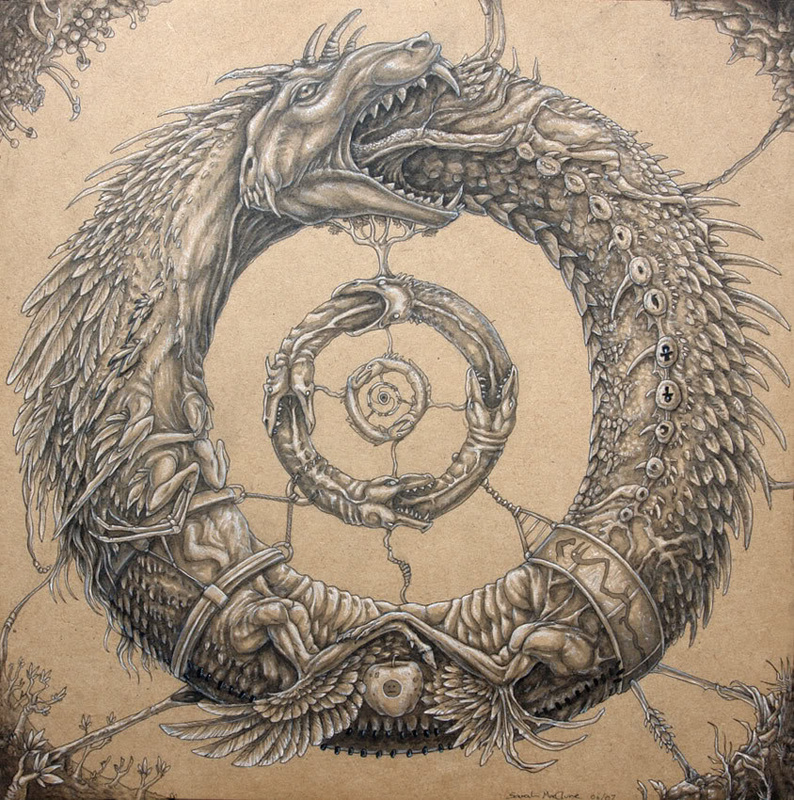
Zanthus
The Ring of Power, the Alchemist’s Oroborus, was the figure of a Dragon or Serpent encurved into a circle and set in
the act of biting its own tail. It was the symbol both of eternity and, as the
symbol of primordial chaos, the Dragon Ring also represented Tiamat, the mother of Anu, the Nephilim and the Titans. It also is the opening of the womb
and the cosmic ecliptic. The Ring
of Power,
the Dragon
and the Grail
are exactly one and the same
female symbol of sovereignty,
nurturance and subsequent transcendence, hence the never-ending circle of
eternity and the joyous chaos of the unlabelled, the unnamed and the undefined
that Tiamat really stands for.
The Ring equates with the well and the fountain deep within the Maze hidden at the centre of the dark,
mysterious forest. Guarded by a water nymph or Dragon
Maiden,
the flow of this fountain and the waters of this well bring union with the
eternal, heal the divisions within the mind and bestow Anschau. With a still mind the supplicant
of the Maid feels the surge of power released and the gift of wisdom revealed.
At one with themselves and consequently with the Godhead and the source of all power they
understand themselves to be the centre and the source of all things. In this
revelation there is obtained absolute Sovereignty over self which itself
becomes Sovereignty.
The Dragon that bestowed the ring on
Charlemagne was Frastrada the Fairy. Like Tiamat, Lilith, Tamaris, Sheba,
Diana, Arduin, Brigid, Lamia, Janet of Carterhaugh, Gwenhyfar, Pressina and Melusine, Frastrada was a Dragon Princess and a Grail Maiden. She is a Mary Magdalene and a Maid Marion.
Without these Queens
and Princesses, none of the Kings associated with them throughout history would
have been fit to reign. It
is only she
who can bestow the gift that brings sovereignty which as transcendence and
creativity, bestows blessing and fertility upon the kingdom through a wisdom
and depth of vision that anticipates difficulty and initiates productivity
through activity that, for any other than the King and Queen, would appear totally uncausative.
Through the ability to see situations several steps down the line, they are able
to plan ahead and bring blessing upon the land and the people.
The
ouroboros is usually a snake or dragon biting its tail, though the continual
circle can be formed by other animals, such as two birds. In any event, it is a
consistent symbol of an endless cycle. This tail devourer symbolizes Sun
and Moon unions in all its meanings. As well as representing how active
fixed Sun and passive volatile Moon act on each other. Solve et Coagula
rotations too. This long serpent-like animal, half white laminar stripped and
half colored and puffy, is eternally gorging itself on its end.
Ουραβσρσς. End –
Ουρα and devourer –
βσρσς. Be aware that devourer is devouring and
not biting its tail. That is: actions involved are a bit more complicated
than simply tending to restart again. Operations involved are closer to the
motto inside: εν το ϖαν, one the whole.
Mclean mentions that
the dragon in general is a very double edged symbol, representing the first
alchemical stage (black, decomposed) when unwinged and the last stage “the
spiritualising of the earthly substance” when winged. Thus, there is a double
impact to the Homunculi’s ouroboros: a winged dragon biting it’s tail could
indicate a sustainable perfected reaction, yet it invites contemplation of the
unwinged dragon. The Homunculi are an expression of decomposition and of the
cycle of rebirth that an unwinged snake biting its tail would normally refer
to. One
way to read the whole symbol is as a statement that when the volatile is fixed
into a stable state,
the emergent qualities of individuation become stabilized as self-realization.
http://www.levity.com/alchemy/alcbirds.html
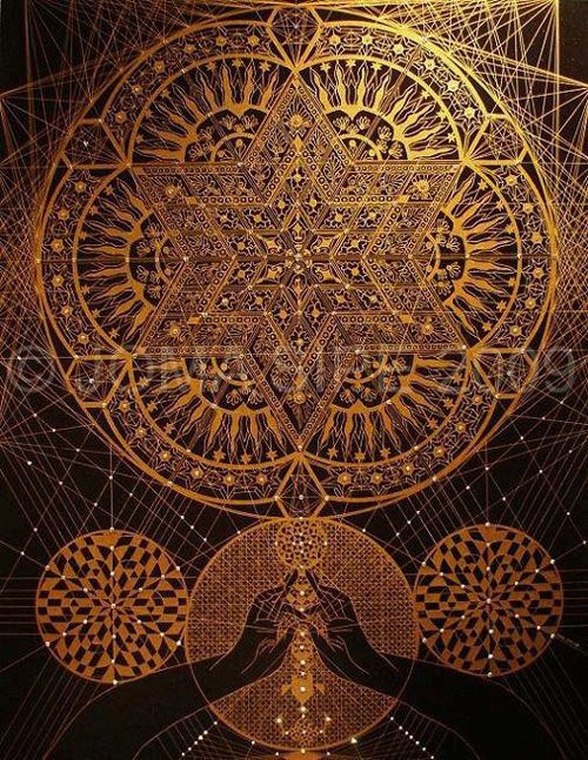
In Solomon's Seal, the two triangles that make it up will be different colors, if the image is colored, often blue and red or black and white. This is a common way of noting opposing forces such as water and fire, or masculinity and femininity. Thus the Seal, which may show the triangles interlaced, indicates the balance or combination of opposing elements, up to and including the Above and Below. The symbol indicates the balanced unity of all that is, which can be taken as an aspect of perfection. The Seal reinforces the notion of the winged ouroboros as an expression of the final stage, of perfection. The symbol as a whole suggests eternal perfection. The Seal and ouroboros refer to the incorruptible spirit and body.
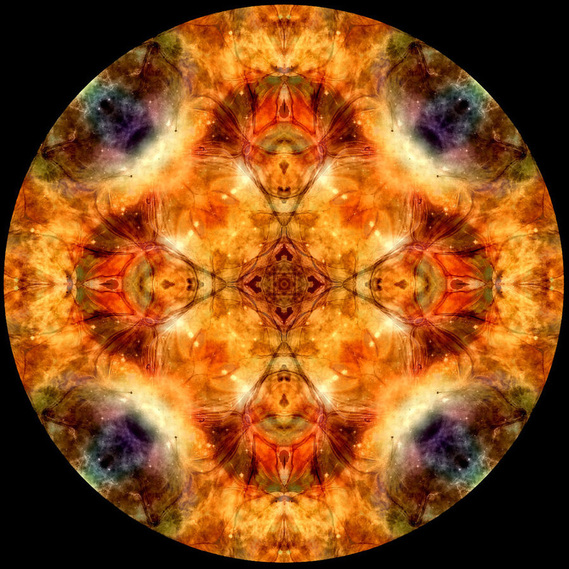
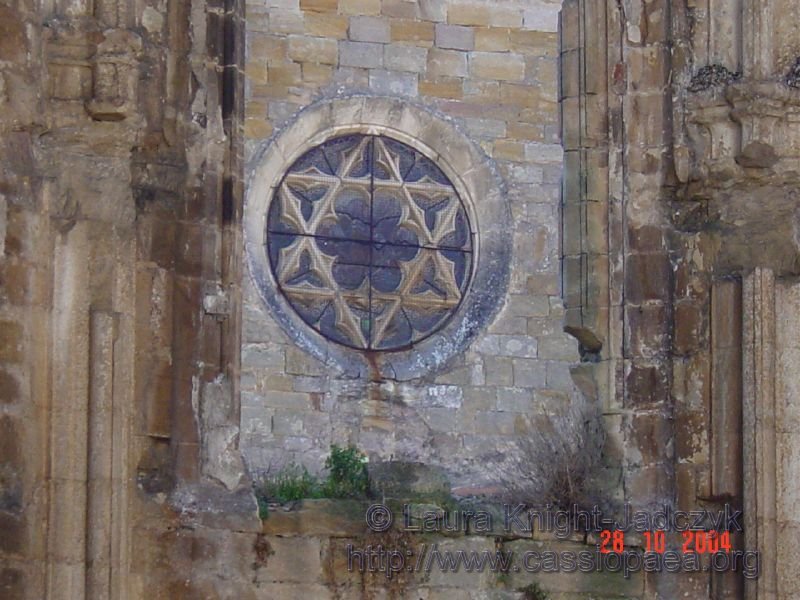
Rennes
http://cassiopaea.org/Rennes-le-Chateau/rennes7.html
Jung
advises that mandalas found in monasteries and temples are of no particular
significance; many mandalas are not free and individual formations.]
In 1938, I had the
opportunity, in the monastery of Bhutia Busty, near Darjeeling, of talking with
a Lamaic rimposhe, Lingdam Gomchen by name, about the khilkor or mandala. He
explained it as a dmigs-pa (pronounced “migpa”), a mental image which can be
built up only by a fully instructed lama through the power of imagination.
He said that no
mandala is like any other, they are a individually different. Also, he said ,
the mandalas to be found in monasteries and temps were of no particular
significance because they were external representations only.
The true mandala is
always an inner image, which is gradually built up through (active)
imagination, at such times when psychic equilibrium is disturbed or when a
though cannot be found and must be sought for, because it is not contained in
holy doctrine.
The aptness of this
explanation will become apparent in the course of my exposition. The alleged
free and individual formation of the mandala, however, should be taken with a
considerable grain of salt, since in all Lamaic mandalas there predominates not
only a certain unmistakable style but also a traditional structure.
For instance they are
all based on a Quaternary system, a quadratura circuli, and their contents are
invariably derived from Lamaic dogma. There are texts, such as the
Shri-Chakra-Sambhara Tentra, which contain direcctions for the construction of
these “mental images.” ~Carl Jung, Psychology and Alchemy, Paragraph 123.
Ankh
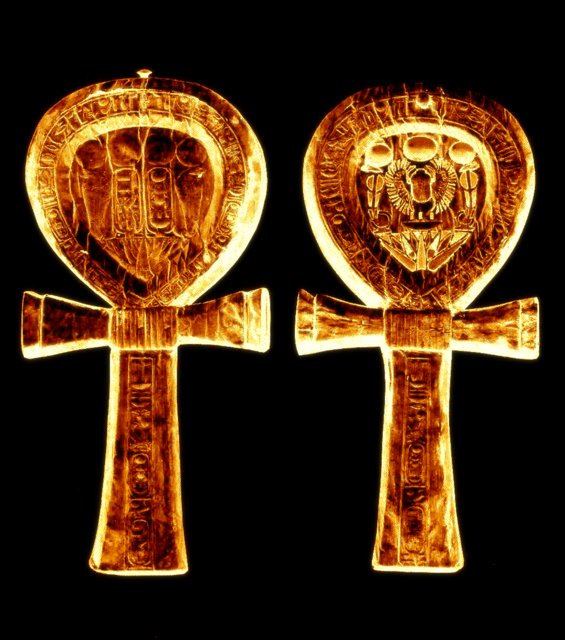
The
ankh (/ˈæŋk/
or /ˈɑːŋk/;
Egyptian IPA: [*ʕaːnax]; U+2625 ☥ or U+132F9 𓋹), also known as key of life, the
key of the Nile or crux ansata (Latin meaning "cross with a
handle"), was the ancient Egyptian hieroglyphic character that read
"life", a triliteral sign for the consonants ꜥ-n-ḫ. Symbol of father, mother and
child.
The ankh is the
Egyptian symbol of eternal life.
Some say it represents the giving of life.
It represents the
concept of eternal life. The Egyptian gods are often portrayed carrying
it by its loop, or bearing one in each hand, arms crossed over their chest.
The origin of ankh is
highly debated and it is represented by an oval or point-down teardrop set atop
a T shape. The
ankh is a wormhole, the symbol of life and Cosmos at the same time.
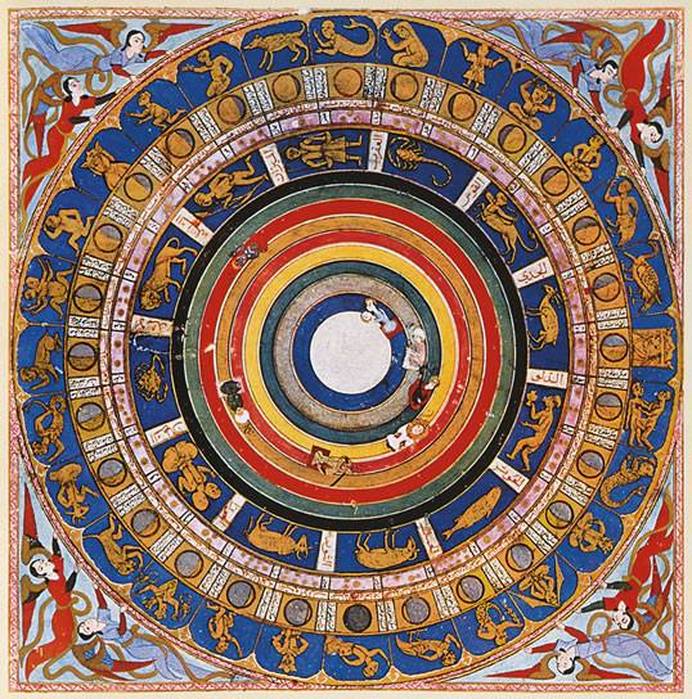
Mandala,
the Self, the Stone, the Grail
MANDALA. The
Sanskrit word for circle. For Jung, the mandala was a symbol of wholeness,
completness, and perfection. Symbolized the self.
One of the richly
illustrated manuscripts of the sixteenth century is the Zubdat-al Tawarikh in
the Museum of Turkish and Islamic Arts in Istanbul, dedicated to Sultan Murad
III in 1583. The manuscript contains forty miniatures of the finest quality
reflecting the mature Ottoman court style of the latter part of the sixteenth
century. Celestial map, signs of the Zodiac and
lunar mansions. The art of Ottoman Turkish miniature painting reached
its peak in the sixteenth century, especially during the reigns of Suleyman the
Magnificent and Murad III, who were both great patrons of art responsible for
the uninterrupted output of the imperial ateliers during this period. Most of
the miniatures executed in the sixteenth century took their subjects from
Ottoman history illustrating major political and social events of the time.
Less attention was given to producing literary manuscripts. Illustrated
religious texts which increased in number later in the century very often
remained in a historical framework. That is, in some of the major books on
world history, Ottoman sultans were linked genealogically with Koranic and
Biblical prophets. The Zubdat-al Tawarikh is a book of that nature where the
text is a summary of Biblical and political world history covering the creation
of the world, stories of the prophets and prominent historical figures of the
past.
Carl
Jung on the Self which can bear no Self-Deception
"Only now did I
gradually come to what the mandala really is:
"Formation,
transformation, the eternal mind's eternal recreation." And that is the
self, the wholeness of the personality; which, when everything is well, is
harmonious, but which can bear no self-deception. My mandala images were
cryptograms on the state of my self, which were delivered to me each day. ~Carl
Jung, Memories Dreams and Reflections, Page 121 [as cited in The Red Book;
Footnote 136.]
Carl Jung calls the
totality of our being the ‘self’. The self includes the conscious and the
unconscious. This is represented by the ‘ego’ and the ‘superordinate’ aspects.
Jung says:
“I usually describe
the supraordinate personality as the “self,” thus making a sharp distinction
between the ego, which, as is well known, extends only as far as the conscious
mind, and the whole the personality, which includes the unconscious as well as
the conscious component. The ego is thus related to the self as part to whole.
To that extent the self is supraordinate.” (Carl Jung, CW 9i, para. 314-315)
Now this is rather
amazing: Jung says that the self is felt (empirically) as an object not as a
subject. He says:
“Moreover, the self is felt
empirically not as subject but as object, and this by reason of its unconscious
component, which can only come to consciousness indirectly, by way of
projection.”
(ibid)
This implies that we
have some distance from our ‘self’. It is the object of our contemplation. It
is not necessary directly accessible or subjectively experienced (at least in
the beginning of our journey). Instead, it is the aspect of our being
that we have to get to know through contemplation, imagination, dreaming. To
discover the self is to know it as it appears to us through archetypal images
emanating from the unconscious. Jung says:
“Because of its
unconscious component the self is so far removed from the conscious mind that
it can only be partially expressed by human figures; the other part of it has
to be expressed by objective, abstract symbols. The human figures are father
and son, mother and daughter, king and queen, god and goddess. Theriomorphic
symbols are the dragon, snake, elephant, lion, bear, and other powerful
animals, or again the spider, crab, butterfly, beetle, worm, etc. Plant symbols
are generally flowers (lotus and rose). These lead on to geometrical figures
like the circle, the sphere, the square, the quaternity, the clock, the
firmament, and so on.”
(ibid)
Ultimately the self is
indefinite, incomprehensible. Archetypal images emerge as representations of
that which is inarticulable. Jung says:
The indefinite extent
of the unconscious component makes a comprehensive description of the human
personality impossible. Accordingly, the unconscious supplements the picture
with living figures ranging from the animal to the divine, as the two extremes
outside man, and rounds out the animal extreme, through the addition of and
inorganic abstractions, into a microcosm. These addenda have a high frequency
in anthropomorphic divinities, where they appear as “attributes.” (ibid)
References:
Image uploaded to the creative commons by user named Daniel Csörföly- 2007.
Jung, C. G., The Archetypes and the Collective Unconscious – CW 9i
(1934–1954) (1981 Collected Works Vol.9 Part 1)
http://thejungian.com/2013/03/12/carl-jung-the-self-and-its-corresponding-figures-and-symbols/
Walter Bruneel, Mandala 2013
‘The mandala’s
basic motif is the premonition of a center of personality, a kind of central
point within the psyche, to which everything is related, by which everything is
arranged, and which is itself a source of energy….
This center is not
felt or thought of as the ego, but if one may so express it, as the self.
Although the center is represented as the innermost point, it is surrounded by
a periphery containing everything that belongs to the self — the paired
opposites that make up the total personality.
This totality comprises
consciousness first of all, then the personal unconscious, and finally an
indefinitely large segment of the collective unconscious whose archetypes are
common to all mankind.”
~Carl Jung, Concerning Mandala Symbolism, Collected Works 11, 23ff.
Dovecot, keeper of the Sacred Doves
Psyche
and Matter by Marie-Louise von Franz
[selected passages]
"Matter and
Psyche from the Point of View of the Psychology of C.G. Jung" (1974)
"There are
probably many different numerical structures that repeatedly make a parallel
appearance in the psychic and physical realms. ... This is ... where further
research must be encouraged. When Jung came to this point, he said the
following: 'Now I have the feeling that I've hit my head against the ceiling. I
can't get any farther than this.' This was shortly before his death. Now, I
have not tried to produce any creative new ideas, but rather, in my book Number
and Time I have tried to take this idea that Jung hinted at somewhat further
and to show that the natural numbers in fact do possess in exactly the same way
in the world of psychic representations all the qualities that they possess
mathematically and that they have in physics and in the hereditary code. Thus a
real, absolute isomorphism is present. I was able to take this up to the number
four. Then it became too complicated, and at that point I also hit my head on
the ceiling." Page 37.
"Symbols of the
Unus Mundus" (1968)
"When he created
the concept of synchronicity, Jung laid a foundation which might lead us to see
the complementary realms of psyche and matter as one reality. ... Synchronistic
events ... seem to point towards a unitary aspect of existence which transcends
our conscious grasp and which Jung has called the unus mundus." Page 40.
The "mandala is
the psychological equivalent and synchronicity the parapsychological equivalent
of the unus mundus." Page 41.
"The
above-mentioned mandalas [in the writings of Marsilio Ficino, Pico della
Mirandola, Giordano Bruno, Ramon Lull] are attempts to combine the psychic
equivalent of the unus mundus (i.e., mandala) with an attempt to tap the
'absolute knowledge' (i.e., synchronicity). Some of them are triadic, and these
seem more explicitly intended to put the inner man in order, whereas others can
be turned, and these have the additional purpose of obtaining ESP knowledge or
of producing magical effects. Some of these cosmic models, such as the calendar
of Guillaume de Digulleville, which describes in Psychology and Religion and
Psychology and Alchemy, have a double structure of two circles.
The same holds true
for the mysterious modern vision of a world clock which Jung published in
Psychology and Alchemy. Jung suggests that this world clock might
represent the essence
of the time-space union or rather its origin ... ." Page 44.
"This
complementary double aspect of number (quantity and quality) is in my opinion
the thing which makes is possible for the world of quantity (matter) and of
quality (psyche) to interlock with each other in a periodical manner (world
clock!)." Page 57.
"The
Psychological Experience of Time" (1978)
Speaking of two dreams
of a seven-year old child in which things get run over: "These two
dream-visions mean to give the child a helpful shock, in order to wake her up
to our cultural time world, to which she now has to adapt when going to school.
She has to learn that all goes over rapidly and that she now has to live in time."
Page 128.
"Probably most of
you have had once or more times that typical agonizing dream of having to catch
a train, coming across one obstacle after another. This generally indicates
that we are not in harmony with time, that we are not 'up to the moment' in one
way or another, but that we sleepily drift along in life not realizing what is
meant to be realized at that moment." Page 128.
"In the realm of
physics ... acausal orderedness manifests, for instance, in the time rate of
radioactive decay, which is a just-so fact, for which we cannot indicate a
cause. In the realm of the psyche an example of acausal orderedness would be
the just-so-ness of individual natural numbers, 1, 2, 3, etc." Page 130.
"Numbers
altogether in China was closely related to time. ... Numbers are not only names
for quantities but also indicate qualitative time phases in the existence of
the whole." Page 132.
"To the three
great archetypal symbols of time, the river (or snake), the procession (or
train), and the wheel (or clock), we could add one more archetypal image, the
God of Death." Page 136.
"Psyche and
Matter in Alchemy and Modern Science" (1975)
"[S]pirit and
matter are two unknown realms of existence which we call inner and reality. We
have to make such a dualistic distinction because there are two archetypes at
work—father-spirit and mother-matter. ... The rationalism of the seventeenth
century thus had one advantage after all; it drove father-spirit and
mother-matter so far apart that now we can reunite them in a cleaner way."
Page 157.
The "point, Jung
thought, was to investigate synchronicity further, because synchronistic events
are obviously the meeting point. In a synchronistic event something happens
materially and psychically, coincides, and is united by a common meaning."
Page 162.
Jung "pointed out
that the natural numbers have completely individual mathematical qualities; and
that, he said, must account also for their magical importance. For the first
time, he tried to unite these two streams.
"Jung's idea was
that one should study the individuality of these numbers—be interested in what
each has that the others have not, rather than what they have in common. ...
Then he said he couldn't do it; he felt too old. That was about two years
before his death. ... [T]hat's why I have now written this rather unreadable
book, Number and Time, making at least a little attempt. I have tried the first
four integers, as you know; I counted to four and tried to assemble the
qualities of each in psychology, mythology, physics, mathematics; and it is, to
me at least, quite clear that they really have the same function—that if you
compare the role of three in mathematics and physics, there is a similar
function in psychological and symbolic manifestation. Then I discovered, to my
amazement, that Chinese mathematics were completely built on this idea of the
quality of numbers." Page 164.
"There were once
eleven [Chinese] generals, and they had to vote if they should attack or
retreat. They voted, and eight were for attack and three were for going back.
Therefore, they retreated. The three had won out because three is the number of
harmony; three is a better number, qualitatively, than eight. So the people who
hit the three won out." Page 164.
"I have made
endless charts, and then I have been discouraged and left it. I have left it a
year, and now my dreams say I should not leave it, that it's still there, that
I've only attacked it from the wrong angle. So now I have tp pick it up again
and try from another angle. I don't know, I'm just groping ... that's all I can
say." Page 165.
"Some Historical
Aspects of C.G. Jung's Synchronicity Hypothesis" (n.d.)
"My attempt to
penetrate into the fundamental problems of mathematics has until now been
nearly entirely ignored. However, I am convinced that the next steps of
creative scientific thinking will go further in this direction ... " Page
199.
"What creates a
great problem for the acceptance of the synchronicity hypothesis is the fact
that it breaks with ago-old habitual patterns of thought. It is true that the
omnipotence of causality has been breached in such a way as to cast doubt on
the simple-minded clockwork fantasy of a deterministic universe, but in
addition the hidden omnipotence of the surviving magical thought mode is also
being done away with. This amounts to a checkmate for the power drive of the
scientific intellect. What the new hypothesis of Jung has to recommend it, is
the fact that it introduces a creative element and a factor of meaning into the
hard sciences of nature. But with this, the feelings and ethical values of the
observer must be taken into account by scientific inquiry. This aspect is
something that, much to our detriment, has until now been excluded by
science." Page 199.
"The
Synchronicity Principle of C.G. Jung" (1979)
"The numbers are
probably the most primordial archetypes that there are; they represent the
actual matrix of the archetypes.... Number, as it were, lies behind the psychic
realm as a dynamic ordering principle, the primal element of that which Jung
called spirit. As an archetype, number becomes not only a psychic factor, but
more generally, a world-structuring factor. In other words, numbers point to a
background of reality in which psyche and matter are no longer distinguishable.
... [O]ne and the same ordering principle underlies both living matter and the
human psyche ... " Page 216.
"According to
Jung, the mandala is the psychic equivalent and synchronistic phenomena are the
parapsychological equivalent of the unus mundus. Page 218.
"The coincidences
between dreams and real situations seem to belong to the operative type
'attraction of related phenomena.'" Page 221.
"Some Reflections
on Synchronicity" (1984)
Jung uses the term
psychoid "to characterize the fact that the archetypes of the objective
psyche sometimes seem to cross over into the realm of matter." Page 251.
"Meaning and
Order" (1981)
"In his book on
synchronicity, C.G. Jung introduces two new concepts into depth psychology
concerning the world of so-called chance. One is the concept of 'acausal
orderedness' and the other that of 'synchronistic events.' The former means a
regular omnipresent just-so-ness, such as, for instance, the specific speed of
light, the quantization of energy, the time-rate of radioactive decay, or any
other constant in nature. Because we cannot indicate a cause (for these
regularities); we generally express this just-so-ness by a number ... "
Page 267.
Numbers are, "in
Jung's view, ... archetypal symbols. They are also individuals and have an aspect
of just-so-ness ... " Page 269.
"We could say
that mathematics deals with the 'acausal orderedness' in our own mind, which is
based on number; and physics, among other themes, deals with the 'acausal
orderedness' in nature, such as the speed of light and the rate of radioactive
decay, which could also be designated by number." Page 270.
Concerning
synchronicity: "[T]here also exists a 'danger that meaning will be read
into things where actually there is nothing of the sort, or that one
misinterprets the meaning." Page 272.
.
"Physics and
psychology indicate that ... numbers ... appear as qualities of matter—just as
they appear as a quality of psychic contents. The only difference, it seems to
me, would lie in an interpretation of this quality only in terms of order or
also, as we do in psychology, in terms of meaning. Up until now most physicists
certainly do not associate consciously any meaning with order." Page 285.
The "meaningful
but rather vague language of myth is in his [Jung's] view more appropriate for
the description of psychological facts. Only so can it include the vagueness of
meaning and the feeling function. This, I think, will always keep psychology
separate from physics. If we try, all the same, to meet, it is for the reason
that in its fringes, where psychology reaches over to the other fields of
science, there should exist—if possible—no fundamental contradictions. A
psychology which does not keep pace with the findings of other sciences seems
to me no good. I think that Jungian psychology meets nuclear physics on a
fringe via the concept of order, especially close in the view that number is an
archetype as well as a property of material phenomena, be it quantum numbers or
patterns of particle interactions.
Dr. Capra writes:
'When the particles are arranged according to their values of their quantum
numbers they are seen to fall into very neat patterns ... .' Very similar
patterns appear in the archetypal structures produced by the unconscious
psyche, but in contrast to the aspect of order alone we have in psychology also
to search for their 'meaning.' Number, it seems to me, unites both: order and
meaning, and is therefore ... a possible meeting point for the two fields of
science." Pages 288-9.
http://www.jgsparks.net/guides/vF/Psyche&Matter.pdf
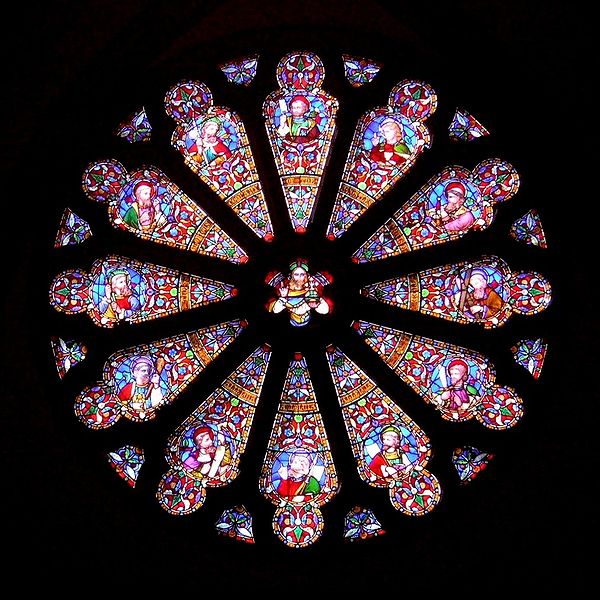
Rosewindow
It
is not without importance for us to appreciate the high value set upon the
mandala, for it accords very well with the paramount significance of individual
mandala symbols which are characterized by the same qualities of a – so to
speak – “metaphysical” nature.
Unless everything
deceives us, they signify nothing less than a psychic center of the personality
not to be identified with the ego.
I have observed these
processes and their products for close to thirty years on the basis of very
extensive material drawn from my own experience.
For fourteen years I
neither wrote nor lectured about them so as not to prejudice my observations.
But when in 1929, Richard Wilhelms laid the text of the Golden Flower before
me, I decided to publish at least a foretaste of the results.
One cannot be too
cautious in these matters, for what with the imitative urge and a positively morbid
avidity to possess themselves of outlandish feathers and deck themselves out in
this exotic plumage, far too many people are misled into snatching at such
“magical” ideas and applying them externally, like an ointment.
People will do
anything, no matter how absurd, in order to avoid facing their own souls.
They will practice
Indian yoga and all its exercises, observe a strict regimen of diet, learn
theosophy by heart, or mechanically repeat mystic text from the literature of
the whole world - all because they cannot get on with themselves and have not
slightest faith that anything useful could ever come out of their own souls.
Thus the soul has been
turned into a Nazareth Gradually from which nothing good can come. Therefore
let us fetch it from the four corners of the earth - the more far-fetched and
bizarre it is the better!
I have no wish to
disturb such people at their pet pursuits, but when anybody who expects to be
taken seriously is deluded enough to think that I use yoga methods and yoga doctrines
or that I get my patients, whenever possible, to draw mandalas for the purpose
of binging them to the “right point” – then I really must protest and tax these
people with having read my writings with the most horrible inattention.
The Doctrine that all
evil thoughts come from the heart and that the human soul is a sink of iniquity
must be deep in the marrow of their bones.
We that so, then God
had made a sorry job of creations, and it were high time for us to go to
Marcion the Gnostic and depose the incompetent demiurge.
Ethically, of course,
it is infinitely more convenient to leave God the sole responsibility for such
a Home for Idiot Children, where no one is capable of putting a spoon into his
own mouth.
But it is worth man’s
while to take pains with himself, and he has something in his soul that can
grow.
It is rewarding to watch
patiently the silent happenings in the should and the most and best happens
when it is not regulated from outside and from above.
I readily admit that I
have such great respect for what happens in the human soul that I would be
afraid of disturbing and distorting the silent operation of nature by clumsy
interference.
This was why I even
refrained from observing this particular case myself and entrusted the task to
a beginner who was not handicapped by my knowledge-anything rather than disturb
the process.
The results which I now
lay before your are the unadulterated, conscientious, and exact
self-observations of a man of unerring intellect, who had nothing suggested to
him from outside and who would in any case not have been open to suggestion.
Anyone at all familiar
with the psychic material will have no difficulty in recognizing the authentic
character of the results. ~Carl Jung, Psychology and Alchemy, Paragraph 126.
La Rappresentazione Geometrica di Dio,Zero, Olio su tela di Claudio Secchi
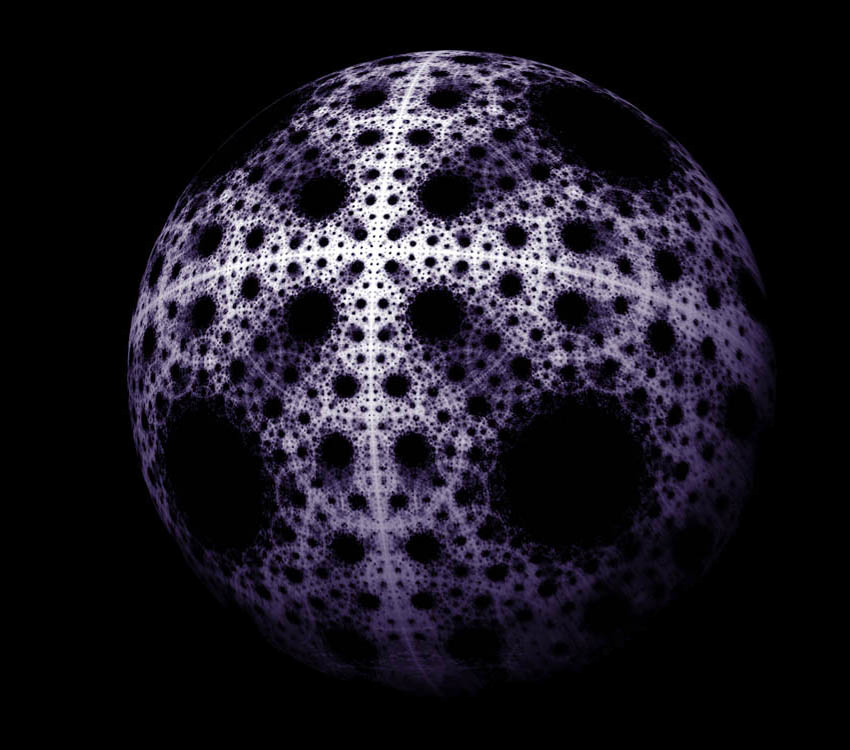
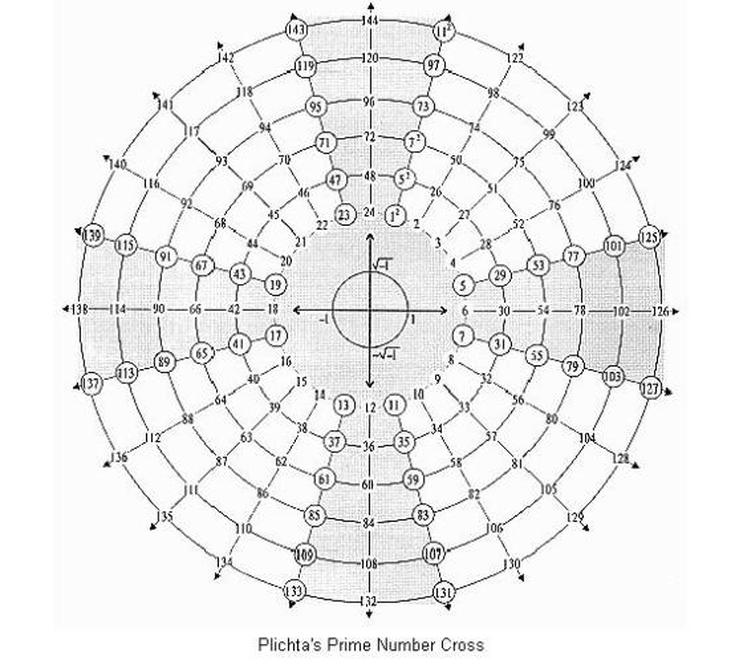
Timewheel, Pouyan Khosravi's visionary project, Pineal Visions, explores beautiful and intense scenes inspired by meditative states, out-of-body experiences and revelation.
According
to Dr Peter Plichta a German chemist, the ancient Egyptians were aware of a
hidden pattern buried away within the prime number sequence. By placing the
numbers from 1 to 24 into a circle,as we did previously with the 24 reduced
Fibonacci numbers and moving in a clockwise direction, then placing the
next 24 numbers of the sequence running concentrically around it, repeating
this maneuver, we discover that the prime numbers fall on the diagonals which
in turn appear to form the image of a Templar cross.
Contained within his prime number cross are the numbers from 1 to 144
Within this series of the first 144 numbers there are 34 prime numbers.
On Plichta’s diagram we note that only 32 primes fall into the cross.
The primes 2 and 3 are for some reason, excluded from this Templar cross
patterning.
Taking these primes which fall within the cross;
5,7,11,13,17,19,23,29,31,37,41,43,47,53,59,61,67,71,73,79,83,
89,97,101,103,107,109,113,127,131,137,139.
Their total value is 2124 which reduces to 9.
The numbers 2 and 3 are the excluded exceptions
2 plus 3=5
Taking the full prime sequence up to 144
2,3,5,7,11,13,17,19,23,29,31,37,41,43,47,53,59,61,67,71,73,79,
83,89,97,101,103,107,109,113,127,131,137,139.
Their total value is 2129 which in turn reduces to 5.
(14=5-PHIve)
Reducing the numbers on the prime cross to a single digit by mod 9
reveals the following array-and it is a familiar one also-all the the numbers
fall into 3 distinct sequences alternating as follows;
1-4-7
2-5-8 3-6-9
Which in turn break down further to a single digit pattern
3-6-9
3-6-9 patterning with prime number cross.
(Click image to enlarge.)
This is exactly the same patterning as we have witnessed so far within the
repeating 24 Fibonacci sub-code
and the 3 groupings of the prime numbers divisable by 1,2 and 3.
Or even by adding the single numbers together;
1,4,7=1-10-28(1-1-1)=3
2,5,8=3,15,36(3-6-9)=9
3,6,9=6,21,45(6-3-9)=9
3,9,9=21(3)
21
Counting down;
1,3,6=10(1)
1,6,3=10(1)
1,9,9=19(1)
1-1-1
1-1-1 times 8
(The pattern occurs 8 times in the prime cross)
8-8-8
(8-8-8=24-Indicative of time perhaps?)
Applying the same rule as above;
36-36-36=9-9-9
36+36+36=108=9
108
3 nines
27
9-8
Toroidal ‘S’ curves are also visibly present within the prime number cross
sequence.
(Starting from the 1 position in the cross)
Note; all chains in this progression break down by mod 9 to the 3-9-6 sequence.
The last two numbers of a chain are always the first two numbers of the
second (highlighted in red)
The commencing number in the first line (18) is the same as the final number in
the last line.
(Highlighted in blue)
This pattern repeats throughout the cross,turning on each 9th chain.
Also there would appear to be another sequence occuring in the last two numbers
of each chain;
The first four seem to follow a 2,4,6,8 sequence
The next five follow a 1,3,5,7,9 pattern.
Patterns are also visible within the array of numbers if we read them in
straight lines from inner to outer;
eg;714714,
this continues over in the opposite line with a chirality of 471471
The same patterning occurs within all the number stands throughout the
prime number cross.
There are six concentric circles in the cross within which the numbers are
distributed.
(Inner to Outer)
1.
2,3,5,7,11,13,17,19,23.
(9 units;value-100=1)
2.
29,31,37,41,43,47.
(6 units;value-228-12=3)
3.
53,59,61,65,67,71
(6 units;value-376-16=7)
4.
73,79,83,89,
(4 units;value-324=9)
5.
97,101,103,107,109,113
(6 units;value-620=8)
6.
127,137,139
(3 units;value-403=7)
1 3 7 9 8 7
value=35=8
http://tombedlamscabinetofcuriosities.wordpress.com/2013/05/22/an-analysis-of-the-prime-number-cross-and-its-relationship-to-other-models-of-reality-part-1/
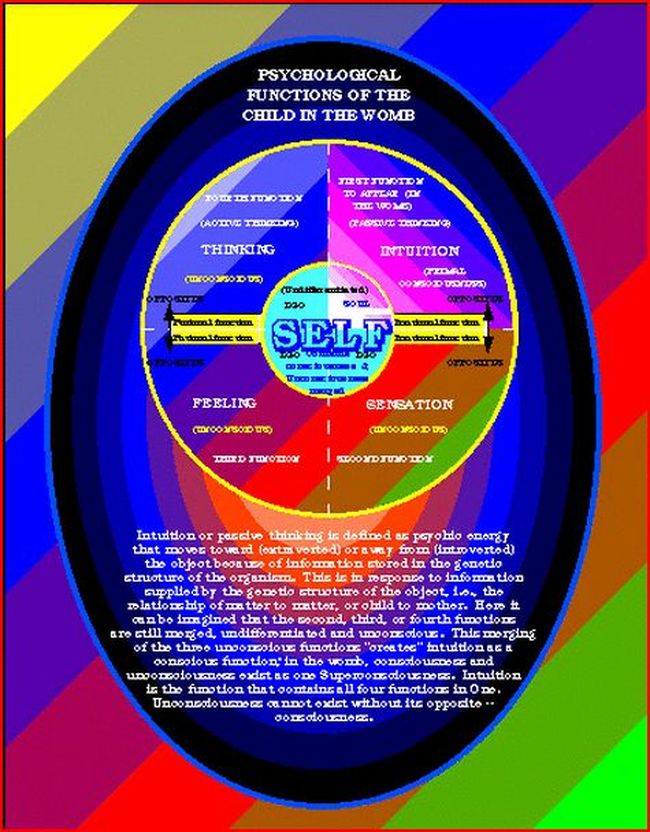
Instead of trying to be a mountain, teaches the ancient Tao Te Ching, "Be the valley of the universe". In this way, you are restored to a wholeness and so "all things will come to you."
"In dreams and fantasies the sea or a large expanse of water signifies the Unconscious…. The sea is the favorite symbol for the Unconscious, the mother of all that lives… Man's task is to become conscious of the contents that press upward from the Unconscious." ~Carl Jung
Ocean_Eye-Cosmic_Sight-Oneness by deathsdream
Merged
Into the Ocean of Oneness
The
Bhakta devotee Sant Tukarama saw God everywhere and within everyone.
The
viewer and the image, the lover and the object of worship,
the
drop and the ocean have become one:
"All of humanity
has become God; My virtues and defects have both been removed.Sublime beyond
words, it is indeed a blessing; In this great triumph, my heart is at peace.The
reflection in the mirror appears a separate being, But the viewer and his image
are one and the same.When it merges into the Ocean, O Tuka, The streamlet
becomes the Ocean itself."
-- Sant Tukarama,
Gatha 3132
Oceanic feeling is a
psychological term coined by Romain Rolland and popularized by Sigmund Freud in
his books The
Future of an Illusion
(1927) and Civilization
and Its Discontents
(1929/1930) to criticize the psychological feeling of religion, the
"oceanic" feeling of limitlessness. According to Rolland's definition
of the term, this feeling is the source of all religious energy which permeates
in various religious systems. It is a sensation of an indissoluble bond, as of
being connected with the external world in its integral form. This feeling is an entirely
subjective fact and is not an article of faith. Rolland's view is that one may
justifiably call oneself religious on the basis of this oceanic feeling alone,
regardless if the adherent renounces every belief and every illusion. On
the other hand, Freud cannot sympathize with such feeling since he admits he
cannot find it in himself. It is not easy, he says, to analyze emotions
scientifically. To Freud, this feeling is a fragment of infantile consciousness
when the infant begins to differentiate himself from his human and non-human
environment. In his opinion, there is not a strong enough need for it to be the
source of all religious energy. Freud does not deny that this feeling may occur
in people and offers a psychoanalytical explanation.
http://en.wikipedia.org/wiki/Oceanic_feeling
The Golden Bough by valkenburg
Symbols
of Transcendence
. . . it
is quite certain that the fundamental goal of initiation lies in taming the
original Trickster-like wildness of the juvenile nature. It therefore has a
civilizing or spiritualizing purpose, in spite of the violence of the rites
that are required to set this process in motion. P. 146 There is . . . another
kind of symbolism . . . also connected with the periods of transition . . .
they concern a man's release from any confining pattern of existence, as he
moves toward a superior or more mature stage in his development. P. 146
A child . . .possesses
a sense of completeness, but only before the initial emergence of his
ego-consciousness. In the case of an adult . . . completeness is achieved
through union of the consciousness with the unconscious contents of his mind.
Out of this . . . a man can achieve his highest goal: the full realization of
the potential of his individual Self. P. 146
. . . the symbols of
transcendence provide the means by which the contents of the unconscious can
enter the conscious mind . . . p. 147
. . . we again meet
the Trickster theme . . . he no longer appears as a lawless would-be hero. He
has become the shaman . . . the medicine man . . . whose magical practices and
flights of intuition stamp him as a primitive master of initiation. P. 147
Evidence of such
powers can be found as far back as the Paleolithic period of prehistory . . .
p. 147
At the highest level
of this type of initiatory activity . . . we find the Hindu master yogis. In
their trance states they go far beyond the normal categories of thought. P. 147
. . . the theme of the
lonely journey . . .which somehow seems to be a spiritual pilgrimage on which
the initiate becomes acquainted with the nature of death. But this is not death
as a last judgment or other initiatory trial of strength: it is a journey of
release, renunciation, and atonement, presided over and fostered by some spirit
of compassion. P. 150
In the first part of
life . . . this may be experienced as that moment of initiation at which one
must learn to take the decisive steps into life alone. P. 150
At a later period . .
. one may not need to break all ties . . . nonetheless one can be filled with
that spirit of divine discontent which forces all free men to face some new
discovery or to live their lives in a new way. This change may become
especially important between middle and old age. P. 151
This need may be
filled temporarily . . . by a trip . . . or nothing more than a move to a
smaller house. But none of these will serve unless there has been some inner
transcendence of old values in creating not just inventing, a new pattern of
life. P. 151
Perhaps the commonest
dream symbol of transcendence is the snake . . . chthonic transcendence is the
motif of the two entwined serpents. Naga serpents of India . . .Greece . . . on
a staff belonging to the god Hermes . . . p. 155
It is not easy for
modern man to grasp the significance of the symbols . . . from the past . . .
or that appear in dreams. P. 156
Initiation is,
essentially, a process that begins with a rite of submission, followed by a
period of containment, and then by a further rite of liberation. In this way
every individual can reconcile the conflicting elements of his personality: He
can strike a balance that makes him truly human, and truly the master of
himself. P. 156
Nexus Stock by Moonchilde-Stock
Vesica Pisces
The
Mandorla is a symbol that is all but unknown today. It was used during medieval
Christianity. It is an ancient symbol of two circles coming together and
overlapping one another to form an almond shape in the middle. Jensen (1996)
describes the mandorla as similar to the image of two mandalas (Sanskrit for
circle) merging together until an almond shape is formed in the center. Also
known as the "Vesica Piscis", symbolizing the interactions and
interdependence of opposing worlds and forces, the circles may be taken to
represent spirit and matter or heaven and earth (Baldock, 1990).
Mandorla is the
Italian word for almond. According to Biedermann (1994), the almond is an
ancient symbol for the closing up of valuable contents in a hard, almost impenetrable
shell. It is a mysterious image of concentration upon the light that shines
from within. Christ's true nature is supposed to lie beneath the surface of the
corporal (bodily) being.
During medieval times,
the almond was interpreted as a symbol of the embryo enclosed in the uterus.
The form of the almond which suggests a stylized vulva may have contributed to
such an interpretation (Biederman, 1994). It is also a variant of a halo which
surrounds the whole body of the holy person (Bruce-Mitford, 1996).
According to Fontana
(1994), the mandorla symbolizes power as well as spirituality, and is often
appeared around the body of Christ to represent the Assention (Fontana, 1994).
Although the symbol
may have its roots before the Christian movement began, the early Christians
used the symbol as a method to describe the coming together of heaven and earth
or spirit and matter. Also, the early Christians would make themselves known to
one another by scrapping into the walls two lines indicating a stylized fish-which
is the Mandorla. One would scratch a small circle in the wall, and another
would come by and make another circle slightly overlapping, thus completing a
Mandorla.
The mandorla has a
healing encouraging function. When one is so tired, discouraged or battered by
life that one can no longer live in the tension of the opposites, the symbol
can show what one can do. When the most Herculean efforts and the finest
disciplines no longer can keep the painful contradictions of life at bay, one
can find relief in the mandorla. According to Johnson (1991)it helps us to
transfer cultural life into religious life(but culture has been around long
enough that it is not wiped out).
The mandorla begins
the healing of the split. The overlap generally is very thin at first, only a
sliver of a new moon, but it is a beginning. As time passes, the greater the
overlap, the greater and more complete is the healing. The mandorla binds
together that which was torn a part and made unwhole-unholy. It is considered
the most profound religious experience one can have in life.
The mandorla is the
place of poetry. It is similar to the duty of a true poet to take the
fragmented world that we find ourselves in and make unity of it. When the
images such as fire and a rose are overlapped, we have a mystical statement of
unity; we have a rebirth once again. We begin to feel a safety and sureness in
our fractured world, and the poet has provided us with a demonstration of
synthesis. Great poetry makes such leaps and unites the beauty and the terror
of existence. It has the ability to surprise and shock-to remind us that there
are links between the things we always thought of as opposites.
http://carljungdepthpsychology.blogspot.com/2012/02/mandorla.html#.UnUrWHcvY_M
http://en.wikipedia.org/wiki/Vesica_piscis
|
|
|
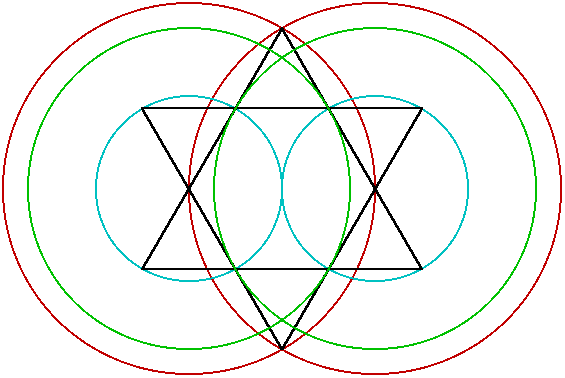
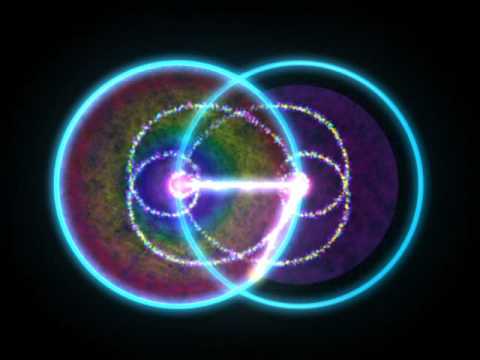
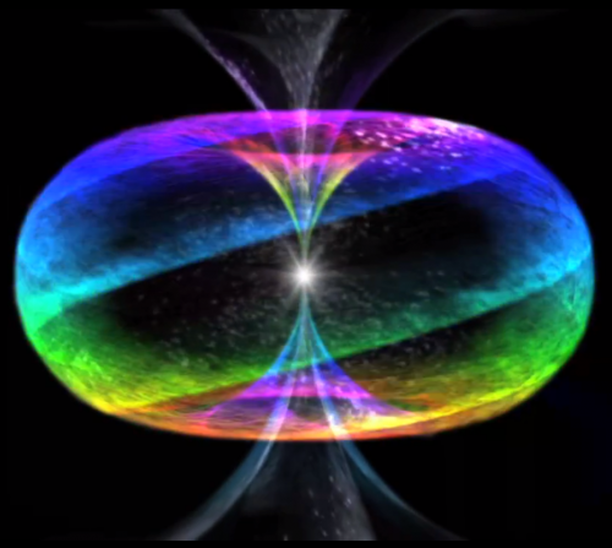
Torus
The most deconstructed
archetypal forms are vortexes, toroids, solitons, and singularities..
The most fundamental
archetype of process is the Field. The quantum vacuum is a dynamic massless
scalar field. Scalars are just active information; a hologram is pure
information. Entanglement is a property of nonlocal quantum information
exchange.
The central spiral
vortex crossover point (all adjoining toroidal fractal involved fields)
is what physicists
call a “twistor” or a “wormhole”.
The underlying
structure of the torus is the Vector Equilibrium, or “VE.”
It is the blueprint by
which nature forms energy into matter.
In a Vortex
"OUTER" coexists with "INNER" in a dimensional MORPHING
contorsion-continuum. This vortex energy modality of the fractal universes,
this fractal repeats in every manifestation, including the Earth (the Body),
the Psyche, the Soul, the Spirit that are manifested in the 4 Elements of Earth
/ Water / Air / Fire and their Torus-Vortex interactions.
http://holographicarchetypes.weebly.com/
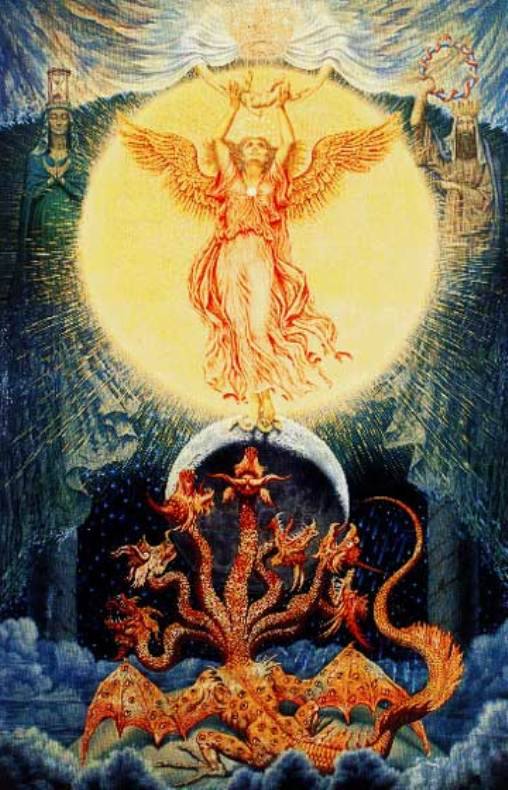
Anima Mundi
“The deeper “layers”
of the psyche lose their individual uniqueness as they retreat farther and
farther into darkness. “Lower down,” that is to say as they approach the
autonomous functional systems, they become increasingly collective until they
are universalized and extinguished in the body’s materiality… Hence “at bottom”
the psyche is simply “world.”… in the symbol the world itself speaking.” (Carl
Jung, CW 9i, para 291)
Hermetic
Christ / Divine child
http://journals.sfu.ca/pgi/index.php/pacificamyth/article/view/49/84
Sacrifice:
Psychologically,
associated with the need to give up the world of childhood, often signaled by
the regression of energy. One must give up the retrospective longing which only
wants to resuscitate the torpid bliss and effortlessness of
childhood.["The Sacrifice," CW 5, par. 643.]
For him who looks
backwards the whole world, even the starry sky, becomes the mother who bends
over him and enfolds him on all sides, and from the renunciation of this image,
and of the longing for it, arises the picture of the world as we know it
today.[Ibid., par. 646.]
http://www.nyaap.org/jung-lexicon/s
The Psychological
Meaning of Sacrifice – Sacrificial Gifts
Kramp, in his book on
the Roman liturgy, makes the following observations about the substances
symbolizing the sacrifice:
“Now bread and wine
are not only the ordinary means of subsistence for a large portion of humanity,
they are also to be had all over the earth (which is of the greatest
significance as regards the worldwide spread of Christianity). Further, the two
together constitute the perfect food of man, who needs both solid and liquid
sustenance. Because they can be so regarded as the typical food of man, they
are best fitted to serve as a symbol of human life and human personality, a
fact which throws significant light on the gift-symbol.”
It is not immediately
apparent why precisely bread and wine should be a "symbol of human life
and human personality."
This interpretation
looks very like a conclusion a posteriori from the special meaning which
attaches to these substances in the Mass.
In that case the
meaning would be due to the liturgy and not to the substances themselves, for
no one could imagine that bread and wine, in themselves, signify human life or
human personality.
But, in so far as
bread and wine are important products of culture, they do express a vital human
striving. They represent a definite cultural achievement which is the fruit of
attention, patience, industry, devotion, and laborious toil.
The words ''our daily
bread" express man's anxious care for his existence.
By producing bread he
makes his life secure. But in so far as he "does not live by bread
alone," bread is fittingly accompanied by wine, whose cultivation has
always demanded a special degree of attention and much painstaking work. Wine,
therefore, is equally an expression of cultural achievement.
Where wheat and the vine
are cultivated, civilized life prevails. But where agriculture and vine-growing
do not exist, there is only the uncivilized life of nomads and hunters.
So in offering bread
and wine man is in the first instance offering up the products of his culture,
the best, as it were, that human industry produces. But the "best"
can be produced only by the best in man, by his conscientiousness and devotion.
Cultural products can
therefore easily stand for the psychological conditions of their production,
that is, for those human virtues which alone make man capable of civilization.
As to the special
nature of these substances, bread is undoubtedly a food. There is a popular
saying that wine "fortifies," though not in the same sense as food
"sustains."
It stimulates and
"makes glad the heart of man" by virtue of a certain volatile
substance which has always been called "spirit." It is thus, unlike
innocuous water, an "inspiriting" drink, for a spirit or god dwells
within it and produces the ecstasy of intoxication.
The wine miracle at
Cana was the same as the miracle in the temple of Dionysus, and it is
profoundly significant that, on the Damascus Chalice, Christ is enthroned among
vine tendrils like Dionysus himself.
Bread therefore
represents the physical means of subsistence, and wine the spiritual. The
offering up of bread and wine is the offering of both the physical and the
spiritual fruits of civilization.
But, however sensible
he was of the care and labor lavished upon them, man could hardly fail to observe
that these cultivated plants grew and flourished according to an inner law of
their own, and that there was a power at work in them which he compared to his
own life breath or vital spirit.
Frazer has called this
principle, not unjustly, the "corn spirit."
Human initiative and
toil are certainly necessary, but even more necessary, in the eyes of primitive
man, is the correct and careful performance of the ceremonies which sustain,
strengthen, and propitiate the vegetation numen.
Grain and wine therefore
have something in the nature of a soul, a specific life principle which makes
them appropriate symbols not only of man's cultural achievements, but also of
the seasonally dying and resurgent god who is their life spirit. Symbols are
never simple only signs and allegories are simple.
The symbol always
covers a complicated situation which is so far beyond the grasp of language
that it cannot be expressed at all in any unambiguous manner. Thus the grain
and wine symbols have a fourfold layer of meaning:
1. as agricultural
products;
2. as products
requiring special processing (bread from
grain, wine from
grapes);
3. as expressions of
psychological achievement (work, industry,
patience, devotion,
etc.) and of human vitality in general;
4. as manifestations
of mana or of the vegetation daemon.
From this list it can
easily be seen that a symbol is needed to sum up such a complicated physical
and psychic situation. The simplest symbolical formula for this is "bread
and wine," giving these words the original complex significance which they
have always had for tillers of the soil. ~Carl Jung, Psychology and Religion,
Paragraphs 381-386.
Jewel in the Lotus, Io, 2005
edward_burne-jones_-_the_wheel_of_fortune
(c)2014; All Rights Reserved, Iona Miller, Sangreality Trust
iona_m@yahoo.com
Fair Use Notice
This site contains
copyrighted material the use of which has not always been specifically
authorized by the copyright owner. We are making such material available in our
efforts to advance understanding of environmental, political, human rights,
economic, democracy, scientific, and social justice issues, etc. We believe
this constitutes a 'fair use' of any such copyrighted material as provided for
in section 107 of the US Copyright Law. In accordance with Title 17 U.S.C.
Section 107, the material on this site is distributed without profit to those
who have expressed a prior interest in receiving the included information for
research and educational purposes. If you wish to use copyrighted material from
this site for purposes of your own that go beyond 'fair use', you must obtain
permission from the copyright owner.
The Bookworm
(Der Bücherwurm): Carl
Spitzweg, c. 1850, oil on canvas; image by Tagada Victoria, 10 October 2008
(Sammlung Georg Schäfer, Schweinfurt)
Powered by