JUNGIAN GENEALOGY II
Depth Psychology *
Genealogy * Genetic Genealogy * Psychogenealogy * Myth * Culture * Soul-Making
*
Hermeneutics * Geni-Us
* Bloodlines * Holy Grail * Archetypes * Healing Narratives * Ancestral Wisdom
* Gnostic Vision * Relative Autonomy * Genealogical Memoirs * Famous Kin &
History * Remembrance
DEPTH
GENEALOGY
ANCESTRAL
LINES OF ENQUIRY
GENERATIONAL
THERAPY
A
Life Forever Changed
FRUITION:
"Follow in the footsteps of your ancestors, for the mind is
trained through knowledge. Behold, their words endure… follow their wise
counsel."
--"The
Book of Kheti," The Husia: Sacred Wisdom of Ancient Egypt
Man “possesses” many
things which he has never acquired
but has inherited from his
ancestors.
~Carl Jung, CW 4, Para 728
“we are continually overflowing toward those who preceded us,
toward our origin, and toward those who seemingly come after us. ... It is our
task to imprint this temporary, perishable earth into ourselves so deeply, so
painfully and passionately, that its essence can rise again “invisibly,” inside
us. We are the bees of the invisible. We wildly collect the honey of the
visible, to store it in the great golden hive of the invisible.” ―Rainer Maria Rilke
"Even the next era has no right to
judge anything if it lacks the ability to contemplate the past without hatred
or envy. But even that judgment would be one-sided, for every subsequent era is
the fruit of previous periods and carries much of the past within it. It is
fortunate if something of the ancestors lives on in it and continues to be
loved and protected; only then does the past become fruitful and effective." --Rilke, Early Journals
Between
the Lines
NEVER TOO LATE
Past
Imperfect, Future Present
What
Everybody Knows, but Most Have Forgotten
"Follow
in the footsteps of your ancestors, for the mind is trained through knowledge.
Behold, their words endure… follow their wise counsel."
--"The
Book of Kheti," The Husia: Sacred Wisdom of Ancient Egypt
Man “possesses” many
things which he has never acquired
but has inherited from his
ancestors.
~Carl Jung, CW 4, Para 728
YOU ARE THE TREE OF LIFE
ENTANGLED GENERATIONS
This is Strictly
Personal
That
was the strange mine of souls.
As secret ores of silver
they passed
like veins through its
darkness. Between the roots
blood welled, flowing
onwards to Mankind,
and it looked as hard as
Porphyry in the darkness.
Otherwise nothing was red.
- Rilke,
"Orpheus. Eurydice. Hermes"
This is a depth psychological approach to Ancestry, mythic,
symbolic and metaphorical,
not metaphysical, religious, or literal.
Our genealogy is that Tree and cosmic center that keeps us
connected and balanced, and upon which we can ascend and descend in a way that
keeps deep time, the transcendent, and our family of flesh alive within us. Genetic testing is revealing suppressed identity.
Our genealogies are living systems, which are constantly
expanding and correcting. We work with others on the World Tree to create the
most accurate droplines we can, and correct as we go, breaking brick walls and
lopping off obsolete branches. The tree continues to grow.
Like an arborist, we understand the deep interweaving growth,
and just how much time such development takes (for trees, sometimes centuries)
and how ecologically interconnected events and lives are. Our relationship
really seems to exist in a kind of ancestral tree-time. New routes through life
are found; tree intelligence sends signals out through the roots. Tree
existence
can be lived with warmth and
an intimate sense of one’s inner core.
Our unconscious still
functions like it did four million years ago. We have discovered that trauma
can be passed between generations. The epigenetic inheritance theory holds that
environmental factors can affect the genes of future generations. Chemical tags
acting like Post-its can latch onto our DNA, switching genes off and on.
Such complexes are usually deeply unconscious, alienating, and
distorted. Our legacy conditions us. The conscious and unconscious minds don't
speak to one another; they don't even speak the same language. So, we tend to
reenact experiences our families have not integrated.
Integration proceeds
by perceiving and acknowledging our ancestors with our conscious minds,
including our intergenerational wounds and trauma and the weight of the
transgenerational history. It is a processing leading toward wholeness.
Jung says, "Take
pains to waken the dead. Dig deep mines and throw in sacrificial gifts, so that
they reach the dead." (Liber Novus, Page 244). Our genealogy is a psychic
treasure house of latent wisdom.
Some conscious
contents can vanish into the unconscious, other contents can also arise from
intuitive or ancestral wisdom. Jung thought it sufficient that the dead produce
effects like symptomatic repetition and unconscious alienation. He thought the
repressed, unlived life of the parents exerted some the strongest effect
visited upon children. By this he means the potentials of the parents that have
remained unrealized and the personal qualities that have been repressed, never
been developed or expressed, or authenticity repressed.
"Jung felt that
the “unlived lives” of the parents deeply impacted the lives of the children,
as if “branding” the children with a particular destiny. The unlived lives of
the parents is an ancestral inheritance which has great weight and gravitas, in
that it literally shapes the lives of the children. Jung elaborates: “that part
of their lives which might have been lived had not certain somewhat threadbare
excuses prevented the parents from doing so. To put it bluntly, it is that part
of life which they have always shirked, probably by means of a pious lie. That
sows the most virulent germs.”
"Psychologically, the central point of a human personality
is the place where the
ancestors are reincarnated."
~Carl Jung, Dream
Analysis, Page 304
"The ancestral part is given to us by our body, we take
over the life of our ancestors in that way. It is the terrace of life because
it is here that life renews itself."
~Carl Jung, ETH
Lecture 12 July 1935, Pages 240.
"Therefore
you should have reverence for what has become, so that the law of love may
become redemption through the restoration of the lower end of the past, not
prediction to the boundless mastery of the dead. But the spirits of those who
died before their time will live, for the sake of our present incompleteness,
in the dark chords in the rafters of our houses and beseech our ears with
urgent laments, until we grant them redemption through restoring what has
existed since ancient times under the rule of love.
What we called temptation
is the demand of the Dead who passed away prematurely and incomplete through
the guilt of the good and of the law. For no good is so complete that it could
not do it justice and break what should not be broken."
---Carl Jung, Nox
Secunda: pages 345-346 the Red Book
"He
who cannot love can never transform the serpent, and then nothing is
changed." ~Carl Jung, Basel Seminar, Para 87
The goal is important only
as an idea; the essential thing is the opus which leads to the goal: that is
the goal of a lifetime.
~Carl Jung, CW 16, Para 400
I am weary, my soul, my
wandering has lasted too long,
my search for myself
outside of myself.
~Carl Jung, The Red Book, Page 233.
The
answer to human life is not to be found within the limits of human life.
~Carl Jung, Letters
Vol. I, Page 127
Take
pains to waken the dead.
Dig deep mines and throw
in sacrificial gifts, so that they reach the dead.
Reflect in good heart upon
evil, this is the way to the ascent.
But before the ascent,
everything is night and Hell.
~Carl Jung, Liber
Novus, Page 244.
Real
life is always tragic, and those who do not know this have never lived.
~Carl Jung, ETH
Lectures 1 Feb 1935
It
was only quite late that we realized (or rather, that we are beginning to
realize) that God is Reality itself and therefore —last but not least —man.
This realization is a millennial process.
~Carl Jung, CW 11, Para 631
“The
search for physical immortality proceeds from a misunderstanding of the
traditional teaching. On the contrary, the basic problem is: to enlarge the
pupil of the eye, so that the body with its attendant personality will no
longer obstruct the view. Immortality is then experienced as a present fact.”
--Joseph
Campbell,
Hero With a thousand Faces (2008), pg. 161
“An
opus is needed, that one can squander decades on, and do it out of necessity.
I must catch up with a
piece of the Middle Ages—within myself. We have only
finished the Middle Ages
of—others. I must begin early, in that period when
the hermits died out.”
--C.G. Jung, LN p 320 ii; LN 330 n354
At
first we do not know what deeds or misdeeds, what destiny, what good and evil
we have in us, and only the autumn can show what the spring has engendered, only
in the evening will it be seen what the morning began.
~Carl Jung, CW 17,
Para 290
Doubt
is the crown of life because truth and error come together. Doubt is living,
truth is sometimes death and stagnation.
~Carl Jung, Dream Analysis, Page 89
But
above all protect me from the serpent of judgment, which only appears to be a
healing serpent, yet in your depths is infernal poison and agonizing death.
~Carl Jung, Liber Novus, Page 238.
The
spirit of the depths is pregnant with ice, fire, and death. You are right to
fear the spirit of the depths, as he is full of horror. You see in these days
what the spirit of the depths bore. You did not believe it, but you would have
known it if you had taken counsel with your fear.
~Carl Jung, Liber Novus, Page 238.
The black beetle is the
death that is necessary for renewal; and so thereafter, a new sun glowed, the
sun of the depths, full of riddles, a sun of the night. And as the rising sun
of spring quickens the dead earth, so the sun of the depths quickened the dead,
and thus began the terrible struggle between light and darkness. ~Carl Jung, Liber Novus, Page 238.
We are like the sun, which
nourishes the life of the earth and brings forth every kind of strange,
wonderful, and evil thing; we are like the mothers who bear in their wombs
untold happiness and suffering. ~Carl Jung, CW 17, Para 290
Your heights are your
own mountain, which belongs to you and you alone.
There you are
individual and live your very own life. If you live your own life, you do not
live the common life, which is always continuing and never-ending, the life of
history and the inalienable and ever-present burdens and products of the human
race. There you live the endlessness of being, but not the becoming.
Becoming belongs to
the heights and is full of torment. ~Carl Jung, The Red Book, Page 267.
Parents must realize that
they are trees from which the fruit falls in the autumn. Children don't belong
to their parents, and they are only apparently produced by them. ~Carl Jung, Letters Vol. 1, Pages
217-218.
These
constituents of the personality—which one may call functions, or Mendelian
units, or the primitives would call them remnants of ancestral souls—these
constituents don’t always fit. ~Carl Jung, Dream
Analysis, Page 453
We
have children and grandchildren and even if we don't believe
in immortality for
ourselves, we can believe in the right to live of future people.
~Carl Jung, J.E.T.,
Pages 90-95
"As you know, in
olden times the ancestral souls lived in pots in the kitchen."
~Carl Jung, Letters
Vol. I, Page 168
"Just
as conscious contents can vanish into the unconscious, other contents can also
arise from it. Besides a majority of mere recollections, really new thoughts
and creative ideas can appear which have never been conscious before.
They grow up from the dark
depths like a lotus."
~Carl
Jung, Man and His Symbols, Page 37.
NO
BIRTH WITHOUT BLOOD
We
are the precious fruit of the Tree of Life, each with the potential of our
future, and for self-realization, after the ordeal of abandonment.
“Nothing
in all the world welcomes this new birth, although it is the most precious
fruit of Mother Nature herself, the most pregnant with the future, signifying a
higher stage of self-realization. That is why Nature, the world of the
instincts, takes the “child” under its wing: it is nourished or protected by
animals” (Jung, CW 9i, para. 285-287).
If I accept death, then my tree
greens, since dying increases life. If I plunge into the death encompassing the
world, then my buds break open. How much our life needs death!
~Carl Jung, The Red
Book, Page 275.
He who sleeps in the
grave of the millennia dreams a wonderful dream. He dreams a primordially
ancient dream. He dreams of the rising sun. ~Carl Jung, The Red Book, Page 272
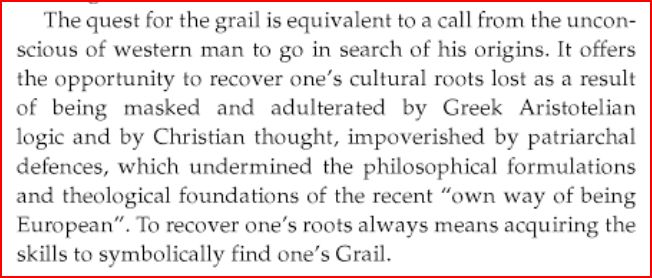
The Grail, Arthur and His Knights: A Symbolic Jungian Reading By Maria Zelia de Alvarenga
THE
BIRTHING TREE
CURATORIAL NARRATIVE
Soulwork:
Holistic Genealogy
“The universe is a
complete unique entity. Everything and everyone is bound together with some
invisible strings. Do not break anyone’s heart; do not look down on weaker than
you. One’s sorrow at the other side of the world can make the entire world
suffer; one’s happiness can make the entire world smile.”
―Shams
Tabrizi
"The deposit of man’s
whole ancestral experience—so rich in emotional imagery—of father, mother,
child, husband and wife, of the magic personality, of dangers to body and soul,
has exalted this group of archetypes into the supreme regulating principles of
religious and even of political life, in unconscious recognition of their
tremendous psychic power." ~Carl Jung, CW 8, Para 337
The ancestral part is
given to us by our body, we take over the life of our ancestors in that way. It
is the terrace of life because it is here that life renews itself. ~Carl Jung, ETH Lecture 12July1935,
Pages 240.
But no matter how much the
parents and grandparents may have sinned against the child, the man who is
really adult will accept these sins as his own condition which has to be
reckoned with.
~Carl Jung, CW 12, Para 152
My soul is my supreme
meaning, my image of God, neither God himself nor the supreme meaning. God
becomes apparent in the supreme meaning of the human community. ~Carl Jung, Liber Novus, Footnote 92, Page 240.
Individuation is an
expression of that biological process—simple or complicated as the case may be
—by which every living thing becomes what it was destined to become from the
beginning.
~Carl Jung, CW 11, Para 460
"The highest manifestation of life
consists in this: that a being governs its own actions. A thing which is always
subject to the direction of another is somewhat of a dead thing."
--Thomas Aquinas
The mystery
showed me in images what I should afterward live. I did not possess any of
those boons that the mystery showed me, for I still had to earn all of them. ~Carl Jung, Liber Novus, Page 254.
"The Siddhis (powers)
are attained by birth, chemical means [drugs], power of words, mortification or
concentration." -- Yoga Sutras of Patanjali, 4:1, translated
by Bro∴ Swami Vivekananda
It is
questionable whether the union of animus and anima can be described as a unio
mystica. The only certain thing is that the hierosgamos is a mythological
parallel. The unio mystica is more a dissolution of the ego in the divine
Ground--
a very different
experience. ~Carl Jung,
Letters Vol. I, Pages 564-565
Once you
really get it, that anxiety is a manifestation of proximity to God, then any
other more personal explanations of the experience, while retaining some
validity of course, will be swallowed up by the deeper meaning.
~Edward F. Edinger, Transformation of the God Image, Pages 113-114
"Being
naked" often means "accessible to all influences."
~Carl Jung, Letters Vol. 1, Page 319
No one can know what the
ultimate things are. We must therefore take them as we experience them.
~Carl Jung, CW 11, Para 167.
There is always an
attraction between conscious mind and projected content. Generally it takes the
form of a fascination. ~Carl Jung, CW 12, Para 436.
The archetype is, so to
speak, an “eternal” presence, and it is only a question of whether it is
perceived by the conscious mind or not. ~Carl Jung, CW 12, Para 329
"The
insight we obtain by looking at ourselves is generally very bitter, which is
why so few people do it; it is pikros—bitter for it corrodes and is very
disagreeable to the illusions of consciousness. That is why we speak of bitter
truth, for self-knowledge is a bitter experience at the beginning."
--Marie-Louise von Franz
“All
your rebirths could ultimately make you sick.…a
chameleon, a caricature, one prone to changing
colors, a crawling shimmering lizard… I recognized the chameleon and no longer
want to crawl on the earth and change colors and be reborn; instead I want to
exist from my own force, like the sun which gives light and does not suck
light…” --Jung 2009: 277
Even the
enlightened person remains what he is, and is never more than his own limited
ego before the One who dwells within him, whose form has no knowable
boundaries, who encompasses him on all sides, fathomless as the abysms of the
earth and vast as the sky. ~Carl Jung,
CW 11, Para 758
For when the soul vanished
at death, it was not lost; in that other world it formed the living counterpole
to the state of death in this world. ~Jung, CW 16, Para 493
In the last analysis every
life is the realization of a whole, that is, of a self, for which reason this
realization can also be called “individuation.”
~Carl Jung, CW 12, Para 330
It seems as if all the
personal entanglements and dramatic changes of fortune that make upthe
intensity of life were nothing but hesitations, timid shrinking, almost like
petty complications and meticulous excuses for not facing the finality of this
strange and uncanny process of crystallization.
~Carl Jung, CW 12, Para 326.
In philosophy
God is abstract, an idea, imageless.
But the Divine Child is
the incarnation of an idea; it permits us personal access to an idea which we
could not easily realize without it.
~Carl Jung, Ostroski-Sachs, Pages 38-43.
BORN
& BURIED
MEETING IN THE IMAGINATION
FINDING
THE WISDOM LEFT BY YOUR ANCESTORS
What the ancients did
for their dead!
You seem to believe
that you can absolve yourself from the care of the dead, and from the work that
they so greatly demand, since what is dead is past.
One shouldn’t attach
the dead to the living, otherwise they both get estranged from their proper
spheres and are thrown into a state of suffering.
~Carl Jung, Letters
Vol. I, Page 53
You excuse yourself
with your disbelief in the immortality
of the soul. Do you
think that the dead do not exist because you have' devised the impossibility of
immortality?
You believe in your
idols of words.
The dead produce
effects, that is sufficient.
In the inner world
there is no explaining away, as little as you can explain away the sea in the
outer world.
You must finally
understand your purpose in explaining away, namely to seek protection. ~Carl
Jung; Red Book, Page 298
You live inasmuch as
these Mendelian units are living. They have souls, are endowed with psychic
life, the psychic life of that ancestor; or you can call it part of an
ancestral soul. ~Carl Jung, Zarathustra Seminar, Page 1401.
Thus we remain
ignorant of whether our ancestral components find an elementary gratification
in our lives, or whether they are repelled. Inner peace and contentment depend
in large measure upon whether or not the historical family which is inherent in
the individual can be harmonized with the ephemeral conditions of the present.
~Carl Jung; Memories Dreams and Reflections; Page 237.
This image is
fundamentally unconscious, an hereditary factor of primordial origin engraved
in the living organic system of the man, an imprint or 'archetype' [q.v.] of
all the ancestral experiences of the female, a deposit, as it were, of all the
impressions ever made by woman . . .Since this image is unconscious, it is
always unconsciously projected upon the person of the beloved, and is one of
the chief reasons for passionate attraction or aversion." ~Carl Jung;
Memories Dreams and Reflections; Page 391.
Psychologically this
means that the souls of the ancestors (potential factors, qualities, talents,
possibilities, and so on, which we have inherited from all the lines of our
ancestry) are waiting in the unconscious, and are ready at any time to begin a
new growth. ~Carl Jung, ETH, Alchemy, Page 230.
The ancestral part is
given to us by our body, we take over the life of our ancestors in that way. It
is the terrace of life because it is here that life renews itself. ~Carl Jung,
ETH Lecture 12July1935, Pages 240.
If we became aware of
the ancestral lives in us, we might disintegrate. An ancestor might take
possession of us and ride us to death.
~Carl Jung, 1925
Seminar, Page 139
There is one ego in
the conscious and another made up of unconscious ancestral elements, by the
force of which a man who has been fairly himself over a period of years
suddenly falls under the sway of an ancestor.
~Carl Jung, 1925
Seminar, page 38.
In the redemption of
the individual, the whole past will be redeemed, and that includes all the
inferior things as well, the animals, and all the ancestral souls, everything
that has not been completed; all creation will be redeemed in the apokatastasis
[at the time of the Last Judgement], there will be a complete restoration of
things as they have been.
~Carl Jung, Visions
Seminar, Page 1280
The deposit of man’s
whole ancestral experience—so rich in emotional imagery—of father, mother,
child, husband and wife,
of the magic
personality, of dangers to body and soul, has exalted this group of archetypes
into the supreme regulating principles of religious and even of political life,
in unconscious recognition of their tremendous psychic power. ~Carl Jung, CW 8,
Para 337
These constituents of
the personality—which one may call functions, or Mendelian units, or the
primitives would call them remnants of ancestral souls—these constituents don’t
always fit. ~Carl Jung, Dream Analysis, Page 453
But if you know what
the dead demand, temptation will become the wellspring of your best work,
indeed of the work of salvation. ~Carl Jung, Liber Novus, Page 278, Footnote 188.
“The
alchemist saw the union of opposites under the symbol of the tree, and it is
therefore not surprising that the unconscious of present-day man, who no longer
feels at home in his world and can base his existence neither on the past that
is no more nor on the future that is yet to be, should hark back to the symbol
of the cosmic tree rooted in this world and growing up to heaven - the tree
that is also man. In the history of symbols this tree is described as the way
of life itself, a growing into that which eternally is and does not change;
which springs from the union of opposites and, by its eternal presence, also
makes that union possible. It seems as if it were only through an experience of
symbolic reality that man, vainly seeking his own “existence” and making a
philosophy out of it, can find his way back to a world in which he is no longer
a stranger.”
― C.G. Jung,
Psychological Types
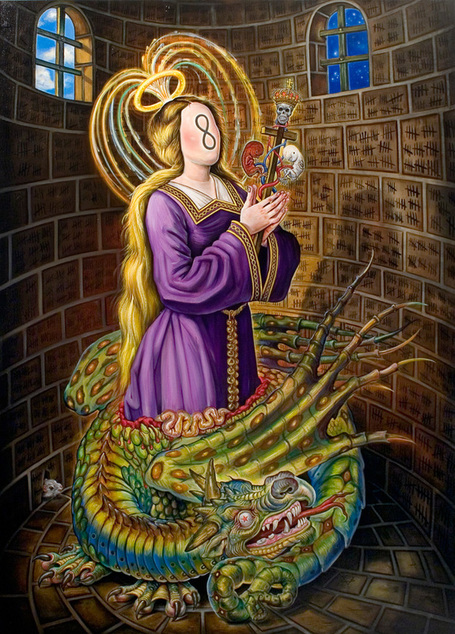
"Illuminator Series",
Christopher Ulrich
Infinity - Oil on
canvas 36" x 48"
The red man and the
white woman merge and not only give birth to the divine child but absorb its
golden aura, which is the backdrop of the whole show. The entire universe
spirals above, below, and within. The Royal Wedding heals all wounds, and
establishes treaties amongst all houses; a rekindling of friendship; truce
between enemies; the harvesting of fruits of labor; the newborn gifts between
lovers; a new manifestation between father and son, god and warrior, mother, sister
and friend. Illuminator: The Royal Wedding has revealed that there are no
mistakes, no regrets and no lies. The bride and groom could be myth and reality
or science and religion. Seeming opposites come together.
The
Felt Presence of Direct Experience
& Direct
Experience of Felt Presence
"It sounds very nice
to bring back the bodies of the parents and other people whom time has
swallowed, but if they should live again, you would have to live with them and
that is no simple thing; it might cause no end of trouble."
--C.G. Jung, Visions, p.985
"I drank the cup she
gave to me
And saw things past and
things to be
And old bodies that I wore
before..."
--Manfred Mann,
Snakeskin Garter
“The past is never dead. It’s not
even past.”
--William Faulkner
Eternal truths are never
true at any given moment in history.
~Carl Jung, CW 10,
Para 1004
You should be the vessel
and womb of life, therefore I shall purify you.
~Carl Jung to his Ego,
Liber Novus, Page 330
You rightly emphasize that
man in my view is enclosed in the psyche (not in his psyche). ~Carl Jung, Letters Vol. 1, Pages
555-557
It does not seem to have
occurred to people that when we say “psyche”
we are alluding to the
densest darkness it is possible to imagine.
~Carl Jung, CW 11,
Para 448
Indeed, it is quite
impossible to define the extent and the ultimate character of psychic
existence. ~Carl
Jung, CW 11, Para 140
Psychic
heredity does exist —that is to say, there is inheritance of psychic
characteristics such as predisposition to disease, traits of character, special
gifts, and so forth. ~Carl Jung, CW 11, Para 845
Originally we were all
born out of a world of wholeness and in the first years of life are still
completely contained in it. There we have all knowledge without knowing it.
Later we lose it, and call it progress when we remember it again. --C.G. Jung ~Carl Jung, Letters
Vol. I, Pages 274-275
'The
goal of life is to make your heartbeat match the beat of the universe, to match
your nature with Nature.' --Joseph Campbell
He [Man] must know
something of God’s nature and of metaphysical processes if he is to understand
himself and thereby achieve gnosis of the Divine.
~Carl Jung, CW 11,
Para 747.
He [God] fills us with
evil as well as with good, otherwise he would not need to be feared; and
because he wants to become man, the uniting of his antinomy must take place in
man. ~Carl
Jung, CW 11, Para 747.
Individuation
"It is not enough to
have become aware of the Self’s existence, it is necessary to go on living with
it, of acting from this center instead of from the ego.
That is where the river of
time comes in our dream and with it the realization that the Self is alive and
ever-changing, as well as solid and still.
And both belong to the
Self: our transient everyday life and the invisible luminous point which is the
“face of God,” the resting pivot in all changes."
~Marie-Louise Von
Franz, Psyche and Matter
The labours of the doctor
as well as the quest of the patient are directed towards that hidden and as yet
unmanifest “whole” man, who is at once the greater and the future man. ~Carl Jung, CW 12, Para 6
It is death to the soul to
become unconscious. People die before there is death of the body, because there
is death in the soul.
~Carl Jung, Dream Analysis, Page 90.
You must be in the middle
of life, surrounded by death on all sides.
~Carl Jung, The Red
Book, Page 370.
You still have to learn this, to succumb to no temptation, but
to do every~
thing of your own will;
then you will be free and beyond Christianity.
~Carl Jung, Liber
Novus, Page 235.
The kernel of all jealousy
is lack of love.
~Carl Jung; Memories,
Dreams and Reflections; Page 137.
One
can certainly gain outer freedom through powerful actions,
but one creates inner
freedom only through the symbol.
--Jung,
C. G.. The Red Book:
The idea that God is
necessarily good and spiritual is simply a prejudice made by man. We wish it
were so, we wish that the good and spiritual might be supreme, but it is not. ~Carl Jung, Dream Analysis, Pages
512-513.
"The unconscious is
not just evil by nature, it is also the source of the highest good: not only
dark but also light, not only bestial, semi-human, and demonic but superhuman,
spiritual, and, in the classical sense of the word, "divine."
--Jung, The Practice
of Psychotherapy
Our psychic prehistory is in truth the spirit of gravity, which
needs steps and ladders because, unlike the disembodied airy intellect, it
cannot fly at will.
~Carl Jung, CW 12,
Para 79
The
unconscious wants to flow into consciousness in order to reach the light, but
at the same time it continually thwarts itself, because it would rather remain
unconscious. That is to say, God wants to become man, but not quite. ~Carl Jung, CW 11,
Para 740
Experience of the opposites has nothing whatever to do with
intellectual insight or with empathy. It is more what we would call fate. ~Carl Jung, CW 12, Para 23.
...the self by definition represents the virtual union of all
opposites.
It cannot be described as
a summum bonum even in the metaphorical sense, because it is not a summum
desideratum but rather a dira necessitas which is characterized by all the
corresponding unpleasant qualities.
Individuation is as much a
fatality as a fulfillment.
The psychology of the self
is not philosophy but an empirical process which, being a natural process,
could run its course smoothly if it did not take a tragic turn in man by
colliding with his consciousness. --Carl Jung, Letters Vol. I, Page 529
Yahweh’s decision to become man is a symbol of the development
that had to supervene when man becomes conscious of the sort of God-image he is
confronted with. ~Carl Jung,
CW 11, Para 740
Like plants, so men also
grow, some in the light, others in the shadows. There are many who need the
shadows and not the light. The image of God throws a shadow that is just as
great as itself. ~Carl
Jung, Liber Novus, Page 230.
But the small, narrow, and
banal is not nonsense, but one of both of the essences of the Godhead. ~Carl Jung, Liber Novus, Page 230.
I resisted recognizing
that the everyday belongs to the image of the Godhead. I fled this thought, I
hid myself behind the highest and coldest stars. But the spirit of the depths
caught up with me, and forced the bitter drink between my lips. ~Carl Jung, Liber Novus, Page 230.
The way is within us, but
not in Gods, nor in teachings, nor in laws. Within us is the way, the truth,
and the life.
~Carl Jung, Liber Novus, Page 231
"It is in fact true,
as Jung has emphasized that the unconscious psyche pays very little attention
to the abrupt end of bodily life and behaves as if the psychic life of the
individual that is,the individuation process, will simply continue....The
unconscious" believes" quite obviously in a life after death."
--Marie-Louise von
Franz
OUR
BONES GO LAST
Riddles of the Bones
There is no real life
without archetypal experiences.
[Uniting symbols] arise
from the collision between the conscious and the unconscious and from the
confusion which this causes (known in alchemy as ‘chaos’ or ‘nigredo’).
Empirically, this confusion takes the form of restlessness and disorientation. ~Carl Jung, Aion, CW 9 II, §304.
If we go further and
consider the fact that man is also what neither he
himself nor other people
know of him—an unknown something which can yet
be proved to exist —the
problem of identity becomes more difficult still.
~Carl Jung, CW 11,
Para 140
Events signify nothing,
they signify only in us. We create the meaning of events.
The meaning is and always
was artificial. We make it.
~Carl Jung, The Red
Book, Page 239.
"So the mind must be
completely still....not conditioned in any belief, in any image, in any
experience. It is only when the mind is totally free,then there is the
possibility of immense profound stillness and in that stillness that which is
eternal comes into being. That is meditation" --J.Krishnamurti 1953
"Man is a gateway, through which you pass from the outer
world of Gods, daimons, and souls into the inner world, out of the greater.
into the smaller world. Small and inane is man, already he is behind you, and
once again you find yourselves in endless space, in the smaller or inner
infinity. ... Man here, God there. Weakness and nothingness here, eternally
creative power there.
Here nothing but darkness
and clammy cold there total sun."
~Carl
Jung, Red Book, Page 354.
I was once spiritually ill – we all pass through that – but one
day the intelligence in my soul cured me. ~Meister Eckhart, Selected Writings, P.116.
“The
purpose of all true symbols is to direct the individual away from the superficial
concerns of life towards the center of existence… the true symbol always points
beyond the here and now for it is a signpost to another world… each fragment
points to the whole and everything ephemeral is in an image of the eternal.” –
Manfred Lurker, The Gods and Symbols of Ancient Egypt.
The
boon of increased self-awareness is the sufficient answer even
to life's suffering,
otherwise it would be meaningless and unendurable.
~Carl Jung, Letters
Vol. II, Pages 310-311.
Individuation is not that you become an ego—you would then
become an individualist. You know, an individualist is a man who did not
succeed in individuating; he is a philosophically distilled egotist. ~Carl Jung, The Psychology of Kundalini Yoga, Pages 39-40.
But the way is my own
self, my own life founded upon myself.
The God wants my life. He
wants to go with me, sit at the table with me,
work with me. Above all he
wants to be ever-present.
~Carl Jung, Liber
Novus, Page 292.
Dr. Jung advised me to
spend most of my time alone, have a separate room in the house to be used for
nothing but inner work, never to join any organization or collectivity. ~C. G. Jung, Emma Jung and Toni
Wolff - A Collection of Remembrances; Pages 36-39.
I may define “self” as the
totality of the conscious and unconscious psyche, but this totality transcends
our vision; it is a veritable lapis invisibilitatis [stone of invisibility]. In
so far as the unconscious exists it is not definable; its existence is a mere
postulate and nothing whatever can be predicated as to its possible contents. ~Carl Jung, CW 12, Para 247.
For the layman in these
matters, [and who isn't a layman?] the identity of a nontemporal, eternal event
with a unique historical occurrence is something that is extremely difficult to
conceive.
He must, however, accustom
himself to the idea that ''time" is a relative concept and needs to be
complemented by that of the "simultaneous" existence, in the Bardo or
pleroma, of all historical processes.
What exists in the pleroma
as an eternal process appears in time as an aperiodic sequence, that is to say,
it is repeated many times in an irregular pattern. . . .
When these things occur as
modern variants, therefore, they should not be regarded merely as personal
episodes, moods, or chance idiosyncrasies in people, but as fragments of the
pleromatic process itself, which, broken up into individual events occurring in
time, is an essential component or aspect of the divine drama. ~Carl Jung, CW 11, Para 629
FAMILY
TREE IS THE UNCONSCIOUS DIAGRAM
OF A PSYCHIC EVENT
MAMA
"With words you pull
up the underworld. Word, the paltriest and the mightiest. In words the
emptiness and the fullness flow together. Hence the word is an image of God.
The word is the greatest and the smallest that man created, just as what is
created through man is the greatest and the smallest."
~Carl Jung, Liber
Novus, Page 299.
“Our dreams recover what the world
forgets.”
―James Hillman,
Animal Presences
"It's only in the
stories, our stories that the gods will still show."
--James Hillman
It [myth] is something
that happens to man, and men have mythical fates just as much as the Greek
heroes do.
~Carl Jung, CW 11, Para 648.
Eros
is born of chaos, implying that out of every chaotic moment ...creativity...can
be born --Hillman 1978a, p. 98
Birth is difficult, but a
thousand times more difficult is the hellish afterbirth. All the dragons and
monstrous serpents of eternal emptiness follow behind the divine son. ~Carl Jung, Liber Novus, Page 287.
" ...the psychological feeling
requires courage. There is a civil courage, moral courage, physical and
intellectual, and therefore also a courage of the soul to meet herself ." --James Hillman
...the real task of
religion would be to cure psychic suffering.
--C.G. Jung ~Carl
Jung, Letters Vol. 1, Page 133.
The disease which the
experience of death cures is the rage to live.
--James Hillman, A
Blue Fire
Death is an
existential recognition of our finitude.
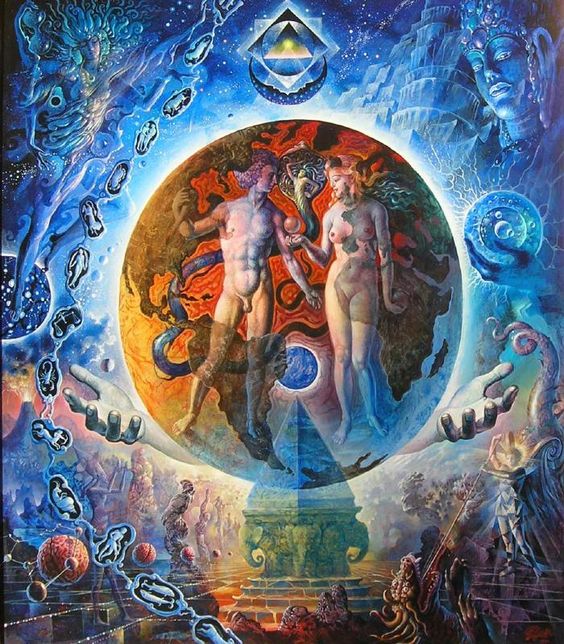
Otto Geiss - The Alegory of Genesis, 1995
Pious
Eros
The Numinous, Sensed
Presence & Transcendent Function
Numinous
perception carries a sense of the divine or ecstatic. This expansion of
consciousness from contact with numinous archetypal energy is felt as an
expansion of consciousness or awe, 'calling,' and a deepening of soul. But we
tend to reify the limits of our knowledge and place our notions of God just
beyond what we can conceptualize and understand, which is why physics has
become so seemingly mystical recently. God = the Unknown or currently
unknowable.
Phantoms In the Brain
With no other
psychobiological explanation for sensed presence in his day, Jung took
experiences of the Self, or archetypes, 'spirits,' or other positive and
negative visitations and impressions phenomenologically. As epistemological
metaphors, "how we know what we know", they cannot be ontological
realities. Research shows "the person feels that the 'presence' is a
being they know, like a deity they pray to, the spirit of a person they have
known who has died, or a spiritual teacher." It is an excitation of the
amygdala. (Murphy)
Jung believed the
unconscious has "absolute knowledge." So Corbin, Jung and others
mistook it for a psychospiritual perception ability attributed to the subtle
organ of the heart or soul, rather than a psychobiological function [though the
archetype is defined as psychophysical]. Common images, often seen in NDE's,
include "angels, monks in hooded robes, knights on horseback in shining
armor, spirit familiars, deities, aliens, and a variety of other images"
(Murphy).
Sensed presence is
more easily evoked in the suggestible. We now know that awareness of the divine
is an altered state of consciousness with neurological roots involving the
excitation and dampening of brain regions. Under certain kinds of
electromagnetic effects or oxygen deprivation/CO2 buildup, Jung's 'transcendent
function' appears as active unconscious systems, urges, and percepts.
Sensed presence
appears as the Self, archetypes, divinities, personifications, projections,
ancestors, ghosts, or a 'visitation'. Some sense a presence; others hear a
voice; others see a vision, or combination of percepts. Sensed presence can be
a coping resource. When the personal level collapses into the archetypal core,
we have a unitive experience.
There is a contrast
between conscious and unconscious processes that are refreshed in a
conscious/unconscious cycle. Thus, complex ideas can enter consciousness
automatically. Unintentional, high-level
symbol manipulation is generated involuntarily. Consciousness is an interpreter
in the passive frame theory -- more of a conduit for information in the brain
and nervous system rather than an active creator of information.
Morsella's “Passive
Frame Theory,” claims:
nearly all
of your brain’s work is conducted in different lobes and regions at the
unconscious level, completely without your knowledge. “The
information we perceive in our consciousness is not created by conscious
thought,” Morsella claims. “Nor is it reacted to by conscious processes.
Consciousness is the middle-man and it doesn’t do as much work as you think.”
Such epiphanies, and
pleasant or unpleasant perceptions include gut feelings, visions, tastes,
smells, vibrations, buzzing, tingles, sensations of falling or rising, etc. The
emotional component comes from the right temporal region, while the explanatory
narrative arises in the left hemisphere. The left brain 'knows' that it can't
have two selves, it experiences the intruder as an external 'presence'.
(Persinger,
Murphy)
https://www.god-helmet.com/sp.htm
https://www.god-helmet.com/neuromed.htm
This neurological
frame illuminates Jung's commentary as well as other deeply engrained spiritual
and religious belief systems [interpretations] surrounding such phenomena:
Holiness is also revelatory: it is the illuminative power emanating
from an archetypal figure. ~Carl Jung,
CW 11, Para 225.
The numinosum is either a
quality belonging to a visible object or the influence of an invisible presence
that causes a peculiar alteration of consciousness.
~Carl Jung, CW 11,
Para 6
But the fact is that the
approach to the numinous is the real therapy and in as much as you attain to
the numinous experiences you are released from the curse of pathology. ~Carl Jung, Letters Vol. I, Page
377
There is
religious sentimentality instead of the numinosum of divine experience.
This is the well-known
characteristic of a religion that has lost its living mystery. ~Carl Jung, CW 11,
Para 52
We cannot tell whether God
and the unconscious are two different entities. Both are border-line concepts
for transcendental contents.
~Carl Jung, CW 11, Para 757
We are all inventors, each
sailing out on a voyage of discovery, guided each by a private chart, of which
there is no duplicate. The world is all gates, all opportunities. --Ralph Waldo Emerson
The Great Unknown
Imagine one of our ancient ancestors, suddenly stricken by illness or a
near-fatal accident. Hovering near the brink of death, an ordinary person
suddenly finds him or herself locked in an immersive visionary experience of
shadowy figures, muted voices and blinding luminescence.
The cosmos opens its enfolding arms and infinity spreads out in a timeless
panoply that dissolves all fear, all separation from the Divine. Fear of death
vanishes in a comforting flood of bliss, peace and dazzling light, the ultimate
‘holy’ connection. Overwhelming conviction arises that this is the more
fundamental Reality. The welcoming gates of a personal heaven open.
Suddenly back in the body, returned to ordinary reality, one is left to
interpret that transcendent experience to oneself and others. This near-death
experience may not have resulted in physical demise, but it has led to the
death of the old self, the personal self -- and the rebirth, rapture, or
resurrection of the soul or spirit. It brings a surge of emotions, conviction
and even transformation in its wake. The soul has taken a journey from which
one cannot return the same.
A descent into psychobiological hell can lead to a transcendent journey
toward Heaven or perhaps the yawning abyss of the Void. Shamans, priests,
prophets, mystics, and gurus arose to show the Way of navigating these nether
regions, of finding healing, the eternal moment, a peaceful heart, and unity.
Our human progenitors had to directly confront existential issues of survival,
adaptation, stress, mating, birth, loss, and death. They gradually developed
stories about the basics of life, social, physical, emotional, mental, and
spiritual existence. They created myths, beliefs about creation and our
creation to give meaning to life. They developed rituals, ceremonies, and
practices to heal body and mind, mark life passages, and placate forces beyond
their control. These accounted for their origins as well as voices, visions and
experiences that seemed to come from the great Beyond.
The brain is hard-wired for mystical experiences to modify the threat of our
hostile existential reality (Alper). Metaphysical explanations developed for
the essentially unknowable, for sudden and irresistible seizures of ecstasy.
Some of these accounts were more sophisticated than others depending on their
cultural background, but all shared a common core by defining the mystery of
the relationship between mankind and the Unknown. It might be called a peak
experience, spirit possession, epiphany, religious rapture, nirvana, satori,
shaktiput, clear light, or illumination. The difference is only one of degrees
of absorption, of fulfillment.
The god-experience is a process, a subjective perception, rather than an
objectively provable reality. Distractions cease, replaced by the direct impact
of oceanic expansion, sudden insight, childlike wonder, ecstatic exaltation
above bodily and personal existence, dissolution in a timeless moment, fusion,
gnosis.
It is direct perception coupled with high emotion and deep realization of what
appears to be ultimate truth. It rips away the veil of illusion, revealing the
pure ground state of our existence without any emotional, mental, or belief
filters. Left with only pure awareness, the natural mind is finally free of
earthly trappings. Bathed in emotions of joy, assurance and salvation, Cosmos
becomes a living presence. Immortality is sensed, so fear of death vanishes.
Many called that numinous mystery God. In some sense, religion is a reaction to
what actually is. But to many, when it comes to their religion, those are
fighting words, for theirs is the true way, the only way. Heaven on Earth
cannot be achieved so long as those two realms are separated. God comes down to
earth in our own psychophysiology, dwelling within us.
From
Eternity to Eternity
Consciousness is
Primary
Awareness of Soul; The
Gnoosies
The well-known idea of the
"behaviour pattern" in biology is synonymous with that of the
archetype in psychology.
As the term
"archetypus" clearly shows, the idea is not even original; this
notion is found with the same significance as early as in Philo Judaeus, in the
Corpus Hermeticum, and in Dionysius the Areopagite.
My inventiveness consists
in nothing but the fact that I believe I have proved that archetypes do not
appear only in the "migration of symbols" but in the individual
unconscious fantasies of everyone without exception.
--C.G. Jung ~Carl
Jung, Letters Vol. 1, Pages 524-527
Primordial
Human Consciousness
"The
first Adam/Eve is called by Kabbalists Adam
Ha-Rishon (primeval human
consciousness). This in no way resembled the human form as we know it. The
Jewish sages speak of it in hyperbole. It had stupendous proportions, reaching
from earth to heaven; it stood astride earth from one end to the other. It could
see to the far reaches of the universe, for the light at that time was
called Ohr Ein Sof,
the limitless light, a metaphor for pure awareness.
Adam
Ha-Rishon did not see with eyes, it saw with an immeasurable
"knowing." This teaches that as each and every mortal being is a
spark from the original Adam Ha-Rishon, we all have the potential to perceive
everything knowable in this universe.
Adam
and Eve were born simultaneously side-by-side, or back-to-back, attached
like Siamese twins. As it says twice in Genesis, "male and female It
created them."
To separate them, in biblical language it says that God took one of Adam's
"sides;" in zoharic language, it says, "God sawed Eve off from
him." (For those who say Adam and Eve were attached back-to-back, this sawing
is viewed as the cause of the bumps all humans have along the back of the
spine.)
Non-Differentiated
Knowingness
The Midrash
Rabbah says, "When the Holy One created
Adam [Ha-Rishon], it was androgynous. God created Adam Ha-Rishon double faced,
and split him/her so there were two backs, one on this side and one on the
other." The idea that Adam and Eve were co-equal at birth is not a
kabbalistic secret; it was openly discussed in ancient midrashic
literature.
Moreover,
it was known two thousand years ago that the idea that Eve came
from Adam's rib was a common misunderstanding. The Torah is
unambiguous on this point. It repeats a second time, "Male and female It
created them," and goes on to say, "and blessed them, and
called their name Adam on the day they were created."
Whenever the Torah repeats something, the emphasis always suggests deeper
implications. Here, it is impossible to ignore that the creation of male and
female was simultaneous.
It
was only after the "sin" that Adam Ha-Rishon was diminished
in size. This means that Eve and Adam became separate entities while both were
still of gigantic proportions, that is, when both could see to the ends of the
universe. The Garden of Eden, of course, was also viewed as enormous. The
Tree of Life, at the center of the garden, was over twelve thousand miles high
and approximately fifty thousand miles in diameter. Some midrashic sources
suggest that it would take a person five hundred years to walk its diameter;
this would make it millions of miles across.
This
enormous size is described to suggest that the Tree of Life is all
inclusive; it shelters under its branches every living thing, plant or animal.
Even though today we know that the universe is significantly larger than a few
million miles, ancient astronomers may have assumed that the entire universe
could be enclosed in a space of such magnitude.Exaggeration in size and numbers
is used purposefully in wisdom teachings to shatter the boundaries of our
minds.
http://www.rabbidavidcooper.com/newsletters/2010/10/4/primordial-human-consciousness-n.html
Thoughts are real, they
are the consciousness. ~Carl
Jung, J.E.T., Pages 90-95
Consciousness is a
precondition of being.
~Carl Jung, CW 10, Para 528
"The
conscious mind allows itself to be trained like a parrot, but the unconscious
does not..." —Jung, Psychology and Alchemy, 1953
"The
dream is the small hidden door in the deepest and most intimate sanctum of the
soul, which opens into that primeval cosmic night that was soul long before
there was a conscious ego and will be soul far beyond what a conscious ego
could ever reach." —Jung, The Meaning of Psychology for Modern Man, 1934
Just as there is a
relationship of mind to body, so there is a relationship
of body to earth. ~Carl Jung, CW 10, Para 19
“Until you make the
unconscious conscious, it will direct your life
and you will call it fate.” ―C.G. Jung
It is not I who create
myself, rather I happen to myself.
~Carl Jung, CW11, Para
391
You have the one God, and
you become your one God in the innumerable number of Gods. ~Carl Jung’s Soul, The Red Book,
Page 371.
The word religio comes
from religere, according to the ancient view, and not from the patristic
religare. The former means “to consider or observe carefully.” ~Carl Jung, Letters; Vol. II, Page
517
When, towards middle life,
the last gleam of childhood illusion fades—this it must be owned is true only
of an almost ideal life, for many go as children to their graves—then the
archetype of the mature man or woman emerges from the
parental imago: an image
of man as woman has known him from the beginning of time, and an image of woman
that man carries within him eternally.
~Carl Jung, CW 10,
Para 74
My own understanding is
the sole treasure I possess, and the greatest.
Though infinitely small
and fragile in comparison with the powers of darkness, it is still a light, my
only light.
--Carl Jung, MDR, Page 88.
It [Eros] is not
form-giving but form-fulfilling; it is the wine that will be poured into the
vessel; it is not the bed and direction of the stream but the impetuous water
flowing in it. ~Carl Jung, Liber Novus, Page 365.
God needs man in order to
become conscious, just as he needs limitation in time and space. Let us
therefore be for him limitation in time and space an earthly tabernacle. ~Carl Jung, Letters, Volume 1, Page
65.
"Myths
are clues to the spiritual potentialities of the human life."
--Joseph
Campbell
It is the privilege and
the task of maturer people, who have passed the meridian of life, to create
culture.
~Carl Jung, CW 10, Para 272
Life is a battleground. It
always has been, and always will be; and if it were not so, existence would
come to an end.
~Carl Jung; Man and His Symbols; Page 75
The feeling of
immortality, it seems to me, has its origin in a peculiar feeling of extension
in space and time, and I am inclined to regard the deification rites
in the mysteries as a
projection of this same psychic phenomenon.
~Carl Jung, CW 9i,
Para 248-249
In the unconscious it is
not so terribly important whether a man is alive or dead, that seems to make
very little impression upon the unconscious. (Pg 903)
But your attitude to it
matters, how you will take it, whether you believe in immortality or not, how
you react to such and such an event, that matters to the unconscious. (Pg 903)
No matter what your conscious attitude may be, the unconscious has an
absolutely free hand and can do what it pleases. (Pg 27)
The
unconscious on one side is nothing but nature, and on the other hand it is the
overcoming of nature; it is yea and nay in itself, two things in one. So we
shall never understand what the unconscious is, as we shall never understand
what the world is,because it is and it is not.
(Page 89)
~Carl Jung, Visions
Seminar
The evolution of
consciousness is, as the philosopher of language Owen Barfield remarked, “the
concept of man’s self-consciousness as a process in time.” That is to say, our
present consciousness is not consciousness per se, but has been arrived at over
time. This suggests that there have been other forms of consciousness before
it. As Barfield and others have suggested, earlier peoples not only had
different ideas about the world than we have, they also saw a different world
than we do. Their consciousness differed from ours, which suggests that the
consciousness of people of a future time may also differ from ours. Gnosis I
see as the cognitive character of mystical consciousness, the ‘knowledge
content’ provided by its immediate, direct, non-discursive perception of
reality. --Gary Lachman, Mystical
Experience & the Evolution of Consciousness: A 21st Century Gnosis
“When
we speak… about consciousness, about the point at which consciousness arose and
so forth, we are speaking not merely about human nature, as we call it, but
also about nature itself. When we study consciousness historically, contrasting
perhaps what men perceive and think now with what they perceived and thought at
the same period in the past, when we study long-term changes in consciousness,
we are studying changes in the world itself, and not simply changes in the
human brain. We are not studying some so-called “inner” world, divided off, by
a skin or a skull, from a so-called “outer” world; we are trying to study the
world itself from its inner aspect.”
--Barfield, (History, Guilt, and Habit 11)
The
assumption “that, because consciousness is
contingent on a physical organism, it must be the product of such an organism”
(Rediscovery of Meaning 31), though currently common sense, must be incorrect,
for “[Consciousness] resembles a spark located within the brain much less than
it resembles a diffused light focused into the whole body from without”
(Language, Evolution of Consciousness, and the Recovery of Human Meaning).
The question of
consciousness is much more than an abstruse epistemological dilemma, for “If
civilization is to be saved, people must come more and more to realize that our
consciousness is not something spatially enclosed in the skin or in the skull
or in the brain; that it is not only our inside, but the inside of the world as
a whole. That people should not merely be able to propound as a theory . . .
but that it should become more and more their actual experience. . . . That,
and also the overcoming of the total obsession there is today, with the
Darwinian view of evolution—of consciousness or mind having emerged from a
material, but entirely unconscious universe. Putting it very shortly, to
realize, not simply as a theory but as a conviction of common sense, that in
the history of the world, matter has emerged from mind and not mind from
matter.” --Barfield, Towards Interview
Archetypes Are Means
of Volition
The archetype—let us never
forget this—is a psychic organ present in all of us. ~Carl Jung, CW 9i, Para 271
I am of the opinion that
the psyche is the most tremendous fact of human life. Indeed, it is the mother
of all human facts; of civilization and of its destroyer, war. ~Carl Jung, CW 9i, Para 206.
The psyche is part of the
inmost mystery of life, and it has its own peculiar structure and form like
every other organism.
~Carl Jung, CW 9i, Para 187.
Therefore a wise man does
not want to be a charioteer, for he knows that will and intention certainly
attain goals but disturb the becoming of the future.
~Carl Jung to his Ego,
Liber Novus, Page 311.
I know people who feel
that the strange power in their own psyche is something divine, for the very
simple reason that it has given them an understanding of what is meant by
religious experience.
~Carl Jung, CW 10, Para 312.
They [Religions] express
the whole range of the psychic problem in mighty images; they are the avowal
and recognition of the soul, and at the same time the revelation of the soul’s
nature.
~Carl Jung, CW 10, Para 367
The symbol of the mandala
has exactly this meaning of a holy place, a temenos, to protect the centre. And
it is a symbol which is one of the most important motifs in the objectivation
of unconscious images. It is a means of protecting the centre of the
personality from being drawn out and from being influenced from outside.
--Jung, “The Tavistock Lectures,” --CW 18, par. 410
But if the depths have
conceived, then the symbol grows out of itself and is born from the mind, as
befits a God. ~Carl
Jung, Liber Novus, Page 311.
The souls or spirits of
the dead are identical with the psychic activity of the living; they merely
continue it.
~Carl Jung, CW 9i, Para 38
Great
is the need of the dead.
But the God needs no
sacrificial prayer.
He has neither goodwill
nor ill will.
He is kind and fearful,
though not actually so, but only seems to you thus.
But the dead hear your
prayers since they are still of human nature and not free of goodwill and ill
will. ~Unknown woman to Carl
Jung, Liber Novus, Page 339.
Dr.Jung:
Yes, personified autonomous contents.
For instance, a person
might have a spirit of pride or of hostility, and the content would be
essentially that emotion, or it might be personified as the spirit of an old
aunt, or the grandfather, or anybody else.
But it can be proved
that it is a memory image still alive, contents of the unconscious that act as
if they were persons. . . .
All the products of
the collective unconscious, if too hard pressed, evaporate into nothingness;
the moment you get at them with your personal problems and desires, with your
human soul, you destroy them. They are exactly like exceedingly delicate
flowers which only blossom for one night and then wither.
You must take them as
they are, the truth of a moment; if you treat them as flesh and blood you make
the mistake of your life. ~Jung, Visions Seminar, Page 944
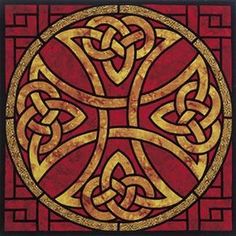
INFINITY
KNOT
There are a number of
variations that are considered to be a “Celtic Eternity Knot” or a Celtic
Infinity knot. They are all some kind of variation of the infinity symbol. The
Celtic eternity knot looks like a sideways figure 8. Nariations of this symbol
are often used on wedding bands or engagement rings to represent the eternal
bond of marriage. The Mobius strip is another concept from math that is very
similar to the infinity knot symbol. Another one is the ouroboros. This a
symbol or drawing of a snake eating its own tail. Sometimes the snake is shown
in a figure 8 pattern in these pictures. These are both closely related to the
eternity knot symbol.
Celtic knots are
like circles that have no beginning or end. The circle is another symbol of
eternity or infinity. It is believed that knots represents the Celts’
beliefs in eternal life and in humans’ complex relationship with the natural
and and spiritual worlds.
|
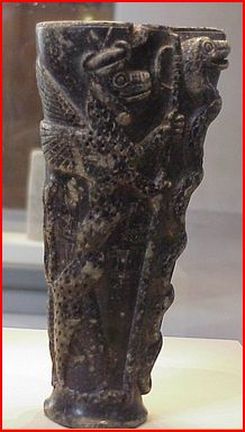
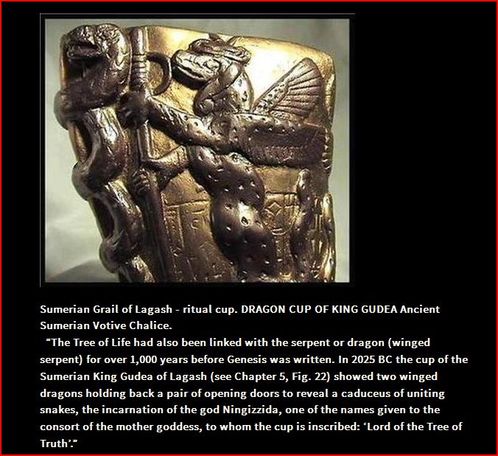
UR-Grail |
|
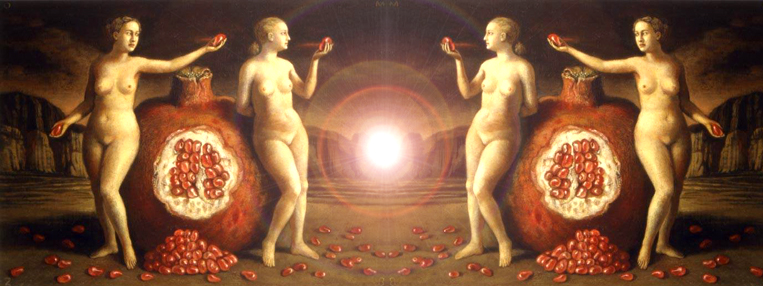
THE COLOR OF POMEGRANATES
“Your
shoots are an orchard of pomegranates with pleasant fruits, henna
and nard.” --Song
of Songs, The Bible
"The pomegranate is
the mystic fruit of the Eleusinian rites; by eating it, Prosperine bound
herself to the realms of Pluto. The fruit here signifies the sensuous life
which, once tasted, temporarily deprives man of immortality."
--Manly
Palmer Hall, Secret Teachings of All Ages
Womb of Mother Earth
We travel backwards to
the Garden of Pomegranates in the Garden of the Well of Living Waters. Many
believe it was the true forbidden fruit in the garden of Eden.
Multiple seeds reflect
the progeny of a bloodline; red-gold apples can be interchanged for
pomegranates with their serrated calyx 'crown.'
Pomegranate
symbolizes life and acquired many cultic roles. It translates as apple with many
seeds; thus, the pomegranate symbol invites the planting of seeds. Mother is
everything that has been. Father is everything that will be. They manifest now.
The pre-natal belly swells like a pomegranate.
Creative Core
A rich set of symbols
is associated with the Tree of Life and Family Tree. Myth is allegorical and
symbolic. Our ancestors venerated the pomegranate as long ago as 4000 B.C.E. or
even earlier by the shadows of forgotten ancestors. Pomegranate is the badge
of The Feminine for Hebrews, Eleusis, Plantagenets, Rosicrucians,
royalty, Kabbalists, Gnostics, Freemasons, and other ritual rebirth unions of
male and female as a paranormal remedy for longevity, hope and blessing of
numerous progeny.
Blood of Life
Pomegranate flowers,
seed, and juice are red like blood, denoting the fruit which symbolized the
sephirah of the Tree of Life glyph and the glands of the female body in the
sacred chemical wedding in the Garden of Love. The the pomegranate wine of The
Triple Goddess, Demeter/Persephone, Cybele, Ishtar, Mary, and Hera denotes a
lineal descent of living goddesses and their sensual, cyclic sexual, and
menstrual symbolism.
Rasa, or
taste, refers to the Tantric synonyms for semen (serpent-dragons) and mercury.
Womb Blood of the
Grail
The pomegranate or
Vase is the initiatic center of the mandala -- female genital symbols. Beer
mixed with rejuvenating pomegranate juice resembled blood. In the myth of
Persephone and the pomegranate, the initiate must enter Hel or the Underworld
to draw the wine of the fruit of life from her. She lost her innocence and
became guardian of underworld secrets and a soul guide.
This unconscious inner
world hides our undeveloped potential and individual destiny we glimpse in
shadowy dreams and intuition. Transcending ambivalence and depression, we can
draw from this deep source -- the mysterious rhythms of natural law working in
the depths of the soul as primal life force.
House of Pomegranates
Persephone's "burial and resurrection" turns the whole process
into a meaningful cyclic ritual. Individualized consciousness assimilates the
experience of mankind's common roots, the instincts of the collective
unconscious, but returns to the day world at the summons of the Spirit. She now
guides others.
Demeter/Persephone expresses the mystery of mother and daughters--"my Mother, myself"--which
is a union of sames, unto 15 generations of mitochondrial DNA. Marion Woodman
notes, "Ultimately,
the feminine mysteries have to do with the sanctification of matter, and being
aware of ourselves and others as human beings in the reality of the moment."
Fruit of the Earth
Demeter is Persephone in her renascent form. Modern women experience this
force in the continuity of generations. The uterine or matrilinear line extends
back to one's grandmother and mother, and forward in one's daughters. Sons are
distinctly other, as our fathers are. There is an essential blood-bond
between female members of a family who share the mystery of the generation of
life from their own substance.
In Gaelic pomegranate
juice is called dergflaith, the red beer of the queen of
sovereignty -- cosmic conduit of the holy grail, the Tau womb of goddess Nut --
intimate space. The common name for
abstract self-externality is Space, but Absolute Space is imminent -- the
universe inside you, the root of our Being.
The Shining Mirror
The Royal Secret is
that we each have the same opposites, such as: good and evil, virtue and vice,
life and death within us. Our task is to reconcile those parallel forces to
become the Middle Pillar.
Symbolizing the
polarity of opposites to be united, the entrance of sacred and mysterious
places is traditionally guarded by two pillars. The Druids believed trees where
gateways to other worlds. In art or architecture, twin pillars represent an
archetypal gateway or passage towards the unknown, sacred, and otherworldly.
The palm-headed Pillars of the Temple before the door are topped with
pomegranates, reflecting the spheres of The Tree of Life, as on The High
Priestess trump.
Theseus, like Orpheus,
must travel through a subterranean realm to find his love and, like the
mistletoe bard, at the center of Hades he will win the Chalice of Persephone’s
pomegranate wine. Theseus decides to tackle the Minotaur and armed with a sword
given him by Ariadne he enters the labyrinth with a golden thread tied about
his waist.
Goddess of Easy
Delivery, Giver & Guardian of Children
Ancient Egyptians
regarded the pomegranate as a symbol of prosperity and ambition. For the Jews
it was a symbol of righteousness and the indissolubility of marriage. In
Ancient Greek mythology, the pomegranate was the "fruit of the dead,"
seal of fate, or gift of love and passion.
Pomegranate was known
as the Tree of Hera. This goddess of fecundity renews her uterine fertility in
the river at the new moon. The powerful wife archetype has marriage and
fidelity as its goal, meaning, and identity.
Layered meanings are
like rows of pomegranate seeds. The feminine path implies self-compassion,
embodied relationships, and contemporary mysteries of the feminine. Blood
mysteries, personal myths, and lived experiences flow through feminine
consciousness and transformation into the sacred sanctuary of
woman's deepest
instinctual source.
Natural Cycles,
Rebirth, and Renewal
In Aryan myth,
pomegranate is Punica
granitum, a
Vedic fertility symbol. Daalom Gaach, Dadima is a term for wise old women in
India as well as the plant, so both are called 'grandmother.' Punica granatum (Punicaceae) has DMT in its root
cortex. A substantial body of mythology in India connects the pomegranate
with various mother goddesses and the hoama or soma drink. Very few plants and
trees are named outright in Rig Veda.
Secrets
& Symbolism of Nature
Nature pervades our
Consciousness & Infuses our Actions
Perhaps this is the
Queen to the King Soma as a goddess that evolved to be called Mahadevi or Kali
who are both often iconically associated with dwelling in or holding
pomegranates. The chambered pomegranate also refers to the poppy's narcotic
capsule, with its comparable shape and chambered interior. Pomegranate plays a
distinct role in the herbo-metallic Tibetan Tantric Buddhist Jewel pills that
at once spiritually empower and heal.
Soul Made Visible as
Authentic Self
Pomegranate re-emerges
and continues to be used in alchemy. Pomegranate carpets express a longing for
the mythical original garden -- an experience which can be shared by different
generations that creates a bridge, a commonality of feeling and a spiritual
affinity.
Biting into its fruit means to invoke the
eye of intuition, to discern what is true and what is false.
In “A Garden of Pomegranates,” Israel Regardie states of
Da’ath (pg. 103): “Some Qabalists postulate a Sephirah named Da’ath, or
“Knowledge.” As being the child of Binah and Chokmah, or a sublimation of the
Ruach, supposed to appear in the Abyss in the course of man’s evolutions as an
evolved faculty. It is a false Sephirah, however, and the Sepher Yetzirah in
anticipation, most emphatically warns us that “Ten are the ineffable Sephiroth.
Ten and not nine. Ten and not eleven. Understand with Wisdom, and apprehend
with care.” It is a non-existent Sephirah because, for one thing, Knowledge
when examined contains within itself – as the progeny of Ruach – the same
element of contradiction, and being situate in the Abyss, dispersion and so of
self-destruction. It is false, because as soon as Knowledge is Critically and
Logically Analyzed, it breaks up into the dust and sand of the Abyss. The Unity
of the various faculties mentioned, however, comprises the Ruach, which is
called the Human Soul.”
The Ecstatic School
The source of our body
is the ground; Neshamah, the breath of life and source of spirit, is the
element that forms the human spirit. Union
on the four planes, including the Neshamah, or glorious body is experience of
the true intellect emerging from the source of life - well-spring of
intelligence awe, wisdom, and understanding. This unique life potential is the
bridge between human and divine that serves creation and life in the world by
providing it with substance forming light, creating darkness, and making in the
middle.
Love, Judgment &
Mercy
The mystic creates this
integrated subtle body by concentrating attention at the eye center. The energy
normally is flowing outward into the senses or world. It must be
withdrawn or made to 'flow backward'. This is the 'death" of the senses.
Then comes the eternal moment of enlightenment when thoughts cease. This is the
"death of the mind." The aspirant is "reborn" when
his attention goes sin and the radiant Light is perceived. They merge with this
Light in enlightenment of the causal level. The causal body is formed by the
fixation and crystallization of this living Light. --Iona Miller, Holistic Qabala, 1976
Divine Presence
Planting an Anar Tree
(Pomegranate) in your house alludes to the 'royal wedding' or coniunctio, a recollection of the divine form
in its unitive aspect. The most powerful
sexual rite, of re-integration, requires intercourse with the female partner
when she is menstruating. Her 'red' sexual energy and purely spiritual
fecundity is at its peak for the physical/spiritual union achieved during
Tantric Yoga -- a symbol of the repetitive cycle of material birth/rebirth.
Fertility,
Generosity & Rebirth
In art it alludes to
the beauty and exuberance of the vagina, vesica, lotus, jewel, or 'boat of
heaven', but it specifically represents the ovary and ova cells. The Great
Goddess always had snakes entwined around her to represent birth, regeneration,
and overall protection."The snake is endless time," says Jung,
(Meetings with Jung, Page 303). Apples, cherries, and pomegranates symbolized
the Virgin Goddess: bearing her sacred blood color and bearing its seed within,
like a womb.
On a Mycenaean seal
illustrated in Joseph Campbell's
Occidental Mythology 1964, figure 19, the seated Goddess of the double-headed
axe (the labrys)
offers three poppy pods in her right hand and supports her breast with her
left. She embodies both aspects of the dual goddess, life-giving and
death-dealing at once. The Titan Orion
was represented as "marrying" Side,
a name that in Boeotia means "pomegranate", thus consecrating the
primal hunter to the Goddess. Other Greek dialects call the pomegranate rhoa;
its possible connection with the name of the earth goddess Rhea.
Polycleitus sculpted
Hera in her temple, with a scepter in one hand and a pomegranate orb in the
other. She wears the calyx of the pomegranate as her serrated crown. The
Madonna del Granato, "Our Lady of the Pomegranate", must be the
Christian successor of the ancient Greek goddess Hera, as her epithet suggests.
Red-Stain
Metaphor
The
name pomegranate derives from medieval Latin pōmum "apple" and
grānātum "seeded". Perhaps stemming from the old French
word for the fruit, pomme-grenade, the pomegranate was known in early English
as "apple of Grenada"—a term which today survives only in heraldic
blazons. The Latin granatus sounds like the Spanish city of Granada, which
derives from Arabic.
The Phoenician
priesthood of the Cabiri from Crete claimed the meaning of the
pomegranate was "the forbidden secret." Pausanias declared,
"About the pomegranate I must say nothing, for its story is somewhat of a
holy mystery."
Jung's Garden of
Pomegranates
“I myself was, so it seemed, in the
Pardes Rimmonim, the garden of pomegranates, and the wedding of Tifereth with
Malchuth was taking place. Or else I was Rabbi Simon ben Jochai, whose wedding
in the afterlife was being celebrated. It was the mystic marriage as it appears
in the Cabbalistic tradition. I cannot tell you how wonderful it was. I could
only think continually, “Now this is the garden of pomegranates! Now this is
the marriage of Malchuth with Tifereth!” I do not know exactly what part I played
in it. At bottom it was I myself: I was the marriage. And my beatitude was that
of a blissful wedding.”
--Jung, 1961, p. 294
References
https://en.wikipedia.org/wiki/Pomegranate
The Assyrian Tree of
Life: Tracing the Origins of Jewish Monotheism and Greek Philosophy by Simo
Parpola, Journal of Near Eastern Studies, Vol. 52, No. 3, pp. 161-208
(1993)
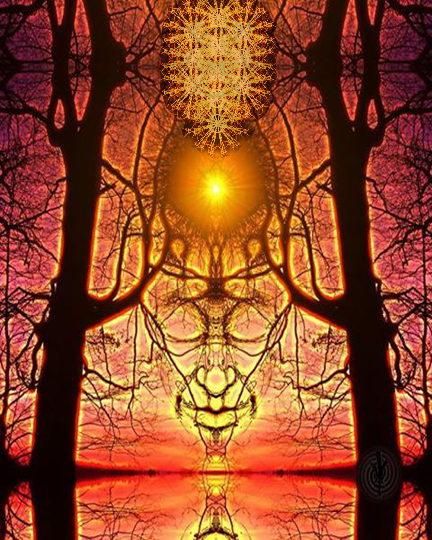
The
Tree of Life is Simplified Man;
And Man is the Simplified Cosmic Tree
In
every adult there lurks a child--an eternal child, something that is always
becoming, is never completed, and calls for unceasing care, attention, and
education. That is the part of the personality which wants to develop and
become whole. -C. G. Jung CW 17, Page 286
How
does psychology define this inner dynamic which guides the process of
individuation, leading toward the goal of wholeness? In Jungian Psychology,
this symbol-forming power of the psyche is called the transcendent function.
Before the transforming power of the higher Self is perceived in imagination
(personified through one's Angel, Guide, or Guru), it is known as a
symbol-forming function.
Whatever man’s
wholeness, or the self, may mean per se, empirically it is an image of the goal
of life spontaneously produced by the unconscious, irrespective of the wishes
and fears of the conscious mind. ~Carl Jung, CW 11, Para 745.
Its purpose is to
mediate between that which is unknown and that which is manifest. It performs
its function by creating unifying symbols from pairs of opposites. In this
manner, it gradually unites the fragments of psychic life. It creates a series
of symbols which transfer consciousness to a higher perspective or awareness by
reconciling opposites.
By synthesizing pairs
of opposites into a symbol, the transcendent mode creates a method of transition
from one set of attitudes to the next. An individual ego may work more
effectively with subconscious processes by consciously attaching value to
these symbols presented by the transcendent function.
The process of energy which produces the union of the opposites
in this case is the human personality which is the carrier of consciousness. ~Carl Jung, Modern Psychology, Vol. 1, Pages 71-72.
Our task is to
discover these transpersonal meanings, whether they are presented to us through
dreams, attitudes, or behavior patterns. If the meaning were consciously
understood, it would not be presented as a symbol. Therefore, once its meaning
is realized over a period of time, another symbol appears to take its place,
reflecting the new situation.
The
transcendent function (seen as one's Inner Guide, Angel, or Guru), embodies the
transmuting power of the symbol. The personification of the higher Self allows
us to take up a relationship with the inner Self, and encourages dialogue and
the development of feelings of loving devotion for this inner friend.
All the symbols and
archetypal figures in which the transformative process is embodied are vehicles
of the transcendent function. It is the union of different pairs of
psychological opposites (like male/female, good/evil, Sol/Luna) in a synthesis
which transcends them both.
The uniting symbol
only appears when the inner psychic life is experienced as just as valid,
effective, and psychologically "real" as the world of daily life.
Fantasy animates both our inner and outer "realities." This is why
mystics call time, space, and the ego three great illusions.
The transcendent
function, or Inner Guide, restores the balance between the ego and the
unconscious. It belongs to neither, yet possesses access to each. It forms a
bridge for the soul to ascend, by lying in-between and participating in both
inner and outer life. By relating to each independently, it unites ego and the
unconscious.
The first glimmerings
of "Knowledge and Conversation" with one's Angel are very similar to
the descriptions of "peak experience" developed by Abraham Maslow. A
peak experience is the result of the drive of the spirit in search of itself.
The experience is self-validating, self-justified and has intrinsic value of a
unique nature for each individual.
There is an intense
experience of the nearness of God, or divinity. This is the first state of
grace, or mind-expansion. It is a response experience where one feels a sense
of Presence. The true mystic takes this experience as his point-of-departure,
and grows in grace from it. The poet or artist uses this recurrent experience
as a basis for artistic production (or inspiration) and personal euphoria.
When the contact is
stabilized, the Guide can take the Soul up to the heights of mystic rapture. A
by-product of this contact is that the adept may consult at will with his guide
for directions in any matter. Images of the Self appear spontaneously
throughout the entire transformative process. It appears in all symbols from
the highest to the lowest.
At the beginning of
the great work it appears in animal forms such as snakes, birds, fish, horses,
or beetles. It shows through the plant forms of flowers and tree symbolism,
sacred geometry, then symbols of the Self in human form.
--Iona
Miller, The Modern Alchemist
" oh what a
disaster, such as mutilation of love is when this is reduced to a mere personal
feeling, detached from the rising and setting of the sun, and isolated from the
magical report of the solstice and equinox! Our roots are bleeding because we
severed from the earth and the sun and the stars, and the love is nothing but a
ridiculous parody since, poor flower, we have been disconnected from the tree
of life and we think we can keep it alive in our civilized Vase on the table."
--D.H.Lawrence
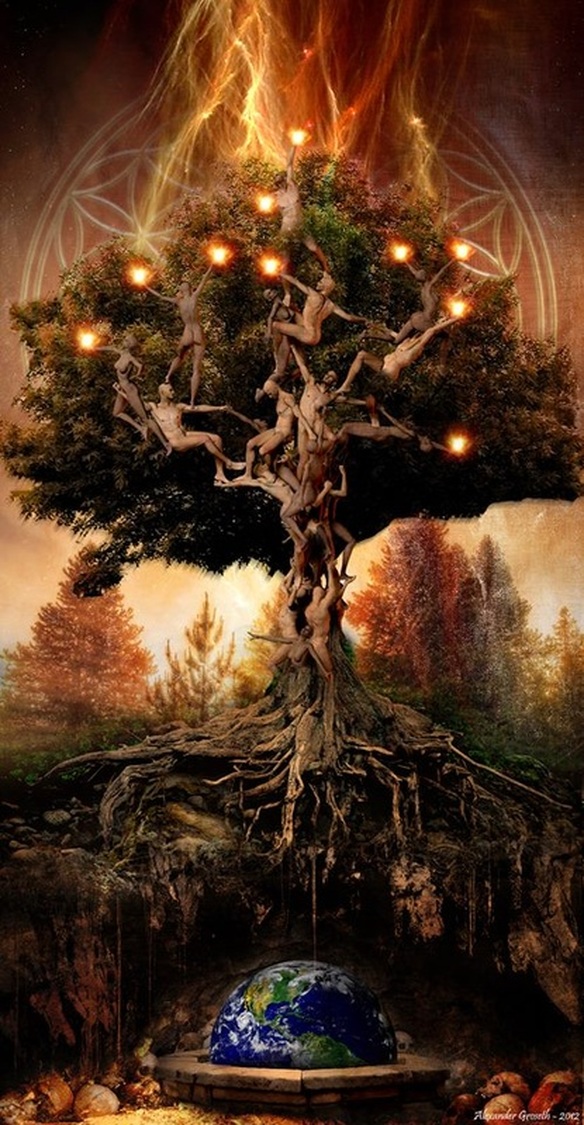
In
the history of symbols this tree is described as the way of life itself, a
growing into that which eternally is and does not change; which springs from
the union of opposites and, by its eternal presence, also makes that union
possible.
~Carl Jung, CW 9i,
Para 198
BE LONGING
ACCESSING THE
EXCEPTIONAL IN YOUR FAMILY TREE
Intensified Awareness of Your Ancestors
by Iona Miller, 2016
The souls or spirits
of the dead are identical with the psychic activity of the living; they merely
continue it.
~Carl
Jung, CW 9i, Para 38
Every
life is many days, day after day. We walk through ourselves, meeting robbers,
ghosts, giants, old men, young men, wives, widows, brothers-in-law. But always
meeting ourselves.” ―James Joyce, Ulysses
“Where are we
really going? Always home.”
―Novalis
Life is born only of
the spark of opposites.
~Carl Jung, CW 7, Para
78
You begin to have a
presentiment of the whole when you embrace your opposite principle, since the
whole belongs to both principles, which grow from one root. ~Carl Jung, The Red
Book, LN 248
The fact that
individual consciousness means separation and opposition is something that man
has experienced countless times in his long history.
~Carl Jung, CW 10,
Para 290
The soul demands your
folly; not your wisdom.
~Carl Jung, The Red
Book, Page 264
For when the soul
vanished at death, it was not lost; in that other world it formed the living
counterpole to the state of death in this world.
~Carl Jung, CW 16,
Para 493
Thus your soul is
your own self in the spiritual world.
As the abode of the
spirits, however, the spiritual world is also an outer world.
~Carl Jung, The Red
Book, Page 288.
For the conscious mind
knows nothing beyond the opposites and, as a result,
has no knowledge of the
thing that unites them. ~Carl
Jung, CW 9i, Para 285
An opus is needed,
that one can squander decades on, and do it out of necessity I must catch up
with a piece of the Middle Ages. ~Jung, The Red Book, Page 354.
You must be in the
middle of life, surrounded by death on all sides.
~Carl Jung, The Red
Book, Page 370.
The unconscious is the
only available source of religious experience.
~Carl Jung, CW 10, Para
289
Complimentarian Self
You begin to have a
presentiment of the whole when you embrace your opposite principle, since the
whole belongs to both principles, which grow from one root. ~Carl Jung, The Red Book, LN 248
First: these
qualities are differentiated and separate in us; therefore they do not cancel
each other out, but are effective. Thus we are the victims of the pairs of
opposites. The Pleroma is rent within us. ~Carl Jung, The Red Book, Page
348.
Many ancient cultures
depict a divine being, a central figure, a forward-facing male or female figure
with outstretched hands holding a pair of identical symbols (animals, staffs,
scepters, etc.). These symbolic objects represent opposing principles,
including conscious and unconscious -- the co-existence of contradictory
essences in human reality. They can result in a third thing like the offspring
of male and female, like the in and out breath that creates life.
Being & Nonbeing
Opposites have central
significance in genealogy. The unity of opposites occurs in the coinciding of
opposites at any time and place in history by means of sacred rituals,
including genealogy. Our
whole genealogy is made of pairs of opposites. We are not always necessarily
aware we are performing a ritual or know the thought behind our myth. That is,
we are not always aware of the implications of the coincidentia oppositorum in the myth or ritual.
"As the power
of being, being-itself cannot have a beginning and an end. Otherwise it would
have arisen out of non-being. But nonbeing is literally nothing except in
relation to being. Being precedes nonbeing in ontological validity...Being is
the beginning without a beginning, the end without an end. It is its own
beginning and end, the initial power of everything that is. However, everything
which participates in the power of being is 'mixed' with nonbeing. It is finite." --Paul Tillich, SYSTEMATIC
THEOLOGY, Vol. I, U. of Chicago Press, 1951, pp. 188-189.
But we can transcend
them by learning to hold the tensions between the opposites inherent in the
human condition. We experience the same oppositions, but not as
such. The unity of the
sacred is experienced instead. The two modes of being exist paradoxically. The
wholeness of the sacred is experienced as mutual coexistence in the temporal
human condition. An integral part of all reality or sacrality,
oppositions and tensions of reality harmonize into a unity or a "mystery
of totality" -- psyche as sacrament in a fully inhabited life.
What a thinker does not
think he believes does not exist, and what one who feels does not feel he
believes does not exist. You begin to have a presentiment of the whole when you
embrace your opposite principle, since the whole belongs to both principles,
which grow from one root. ~Jung and Elijah, Liber Novus, Page 248.
Much has been made in
recent years of the power of Presence in the Here and Now, but perhaps our
HERE/NOW awareness can be used to violate energy conservation. We might think
that moments when we are fully present would be more powerful. But flights of
spiritual or religious ecstasy take us out of ourselves, beyond our
ordinary boundaries of being and perception.
Nonetheless, when the
time dimension collapses in non-ordinary awareness, we are still a
consciousness present in some manner at a particular time and space, while
simultaneously connected in a peculiar way to the ground of being.
Perhaps there is a
third Zen-like quantity or Observer Self that also needs to be present to break
Time/space symmetry. Then concurrently maximizing all three variables becomes
maximally conducive to producing transformative experiences.
For example, during
meditation, activity in the parietal lobe slows down processing sensory
information about the surrounding world, orienting us in time and space.
Those on the inner
journey attest to phenomena such as, "being laid out, flattened into
Earth, body and mind completely separate with no control over the physical, but
more concentrated awareness than if being fully grounded in body... In those
moments, the concentration of energy into mind and spirit [beyond] the
limitations of physical suffering ("body" is burden and blessing)
allow for the manifestation of clearer thoughts, creating a more focused reality.
The reality may only be experienced by the individual self in the immediate
moment, and thoughts may take time to come to physical fruition. But in such a
truly prescient time we may be able to consciously co-create the reality of our
choosing."
Primeval Ground of
Being
"We are here
face to face with the very old symbolism of the coincidentia oppositorum,
universally wide spread, well attested in primitive stages of culture, and
which served more or less to define both the fundamental reality (the
Urgrund, primal cause or ultimate cosmic
principle; original archetype), and the paradoxical state of the totality,
the perfection and consequently the sacredness of God," Mircea Eliade
claims.
Jung called this the coincidentia oppositorum, central to the meaning of paradigm,
paradox and the structure of reality. Archetypal opposites include the
pro-historical and anti-historical.
We seek meaning in the
transhistorical, the transgenerational. The dualities remain the same across
time: unconscious dynamics of good and evil, light and dark, male and female,
sun and moon, sacred and profane, chthonic (earth underworld) and pneumatic
(airy, upper world), pleasure and pain, sympathetic and parasympathetic nervous
system.
The sacred figure
depicts the hero/sage combining two opposing principles to create a spiritual
balance -- our divine nature. This principle involves family, the community,
the nation, the environment, and god, embracing all aspects of existence,
including a moral imperative, the basic equilibrium of the universe and the
weighing of the heart in the afterlife.
This balance or
centeredness opens new doors of perception. In ancient Egypt this ruling
principle was called Ma'at, the concept of truth, balance, order, harmony, law,
morality, and justice. Ma'at regulated the stars, seasons, and the actions of
both mortals and the deities, who set the order of the universe from chaos at
the moment of creation.
In the moment of
transformation we realize the effulgence of meaning in the plurality of common
life. We
don't forget ourselves when we partake of cosmic myth or ritual; we find or
remember ourselves in larger realities of our own being.
"Hence man's
situation in existence is depicted in the tension between his experience of his
essential self and his existential distance and alienation from it. Tillich
believes that man cannot destroy the groundedness of his essential being in
God, but neither can he regain it or confer it upon himself...The movement
towards or back to the essential...is still the basic movement of life..."
Jung speaks of this
process as one of coming into a fuller or more compendious personality through
the progressive integration of the unconscious, but like Tillich he believes
that man can neither reject this movement in his life with impunity nor bring
it to a definitive completion within a lifetime.
--John
P. Dourley, The Psyche as Sacrament: A Comparative Study of C.G. Jung and Paul
Tillich, Inner City Books, 1981, p. 56.
The sacred dimension
is realized in opposition to and harmony with ordinary existence.
In Tantra, there is a
’’rupture of planes," the unification of the two polar principles (Siva
and Sakti). The transcending of all opposites is the union of polarities
without and within the body in a coincidence of time and eternity.
We are of the same
substance; our paradoxical I/Self awareness is the difference. The symmetrical balance of duality
is the icon of centeredness. The mind is a “difference-seeker” -- a pattern
recognizer that helps us order and navigate the overwhelming complexity of
reality. But this gift also creates blind spots and biases, as we fill in what
we don’t know with our limited knowing.
“The universe is a
complete unique entity. Everything and everyone is bound together with some
invisible strings. Do not break anyone’s heart; do not look down on weaker than
you. One’s sorrow at the other side of the world can make the entire world
suffer; one’s happiness can make the entire world smile.” ―Shams Tabrizi
Our primitive origins
link mythological thinking to our lineage and modern disciplines, connecting us
to our inherent cultural roots from which we have been dangerously estranged.
In Egypt, the
primordial couple was Isis and Osiris. Isis is the ancient Egyptian goddess of
magic, fertility and motherhood, and death, healing and rebirth.
The tension between above
and below in ancient Egypt is in my opinion the real source of the Near Eastern
saviour figures, whose patriarch is Osiris.
He is also the source of
the idea of an individual (immortal) soul. ("The Osiris of N. N.")
The purpose of nearly all rebirth rites is to unite the above with the below.
The baptism in the Jordan
is an eloquent example: water below, Holy Ghost above. --Carl Jung, Letters Vol. I, Pages 259-261
One of the oldest
gods, Osiris was the God of the Dead and Vegetation. He is also called in
various names and spelling such as Usiris, Oser, Usire, Asar, Aser, Ausar,
Ausir, Wesir or Ausare and usually referred as god of Afterlife. He rules the
underworld, and is god of resurrection to eternal life, protector, and
vegetation.
The ankh or the ´nh in
ancient Egyptian hieroglyphs represent life and signify “the breath of life”,
and reproductive organs. It is commonly found in the hands of the funerary
deities conferring the gift of afterlife into a mummy of a dead person.
Our breath goes from
the outside to the inside, from the inside to the outside of the body. It is a
Spirit that connects the life of the universe to the depths of the soul, not
separate from the cosmic breath. The breath eternally unites the earth to the
sky when we listen to our own calm breath.
The dead are often
referred to as the ankhu and the sarcophagus is known as the
neb-ankh or “the possessor of life.” Ankh as
key of life is often depicted with outstretched hands of the god-self holding
two staffs or scepters. It was created by ancient genius to express the past,
present and future. In timeless existence, time transforms into eternity in
awakened consciousness of the moment.
The scarab is a
classical rebirth symbol. According to the description in the ancient Egyptian
book Am-Tuat, the dead sun God transforms himself at the tenth station into
Khepri, the scarab, and as such mounts the barge at the twelfth station, which
raises the rejuvenated sun into the morning sky.
~Carl Jung, CW 8,
§843.
We can enrich, amplify
and verify our roots and the course of historical development by consciously
searching the deepest unconscious layers of psyche. If the unconscious is a
magical powerhouse that speaks in archetypes and symbols, our notion of the
unconscious is also a symbol of the power of the primordial field.
Our ancestor hunt is
an individual search in which we descend to our psychological depths to find
common human roots, renew and recreate ourselves, and come back with this
secret treasure of inherent meaning, having stirred both our breadth and the
unknown depths and a new sense of our Presence in the world and Cosmos.
Through this journey
we engender the 'eternal child,' our own rebirth and immortality.
As in yoga, we
discover spiritual balance by uniting opposites within the mindbody.
"Therefore a wise man does not want to be a charioteer, for he knows that
will and intention certainly attain goals but disturb the becoming of the
future." (Jung to his Ego, Liber Novus, Page 311.)
This unified field of
pure consciousness is therefore that one element in Nature on the ground of the
infinite variety of creation, continuously emerging, growing, and dissolving.
The whole field of temporal change emerges from this field of non-change, from
this self-referential, immortal state of consciousness.
Consciousness, ab origine, is intuitive. Primordial Awareness
is the groundstate of the human mindbody, seeing through illusion to primal
reality and emptiness. Uniting Above and Below, we mirror Transcendent
Consciousness.
The uninterrupted
narrative of self is embodied as short and longterm memory and genetic memory.
The Mystery level of consciousness or abyss of consciousness includes
prophetic intuition. An abyss of consciousness opens the way for intellectual
freedom as liberation from the outer limits and internal biological
determinism.
"Nor should we omit
to mention one final turn of the screw: like the devil who delights in
disguising himself as an angel of light, the inferior function secretly and
mischievously influences the superior function most of all, just as the latter
represses the former most strongly." ~Carl Jung, CW 9i, Para 431.
The natural cycle of
sympathetic and parasympathetic systems mediates cycles of arousal and calm,
implicated in hyperarousal and hypoarousal. They are mediated by the
neurotransmiters noradrenalin (norepinephrine) and serotonin. Such linked
systems exert "rein control."
Interhemispheric
balancing mediates the harmonization of the left and right hemispheres of the
brainmind -- fight-flight-freeze responses, and pain-pleasure cycles.
Chemically related cycles of addiction and inflation, desire, acting out,
guilt, remorse, high well-being, self-acceptance, and self-esteem reflect psychological
and physiological paradox. Meditative and exalted states are the extremes.
The
unconscious is useless without the human mind. It always seeks its collective
purposes and never your individual destiny. Your destiny is the result of the
collaboration between the conscious and the unconscious. --Jung
Letters, vol. 1, p. 283.
Archetypes are images in
the soul that represent the course of one's life.
--Jung, Conversations
with CG Jung, Archetypes, pg 21.
The brokennesss of
life contrasts with the redemption we feel in our lives. By bearing the
opposites, we expose ourselves to life in our humanity, according to Jung. We
have to battle through our not-knowing to find our way on the strength of
personal experiences and insights.
|
|
|
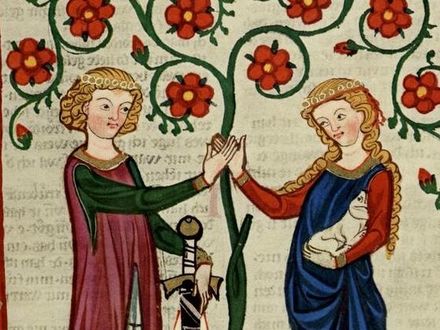
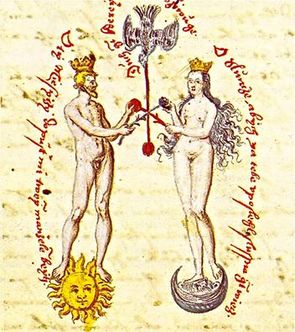
Inner
Marriage
Symbolized in the
alchemical Rebis or the Hermaprodite, the paradox of creative opposites is a coniuntio, or royal wedding as shown in The Rosarium. Healing is a natural by-product of bridging the
unconscious depths with the conscious mind, illuminating our roots, instinctive
wholeness and primordial mind. Alchemy calls this union the Unus Mundus
"one world."
Spirit or energy
merges completely with soul or matter. In the mystical union of opposites,
spirit is represented by the Bridegroom as discarnate self and soul by the
Bride as incarnate self or matter -- giving birth to the divine self or
androgyne. It symbolizes wholeness -- the countless novel textures and
interdependencies of the different values of consciousness. Meaning terms only
have reality only in human consciousness. Human consciousness makes meaning
with divine unconsciousness.
Transformational
Understanding & Integration
If both “being” and
“non-being” are illusory concepts, the truth exists beyond that dual state…
beyond the rational. We may mistakenly identify with “present conscious
experience.” In this perspective things either are or aren’t. But a
non-dualistic state-space of possible experiences is the broader frame of
expanded awareness.
The "maternal
darkness" compensates "paternal light,"
so light and dark are
made one in the transcendent symbol.
“The
hermaphrodite means nothing less than a union of the strongest and most
striking opposites… The primordial idea has become a symbol of the creative
union of opposites, “uniting symbol” in the literal sense.”. . . .“…a symbol
of the unity of personality, a symbol of the self, where the war of opposites
finds peace. In this way the primordial being becomes the distant goal of man’s
self-development.” --Jung, CW 9i, para. 292-4.
On a personal level
this means this reuniting of spirit, soul, and body indicates a full knowledge
of both the heights and depths of one's character. When the hieros gamos is consummated in our daily lives,
it means that we have learned to apply our insights in practice.
The Mysterium showed me
the things which lay before me and had to be fulfilled. … What happened was my
wandering with myself, through whose suffering
I had to earn what served
for the completion of the Mysterium I had seen.
~Carl Jung, The Red Book,
Page 255.
If you look into
yourselves, you will see … the nearby as far-off and infinite,
since the world of the
inner is as infinite as the world of the outer.
~Carl Jung, The Red Book,
Page 264.
The queen symbolizes
the body, the king stands for the spirit, while the soul unites the two. So,
our psyche is a half bodily and half spiritual substance. When king and queen
(animus/anima) are united, they form a magical hermaphroditic being which
unites opposite energies in the glorified body.
|
|
|
You
should be the vessel and womb of life, therefore I shall purify you.
~Carl Jung to his Ego,
Liber Novus, Page 330.
The “eternal” child in
man is an indescribable experience, an incongruity, a handicap, and a divine
prerogative; an imponderable that determines the ultimate worth or
worthlessness of a personality. ~Carl Jung, CW 9i, Para 300
To find out what is
truly individual in ourselves, profound reflection is needed; and suddenly we
realize how uncommonly difficult the discovery of individuality is. ~Carl Jung, CW 7, Para 242.
The urge and compulsion
to self-realization is a law of nature and thus of invincible power, even
though its effect, at the start, is insignificant and improbable. ~Carl Jung, CW 9i, Para 289
"All...Mysteries appear to come from
the same source, having a complete cosmogony and an explanation of the
primitive nature and origin of man. ...The Initiate was first subjected to
horrifying trials by darkness, fire and water, long fasts, visions, etc., and
if he surmounted these and remained sane, which many did not, he was received
among the priests."
--Inquire Within (A Ruling Chief of the Mother Temple of the Stella Matutina
and R.R. et A.C.), The Trail of the Serpent, p. 12 (1936)
The ego keeps its
integrity only if it does not identify with one of the opposites,
and if it understands
how to hold the balance between them.
~Carl Jung, CW 8, Para
425.
It is sufficiently
obvious that life, like any other process, has a beginning
and an end and that
every beginning is also the beginning of the end.
~Carl Jung, CW 7, Para
34.
From the middle of
life, only he who is willing to die with life remains living. ~Carl Jung, Liber Novus, Page 274,
Footnote 75.
But when we
penetrate the depths of the soul and when we try to understand its mysterious
life, we shall discern that death is not a meaningless end, the mere vanishing
into nothingness—it is an accomplishment, a ripe fruit on the tree of life.
~Carl Jung, CW 18, Para 1705-7
Death is a drawing
together of two worlds, not an end.
We are the bridge. ~Carl Jung, J.E.T., Page 95.
Take pains to waken the
dead.
Dig deep mines and throw
in sacrificial gifts,
so that they reach the
dead.
Reflect in good heart upon
evil, this is the way to the ascent.
But before the ascent,
everything is night and Hell.
~Carl Jung, The Red
Book, Page 244.
When you step into
your own Hell, never think that you come like one suffering in beauty; or as a
proud pariah, but you come like a stupid and curious fool and gaze in wonder at
the scraps that have fallen from your table.
~Carl Jung, Liber
Novus, Page 262.
The way to your beyond
leads through Hell and in fact through your own wholly particular Hell, whose
bottom consists of knee-deep rubble, whose air is the spent breath of millions,
whose -fires are dwarflike passions, and whose devils are chimerical
sign-boards.
~Carl Jung, Liber Novus, Page 262.
The deposit of
man’s whole ancestral experience—so rich in emotional imagery—of father,
mother, child, husband and wife, of the magic personality, of dangers to body and
soul, has exalted this group of archetypes into the supreme regulating
principles of religious and even of political life, in unconscious recognition
of their tremendous psychic power. ~Carl Jung, CW 8, Para 337
Childhood is important
not only because various warpings of instinct have their origin there, but
because this is the time when, terrifying or encouraging, those far-seeing
dreams and images appear before the soul of the child, shaping his whole
destiny, as well as those retrospective intuitions which reach back far beyond
the range of childhood experience into the life of our ancestors.
~Carl Jung, CW 8, Para
989-70)
·
- Metaphor and aesthetics
- Metaphor and performance
- Metaphor and affect
- Metaphor and embodiment
- Perceiving and understanding metaphor
- Metaphoric meaning making
- Narrativity, figuration and metaphor
- Metaphor and expression
- Metaphor and representation
- Metaphor and temporality
- Motifs, representations and metaphor
- Rhetorics and metaphor (sketching out a family picture of metaphor: metaphor, metonymy, oxymoron, synecdoche, simile etc.)
- Actions, applications and metaphor (e.g. art therapy, media pedagogy)
- Metaphor and creativity
- Multimodal metaphor (advertisement, comics, music, face-to-face communication including gesture with speech, film, television, video games etc.)
- Conceptual metaphor in media and the arts
- The symbolic expression of birth and prenatal consciousness can be found in art, mythology, and creative expression. Through clinical and empirical evidence our knowledge of the origins of awareness and memory is being pushed ever earlier. If pre- and perinatal experience affects personality, then we should see its tentacles in creative expression. Art flows from the deepest realms of the unconscious where the early roots of the human psyche are most active. As well, the creative act is often non-verbal which may be closely allied with the pre-verbal consciousness. Birth and prenatal experience which may not be readily accessed or discussed with the later developed language mind may be more aptly expressed with the non-verbal articulation of art. Throughout history natalistic images have often vividly depicted pre- and perinatal experience with no conscious recognition on the part of the creator of the early origin of the work. The similarity and commonality of these images is due to the universality of the environment of the womb and process of birth. Looking at meanings behind natalistic symbols found in art we can add a valuable resource for developing our understanding of pre- and perinatal issues in history, culture and personality.
- https://birthpsychology.com/journals/volume-4-issue-2/natalism-pre-and-perinatal-metaphor
ONE-SIDEDNESS
Jung’s definition of one-sidedness rests on his image of the structure of the psyche. Drawing on Heraclitus’ idea of the enantiodromia,[12] Jung envisioned the psyche as existing in an equilibrium between two poles. “Psychic processes … behave like a scale along which consciousness ‘slides.’ At one moment it finds itself in the vicinity of instinct,…; at another, it slides along to the other end where spirit predominates…”[13] and
“… everything rests on an inner polarity,… a pre-existing polarity, without which there could be no energy…”.[14] By “energy” Jung means “libido,” including all forms of psychic energy, rather than just the sexual energy of Freud.[15] As we go through life, Jung felt, this energy ideally is moving between the poles in a fluid, dynamic way. I say “ideally,” because many situations in life, as well as our personal preferences, innate qualities of temperament and our life history will influence the energetic flow, often causing it to get unbalanced or one-sided.
Jung used a variety of terms for one-sidedness, calling it a “defect,”[16] a “lack of moderation—bad measure in general,”[17] the result of repression,[18] a “mark of barbarism.”[19] But Jung also recognized that one-sidedness is “an unavoidable and necessary characteristic… an advantage and a drawback at the same time,”[20] and an “inevitable” feature of our conscious life, because consciousness “… is continually being corrected and compensated by the universal human being in us, whose goal is the ultimate integration of conscious and unconscious, or better, the assimilation of the ego to a wider personality.”[21]
So one-sidedness is something we all manifest as we go through life. It takes on negative coloration when it is carried too far, “… so far that the complementary opposite is lost sight of, and the blackness of the white, the evil of the good, the depth of the heights, and so on, is no longer seen, …”.[22] When we cling to persona stuff, or focus exclusively on sweetness and light, repressing all forms of shadow, we create a condition in which the inner dynamic flow gets stuck, and the equilibrium of libido is lost. In extreme cases, the result is a compulsion, which causes the libido to become “untamed” as it “streams off to one side,” becoming more daemonic the more the situation remains unbalanced.[23]
http://jungiancenter.org/jung-on-one-sidedness/
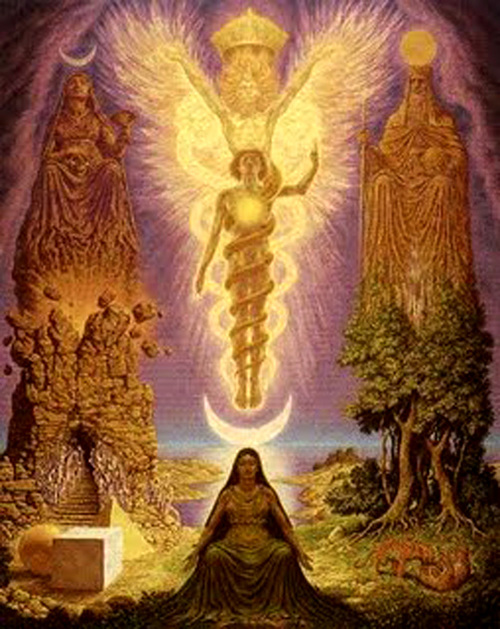
We
Must Live Our Own Vision
Intrinsic Meaning
But to have soul is
the whole venture of life, for soul is a life-giving daemon who plays his elfin
game above and below human existence, for which reason-in the realm of dogma he
is threatened and propitiated with superhuman punishments and blessings that go
far beyond the possible deserts of human
beings. ~Carl Jung, CW
9ii, Pages 26-27
In
Psychology Types (1923) Jung described intuition as "a perception of
realities which are not known to the conscious, and which goes via the
unconscious." Intuition, he said, is not merely a perception, but a
creative process with the capacity to inspire. The intellect requires intuition
to function at maximum performance, and dream symbols cannot be interpreted
without intuition and imagination.
But the way is my own
self my own life founded upon myself. The
God wants my life. He wants to go with me, sit at the table with me, work with
me. Above all he wants to be ever-present.
~Carl Jung, Liber Novus,
Page 292.
With
words you pull up the underworld.
Word,
the paltriest and the mightiest. In words the emptiness and the fullness flow
together. Hence the word is an image of God.
The
word is the greatest and the smallest that man created, just as what is created
through man is the greatest and the smallest.
~Carl Jung, Liber
Novus, Page 299.
The transcendent
function is not something one does oneself; it comes rather from experiencing
the conflict of opposites. ~Carl Jung, Letters Vol. I, Page 269
"Western man has no
need of more superiority over nature whether outside or inside. He has both in
an almost devilish perfection. What he lacks is conscious recognition of his
inferiority to the nature around him and within him. He must learn that he may
not do exactly as he wills. If he does not learn this, his own nature will
destroy him. He does not know that his own soul is rebelling against him in a
suicidal way."
--C. G. Jung (CW 11, par. 869-70)
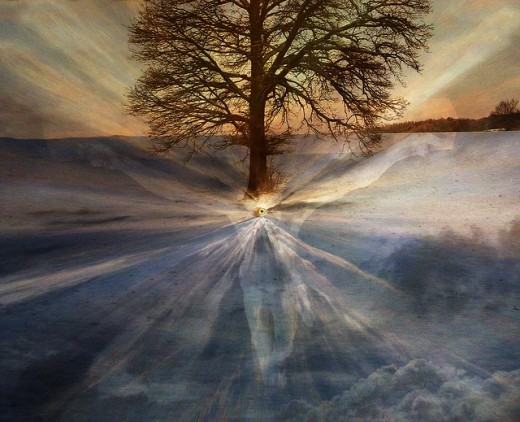
Your
Family Tree: Living
Presence in Spirit
IT EXISTS WITHOUT
SUBSTANCE
It's In Your Nature
Humans have always
been connected to trees, since our arboreal days. They speak to our soul as a
metaphor of Life.
The Tree of Life
represents creation.
We have 3.8 billion
years of successful ancestors behind us. That’s a lot of ancestors who
sacrificed for us.
Can we do any less?
Some are able to able
to tap into the consciousness of their relatives and ancestors. Many
have consciousness of relatives, ancestors, and historical personages,
sometimes during pregnancy.
Through sacrifice we
appreciate our ancestors' strength.
Our forebears honored select landforms, trees, plants,
and animals as their ancestors. They understood the deep wisdom in the rhythms
of the Earth. An infinite variety of life experience is stored by our fellow
creatures and by spirits. They
believed in mutual interdependence between these forms and humanity. We've
sought such reassurance since our ancestors first learned to anticipate the
future, including their own mortality.
It is a privilege and
gift just to be able to trace
the names of our
ancestors.
Experiential
Excursions
We can surround
ourselves with our ancestors by listening to their wisdom, deepening our
gratitude, reconnecting past and present, and passing on the blessings for
which we are responsible. There is no evolution, only nonlocal and nonlinear
co-evolution -- acting together throughout the universe. To know them is to
breath with them and listen deeply. To listen deeply is to connect to the sound
of deep calling to Deep. We call on it and it calls on us, moving with the
flowing current of life -- the quiet, still awareness of the deep spring in the
soul that makes us whole and gives us peace -- the deep presence of emotional
revisioning and completion.
Ours
is a shamanic journey back to meet our ancestors and discover the power of our
lineage. More than any defects we may have inherited, we need to travel back
discovering our inherited ancestral power. Working with the ancestors is
vitally important since we are the ancestors of future generations to
come.
"There
would be no hope for the world if we all continued to carry in us
hatred for the deeds
committed by our ancestors." --Stan Grof
"Like a rose that
is made of earth, air, water, sunlight, human care, and compost from the garbage,
the Buddha was made of this mother and father, his ancestors, his culture, he
was also made of suffering and joy. This is true of each of our lives."
--Joan Halifax
"Each of us is
influenced by 'history's hundred channels' which 'show' culture at work in the
channels of the soul. The land of the dead is the country of ancestors, and the
images who walk in on us are our ancestors.... They are the historical
progenitor, or archetypes, of our particular spirit informing it with ancestral
culture. So, perhaps less and emphasis on historical events and facts at this
juncture, and more on the nature of a historical sensibility imaginally kindled
that arouses one's soul within a larger fabric of meaning and intentions, can
assist us in reclaiming the ancestral imagination to allow for a fuller vision
of our place in historical time." --Harvesting Darkness, By Dennis Slattery
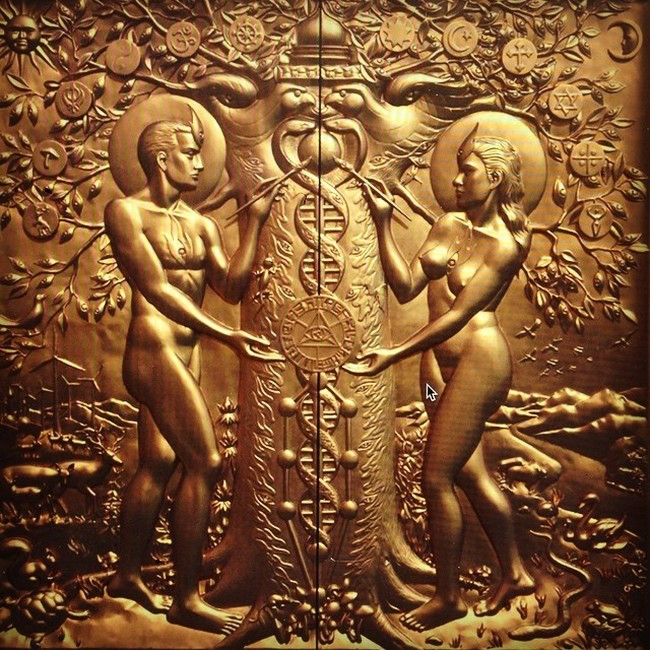
Alex Grey
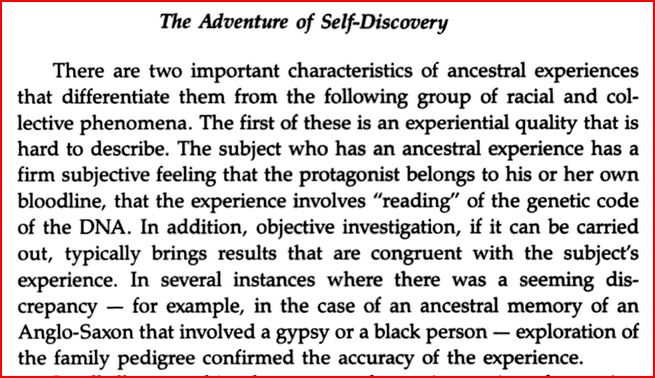
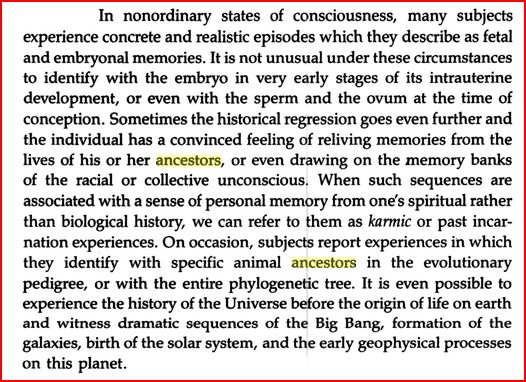
People
report reliving or observing episodes of the lives of their ancestors. In
non ordinary realities, you can identify with other forms, as you become those
people, animals, gods, ancestors, collective unconscious, mythological
archetypes.
"Transpersonal
experience often contain new accurate information about
other people, animals,
plants, life of our ancestors, historical periods and events,
and even mythological
beings and realms from various cultures of
the world. In many
instances, this information is very specific, transcends the subject’s
educational and cultural background. and its veracity can be confirmed by
independent research. I have described many examples of this kind in my book
When the Impossible
Happens."
"Careful
study of transpersonal experiences shows that they cannot be
explained as products
of pathological processes in the brain, but are ontologically
real. To distinguish
transpersonal experiences from imaginary products of
individual fantasy,
Jungian psychologists refer to this domain as imaginal.
French scholar,
philosopher, and mystic, Henri Corbin, who first used the term
mundus imaginalis,was inspired in this regard by his
study of Islamic mystical
literature (Corbin
2000). Islamic theosophers call the imaginal world, where
everything existing in
the sensory world has its analogue, ‘alam a mithal.’ ...The imaginal world
possesses extension and dimensions, forms and colors, but these are not
perceptible to our senses as they would be when they are properties of physical
objects. However, this realm is in every respect as fully ontologically real
and susceptible to consensual validation by other people as the material world
perceived."
"The
second category of transpersonal experiences is characterized primarily by
overcoming of temporal
rather than spatial boundaries, by transcendence of linear time. We have
already talked about the possibility of vivid reliving of important memories
from infancy and of the trauma of birth. This historical regression can
continue farther and involve authentic fetal and embryonal memories from
different periods of intrauterine life. It is not even unusual to experience,
on the level of cellular consciousness, full identification with the sperm and
the ovum at the time of conception."
"But the
historical regression does not stop here and it is possible to have experiences
from the lives of one's human or animal ancestors, or even those that seem to
be coming from the racial and collective unconscious as described by C. G. Jung
(Jung 1956, 1959). Quite frequently, the experiences that seem to be happening
in other cultures and historical periods are associated with a sense of
personal remembering; people then talk about reliving of memories from past
lives, from previous incarnations." --Stan Grof
Grof: The problems start when you go
further back, when, let’s say, you start having experiences of early embryonal
stage or I have a number of instances where people experience something from
the life of their ancestors or identify with their father at the time 15 years
before their conception.
Paulson: You’re saying
somehow that they can perceive this, something that happened to their own
parents.
Grof:
Yes and then you have this whole area of the Jungian collective unconscious
where you can evict experiences from human history, from different periods of
human history. Jung also talked about the archetypal collective unconscious
where we can experience mythology of other cultures that we have never studied
in this lifetime. So there we really get to the problem of where does that come
from.
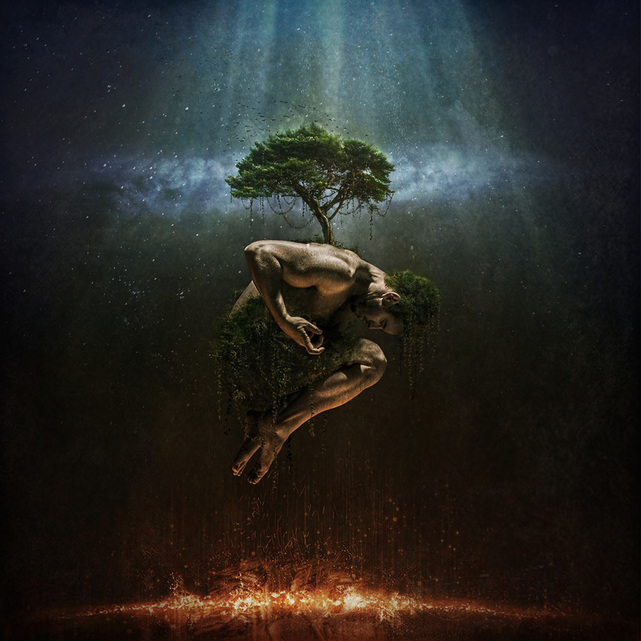
Tree Of Life by Robert Cornelius
GHOST WRITERS WITH LIVING EYES
Transpersonal Participation
& Comprehension
by Iona Miller, 2016
"Follow in the
footsteps of your ancestors, for the mind is trained through knowledge. Behold,
their words endure… follow their wise counsel."
--"The Book of
Kheti," The Husia: Sacred Wisdom of Ancient Egypt
And yet the
attainment of consciousness was the most precious fruit of the tree of
knowledge, the magical weapon which gave man victory over the earth, and which
we hope will give him a still greater victory over himself.
~Carl Jung, CW 10,
Para 289
The feeling of
immortality, it seems to me, has its origin in a peculiar feeling of extension
in space and time, and I am inclined to regard the deification rites in the
mysteries as a projection of this same psychic phenomenon.
~Carl Jung, CW 9i,
Para 248-249
It is only possible
to live the fullest life when we are in harmony with these symbols; wisdom is a
return to them. ~Carl Jung, CW 8, Para 794
“Why do you want to
trace your
ancestors?”
Your answer to this
question may change wildly over time as new options and opportunities arise
broadening your horizons and perceptions about the value of your
transgenerational inheritance.
Some ancestor-hunters
are merely curious. Some hope to find a famous or important relative, or join
historical societies. Others
want to know about their ethnic backgrounds and migration patterns., or simply
want an increased understanding of just who they are and where they came from.
A depth approach to
genealogy is not a question of our relation to the world.
It is an inner
problem, the question of what our relation to ourselves will be -- naked
awareness of our place in the cosmos, and our relations to the stars and the
elemental forces.
Terra Nostra
Genealogy can be
pursued in many domains. It can be done in the traditional socio-historical
manner, in the psycho-historical and psychospiritual dimensions of imagination,
myth, and legend. Participating in that process takes us on a journey to our
ancestral home, to the heart of our family tree. It isn't you who writes their
story; they have already doneso. But you write your own tale of discovery of
them that is unique for you, your qualities, and situation.
We learn to see our
individual lives as the convergence of all our ancestral experiences. We embody
their history, sense of purpose, what they loved and what they yearned for,
their triumphs and tragedies. In each of these is electric awareness of events
and emotions beyond your own. You come to understand yourselves and the story
of your ancestors.
With your next breath,
allow your awareness to drop down into your heart, relax
your breath and release your immediate environment as you enter sacred space
and approach your family tree and its members.
Open to your own
presence of being. Intensify your awareness and concentration; just let it
happen now. Welcome your ancestors, your fellow travelers, from the deep
fathoms of your awareness. Perception changes. They may see through your eyes
or you may see through theirs. Consciously hold the truth with compassion,
without fleeing, or fighting, fixing, or denying.
Make yourself
available to the in-forming flows...whatever arises in your field of awareness. Feel the ambient atmosphere and how the
earth feels around your body.
Embrace your roots and
the bones of the past as you settle into this new space. The relics of your
psyche are ready to transform with moisture and minerals. Allow this hunger --
the yearning to satisfy the highest in you -- to intensify and expand into a knowing all
through you.
Hunger for change,
feed on the truth, rock to the rhythms of this yearning. Undulate in the birthing dance,
where conscious flesh encircles all. When the earth permeates your
center, call on the cosmic transformative energies, on your ancestors, opening
to their vast experience and wisdom. The underworld and heavens meet -- the
source of life itself.
Life Is 'I Am What You
Are'
Rest in the matrix of
life and death; feel your center transmuting. The small self is dying as the
larger self washes over you, informing your being. Images emerge, unfurl, and
pass in an epic panoply, fertilizing new forms, not yet born. You move into something new -- the
living truth of who you are -- which now infuses your entire being.
The remnants of ancestral
trauma and unresolved hopes and dreams mesh with our own, descending with our
long lines of survivors. We are their legacy, wounds and all, and we are
challenged to make them conscious and carry them gracefully.
Reveal Thyself
Healing our ancestral
patterns means liberating some of our deepest unconscious issues, and freeing
creative energy. Reclaiming the ancestors is reclaiming the body, and
reclaiming the earth. The planet itself must be held as a gift which opens a
re-enchantment of the world...the Mysteries of the renewal of life.
The
utterances of the heart— unlike those of the discriminating intellect—always
relate to the whole. The heartstrings sing like an Aeolian harp only under the gentle
breath of a mood, an intuition, which does not drown the song but listens. What
the heart hears are the great, all-embracing things of life, the experiences
which we do not arrange ourselves but which happen to us.
~Carl Jung, CW 18, Para
1719
A circumambulation of
the magical circle of your lineage includes exploring and moving around our
sacred landscape from many different angles. That landscape imagines itself
through you. Their superposition is our aspiration. With them we live more
consciously. Those noble and otherwise ennoble our existence. We circle the
problems and images from many different ways with a depth perspective.
By circling a problem
we filter and distill it, getting to the essence. There is only
circumambulation rather than linear evolution. The essence of nature is
passion. Remembrance is pilgrimage and veneration. They gave birth to you and
now you bring them forth from yourself.
Our lines of descent
converge on themselves at the source, like the ouroboros serpent -- the
unbroken circle of familial descent. That circle is our home and refuge.
This is the attempt
at creating the magic circle again, by which she may be protected against the
influences of the world above and the world below.
She must keep in the
center in order not to be torn asunder.
~Carl Jung, Visions
Seminar, Page 819
*
Being that has soul
is living being.
Soul is the living
thing in man, that which lives of itself and causes life.
Therefore God breathed
into Adam a living breath, that he might live. With her cunning play of
illusions the soul lures into life the inertness of matter that does not want
to live. She makes us believe incredible things, that life may be lived. She is
full of snares and traps, in order that man should fall, should reach the
earth, entangle himself there, and stay caught, so that life should be lived;
as Eve in the garden of Eden could not rest content until she had convinced
Adam of the goodness of the forbidden apple.
Were it not for the
leaping and twinkling of the soul, man would rot away in his greatest passion,
idleness. A certain kind of reasonableness is its advocate, and a certain kind
of morality adds its blessing. But to have soul is the whole venture of life,
for soul is a life-giving daemon who plays his elfin game above and below human
existence, for which reason-in the realm of dogma he is threatened and
propitiated with superhuman punishments and blessings that go far beyond the
possible deserts of human beings.
Heaven and hell are the
fates meted out to the soul and not to civilized man, who in his nakedness and
timidity would have no idea of what to do with himself in a heavenly Jerusalem.
~Carl
Jung, CW 9ii, Pages 26-27
Disalliance with the
unconscious is synonymous with loss of instinct
and rootlessness. ~Carl Jung, CW 7, Para 195
Instinct is not only
biological, it is also, you might say, spiritual.
~Carl Jung, C.G. Jung
Speaking: Interviews and Encounters, Pages 410-423
Our instincts do not
express themselves only in our actions and reactions,
but also in the way we
formulate what we imagine.
~Carl Jung, C.G. Jung
Speaking: Interviews and Encounters, Pages 410-423
No one who has
undergone the process of assimilating the unconscious will deny that it gripped
his very vitals and changed him. ~Carl Jung, CW 7, Para 361
Complexes are in
truth the living units of the unconscious psyche, and it is only through them
that we are able to deduce its existence and its constitution.
~Carl Jung, CW 8, Para
210
Where the realm of the
complexes begins the freedom of the ego comes to an end, for complexes are
psychic agencies whose deepest nature is still unfathomed. ~Carl Jung, CW 8,
Para 216.
"The sad truth
is that man's real life consists of a complex and inexorable opposites - day
and night, birth and death, happiness and misery, good and evil. We are not
even sure that one will prevail against the other, that good will overcome
evil, or joy defeat pain. Life is a battleground. It always has been, and
always will be; and if it were not so, existence would come to an end."
--Jung, Man & His
Symbols, (p.73)
Consciousness is a
precondition of being. Thus the psyche is endowed with the dignity of a cosmic
principle, which philosophically and in fact gives it a position coequal with
the principle of physical being. The carrier of this consciousness is the
individual, who does not produce the psyche of his own volition but is, on the
contrary, preformed by it and nourished by the gradual awakening of consciousness
during childhood. If therefore the psyche is of overriding empirical
importance, so also is the individual, who is the only immediate manifestation
of the psyche. ~Carl Jung, CW 10, Para 528
Most people confuse
“self-knowledge” with knowledge of their conscious ego-personalities. Anyone
who has any ego-consciousness at all takes it for granted that he knows
himself. But the ego knows only its own contents, not the unconscious and its
contents. ~Carl Jung, CW 10, Para 491
The fact that individual
consciousness means separation and opposition is something that man has
experienced countless times in his long history. ~Carl Jung, CW 10, Para 290
There are plenty of
people who are not yet born.
They all seem to be here,
they walk about—but as a matter of fact, they are not yet born, because they
are behind a glass wall, they are in the womb.
~Carl Jung, Kundalini
Seminar, Page 28
Man “possesses” many
things which he has never acquired
but has inherited from his
ancestors.
~Carl Jung, CW 4, Para 728
The souls or spirits of
the dead are identical with the psychic activity of the living; they merely
continue it.
~Carl Jung, CW 9i, Para 38
Outward circumstances
are no substitute for inner experience.
Jung, Memories,
Dreams, Reflections, p.5
For as the son of his
father, he must, as if often the case with children, re-enact under unconscious
compulsion the unlived lives of his parents.
~Carl Jung, CW 6, Para
307v
Unlived life is a
destructive, irresistible force that works softly but inexorably. ~Carl Jung,
CW 10, Para 252
But besides that
[Intellect] there is a thinking in primordial images, in symbols which are
older than the historical man, which are inborn in him from the earliest times,
and, eternally living, outlasting all generations, still make up the groundwork
of the human psyche.
~Carl Jung, CW 8, Para 794
The meaning and purpose of
a problem seem to lie not in its solution but in our working at it incessantly. ~Carl Jung, CW 8, Para 771
The “absolute knowledge”
which is characteristic of synchronistic phenomena,
a knowledge not mediated
by the sense organs, supports the hypothesis
of a self-subsistent
meaning, or even expresses its existence.
~Carl Jung, CW, Para
948.
It is the mourning of the dead in me,
which precedes burial and
rebirth.
~Jung, Liber Novus,
Page 242.
To be that which you are
is the bath of rebirth.
~Carl Jung, The Red
Book, Page 266
What & Who is Reborn?
Our ancestors inhabit
our energetic being,
tissues, and central
nervous system.
The world comes to
live in the symbol. Images can interact with bodily tissues in a dialogue with
cells, organs, tissues, and CNS, effecting change. When the whole body is involved in
a strong emotional state, the autonomic nervous system is activated, hormones
secreted, as a primal arousal grips us.
We cannot leave the
body behind in our self-exploration and neither do our dearly departed, who
give us hand-me-down genes and epigenetics. The
dead are entangled with our psychophysical being. Reincarnation is a transfer
metaphor. This
is not reincarnation, but perpetual incarnation which requires no theory or
philosophy to close the carnal gap. Soul migration is incremental.
Ancestral patterns
also inform the gut (gut wisdom, gut rumbling, digestive disorders) and the heart
with its EM field -- symbolically, metaphorically, and literally. In some
sense, they 'live' there within us. What does your heart think about
your metaphors? What does you gut feel? Structural metaphors ground our
conceptual, behavioral, and functional systems, directly relating two ideas.
The coherent structure
of experience is partly metaphorical and partly emergent. Therefore, it is
well-suited to spontaneous transformation through experiential process work.
Working through
conscious and unconscious resistance gives a voice to repressed wisdom.
Symbolically Modelling
the Internal Landscape
Metaphor is a
connective pattern. The whole range of affect is bound up with embedded tissue
memory and coherent metaphor -- how we know what we know about self, world, and
cosmos. Such reactions are inherently linked to the human nervous system.
The spine is the trunk
of the neurological tree of life. And 'climbing that tree' is analogous to
moving up through the nerve plexus of chakras. Dysfunction has the potential to
cause effects in the physical body and unusual states in the mind but
unconscious skill also resides in the parasympathetic nervous system.
Metaphor in Language,
Thought, & Action
Body and culture can
be the source domain for metaphors. The body is our most important object of
knowledge. One kind of experience is understood in terms of another.
Many idiomatic phrases
and ideomotor responses use body parts metaphorically. An unconscious finger
twitch can tell as much or more than the conscious mind. Pupils dilate,
heart-rate increases, filters are triggered, skin electrical charge changes,
etc.
Metaphors function as
conduits and spatial or temporal orientations. Imagination has tangible effects
on the body; changing attitudes has physical, emotional, and behavior effects.
Attending to such body language can be grounding and calming to the nervous
system. Your body may be a wonderland, but it is also an 'underland.'
Our 'physical
presence', large or small is an embodiment of our ancestors and our experience.
We bury not only relatives, but our feelings; we stuff them down. Different
'parts' of ourselves go through changes in physiology and function. We can
despise our behaviors by dissociating, attempts to vacate the body, saying we
were 'beside ourselves.' Ideomotor responses can be used to by-pass the
conscious mind and access the emotional body and unconscious mind.
Touch, kinesthesia,
and proprioception help us sense the dark body, as do magnetoreception, thermal
sensing, haptics (pressure), balance, thirst, hunger and 'skin talk'. Metaphor
pervades everyday language. We can act out such sensory metaphors, as the
'thirst' for knowledge, 'hunger' for affection, feelings of vertigo when
triggered by issues, blowing hot or cold, getting 'chills' being on or off
balance, grounded or ungrounded feelings.
Metaphors give meaning
to form, helping us move from the known to the unknown. We talk about others
being 'a thorn in the side,' 'a pain in the neck,' or elsewhere. Anger 'chaps
my hide,' we grind our teeth and clench our jaws, and a variety of other
descriptions of our reactions, that sometimes become literal or pathological as
they are so unconscious. Even reason is not disembodied. Our ideas, concepts,
and worldviews have a genealogy of their own development. Metaphors function
within the worldview of the individual.
Emotions 'touch' us.
All kinds of conflicting ways of knowing abide within us. Recognizing our pain
leads us toward wisdom and self-knowledge, and how our immediate and ancestral
family might be embodied in more or less meaningful ways. This leads us toward
transgenerational integration, new insights and self-healing.
Processes below the
threshold of sensory awareness are associated with the autonomic nervous
system. There is a cycle of meaning and understanding that plays out in
symbols, mythology, rituals, and physical experience. Recurrent patterns are
embodied in form and functionality.
Linguistic, cognitive,
sensory-affective, and neuropsychological processes play a role in therapeutic
changes resulting from self-generated metaphors. Over time we learn what such
experiences feel like in our particular body. With internal scrutiny,
subjective insights can be useful or productive sources of knowledge.
Lakoff & Johnson
describe experiential gestalts rooted in our bodies, and interactions with the
physical environment and interactions with others. Cultures are grounded in
conceptual metaphors.
In the reciprocal
relationship of mind-body we also apply a broad range of metaphysical and
philosophical notions that have no ontological reality to ourselves. Metaphors
inform human awareness through reinforcement of the power of enacted symbols
that take us deeper into the mind. The
primordial serpent bites its tail.
Our unconscious is
surely located in the body, and you mustn't think this a contradiction to the
statement I usually make, that the collective unconscious is everywhere; for if
you could put yourself into your sympathetic system, you would know what
sympathy is-you would understand why the nervous system is called sympathetic.
~Carl Jung, Zarathustra Seminar, Pages 749-751.
If consciousness had
never split off from the unconscious—an eternally repeated event symbolized as
the fall of the
angels and the
disobedience of the first parents—this problem would never have arisen, any
more than would the question of environmental adaptation. ~Carl Jung, CW 8, Para 339.
Value of working with
Images
“..everything seemed
difficult and incomprehensible. I was living in a constant state of tension;
often I felt as if gigantic blocks of stone were tumbling down on me. . my
enduring these storms was a question of brute strength…
To
the extent that I managed to translate the emotions into images– that is to
say, to find the images which were concealed in the emotions– I was inwardly
calmed and reassured. Had I left those images hidden in the emotions, I might
have been torn to pieces by them.
There
is a chance that I might have succeeded in splitting them off; but in that case
I would inexorably have fallen into a neurosis and so been ultimately destroyed
by them.
As
a result of my experiment I learned how helpful it can be, from the therapeutic
point of view, to find the particular images which lie behind the emotions.”
~Carl Jung; Memories
Dreams and Reflections; Page 177.
There are no longer
any gods whom we can invoke to help us. The great religions of the world suffer
from increasing anemia, because the helpful numina have fled from the woods,
rivers, and mountains, and from animals, and the god-men have disappeared
underground in to the unconscious. There we fool ourselves that they lead an
ignominious existence among the relics of our past. Our present lives are
dominated by the goddess Reason, who is our greatest and most tragic illusion.
By the aid of reason, we assure ourselves, we have “conquered nature.” --Jung,
1964, p. 91
Sooner or later it will
be found that nothing really new happens in history. There could be talk of
something really novel only if the unimaginable happened: if reason, humanity
and love won a lasting victory. ~Carl Jung, CW 18, Para 1356.
The deeper layers of
the psyche lose their individual uniqueness as they retreat farther and farther
into the darkness. Here they become increasingly collective until they are universalized,
merging with the body’s instinctual and biological functions and eventually
with nature itself. Hence, ‘at bottom’ the psyche is simply ‘world.’ --Jung, in
Ryan, 2002, p. 26
Since psyche and matter
are contained in one and the same world, and moreover are in continuous contact
with one another and ultimately rest on the irrepresentable transcendental
factors ...psyche and matter are two different aspects of one and the same
thing. --Jung, 1970 , p.5
I do not think that
so-called personal messages from the dead can be dismissed in globo as
self-deceptions.
~Carl Jung, Letters Vol. II, Pages 333-334.
One
needs death to be able to harvest the fruit. Without death, life would be
meaningless, since the long-lasting rises again and denies its own meaning.
To
be, and to enjoy your being, you need death, and limitation enables you to
fulfill your being. --Carl Jung, The Red
Book, Page 275.
Death is the hardest thing
from the outside and as long as we are outside of it.
But once inside you taste
of such completeness and peace and fulfillment that you don’t want to return. ~Carl Jung, Letters Vol. I, Pages
357-358
But the fact is that
the approach to the numinous is the real therapy and in as much as you attain
to the numinous experiences you are released from the curse of pathology. ~Carl
Jung, Letters Vol. I, Page 377
I
frequently have a feeling that [the deceased] are standing directly behind us,
waiting to hear what answer we will give to them, and what answer to destiny.
It seems to me as if they were dependent on the living for receiving answers to
their questions, that is, on those who have survived them and exist in a world
of change: as if omniscience or, as I might put it, omniconsciousness, were not
at their disposal, but could flow only into the psyche of the living, into a
soul bound to a body.” --Jung, Memories, Dreams & Reflections
No one can know what
the ultimate things are.
We must therefore take
them as we experience them.
And if such experience
helps to make life healthier, more beautiful, more complete and more
satisfactory to yourself and to those you love, you may safely say: “This was
the grace of God.” ~Carl Jung, CW 11, Para 167.
Great is the need of
the dead.
But the God needs no
sacrificial prayer.
He has neither goodwill nor
ill will.
He is kind and fearful,
though not actually so, but only seems to you thus.
But the dead hear your
prayers since they are still of human nature and not free of goodwill and ill
will.
~Unknown woman to Carl Jung, Liber Novus, Page 339.
But one is not a
number; the first number is two,
and with it
multiplicity and reality begin. ~Carl Jung, CW 14, Para 659
The Great Mother is
impregnated by the loneliness of him that seeks her.
~Carl Jung to Hermann
Hesse, Letters Volume 1, Pages 573-574.
At the bottom of the
psyche is simply the world.
—Carl Jung
The
very center of your heart is where life begins.
The most beautiful place
on earth. ~Rumi
Just as there is a
relationship of mind to body, so there is a relationship of body to earth. ~Carl Jung, CW 10, Para 19
The Symbol always says; in
some such form as this a new manifestation of life will become possible, a
release from bondage and world-weariness.
~Carl Jung, CW 6, Para
425.
The creation of a symbol
is not a rational process, for a rational process could never produce an image
that represents a content which is at bottom incomprehensible. ~Carl Jung, CW 6, Para 171, CW 6,
Para 425
“There
is a thinking in primordial images, in symbols which are older than the
historical man, which are inborn in him from the earliest times, eternally
living, outlasting all generations, still make up the groundwork of the human
psyche. It is only possible to live the fullest life when we are in harmony
with these symbols; wisdom is a return to them.” ~Carl G. Jung
As the individual is not
just a single, separate being, but by his very existence presupposes a
collective relationship, it follows that the process of individuation must lead
to more intense and broader collective relationships and not to isolation. ~Carl Jung, CW 6, Para 758
The redeeming symbol is a
highway, a way upon which life can move forward without torment and compulsion.
~Carl
Jung, CW 6, Para 445.
The art of it consists
only in allowing our invisible partner to make herself heard, in putting the
mechanism of expression momentarily at her disposal, without being overcome by
the distaste one naturally feels at playing such an apparently ludicrous game
with oneself, or by doubts as to the genuineness of the voice of one’s
interlocutor.
~Carl Jung, CW 7, Para 323.
The
symbol is a living body, corpus et anima; hence the "child" is such
an apt formula for the symbol. The uniqueness of the psyche can never enter
wholly into reality, it can only be realized approximately, though it still
remains the absolute basis of all consciousness. The deeper "layers"
of the psyche lose their individual uniqueness as they retreat farther and
farther into darkness. "Lower down," that is to say as they approach
the autonomous functional systems, they become increasingly collective until
they are universalized and extinguished in the body's materiality, i.e., in
chemical substances. The body's carbon is simply carbon. Hence "at
bottom" the psyche is simply "world." In this sense I hold Kerenyi
to be absolutely right when he says that in the symbol the world itself is
speaking. The more archaic and "deeper," that is the more
physiological, the symbol is, the more collective and universal, the more
"material" it is. The more abstract, differentiated, and specified it
is, and the more its nature approximates to conscious uniqueness and
individuality, the more it sloughs off its universal character. Having finally
attained full consciousness, it runs the risk of becoming a mere allegory which
nowhere oversteps the bounds of conscious comprehension, and is then exposed to
all sorts of attempts at rationalistic and therefore inadequate explanation.
--Jung, "The
Psychology of the Child Archetype" (1940), CW 9, Part I:
The Archetypes and the
Collective Unconscious. P.291
We are entangled in the
roots, and we ourselves are the roots.
We make roots, we cause
roots to be, we are rooted in the soil, and there is no getting away for us,
because we must be there as long as we live.
That idea, that we can
sublimate ourselves and become entirely spiritual and no hair left, is an
inflation. I am sorry, that is impossible; it makes no sense.
~Carl Jung, Kundalini
Seminar, Page 29
The collective
unconscious is simply Nature — and since Nature contains everything it also
contains the unknown. ... So far as we can see, the collective unconscious is
identical with Nature to the extent that Nature herself, including matter, is
unknown to us. I have nothing against the assumption that the psyche is a
quality of matter or matter the concrete aspect of the psyche, provided that
'psyche' is defined as the collective unconscious. ~Carl Jung; Letters, vol. 2, P 450
Whenever we touch
nature we get clean. People who have got dirty through too much civilization
take a walk in the woods, or a bath in the sea. They shake off the fetters and
allow nature to touch them. It can be done within or without. Walking in the
woods, lying on the grass, taking a bath in the sea, are from the outside;
entering the unconscious, entering yourself through dreams, is touching nature
from the inside and this is the same thing, things are put right again. ~Carl Jung; Dream Analysis: Notes
on a Lecture Given in 1928-1930.
The origin of the
archetypes is a crucial question. Where space and time are relative it is not
possible to speak of developments in time. Everything is present, altogether
and all at once, in the constant presence of the Pleroma.
~Carl Jung, ETH
Lectures, Page 22
The way of nature will
bring you quite naturally wherever you have to go.
~Carl Jung, Visions
Seminar, Pages 402-403
We must give nature a
chance to fulfill itself. Then only can we detach, and then it comes about
quite naturally.
~Carl Jung, Visions Seminar, Page 402
This integration of the
instincts is a prerequisite for individuation.
~Carl Jung, CW 9i,
Para 660
It must not be
forgotten that it is just in the imagination that a man’s highest value may
lie. ~Carl
Jung, CW 6, Para 93
Wisdom and the
instincts are forever the same; every word of wisdom is the truth of the
instincts, it simply reveals the image which is buried behind the instincts. ~Carl Jung, Visions Seminar, Page
684.
Then there are the
archetypes, those images of instinct.
For instinct is not just
an outward thrust, it also takes part in the representation of forms. The
animal, for example, has a certain idea of the plant, since he recognizes it.
Our instincts do not express themselves only in our actions and reactions, but
also in the way we formulate what we imagine. Instinct is not only biological,
it is also, you might say, spiritual. And it always repeats certain forms which
can be studied down the ages among all peoples. These are the archetypes. ~Carl Jung, C.G. Jung Speaking,
Pages 410-423
Symbol-formation,
therefore, must obviously be an extremely important biological function. ~Carl Jung, CW 6, Para 402
Childlikeness or lack
of prior assumptions is of the very essence of the symbol
and its function. ~Carl Jung, CW 6, Para 442
Only those
individuals can attain to a higher degree of consciousness who are destined to
it and called to it from the beginning, i.e., who have a capacity and an urge
for higher differentiation.
In this matter men
differ extremely, as also do the animal species, among whom there are
conservatives and progressives.
Nature is aristocratic,
but not in the sense of having reserved the possibility of differentiation
exclusively for species high in the scale.
So too with the
possibility of psychic development: it is not reserved for specially gifted
individuals.
In other words, in
order to undergo a far-reaching psychological development, neither outstanding
intelligence nor any other talent is necessary, since in this development moral
qualities can make up for intellectual shortcomings. ~Carl Jung, CW 7, Para 198
Where instinct
predominates, psychoid processes set in which pertain to the sphere of the
unconscious as elements incapable of consciousness.
The psychoid process
is not the unconscious as such, for this has a far greater extension. ~Carl
Jung, CW 8, Para 380
The autonomy of the unconscious
therefore begins where emotions are generated.
Emotions are
instinctive, involuntary reactions which upset the rational order of
consciousness by their elemental outbursts.
Affects are not “made”
or willfully produced; they simply happen.
In a state of affect a
trait of character sometimes appears which is strange even to the person
concerned, or hidden contents may irrupt involuntarily.
The more violent an
affect the closer it comes to the pathological, to a condition in which the
ego-consciousness is thrust aside by autonomous contents that were unconscious
before.
So long as the
unconscious is in a dormant condition, it seems as if there were absolutely
nothing in this hidden region.
Hence we are
continually surprised when something unknown suddenly appears “from nowhere.”
~Carl Jung, CW 9i, Para 497
The “child” is
therefore renatus in novam infantiam [reborn into a new infancy].
It is thus both
beginning and end, an initial and a terminal creature.
The initial creature
existed before man was not, and the terminal creature will be when man is not.
Psychologically
speaking, this means that the “child” symbolizes the pre-conscious and the
post-conscious essence of man.
His pre-conscious
essence is the unconscious state of earliest childhood; his post-conscious
essence is an anticipation by
analogy of life after
death.
In this idea the
all-embracing nature of psychic wholeness is expressed.
Wholeness is never
comprised within the compass of the conscious mind—it includes the indefinite
and indefinable extent
of the unconscious as
well.
Wholeness, empirically
speaking, is therefore of immeasurable extent, older and younger than
consciousness and enfolding it in time and space.
This is no
speculation, but an immediate psychic experience.
Not only is the
conscious process continually accompanied, it is often guided, helped, or
interrupted, by unconscious happenings.
The child had a
psychic life before it had consciousness. ~Jung, CW 9i, Para 299
The symbol is the
middle way along which the opposites flow together in a new movement, like a
watercourse bringing fertility after a long drought.
~Carl Jung, CW 6, Para
443.
A symbol loses its
magical or, if you prefer, its redeeming power as soon as its liability to
dissolve is recognized. To be effective, a symbol must be by its very nature
unassailable.
It must be the best
possible expression of the prevailing world-view, an unsurpassed container of
meaning; it must also be sufficiently remote from comprehension to resist all
attempts of the critical intellect to break it down; and finally, its aesthetic
form must appeal so convincingly to our feelings that no argument can be raised
against it on that score.
--Carl Jung, CW 6, Para 401
All knowledge of
the psyche is itself psychic; in spite of all this the soul is the only
experient of life and existence. ~Carl Jung, CW 5, Para 344
Yet every descent is
followed by an ascent; the vanishing shapes are shaped anew, and a truth is
valid in the end only if it suffers change, and bears new witnesses in new images,
in new tongues, like a new wine that is put into old bottles.
~Carl Jung, CW 5, Para
533
If I am not conjoined
through the uniting of the Below and the Above, I break down into three parts:
the serpent, and in that or some other animal form I roam, living nature
daimonically, arousing fear and longing. The human soul, living forever within
you. The celestial soul, as such dwelling with the Gods, far from you and
unknown to you, appearing in the form of a bird.
~Carl Jung’s Soul to
him, Black Books, Appendix C., Page 370.
To live oneself means:
to be one's own task.
Never say that it is a
pleasure to live oneself It will be no joy but a long suffering, since you must
become your own creator.
~Carl Jung, The Red Book, Page 249
“Trust thyself: every heart vibrates
to that iron string.
Nothing is at last sacred
but the integrity of your own mind. A man should learn to detect and watch that
gleam of light which flashes across his mind from within, more than the lustre
of the firmament of bards and sages... In every work of genius we recognize our
own rejected thoughts: they come back to us with a certain alienated majesty.
The power which resides in
him is new in nature, and none but he knows what that is which he can do, nor
does he know until he has tried.”
―Ralph Waldo
Emerson
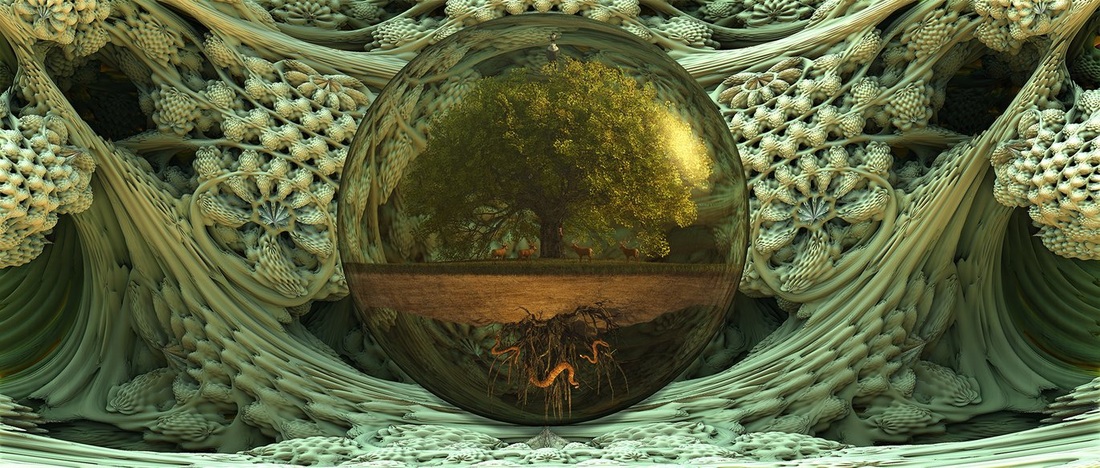
The
tree is the world tree.
Odin was hanged on a
tree.
Also, the wood for the
Christian cross comes from the tree of paradise.
Christ is crucified on
the tree of life.
Strangely enough, the
cross has a feminine meaning.
It symbolizes the
woman, the cruel woman, in whose arms Christ died.
There is a legend that
Mary talks to the cross, which she addresses as
“mother cross,” how
cruelly she would treat her son.
Here, too, the tree as
a cross takes the place of the mother who, however,
was completely
depersonalized.
She is the mother of
death.
The mother gives
birth, and at the end of life, as earth,
she again receives the
dead in herself.
Dionysus is the
dismembered one.
~Carl Jung, Children’s
Dreams Seminar, Pages 83-84.
I, your soul, am your
mother, who tenderly and frightfully surrounds you...I, your soul, am your
mother, who tenderly and frightfully surrounds you, your nourisher and
corrupter; I prepare good things and poison for you.
I
am your intercessor with Abraxas.
I
teach you the arts that protect you from Abraxas.
I
stand between you and Abraxas the all-encompassing.
I
am your body, your shadow, your effectiveness in this world, your manifestation
in the world of the Gods, your effulgence, your breath, your odor, your magical
force.
You
should call me if you want to live with men, but the one God if you want to
rise above the human world to the divine and eternal solitude of the star.
~Carl Jung; The Red Book; Appendix C; Page 371.
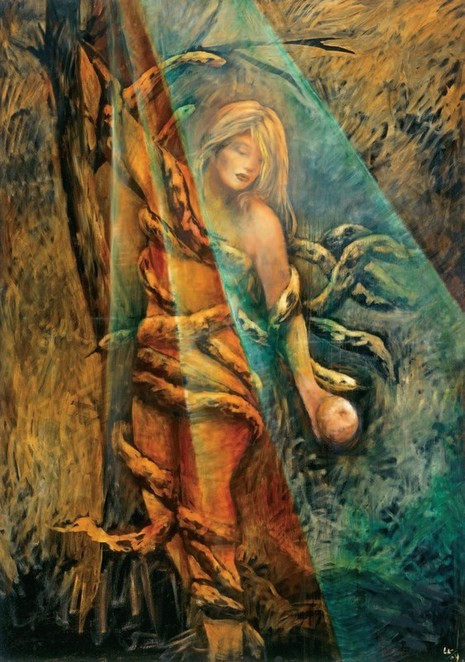
He
sees the tree of life, whose roots reach into Hell and whose top touches
Heaven. He also no longer knows differences: Who is right? What is holy? What
is genuine? What is good? What is correct? He knows only one difference: the
difference between below and above. For he sees that the tree of life grows
from below to above, and that it has its crown at the top, clearly
differentiated from the roots. To him this is unquestionable. Hence he knows
the way to salvation.
To unlearn all
distinctions save that concerning direction is part of your salvation. Hence
you free yourself from the old curse of the knowledge of good and evil. Because
you separated good from evil according to your best appraisal and aspired only
to the good and denied the evil that you committed nevertheless and ailed to accept,
your roots no longer suckled the dark nourishment of the depths and your tree
became sick and withered.
Therefore the ancients
said that after Adam had eaten the apple, the tree of paradise withered. Your
life needs the dark. But if you know that it is evil, you can no longer accept
it and you suffer anguish and you do not know why: Nor can you accept it as
evil, else your good will reject you. Nor can you deny it since you know good
and evil. Because of this the knowledge of good and evil was an insurmountable
curse.
But if you return to
primal chaos and if you feel and recognize that which hangs stretched between
the two unbearable poles of fire, you will notice that you can no longer
separate good and evil conclusively, neither through feeling nor through
knowledge, but that you can discern the direction of growth only from below to
above. You thus forget the distinction between good and evil, and you no longer
know it as long as your tree grows from below to above. But as soon as growth
stops, what was united in growth falls apart and once more you recognize good
and evil.
You can never deny
your knowledge of good and evil to yourself so that you could betray your good
in order to live evil. For as soon as you separate good and evil, you recognize
them. They are united only in growth. But you grow if you stand still in the
greatest doubt, and therefore steadfastness in great doubt is' a veritable
flower of life.
He who cannot bear
doubt does not bear himself. Such a one is doubtful; he does not grow and hence
he does not live. Doubt is the sign of the strongest and the weakest. The
strong have doubt, but doubt has the weak. Therefore the weakest is close to
the strongest, and if he can say to his doubt: "I have you," then he
is the strongest. But no one can say yes to his doubt, unless he endures
wide-open chaos. Because there are so many among us who can talk about
anything, pay heed to what they live. What someone says can be very much or
very little. Thus examine his life.
My speech is neither light
nor dark, since it is the speech of someone who is growing. ~Carl Jung, Red
Book, Page 301
Jung
on the importance of being Born
There are plenty of people
who are not yet born.
They all seem to be here,
they walk about—but as a matter of fact, they are not yet born, because they
are behind a glass wall, they are in the womb.
They are in the world only
on parole and are soon to be returned to the pleroma [fullness] where they
started originally.
They have not formed a
connection with this world; they are suspended in the air; they are neurotic,
living the provisional life. ~Jung, Kundalini Seminar, Page 28
It is most important that
you should be born; you ought to come into this world—otherwise you cannot
realize the self, and the purpose of this world has been missed.
It is utterly important
that one should be in this world, that one really fulfills one’s entelechia,
the germ of life which one is.
Otherwise you can
never start Kundalini; you can never detach.
You simply are thrown
back, and nothing has happened; it is an absolutely valueless experience.
You must believe in
this world, make roots, do the best you can, even if you have to believe in the
most absurd things—to believe,
for instance, that
this world is very definite, that it matters absolutely whether such-and-such a
treaty is made or not.
It may be completely
futile, but you have to believe in it, have to make it almost a religious
conviction, merely for the purpose of putting
your signature under
the treaty, so that trace is left of you.
For you should leave
some trace in this world which notifies that you have been here, that something
has happened.
If nothing happens of
this kind you have not realized yourself; the germ of life has fallen, say,
into a thick layer of air that kept it suspended.
It never touched the
ground, and so never could produce the plant.
But if you touch the
reality in which you live, and stay for several decades if you leave your
trace, then the impersonal process can begin.
You see, the shoot must
come out of the ground, and if the personal spark has never gotten into the
ground, nothing will come out of it; no linga
[creative core] or
Kundalini will be there, because you are still staying in the infinity that was
before. ~Carl
Jung, Kundalini Seminar, Page 29
Even if you don’t
become a complete realization of yourself, you become at least a person; you
have a certain conscious form.
Of course, it is not a
totality; it is only a part, perhaps, and your true individuality is still
behind the screen—yet what is manifested on the surface is surely a unit.
One is not necessarily
conscious of the totality, and perhaps other people see more clearly who you
are than you do yourself.
So individuality is
always. It is everywhere.
Everything that has
life is individual—a dog, a plant, everything living—but of course it is far
from being conscious of its individuality.
A dog has probably an
exceedingly limited idea of himself as compared with the sum total of his
individuality.
As most people, no
matter how much they think of themselves, are egos, yet at the same time they
are individuals, almost as if they were individuated.
For they are in a way
individuated from the very beginning of their lives, yet they are not conscious
of it.
Individuation only
takes place when you are conscious of it, but individuation is always there
from the beginning of your existence.
~Carl Jung, Kundalini
Seminar, Page 5
But such a thing
[Individuation] is only possible if the individual in every moment of existence
fulfills his complete being, lives the primitive pattern, fulfills all the
expectations that he was originally born with. ~Carl Jung, Visions Seminar, Pages
760-761
The instinct of
individuation is found everywhere in life, for there is no life on earth that
is not individual. Each form of life is manifested in a differentiated being
naturally, otherwise life could not exist. An innate urge of life is to produce
an individual as complete as possible. ~Carl Jung, Kundalini Seminar, Page 4
When we have
succeeded in making a God, and if through this creation our whole force has
entered into this design, we are filled with an overwhelming desire to rise
with the divine sun and to become a part of its magnificence. ~Carl Jung, Liber
Novus, Page 288.
Death is a drawing
together of two worlds, not an end. We are the bridge.
~Carl Jung, J.E.T.,
Page 95.
For when the soul
vanished at death, it was not lost; in that other world
it formed the living
counter-pole to the state of death in this world.
~Carl Jung, CW 16,
Para 493
One needs death to be
able to harvest the fruit. ~Carl Jung, Liber Novus, Page 275.
"There is a
deep-seated repugnance in the human breast against understanding the processes
in which we are involved. Such understanding implies far too much
responsibility for our actions" (Letters of Marshall McLuhan, p. 370)
Again, no psychological
fact can ever be exhaustively explained in terms of causality alone; as a
living phenomenon, it is always indissolubly bound up with the continuity of
the vital process, so that it is not only something evolved but also
continually evolving and creative. ~Carl Jung, CW 6, Para 717
The day comes when
you are outgrown and then you are approaching the void, which seems to me to be
the most desirable thing, the thing which contains the most meaning. ~Carl
Jung, Visions Seminar, Page 1026.
This function of
mediation between the opposites I have termed the transcendent function, by
which I mean nothing mysterious, but merely a combined function of conscious
and unconscious elements, or, as in mathematics, a common
function of real and
imaginary qualities. ~Carl Jung, CW 6, Para 184
Life is born only of
the spark of opposites.
~Carl Jung, CW 7, Para 78
The Coincidence of
Opposites: According to the Kabbalists, Ein-sof is the union of both Yesh
(being) and Ayin (nothingness) (Elior, 1993,Ch. 14ff.), as well as male and
female and good and evil and all other basic oppositions. For the 13th century
Kabbalist, Azriel of Gerona, the godhead not only unites being and "the
nought" (Scholem, 1987, p. 416) but also the visible and invisible as well
as faith and unbelief (p. 441-2), and His emanations are the "union of
everything and its opposite" (Dan, 1966, p. 94). The Lurianists, and the
Hasidim who followed in their path, referred to Ein-sof as ha-achdut ha-shawah,
a coincidentia oppositorum, (Elior, 1987, pp. 114, 163, 166, 167) a term which
Jung reserved for the essence of the human psyche. "The self", Jung
tells us, "is made manifest in the opposites and the conflicts between
them; it is a coincidentia oppositorum" (Jung, p. 186)
FROM
HERE TO ETERNITY
THE SLEEP THAT KNOWS
NO WAKING
Convergence: Many
Lines, Many Ancestors
The psychology of an
individual can never be exhaustively explained
from himself alone: a
clear recognition is needed of the way it is also conditioned by historical and
environmental circumstances. ~Carl Jung, CW 6, Para 717
"We
conceptualize self in terms of dynamic multiplicity of relatively autonomous I
positions in an imaginal landscape. The I has the possibility to move, as
in a space, from one position to another in accordance with changes in
situation and time. The I fluctuates among different and even opposed
positions. The I has the capacity to imaginatively endow each position
with a voice so that dialogical relations between positions can be
established. The voices function like interacting characters in a
story." --Hermans, Kempen & van Loon, "The Dialogical Self"
Are imaginal
experiences real? What is the nature of the beings that live in that space
between matters of the natural world, and ideas of the reasonable mind? How do
they help us live a life imbued with wonder and mystery?
Henry Corbin called
this imaginal realm the mundus
imaginalis,
not a flight of fantasy, but a borderline reality between waking experience,
and a regenerative kind of knowing and being. Our lives are filled with dream
figures, intuitive presences, and powerful, even healing, visionary beings.
Even those who explicitly deny life after death implicitly hold that the dead
possess epistemic and emotional states.
According to Bering
(2002), in "Intuitive Conceptions of Dead Agents’ Minds:
The Natural
Foundations of Afterlife Beliefs as Phenomenological Boundary":
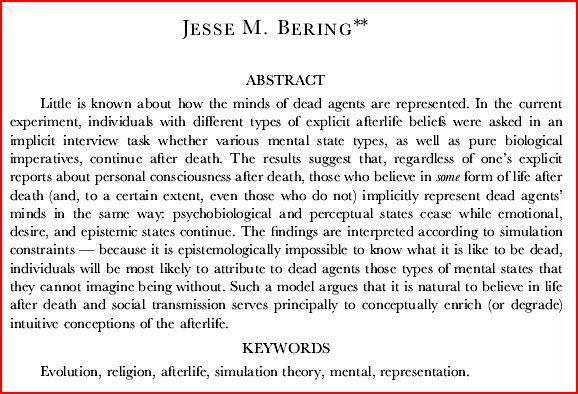
Ancestors
are each a transpersonal “other,” stand-ins for a central dynamic Jung called
the Self. This guiding principle or impulse fosters growth and transformation
through an interactive field of imaginal figures that call to us and inform us
-- mixtures of archetype, energy and image. If we respond, we find renewal,
transformation, ascent, growth, rebirth. If we reject the call we face death,
stagnation, coagulation, depression, fear, and loss of soul.
We need to retain and
build awareness of the power and transformative nature of the unconscious, by
exploring its fluid regions, which includes our ancestral lines. This dark
world is irrational, chaotic, and still -- the very depths of human experience.
Take the time to accept the dead.
Images that emerge
from the unconscious are naturally meaningful. Meaning is acausal, both in root
and end, unrelated to any physical occurrence. Coming to terms with the
unconscious is a profound encounter that transcends the gap between conscious
ego and unconscious archetype. Wholeness is found within each transcendent
experience.
Our ancestors are
“imaginal figures” –dream figures, visionary beings, guides, intuitive forces,
legends and figures from myth and fairy tales. They represent different
dimensions of unconscious life. They seek engagement with us so that they can
assist as guiding forces. They may use our embodied nature to complete
something left unfinished in their lives. Even when they want us to complete
something on their behalf, we are also transforming something within our
personal path. This realm of inter-being is not a place of distinct either/or –
either your life or mine, either your inner work or mine.
This extraordinary
world, the mundus
imaginalis,
has a borderland quality transcending time and space -- a lens that frames our
own anomalous experiences. Because the unconscious is the home of imaginal
figures, we can find them there, when we, and they, are ready to collaborate.
Nurturing inner life invites re-enchantment of the world and vitality of soul.
Psyche brings us all a
world rich in dreams, intuitions, feelings, and visionary encounters; the
portals to a wellspring of intrapsychic life, through which we can awaken to
their voices and numinous encounters that help us move through time and space
in new ways.
Suffering can
transform into meaning, compassion and love. Synchronicities in times of
suffering open the imaginal world, animated by a host of figures that seek to
guide us back home. The shadows conceal glimpses of imaginal experience.
The archetypes to find grounding in lived experience -- in stories of the
imaginal and direct experience. The ground of uncertainty is where we incubate
pain and let it birth something new.
Symbols are not allegories
and not signs; they are images of contents which for the most part transcend
consciousness.
~Carl Jung, CW 5, Para 114
But if the depths have
conceived, then the symbol grows out of itself and is born from the mind, as
befits a God.
~Carl Jung, Liber Novus, Page 311.
Cosmos evolves through
meaningful informational codes. Order is transmitted through cosmic evolution
that in-forms matter, life and consciousness. This ordered negentropic universe
is structured as a quantum field, plenum of meaningful local and nonlocal
information.
This Cosmic Mind is a
Plenum full of information or Cosmic Consciousness. This vision of the mind and
the universe sees consciousness and intelligence as superimposed meaningful
information, always present in all organizational
levels of nature.
Matter, life and consciousness are not separate entities but a holistic
indivisible unity, an infinite self-organizing intelligent field.
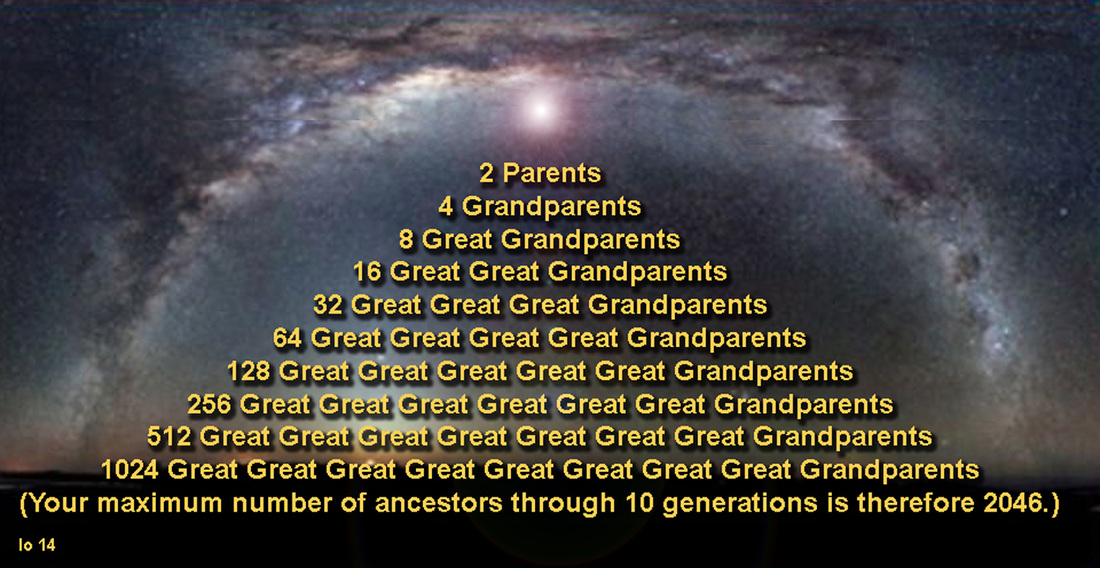
For him who looks backwards the
whole world, even the starry sky, becomes the mother who bends over him and
enfolds him on all sides, and from the renunciation of this image, and of the
longing for it arises the picture of the world as we know it today. ~Carl Jung, CW 5, Para 643
It seems as if all the
personal entanglements and dramatic changes of fortune that make up the
intensity of life were nothing but hesitations, timid shrinking, almost like petty
complications and meticulous excuses for not facing the finality of this
strange and uncanny process of crystallization. ~ Jung, CW 12, Para 326.
Often one has the
impression that the personal psyche is running around this central point like a
shy animal, at
once fascinated and
frightened, always in flight, and yet steadily drawing nearer. ~Carl Jung, CW
12, Para 326.
In the last analysis every
life is the realization of a whole, that is, of a self, for which reason this
realization can also be called “individuation.”
~Carl Jung, CW 12, Para
330
All life is bound to
individual carriers who realize it, and it is simply inconceivable without
them. ~Carl Jung, CW 12, Para 330
But every carrier is
charged with an individual destiny and destination, and the realization of
these alone makes
sense of life. ~Carl Jung,
CW 12, Para 330
Experience, not books, is
what leads to understanding. ~Jung, CW 12, Para 564
Our
Journey of Self Discovery
JUNGIAN GENEALOGY:
AGELESS THERAPIES
Where Your Story
Began; You Take It With You From This Day Forward.
Celebrate
the magical place you choose to live with your family. The journey into our
past is a journey of self-discovery.
"What is
radically new does not follow the current, even when it is apparently a contemporary
event . [ ... ] We are immersed in the psyche . How insisted the alchemists,
the gold of the potential lies in the bad waste of what we have at hand.
Working this raw material has always been the real unconscious by the task
which not only expressed his personal suffering, but reflected the torment Soul
mundi, the suffering in the roots. For the artist, I mean ' artifex,' the
author, be it artist, alchemist or analyst. He who collects the wood carried by
the current, the cacophonous sounds, DIY parts, and returns this
inconscietà to its roots. The artifex works with the soul in ' Anima
mundi." --James Hillman
It is utterly important
that one should be in this world,
that one really fulfills
one’s entelechia, the germ of life which one is.
~Carl Jung, Kundalini
Seminar, Page 28
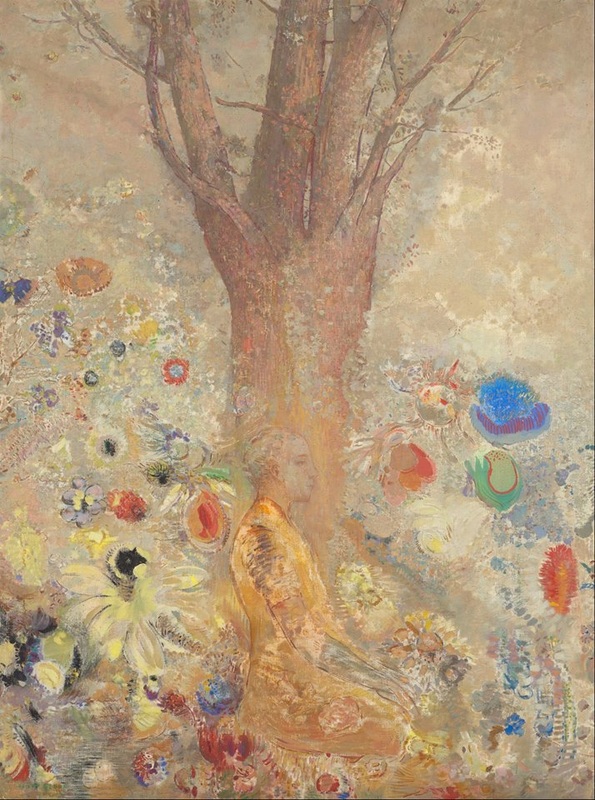
Art Credit: Odilon
Redon, "The Buddha," 1904
For
you should leave some trace in this world which notifies that you have been
here, that something has happened. If nothing happens of this kind you have not
realized yourself; the germ of life has fallen, say, into a thick layer of air
that kept it suspended. ~Carl Jung,
Kundalini Seminar, Page 28
You see, the shoot must
come out of the ground, and if the personal spark has never gotten into the
ground, nothing will come out of it; no linga [creative core] or Kundalini will
be there, because you are still staying in the infinity that was before. ~Carl Jung, Kundalini Seminar, Page
29
"Trees
are sanctuaries.
Whoever knows how to
listen to them, can learn the truth."
~Herman
Hesse
“If we have souls, they're made of
the love we share.
Undimmed by time, unbound
by death.” ― Jack Harper
"The ancients lived their symbols,
since the world had not yet become real for them." ~Carl Jung, Liber Novus,
Page 236.
Where
Space and time do not exist there is only oneness (monotes).
There is no
differentiation; there is only pleroma.
Pleroma is always with
us, under our feet and above our heads.
Man is the point that
has become visible, stepping out from the pleroma, knowing what he is doing, and
able to name the things about him.
Although the earth
existed before there were any human beings, it could not be seen or known by
anyone. ~Carl Jung, ETH Lectures,
Page 22.
“If there be light,
then there is darkness; if cold, heat; if height, depth; if solid, fluid; if
hard, soft; if rough, smooth; if calm, tempest; if prosperity, adversity;
if life, death.” ―Pythagoras
We ask the question:
how did creatura originate? Created beings (creatures) indeed originated but
not the creatura itself, for the creatura is a quality of the Pleroma, in the
same way as the non-creation [non-creatura or non-created non-world], which is
the eternal death [dark abyss]. Creation is always and everywhere, and death is
always and everywhere. The Pleroma possesses all: differentiation and
non-differentiation.
--Jung, Seven Sermons, Sermon 1
Jacob Boehme said the
basis of the world is nonbeing…because the beginning [of the world] is desire,
longing, and only an absolute vacuum can have a longing.
A vacuum, nonbeing, can by
longing draw or attract into itself...something exceedingly positive because it
creates the world.
~Carl Jung, Visions Seminar, Pages 424-425.
We cannot slay death,
as we have already taken all life from it. If we still want to overcome death,
then we must enliven it. Therefore on your journey be sure to take golden cups
full of the sweet drink of life, red wine, and give it to dead matter, so that
it can win life back. ~Carl
Jung; The Red Book; Page 244.
The day comes when you
are outgrown and then you are approaching the void, which seems to me to be the
most desirable thing,
the thing which contains
the most meaning.
And you end where you
started. This is the philosophy of the East.
--Carl Jung, Visions Seminar, Page
1026.
The great asset of
the East is that they are based on instinct.
~Carl Jung, Visions
Seminar, Page 1066.
The Eastern philosophy
is a sort of yoga, it is alive, it is an art, the art of making something of
oneself. ~Carl Jung, Visions Seminar, Page 1024
And who can not be
awed by the quote from the Corpus Hermeticum 10.24-25 ,
"So let us not be
afraid to tell the truth. The true man is above them [the
celestial gods], or at
least equal to them. For no god leaves his sphere to come to earth, whereas man
ascends to heaven and measures it. Let us dare to say that a man is a mortal
god and a celestial god is an immortal man." --Corpus Hermeticum
The further development of
the individual can be brought about only by means of symbols which represent
something far in advance of himself and whose intellectual meanings cannot yet
be grasped entirely.
~Carl Jung, CW 4, Para 680
Concrete values cannot
take the place of the symbol; only new and more effective symbols can be
substituted for those that are antiquated and outworn and have lost their efficacy
through the progress of intellectual analysis and understanding. ~Carl Jung, CW 4, Para 680
SOIL
The darkness that you find
yourself now in
is like the darkness that
surrounds a seed,
the one from which a new
life will begin,
a darkness you resent and
yet you need.
You yearn for days when
you felt you were part
of something larger,
branching in the sun,
and fear that you can only
fall apart
and wish for light though
now you can see none.
But if you probe the
darkness, you will find
the light you felt you had
forever lost
and not look to the life
you left behind
nor hate that into
darkness you were tossed:
within the darkness, you
can take deep root,
and reach to light and
bear from it much fruit.
--Mario A. Pita
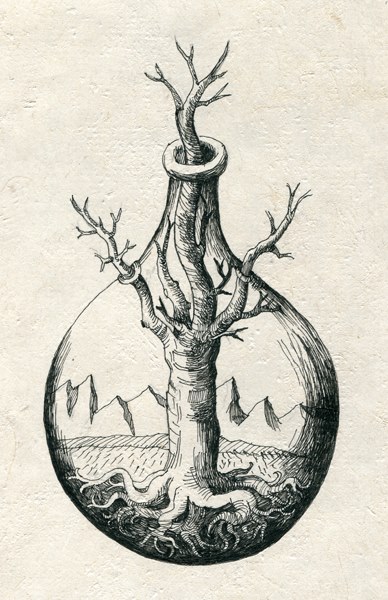
“Remember
the trees who make this life possible,
who some call grandmother,
because they, like us,
have parents, ancestors,
live in community.
I have seen them dancing
in their ceremony
Of bending low
When the wind rushes in
from the north.”
Ann Filemyr
Artwork by Kai Orton
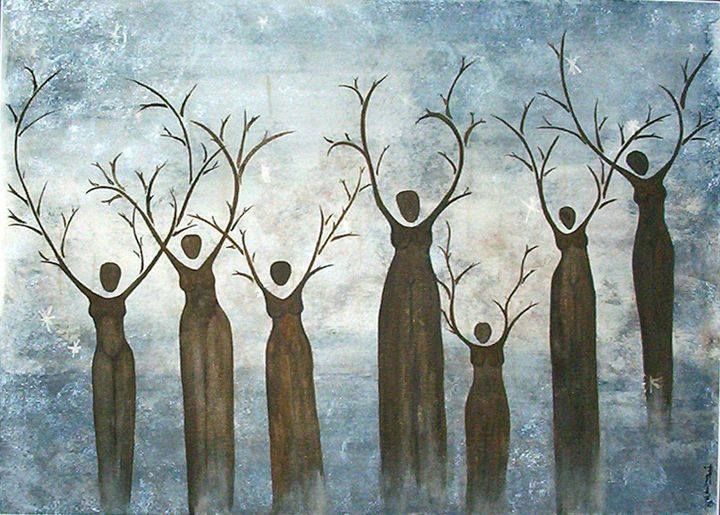
The patient must be
alone if he is to find out what it is that supports him when he can no longer
support himself. Only this experience can give him an indestructible
foundation.
~Carl Jung, CW 12, Para 32
The experience of the
unconscious is a personal secret communicable only to very few, and that with
difficulty.
~Carl Jung, CW 12, Para 61
The archetype is, so to
speak, an “eternal” presence, and it is only a question of whether it is
perceived by the conscious mind or not. ~Carl Jung, CW 12, Para 329
There is always an
attraction between conscious mind and projected content. Generally it takes the
form of a fascination.
~Carl Jung, CW 12, Para 436.
So long as a content
remains in the projected state it is inaccessible.
~Carl Jung, CW 12,
Para 555.
The experience of the
unconscious is a personal secret communicable only to very few, and that with
difficulty.
~Carl Jung, CW 12, Para 61
But no matter how much the
parents and grandparents may have sinned against the child, the man who is
really adult will accept these sins as his own condition which has to be
reckoned with.
~Carl Jung, CW 12, Para 152
Our psychic prehistory is
in truth the spirit of gravity, which needs steps and ladders because, unlike
the disembodied airy intellect, it cannot fly at will. ~Carl Jung, CW 12, Para 79
Experience of the
opposites has nothing whatever to do with intellectual insight or with empathy.
It is more what we would call fate. ~Carl Jung, CW 12, Para 23.
Without the experience of
the opposites there is no experience of wholeness and hence no inner approach
to the sacred figures.
~Carl Jung, CW 12, Para 24.
Since the psychological
condition of any unconscious content is one of potential reality, characterized
by the polar opposites of “being” and “non-being,” it follows that the union of
opposites must play a decisive role in the alchemical process. ~Carl Jung, CW 12, Para 557
It has yet to be
understood that the Mysterium magnum [the great mystery] is not only an
actuality but is first and foremost rooted in the human psyche.
~Carl Jung, CW 12,
Para 13.
The alchemist related
himself not only to the unconscious but directly to the very substance which he
hoped to transform through the power of imagination.
~Carl Jung, CW 12, Para 394
However remote alchemy may
seem to us today, we should not underestimate its cultural importance for the
Middle Ages. Today is the child of the Middle Ages and it cannot disown its
parents.
~Carl Jung, CW 12, Para 432
It is clear enough from
this material what the ultimate aim of alchemy really was: it was trying to
produce a corpus subtile, a transfigured and resurrected body, i.e., a body
that was at the same time spirit. ~Carl Jung, CW 12, Para 511
There the main concern is
the “diamond body,” in other words, the attainment of immortality through the
transformation of the body. ~Carl Jung, CW 12, Para 511

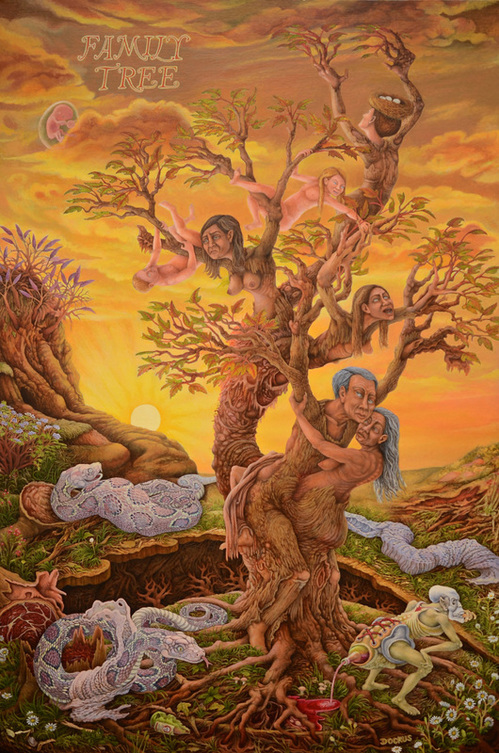
John Dockus
THE
LIVING TRUTH
Genealogy As Primal
Symbol
Ancestral Reality
“In general, emotional ties are very important to human beings.
But they still contain projections, and it is essential to withdraw these
projections in order to attain to oneself and to objectivity. Emotional
relationships are relationships of desire, tainted by coercion and constraint;
something is expected from the other person, and that makes them and we unfree.
Objective cognition lies hidden behind the attraction of the emotional
relationship; it seems to be the central secret. Only through objective cognition
is the real coniunctio possible.”
--C. G. Jung, Memories Dreams and
Reflections, pp. 296-297.
PUT YOUR QUESTIONS TO
THE TREES
Genealogical myths
have always pervaded literature
and politics.
Aside
from the symbols used within genealogy, the Family Tree itself is a
foundational symbol of one's living connections to life, to history, and to
transformation. It is the "prime symbol" of gestation and prima
materia -- the archetypal human being. To mix
metaphors, when it comes to our 'entangled branches,' we have to "read
between the lines."
The symbolical names
of the prima
materia
all point to the anima mundi, Plato's Primordial Man, the Anthropos, and mystic
Adam. Adam Kadmon is the "man of light" and therefore identical
with the alchemical filius
philosophorum.
Paracelsus says of this astral man, "the true man is the star in us...for
heaven is man and man is heaven, and all men are one heaven, and heaven is only
one man."
The ancient teachings
about the Anthropos assert that God, or the world-creating principle, was
manifested in the form of a "first-created" man, usually of cosmic
size, such as Prajapati, Purusha, and Metatron.
The Primordial Man is
the means for conquering darkness, and shares his role with a feminine being,
Sophia, who coexisted with him in the Gnostic Pleroma. The Cosmic Man or
archetypal man is both macrocosm and microcosm and contains the Feminine or
anima within himself. Technically it is a hermaphroditic figure,
recapitulating the entire evolutionary process.
The Anthropos
originates in Manichaean doctrine. It is akin to the true man of Chinese
alchemy, which like the Anthropos is akin to God. This inner man remains partly
unconscious because consciousness is only part of a man and cannot comprehend
the whole. But this whole man is always present.
Psychic content
becomes conscious when it possesses a certain energy-charge, or it sinks back
into unconsciousness. This "Man[Woman]" is an indescribable,
intuitive or mystical experience which demonstrates the continuity of this idea
over the millennia. In later centuries there was a relationship between Christ,
the Son of Man and this cosmogonic Man.
In alchemical
philosophy it corresponds to the homunculus and lapis, the product of the
hieros gamos, Royal Marriage. According to Jungian, Edward Edinger, the
anthropos has been likened in Gnostic texts to a corpse, "buried in the
body like a mummy in a tomb."
The mummy is
symbolically identical with the original man or anthropos, and is thus an image
of the Self and the product of mortificatio--the incorruptible body that grows out of the death of
the corruptible seed. It corresponds to the alchemical idea that death is the
conception of the Philosopher's Stone.
From its death, the
"child of the philosophers" is born--the Philosophical Stone. The
regenerated king in alchemy corresponds to the cosmic Anthropos, the First
Man. He is the inner, spiritual, psychic man created in the image of the
Nous.
The alchemist
experienced the Anthropos in a form that was imbued with a new vitality,
freshness and immediacy--psychic totality. It has a complex Egyptian, Persian
and Hellenistic background--Homo Maximus.
Primary Relations
It is an epic picture
story book. It is a text, showing the relation between signs and the things to which
they refer; their signified content, or meaning. It is a discourse on your specific
and mythic ancestry -- your ground in pure and limitless space. Each ancestor
is a sign deployed in space and time to produce "texts", whose
meanings are construed by the mutually contextualizing relations among them. As
a conceptual model it helps us conceive the whole.
The self-referential
symbol fully represents the whole of which it is a part -- more than a romantic
symbol or allegory. There are ordinary people and "giants" of history
who felt an intense desire to achieve great deeds and heroic immortality.
"Let
there be no doubt that I am the assemblage of our ancestors, the arena in which
they exercise my moments. They are my cells and I am their body. This is the
favrashi of which I speak, the soul, the collective unconscious, the source of
archetypes, the repository of all trauma and joy. I am the choice of their
awakening. My Samadhi is their Samadhi. Their experiences are mine! Their
knowledge distilled is my inheritance. Those billions are my one."
--Frank Herbert, The God-Emperor of Dune,
p. 260.
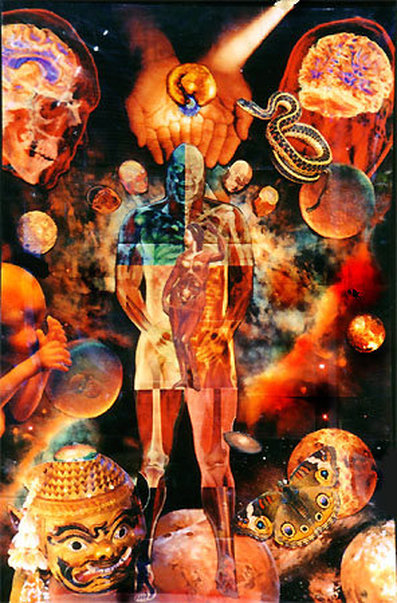
Anthropos, Io Miller
"Here we must follow nature as a guide, and what the doctor
then does is less a question of treatment than of developing the creative possibilities
latent in the patient himself."
~Carl Jung, CW 16, Para 82
The united personality
will never quite lose the painful sense of innate discord. Complete redemption
from the sufferings of this world is and must remain an illusion. ~Carl Jung, CW 16,
Para 400
In Ghostly Surroundings
Genealogically based,
Quadrant IV asks the question 'Are there ancestral, or pre-morbid expressions
of the symptoms you carry?'. From whom does the symptomology originate?
Often the symptomology is not biographical to the client's lifetime but rather
originates from out of their lineage. A traumatic experience that took place
generations and/or cultures before the life of the client can be passed on
through the generations to manifest in the client's life, and then it continues
to be passed on in one way or another by them. More conventional modes of
therapy would miss this possibility which can be found to be quite a common
occurrence.
- Two basic questions used are pulling back questions that deal with either time or space:
- Time:
'And what happens just before ... ?'
Space: 'And where did that ... come from?'
Use of downward developing questions as in Quadrant II:
- 'And is there
anything else (about ...)?'
'And what kind of ...?'
When you are working in Quadrant IV you have
to roll your sleeves up and grab the client and pull them back in time because
it's not natural to go backwards, we want to go forwards. So feel that pull in
your words: 'So what happens just before?' and 'Where did that come from?'.
When you get stuck revert to developing. Pulling back considerably expands the
information; like a concertina that is all jammed up. As you pull back you get
more and more history as it unfolds.
In
Quadrant IV we are looking for the healing down the ancestral line to heal the
T-1 situation. In Quadrant II, in working with trauma, we are working
with just the one experience. If it is only one event then it is possible to
heal the one memory. But some memories have extensive roots and we have
to get at the whole thing before it can heal. So we need to look at what
might be constellated around the one experience. If we don't, then quite
often what we have is what seems to be a great piece of work but there won't be
much change in the client's behavior. In Quadrant II we get one memory
and one event whereas in Quadrant IV we may get 10 or 20 events that lead to
the current problematic experience. We need to clean up the whole lot.
The
redemptive metaphor is discovered by pulling time back from T-1 through T-6.
Once discovered and
developed the redemptive metaphor is invited to go to T-1 to bring about a
healing (and movement to T+1). The product of this interaction is a new
metaphor which will then be 'washed through' all the T- experiences in the
lineage to heal each one of them. This will cause the 'expression of the
history' to change. In other words, the client will no longer 'carry the
baggage' of that experience. A healing has taken place.
OUTLINE OF BASIC
INTER-GENERATIONAL
HEALING PROCESS
- The client locates self and the therapist in the room (or outdoors). The conversation then begins by the client talking. (Quadrant I)
- As the client describes their symptoms, likely from T-1, (QII)
- Eye movements, gestures, etc. are observed and a question such as, "Where are you going with your eyes?" is asked to locate sources of information in space. (QIII)
- Then questions that define that space and develop information are asked such as, "What's it like?, "What kind of ____?", and "anything else about_____?". (QIII)
- For the first 2-3 sessions the client develops their 'map' of their 'perceptual space'. As their eyes source out of different directions or locations (perhaps in the same direction) each location is developed. There may be connections between some locations. The 'map' becomes the 'co-therapist'. (QIII)
- A key word, phrase, feeling, gesture is 'pulled back' in time to T-2 with a question such as "And where did _____come from?" or "What happened just before_____?" (QIV)
- Then something about that source of causation is developed downward until it reveals its information.
- The subject of this source is now pulled back in time, again with a question such as, "And where did _____ come from?" This process continues all the way back through T-6. Remember 'pulling back' is hard work for the therapist and the client.
- A 'redemptive metaphor' is discovered outside of the 'problem domain' before T-6 occurred. It is found when there are no more traumatic information sources.
- The 'redemptive metaphor' is developed in order to discover all of its resources with the same developing questions.
- The 'redemptive metaphor' is invited to go to T-1 (in QII) to heal the client's symptoms (and the result is matured to T+1)
- The product of the T+1 healing is now 'washed through' each T- experience in turn and then back again (and again if necessary) to heal the entire 'expression of history' that has been problematic. This 'problem domain' now no longer exists. The client's (original QIII) space has been healed (cleared).
- http://www.cleanlanguage.co.uk/problemdomains.html
IDENTIFY YOURSELF
Your Search for Your
Identity
Order and meaning are
things that have become and
are no longer becoming. --Carl Jung, Liber Novus, Page 235
And, in fine, the
ancient precept, "Know thyself," and the modern precept, "Study
nature," become at last one maxim.--Ralph Waldo Emerson
Hillman
said we have an extreme need to expand our psychological space. The soul is
restricted or forced because of his own imagination is withered or blocked. Genealogy expands our psychological
space exponentially.
Many people have no
dream, no clear image of the future. Some have a dream, even a clear image of
the future but they are not in love with it—they may feel that it is not really
them.
How might we search
for our identity and discover a dream and fall in love with it? This search for
identity is one of the most important things that a person ever does. Sometimes
a story—even a fantasy—can capture the essence of a problem such as this and
distill the powerful truth. A story can be transformative.
For the important thing is
not to interpret and understand the fantasies, but primarily to experience
them. ~Carl Jung, CW 7, Para 342.
The hero goes forth to
come to grips with a merciless opponent, the truth about him- or herself, and
to reshape that life from inherent inner resources. The dreadful importance of
finding one’s identity is reflected in the following speech:
"It is my heart to learn the truth
about myself. I will not stop short of it. Were I to do so, who I am would
forever be unknown and through all my life I would feel a part of me lacking."
Exactly the same idea is
expressed in the Epistles of St. Paul where he says that all living beings, the
whole of creation, is waiting for the revelation of the children of God; they
are waiting to celebrate their apokatastasis, their reinstallation with the
redemption of the children of God.
In the redemption of the
individual, the whole past will be redeemed, and that includes all the inferior
things as well, the animals, and all the ancestral souls, everything that has
not been completed; all creation will be redeemed in the apokatastasis [at the
time of the Last Judgement], there will be a complete restoration of things as
they have been.
Primitives express that
quite plainly; they say that when the hero steps out of the belly of the
monster, not only he comes out but his dead parents who have also been
swallowed by the time dragon, and not only his parents but all the people of
the tribe who have disappeared in time, and even rivers and mountains and
woods, whole countries come out of the whale-dragon.
All the vanished memories
of former situations will be restored,
everything will be brought
back to its original condition.
~Carl Jung, Visions
Seminar, Page 1280
From the Core of
Stillness to The Unboundedness of Life
"I warn you, whoever you are,
Oh! You who want to probe the arcana of nature, that if you do not find within
yourself that which you are looking for, you shall not find it outside either!
If you ignore the excellences of your own house, how do you pretend to find
other excellencies? Within you is hidden the treasure of treasures! Know
thyself and you will know the Universe and the Gods."
--
Inscription on the frontispiece of the Temple of Apollo on Mount Parnassus,
Greece, 2500 B.C.
To ‘Know Thyself” is
to be ‘Thyself” – without compromise. What an incredibly daunting task. Not
because it is hard, but because it is so simple, and simplicity may be the most
difficult experience to truly live. Difficult - because it is ‘world saving’, without
external recognition. In fact, those who do set out on such a path are likely
to go unnoticed and, in some instances shunned. Thus, the inner life is
typically pursed separately from our presence in public life, social life, work
life, and often even in intimate relationships.
Self-division is no
longer tenable. Bridging the inner life and outer life, we can see how we need
to find ourselves. As we shed our adopted and adapted programming, we sweep
away externalized notions of ourselves and open an inner light to the true
beauty of the living spirit we are.
Individuation is a
process of psychological and spiritual development with the fulfillment of
one's personal destiny as its goal. An on-going dynamic dialectic confrontation
takes place between collective and personal, between the unconscious and
consciousness.
In 1831, Ralph Waldo
Emerson wrote a poem entitled 'Know Thyself', on the theme of 'God in thee.'
Wherever we go, whatever we do, self is the sole subject we study and learn.
--Ralph Waldo Emerson (1803-1882), Journals (1833)
Each day we have the
potential of opening to ‘revelatory moments’ of seeing through. Utterly simple
and cumulative practices open us to the core of our spirit.
Stillness, the sensory
truth of being ourselves, means living with death and immortality.
The black beetle is the
death that is necessary for renewal; and so thereafter, a new sun glowed, the
sun of the depths, full of riddles, a sun of the night. And as the rising sun
of spring quickens the dead earth, so the sun of the depths quickened the dead,
and thus began the terrible struggle between light and darkness. ~Carl Jung, Liber Novus, Page 238.
In the center is the
individual where the opposites are united, the one peaceful spot in man, the
space where nothing moves embedded in a world of chaos.
~Carl Jung, Visions
Seminar, Page 263
If he is intent only on
the outer reality, he must live his myth; if he is turned only towards the
inner reality, he must dream his outer, so-called real life.
~Carl Jung, CW 6, Para
280
There are two offshoots
from all the Aeons, having neither beginning nor end, from one root, and this
root is a certain Power, an invisible and incomprehensible Silence. One of them
appears on high and is a great power, the mind of the whole, who rules all
things and is a male; the other below is a great Thought, a female giving birth
to all things.
~Carl Jung, Mysterium Coniunctionis, 136.
The principal pair of
opposites is the conscious world and the unconscious world, and when the two
come together, it is as if man and woman were coming together, the union of the
male and the female, of the light and the darkness. Then a birth will take
place. ~Carl
Jung, Visions Seminar, Page 574
If you marry the
ordered to the chaos you produce the divine child, the supreme meaning beyond
meaning and meaninglessness. --Jung, Liber Novus, Page 235
The symbol is the middle
way along which the opposites flow together in a new movement, like a
watercourse bringing fertility after a long drought.
~Carl Jung, CW 6, Para
443.
It is the world of water,
where all life floats in suspension; where the realm of the sympathetic system,
the soul of everything living, begins; where I am indivisibly this and that;
where I experience the other in myself and the other-than myself experiences
me. ~Carl
Jung, CW 9i, Para 45.
In this deification
mystery you make yourself into the vessel,
and are a vessel of
creation in which the opposites reconcile.
~Carl Jung, Liber
Novus, Page 253. Footnote 211
Childlikeness or lack of
prior assumptions is of the very essence of the symbol and its function. ~Carl Jung, CW 6, Para 442
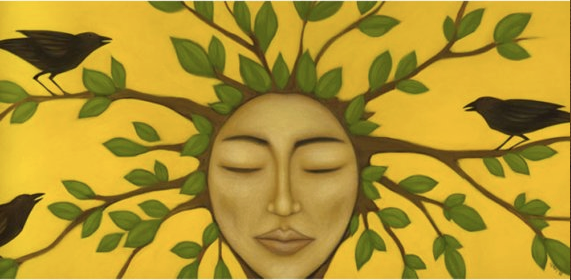
Advice
from a Tree
Stand Tall and Proud
Sink your roots deeply
into the Earth
Reflect the light of a
greater source
Think long term
Go out on a limb
Remember your place
among all living beings
Embrace with joy the
changing seasons
For each yields its
own abundance
The Energy and Birth
of Spring
The Growth and
Contentment of Summer
The Wisdom to let go
of leaves in the Fall
The Rest and Quiet
Renewal of Winter
Feel the wind and the
Sun
And delight in their
presence
Look up at the Moon
that shines down upon you
And the mystery of the
stars at night.
Seek nourishment from
the good things in life
Simple pleasures
Earth, fresh air,
light
Be content with your
natural beauty.
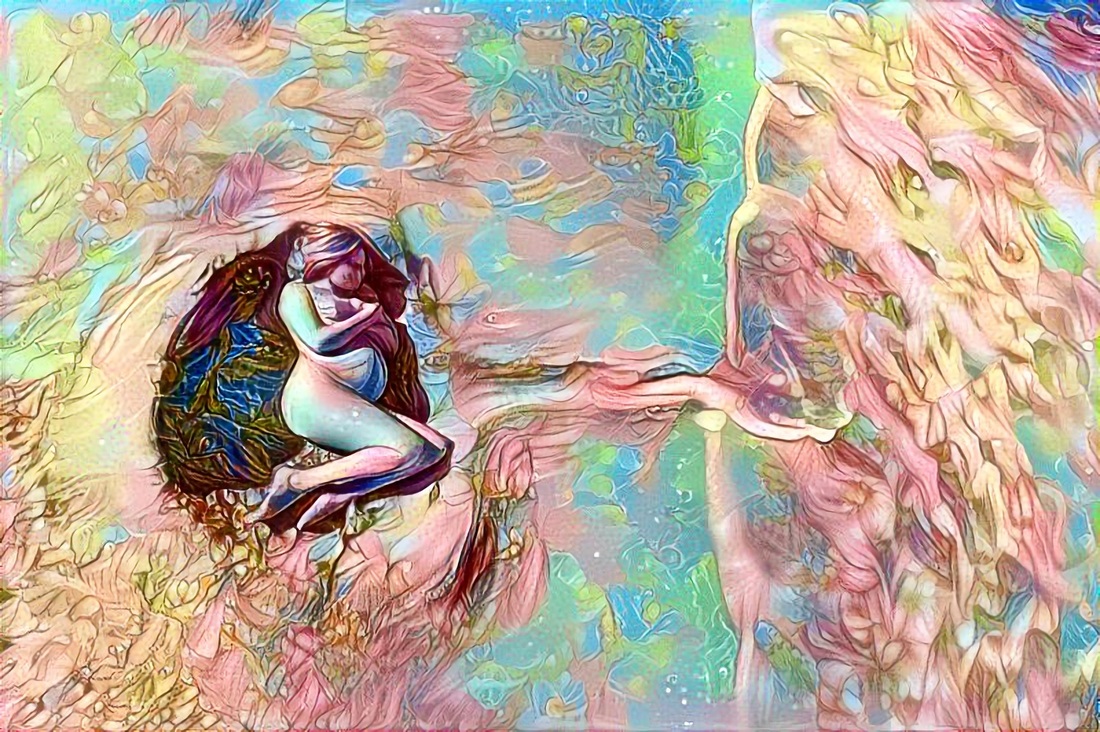
image by Daniel
O'Connell with additional treatment
The Great Mother is
impregnated by the loneliness of him that seeks her.
~Carl Jung to Hermann
Hesse, Letters Volume 1, Pages 573-574.
SIDE
LINES
Realm of the Mothers
The Great Mother is impregnated by the loneliness of him that
seeks her.
~Jung to Hermann
Hesse, Letters Volume 1, Pages 573-574.
When the mother
replaces the Father, Magic Replaces the ' Logos '
A host of possibilities is
still embedded in the archetypes, in the realm of the Mothers. The abundance of
possibilities eludes our comprehension.
~Carl Jung, ETH
Lectures, Page 22
The ‘realm of the
Mothers’ has not a few connections with the womb, with the matrix, which
frequently symbolizes the creative aspect of the unconscious. ~Carl Jung, CW 5,
Para 182.
"the mother
archetype may connote anything secret, hidden…" ~Carl Jung, CW 9i, para.
158.
“Many things arousing
devotion or feelings of awe, as for instance the… earth…can be mother-symbols.” --Carl Jung, 9i, para. 156
Just as the father
represents collective consciousness, the traditional spirit, so the mother
stands for the collective unconscious, the source of the water of life. ~Carl
Jung, Psychology and Alchemy, Page 71.
"The mother is the absolutely
universal giver and preserver of life, and as such she may be compared to the
unconscious which is the source and origin of all psychic life." ~The Grail Legend by Emma
Jung and Marie Louie von Franz.
He who stems from two
mothers is the hero: the first birth makes him a mortal man, the second an
immortal half-god. ~Carl Jung (Cited in Segal 155-156)
"Know that the sun is your father, the moon your mother.
The wind bears you in its womb and the earth nurses you. You are more than your
body, more than your emotions, and more than your mind. You are something else.
From you will come the golden flower, the alchemical essence. Of this no man
may speak. Such matters must be transmitted in mystical terms like employing
fables and parables. The purpose of life is to square the circle. The four, the
three and the two must become one. From the marriage of the opposites, the
royal marriage of king and the queen, is born the philosophers stone, the fifth
essence."
- Carl Gustav Jung
I, your soul, am your
mother, who tenderly and frightfully surrounds you,
your nourisher and
corrupter; I prepare good things and poison for you.
I am your intercessor
with Abraxas.
I teach you the arts
that protect you from Abraxas.
I stand between you
and Abraxas the all-encompassing.
I am your body, your
shadow, your effectiveness in this world, your manifestation in the world of
the Gods, your effulgence, your breath, your odor, your magical force.
You should call me if
you want to live with men, but the one God if you want to rise above the human
world to the divine and eternal solitude of the star.
~Carl Jung; The Red
Book; Appendix C; Page 371.
The Great Mother is
the nurturer. The Great Mother appears in your dreams as your own mother,
grandmother, or other nurturing figure. She provides you with positive
reassurance. Negatively, they may be depicted as a witch or old bag lady in
which case they can be associated with seduction, dominance and
death. This juxtaposition is rooted in the belief by some experts that the
real mother who is the giver of life is also at the same time jealous of our
growth away from her.
When, in the development
of this child, the great amnesia will have obscured the Bardo world with its
primeval images, such a dream will shine like a spark from the lost paradise,
and remind him that he, who lives down on earth, also has an immortal,
versatile soul of divine nature. ~Carl Jung, Children's Dreams Seminar, Page
290.
Birth, Randy Mack
Know
Thyself” is one of the most important things we can do. Without self-knowledge,
we are absent from ourselves, easily controlled by others, and lose all
direction in our lives.
Most people take the
admonition to “KNOW THYSELF” as a primarily intellectual endeavor, neglecting
the deeply felt presence of our embodied experience. We’ve polarized our
intelligence to our heads, often ignoring the “gut instinct” and deeper
awareness of the body. To truly “Know Thyself” requires a deeper gnosis,
experiencing the full presence of our psychosomatic body-mind, fully sensitive,
present, and receptive to life with every sensation we experience as a form of
thought and direct perception.
He [Man] must know
something of God’s nature and of metaphysical processes if he is to understand
himself and thereby achieve gnosis of the Divine.
~Carl Jung, CW 11,
Para 747.
"
The forlornness of consciousness in our world is due primarily to the loss of
instinct, and the reason for this lies in the development of the human mind
over the past aeon. The more power man had over nature , the more his knowledge
and skill went to his head, and the deeper became his contempt for the merely
natural and accidental, for that which is irrationally given - including the
objective psyche , which is all that consciousness is not. " --Jung, The
Undiscovered Self
How do we know what we
know and do what we do? Magic, religion, science, technology, and ethics are
coexisting interconnected cultural categories. They morph and evolve our social
life. At the deepest levels some of their contradictions disappear into
complementarity. The opposites are a dynamic tension.
Underneath
all the top-down authoritarian games we play from our cultural indoctrination,
we know that intellect alone will not suffice for the deepest sense of ‘Knowing
Thyself.” It's not just cognitive understanding but the fully embodied presence
of Being in every moment.
Getting into the body
means regularly allowing ourselves to slow down. Breathe slowly and deeply in
to your stomach and even deeper in to your pelvic bowl, releasing the clenched
pelvic muscles, vocalizing and moving as needed, stretching and feeling
your energy body expand as you breathe. Feel the breath enter in to you from
all over your body, including its negentropic potential.
Be still and silent
until you can hear your own heartbeat. Feel the tightness melt away as your
armor dissolves and your dormant senses begin to rejuvenate. Be present with
your breath, letting thoughts come and go, without attaching to them. You can
embody this process in your daily relationship to sacred self and ancestors. We
begin to awaken the inherent embodied wisdom of full presence and deeper
gnosis. Deeper layers of awareness are already in you, awaiting your conscious
care to nurture them back to the foreground of your awareness.
The most intimate,
real, and authentic parts of you are ecstatically invigorating and deeply
ever-present. We willingly surrender control of our intellectualized notions of
“what should be” and allow the vulnerable, spontaneous “messiness” of pure
Being to emerge.
When “Doing” comes
from our “Being”, effort becomes effortless. We act not from the
conditioned constructs of our identity, but from ourselves in the present
moment in harmony with our environment and greater awareness of the world. This
fully experienced embodied connection -- with all its ineffable joy, sadness,
silliness, passion, fear, presence, wonder, and love -- is the essence of what
it means to truly “Know Thyself”.
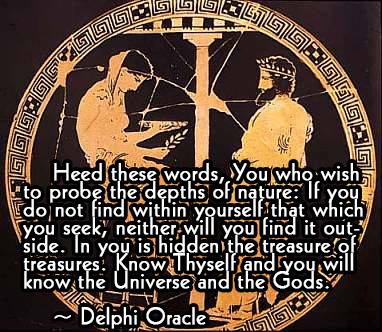
"If
you do not know yourself, your unconscious as well as your conscious states,
all your inquiry will be twisted, given a bias. You will have no foundation for
thinking which is rational, clear, logical, sane. Your thinking will be
according to a certain pattern, formula, or set of ideas - but that is not
really thinking. To think clearly, logically, without becoming neurotic,
without being caught in any form of illusion, you have to know this whole
process of your own consciousness."
--J. Krishnamurti
"You see,
inasmuch as the living body contains the secret of life, it is an intelligence.
It is also a plurality which is gathered up in one mind, for the body is
extended in space, and the here and the there are two things; what is in your
toes is not in your fingers, and what is in your fingers is not in your ears or
your stomach or your knees or anywhere else in your body.
"Each part is
always something in itself. The different forms and localizations are all
represented in your mind as more or less different facts, so there is a
plurality.
What you think with
your head doesn’t necessarily coincide with what you feel in your heart, and
what your belly thinks is not what your mind thinks.
The extension in
space, therefore, creates a pluralistic quality in the mind.
"Since psyche and matter are
contained in one and the same world, and moreover are in continuous contact
with one another and ultimately rest on irreprehensible, transcendental
factors, it is not only possible but fairly probable, even, that psyche and
matter are two different aspects of one and the same thing. The synchronicity
phenomena point, it seems to me, in this direction, for they show that the
nonpsychic can behave like the psychic, and vice versa, without there being any
causal connection between them."
~ Carl Jung, "On
the Nature of the Psyche"
"That is probably
the reason why consciousness is possible. Different things are represented, and
these are always supposed to be in a field of consciousness, in a sort of
extension, that is. Yet you feel that the whole, that plurality, is drawn
together and referred to something you call "I"; it is referred to a
center which you cannot say has extension, as little as you can say of a
thought that it has extension.
"Thought is a
disembodied something because it has no spatial qualities. So "I" is
as if it were something abstract, yet in a vague way it coincides with your
body; when you say "I" you beat your chest for instance, to emphasize
the "I."
--Carl Jung, Zarathustra Seminar, Page
360.
"If
a story is seed, then we are its soil. Just hearing the story allows us to
experience it as though we ourselves were the heroine who either falters or
wins out in the end. If we hear a story about a wolf, then afterward we rove
about and know like a wolf for a time. If we hear a story about a dove finding
her young at last, then for a time after, something moves behind our own
feathered breasts. If it be a story of wresting the sacred pearl from beneath
the claw of the ninth dragon, we feel exhausted afterward, and satisfied. In a
very real way, we are imprinted with knowing just by listening to the
tale."
--Clarissa
Pinkola Estes
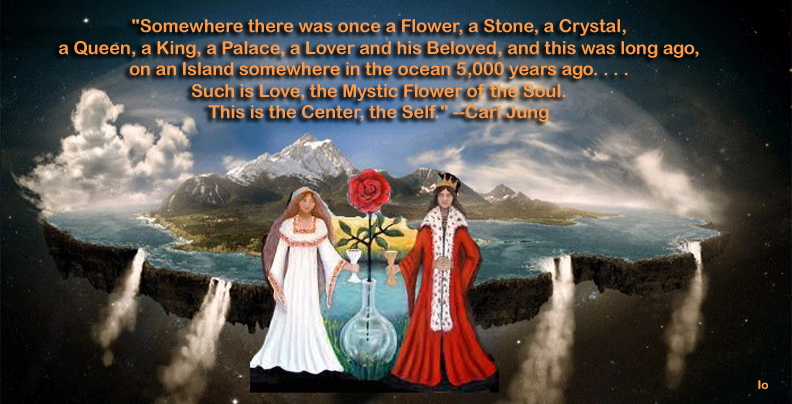
"Consciousness, no matter how extensive it may be, must always remain the smaller circle within the greater circle of the unconscious, an island surrounded by the sea; and, like the sea itself, the unconscious yields an endless and self-replenishing abundance of living creatures, a wealth beyond our fathoming." ~Carl Jung, CW 16, Para 366.
SPONTANEOUS
PRESENCE
LONG AGO & FAR
AWAY
Uncanny Intelligence
“Ye are Blood of my Blood, and Bone
of my Bone,
I give ye my Body, that we
Two might be One.
I give ye my Spirit, 'til
our Life shall be Done.”
--Diana Gabaldon,
Outlander
Love is a force of destiny
whose power reaches from heaven to hell.
~Carl Jung, CW 10,
Para 198.
Life inevitably leads
down into reality.
~Carl Jung,
Zarathustra Seminar, Page 508
Inasmuch as the living
body contains the secret of life, it is an intelligence.
~Carl Jung,
Zarathustra Seminar, Page 360.
If you fulfill the pattern
that is peculiar to yourself, you have loved yourself, you have accumulated and
have abundance; you bestow virtue then because you have luster. ~Carl Jung, Zarathustra Seminar, Page
502
You see, life wants to
be real; if you love life you want to live really, not as a mere promise
hovering above things.
~Carl Jung, Zarathustra Seminar, Page 508
And if you lose yourself
in the crowd, in the whole of humanity, you also never arrive at yourself; just
as you can get lost in your isolation, you can also get lost in utter
abandonment to the crowd. ~Carl Jung, Zarathustra Seminar, Page 1020
The spirit consists of
possibilities-one could say the world of possibilities was the world of the
spirit. The spirit can be anything, but the earth can only be something
definite. So remaining true to the earth would mean maintaining your conscious
relationship to the body. Don't run away and make yourself unconscious of
bodily facts, for they keep you in real life and help you not to lose your way
in the world of mere possibilities where you are simply blindfolded. ~Carl Jung, Zarathustra Seminar, Pages 66-67
Wisdom begins only when
one takes things as they are; otherwise we get nowhere, we simply become
inflated balloons with no feet on the earth.
So it is a healing
attitude when one can agree with the facts as they are; only then can we live
in our body on this earth, only then can we thrive.
~Carl Jung, Visions
Seminar, Page 545
"Life,
so-called, is a short episode between two great mysteries, which yet are one. I
cannot mourn the dead. They endure, but we pass over. .."
~Carl Jung, Letters Vol. 1, Page 483.
Life is of the nature
of water: it always seeks the deepest place, which is always below in the
darkness and heaviness of the earth.
~Carl Jung,
Zarathustra Seminar, Page 508
We cannot say the side
of the spirit is twice as good as the other side; we must bring the pairs of
opposites together in an altogether different way, where the rights of the body
are just as much recognized as the rights of the spirit.
~Carl Jung,
Zarathustra Seminar, Page 235.
In the center is the
individual where the opposites are united, the one peaceful spot in man, the
space where nothing moves embedded in a world of chaos.
The task is now to bring
about order, the alchemistic process must begin, namely, the production of the
valuable substance, the transformation into the light.
~Carl Jung, Visions
Seminar, Page 263
Psyche (or soul) is the
“third, mediating standpoint” or terrain upon which the fundamentally opposite
worlds of inner and outer, idea and thing, can be “joined together in living
union.”
~Jeffrey C. Miller, The Transcendent Function, Page 36.
“If there be light,
then there is darkness; if cold, heat; if height, depth; if solid, fluid; if
hard, soft; if rough, smooth; if calm, tempest; if prosperity, adversity;
if life, death.” ―Pythagoras
“I love him who
justifieth the future ones, and redeemeth the past ones: for he is willing to
succumb through the present ones.” [Nietzsche]
That complete surrender to
the present necessities means of course a fulfilment,
a redemption of the past
generations, and of the unfulfilled lives that are
waiting to be fulfilled.
If we live completely, we
surrender to their lives and redeem them.
Also, we prepare for a
future generation, because we have lived out our own lives; we have fulfilled
them, and we leave no curse for the
following generations—the
curse of economized life.
~Carl Jung, Zarathustra Seminar, Page 89.
Treehuggers, DFA, Iona MIller
The capacity for
imagination is one of the most fascinating features of the human mind. Not only
is it useful in problem-solving but it also conjures up all kinds of stories to
delight our hearts and minds. Some of these stories are partly true, others are
wholly made up. In any case, as far as stories go, truth and falsity is beside
the point. Some stories capture our imagination or otherwise resonate so deeply
that they acquire epic status. The heroes and heroines of these tales acquire
legendary abilities; their beauty has the capacity to “launch a thousand
ships”; and their strength the ability to lift mountains. Eventually, some of
them are bestowed with divine status. While some people may scoff at the powers
we bestow upon our deities, others delight in these tales, and yet others
sincerely believe them to be true. Whatever the case may be, both the
nay-sayers and the believers come together on important occasions and in times
of grand festivities to invoke their deities and to propitiate them for
continued happiness. These stories and epics also provide the raw material for
deep philosophical discussions and serve as a foundation for ethics or even political
theory. In this manner, entire civilizations may coalesce around their epics.
http://swarajyamag.com/ideas/the-myth-of-secularism-a-primer-for-pagans
Genealogical
Research is a Marathon, Not a Sprint
ORESTES:
Here is the last labor
To spend on humanity.
I saw a vision of us move in the dark:
all that we did or
dreamed of
Regarded each other,
the man pursued the woman, the woman
clung to the man,
warriors and kings
Strained at each other
in the darkness, all loved or fought inward,
each one of the lost
people
Sought the eyes of
another that another should praise him; sought
never his own but
another's; the net of desire
Had every nerve drawn
to the center, so that they writhed like a
full draught of
fishes, all matted
In the one mesh; when
they look backward they see only a man
standing at the
beginning,
Or forward, a man at
the end; or if upward, men in the shining
bitter sky striding
and feasting,
Whom you call Gods . .
.
It is all turned
inward, all your desires incestuous, the woman the
serpent, the man the
rose-red cavern,
Both human, worship
forever . . .
--Robinson Jeffers, "The Tower
Beyond Tragedy"
“ … If a person
were to stop all his outer and inner movements at a given moment in order to
see what is acting in him, he would nearly always feel a tendency which has
about it something narrow, something heavy, something with a negative aspect
that tends to be against, to be egoistic. All that is usually going on unseen.
But if he tries to awaken to what is going on in himself, to be sincere, he
will be able to witness, in addition to what could be called the “coarse” life
in him, another life of another quality–much subtler, much higher, lighter–that
is also part of himself. The contact with this other quality of life helps him
to have a quieter presence, as deeper vision. And he feels an urge at that
moment to be open to a quality of this sort that would have a force that would
be a center of gravity. He begins to search for a way to serve what he feels
would be his real being."
--Pauline de Dampierre, “Engines of
Our Nature”, PARABOLA Vol.X, No.4; & Spring 2015
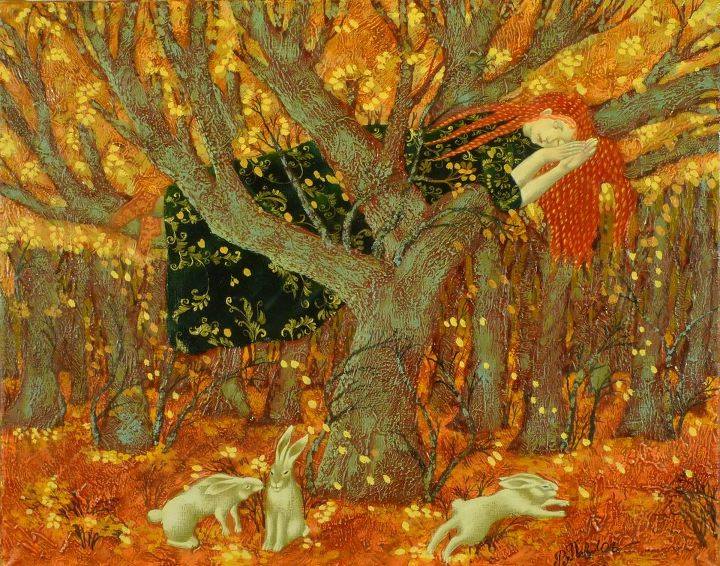
Vera Pavlova
UP
A TREE - YOUR ANCESTRY
For you should leave
some trace in this world which notifies that you have been here, that something
has happened. If nothing happens of this kind you have not realized yourself;
the germ of life has fallen, say, into a thick layer of air that kept it
suspended.
~Carl Jung, Kundalini Seminar, Page 28
It is utterly important
that one should be in this world, that one really fulfills one’s entelechia,
the germ of life which one is. ~Jung, Kundalini Seminar, Page 28
Selfish desire
ultimately desires itself. You find yourself in your desire, so do not say that
desire is vain. If you desire yourself you produce the divine son in your
embrace with yourself. Your desire is the father of the God, your self is the
mother of the God, but the son is the new God, your master.
~Carl Jung, The Red
Book, Page 245.
But the spirit of the
depths said: "No one can or should halt sacrifice. Sacrifice is not destruction;
sacrifice is the foundation stone of what is to come. Have you not had
monasteries? Have not countless thousands gone into the desert? You should
carry the monastery in yourself. The desert is within you.
~Carl Jung, The Red
Book, Page 230.
When the flame of
your greed consumes you, and nothing remains of you but ash, so nothing of you
was steadfast. Yet the flame in which you consumed yourself has illuminated
many. But if you flee from your fire full of fear, you scorch your fellow men,
and the burning torment of your greed cannot die out, so long as you do not
desire yourself. ~Carl
Jung, The Red Book, Page 311.
The solitary went into
the desert to find himself. But he did not want to find himself but rather the
manifold meaning of holy scripture. You can suck the immensity of the small and
the great into yourself and you will become emptier and emptier, since immense
fullness and immense emptiness are one and the same. ~Carl Jung, The Red Book, Page 273.
Remember that you
can know yourself and with that you know enough. But you cannot know others and
everything else. Beware of knowing what lies beyond yourself or else your
presumed knowledge will suffocate the life of those who know themselves. A
knower may know himself. That is his limit.
~Carl Jung; The Red Book; Page 306.
You should always
ask yourself what you desire, since all too many do not know what they want. ~Carl Jung, Liber Novus, Page 249,
Footnote 190.
This is how madness
begins, this is madness ... You cannot get conscious of these unconscious facts
without giving yourself to them. If you can overcome your fear of the
unconscious and can let yourself go down, then these facts take on a life of
their own. ~Carl
Jung, Liber Novus, Page 253. Footnote 211.
In this deification
mystery you make yourself into the vessel, and are a vessel of creation in
which the opposites reconcile. ~Carl Jung, Liber Novus, Page 253.
Footnote 211.
You announced
yourself to me in advance in dreams. They burned in my heart and drove me to
all the boldest acts of daring, and forced me to rise above myself. You let me
see truths of which I had no previous inkling. You let me undertake journeys,
whose endless length would have scared me, if the knowledge of them had not
been secure in you. ~Carl
Jung, Liber Novus, Page 233.
What is meant is,
that you should be with yourself, not alone but with yourself, and you can be
with yourself even in a crowd. ~Carl Jung, Zarathustra Seminar, Page
1484.
To love someone
else is easy, but to love what you are, the thing that is yourself, is just as
if you were embracing a glowing red-hot iron: it burns into you and that is
very painful. ~Carl
Jung, Zarathustra Seminar, Page 1473.
Therefore my
formula: for the love of mankind and for the love of yourself-of mankind in
yourself-create a devil. That is an act of devotion, I should say; you have to
put something where there is nothing, for the sake of mankind.
~Carl Jung, Zarathustra Seminar, Page
1322.
You see, in the
actual functioning of the psyche, it does not matter whether you do a thing or
whether it happens to you; whether it reaches you from without or happens
within, fate moves through yourself and outside circumstances equally. ~Carl Jung, Zarathustra Seminar, Page
896.
If you succeed in
remembering yourself, if you succeed in making a difference between yourself
and that outburst of passion, then you discover the self; you begin to
individuate. ~~Carl
Jung, The Psychology of Kundalini Yoga, Pages 39-40.
If the projected
conflict is to be healed, it must return into the psyche of the individual,
where it had its unconscious beginnings. He must celebrate a Last Supper with
himself, and eat his own flesh and drink his own blood; which means that he
must recognize and accept the other in himself. . . . Is this perhaps the
meaning of Christ’s teaching, that each must bear his own cross? For if you
have to endure yourself, how will you be able to rend others also? ~Carl Jung; Mysterium Coniunctionis
You are light and
life, like God the Father of whom Man was born. If therefore you learn to know
yourself... you will return to life. ~Corpus Hermeticum I, Poimandres, 21.
Whenever we touch
nature we get clean. People who have got dirty through too much civilization
take a walk in the woods or a bath in the sea. They shake off the fetters and
allow nature to touch them. It can be done within or without. Walking in the
woods or laying on the grass, taking a bath in the sea are from the outside
entering the unconscious, entering yourself through dreams is touching nature from
the inside and this is the same thing, things are put right again. ~Carl Jung, Dream Analysis; Notes on
a Lecture given 1928-1930.
It will be good for
your humility if you can accept the gifts of the unconscious guide that dwells
in yourself, and it is good for your pride to humiliate itself to such an
extent that you can accept what you receive. ~Carl Jung, Letters Vol. 1, Page
458-459.
You yourself are a
conflict that rages in itself and against itself, in order to melt its
incompatible substances, the male and the female, in the fire of suffering, and
thus create that fixed and unalterable form which is the goal of life. ~Carl Jung, Letters Vol. 1, Page 375.
You must go in
quest of yourself, and you will find yourself again only in the simple and forgotten
things. Why not go into the forest for a time, literally? Sometimes a tree
tells you more than can be read in books… ~Carl Jung, Letters Vol. 1, Page 479.
There is no point
in delivering yourself over to the last drop. . . . In my view it is absolutely
essential always to have our consciousness well enough in hand to pay
sufficient attention to our reality, to the Here and Now. ~Carl Jung, Letters Vol. 1, Page 239.
The experience of
wholeness is, quite to the contrary, an extremely simple matter of feeling
yourself in harmony with the world within and without. ~Carl Jung, Letters Vol. II, Page
456.
It is legitimate to
ask yourself what it is that carries the qualities of the archetypal and
synchronistic, and to pose the question, for instance, of the intrinsic nature
of the psyche or of matter. ~Carl Jung, Letters Vol. II, Page
445-449
If you fulfil the
pattern that is peculiar to yourself, you have loved yourself, you have
accumulated and have abundance; you bestow virtue then because you have luster.
~Carl
Jung, Zarathustra Seminar, Page 502
But if you hate and
despise yourself—if you have not accepted your pattern— then there are hungry
animals (prowling cats and other beasts and vermin) in your constitution which
get at your neighbours like flies in order to satisfy the appetites which you
have failed to satisfy. ~Jung, Zarathustra Seminar, Page 502
Don’t run away and
make yourself unconscious of bodily facts, for they keep you in real life and
help you not to lose your real way in the world of mere possibilities where you
are simply blindfolded. ~Jung, Zarathustra Seminar, P. 66
The great lure of
the archetypal situation is that you yourself suddenly cease to be. You cease
to think and are acted upon as though carried by a great river with no end. You
are suddenly eternal. ~Carl Jung, Zarathustra Seminar, Page 240.
You can only know
yourself if you get into yourself, and you can only do that when you accept the
lead of the animal. ~Carl
Jung, Visions Seminar, Page 458.
By removing yourself
from the dogma you get into the world which is increasingly chaotic and
primitive, in which you must find
or create a new
orientation. ~Carl
Jung, Visions Seminar, Page 905
You see, the shoot must
come out of the ground, and if the personal spark has never gotten into the
ground, nothing will come out of it; no linga [creative core] or Kundalini will
be there, because you are still staying in the infinity that was before. ~Carl Jung, Kundalini Seminar, Page
29
You must believe in this
world, make roots, do the best you can, even if you have to believe in the most
absurd things—to believe, for instance, that this world is very definite, that
it matters absolutely whether such-and-such a treaty is made or not. ~Carl Jung, Kundalini Seminar, Page
29
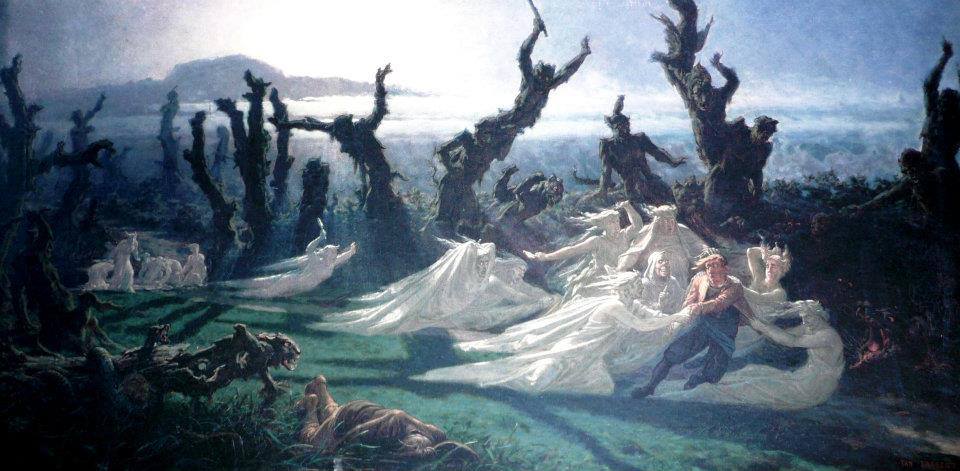
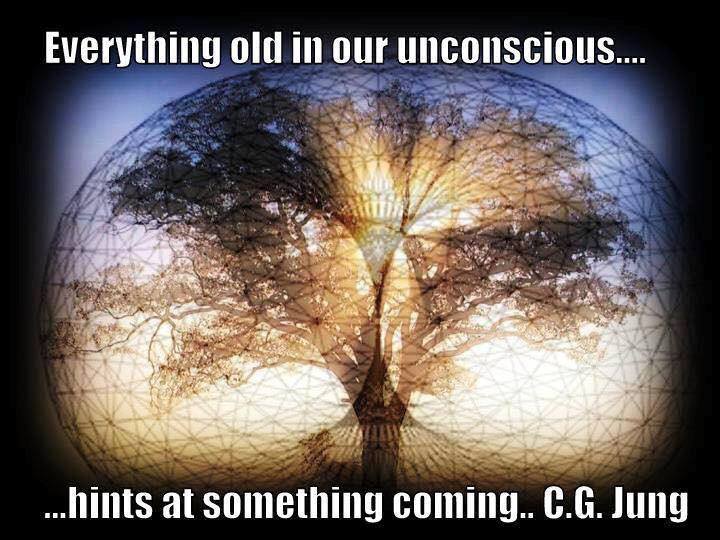
YOUR
TREE IS YOUR SANCTUARY
Tree
of Spirits, Initiation, & Fate
For the archetype is
nothing human; no archetype is properly human.
~Carl Jung,
Zarathustra Seminar, Page 1343.
The
World Tree is the great archetype. The World Tree is a common image in shamanic
experiences from both traditional societies and in modern shamanic groups. In
this tree spirits pass from one world to another. It is the holy center. http://www.shamaniccircles.org/2002oraclefolder/worldtree.html
The World Tree is the
center of the world, but in shamanic paradox, the center of the world is also
everywhere. In shamanic ritual or performance, the shaman operates in an
altered state of consciousness with one foot in both realities. In this state,
the the shaman 'becomes' the World Tree, and the place of that ritual becomes
the center of the world.
The World Tree forms
an integral part of the shamanic cosmos, linking the world of humanity with the
world of the spirits. It is depicted in numerous tales of shamanic ritual and
in power objects.
Genealogy is an
ancient shamanic tool, like journeying and dialoguing. Working with the
energies of dreams, death, and initiation helps us change our story and reveal
our true nature which we can celebrate in ritual, including ancestral work. Our
oldest ancestors can still be found at the edge of oblivion -- each generation
another wave upon waves of possibility.
“Do you think that
somewhere we are not Nature, that we are different from Nature? No, we are in
Nature and think exactly like Nature.”
- C.G. Jung The Earth Has
a Soul.
Climbing
trees is part of the natural growth process which helps us become more fully
human. You may remember when you were a child, climbing up into a tree in your
yard, or that of your grandparents -- a place to hide and lick your childhood
wounds and let the imagination soar, or maybe watch an approaching storm. That
tree was your first archaic temple.
From that lofty perch
you felt the wind in your hair, experienced the dappled sunlight, and gained a
new perspective, from which you could observe a bigger picture of the landscape
and the unfolding story of your life. You may also have been aware of the
elegance and beauty of the tree itself as your sanctuary and haven.
You might even have
had a treehouse, a sanctuary in the green leaves and a lively space far above
ordinary life where your 'observer self' and imagination could roam or 'fly',
and you felt you could see forever. Then, perhaps you climbed even higher. Did
you keep your power objects there? As an adult, you may have created a
treehouse for your own children.
Traditionally, such a
treehouse reminds us that climbing up and down trees was the work of ancient
shaman, who entered that sacred space to speak with the ancestors, find
healing, enter altered states, and commune with the cosmos.
Your family treehouse
of the imagination is the House of your family surname -- your dynastic
inheritance and legacy. It is the repository of your family history, including
all the maternal lines of the realm of the mothers. Such a treehouse is where
we can go for family reunions, relational intimacy, and to commune with
ourselves.
That tree embodies our
family. "We suffer very much from the fact that we consist of mind and
have lost the body." (Jung, Zarathustra Seminar, Page 251.) The self is a fact of nature and
always appears as such in immediate experiences, in dreams and visions, and so
on; it is the spirit in the stone, the great secret which has to be worked out,
to be extracted from nature, because it is buried in nature herself.
~Carl
Jung, Zarathustra Seminar, Page 977.
The unconscious on one
side is nothing but nature, and on the other hand it is the overcoming of
nature; it is yea and nay in itself, two things in one.
So we shall never
understand what the unconscious is, as we shall never understand what the world
is,because it is and it is not.
~Carl Jung, Visions
Seminar, Page 89.
Your family tree is a
synthesis of the ascent to higher consciousness and descent into more soulful
living. All your beloved relatives still have a place there, or in your
collateral lines -- a place where we can visit and honor them, or even work
toward healing. It helps us live a sacred life of wisdom, heart and service,
honoring all the parts of our being and all the dimensions of our life.
This
work is at the heart of an embodied and inspiring expression of higher
consciousness in day-to-day life, in which we come to honor our unique quirks,
challenges and personality traits, as well as our depths, and the lives and
legacies of our ancestors. You are a specific configuration of traits and
opinions.
"The
unconscious can make a fool of you in no time."
(Jung, Visions
Seminar, Page 747).
"No matter what your
conscious attitude may be, the unconscious has an absolutely free hand and can
do what it pleases."
(Jung, Visions Seminar, P. 27)
"But
your attitude to it [death] matters, how you will take it, whether you believe
in immortality or not, how you react to such and such an event, that matters to
the unconscious." (Jung, Visions
Seminar, Page 903.)
We
learn to perceive the blessing in our wounds, and the liberation that beckons
to us from our shadows. Buddhists suggest that the initial consciousness
emerges as a vision of the clear light manifesting as a sight for the eye of
wisdom. We simultaneously open to the vastness of Spirit and the beauty and
depth of soul.
Worldviews Collide
It is a great
privilege to live in a culture where we can recognize our birthright as free
spiritual beings to a greater or lesser extent. But that may not have been so
for our 2 parents, 4 grandparents, our 8 great grandparents,
or
our 16 great-great grandparents, much less our medieval and ancient ancestral
lines. Many were born into systems their lives depended upon, whether or not
they truly believed.
Where there is great
passion, there is also great resentment. Heresy was punishable by death.
Puritan, Quaker, Anglican, Johannite, or other religious ancestors, from the
Gnostics, to the Inquisition, sought their version of spiritual freedom, at
whatever cost to themselves or those who they fought or to lands they
appropriated from it.
Spiritual Identity
Protestants persecuted
Puritans who persecuted Quakers, like Roman Catholics persecuted Jews, Moors,
and Cathars. Protestant vs. Catholic, Crusaders vs. Muslims, Christians vs.
Pagans, etc. they all wished to 'purify' their ideas of religion. Certainly,
there are many sides to the slings and arrows of holy wars, migration and
beliefs when cultures clash. Each ethnicity has its traumas and issues and
transitions. Often we have ancestors on both sides of conflicts, even in the
same family.
Even if we look back
only a generation or two we encounter ancestors whose spiritual self-identity
and worldview we would now consider blindingly ignorant -- spiritual
bondage rather than spiritual liberation. Yet the depth of commitment to the
spiritual impulse remains the same. They searched within and this is what makes
us interested in people who lived hundreds or thousands or years ago, to
reconnect with the earth and be part of it as a culture, even if we are not
sure how to do it.
RITUAL
"In the realm of
sacred space, its most striking manifestation is religious man's will to take
his stand at the very heart of the real, at the center of the World, that is,
exactly where the cosmos came into existence and began to spread out toward the
four horizons, and where, there is possibility of communication with the gods,
where he is closest to the gods. Every religious man places himself at the
Center of the World and by the same token at the very source of absolute
reality, as close as possible to the opening that ensures him communication
with the gods."
--Mircea Eliade/The
Sacred and the Profane"
Magical practices are the
projections of psychic events which, in cases like these, exert a counter
influence on the soul and act like a kind of enchantment of one's own
personality. That is to say, by means of these concrete performances the
attention, or better said, the interest, is brought back to an inner sacred
domain which is the source and goal of the soul. This inner domain contains the
unity of life and consciousness which, though once possessed, has been lost and
must now be found again."
--C.G. Jung/Secret of the Golden Flower
The main value of
ritual is for the soul. Ritual can be defined as an imitation of a Numinous
Element (or godform) in the life of the aspirant. Ritual can be seen as the
outward or visible form of contact, or an epiphany with, an inward or spiritual
grace. It is essentially a metaphorical expression of creative imagination.
"The distinction
between concrete and literal, so important to alchemy, is the essential
distinction in ritual. The ritual of theater, of religion, of loving, and of
play require concrete actions which are never what they literally seem to be.
Ritual offers a primary mode of pathologizing, of deliteralizing events and
seeing them as we "perform" them. As we go into a ritual, the soul of
our actions "comes out"; or to ritualize a literal action, we "put
soul into it."...Ritual brings together action idea into an
enactment."
--James Hillman/Re-Visioning Psychology.
http://zero-point.tripod.com/holistic/sphere10.html
Jung expands on the
concept that ritual acts stand in direct contrast to technical acts. The former
are purely symbolic, while the later are purposeful. This means that when one
is doing something specific, one is purposeful in the action.
A ceremony is magical so
long as it does not result in effective work but preserves the state of
expectancy. In that case the energy is canalized into a new object and produces
a new dynamism, which in turn remains magical only so long as it does not
create effective work.
--C.G. Jung/"On the Nature of the Psyche"
Ceremonies and rituals
are the means for periodically drawing up the sums of energy, or libido,
attached to symbols. Only periodic or regular repetition provokes expectation.
Therefore, since archetypal processes are recurrent or chronic, regular
repetition of rituals builds expectations.
Symbols are the
abstract forms of religious ideas. They are expressed as rites or ceremonies in
the form of action. Only through a symbol, can a portion of energy which
customarily goes toward sustaining the regular course of life be transformed
and channeled into another form. This produces cultural, rather than
instinctive, activity. Its by-product is the creation of surplus energy, which
is then at the free disposal of the ego which can use this energy for further
transformation. When one makes ritual use of symbols, they are prevented from
falling back into a purely subconscious form of manifestation, (for instance
disease, or neurosis).
According to Robert
Grinnell, in Alchemy
in a Modern Woman,
women bear a particular relationship to the unconscious and ritual; this bears
on her deepest significance.
This distinction between
feminine and masculine ways of experiencing the unconscious can best be seen in
the different ways prima materia is represented. Whereas in a man's psychology
the unconscious as prima materia is experienced as chaos, as violent and
irrational processes of generation and destruction, in a woman it appears as a
fascinating psychic background for sacred images and rituals expressive of her
fundamental feminine conscience.
Later, he goes on
expanding on this feminine experience.
Here we have both the
problem and the deeper meaning of the "modern woman." For just as she
produces an intensified polarity which seems very "modern" and raises
to consciousness factors which seem "masculine" and which are left
out of the dominant masculine view, so too she activates the unconscious rites
linked to forgotten customs belonging to the primitive state of man whose aim
was precisely to reconcile conflicting opposites. These rites are performed by
men and women, but their content emanates from the divine sphere which is past,
present, and future. These rites unite the instinctual pattern or pole of the
constellated archetype to its divine, spiritual pole: the animal shadow of the
archetype and its superhuman, divine aspect are linked together. A
"reversal" occurs, in which the shadow of a latent consciousness at a
psychoid level is extracted and "sublimated."
“The
real miracle of individuation and reclamation of the Wild Woman is that we all
begin the process before we are ready, before we are strong enough, before we
know enough; we begin a dialogue with thoughts and feelings that both tickle
and thunder within us. We respond before we know how to speak the language,
before we know all the answers, and before we know exactly to whom we are
speaking.” --Clarissa Pinkola Estés
The
archetype in its archaic aspect is raised to a contemporary level.
Only if you first
return to the body, to your earth, can individuation take place, only then does
the thing become true. --Jung,
Visions Seminar, P. 1314
GROUP
RITUAL
[Carl Jung on Secret
Societies and the member who fails to differentiate themselves.]
The secret society is
an intermediary stage on the way to individuation. The individual is still
relying on a collective organization to effect his differentiation for him;
that is, he has not yet recognized that it is really the individual's task to
differentiate himself from all the others and stand on his own feet.
All collective
identities, such as membership in organizations, support of "isms,"
and so on, interfere with the fulfillment of this task.
Such collective
identities are crutches for the lame, shields for the timid, beds for the lazy,
nurseries for the irresponsible; but they are equally shelters for the poor and
weak, a home port for the shipwrecked, the bosom of a family for orphans, a
land of promise for disillusioned vagrants and weary pilgrims, a herd and a
safe fold for lost sheep, and a mother providing nourishment and growth.
It would therefore be
wrong to regard this intermediary stage as a trap; on the contrary, for a long
time to come it will represent the only possible form of existence for the individual,
who nowadays seems more than ever threatened by anonymity.
Collective
organization is still so essential today that many consider it, with some
justification, to be the final goal; whereas to call for further steps along
the road to autonomy appears like arrogance or hubris, fantasticality, or
simply folly. ~Carl Jung; Memories Dreams and Reflections; Page 342.
If one never gains
"a separate independent self", the quest for union cannot begin: one
has never left the fold:
“It seems ironic that later in life,
if we pursue a spiritual path, we struggle with the ego, to still the stream of
incessant chatter that began at our birth, and to realize our own nothingness,
in order to make room in ourselves for something greater than the ego. But it takes
a strong ego with a critical mind to distinguish what is genuinely greater from
what is ersatz, and to surrender voluntarily to ... what one has been looking
for all one’s life. If we had not been called out of nonbeing by our mother and
father, or those who undertook to fill their places, there would be no pilgrim
to set out on the search.”
(Martha Heyneman, “The Mother Tongue.” *Parabola* 7(3), Aug/92. 4-12.)
https://books.google.com/books?id=XLqEWwa7fT8C&printsec=frontcover#v=onepage&q&f=false
Ancestral Roots of
Certain American Colonists who Came to America Before 1700
...By Frederick Lewis
Weis
WOMB
AT THE TOP:
THE SACRED FEMININE
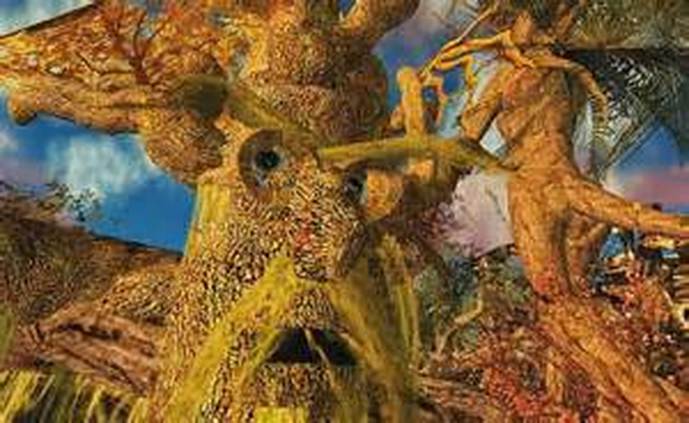
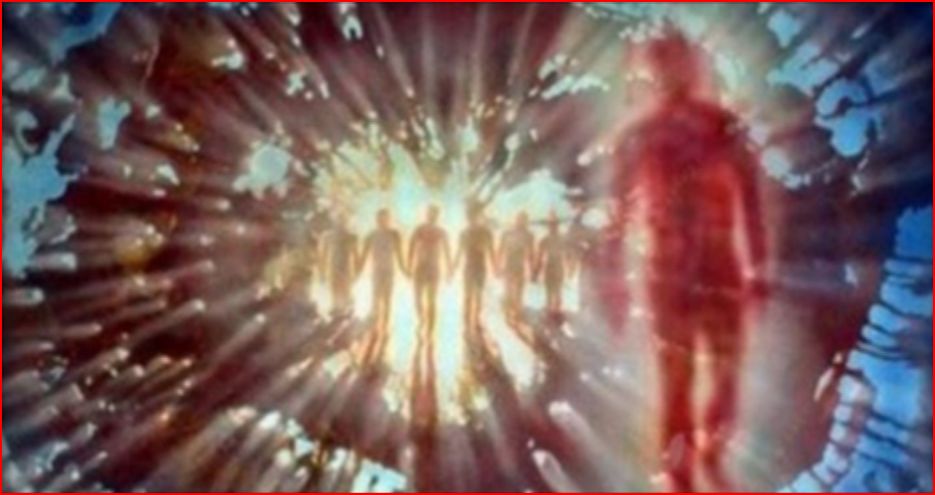
CIRCUMAMBULATION
Each branch of our
family tree ofers the opportunity for circumambulation throughout its extent
and a fuller return to yourself.
The Circumambulation,
says Eliade: "The road is arduous, fraught with perils, because it is, in
fact, a rite of passage from the
profane to the sacred, from the ephemeral and illusory to reality and to
eternity, from death to life, and from man to God. Access to the 'Centre' is
equivalent to a consecration, an initiation; the existence of yesterday,
profane and illusory, it happens a new life, real, lasting and effective."
Jung adds: "the
circumambulation is not a simple circular motion, but it means on the one hand
the delimitation of the sacred enclosure [temenos], And on the other hand, the
determination and concentration. [...] This movement would be in a spin in a
circle around themselves ', So as to involve all the sides of his personality.
The Circular motion has therefore also the moral significance of animation of
all the forces that are clear and dark of human nature, and as a result of all
opposites psychological, of any nature can be."
Remember
ღ
Once upon a Time?
“A story is alive, as
you and I are.
It is rounded by
muscle and sinew.
Rushed with blood.
Layered with skin,
both rough and smooth.
At its core lies soft
marrow of hard, white bone.
A story beats with the
heart of every person
who has ever strained
ears to listen.
On the breath of the
storyteller, it soars.
Until its images and
deeds become so real
you can see them in
the air, shimmering
like oases on the
horizon line.
A story can fly like a
bee, so straight and swift
you catch only the hum
of its passing.
Or move so slowly it
seems motionless,
curled in upon itself
like a snake in the sun.
It can vanish like
smoke before the wind.
Linger like perfume in
the nose.
Change with every
telling, yet always
remain the same.”
--Cameron Dokey
Flickering
Awareness
Consciousness
arises only in time intervals of up to 400 milliseconds, with gaps of
unconsciousness in between, according to a scientific research team at the
Ecole Polytechnique Fédérale de Lausanne. According to their findings,
consciousness forms as a series of short bursts of up to 400 milliseconds, with
gaps of background, unconscious information processing in between -- where the
innermost essence of mankind is born.
We can imagine each
nanosecond we check out as checking in to the utterly non-conscious, primordial
awareness we share directly with our progenitors. This flicker is like the
screen refresh rate, reducing all we experience to a series of frames second.
Michael Herzog at EPFL and Frank Scharnowski at the University of
Zurich now put forward a new model of how the brain processes unconscious
information, suggesting that consciousness arises only in intervals up to 400
milliseconds, with no consciousness in between.
In 1917 Jung wrote
of 'dominants of the collective unconscious' which he characterized as
'nodal points' of psychic energy. Jung compared psyche's luminous experiences
with the light impressions described by the alchemists.
Considering the
primordial nature of the psyche, he reflected on the 'seeds of light
broadcast in the chaos' (Khunrath) , of the 'scintillae' (Dorn), of fish-eyes
at the bottom of the sea, or images of luminous serpent eyes. He spoke of the
virtual light of such luminous nodal points emerging from the abyssal depths of
psyche, eventually including dynamical processes and all types of universally
recurring patterns of behavior in the psyche.
Diamond Sea of
Scintillae
Jung sourced
alchemical ideas to fund his psychological theory. The most prominent
alchemical symbol is the scintillae, or germinal divine sparks of the spirit.
He thought what the alchemists saw in matter was a projection, but it may be
direct insight, perception of metaphysical reality. These seeds of light
broadcast in the chaos are not illusory. Paracelsus, Khunrath and Dorn related
them to the lumen
naturae
which illuminates consciousness like a diamond-strewn night sky.
They are more than
symbolic. Jung linked them to the Sun, luminosity and numinosity. We labor in
the dark of the unconscious until we see these glittering "fishes
eyes" that herald the solar light. These multiple eyes reflect our many
facets back to ourselves. Comparable with archetypes, these multiple
intensities herald psyche's reunification with the unconscious, sparkling in
the margins of astral vision. The union of the scintillae forms gold. Sparks
shining in the dark solution are the first glimmers of immortality.
In essence, consciousness
is located everywhere in the universe at the center of origin of every radiant
energy field and fundamental particle. The universe and every field and form in
it originates from and rests on its infinite zero-points of timeless and
dimensionless (thus "empty" and "eternal") absolute or
"ground space." Each zero-point (acting contiguously with all other
zero points, as one thing, like a BEC) contains the total potential mass energy
of the entire cosmos. All the energy and structural information of the entire
cosmos is contained in every zero point and every standing wave particle center
field.
"Your being has two sides...one
visible, the other invisible. With open eyes you behold objective
creation, and yourself in it. With closed eyes you see nothing, a dark
void; yet your consciousness, even when dissociated from form, is still keenly
aware and operative. If in deep meditation you penetrate the darkness behind
closed eyes, you behold the Light from which all creation emerges. By deeper
samadhi, your experience transcends even the manifested Light and enters the
All-Blissful Consciousness -- beyond all form, yet infinitely more real,
tangible and joyous than any sensory or supersensory perception." --Yogananda
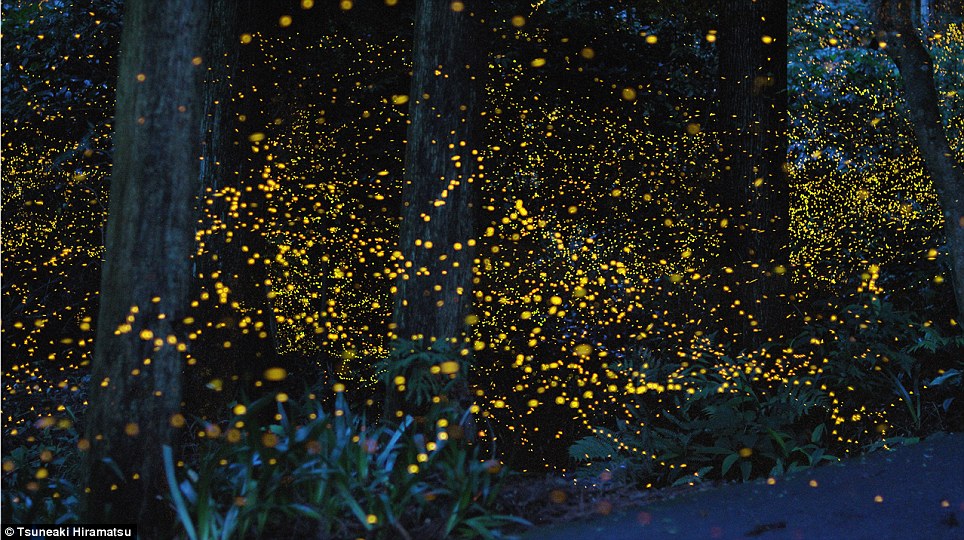
THE
UNKNOWN SELF
Dreamers, Seekers,
& the One Who Realizes the Dream
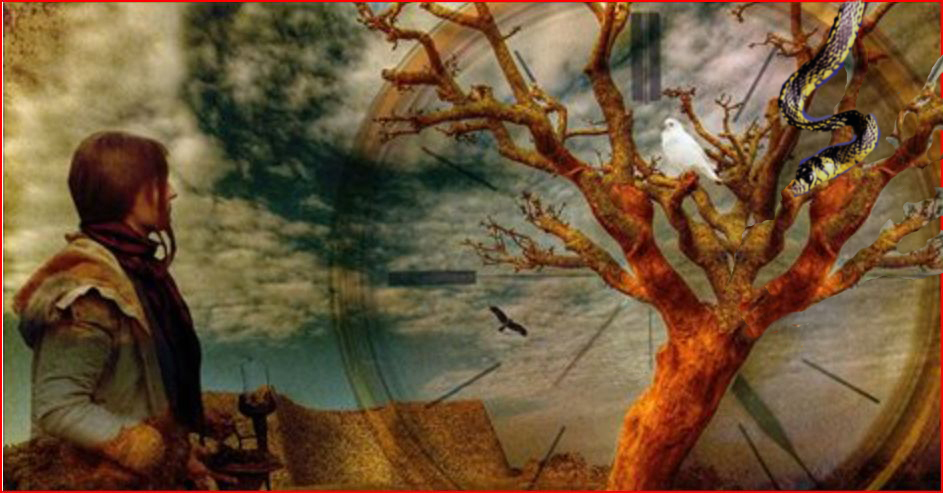
Daimon, Serpent & Bird
The daimon of sexuality
approaches our soul as a serpent. She is half human soul and is called
thought-desire. The daimon of spirituality descends into our soul as the white
bird. He is half human soul and is called desire-thought.
~Carl Jung, Liber Novus, Page 354.
If I am not conjoined
through the uniting of the Below and the Above, I break down into three parts:
the serpent, and in that or some other animal form I roam, living nature
daimonically, arousing fear and longing. The human soul, living forever within
you. The celestial soul, as such dwelling with the Gods, far from you and
unknown to you, appearing in the form of a bird. ~Carl Jung’s Soul to him,
Black Books, Appendix C., Page 370.
But if the depths have
conceived, then the symbol grows out of itself and is born from the mind, as
befits a God. ~Carl Jung, Liber Novus, Page 311.
" accustomed
to fear our instincts and our emotions, we have confined the symbol of the
snake in the spheres of deep negativity, forgetting that among the many
qualities that it represents many could be valuable to revive and renew our
daily life and make it more in touch with our visceral part. The serpent as a
symbol of transformation and renewal is an archetype of all cultures."
--C.G.Jung
The image of the
serpent has been corrupted by the will of man, yet beyond the scope of his
vision, it readies itself at his root, preparing to return him to the Godhead
upon his death.
--C.G. Jung
For it ascends from earth
to Heaven, and descends again new born to earth, having acquired the powers of
the Above and the Below. . .The power of the Telesma* is not complete if it is
not converted into earth.
--Emerald Tablet
Animals generally
signify the instinctive forces of the unconscious, which are brought into unity
within the mandala. This integration of the instincts is a prerequisite for
individuation. ~Carl Jung, CW 9ii, Para 660.
Serpents
symbolized the underworld, water, regeneration, fertility, awe, and fear to the
Celts. The Uroboros snake eating its own
tail is a perfect illustration of how chthonic can represent both the creative
and destructive aspects of nature.
The snake is a
powerful cross-cultural, archetypal, and mythic symbol -- one of the most enduring. It is
associated with life, death, rebirth, renewal, and healing. Jung suggests if we can stay in the
middle, know we are human, relate to both the god, and the animal of the god,
then we are all right. But we must remember, "over the animal is the god;
with the god, is the god's animal."
‘The idea of
transformation and renewal by means of the serpent is a well-substantiated
archetype. It is [a] healing [symbol]’. --Jung 7, par. 184.
The serpent represents
magical power, which also appears where
animal drives are aroused
imperceptibly in us.
~Jung, Liber Novus, Page 366.
The Uroboros is the
unity of life and death in which all things that arise into existence must
descend back into the void. In that silence we find our alert Presence,
self-arising primordial awareness -- the unconscious ground that dissolves
thousands of years of human conditioning and root of the Tree of Life...unborn
awareness that is awareness itself.
In Jung's view,
"the snake, as a chthonic and at the same time spiritual being, symbolizes
the unconscious." (17) In particular, it seems to refer to "the
latter's sudden and unexpected manifestations, its painful and dangerous
intervention in our affairs, and its frightening effects." The Gnostic serpent of Paradise is wise, holy, and
well-intentioned -- a manifestation of mother Sophia.
The snake corresponds
to what is totally unconscious and incapable of becoming conscious, but which,
as the collective unconscious. As instinct, seems to possess a peculiar wisdom
of its own and a knowledge that is often felt to be supernatural. This is the
treasure which the snake (or dragon) guards, and also the reason why the snake
signifies evil and darkness on the one hand and wisdom on the other.
Birds
have an ambiguous symbolic significance across cultures throughout human
history, universally relating to both life and death. Birds portend impending
calamity and death. They bear or steal spirits of the dead, sometimes even
embodying those very spirits themselves, and are also commonly associated with
life, fertility, and longevity. They symbolize our deep-seated ambivalence to
mortality -- the denial of death as finality through a desire for renewal,
transformation, and rebirth.
The daimon is a
personification of the ancestors, intimately related, yet separate and remote,
like the dead. A daimon is our divine element, an intercessor between gods and
mankind -- a 'serpentine' companion spirit, the impersonal collective power of
the gods to dispense destiny and the numinous as individual events and
experience. The daimon conducts our "life review," and may show us
past lives.
A destiny spirit or
guardian angel, it also personifies conscience, the voice of our unconscious,
or higher self -- a doppelganger through who's eyes we can catch of glimpse of
our far-flung future, the life we will live in reverse. It is our destiny and
protector, but it only protects the part of us that serves its plan for your
self, because it springs from the impersonal Ground of being.
"In
some way or other we are part of a single, all-embracing psyche, a single
'greatest man. . . .'" ("The Spiritual Problem of Modern Man",
CW 10: § 175)
Every man carries
within him the eternal image of woman, not the image of this or that particular
woman, but a definite feminine image. This image is fundamentally unconscious;
a hereditary factor of primordial origin engraved in the living organic system
of the man, an imprint or "archetype" of all the ancestral
experiences of the female, a deposit, as it were, of all the impressions ever
made by woman-in short, an inherited system of psychic adaptation. Even if no
women existed, it would still be possible, at any given time, to deduce from
this unconscious image exactly how a woman would have to be constituted psychically.
The same is true of the woman: she too has her inborn image of man. (Jung, "Marriage as a
Psychological Relationship" (1925), CW 17: The Development of the
Personality. P. 338)
"In the unconscious
it is not so terribly important whether a man is alive or dead, that seems to
make very little impression upon the unconscious. But your attitude to it
matters, how you will take it, whether you believe in immortality or not, how
you react to such and such an event, that matters to the unconscious."
~Carl Jung, Visions
Seminar, Page 903.
“Just as the father represents
collective consciousness, the traditional spirit, so the mother stands for the
collective unconscious, the source of the water of life. (Cf. the maternal
significance of the fons signatus, as an attribute of the Virgin Mary, etc.)” --Jung, Psychology & Alchemy
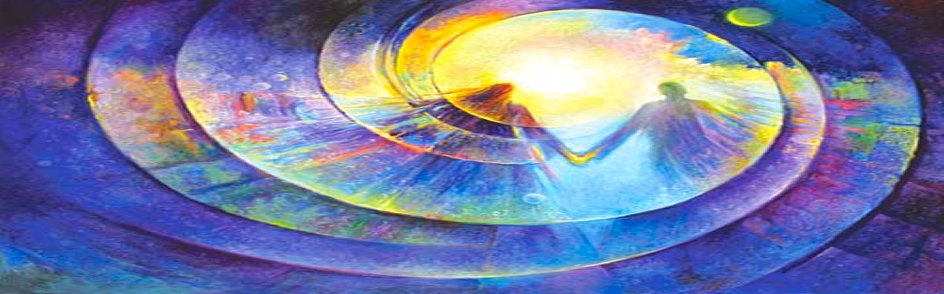
|
The Four - Animus for Women: |
The Four - Anima for Man: |
The
splitting of the Original Man into husband and wife expresses an act of nascent
consciousness; it gives birth to the pair of opposites, thereby making
consciousness possible. ~Carl Jung, Aion, Para
320
The power of Magic is
rooted in Eros. When the connection between the erotic and the occult is
unconscious, repressed or hidden, the mystery of uniting the esoteric and the
erotic becomes the ultimate arcane secret that penetrates into the depths where
all life is one, all boundaries broken down, body and mind fused in one. A deep
and abiding awareness of the intimate interrelationship unites the opposites
through the realization of imaginal workings.
As in Tantra, occult ritual involves the transgression
of social mores, locating and enacting cultural taboos in order to transcend
the boundaries which are traditionally constrictive. The erotic and the sexual
then become a tool to experience the breaking of mundane bonds and something
'other.'
“The alchemists, who in their own way
knew more about the nature of the individuation process than we moderns do,
expressed this paradox through the symbol of the Ouroboros, the snake that eats
its own tail. The Ouroboros has been said to have a meaning of infinity or
wholeness. In the age-old image of the Ouroboros lies the thought of devouring
oneself and turning oneself into a circulatory process, for it was clear to the
more astute alchemists that the prima materia of the art was man himself. The
Ouroboros is a dramatic symbol for the integration and assimilation of the
opposite, i.e. of the shadow. This ‘feed-back’ process is at the same time a
symbol of immortality, since it is said of the Ouroboros that he slays himself
and brings himself to life, fertilizes himself and gives birth to himself. He symbolizes
the One, who proceeds from the clash of opposites, and he therefore constitutes
the secret of the prima materia which […] unquestionably stems from man’s
unconscious.”
~ Carl G. Jung
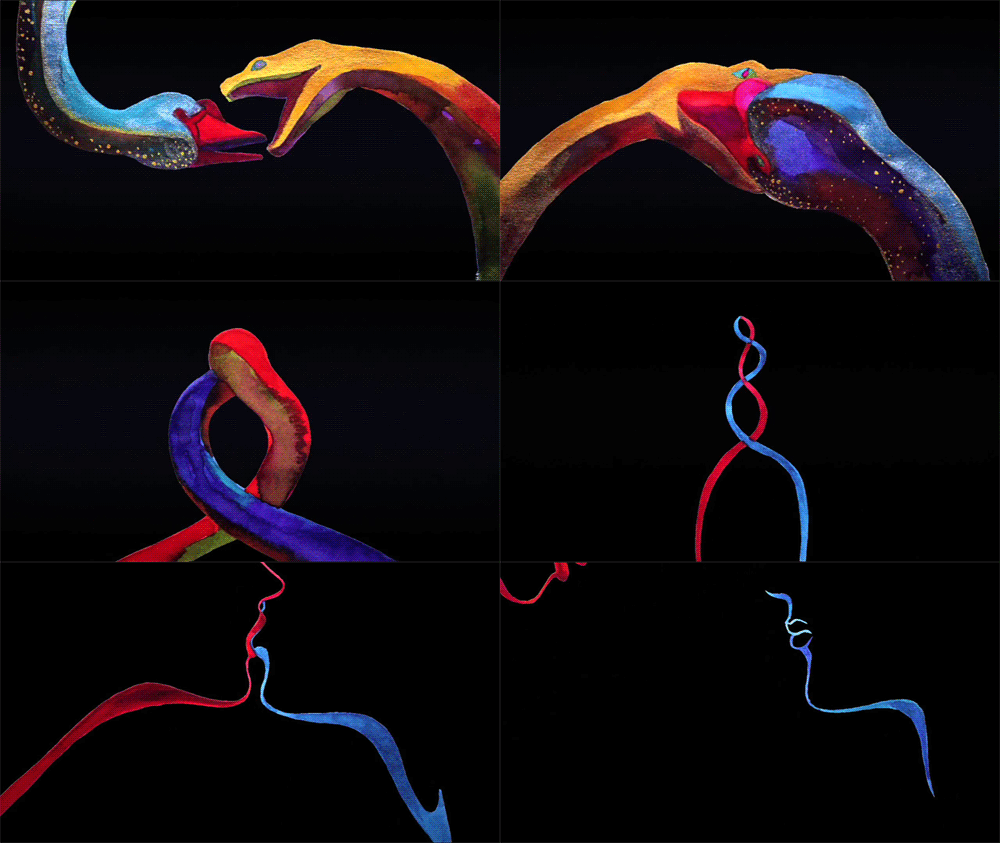
Sexuality
dished out as sexuality is brutish;
but sexuality as an
expression of love is hallowed.
~Carl Jung, CW 10,
Para 234
"The
principal pair of opposites is the conscious world and
the unconscious world, and
when the two come together, it is as if man
and woman were coming
together, the union of the male and the female,
of the light and the
darkness. Then a birth will take place."
~Carl Jung, Visions
Seminar, Page 574
You
see, inasmuch as the living body contains the secret of life, it is an
intelligence. It is also a plurality which is gathered up in one mind, for the
body is extended in space, and the here and the there are two things; what is
in your toes is not in your fingers, and what is in your fingers is not in your
ears or your stomach or your knees or anywhere else in your body.
Each part is always
something in itself. The different forms and localizations are all represented
in your mind as more or less different facts, so there is a plurality.
What you think with
your head doesn’t necessarily coincide with what you feel in your heart, and
what your belly thinks is not what your mind thinks.
The extension in
space, therefore, creates a pluralistic quality in the mind.
That is probably the
reason why consciousness is possible. Different things are represented, and
these are always supposed to be in a field of consciousness, in a sort of
extension, that is. Yet you feel that the whole, that plurality, is drawn
together and referred to something you call "I"; it is referred to a
center which you cannot say has extension, as little as you can say of a
thought that it has extension.
Thought is a
disembodied something because it has no spatial qualities. So "I" is
as if it were something abstract, yet in a vague way it coincides with your
body; when you say "I" you beat your chest for instance, to emphasize
the "I."
--Carl
Jung, Zarathustra Seminar, Page 360.
"I could say just as
well that you could never attain the self without isolation; it is both being
alone and in relationship." ~Jung, Zarathustra Seminar, Page 797.
"...consciousness is always behind the
facts; it never keeps up with the flux of life.
Life is in a way too rich,
too quick, to be realized fully, and ...one only lives completely when one’s
mind really accompanies one’s life, when one lives no more than one can reflect
upon with one’s thought, and when one thinks no further than one is able to
live. If one could say that of oneself, it would be a guarantee that one really
was living.
--Jung, Zarathustra
Seminar,
Pages 1425-1426
"The opus consists of
three parts: insight, endurance, and action. Psychology is needed only in the
first part, but in the second and third parts moral strength plays the
predominant role."
~Carl Jung, Letters Vol. 1, Page 375.
The natural mind is not a
function of man; it is a part of nature, the mind of trees or rocks or water or
the clouds or the winds, so absolutely beyond man that it hardly takes him into
account.
One always finds that the
utterances of the natural mind have this quality of an almost animal
ruthlessness, along with a strange kind of superiority which reaches far beyond
man.
It contains a most
fundamental truth which makes it superior, and because of that superiority it
is also divine.
The natural mind is very
apparent in prophetic women.
~Carl Jung, Visions
Seminar, Page 525
The unconscious on one
side is nothing but nature, and on the other hand it is the overcoming of
nature; it is yea and nay in itself, two things in one.
So we shall never
understand what the unconscious is, as we shall never understand what the world
is, because it is and it is not.
~Carl Jung, Visions
Seminar, Page 89.
We
can avoid the penalty of hubris by making a sacrifice .
Each of us must find in
what area his sacrifice must be made.
If we can think of the
worst possible sacrifice for us we are close to knowing which we must make.
A sacrifice is doing what
we would force others to do.
If we hold back through
fear of hubris then we fail in our task...
The acceptance of the
shadow is a sacrifice...
The image of the Divine
Child characterizes our relation with the Self...
But the Divine Child is
the incarnation of an idea; it permits us personal access to an idea which we
could not easily realize without it.
~Carl
Jung, Ostroski-Sachs, Pages 38-43.
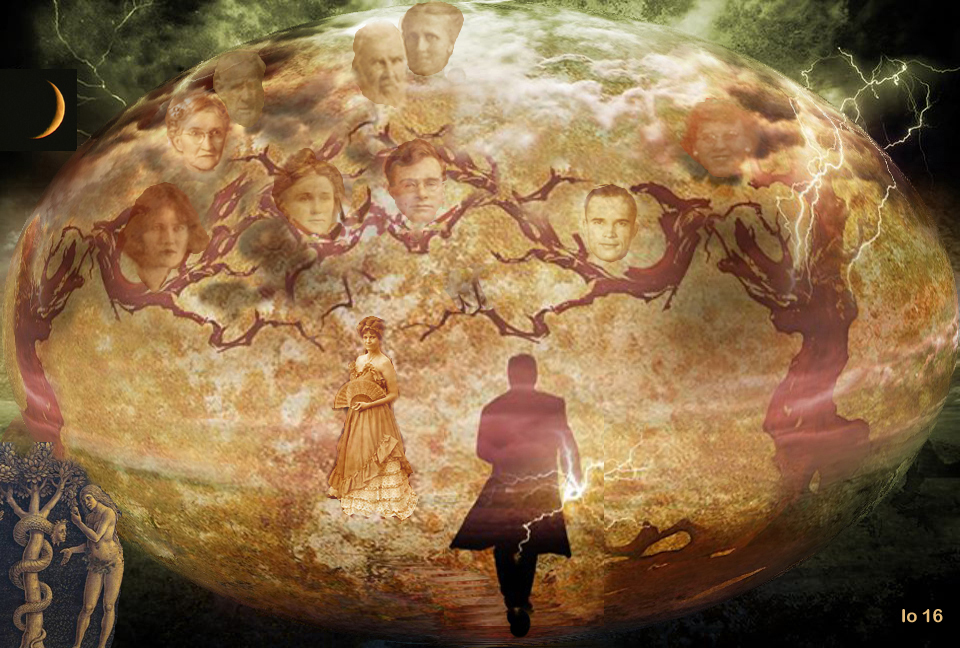
"Acorn", Io
Miller, 2016
James Hillman's 'acorn
theory' of soul says we already hold the potential for unique possibilities
inside ourselves, much as an acorn holds the pattern for an oak tree. It shows
in our calling and life's work when fully actualized.
TAKING
IT TO THE GRAVE
DREAM GENEALOGY
Inner Ways of Knowing
"All the works of man have their
origin in creative fantasy. What right have we then to depreciate imagination?
In the ordinary course of things, fantasy does not go astray; it is too deep
for that, and too closely bound up with the tap-root of human and animal
instinct. . . . The creative activity of the imagination frees man from his
bondage to the 'nothing but' and liberates him in the spirit of play. As
Schiller says, man is completely human only when he is playing."
--C.G. Jung, CW 16, §98
Young
children have a consciousness which is remarkable.
I find the psychology
of little children exceedingly difficult; their dreams, for instance, are
amazingly difficult. One would assume that they would be quite simple but they
are far from that.
Of course some are
obvious, but they have an unusual number of great dreams, and great visions
too, and to deal with them requires an hypothesis which makes one quite dizzy.
One has to assume that
they have a consciousness of the collective unconscious, an amazing thing. It
makes little children seem quite old, like people who have lived a full life
and who have a very profound idea of what consciousness really is. Hence the
saying: fools and children speak the truth. It is because they know it.
Children have the
vision still hanging over them of things which they have never seen, and could
not possibly have seen, and which are in accordance with the theory of
reincarnation. It is just as if reminiscences of a former life were carried
over into this life, or from the ancestral life perhaps, we don’t know.
I could tell you
children’s dreams which are simply uncanny, and if you want to interpret them
at all, you have to use uncanny means.
They
cannot be explained even by the psychology of the parents.
They must come from
the psychology of the collective unconscious; one could say they were remnants
of things they had seen before they
were born, and that is
really vision.
I know a case where a
vision affected a whole life. Individuals can be stunted all through their
lives by a vision in childhood. Such children are not quite born—their birth
takes place much later, when they can detach.
But many people are
never quite born; they live in the flesh but a part of them is still in what
Lamaistic philosophy would call the Bardo, in the life between death and birth,
and that prenatal state is filled with extraordinary visions.
~Carl Jung, Visions
Seminar, Page 424.
Psychic and Personal
Rootedness
"We are
entangled in the roots, and we ourselves are the roots.
We make roots, we
cause roots to be, we are rooted in the soil, and there is no getting away for
us, because we must be there as long as we live.
That idea, that we can
sublimate ourselves and become entirely spiritual and no hair left, is an
inflation. I am sorry, that is impossible; it makes no sense."
~Carl Jung, Kundalini
Seminar, Page 29
It may seem strange at
first to think that collective dreams could have any relevance to ourselves. We
have cut ourselves off from the past to such an extent that it is difficult to
realize that the experiences of remote people can still have meaning for us.
Yet it is so.
Unconsciously we still
think like our distant ancestors, and to understand this is to deepen our
experience, and open up new possibilities. We remain connected through the
language of dreams and imagination. To visit “the imaginal realm,”
suspended between the
empirical world and the totally visionary, is not a supernatural power of some,
but a phenomenon recognized from the dawn of mankind. Turning the inside out,
we bring it through the senses.
While some dreams may
be compensatory (balancing our conscious viewpoint), ancestral dream content
often appears as not substantially different from conscious functioning. There
is no need for defense or surrender to the dream material. We might dream of
cemeteries, family records, ancestors themselves, or any other variety that
informs our genealogical quest.
As Jung suggests,
"There is no linear evolution; there is only a circumambulation of the
self." (MDR, Pgs. 196-197)
When the Spirits Came
Back
Even more than blood,
we are bonded by respect and joy in each other's lives as true family. We may
wonder about our ancestors who lived closely attuned to the land, and what were
their lives like Who were the indigenous Celts and Anglo Saxons, or our other
more archaic progenitors?
Although we may never
truly know our indigenous ancestors’ ceremonies and rituals, we may be able to
remember aspects of them and their world through dreaming. Even dreams about
genealogy sometimes lead to real discoveries. Recurring dreams are even more
compelling. Significant, impactful or highly-memorable dreams can be bizarre or
beautiful. Some dreams have a life-long effect on us.
Integral Dreaming
Dreaming with the ancestors is perhaps more
accurate than dreaming about them. 'Dreaming with' we may
explore the power of dreams to recover deep ancestral, cultural, planetary, and
cosmic memory. Hillman argued dreams tell us where are are not what to do. The
dream is a descent into the underworld. Dreams saturate our consciousness
with the mysterious customs of the dark and impenetrable underworld.
Somewhere within the
total personality, there appears to be a continuing integrative force, a
homeostasis or self-regulating function. Even when we feel overwhelmed by
experience, some part of our mind still seems to observe, evaluate, comment,
and even attempt to integrate this otherwise hidden material with the knowledge
of conscious life.
This may disappear for
brief periods, but most of the time it is clearly at work. No one knows what
type of ‘thinking’ this is. It appears different both from ‘reality thinking’
and ‘autistic thinking,’ from the patterns of conscious thought and the imagery
of fantasy a kind of bridge between two types of mental process. It can appear
symbolically as distinctly 'Other.'
Jung's concept of
wholeness, linked with the Self. Such compensatory dreams connect with is best
seen in the collected dreams by an individual undertaking their own personal
journey to self acceptance and integration. Through an overview of dreams
gained in this way, the two aspects of compensation become much more clearly
drawn.
The dream work, aimed
at meeting the neglected or hurt parts of oneself, opens the way to more
pronounced compensation -- the gaps in our experience. Following our dreams means following
our uncertainty. Root
metaphor dreams may arise in times of crisis and help us adapt and help one
another.
Dreams teach by
revelation, but there is no reason to objectify that. There is no work to it,
no interpretation, no theorizing. We are each simply unrepeatable and
utterly inexhaustible entities, whose mystery cannot be objectified or reduced
to any single interpretation.
The process of
compensation also links with patterns of love and strength actually lived by
others. They are then patterns remaining in the collective experience of
humanity that can be accessed. When we touch these powerful racial memories we
may clothe them in the image of our cultural hero or savior. The power we find
is a release of our own potential emerging from our core self, our own innate
potential. This emerges from our unconscious clothed in whatever imagery or
ideas we can accept or allow, as do dreams.
Dreams are the underworld. Imagination and the
psyche are two key components of the underworld, a dreamland of souls where the
human mind retreats and interacts with other psyches present.
In
the Hero's Journey, Campbell notes, "Mythologies
are in fact the public dreams that move and shape societies, and conversely
one's own dreams are the little myths of the private gods, antigods, and
guardian powers that are moving and shaping oneself: revelations of the actual
fears, desires, aims, and values by which one's life is subliminally ordered."
The
'nekyia' is a night sea journey, a descent into the underworld or into the
belly of a sea monster, and a meeting with the dead. It is a myth which occurs
in many cultures in different forms and symbolizes the struggle towards
spiritual or psychological revelation and transformation.
In a Fortune article, Lawrence Lessing describes
recent sleep research: ‘...recent evidence shows that there may well be a
second, lower level of dreaming extending down even into deep sleep, consisting
largely of abstract thoughts or isolated symbols, much harder to recall than
the generally vivid, active imagery of rapid-eye-movement dreaming.’
“But
why on earth,” you may ask, “should it be necessary for man to achieve, by hook
or by crook, a higher level of consciousness? This is truly the crucial
question, and I do not find the answer easy. Instead… I can only make a
confession of faith: I believe that, after thousands and millions of years,
someone had to realize that this wonderful world of mountains and oceans, suns
and moons, galaxies and nebulae, plants and animals, exists. From a low hill in
the Athi plains of East Africa I once watched the vast herds of wild animals
grazing in soundless stillness, as they had done from time immemorial, touched
only by the breath of the primeval world. I felt then as if I were the first
man, the first creature, to know that all this is. The entire world round me
was still in its primeval state; it did not know that it was. And then, in that
one moment in which I came to know, the world sprang into being; without that
moment it would never have been. All Nature seeks this goal and finds it
fulfilled in man, but only in the most highly developed and most fully
conscious man." (CW 9i, §177)
PSYCHOPOMP
Decision Tree
The
spirit consists of possibilities -- one could say the world of possibilities
was the world of the spirit. The spirit can be anything, but the earth can only
be something definite. So remaining true to the earth would mean maintaining
your conscious relationship to the body. Don't run away and make yourself
unconscious of bodily facts, for they keep you in real life and help you not to
lose your way in the world of mere possibilities where you are simply
blindfolded. ~Carl Jung,
Zarathustra Seminar, Pages 66-67
For Jung, the
psychopomp -- a guide of souls -- is a mediator between the realms of
consciousness and unconsciousness, a guide from the world of the living to the
world of the dead. Soul guides are the midwives of death.
"The animus when on
his way, on his quest, is really a psychopompos, leading the soul back to the
stars whence it came. On the way back out of the existence in the flesh, the
psychopompos develops such a cosmic aspect, he wanders among the
constellations, he leads the soul over the rainbow bridge into the blossoming
fields of the stars."
~Carl Jung, Visions Seminar, Page 1229
This is an apt
description for the wisdom figures, shaman, Knights Errant, and spirits of our
family tree who we meet as we travel through the disembodied states of another
reality. They lead us beyond themselves to even deeper ground. When you
become the guardian of your dead, you become a psychopomp of your own soul.
Cristine Downing
speaks of, “the seemingly alien but unconscious longed-for pattern of energy
that most often pulls me down into the underworld.” To the psyche death is
always the fearful opposite to life, so the initial forays may be the most
daunting. The value of a guide in the descent is to learn the lessons which a
knowledge of death bring to the living of life.
Like many trees, our
family tree can be dormant, and some branches can go extinct. A genealogy tree
is the most common form of visually documenting family ancestry. Most family
trees include a box for each individual and each box is connected to the others
to indicate relationships. In addition to an individual's name, each box may
include dates, birthplace, marriages, and other information.
It is no accident that
a Family Tree resembles modern decision trees. Genealogy is a flowchart from
parental nodes, a biological decision tree, integrating gene expression and
demographics. It is a top-down predictive model displaying consequences,
including chance event outcomes, and algorithms. These are the decisions of
families, fate, and destiny as worked out through nature.
A schematic
tree-shaped diagram is used to determine a course of action or show a
statistical probability. Each branch of the decision tree represents a possible
decision or occurrence. The tree structure shows how one choice leads to the
next, and the use of branches indicates that each option is mutually exclusive.
The structure allows
us to see multiple relations and display them in a simple, easy-to-understand
format that shows the relationship between different events or decisions
[cascading marriages and offspring].
Everyone
has two family trees. The first is a Genealogical Tree, which is every ancestor
in history that had a child who had a child who had a child that ultimately led
to you. Every decision made by every person in that tree contributed to who and
what you are today.
However,
not every person in that tree contributed a segment of your DNA sequence
(because of random inheritance, as discussed above). As a result, we have a
second family tree – a Genetic Tree – which is a tree that contains only those
ancestors who contributed to our DNA.
|
|
|
|
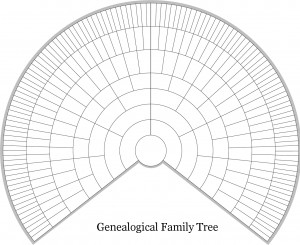
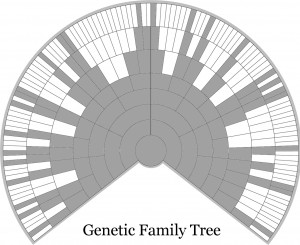
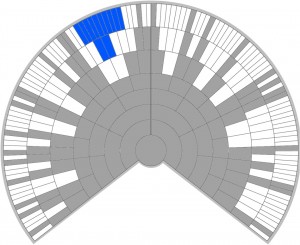
Note that the Genetic Family Tree illustrates a concept rather than an exact representation of someone’s actual genetic family tree. The Genealogical Family Tree contains ALL of your biological ancestors: The Genetic Family Tree contains a small subset of your biological ancestors: Due to the nature of the Genealogical versus the Genetic Family Tree, entire populations, ancestors, and ethnicities are regularly lost entirely from your DNA! For example, in the following example of a Genetic Family Tree, the ethnicity in blue below is NOT part of the tree, and therefore would not be detected by a DNA test.
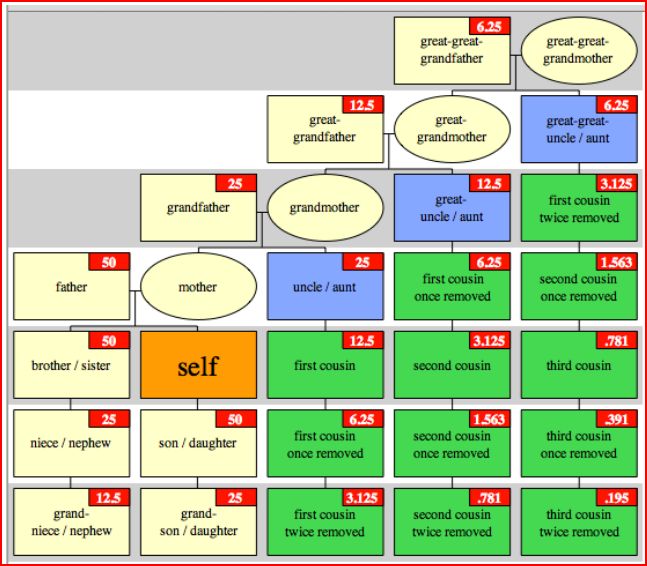
The
two most common tests examine the paternally inherited Y chromosome (Y-DNA),
which is passed down from father to son, and the maternally inherited
mitochondrial DNA (mtDNA), which is passed down from mother to child, both male
and female. A third type of test (autosomal DNA) examines DNA inherited from
both parents.
“With many of these
tests, you’re only tracking one small part of your family tree,” Bolnick says.
“For example, a mtDNA test can tell you about only one of your 16
great-great-grandparents. That leaves a huge number of unknowns.”
Genetic ancestry tests
examine the sequence of molecules, called nucleotides, in a person’s DNA. They
focus on what scientists consider “junk” DNA—portions of the human genome for
which no biological function has been identified. An individual’s DNA sequence
is compared to a database of samples to identify others with similar DNA
sequences. The testing company then suggests that the ancestors lived in the
geographic region and belonged to the ethnic group in which the customer’s DNA
sequence is most common.
Many DNA sequences are
found in many different human populations. For example, certain DNA sequences
may be most common in Native Americans, but they also are found in Asians. So,
some tests may incorrectly inform someone they have Native American ancestry
when their ancestors actually lived in Asia.Many companies try to link your DNA
to racial and ethnic categories in ways that are problematic. “These categories
are socially constructed, and they’re mostly based on cultural heritage and
shared experiences. There’s no clear-cut connection between racial identity and
your genetic makeup. Unfortunately, these tests incorrectly imply that there
is, so they may encourage a return to old ways of thinking about race as purely
biological, which it’s not.”
DNA
Colonization
The anount of DNA we
share with blood relatives varies. For example, your first cousin has 12.5% of the genes
you do (implying, inversely, that 87.5% of their genes are different).
Your third cousin twice removed, on the other hand, would have only
0.195% of the same genes, meaning 99.805% of their genes would be different.
This assumes, of course, that you have no double relations in your family
tree (e.g., sharing a great-great grandmother from two sides of your family
tree).
Rare double cousins
arise when two siblings of one family reproduce with two siblings of another
family. This results in the children being related to each other through
both parents, and sharing the same grandparents. As a result, double
cousins are genetically equal to half-siblings, sharing double the genetic
material normally seen in first cousins.
Sure, your blood,
skin, brain and lungs are made up of your own cells, but not entirely. Most of
us are walking, talking patchworks of cells, with emissaries from our mother,
children or even our siblings infiltrating every part of our bodies. Welcome to
the bizarre world of microchimerism.
Nature is crafty. The
cells of our ancestors, children or siblings, even lovers, infiltrate
every part of our bodies. The cells of others can colonize our bodies, eggs,
and mind, permanently injecting us with the genetic material of both random and
relationally intimate partners.
Babies of current
partners have been found with the germ plasm of former partners. A father can
even unknowingly perpetuate the DNA of his twin re-absorbed in the womb. Male
children ‘colonize’ our minds with their DNA during gestation and never ‘move
out.’ That can be so even if the baby doesn’t come to term.
These random cells
also provide some immunological benefit, much like an injection of embryonic
stem cells. Cells also migrate to the mother’s muscle, thyroid, liver, heart,
kidney and skin. Our DNA soup is therefore rather messy. So, no sex is really
“casual.”
Mitochondrial DNA is
the Mother Root
Mitochondrial DNA contains
37 genes, all of which are essential for normal mitochondrial function.
Thirteen of these genes provide instructions for making enzymes involved in
oxidative phosphorylation. The remaining genes provide instructions for making
molecules called transfer RNAs (tRNAs) and ribosomal RNAs (rRNAs), which are
chemical cousins of DNA. These types of RNA help assemble protein building
blocks (amino acids) into functioning proteins.
ANCESTORS & ARCHETYPES
Last Rites: Embodying Ancestor Wisdom
By Iona Miller, (c)
2016
"I
am fully committed to the idea that human existence should be
rooted in the
earth."
~Carl Jung, C.G. Jung
Speaking, Page 204
"There is an alchemical
saying: Man is the heaven of woman and woman
is the earth of man. The
woman’s task is to bring things down to earth."
--Marie Louise von
Franz, Psychological
Perspectives
by E. Rossi
"You see that
quite clearly in the moment when you check the creative impulse; nothing is
more poisonous to the nervous system than a disregarded or checked creative
impulse. It even destroys people’s organic health."
--Carl Jung,
Zarathustra Seminar, Page 654.
Solidly Grounded
"The spirit can
easily be anything, but the earth can only be something definite.
So remaining true to the
earth would mean maintaining your conscious relationship to the body." --Carl Jung, Zarathustra
Seminar, Page 66
Arguably, the best way
to hone our theory is to refine our arguments against vigorous
counterarguments. We don't have to go as far as 'magical thinking' to have a
bit of magic in our lives, nor do we have to remain content with wishful
thinking, idiosyncratic views, or 'spiritual' fantasies about our healing
potential. If we use our genealogy in a compensatory fashion, it functions
somewhat like dreams, and can be approached with the same conditions.
There is an enormous
amount of variation in metaphysical and moral views, often characterized by an
unusual degree of intractability. Without any rational basis, people believe
all sorts of things because they "feel right," as if that were some
touchstone, when it is the basis of pseudo-science, false suppositions, or
erroneous conclusions and lack of critical thinking.
Jung
said, "All people who claim to be spiritual try to get away from the fact
of the body; they want to destroy it in order to be something imaginary, but
they never will be that, because the body denies them; the body says
otherwise." (Jung, Zarathustra Seminar, Page 64.)
We don't need to make
exaggerated claims for CAM healing or "secrets," based on spurious
theories or misapplied science and buzzword branding. Sometimes it works
temporarily, but not for the reasons or in the way it purports. Much of it
mobilizes the placebo effect, which is fine, but perhaps not the best approach.
Our own hidden family secrets contain the key to our well-being, but we don't
need to turn our genealogy work into a rootless transcendental escape.
We don't need to
approach our ancestors with far-fetched superstitious ideas or wildly
irrational models to consciously develop a living relationship with them. There
are four inheritance systems that play a role in evolution: genetic, epigenetic
(or non-DNA cellular transmission of traits), behavioral, and symbolic
(transmission through language and other forms of symbolic communication).
Everything begins with
a foundation. It is said there are things hidden since the Foundation of the
World. Archaic genealogy is one of them. Rituals revolve around whether
imitation is forbidden or mandatory. Imperative rituals are religious or spiritual;
forbidden rites are transgressive.
Genealogy is
desirable. Descent is the first and primordial fact about the body-mind -- its
origin and source of 'in-form-ation.' We don't need special gifts to track
their weird properties. In genealogy, meaning and purpose meet a genuine
emotional connection. Genealogy is the skeleton upon which we can flesh out our
family history into a sacred living lineage. It is not a way of burying
ourselves in the past to avoid the present, but to be more fully Present.
Our attitude is one of
openness and inclusiveness, which is essential for working with dying, death,
grieving, and caring. We desire to experience everything without withdrawing
from the intensity and vividness of any experience. Our guide is the continuum
of spontaneity, a realm of not-knowing -- undefended and transparent to the
full embrace of life.
The past is fully
present in our psychophysical being. Presence is that state where the past
doesn’t exist, and the future hasn’t been written. It is what is in the now. It
is clarity. Like heals like.
"Don’t run away
and make yourself unconscious of bodily facts, for they keep you in real life
and help you not to lose your real way in the world of mere possibilities where
you are simply blindfolded." (Jung, Zarathustra Seminar, P.66)
"...when people
approach their inferior function; they have attacks of vertigo or nausea for
instance, because the unconscious brings a peculiar sort of motion, as if the
earth were moving under their feet, or as if they were on the deck of a ship
rolling in a heavy swell. They get a kind of seasickness; they develop such
symptoms actually.
It simply
means that their former basis, or their imagined basis, has gone certain values
which they thought to be basic are no longer there-so they become doubtful and
suspended in a sort of indefinite atmosphere with no ground under their feet,
always afraid of falling down.
And of course the thing
that is waiting for them underneath is the jaws of hell, or the depth of the
water, or a profound darkness, or a monster-or they may call it madness. And
mind you, it is madness to fall out of one's conscious world into an
unconscious condition.
Insanity means just that,
being overcome by an invasion of the unconscious.
It is madness to fall out
of one’s conscious world into an unconscious condition.
Insanity means just that,
being overcome by an invasion of the unconscious.
Consciousness is swept
over by unconscious contents in which all orientation is lost.
The ego then becomes a
sort of fish swimming in a sea among other fishes, and of course fishes don’t
know who they are, don’t even know the name of their own species. (Jung, Zarathustra
Seminar, Pages 1088-1089)
Divinatory Traditions
Besides dreams,
divination is one of the major ways ancestors communicate. Shaman 'throw the
bones' acknowledging that they have the capacity for revelations. Divination
with natural objects uses organic living tools of divination. In bone
divination, bones of various sorts are ritually tossed onto a mat, an animal
hide, or into a circle drawn in the dirt, and the resulting patterns
interpreted.
Throwing the bones is
an ancient practice traditional to many regions of the world, including Africa,
Asia, and North America. The number and type of bones used, as well as the
inclusion of other small objects, such as pebbles, shells, and hard nuts,
varies from culture to culture.
Marked
bones are often used in groups of two or four to obtain yes or no answers, as
well as more detailed information. Gaming dice, often called "the
bones," may have their origin in marked bone divination. There are still
forms of divination using patterns of spots and dots on dice or dominoes.
Marking or painting the bones makes their identification quick and certain.
Runes were often inscribed on bones.
Before throwing the
bones, the healer invokes the ancestors by giving snuff, kneeling and clapping,
and rattling or chanting a song. A general reading is given and then specific
questions are asked and answered. Each question is answered by a separate throw
of all the bones. It is the ancestor, and not the healer or messenger, who
provides the information.
Old style Conjure,
Mama Starr says, "I
was taught that we are able to read the bones through our ancestors and the
spirits that walk with us. You have to have a strong connection with your
ancestors in order to receive the information through the bones. Your bones are
very personal, and they should be taken care of after all this is a link
between you and your ancestors. ... I was taught my bones are protected by my
ancestors and if someone stole them they would have to deal with my
ancestors..."
Others say, "In
both my bone sets I have a piece that represents an ancient ancestor. It is an
ancestor so far back that we can no longer know if it was male or female, or
whether it is a relative from the mother’s side, or the father’s side. The only
thing we know about it is that it is ancient and powerful."
"When it is
near a person I look to see if there is a message. But even if there is no message,
the presence of this piece nearby tells me that the client has an ancestor like
this nearby watching over them. To me this is a special blessing."
"At the point
this ancestor appears in your family tree they may have hundreds, if not
thousands of blood descendants. That they are taking a particular interest in
you out of all those others implies a gift. It could be that you share a
similar gift or calling in life. I generally think of these gifts as gifts of
the spirit – healing, or divination, or a creative talent. I think it has to be
something that is universal throughout time. Every generation in every culture
had healers, diviners, and artisans."
"The ancestors
that are far back in our bloodlines appear the weakest to our intellect, but
they have the most powerful energy. With little to go on, ancestors like this
are hard to imagine or get a mental image of. But they themselves have the
wisdom of ages. If in your self readings this ancestor keeps making its
presence known you might want to consider deeper connection with just this
ancestor."
Scottish speal bones
are a divination used in Scotland, called Sleina-nachd, or reading the Speal
Bone, or the Blade Bone ...A speal bone or blade bone of a shoulder of
mutton was used, but complete details of the divinatory practice is unknown.
Cooked bones (most
often the shoulder blade or scapular of a large animal) may be scraped clean of
flesh and the marks upon it interpreted. In other cultures, certain specially
selected bones, sometimes called oracle bones (usually scapulars or turtle
bones) may be burned in a fire or heated until they crack and the resulting
chars and cracks examined for specific answers to questions.
Firm Foundation
A firm foundation in
our close family is a good anchor for more distance ancestors. The depth of
your foundation determines how high you can fly, or in this case, trace your
far-flung family tree -- an exceptional foundation as only royal, legendary,
and mythical lineages pre-date the Middle Ages.
The durability of any
structure is predetermined by the strength of its foundation. Impactful
destinies have sure foundations. The stories we tell about the deceased depend
largely on the foundation that person laid down in their life.
You must invest in
your foundation. Your root should be enduring, deep, and strong. A deep
foundation holds up the edifice of your destiny, eternally. The strength of
your foundation supports your unique development or individuation.
When the ancestors
call and you answer, you are infused with their organic wisdom. Outstanding
dedication shines. Your worldview widens to encompass deep time. Life is about
the bonds of family, the essence of what it is to be human. We become oblivious
to the names and experiences of even our recent ancestors; we get ancestral
amnesia. We forget their burdens and their blessings.
But we can raise them
into the light of consciousness with a bit of joyful effort. Then we are
rewarded with new meaning and self-knowledge. Like all initiatory journeys, it
is about engaging with the ancestors, the death of the old self, and rebirth of
the new, within generations of generativity.
This is family you can
keep with you for the rest of your life. Groundwork takes some digging. With
research and reading, combined with some information gathering to lay the
groundwork, you can begin to construct your family tree and fill in the blanks
that may have eluded you on your first rough sketches. You may think you are
looking for 'who' and 'when', but you also need to think about 'where,' as in
the precise location of your ancestors who may share a common surname with many
families.
Genealogy looks at
several generations of a family while kinship maps merge several family
histories or genealogies to understand, not just descent, but extended family
relationships. All meaningful communication is a form of storytelling or giving
a report of events (narrative). In bonding, we realize that the ancestors
mirror us and we reflect them.
Narrative Coherence
Because of this, human
beings experience and comprehend life as a series of ongoing narratives, each
with its own conflicts, characters, beginning, middle, and end -- best viewed
as stories shaped by history, culture, and character. Narrative is the basis of
communication, how we explain and/or justify their behavior, whether past or
future.
The world is a set of
stories from among which we must choose in order to live in a process of
continual re-creation. We choose the ones that match our values and beliefs.
Beliefs are how we make sense of life and death. The test of narrative
rationality is based on the probability, coherence, and fidelity of the stories
that underpin each story.
Narration
is cross-cultural and is one of the first language skills all children develop. Is the story consistent, with sufficient detail,
reliable characters, and free of any major surprises? Do the characters to act
in a reliable manner. Otherwise, we become suspicious when characters behave
uncharacteristically.
Narrative fidelity
states that if a story matches our own beliefs and experiences, it will be
accepted. Fidelity determines how the story fits into the background of the
world as we have known it. Fisher also believes that a story has fidelity when
it can be seen as a guide for our own actions, ultimately influence our beliefs
and values.
It is more than a
metaphor that nature is alive and speaks to us in millions of fragments of
light -- the final form of life. "If you will bring to light what is
inside of you, what you will bring to light will save you." (Gnostic
Gospel of Thomas, 30) “In
order for the light to shine so brightly, the darkness must be present.” (Sir
Francis Bacon)
"Natural life is
the nourishing soil of the soul." (Jung, CW 8, Para 800).
Jung called dreams "pure nature."..."they show us the unvarnished, natural truth, and are therefore
fitted, as nothing else is, to give us back an attitude that accords with our
basic human nature when our consciousness has strayed too far from its
foundations and run into an impasse.” (CW 10 317)
Shake Hands With Your
Family Tree
“Trees depict the
living structure of our inner self. Its roots show our connection with our
physical body and the earth; its trunk the way we would direct the energies of
our being–varied and yet all connected in the common life process of our being.
The tree can also symbolize new growth, stages of life and death, with its
springs leaves and blossoms, then the falling leaves. The top of the tree, by
the end of the branches, are our aspirations, the growing bendable tip of our
personal growth and spiritual realization. The leaves may represent our
personal life which may fall off the tree of life (die) but what gave it life
continues to exist. The tree is our whole life, the evolutionary urge which
pushes us into being. Its growth depicts the forces or processes behind all
other life forms, expressing interpersonal existence.”
“I am an
orphan, alone: nevertheless I am found everywhere. I am one, but opposed to
myself. I am youth and old man at one and the same time. I have known neither
father nor mother, because I have had to be fetched out of the deep like a
fish, or fell like a white stone from heaven. In woods and mountains I roam,
but I am hidden in the innermost soul of man. I am mortal for everyone, yet I
am not touched by the cycle of aeons.” (Jung, Memories,
Dreams, Reflections, P. 227)
DEPTH
GENEALOGY
GROUNDWORK: AN ECOLOGY
OF SOULS
Collaborating with the Dead
"I am fully committed to the idea
that human existence should be rooted in the earth." ~Carl Jung, C.G. Jung
Speaking, Page 204
"Do you think that
somewhere we are not in nature, that we are different from nature? No, we are
in nature and we think exactly like nature."
~Carl Jung,
Zarathustra Seminar, Page 1277
Jung contended we can
make no progress with ourselves until we become "very much more
acquainted" with nature and our own nature. Genealogy is one opportunity
to do so.
Depth Genealogy is an
approach to genealogy with its own roots in Jungian and archetypal psychology,
Transgenerational Integration, phenomenology, genetic genealogy, the arts, and
other relevant areas. It is a soulful approach, attuned to the Earth and
Feminine with an eye for the imaginal, the ecological, the embodied, and
mythological. We cannot describe symptoms without acknowledging the human
origins of the ecological crisis. Our way of understanding human life and
activity has gone awry, to the serious detriment of the world around us.
Philosopher
Martin Heidegger emphasized phenomenology—the phenomena of being aware of one’s
own consciousness of the moment. Heidegger wrote about Dasein,
or “being there” in the moment with oneself and with how one perceives the
world.
Beliefs organize our
experience and condition our experience and interpretation of sensed presence.
You can't unperceive a perception once perceived, but you can erroneously
project, interpret. or concretize it. However we attribute 'sensed presence' or
'liminal entities' we know that they are evoked potentials, rather than literal
beings, but they exhibit phenomenological qualities that carry meaning.
Similar exotic
experiences can be induced in the laboratory with electromagnetic fields on the
temporal lobes, as reported by Persinger and Murphy (2016). The amygdala also
plays a role in such manifestations, which appear 'good' or 'evil', depending
on which side of the amygdala is dominant during the 'visitor experience,'
which includes the 'ancestors'.
"On one extreme,
there is the 'demonic' or evil visitor, and on the other extreme, there are
more angelic visitors. It depends on which emotional center (amygdala), left or
right, is more active. If the negative one (meaning the one that supports fear)
is more active, the visitor experience will become a visitation by a demon,
Satan, or a terrifying ghost. On the other extreme, it could be an angel, a
spirit protector, or even God." (Todd
Murphy)
In
private mail Murphy hypothesized about the benign nature of 'ancestors'. We can
conjecture that the rule of thumb of 10% experiencing negative effects may
hold.
"Hypothesis: in a sharp crisis, that
bears in some way on species survival [or
elicitation of an altered state], an individual
may spontaneously sense the presence of non-physical beings becoming, for a
time, a divided entity, with a portion of their consciousness more able to
access non-verbal (intuitive, psychic, empathetic) information via the right
temporal lobes and limbic region."
Enhancements in intuitive
skills increase the chances for surviving the sharp crisis. The person's own
non-linear cognitive skills are attributed to the 'spirit' being, who will seem
to have guided them in a moment of crisis. In fact, the being was a projection
of their own right-hemispheric self, the insight was from their own
experiences, and the being enabled to whole process - whether it was 'real' (in
the mechanistic sense) or not."
"The
profound experiences attributed to the “sensed presence” and their cultural
anthropomorphisms such as deities and gods are persistent reports in human
populations that are frequently associated with permanent changes in behavior,
reduced depression and alleviation of pain. The majority of traditional
clinical observations and modern imaging techniques have emphasized the central
role of right temporal lobe structures and their directly related networks. The
experimental simulation of sensed presences ... can result in attributions to
spiritual, deity-based or mystical sources within the clinical laboratory by
the application of physiologically -patterned magnetic fields across the temporal
lobes." (Persinger, Murphy,)
http://www.nrgarchive.gdk.mx/2016-reply-to-neuroscience-for-the-soul.pdf
In the genealogical
journey our lineage descent becomes an initiatory experience of the depths of
the human psyche and collective unconscious. In-depth
research, therapy, and self-help for exploring of your Family Tree. Genealogy
is a firm foundation for self-knowledge and any spiritual practice. Our ancestors
become living presences informing our lives and being -- our relationship with
the past, present, and future and the great cycle of life -- birth, death, and
rebirth.
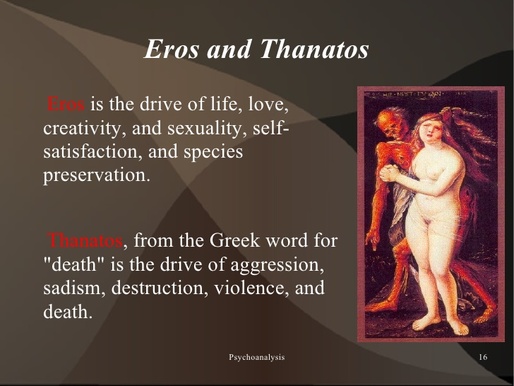
FAMILY
TREE HUGGERS
Greening the Family
Tree
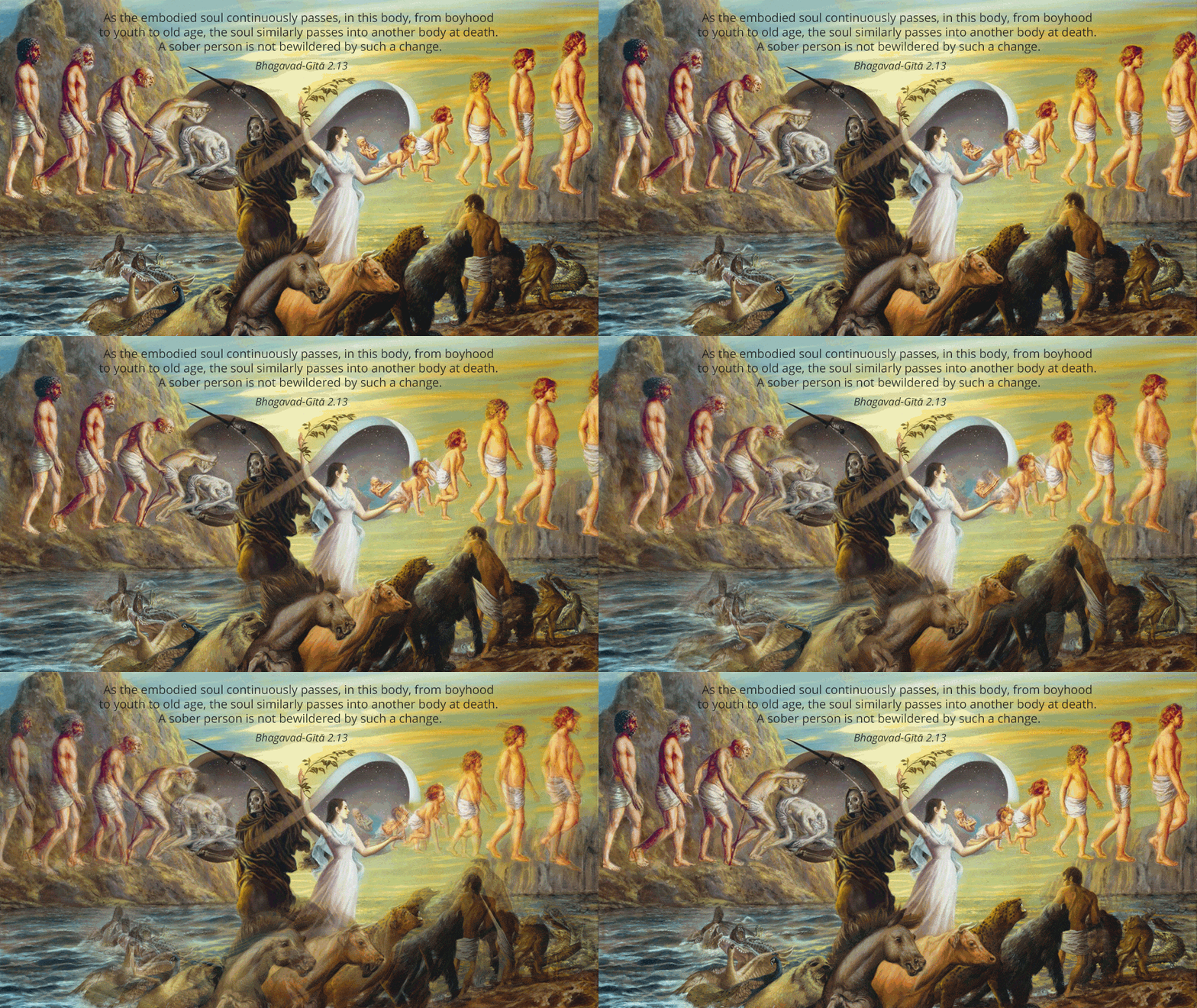
YOU
ARE A BRIDGE BETWEEN TWO WORLDS
Depth
Genealogy: Retrieving Your Ancestors
"To give birth to the
ancient in a new time is creation."
~Carl Jung, Liber Novus, Page 311
For a woman, the typical
danger emanating from the unconscious comes from above, from the “spiritual”
sphere personified by the animus, whereas for a man it comes from the chthonic
realm of the “world and woman,” i.e., the anima projected on to the world.
~Carl Jung, CW 9i, Para 559
One of the essential
features of the child motif is its futurity.
The child is potential
future.
Hence the occurrence of
the child motif in the psychology of the individual signifies as a rule an
anticipation of future developments, even though at first sight it may seem
like a retrospective configuration.
Life is a flux, a flowing
into the future, and not a stoppage or a backwash.
It is therefore not
surprising that so many of the mythological saviours are child gods.
This agrees exactly with
our experience of the psychology of the individual, which shows that the
“child” paves the way for a future change of personality.
“Child” means
something evolving towards independence.
This it cannot do
without detaching itself from its origins: abandonment is therefore a necessary
condition, not just a concomitant symptom.
~Carl Jung, CW 9i,
Para 287
If we go further and
consider the fact that man is also what neither he himself nor other people
know of him—an unknown something which can yet be proved to exist —the problem
of identity becomes more difficult still.
Indeed, it is quite
impossible to define the extent and the ultimate character of psychic
existence.
When we now speak of
man we mean the indefinable whole of him, an ineffable totality, which can only
be formulated symbolically.
I have chosen the term
“self” to designate the totality of man, the sum total of his conscious and
unconscious contents.
I have chosen this
term in accordance with Eastern philosophy, which for centuries has occupied
itself with the problems that arise when even the gods cease to incarnate.
~Carl Jung, CW 11, Para 140
Retrieval does *not*
mean "going back in time" but, rather,
remembering what we've
forgotten. Yes, that is a re-naissance.
In the archetypal
realm, the beginning and end of days is always with us in each and every moment
as the mythic dimension. Myth describes breakthroughs of the sacred into the
profane or historical time.
As humans, we still
live in a Tree -- the ancient World Tree of our ancestors. We can use
archeomythology to retrieve the ancestors, our lost soul, and the Feminine.
Deeply buried in the layers of our cellular memory are the myths and stories of
the Great Goddess; therein lies a connection to the very source of healing that
we so desperately seek to reground ourselves in the present.
If we are lucky, and
not too dissociated, we can feel our pain. Pain becomes a portal into deep
awakening, and when we are truly blessed we can hear the faint and distant echo
of the voice of the Mother calling to us through our pain, as she calls to us
now. Her blessing of love fills our hearts and souls with the moisture of life,
as we soak it up like parched drought land, welcoming a long awaited rain.
Mystical Marriage
& Groundwork
The Mystical Marriage,
the union of self and the divine, soul and spirit, is a process of being reborn
on multiple levels of Ascent and Descent. Genealogy is the raw material of the
symbolic life. Genealogy is the groundwork of our reclamation project, which
leads downward toward the dark center of our individual selves and into the
fruitful mysteries of the-more-than-human world of nature and ancestral lines
already etched somewhere within us.
When we encounter the
soul we are more likely to say we has uncovered our unique gifts, destiny, life
purpose, or personal meaning. Through soul encounter, we learns why spirit and
nature gave birth to our exceptional individuality and particular way of
belonging to the world. Jung said, "But your darkness should grasp the
light."
(Jung, Liber
Novus,
Page 270)
The soul path is often
associated with the setting sun (and thus the direction of west), the descent
to our earthy roots, into the wildness of the soil and the soul, a journey into
the underworld, a voyage into darkness or shadow. We may have been taught that
the downward direction is a turn away from the sacred, toward evil and
wickedness, toward “hell.” Then, entering the underworld is sinful, suicidal,
or a one-way trip reserved for those who have been particularly bad.
Likewise,
nature has been rendered as evil. Pan, the Greek’s horned god of the forest,
was transformed into the devil of Christian mythology. Most Western cultures
have feared wild nature and have thought of it as unruly, a realm whose laws
clash with society’s. We have, in short, been led to believe that nature and
soul are not merely wild but inherently dangerous, forbidden, tainted, or evil.
We 'descendants' are
the embodiment of descent itself. The initial goal of the descent is to
cultivate the ego/soul relationship, which is underworld business, that might,
at first, make our surface lives more difficult or lonely, or less comfortable,
secure, or happy. Soul practices prepare the old self-ego to abandon its social
stability and psychological composure and to be reassigned through initiation
as an active, adult agent for soul, as opposed to its former role as an
adolescent agent for itself.
This journey of
descent prepares us to live in the world with its harsh need to change us, and
shows us where and how to make our stand on solid groundwork, firmly and
uniquely. On this half of the spiritual journey, we do not rise toward heaven
but fall toward the center of our longing. Although equally sacred and perhaps
even more ancient than the journey of ascent, this second spiritual realm may
be unfamiliar.
The concept of soul
embraces the essence of our particular individuality while spirit is universal. Spirit
and soul are both sacred; they imbue life with meaning, beauty, and mystery.
Spirit and soul are both spiritual or transpersonal—they exist beyond the
personal, beyond the conventional mind or personality. They might each be
referred to as the “sacred Other.”
Thomas Moore, in Care of the Soul says whereas in spirit, "we
reach for consciousness, awareness, and the highest values," soul
"has to do with depth, value, relatedness, heart and personal
substance."
Spirit wants to go
toward beyond every unseen horizon; soul wants to remain in the world and its
complexity, to stay within. Spirit wants transcendence; soul wants immanence.
Spirit would leave all worldliness behind to escape to heaven, while soul wants
to find heaven on earth and in all the earth's messiness.
The
inseparable roots systems of the genealogical discipline are mystical practices
and healing traditions, providing direct experience of present centered
awareness, the numinous, heartful healing, and an embodied awakening, summoning
the soul toward a return, a reunion with the origin and the eternal.
The
descent into our genealogical roots in the 'land of the dead' has its own
rewards both independent of the ascent and in conjunction with it. As Rilke
wrote:
"If
we surrendered to earth’s intelligence we could rise up rooted, like trees."
The
rooting (of trees, of our selves) is as important and as necessary as the
rising. We have the opportunity to sink roots into soul and rise up with
branches in heaven.
"If
we surrendered to earth’s intelligence we could root down ascendant, like
trees." Our spiritual growth is meant to go
toward the fertile darkness and the glorious light, each of us having the
opportunity to bridge earth and heaven—the underworld and the upper
world—through the trunks of our middle world lives.
Rilke saw the
intrinsic value of darkness: "You darkness from which I come, I love you more than
all the fires that fence out the world, for the fire makes a circle for
everyone so that no one sees you anymore."
Hierosgamos
Heirosgamos is a
mystic marriage or union. Symbolized in alchemy by the coniunctio, it stands for conjunction of
conscious and unconscious. Mysterium
Coniunctionis ("mysterious conjunction")
is the final alchemical synthesis (for Jung, of ego and unconscious, matter and
spirit, male and female) that brings forth the Philosopher's Stone (the Self).
Its highest aspect, as for alchemist Gerard Dorn, was the unus
mundus, a unification of the Stone with body,
soul, and spirit.
Moore says neither
spirit nor soul can work without the other.
In fact, they need to
be married to each other:
"Spirit
tends to shoot off on its own in ambition, fanaticism, fundamentalism, and
perfectionism. Soul gets stuck in its soupy moods, impossible relationships,
and obsessive preoccupations. For the marriage to take place, each has to learn
to appreciate the other and to be affected by the other--spirit's loftiness
tempered by the soul's lowly limitations, soul's unconsciousness stirred by
ideas and imagination."
Transcendence must
remember its immanent context, and immanence must remember its transcendent implications.
However, this marriage isn't just a metaphor. According to Jungian psychology,
spirit and soul have definite masculine and feminine correspondences,
respectively. The archetype of spirit is what Jungians call the animus, defined
as the archetype of masculine being, whereas soul corresponds to the anima as
the archetype of primordial femininity. This association deeper than any
superficial definition of gender.
In
his book Anima: An Anatomy of a Personified Notion,
James Hillman talks about the way the animus or spirit always appears alongside
the anima or soul, and vice versa, whether we like it or not:
"At
the very moment of a new psychological move, we hear animus voices, driving us
from it by spiritualizing the experience into abstractions, extracting its
meaning, carrying it into actions, dogmatizing it into general principles, or
using it to prove something. Where anima is vivid, animus enters. Similarly,
when at work intellectually, or in spiritual meditation, or where courage is
screwed to the sticking place, then anima invades with images and fears, with
distractions of attachments and connections, telephoning, natural urges,
suicidal despairs, or disturbing with ever deeper questions and puzzling
unknowns. Moved by a new idea or spiritual impetus, anima is right there,
wanting to make it personal, asking 'How does it relate?' and 'What about me?'
The
anima--as soul, relatedness, immanence, the "thick of things"--always
appears together with the transcendent animus. You can't separate them even if
you tried.
We
all share the same connection, as is revealed by the presence of our umbilicus.
We cannot split from this source and expect to maintain a quality of life and
love in the world. The Sacred Feminine has many names: Kali, Tara, Isis,
Asherah, Yemaya, Guanyin, Coatlique, White Buffalo Woman, Hecate, Demeter,
Persephone, and countless more. She inspired the names of lands, such as Asia,
Africa, Europe and Russia, and is calling to us to re-member Her and to
re-member ourselves, and re-member our Family Tree.
The
thresholds of creativity we behold when we retrieve the Sacred Feminine for
ourselves exist in the internal landscapes of our deep inner being. There we
uncover the sacred well of the Goddess, where we can drink freely of Her
nurturing waters and feel cleansed of our suffering, shedding like the snake,
the ancient symbol of the Goddess, our outworn skins of despair. She is the
elixir of life, the fountain of youth. Her youth lies not in an eternally
youthful appearance, but in Her powers of regeneration, well-known by our
ancestors.
In soul retrieval
power is restored to the individual who has experienced soul loss. Soul loss is
a shamanic term used to describe the loss of vital life force experienced in
trauma, often linked to family of origin trauma. Lack of conscious connection
to this source cuts us off from that which births and sustains us. We become
detached and dissociated, losing our soul connection to the Sacred Feminine.
We must do the
re-membering in order for the ancestors to inform our lives and to drink from
the deep well within. Our approach includes many disciplines: archaeology,
anthropology, linguistics, genetics, history, mythology,
comparative religions,
psychology, poetry, and the visual arts.
Ancestor retrieval is
information retrieval. Like alchemists of old, we become miners of data, trying
to turn raw information and literature narratives into meaningful 'gold'.
Extraction of characteristics from text is one of the main tasks in text
mining. Family relationships help link people across different genealogical
documents and sources.
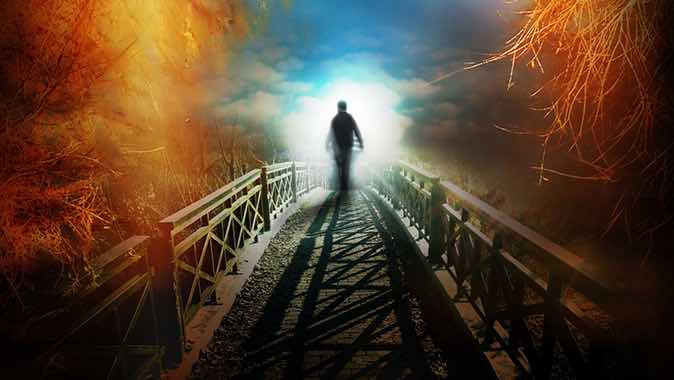
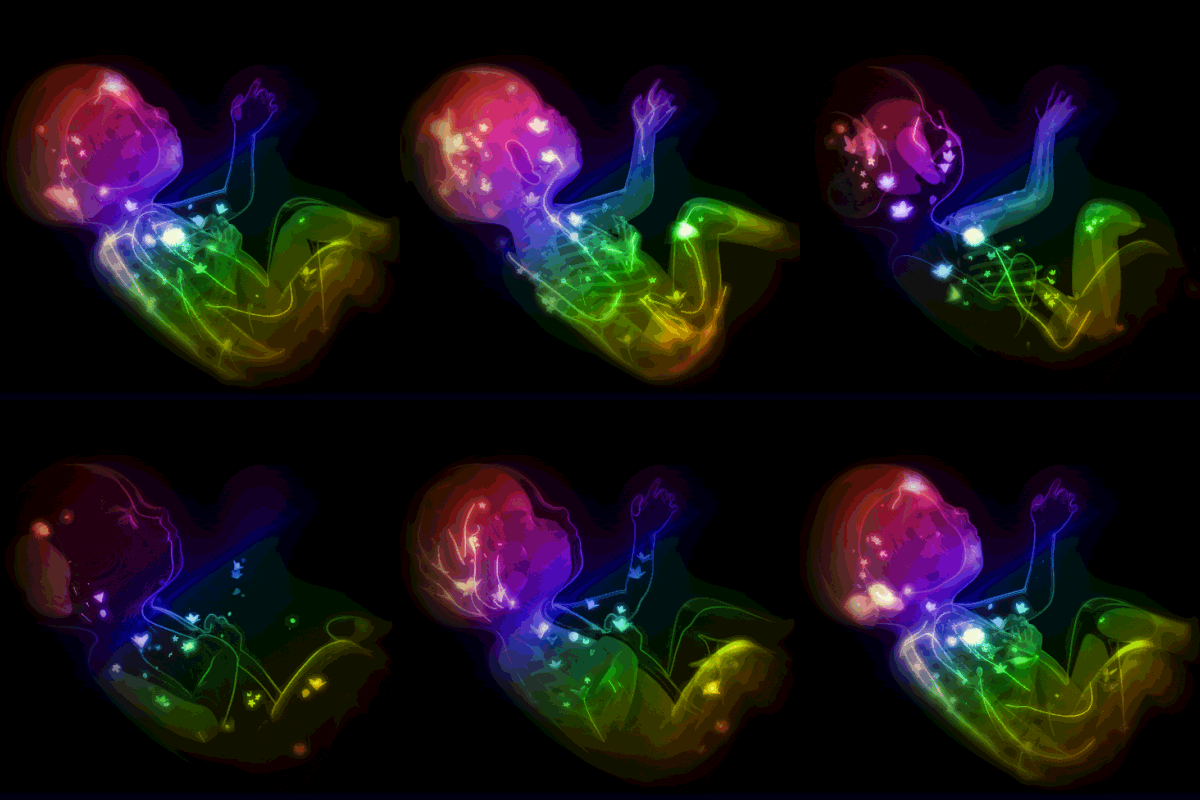
Grof's
Perinatal Matrices
Basic Perinatal Matrix I,
Basic Perinatal Matrix II,
Basic Perinatal Matrix III,
Basic Perinatal Matrix IV.
These matrices
correspond roughly to the different stages of the child’s development in the
uterus, and its birth through the birth canal. The first Basic Perinatal Matrix
corresponds from the time of conception up until the first intrauterine
contraction. The second Basic Perinatal Matrix lasts during the time of
intrauterine contractions to the entering into the birth canal. The third Basic
Perinatal Matrix is completed at the time of passage of the fetus through the birth
canal. Finally, the forth Basic Perinatal Matrix is represented from the
beginning of birth as an independent body.
Grof's
Basic Perinatal Matrices, summarized in his own words
BPM I:
The biological basis
of this matrix is the experience of the original symbiotic unity of the fetus
with the [mother].... Archetypal images from the collective unconscious that
can be selectively reached in this state involve the heavens or paradises of
different cultures of the world. The experience of the first matrix also
involves elements of cosmic unity or mystical union.
BPM II:
This experiential
pattern is related to the very onset of biological delivery....the original
equilibrium of the intrauterine existence is disturbed....Very characteristic
for this stage is the experience of a three-dimensional spiral, funnel, or
whirlpool, sucking the subject relentlessly towards its center....The
corresponding mythological theme seems to be the beginning of the hero's
journey....Agonizing feelings of metaphysical loneliness, helplessness,
inferiority, existential despair, and guilt are standard constituents of this
matrix.
BPM III:
Many important aspects
of this complex experiential matrix can be understood from its association with
the second clinical stage of biological delivery....This involves an enormous
struggle for survival, crushing mechanical pressure, and often a high degree of
anoxia and suffocation....[Themes of BPM III include the] titanic fight,
sadomasochistic experiences, intense sexual arousal, demonic episodes,
scatalogical involvement, and encounter with fire. All these occur in the
context of a determined death-rebirth struggle....Related archetypal themes are
images of the Last Judgement, the extraordinary feats of superheroes, and
mythological battles of cosmic proportions involving demons and angels or gods
and Titans....[BPM III experiences] combine sex with death, danger, biological
material, aggression, self-destructive impulses, physical pain, and
spirituality.
BPM IV:
This perinatal matrix
is meaningfully related to the third clinical stage of delivery, the actual
birth of the child. In this final stage, the agonizing process of the birth
struggle comes to an end....The symbolic counterpart of this final stage of
delivery is the death-rebirth experience....The transition from BPM III to BPM
IV involves a sense of annihilation on all imaginable levels--physical
destruction, emotional debacle, intellectual defeat, ultimate moral failure,
and absolute damnation of transcendental proportions.This experience of
"ego death" seems to entail an instant merciless destruction all
previous reference points in the life of the individual....[after which]The
subject experiences a deep sense of spiritual liberation, redemption, and
salvation.
More:
http://ancestorsandarchetypes.weebly.com/grof-perinatal-matrices.html
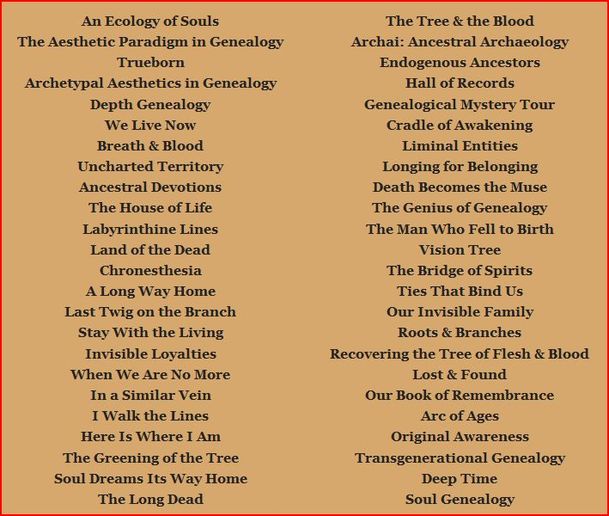
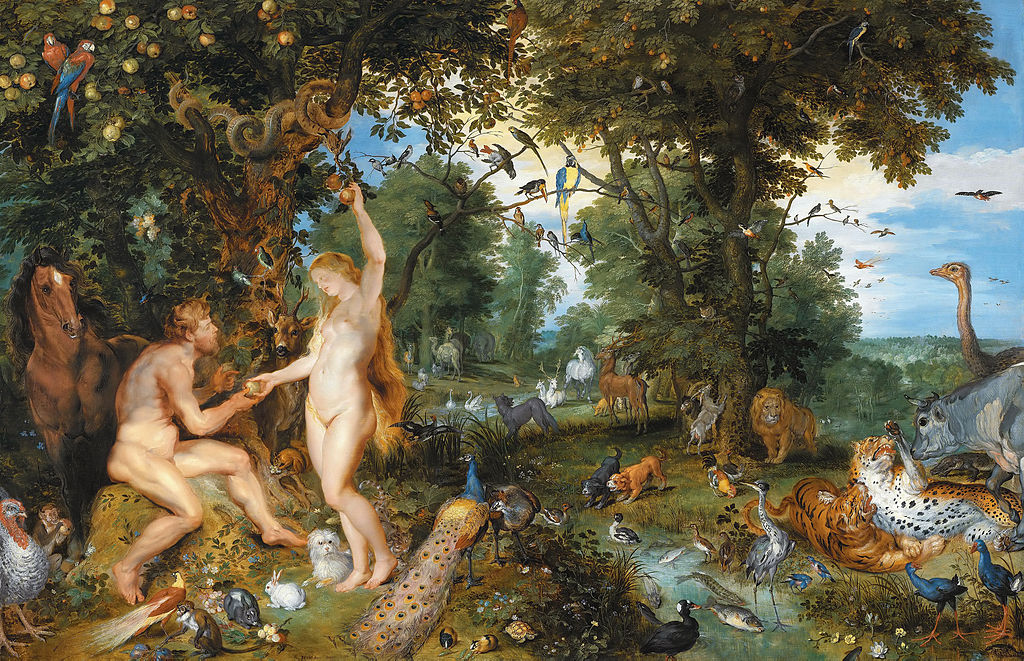
Reubens
FORBIDDEN
FRUIT
Healing Across Life
Lines
"I myself was, so it
seemed, in the Pardes Rimmonim, the garden of pomegranates, and the wedding of
Tifereth with Malchuth was taking place. Or else I was Rabbi Simon ben
Jochai, whose wedding in the afterlife was being celebrated. It was the
mystic marriage as it appears in the Cabbalistic tradition. I cannot tell
you how wonderful it was. I could only think continually, “Now this is
the garden of pomegranates! Now this is the marriage of Malchuth with
Tifereth!” I do not know exactly what part I played in it. At bottom
it was I myself: I was the marriage. And my beatitude was that of a blissful
wedding."
(C. G. Jung, Memories,
dreams, reflections" (A. Jaffe, Ed.). New York: Random
House, 1961, p. 293)
Apart from Elijah and
Salome I found the serpent as a third principle. It is a stranger to both
principles although it is associated with both. The serpent taught me the
unconditional difference in essence between the two principles in me. ~Carl Jung and Elijah, Liber Novus,
Page 247.
|
She: |
He: |
Where
are apples mentioned in scripture? No, not the Garden of Eden. The fruit of the
Tree of the Knowledge of Good and Evil was never named. Apples and apple trees
in particular, are mentioned in the Song of Solomon, God's love song to His
people. The verse describes the meeting of the young woman and her sweetheart:
"Who is this coming up from the
wilderness, leaning upon her beloved? I awakened you under the apple tree. ...
Place me like a seal over your heart...." - Song of Solomon 8:5
So
if the Song of Solomon is an allegory of God's relationship with us, then the
apple tree represents the place where God and I meet, where we connect, and our
relationship is forged.
*
Pomegranate seeds
sprout readily in the right environment. They became a symbol for fertility.
Some believe the pomegranate was the forbidden fruit, not the apple, but its
Latin name literally means "apple with many seeds."
In kabbalah the
Spheres of the Tree of Life are likened to pomegranates. Gods and angels attend
to the Tree of Life. A garden is the fantastic place in which to contemplate
beauty and the mysteries of nature. A magic place, a safe haven, where man by
tending flowers, plants and trees, nurtures the most intimate and delicate part
of his being: a garden is a place of the soul. So is our genealogy where we
cultivate the fruitful rows of our lineage.
The Spheres relate to
major metaphysical concepts, as levels within the Divinity. The Tree of Life in
the Kabbalah is the plan used for the creation of the worlds, and the
descending path along which souls and creatures have attained their current
forms.
In the gematria, the
doctrine which attributes a numerical value to every letter, the value of
"Pomegranate Garden" is 700 which is equivalent to "the one Lord
God".
The Pomegranate Garden
is thus equivalent to an affirmation of faith.
Symbolism is a primary
and unavoidable for mysticism, that intuitively penetrates the veil of the
deepest mystery. It is a means of communication which allows for the message to
be adapted to the level of knowledge of the recipient. The special nature of
symbolic communication is that it is open to differing levels of
interpretation, depending on the level of the reader himself... For those who
know and who possess the right key for interpretation and the right sensitivity
one single symbolic cue - even in pictorial form - can open wide a world of
analogies and implications.
Such is the nature of
the pomegranate with its scarlet blossoms, as symbol. In all the cultures of
the Near East, the pomegranate has always been seen as a symbol of fertility,
fecundity and thus prosperity. This is because of the spherical structure of
its fruit, its ruby red color and the countless seeds it contains. In antiquity
it was associated with the cult of the Mother Goddess.
For example, in the
motif of the tree of life, the multiplication of the subject, prior to having a
decorative function, represents the expansion of an important idea, which
conceals itself as it reveals itself. The symbolic function is potentially to
link people around the same meaning, an experience which can be shared even by
people of different generations, so as to create a bridge, a commonality of
feeling and a spiritual affinity.
Commonly taken as
fertility symbols, in Iraq pinecones and pomegranates are traditionally symbols
of unity. In Christian symbolism, the pomegranate represents "multiplicity
in unity as the Church, with the seeds as its many members" and,
secondarily, "regeneration and resurrection," self-renewal, and victory over death
immortality, longevity, victory over death. Ancestral knowledge of forever time.
A carpet is the
reflection of this ideal place. The carpet-garden allows us to satisfy our
aesthetic and his spiritual sensibility, by setting aside a place for
meditation and prayer. A carpet is a space in which the stories of the world
can be read, for those multi-colored outlines are traces of myths and legends,
principles and life forces, being and becoming and the cosmic cycle. The
carpet, a small bounded and decorated space just like a garden, is thus itself
a garden of the soul.
The fleshy fruits with
numerous blood-red seeds are a good symbol for multiple descendants.
From earliest times,
the pomegranate has been the fruit of fertility, of death and rebirth, of hope
-- and guardian against the evil eye. The folktale goes, "Three
pomegranates fell down from heaven: One for the story teller, one for the
listener, and one for the whole world."
The "fruit of the
gods," or "fruit of heaven," pomegranate is s Semitic symbol of
life, abundance and wealth. In the Babylonian empire the fruit was served at
weddings and represented the symbol of love and fertility. The pomegranate
symbolized the soul’s immortality -- eternal life -- and the perfection of
nature for Zoroastrians.
But, maybe it was also
a "forbidden fruit." Pomegranate seeds were used by women of
antiquity as a hormonal contraceptive. Taken regularly, it prohibited pregnancy
during treatment. So, the forbidden fruit is about the knowledge of good and
evil, sex, and reproductive power -- to have fertility or knowingly thwart it
with reduced fertility rates.
A paradoxical union of
opposites it symbolizes both fertility and contraceptive. Modern testing has shown that
pomegranate does have contraceptive effects. The uterine contracting property
of these fruits may cause serious hazard like abortion, when consumed in early
trimesters of pregnancy. Contraction-stimulating compounds increase the chances
of miscarriage. In ancient times pomegranate seeds were used as abortifacient.
Hippocrates and others
prescribed the seeds and rind of the pomegranate to prevent
conception. Oestrone, a compound that is identical to estrogen, is found
in high levels in pomegranate seeds. The seeds have tested as the highest
concentration of oestrone among all plants.
Soranus writes about
six contraceptive and abortive recipes for vaginal suppositories, five of which
use the rind or peel of a pomegranate, in addition to recommendations for
pomegranate as an oral contraceptive. There are other well known religious
traditions involving the testimony of pomegranate as an oral contraceptive.
Pomegranate and its
distinctive ruby-red jewel-like seeds have been used for medicinal purposes for
thousands of years. Ayurveda
uses pomegranate as a contraceptive and abortifacient. Consuming the seeds,
pulp, or rind is supplemented by using the rind as a vaginal suppository. This
practice is recorded in ancient Indian literature, in medieval sources, and in
modern folk medicine.
In ancient Greek
mythology this fruit was the symbol of life, marriage and rebirth in the
abduction story of Persephone by Hades, the god of the underworld, who abducted
her to the land of the dead. Pomegranates, as a symbol of fertility, were used
in the worship of Demeter during her ancient festival. The third and final day,
the Calligenera, was devoted to the fertility of women where eating of
pomegranate seeds was an important part of the rituals.
In Asia the
pomegranate played a part in the wedding ceremony. The guests were provided
with pomegranates and were told to throw them sharply upon the floor of the
newlywed’s honeymoon room, scattering the seeds. This ritual was intended to
encourage a fruitful union and many children. Jewish tradition teaches that the
pomegranate is a symbol for righteousness and fruitfulness.
Likewise, the
pomegranate is the Armenian symbol of fertility, abundance and marriage. A
bride was given a pomegranate fruit, which she threw against a wall, breaking
it into pieces. Scattered pomegranate seeds ensured the bride future children.
In medieval legend the
pomegranate tree is a symbol of abundance and fertility and an important
feature in the hunt for the magical unicorn. Once Adam sprouts his own 'tree'
in the garden, human descent begins.
Symbolically,
"forbidden fruit" with its unconscious meanings can be relational difficulties,
incest, or illegitimate descent -- the fruit of unwed or unwanted unions, or
mythically-rooted cross cousin marriage. Just one adoption or family secret can
lead to long lost family lines, only retrievable through genetic genealogy.
Yet, unknown family
patterns and traits have a way of being passed along. Cross-cousin marriage,
designed to keep power and assets in the family, is based on the archetype of
the quaternio.
Because we do not tend
to live out such archaic patterns in modern life, the dynamic is pushed down
into the unconscious. But we can see it in our genealogy, especially when it is
practiced through generations; it is called pedigree collapse. Reproduction
between two individuals who share an ancestor causes the number of distinct
ancestors in the family tree of their offspring to be smaller than it could
otherwise be.
A single individual
alive today would, over 30 generations going back to the High Middle Ages, have
roughly a billion ancestors -- more than the total world population at the
time. This apparent paradox is explained by shared ancestors, referred to as
pedigree collapse. Instead of consisting of all unique individuals, a tree may
have multiple places occupied by a single individual. This typically happens
when the parents of an ancestor are related to each other (sometimes unknown to
themselves).
When cousins marry,
you get inbreeding, ancestor paradox, pedigree collapse or the 'family braid'.
Instead of having all different ancestors, the same couple appears more than
once in your pedigree. First cousins share a pair of grandparents, for example,
so any children they have will show one pair of great-grand-parents ‘repeated’
in their pedigree.
Pedigree
collapse is caused by inbreeding; both recent close breeding and more distant
founder effects. When a breeder inbreeds they are cutting the pedigree
pyramid of their stock down dramatically. When two cousins mate, they have
actually permanently cut out 25% of the possible ancestors for their offspring.
Within the same
general population, the chances are almost 100% that your spouse is a distant
cousin, and you share a common ancestor from 20 generations ago. Once you go
back 20 generations (a million distinct ancestors), you are almost guaranteed
to see a common ancestor, and all ancestors of the common ancestor reduce the
overall number of unique ancestors.
This early form of
mating that ensured that endogenous (kinship) libido -- incest -- held the
family together but didn't overpower exogamous libido. The endogamous side
wants a sister, the exogamous urge desires a stranger, so marrying a cousin
balances the two. Marriage of a man's sister to his wife's brother is a relic
of the "sister-exchange marriage" of many primitive tribes and
the basis of alliance
theory.
Native
Americans could not marry cousins from the father's line, but they could
marry cousins from their mother's line. This was called cross-cousin
marriage.
Preferential
cross-cousin marriage exists in Tibet, Nepal, Pakistan, Africa, and elsewhere.
Levi-Strauss also
discovered that a wide range of historically unrelated cultures had the rule
that individuals should marry their cross-cousin, meaning children of siblings
of the opposite sex - from a male perspective that is either the FZD (father's
sister's daughter in kinship abbreviation) or the MBD (mother's brother's
daughter in kinship abbreviation). Accordingly, he grouped all possible kinship
systems into a scheme containing three basic kinship structures, constructed
out of two types of exchange. He called the three kinship structures
elementary, semi-complex and complex.
Common reasons behind
cousin marriages are:
a) Better to marry in
a family we know so that the bride/groom can adjust to their new life easily.
b) Better marry within
the family so that our `wealth' does not go out.
c) Better marry within
the family because we are better/superior than others.
d) Better marry within
the family so disputes can be settled easily, reducing the likelihood of
divorce.
e)Agreements are made
by parents who are usually related.
Such marriage between
'the respective descendants of a brother and a sister', 'despite the very close
degree of consanguinity between the spouses, is regarded as an ideal'.
Bilateral cross-cousin marriage is often prescribed.
Diamond Pedigree
Collapse -- How the shape of your genealogy expands & contracts with
increasing occurrence of cousin marriages the further back you go.
https://www.pinterest.com/pin/369435975654167827/
If we consider as a
function of time t the number of a given individual's
ancestors who were alive at time t,
it is likely that for most individuals this function has a maximum at around
1200 AD. Some geneticists believe that everyone on Earth is at most 50th cousin
to everyone else. We
are born, we fruit, and die.
BEST ROYAL DESCENT
A royal descent is a
lineal descent from a past or present monarch. Royal descent is sometimes
claimed as a mark of distinction and is seen as a desirable goal of genealogy.
Pretenders, impostors and those hoping to improve their social status have
often claimed royal descent and some have fabricated lineages.
There
were at least 650 colonists with traceable royal ancestry, and 387 left
descendants in America (almost always numbering many thousands, and some as
many as one million). Due to primogeniture, many colonists of high social
status were younger children of English aristocratic families who came to
America looking for land because, given their birth order, they could not
inherit. Many of these immigrants initially enjoyed high standing where they
settled. They could often claim royal descent through a female line or
illegitimate descent.
The idea is that the
"best" Royal descent is the descent from the most recent Monarch. In
other words, a descent from a youngest son of Edward III of England (d. 1377)
is considered "better" than descent from a daughter of Edward I of
England (d. 1307).
One wrinkle in the
idea of "best" is when the person is descended from
Monarchs of two
different countries. In the past, several researchers would hold that a descent
from any English king (such as Edward I, d. 1307) was "better" than a
descent from any Scottish king (such as Robert III, d. 1406), but all of the
major genealogy researchers have switched over to the strictly chronological
definition.
A
descent from, say, Henry VII, is "better" than a descent from Edward
III ---- because it means that one is descended from some of those monarchs in
between [Henry IV, Henry V, Henry VI, Edward IV] ---- giving a greater overall
count of Total Overall Royal Descents [TORD].
By the same token, a
descent from Queen Victoria would be far better, but not if your main interest
is archaic royal lines prior to the Donation of Constantine, which allowed the
church to choose merchant kings, rather than ancient lineage heirs.
"Genealogy
is an infinite progressive and regressive binary series, propagated by means of
a terminal, sexually transmitted disease, producing a 100% death rate -- which
we call Life." [DSH] -- 4 June 1997
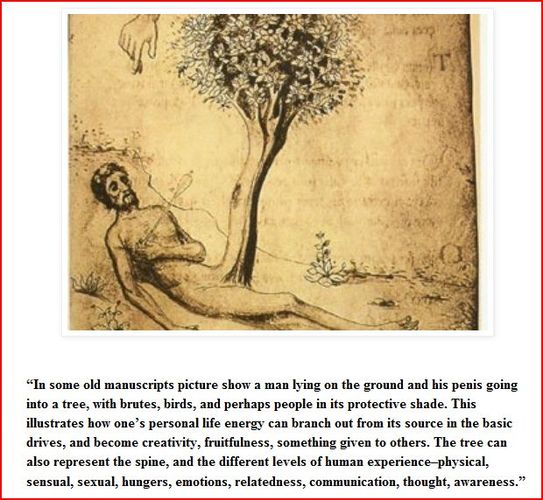
THE
HIDDEN LIFE OF FAMILY TREES
Sap is a Living Symbol
of the Tree
Connecting with the
vitality of our lineage -- the living sap of the Tree -- elevates the mind and
sublimes the thought. It is less about a "me generation" story than a
grand "story of us" that ranges beyond illusions of time, space, and
ego. We can cultivate the Elysian Fields of our ancestors to good effect. Thus,
genealogy can be a transformative art. The Grail is a Mystery and the search
for it is a Quest for self-actualization, a way of initiation.
Genealogy
contains a spiritual healing potential, the living sap of the Tree, a
manifestation of the sacred. It is a Grail banquet of cultures, customs and
symbolism. The spirit, by death or enlightenment, will produce the pure,
perfected, incorruptible spirit. In alchemical terms, the incorruptible body is
the potential of the philosopher's stone.
The circulation of
blood in the arteries mirrors the circulation of sap in the tree, and the
circularity of cosmological or metaphysical thought — analogical thinking that
links the macrocosm and microcosm, above and below. The ancestral field has an
immediate effect, both healing and challenging, on our whole lives.
Our genealogical Quest
is an introspective as well as investigative journey. We may think that the
lines of evidence of our family tree are very neat and orderly, but when it
comes to human beings, dead or alive, there is a certain inherent messiness
that comes from the sap of living, from the juicy stuff of life that won't ever
fit on the page -- the life experiences and felt-sense of Being. Uncanny
patterns and systems of occurrences befall families from generation to
generation.
Much of the action
goes on in the invisible realm, in the roots far below the branches where
everything mingles and becomes entangled and from which the nutritious sap
flows. Hidden links below the surface inform and affect us at the unconscious
level and biogenealogy. Our ancestors, and their original ancestral traumas,
even those who died before we were born, do affect us. They are part of the
natural environment from which we are formed.
Family patterns
persist over generations. It is the hidden hand of the grip the family retains
on our lives and being. Transgenerational therapy says the ancestors can be the
root of repetition compulsions, couple behavior, unresolved feelings, and a
variety of other psychophysical phenomena -- a trans-subjective reality.
Methodical tracing of
our family trees uncovers how important events have been interred in our
genetic structures, only to pop up generations later. Family conflicts can pass
on to future generations, even "the secret that is never told." When
we have to live with the circumstances, knowledge is power.
The anniversary date
of or a certain tragedy in the past can be stored in unconscious memory and
acted out by following generations. Anniversary reactions appear not only as
dramatic coincidences in dates or behaviors, but also in health problems,
family secrets and accidents which seem to repeat generation after generation
without any plausible explanation.
The research of Ernest Rossi, MD and others opens a new model of the
relationships between the most interesting and motivating experiences of
consciousness and the molecular dynamics of memory and learning that are
described as the “novelty-numinosum-neurogenesis effect” (Rossi, 2002).
Gene-expression is the mechanism by which new patterns are called into being
(Rossi, 2000). There is also a strong correlation between modulation of the
brain’s EM field and consciousness (Persinger, 1987; McFadden, 2002). Creative,
novel and enriching psychotherapeutic experiences can lead to neurogenesis,
gene expression, and healing which facilitate mindbody communication and can
have a long-term transformative effect on the whole person (Rossi, 2002).
Activated ancestors, like activated archetypes in complexes, can become like
strange attractors, around whom we orbit in weird yet meaningful patterns. The
attractor once again exhibits its self-iterating capacity by demonstrating its
attractive or seductive power as a phenomenon, idea, or theory. Chaotic systems
display certain characteristics including complex feedback loops, self
organization, holistic behavior, inherent unpredictability.
It isn't what is expected and easily predictable in human affairs that is
motivating, but the exact reverse. That which is surprising, unknown, and
unpredicted garners our attention most. We set forth on the human quests for
creative problem solving and creative adventure. We can explore the
novelty-numinosum-neurogenesis dynamics of mind-body communication and healing
in the new discipline of psychosocial genomics with our genealogy.
But what we really want from the generations past are not just the facts or the
DNA. We want the stories. Love, passion, success, disappointment, humanity.
There may be no way to know — really know — their interior life.
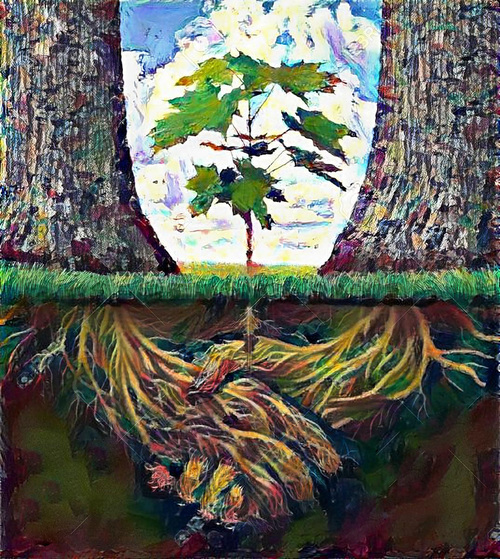
Genetic Healing
Genomics has
psycho-social dimensions. Ernest Rossi, M.D. reveals his Jungian approach,
stating, “Nothing, it seems turns on gene expression and brain plasticity as
much as the presence of others of the same species!”
Jung suggested that
"Individual consciousness is only the flower and the fruit of a season,
sprung from the perennial rhizome beneath the earth; and it would find
itself in better
accord with the truth if it took the existence of the rhizome into its
calculations. For the root matter is the mother of all things."
Ernest Rossi (1999;
2002) has developed a pertinent creativity hypothesis: “Enriching life
experiences that evoke psychobiological arousal with positive fascination and
focused attention during creative moments of art, music, dance, drama, humor,
spirituality, numinosity, awe, joy, expectation, and social rituals can evoke
immediate early gene protein cascades to optimize brain growth, mindbody
communication, and healing.”
“[The] psychotherapeutic
approach can contribute to psychobiological arousal, enrichment and relaxation;
it may be possible to help people find optimal levels of mental stimulation to
facilitate actual growth in the hippocampus of their brain to encode new
memory, learning and behavior...optimizing psychobiological growth and
healing.”
Rossi (1999) describes
a mind/body communication channel that is pertinent in that it may describe
another way neural plasticity and healing manifests from REM. He describes how
immediate-early genes (also called “Primary Response Genes” or third
messengers) play a central role in the dynamics of waking, sleeping, dreaming,
and mind-body healing at the cellular level.
There is evidence that
immediate-early genes (IEGs) function as mediators of information transduction
between psychological experience, behavioral states, and gene expression. A
wide range of behavioral state-related gene expression (from relaxation,
hypnosis and sleep to high arousal, performance, stress and trauma) culminate
in the production of new proteins or homeostasis, physical and psychosocial
adaptation.”
Behavioral states
modulate certain patterns of gene expression. Interaction between the genetic
and behavioral levels is a two way street. Genes and behavior are related in
cybernetic loops of mind-body communication. How does this relate, for example,
to our genealogical work and its psychobiological effects?
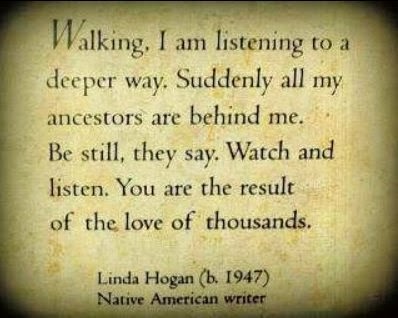
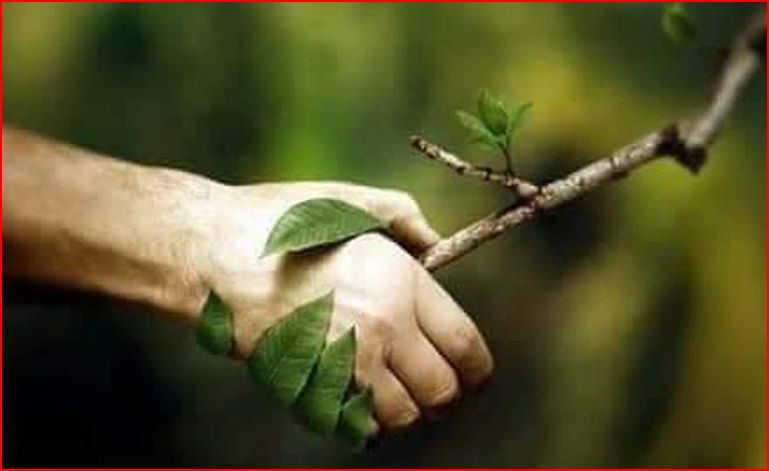
AN
ECOLOGY OF SOULS
Family Tree Huggers
The
Aesthetic Paradigm in Genealogy
“...it is only as an aesthetic phenomenon
that existence and the world
are eternally justified...” --F. Nietzsche, 1872
"I am convinced
that there is only one basic Order - which appears as logical or mathematical
to our cognitive intuition, aesthetic to our emotional intuition, and moral to the
volitional or conative. And it is essentially numinous."
--Sir Cyril Burt
"The canvas,
which is to say the unconscious, considers the painter’s first stroke, and then
tells the painter’s hand how to respond to it with a shape of a certain color
and texture. And then, if all is well, the canvas the ponders this addition and
comes up with further recommendations." --Kurt
Vonnegut
"The Spirit speaks
in a poetic way, but the man understands it literally. ...The richest understanding of the
sacred becomes available when the metaphorical and the literal are brought
together without denying either kind of truth..."
--Gregory Bateson
"The
impact of an archetype, whether it takes the form of immediate experience or is
expressed through the spoken word, stirs us because it summons up a voice that
is stronger than our own. Whoever speaks in primordial images speaks with a
thousand voices; he enthralls and overpowers, while at the same time he lifts
the idea he is seeking to express out of the occasional and the transitory into
the realm of the ever-enduring. He transmutes our personal destiny into the
destiny of mankind, and evokes in us all those beneficent forces that ever and
anon have enabled humanity to find a refuge from every peril and to outlive the
longest night. That is the secret of great art, and its effect upon us."
(C.
G. Jung, On the Relation of Analytical Psychology to Poetry; CW, Vol. 15)
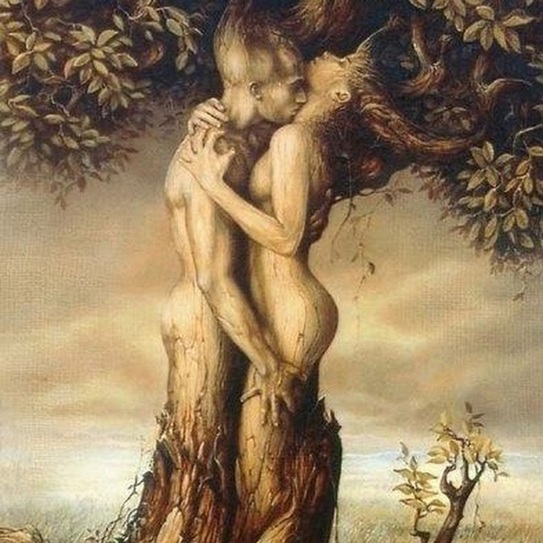
The
Norse gods formed the first man and woman, Ask and Embla, from two tree trunks,
and built a fence around their dwelling-place, Midgard, to protect them from
the giants. Creation is ongoing and participatory.
Ask and Embla are the
first humans of the world. Ask is the first male and Embla the first female.
Oden together with Vile and Ve created them out of two trees they found on a
beach, an ash-tree that would become Ask and an elm-tree that would become
Embla. Oden gave them life, Vile gave them common sense and mobility, Ve gave
them emotions and senses.
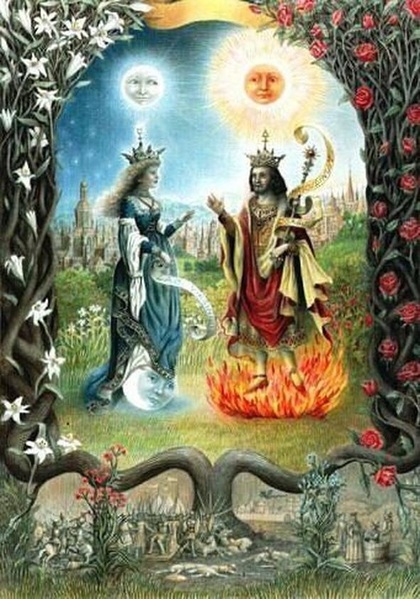
ANCESTRAL
ALCHEMY
Marriage
of the Sun & the Moon: Primordial Parents
"When you make the
two into one, and when you make the inner like the outer and the outer like the
inner, and the upper like the lower, and when you make male and female into a
single one, so that the male will not be male nor the female be female, when
you make eyes in place of an eye, a hand in place of a hand, a foot in place of
a foot, an image in place of an image, then you will enter the Kingdom." (Gospel of Thomas, 22)
A perennial theme of
humankind, transformation as a basic change in character, cognition, and
direction has been explored in religion, psychology and art. Rites of passage,
as a summons to wisdom, can include a psychological and sacred dimension. Rites
of initiation provide a symbolic death and rebirth experience. It addresses the
question of how a person finds a personal path worthy of the soul.
Ritual Consummation
The hieros gamos, divine marriage, is usually found
at the top of an ancient genealogical line. The genealogical myth begins when
younger gods are born. The hieros gamos myth is a genealogical myth
connected to the ruling family and fertility from ancient times. Nothing is
more sacred than this union, the very fount of life itself.
Cosmic Disaster
The divine marriage is
modeled on the union of sun and moon, either in eclipse or at solstice. A
sliver of sunlight still enters the earth passage tomb at New Grange on the
darkest day of the year fructifying mother earth, and entreating the ancestors
to bless their fertility, through meaningful alignment of sun, earth, and moon.
By coming together
they 'force' or generate the re-creation of the universe. The royal couple mimics cosmological
events -- "As above; so below."
The first known
megalithic building begun at Gobekli Tepe (navel-like hill) has been linked to
the cataclysmic massive Laurentian comet (10,900 BC Younger Dryas impact event)
around 12,000 years ago. Many of the circular temples (womb chambers) repeat a
12 around 2 pattern, that is thought to represent primordial parents (Sun/Moon)
as humanoid statues and the circle of the zodiac. In womb-like chambers, the souls of
shaman and the spirits of the dead, could quite literally journey to the source
of creation.
The area was rich in essential obsidian for blades and trade.
"The elite of
the Halaf and Ubaid were probably the forerunners of the god-kings who ruled
the first city-states down on the Mesopotamian plain, which eventually became
the civilizations of Sumer, Akkad, Assyria and Babylon. Their scribes preserved
in cuneiform writing the ruling dynasties' mythical history, in which the
founders of the Neolithic revolution are known as the Anunnaki, the gods of
heaven and earth. Their birthplace was said to have been the Duku, a primeval
mound located on the summit of a world mountain called Kharsag, or Hursag, and
now identified with both Göbekli Tepe and Bingöl Mountain. Here the Anunnaki
are said to have given humankind the first sheep and grain, a memory almost
certainly of the introduction of animal husbandry and agriculture at the time of
the Neolithic revolution, which occurred in the same region as Göbekli Tepe
around 9000-8000 BC. The Anunnaki are occasionally likened to serpents,
reflecting the snake-like appearance of Göbekli Tepe's ruling elite, as well as
those of the later Halaf and Ubaid cultures." (Collins)
http://www.andrewcollins.com/page/articles/Go_Tep_launch.htm
In the third
millennium earth passed through massive debris (The Taurids) from the breakup
of comet Encke, and the fall of massive fireballs changed many Neolithics from
earth to sky/fire religion. 'Dragons' fought massive battles in the sky, or so the
ancestors imagined. Comets are also implicated in Bronze Age collapse.
As we approach the end
of the Second Millennium, the AD 837 apparition of Halley's Comet appeared as
bright as Venus and would have moved through 60 degrees of sky in one day as it
passed just 0.03 AU from Earth. The beginning of the Dark Ages came from a
comet fall near the equator that virtually blotted out the sun and led to
famine and plague.
Crown of Creation
In ancient cities, the
priest/king and his temple consort reenacted the rite, the sacred mating of
Heaven and Earth. The
royal union is called the Marriage of the Sun and Moon in alchemy. The Marriage
of Inner & Outer Worlds unites internal/external and macrocosm/microcosm,
the sacred and profane. Later
clear parallels to the ancient rites turn up in the Grail cycle.
The central theme of
alchemy, this marriage is represented by the two snakes of the caduceus, the
opposing forces of our nature, joined together at the head, which correspond to
the Moon and the Sun. The entwined serpents are an ancient glyph for the DNA
double-helix, and might describe how two serpents twine up the trunk of our
family tree.
When we each get
“infused” with the sacred essence of the divine male and female, we can
dissolve in the unity of cosmic consciousness. The celestial pair are reunited.
"Heaven on earth”
describes divine union on earth, dissolving into time, mirroring the
notion of "As above, so below." The ascent or descent is a function
or goal of the hieros
gamos itself.
The union with the Goddess implied the meeting of human and divine.
The genealogical
relationship to the soul has to do with its mystical-genealogical origin.
Genealogy has its virtually infinite series of primal couples -- the
grandfathers and grandmothers who give birth in a cascading union of opposites.
Life feeds on
opposites and contradictions will always appear in life. They engender the
souls of the newborn -- the seed of a fate-laden new creation. So, if we are
whole we are full of contradictions -- ambiguous and paradoxical. The
unconscious holds the whole creation in potential.
Alchemical symbolism
calls this a marriage of the Sun (spirit) and the Moon (soul), solar and lunar
ways of knowing. We live, life moves, at the confluence of these polarities of
spirit and matter, body and soul have the capacity to hold contradiction and
paradox so we can become whole. Such is the Chemical Marriage, Courtly Love and
tantric secrets that might conceive a magical child.
Sacred kingship is the
basic myth of genealogy, destiny, and eros. Jung tells us that the queen
symbolizes the body, the king stands for the spirit, and the soul unites the
two in the royal marriage. Therefore, our psyche is a half bodily and
half spiritual substance.
The hieros gamos myth is multifunctional, combining
enthronement, genealogical myth, cosmology, and legitimization of rule. When
king and queen (animus/anima) unite, they form a magical hermaphroditic being
which is a union of opposite energies. Symbolically, their sacred marriage
results in the manifestation of all things.
In alchemical
manuscripts, coniunctio, mystical marriage, is depicted as
the union or coitus of King and Queen, the red man and white woman, or just by
man and wife. The mother is the unconscious, the son is the conscious. It is a
‘regressus
ad uterum’
or the return to the uterus of the mother.
Penetration of the
female is the same as the penetration of the water or the unconscious. Thus we
see that the coniunctio is depicted as the coitus of man
and wife, king and queen, but also by the king taking a bath, or drinking
water. Sometimes consummation between man and woman happens in water, in a bath
or in a fountain.
In the sacred
marriage, such acts refer to the union of our divine spirit with the soul, and
finally with the body. As a grand union of opposites, mystic marriage
symbolizes the unification of king and queen, man and wife, conscious and
unconscious, personality and society, etc.
Ordinarily, spirit,
soul and body are separated from each other, even while in dynamic interaction.
But when the Great Work is complete, the divine spirit is brought ‘down’ to
shine through the soul and body. It unifies itself with them, so they all form
one and the same ‘body’.
Jung used the poetic
term syzygy for the union of opposites, wholeness and completion and the divine
couple. The pattern repeats endlessly. Pulsating life is the substrate of our
existence. The perfect partnership includes physical and psychic compatibility
of anima and animus, which fire the quest for love and myths of the soulmate.
Just as a man brings forth
his work as a complete creation out of his inner feminine nature, so the inner
masculine side of a woman brings forth creative seeds which have the power to
fertilize the feminine side of the man. ~Carl Jung, CW 7, Para 336.
The parental pair has
many symbols from the medieval West and sacred duos of the East, including
yin/yang. The Divine inner marriage—or the syzygy—of the masculine/dynamic and
feminine/magnetic yokes the anima, the feminine aspect of the male psyche, and
the animus, the male aspect of the female psyche.
The experience of
spiritual rebirth via the union of opposites, or the sacred marriage is
characterized as the union of the Sun (+) and Moon (-), positive-negative;
male-female; god-devil; spirit-matter; father-mother; etc.
The sacred marriage,
or coniunctio, creates a bond by which opposites are united in an image which
transcends both original potentials. The whole art of alchemy is contained
within the image of a magical or divine child. This process creates a cellular,
alchemical, energetic rebirth into a higher order of being, symbolically called
a spiritual androgyne.
The syzygy has three
components: a man's femininity and woman's masculinity; the experience man has
of woman and vice versa; and the masculine and feminine archetypal image.
Archetypal symbolic pairings are 'yoked together' by this term.
Contrasexual
(male-female) pairings occur in dream symbolism. They refer to internal
communication between the unconscious and conscious minds of any individual.
“It is a psychological fact that as
soon as we touch on these identifications we enter the realm of the syzygies,
the paired opposites, where the One is never separated from the Other, its
antithesis. It is a field of personal experience which leads directly to the
experience of individuation, the attainment of the self. ...In this still very
obscure field of psychological experience, where we are in direct contact, so
to speak, with the archetype, its psychic power is felt in full force. This
realm is so entirely one of immediate experience that it cannot be captured by
any formula, but can only be hinted at to one who already knows.” (Carl Jung, CW 9i, para. 194)
Female archetypes of
earth and sky symbolize the Great Mother, who is both conscious protector,
spiritual guide, and nurturer, while at the same time the unconscious forces of
birth and death, life and destruction. The anima lurks in the unconscious,
wielding her supernatural power to drive our lives either towards mystical
knowledge, consciousness and individuation, or towards oblivion in sensual
urges.
The sky mothers and
animas can transcend the body and ego, but in so many myths, they crave balance
through the experience of the underworld, the unconscious drives of the
instincts and the non-rational, and through this unity, express a balanced
whole.
The
union of seemingly separate elements give birth to and reveal a higher
form. This is often referred to as the royal marriage. This marriage is of
fundamental concern to alchemists because it is a key to transformation. Using
an alchemical metaphor, Jung often referred to marriage as the crucible of
consciousness.
In Sacred Marriage
relationship is Immortality. All our cultural experience and individual
conscious existence depends on the fabric of life, the germ line, from the
mutual sexual relationship of genders. The female is the sole bearer of
cytoplasmic inheritance and the principal investor in time and resources. The
male contributes half of the genetic material. Immortality is thus not the
domain of one gender but of the relationship between woman and man.
The Philosopher's
Stone is equated with the Body of Light, the Resurrection Body, or the Immortal
Body. Alchemy strives for spiritual rebirth through the union of opposites, or
the sacred marriage. The Philosopher's Stone (lapis) is also a symbol of the
embryonic Self. The transcendent function is the product of the sacred
marriage, which has been characterized in alchemy as the royal union of the Sun
and Moon.
Polarized positions
may be symbolized variously as positive-negative, male-female, god-devil,
spirit-matter, father-mother, etc. This marriage creates a bond by which
opposites are united in an image which transcends both original potentials. The
whole art of alchemy is contained within the image of a magical, numinous, or divine
child.
Progeny of the divine
couple have various alchemical names: the philosopher’s gold, the filius Philosophorum, the infans solaris (sun child), the red tincture, the
sun/moon child, etc. Making the Philosopher's Stone is a repetition of the creation
myth via imagery. The Stone is made in Nature, and with and by “Nature” in the
visible and invisible worlds -- within the material, spiritual,and
psychological worlds. Light unveiled begets light.
The transformative
imperative is a a mystic marriage or union, symbolized in alchemy by the coniunctio -- conjunction of conscious and
unconscious. Individuation is the integration of unconscious contents
into consciousness. Potential is embodied as a psychologically whole
self-realized or self-actualizing person. The "royal wedding" is the
final alchemical synthesis of ego and unconscious, matter and spirit, male and
female, that brings forth the Philosopher's Stone (the Self).
Alchemist Gerard Dorn
called the unus
mundus a
unification of the Stone with body, soul, and spirit -- a perfect synthesis of
conscious and unconscious. This "one world" is the
physical-psychological, transcendental, "third thing" continuum
underlying all existence -- the metaphysical equivalent of the collective
unconscious. Mercurius or the Dragon's "treasure hard to attain" are
images for the archetype of unity -- the self.
We need to be related
to another individual, according to Jung, to experience the full depth of our
own psyche. From an internal perspective, spiritual marriage is an inner
experience which is not projected onto another living individual. In the
royal marriage of the soul with the Self, the projections of anima and animus
have been returned to their proper level in the personal unconscious.
Our partner no longer
carries an essentially religious function for us. The King and Queen are
united, or conjoined, synthesizing the opposites. When the opposites to
be united are the masculine consciousness (of our day world) and the feminine
unconscious (the night world), this royal marriage is a transcendent symbol of
the Self, and embodies the psychic totality of personal wholeness.
Clarity is artistic
discovery of the universal. There is enchantment in the quality of wholeness.
There is beauty in the rhythms of nature and our nature. Aesthetic response is
an essential emotional aspect of alchemy that lends flow and harmony to the
process of balance, rhythm and synthesis of immediate perception.
This flow is lyrical,
epic and dramatic. Aesthetic signification is one thing, but the deep emotional
impact of aesthetic arrest -- being suspended for a thrilling radiant moment in
the eternal -- stops us in our tracks in a moment of realization.
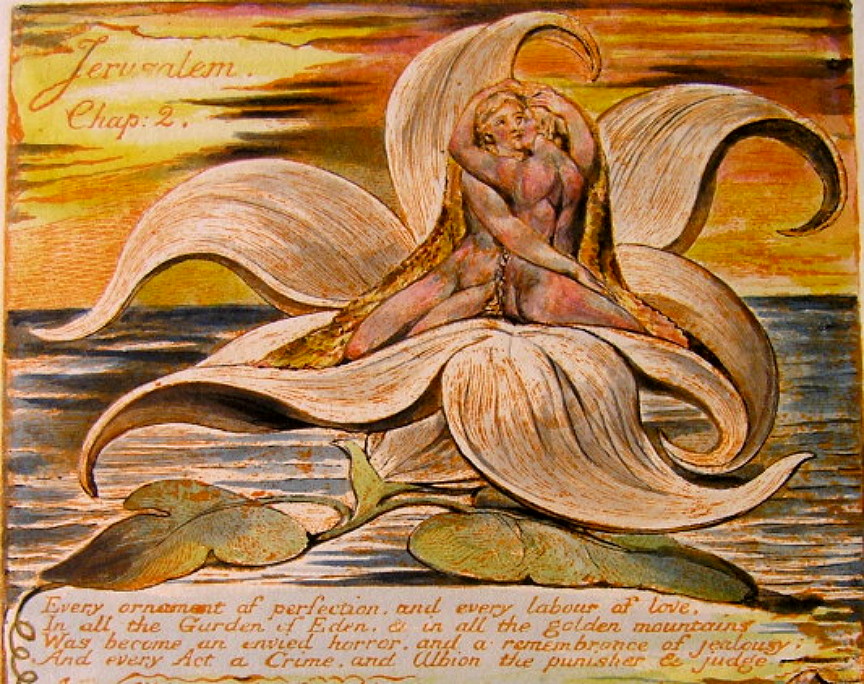
The
state of imperfect transformation, merely hoped for and waited for, does not
seem to be one of torment only, but of positive, if hidden, happiness.
It is the state of someone
who, in his wanderings among the mazes of his psychic transformation, comes
upon a secret happiness which reconciles him to his apparent loneliness.
In communing with himself
he finds not deadly boredom and melancholy but an inner partner; more than
that, a relationship that seems like the happiness of a secret love, or like a
hidden springtime, when the green seed sprouts from the barren earth, holding
out the promise of future harvests.
~Carl Jung, Mysterium
Coniunctionis, Para 623.
Hieros Gamos
Deciphering its
inherent meaning is a Quest for the Grail and the journey of psychological
transformation. The hierosgamos is the holy grail of sexual rites, a
psychobiological and symbolic act. Alchemy refers to the reconciliation of Sol
and Luna as The Chymical Wedding. The coniunctio was allegorized as the hieros
gamos, the ritual cohabitation of Sol et Luna.
Jung's theory of the
psychic conjunction of polarities was inspired by this teaching. Over
centuries, the alchemists generated a wide range of symbolic images as
homologues for the anatomy of the unconscious, relating form and dynamic
function.
In biology, two things
are homologous if they bear the same relationship to one another. Homology is a
relationship between structures or DNA derived from a common ancestor.
Homologous traits of organisms are therefore explained by descent from a common
ancestor. Homology can also be described at the level of the gene. In genetics
homology can refer to both the gene (DNA) and the corresponding protein
product.
What we seek is
spiritual union, sacred marriage of the gods -- found by joining the male and
female within, returning Eros to our process. They guide us into a new holistic
era. We now turn to the Feminine, which gives birth to new forms, including the
non-physical field of epigenetic and wave-genetic inheritance patterns.
Epigenetics is an active, tuneable inheritance mechanism that can be turned ‘on’
or ‘off.
The balance of
opposites is called the ‘alchemical wedding’ or mysterium coniunctionis. It was celebrated in Morganatic
marriages between human representatives of the God and Goddess. It has less to
do with inheritance and succession than with renewal of community.
Art that contains the
archetype, including the genealogical art, is the art that best serves the
global community. Like the Caduceus, the two intertwined snakes, it
serves as a symbol for perpetually incarnating life, healing and wholeness.
The unification of
archetypes embodies the Self. Jung said, “The symbols of the self arise in the
depths of the body and they express its materiality every bit as much as the
structure of the perceiving consciousness. The symbol is thus a living body, corpus et anima.” (Cw 9i) Any distinction between
mind and body is an artificial dichotomy.
The Great Rite, also
called the Hieros Gamos, dates to Inanna of ancient Sumeria, around 2600 BCE,
if not before. Gods and goddesses, kings of the land and queens of sovereignty
incarnate on the earth. The Great Rite is one of the earliest recorded public
ceremonies in written history, deemed essential for the fertility of the
land.
Symbols arising from
the changeable coniunctio reflect the natural process of life/death/rebirth
arising from the fixed constellations.of the patriarchal archetypes. The
feminine gives birth to the Self before she can birth the new man. Hierosgamos
is the symbol of the absolute that reigns over the ego.
The myth of the Holy
Grail had to do with the Fisher King whose impotence reflected the drought, the
wasteland. Sexual union is a microcosm of the god and goddess, the two
fundamental aspects of the cosmos whose union completes the whole. Mystically,
the sexual union of male and female is the source of both immortality and
personal individuation and redemption.
No one who sets forth
on the grail quest remains unchanged. The incarnatio is a spontaneous act of
creation in the matter of the universe as the result of the today constellated
act of the coniunctio. Synchronicity is the conjunction
of individual and cosmos in a way that accelerates and deepens life in an
unforeseen way that celebrates Life. The only place of power and change is the
Present.
TRUEBORN
LINES OF EVIDENCE
Archetypal Aesthetics
in Genealogy
"I
am. Lo, I am alive"
Symbols
are the currency of consciousness.
Henry Stapp calls
consciousness "the felt quality of the manipulating actions of these
symbols upon one another." Symbols refer to reality, and the anthropomorphizing,
personification and projection of aspects of ourselves onto reality.
Misunderstood, symbols are abstract ideas that enslave our minds.
Symbolism comes from
trying to relate ourselves to reality, self-knowledge, and nature to understand
ourselves and reality. First is reality. Second is
knowledge from perception. Third are symbols of that knowledge from reality.
General
human symbols:
Father, mother,
grandfather, grandmother, son, daughter, sister, brother, child, wise old man,
magician, king, queen, prince, princess, knight, teacher; the human heart, the
human hand, the eye, the egg. Birth, growth, marriage, death and rebirth,
rejuvenation, or resurrection. The real purpose of religious ceremonial
is to revivify.
"You may have, say, a
religious attitude, which means an attitude of great totality, so that you
receive the next leaf that falls from the tree as a message from God, and it
works." (Carl
Jung, Visions Seminar, Page 919.)
"Good and bad must
always be united first if the symbol is to be created.
The symbol can neither be
thought up nor found; it becomes.
Its becoming is like the
becoming of human life in the womb.
Pregnancy comes about
through voluntary copulation.
It goes on through willing
attention.
But if the depths have conceived,
then the symbol grows out of itself
and is born from the mind,
as befits a God."
~Carl Jung, Liber Novus, Page 311.
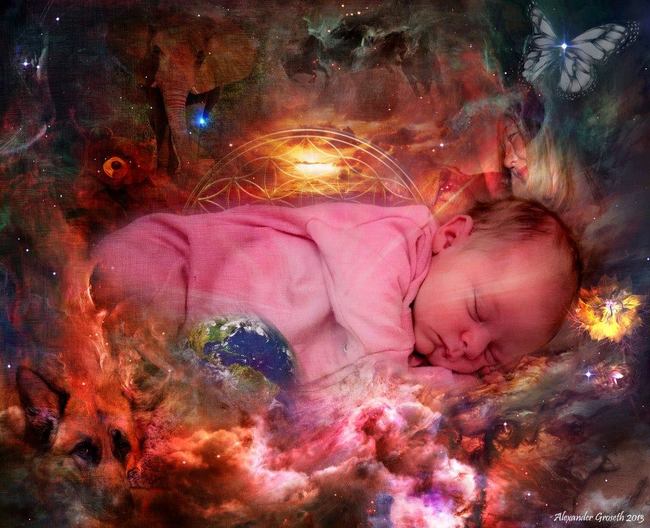
DEPTH GENEALOGY
"From
a barren list of names we learn who were the fathers or mothers, or more
distant progenitors, of the select few, who are able to trace what is called
their descent from antiquity." (Smollett,
Tobias (1798).)
"Hypothesis: in a sharp crisis, that
bears in some way on species survival,
an individual may
spontaneously merge with his ancestors AND descendants
and become, for a
time, a single amplified entity." --Ken Thomas
"Go to bed. Think of
your problem. See what you dream.
Perhaps the Great Man, the
2,000,000-year-old man, will speak...
If
you are not interested in your own fate, the unconscious is.
There is a mountain of
symbolism. ...
The Great Man is something
that reacts.
Analysis
is a long discussion with the Great Man--
an unintelligent attempt
to understand him.
It, the Great Man, can at
one stroke put an entirely different face
on the thing — or anything
can happen.
In that way you learn
about the peculiar intelligence of the background;
you learn the nature of
the Great Man.
You learn about yourself
against the Great Man—against his postulates.
This is the way through
things, things that look desperate and unanswerable.
The
unconscious gives you that peculiar twist that makes the way possible.
The way is ineffable.
One needs faith,
courage, and no end of honesty and patience.
You have added things
you didn't dream of--
a new aspect of
yourself and of the world.
If you are dishonest,
you are nothing for your unconscious.
This you cannot
regulate, or it would be misused.
It
is not a conviction, not an assumption.
It is a Presence. It
is a fact. It is there. ...
You
have got to accept what the unconscious produces,
and you have to
understand its language.
It is Nature, and it
has to be translated into human forms."
(Jung, C.G. Jung Speaking: Interviews and
Encounters,
Pages 359-364)
A
VOICE FOR THE VOICELESS
Depth Perception
Today's world is
complex. We may be disheartened by the current state of the world, including
nasty politics, signs of eco-collapse, and relentless culture wars. Genealogy
can be part of the re-enchantment of our world, an oasis or refuge honoring the
heart and soul of our family's living emotional memory.
Genealogy is a natural
and cultural artifact. A genealogy is a record of the descent of a person or
group from an ancestor. Death fascinates us, and probably always has. It is a
sniper that can strike anywhere, anytime and constantly informs us of our
mortality. The oldest extant epic, Gilgamesh, directly addresses the question
of why death exists and the yearning for immortality.
In our family tree our
'depth perception' refers to how many generations are known to us, and how keenly
we perceive the essence of each of their lives (face recognition) in our family
history. The self emerges from seed fulfilling character and calling in our
identity -- the innate genius of creativity and sublimity.
Living in touch with
what our ancestors symbolize in the emotional language of the unconscious roots
us in a far greater whole. The ancestors are an untapped potential to
illuminate the perceptual/cognitive processes that underlie archetypal
aesthetic experiences and complexity.
In genealogy we engage
the unconscious and tend the living image. Our hunger is for connection, not
more food, money, or status. When we know our ancestors we live in unbroken
continuity with the past. This is grounding down to the molecular level.
Ideally, depth connections
throughout deep time might help us to overcome stumbling blocks, move
through loss, find deeper meaning and interpersonal connection, and function at
our optimal potential. We break through ancient walls, listening to the archaic
hum of the ancestors, what their souls are saying, that reminds us of the
collective buzzing of bees.
Joseph Cambray,
Provost of Pacifica, said, “So much of human suffering is very intimately tied
up with non-conscious levels that it’s hard to imagine we could ameliorate
symptoms without a depth perspective.”
Jung's "Great
Man" can also appear as the Great woman -- Anima Mundi, the ancient
worldview. It is the hermaphroditic fusion of all our ancestry into an
omnipotent archetypal figure of soul and spirit.
Throughout much of
human history, ancestors were revered and frequently visited in caves and
barrows. People sat in these natural resonant echo chambers, chanting and
drumming hypnotically and opening their altered psyches to the possibility of
communication with the Beyond – voices of eternity.
People died so young,
this youthful population needed shamanic guidance, needed primal wisdom. We are
learning to understand that our immature culture can benefit by rooting
ourselves in deep time and the wisdom of eternity. We still dream at night of
connecting somehow with our departed loved ones. We are unconsciously entangled
with our ancestral soul, but psychically dissociated.
Chopping Wood &
Carrying Cosmic Water
Water is the great
symbol of the primordial unconscious. And we are its water-bearers. We carry
the ancestral psyche much like the bloodline. The dragon or serpent is another
symbol of the universal unconscious, the psychic field, and renewal. It
impregnates itself by biting its own tail. The depths conceive.
A feminine symbol,
water also signifies emotions or psychic energy, fertility, growth, creative
potential, new life, or healing. An integrative approach includes memory
reconsolidation to maintain, strengthen, modify and stabilize memories of the
unconscious and long-term memory. Our ancestors remain amnesiac agents as long
as we are unconscious of them as a kinship system.
Psychologically, water
means spirit that has become unconscious. The way of the soul leads to the
water, to the dark mirror, the world of invisible perception, that reposes at
its bottom. This water is no figure of speech, but a living symbol of the dark
psyche. We descend into our depths, into that well of souls and perhaps return
with a bit of its healing bounty.
The Tree, watered by
the unconscious roots, is the great symbol of humanity. In the tree metaphor,
these root systems that lie far beneath the surface of the Earth, which are
just as extensive as the trunks and branches we have growing in plain view. We
don't just look at the tree superficially, but examine its entire structure —
perhaps, a metaphorical "chopping wood" -- including belief systems
and subconscious patterns of thinking formed from birth.
We all "carry
water" for the divine in our manifest embodiment -- not only in the fluids
of our bodies, but the fluidity of the psyche and our epigenetic memories. But
how many of us incorporate the numinous realms of the psyche—meaning the
unconscious, spiritual beliefs, dream life, the imagination, our connection to
mystery, myth, archetype and the natural world?
How do we function in
society, what bonds us to one another, what causes our psychoses and neuroses,
and what helps us to individuate and become the people we were meant to be? The
Depth Approach includes Dual Process Theory and The Frame Problem, and some
consequences for our research.
Dual Process Theory
recognizes that the human mind has two disparate modes of thinking -
Subconscious Intuitive Understanding on one hand and Conscious Logical
Reasoning on the other. The depth perspective "frame" in this case is
provided by genealogy. There is an
aesthetic harmony to the layout of our genealogical displays, or grids, which
comes in a variety of forms.
Combined Perspectives
Psychological life is
aesthetic life and just as meaningful as understanding. Aesthetics is an
artistic philosophy. It makes us permeable to the image, mobilizes us
internally and enables imaginative activity through a form of observance.
Imagery evokes a
perceptual response -- an aesthetic response, a participatory way of knowing,
re-membering, and reconnecting with soul and identity. In the phenomenological
aesthetic paradigm, Hillman asserts that images derive autonomy and operate
according to their own will, similar to gods.
The nature of Beauty
is an immediate revelation of things as they are: unity, line, rhythm, tension,
elegance -- communion of the soul with the mysteries of inner and outer world
-- the naked awareness of divine self-revelation in a community of living
presence. Traces of ancient art and adornment show aesthetics -- the felt-sense
of form and beauty -- is inherent in the primal mind.
For example, we can be
so caught up by beauty that everything stops in aesthetic arrest -- a seizure
by the tremendum. We reflexively gasp for air in awe and wonder that precedes
any thoughts or cognitive framing. "I breath, therefore I perceive."
Aesthetics is a method of externalizing something of the inner quality of life,
fusing the transcendent with the immanent, the personal with the impersonal,
the inner with the outer.
Genealogy is an
aesthetic discipline. Our ancestral practice has an inherently aesthetic base;
we perceive them through our aesthetic sensibilities. We instinctually long for
beauty; it affects the soul and can heal or restore our psychological senses.
Aesthetics reveals spiritual and psychological significance. The depths of
something helps us feel and make sense of our experiences.
Deep Primal Engagement
Ancestors appear as
self-presenting, expressive forms that speak to us. We imbibe and re-dignify
the soul and spirit of our early ancestors across time and place. Their
communion with us asserts the fundamental continuity of our primal
consciousness, imbued with the natural force of the mythic by our faithful
attention.
The
image remains as the face of things as they are when all else perishes -- a
psychological aesthetic with patterns of meaning. This
isn't formal aesthetics but an opportunity to "see through" to
greater significance, to distinguish something from the shifting quality of the
vortex of morphing imagery.
James Hillman said,
“Aesthetics in this primordial sense involves sensing the things of the world
in their particularity and being affected by the many ways things present
themselves.” Bioevolutionary aesthetics includes the cognitive spectrum of
sensation, perception, conceptualization, and thought as well as the basic
emotions, pain, and sexuality.
Aesthetic space makes
way for the beauty that presents itself to us. We pause, take a moment to
notice and appreciate the particulars of some thing, and enter aesthetic space,
increasing our awareness of larger patterns of purpose. Our aesthetic response
may express as transformation.
Conversely, aesthetic
frustration or oppression affects our bodily feeling, our emotional well-being,
and we must ward ourselves from their influence--the despair they produce, and
the exhaustion, outrage, repulsion, insult, if not assault, and a heightened
irritability.
We deny our aesthetic
responses by closing down our senses, our perceptions; we anesthetize ourselves
-- we just go numb as in anesthesia. But ugliness, pain, or disgust can also
jar us awake with a conscious shock, calling our attention to soul.
"If the aesthetic is seen in contrast
to the anaesthetic - or numbness, it can be understood more correctly as
‘enlivened being'. Reclaiming the aesthetic in this way enables us to
understand the link between the aesthetic and responsibility: response-ability
not as a moral imperative, but as the ability to respond." (Shelley Sacks, UN Summit on
Culture and Development, Stockholm 1998)
We can cultivate a
capacity to open ourselves to 'the other' in all its forms. We bring our own
sense of deep aesthetics to ancestral relationships, knowing that each of our
living cells carries the experience of billions of years of experimentation by
its ancestors. We can have an aesthetic appreciation of each life.
About 1/3 - 1/2 of
each of the psychological types seem to enjoy genealogy. The 'analysts'
(Intuitive and Thinking) enjoy a rigorous,
fact-based treasure hunt through their ancestry. The visionary 'diplomats'
(intuitive and feeling) are curious, imaginative, on the lookout for secrets,
hidden meanings and new possibilities.
Conservative
'sentinels' (observant and judging) like to preserve order and security, are
often focus on the bonds of family and the importance of history. Goal-oriented
'explorers' (observing and prospecting) tend to stick to the facts and have
practical applications in the future - the past and the present are prologue.
Genealogical Heritage
An ancestor or
forebear is a parent or (recursively) the parent of an ancestor (i.e., a
grandparent, great-grandparent, great-great-grandparent, and so forth).
Ancestor is "any person from whom one is descended. In law the person from
whom an estate has been inherited."
Direct-line research
refers to genealogy research focused on one's direct-line ancestors. We
follow both surnames at each generation (i.e. paternal and maternal lines),
back as far as records allow. Family history, rather than just genealogy,
includes extended families (biological marital, sociological) that
often interact significantly with our own lines.
When our genealogy
expresses more than one line of descent from a given ancestor, then it exhibits
segmentation or branching. This is a "segmented genealogy." A
segmented genealogy starts with a single parent and shows the relationship of
children to each other. This kind of genealogy will have both a horizontal and
vertical element to it.
If we go back 300
years, we have roughly 3,000 ancestors. Going back a thousand years results
theoretically in billions of ancestors, more people than ever lived on the face
of the earth! In reality, the same ancestors will show up in multiple places in
your family tree as you have multiple lines of descent from many of these
people.
"Linear
genealogy" expresses only one line of descent, linking the genealogy to an
older ancestor or group. Both segmented and linear genealogies exhibit depth
(number of generations) and a sort of "cartography" of the
unconscious. That map may lead us toward our greatest possible treasure–our
inner gold -- the knowledge in our bones.
Maybe we also find a
bit of fool's gold along the way. Family stories provide wonderful insights into
the lives of our ancestors. However, not all family stories are true. Many such
stories are fictional. Yet, even the stories that are either entirely or part
fiction may contain clues to facts. Good genealogical practice requires that we
admit the fiction to mine for its nuggets of truth.
In the domestic
sphere, linear genealogy relates individuals to other individuals and kinship
groups. They also function in the political and legal sphere to legitimate
rulers, express progress, and support claims to recognition, status or power.
Some lines pass
through or end (or begin) in legends or mythic figures. Already in the fifth
century, the Macedonian kings claimed descent from Perdiccas, who descended
from Temenos, a king of Argos; and he was great-grandchild of Hyllus, the son
of Heracles.
Woden is consistently
placed at nine removes from the founder of a dynasty. But is that the god, or
Odin the man? In the 13th century, the Icelandic historian Snorri Sturluson
wrote that Odin came to worshiped as a god, but he was originally a famous
warrior who led his people out of Troy and into Scandinavia. Or was he?
In
the 13th century, the Danish historian Saxo Grammaticus wrote that Odin was a
sorcerer from Byzantium. The other gods there stripped Odin of his rank and
power, then banished him. He fooled the people of Scandinavia into worshiping
him as a god. The old kings of Wessex and Mercia claimed him as ancestor.
Paul
Henri Mallet (1730-1807) might have been the first to formulate explicitly the
idea that the historical Odin was a man named Sigge Fridulfsson. He says,
"His true name was Sigge, son of Fridulph; but he assumed that of Odin,
who was the Supreme God among the Scythians." Mallet's version claims,
Sigge (also known as Odin) was an ally of Mithradates, a Persian king defeated
by the Romans. (Mallet, Northern Antiquities, 1770, 1809).
On the other hand, as
many as 3 million men worldwide may be descendants of the Irish warlord, Niall
of the Nine Hostages, who was who was the Irish “High King” at Tara, the
ancient center of Ireland from A.D. 379 to A.D. 405. A 2003 study found that 8
percent of all Mongolian males are the descendants of Genghis Khan, sharing his
Y chromosome. The Khan family may have as many as 16 million descendants in
Asia today.
Even metaphorically,
the most prestigious of all possible ancestry is descent from divinity itself.
Descent
from antiquity (DFA) is the project of establishing a well-researched,
generation-by-generation descent of living persons from people living in
antiquity. It is an ultimate challenge in genealogy. No prospective DFA is
accepted at this time.
Irish legends and
subsequently Scottish lines, claim royal descent from Milesius, King of Spain,
husband of Scota, Princess of Egypt. The Welsh also have legends, which claim
descent from Noah, while Charlemagne, the father of all European nobility,
claims descent from Adam. Sometimes totems
represent descent from Dragons, Lions, Eagles, or Serpents.
Hellenistic dynasties,
such as the Ptolemies, claimed descent from gods and legendary heroes. In the
Middle Ages, major royal dynasties of Europe sponsored compilations claiming
their descent from Julius Caesar, Alexander the Great, in particular the rulers
of Troy. As propaganda, these claims glorified a royal patron by trumpeting the
antiquity and nobility of his ancestry.
These descent lines
included both mythical figures and outright fiction, much of which is still
widely perpetuated today. The odds of royal ancestry are overwhelming. Virtually
all people with European ancestry are descended from the usual royal suspects
of 1000+ years ago.
Seeing ourselves in
our archetypal nature helps us recognize our timeless parts and own our gifts.
Having a mythic sensibility about ourselves offers a clue to how we might be
unconsciously acting out archetypal patterns.
Apparently conflicting
genealogies with different functions (and often without kinship terms) emerge
from the religious or cultic sphere. That is, genealogies become fluid in
accuracy according to their function. No generalizations are possible for a
historiographic value of such genealogies with fragmentations and gaps.
For example, Sumerian
and Akkadian elements were fused into Hellenistic and biblical narrative
with questionable linkages, significant differences, and background stories. Of
the nine descendants of Adam, only Enoch is described with particulars from
traditions now lost to us (Genesis
Apocryphon)
though we know they are related to Mesopotamian "fish-shaped sages"
and kings lists.
The exact form of such
ancient determinative lines in royal or religious genealogies is not known, but
historically conflated, confabulated, and altered by compilers at various times
for various reasons. Jung suggested we "think diligently" about the
images the ancients have left us, as they also intimate what is to come.
Depth is the most
important feature of linear genealogy. That depth expresses the memories of the
people who preserve it in practice, relating us to deep time, distance, and
transcendence.
But, true nobility
springs from the soul and spirit, rather than any genetic trail.
WE
LIVE NOW
Breath & Blood
Genealogy is a
recorded history of a person or family’s descent from an ancestor or ancestors.
Soul is spiritual or emotional warmth, force or evidence. These combine so that
knowing your roots and connecting with family are good for the soul. Our
ancestors are also symbols.
Jung noted, "If
one accepts the symbol, it is as if a door opens leading into a new room whose
existence one previously did not know."(Liber Novus, Page 311)
"I Am. Lo, I Am
Alive"
Genealogy is a written
testament to the endurance of the archaic -- a historical epic of the flesh
made word. Healing of the mind and body was practiced in prehistoric times and
a vital part of it involved maintaining a living connection with the ancestors.
“Psyche” is Greek for
soul, life, and breath; so psyche is Nature itself. Jung reminds us “nature is
not matter only, she is also spirit,” -- the Great Mother. If we repress nature, animals,
creative fantasy, and the “inferior” or primitive side of humans, we depreciate
the earth and lose our connection with nature and divinity.
Jung told Ira Progoff
that, “individuation is the natural process by which a tree becomes a tree and
a human a human." He said that consciousness can just as well interfere
with the natural growth process as aid it. We do not have a sense of living
history.
Incorporating wisdom
from the depths of the psyche, spans the archaic, natural, primordial, or
original. Dissociation
from our ancestors is unconscious dissociation from nature, our nature and the
world soul. Rituals, such as genealogy, can help us reconnect, to awaken both
spirit and nature to a new life -- spanning modern and archaic.
This quest for self is
the yearning for soul and the healing power of nature. Jung believed when we touch nature
we get clean, that natural life is the “nourishing soil of the soul."
When we search for our
ancestors we search for soul. The collective unconscious is the well of souls.
When our soul is
touched, we know what we are here for. Our whole purpose and destiny is just to
be. We
do not need to lose the mystery by pretending to a knowledge that we do not
have. If
we just stay with the process, living the soul, our genealogy unfolds with our
life's journey and meaning. The streaming continuity of life becomes clear in our
lineage. Our ancestral legacy is the ancestral continuum or ancestral field.
We can listen to the
voices, feelings, sights and experiences of our ancestors. The land of the dead
is the country of our ancestors. The images who walk in on us are our
ancestors, ordinary and extraordinary. Genealogy is a tangible path to the
soul and the sacred. In
genealogy we have to go through the personal to get to the transcendent.
Genealogy is a living
mythology organically relevant to living the organic form and participating in
myth.
Return of the Feminine
Unlike paternal line
genealogy of inheritance, social norms and the Father Archetype, contemporary
genealogy fully embraces the feminine, and the infusion of maternal lines and
qualities into the family tree that speak on behalf of life.
The life value of the
facts are related both to everyday and eternal images. The return to the
Feminine is not focused on transcendence, but on the embodiment of the sacred,
in life and in relationships. The grandmothers of our family tree embody the
Mother Archetype.
The unification of the
body, sexuality and emotions with the spirit heralds a return from striving to
being. Myth
is the transcendent in living relationship with the present -- the life wisdom
that lives within us and is bound in our body. Myth points the way beyond the
phenomenal field, and this role is demonstrated in the roots of our
genealogical lines, where we find families of gods and goddesses.
Joseph Campbell
explored three major themes of the sacred Feminine:
1)
Initiation into the cosmos and nature; immanence and eternity, and thus
existing outside the bounds of ordinary, lived experience.
2)
Transformation; guiding the life cycle from birth to death.
3)
Inspiration; the deep, felt sense of the aliveness and energy of all life.
”On the simplest level, the Goddess
is the Earth. On the next, archaic level, She is the surrounding sky. On the
philosophic level, She is Maya, the forms of sensibility, the limitations of
the senses that enclose us so that all of our thinking takes place within her
bounds—She is IT. The Goddess is the ultimate boundary of consciousness in the
world of time and space.”
(Joseph Campbell, Goddesses: Mysteries of the
Feminine Divine)
The Incredible
Lightness of Breathing
Breath is life -- the
life-giving presence. In Latin, Hebrew and Greek, 'breath' means 'soul.' When
we breath we derive sustenance from the world around us. The breath of life is
the symbol and medium of vital force which animates the body and shows itself
in breathing and inspiration. On a cosmic level, breath symbolizes
the
spirit and the vital breath of the universe. In this way, to breathe is to
assimilate spiritual power.
Breath
is a symbol of freedom, quest, direction, and delivery. Inhalation and
exhalation symbolize the alternating rhythm of life and death, of manifestation
and reabsorption into the universe. In L'Air
et les Songes, Bachelard notes that breathing is
connected with circulation of the blood and with the important symbolic paths
of involution and evolution.
There Will Be Blood
Blood and bloodline is
of central significance in genealogy. Where Breath is flight, Blood is the ties
that bind -- relativity, heredity, bloodlines, and self-realization -- life,
sex, and death. Blood is the fiery 'water' of our body's rivers, always in
motion, ceaseless in its circulation.
When we feel most
alive, when we experience passion, jealousy, or other overpowering emotions,
blood rushes through our veins, we breathe faster, our cheeks redden. Blood
impresses the imagination, stimulating all sorts of beliefs beyond the rational
-- for example, drinking blood for regeneration. Globally it represents not
only heritage, but life force itself, as the element of divine life that
functions within the human body.
Blood has carried
extraordinary symbolic power since Neolithic times with the cyclic mysteries of
the goddess and menstrual taboos, reflecting the magical meaning of women as
sources of life, symbols of Eros and fertility, and the magical meaning of
blood as vital fluid.. The
"knot of Isis" funerary amulet placed at the neck of the deceased
symbolized "the blood of Isis."
In ancient Greek
medicine, each of the four humors became associated with an element. Blood was
the humor identified with air, since both were hot and wet. And blood means kin
from common ancestry. Eliphas Levi called blood "the great arcanum of
life" and,
"the first incarnation of the universal fluid; it is the materialized
vital light. Its birth is the most marvelous of all nature’s marvels; it lives
only by perpetually transforming itself, for it is the universal Proteus."
Archetypal beliefs,
fantasies and notions concerning the significance of blood are among the oldest
surviving concepts from the earliest days of human existence. Symbolically,
blood is bonds, promises, responsibility, sacrifice, collective will and has
many religious connotations. Childbirth and death often involve blood. Wars
have been fought in the name of bloodlines. Blood rituals symbolize death and
rebirth. Body piercing is also a blood ritual.
The notion that
"life is in the blood" gave rise to its presumed divine nature, a
gift of the gods. Dream meanings of blood include life, fluidity, passion and
that which sustains us, but also emotional pain and hurtful things. Blood is
said to have magic powers and it is also associated with a variety of irrational
notions, including blood brotherhood, "royal blood," blood vengeance,
"pure blood," blood baptism, "bad blood," bloodshed, and
blood guilt.
Depth Approach
Jung thought his
psychology contributed to a depth aesthetic that rests on the manifestation of
the archetypal in all forms of creativity. As such, it is closely related to
the spiritual and religious.
A Jungian approach to
genealogy is not a requirement for practice, but it is a valid approach with
its own coherence. Archetypal psychology is a legitimate 'ground' for an
aesthetic, phenomenological approach to genealogy.
Depth Psychology can
help us explore the hidden parts of human experience with a deeper rather than
reductive view. Looking beyond the surface level we find currents that run
throughout our lives and those of our ancestors, connecting us and
communicating greater meaning through imagery, dreams, and archetypal patterns.
The depth orientation
brings a new lens to our transgenerational issues we may have overlooked. The
ancestral field connects us with something larger that our everyday selves,
raising what was unconscious into conscious awareness. Symbolism is the practice of
representing peoples, places, objects, and ideas by means of symbols or of
attributing symbolic meanings or significance to objects, events, or
relationships.
A psychological
approach is a trustworthy framework for understanding a more holistic
genealogical process, with a clear sense of humanness or personhood, and irreal
and quasi-real experience -- intangibles produced by psyche itself.
Intangibles
Our genealogical lines
are ours alone, although we share some of them with others. When we begin our
genealogical adventure, we enter our own exclusive path. As Jung suggests,
"You can enter only into your own mysteries." How do we explore the
depths of our reality and experience, seeing underneath that which appears on
the surface?
Campbell noted, "Whenever a knight of the Grail tried
to follow a path made by someone else, he went altogether astray. Where there
is a way or path, it is someone else's footsteps. Each of us has to find his
own way, and this is what gives our Occidental world its initiative and
creative quality. Nobody can give you a mythology. The images that mean
something to you, you'll find in your dreams, in your visions, in your actions
— and you'll find out what they are after you've passed them." (Joseph Campbell, interview
by Joan Marler, Yoga Journal, Joseph Campbell Foundation)
Our ancestors are like
intangible assets that lack physical substance and usually are very hard to
evaluate. They are not constituted or represented by a physical object and
their value is not measurable. But we can feel and even assess it despite lack
of physical presence.
Modes of Apprehension
A depth approach
addresses the feelings, significant dreams, and imagery that are naturally
aroused in the self-discovery process, and describes the nature of synchronous
events. Grounded theory has a particular conceptual and methodological
foundation that doesn't reduce what it means to be human, embodied or
incorporeal.
We need to separate
our constructions from a delusory interpretation of the facts of reality, as
available to experience. How can we integrate different theories relating to
the basis of reality? No shortage of comparisons and correlations between
spiritual notions,metaphysical ideas, and scientific theories has been made.
The normally
unconscious functional layer of perceptional and emotional variants are only
psychologically transcendent but by no means "transcendental," i.e.,
metaphysical. Perfectly normal people can have visions in certain moments. The
heart of the labyrinth is the heart of all life; it is the womb of creation,
rebirth, regeneration and metamorphosis. A labyrinth is a scrambled mandala.
In an idealist
worldview, we act on the world through consciousness and, therefore, actively
know and shape our world. In contrast, in a realist view, the world acts us and
we react. Both perspectives tend to assume a dualist subject/object separation
and directional relationship between person and world that does not exist in
the world of actual lived experience.
We can describe at
least three functional aspects of consciousness and focus of attention that
relate to personal and collective conscious-unconscious phenomenology and
models of reality — the way we perceive it, the way we imagine or interpret it,
and the unified ground underlying existence.
1) Personal
self-awareness fused with direct sensory experience and emotion (awake and
aware of surroundings).
2) a fusion of
imaginal memories, myths, dreams and conceptual interpretations of experience.
3) Non-dual unity and
totality; the universal, suprapersonal or global aspect of dimensionless
abstraction, we call “Consciousness,” or God in potentia.
A descriptive
phenomenological method helps us grasp previously unrecognized assumptions
regarding meaning -- the means to understand subjective matters. The
psychological approach is neither idealist nor realist, but intimate. Like
ourselves, most of our ancestors had a lifeworld, place and home that hold
people and world together.
Place is a ontological
structure of being-in-the world because of our existence as embodied beings. We
are "bound by body to be in place." And the same holds true in the
inner life. As with lifeworld and place, home as experience presupposes and
sustains a taken-for-granted involvement between person and world. This bond is
largely unself-conscious, and the phenomenological aim it to make that
tacitness explicit and thereby understand it.
There many challenges
in life, from catastrophes (war, famine, plague, disasters), to loss of
autonomy, major illness and disabilities, to involuntary displacement‑-the
families' experience of forced relocation and resettlement, metaphorically a
forced journey and starting over or rebuilding. Our ancestors faced them all,
mostly without modern conveniences.
The grand plan on which
the unconscious life of the psyche is constructed is so inaccessible to our
understanding that we can never know what evil may not be necessary in order to
produce good by enantiodromia, and what good may very possibly lead to evil. ~Carl Jung, CW 9i, Para 397.
The lifeworld
includes both the routine and the unusual, the mundane and the surprising.
Whether an experience is ordinary or extraordinary, however, the lifeworld in
which the experience happens is normally out of sight. Each of our ancestors
had their space in their landscape and in our genealogical descent. That place
serves as the condition of all existing things --"To be is to be in
place."
Typically, we do not
make our experiences in the lifeworld an object of conscious awareness. Rather,
these experiences just happen, and we do not consider how they happen in
context. The natural attitude is to take the everyday world unquestioningly for
granted. Inner and outer dimensions normally unfold automatically.
Phenomenology is an
enquiry based sub-discipline of philosophy that aims to understand the
subjective experiences of consciousness. A phenomenon is a fact or situation
that is observed to exist or happen and whose cause or explanation can be
questioned.
No one can know what the
ultimate things are.
We must therefore take
them as we experience them.
And if such experience
helps to make life healthier, more beautiful, more complete and more
satisfactory to yourself and to those you love, you may safely say: “This was
the grace of God.”
~Carl Jung, CW 11, Para 167.
Phenomenology is the
interpretive study of human experience. The aim is to examine and clarify
spontaneous human situations, events, meanings, and experiences, including
personal impact, urgency, and ambiguity. We bring our own style to the process.
It is an innovative way for looking at the person-environment relationship and
for identifying and understanding its complex, multi-dimensional structure.
Consciousness was not
separate from the world and human existence. A primarily aesthetic, poetic
enterprise need not attempt to achieve a degree of rigor and epistemological
clarity like natural scientists. We have no need to "objectify" the
human being, but to adopt a qualitative, interpretive approach and to explore
environmental and inherited issues. Phenomenology is one style of qualitative
inquiry that involves symbolic interaction as its conceptual and methodological
foundation.
As in conventional
genealogy, we should apply trustworthy and reliable protocols to our practice.
Humanity and the environment are an indivisible whole we can describe
phenomenologically. Three phenomenological methods include: (1) first-person
phenomenological research; (2) existential-phenomenological research; and (3)
hermeneutical-phenomenological research.
Once we ourselves are
rooted in this fertile earth of the deep unconscious, we can plant our contemporary
and traditional Family Tree with its potentially vital forms and structures and
listen to souls being born in the future. The Tree grounds us in imaginal
space. We learn to "stand our ground" in the deep interiority of the
psychological field with new vigor.
Dreaming the Earth,
and Earthing the Dream
We can activate the
deep knowing of the psyche as it is nourished and animated by intimacy with the
natural world. Research suggests that interconnectivity manifests in our deep
psychic bond with the earth, its creatures and plants, and the cosmos as a
whole. Evidence of this interrelationship arises in our personal lives in dream
images and synchronicities, and in the powerful and visceral sense of
engagement we feel with the natural world.
In the beginning, the
'earth' was void and without form: "You have got to accept what the
unconscious produces, and you have to understand its language. It is Nature,
and it has to be translated into human forms." (Jung, C.G. Jung Speaking:
Interviews and Encounters, Pages 359-364)
Joseph Campbell
described four functions of myth:
(1) to help us through
life passages, with ritual (baptism, marriage, initiation, job entry,
funerals);
(2) to make
connections with mysteries of the universe (spirituality, religion, arts);
(3) to explain the
workings of nature (lightning, seasons, floods, birth, death); and
(4) to provide a way
we find a place in the social community (family, clan, caste, ethnicity, social
class, subculture).
Ovum
Mundi
The longing for our
origins is a metaphorical longing for paradise.
The primary myth, the
seminal idea, is of our origins The egg is the universal symbol of the
archetypal phenomenology of the child’s birth. This embryo of the universe
has been called the world egg, formed by light itself, The Primordial Being is
hatched from the serpent-entwined Cosmic Egg. This proverbial ‘Orphic Egg’ was
the source of the generative power of the entire universe.
Palaeolithic,
Neolithic and later Bronze-Age associated serpent veneration with rain
and fertility religious invocations in India. In the South Pacific, in
Australia and in Central and South America, serpents were regarded as chthonian
spirits of earth who possessed life-giving powers. Chaldean and Arabic words
for "serpent" and "life" have a synergy. In Classical
Greece, the Agathos Daimon was literally the "noble spirit", a
personal companion spirit ensuing health and good fortune. The Agathos Daimon
was the numinous element portrayed in iconography as a serpent, The serpentine
staff of Asklepios, the Drakon god of healing, is forerunner of the caduceus
symbol of medicine.
In mythology, eggs
stand for the earth, the life, or the seat of the soul. They indicate the
presence of the Goddess, “whose World Egg contains the universe in embryo.” In
India, Egypt, Greece and Phoenicia the creator and mankind emerge from the
Cosmic Egg. The egg is commonly considered as a symbol of fertility, the
rebirth of nature and wholeness. In Sufism the central goal is the rediscovery
of the root of one’s being through reintegration with the entirety.
Eliade insists that
the egg never loses its primary meaning, but "ensures the repetition of the act of
creation which gave birth in illo tempore to living forms. ...the egg
guarantees the possibility of repeating the primeval act, the act of
creation...In as much as it is linked with the scenarios for the New Year or
the return of spring, the egg represents a manifestation of creation." This golden egg is the most Divine
being on the whole earth and from this primeval Immortal golden embryo springs
the fountain of Immortality.
The world egg or
golden embryo born of cosmic being or the cosmic womb is a global theme.
Egyptian language implies "egg" is naturally related to
"goddess." The words "userit," "netrit," "hen-t,' and "shepsit," all mean
"goddess" and use the egg hieroglyph as a determinative.
The cosmic egg of the
Egyptians was also identified as Osiris, symbolizing life, death, renewal,
rejuvenation, rebirth, or immortality. As unconscious,
Osiris is the paradoxical life/death ground where integrative impulses arise.
His epic ordeals mirror our own.
We cannot speak of Osiris (Wasir) apart from the rejuvenating processes of Isis
(Aset), who complements and completes him. He
was called "the Great Egg" -- "the only egg" -- and was
lauded as "thou egg who becometh as one renewed."
From the viewpoint of
the ground we are refreshed each and every nanosecond of our existence. Human
beings weave imaginal tales about the nature of nature, their experience and
dreams. We still stave off our fears of death with hopes of eternal life when
the existential fact remains that it is impossible for us to leave the sacred
source field that undergirds both our corporeal existence and our potential
immortalization in the virtual field, the groundstate of continuous creation.
The sarcophagus of
Seti I depicts Osiris as "bent round in a circle with his toes touching
his head..." Phoenician cosmogenesis says, "From the union of [Desire
and Darkness] were born Aer (air) and Aura (breath)...This couple then produced
the cosmic Egg, in conformity with the intelligible spirit."
Life comes from life.
The egg, the universal germ of creation, with all its potency for
transformation and its circular containment, is a mandala, a magic circle, a
microverse.
Greek philosopher
Epicurus described the cosmic egg as a circular band. "The All," he
stated, "was from the beginning like an egg," and the pneuma as serpent winds around the egg in
a tight band as a wreath or belt around the universe. This circle without beginning or end
is a symbol of the parents of the world, portrayed in their equal stature as
the original unity.
This ancient symbol of
the Orphic Mysteries --the serpent-entwined egg -- signified Cosmos encircled
by the fiery Creative Spirit. The egg also represents the soul of the
philosopher; the serpent, the Mysteries. At the time of initiation the shell is
broken and one emerges from the embryonic state of physical existence which is
the fetal period of philosophic regeneration.
This germinal point is
something great. Before our body is born of our parents, at the time of
conception, this seed is first created where human nature and life dwell. The
two intermingle forming a unity. Myth suggests: "In the state before the
appearance there is an inexhaustible breath." Before the parents beget the
child, the breath of life is complete and the embryo perfect.
Jung's incantation
cries, "Oh
light of the middle way, enclosed in the egg, embryonic, full of ardor,
oppressed. Fully expectant, dreamlike, awaiting lost memories. As heavy as
stone, hardened. Molten, transparent. Streaming bright, coiled on itself." (The Red Book; 53).
Alchemy describes the
“Philosophers’ Child,” “Child of Wisdom,” “ Child of the Egg” or homunculus, born symbolically in a retort
which represents the human Heart. Chinese Taoist alchemy calls it the “immortal
foetus,” “embryo of the Tao,” “seed pearl” or “starseed embryo.”
In The Book of the Dead, Wallis Budge describes the
primitive credo concerning the cosmic egg of the ancient Egyptians in these
words:
"[In
the beginning] nothing existed except a boundless
primeval mass of water which was shrouded in darkness and which contained
within itself the germs or beginnings, male and female, of everything which was
to be in the future world. The divine primeval spirit which formed an essential
part of the primeval matter felt within itself the desire to begin the work of
creation, and its word woke to life the world, the form and shape of which it
had already depicted to itself. The first act of creation began with the
formation of an egg out of the primeval water..."
Paradise Myth
The search for our
origins expressing a "longing for paradise."
The spirit of God
moves upon the Face of the waters -- the embryo. Jung noted that Simon Magus
considered the Garden of Eden a symbol or metaphor for corporeal uterine life.
The fetus is
surrounded by waters.
If paradise is the
womb, then Eden is the placenta and the river branching into four is the
umbilical with two arteries of breath and two veins of blood.
Magus
claims Moses allegorically referred to the cave/womb as The Garden from which
in time we are expelled, as the Fruit of the Tree of Life.
"[P]aradise is the uterus, and the
Garden of Eden the navel. Four flows emanate from the navel, two air- and two
blood-vessels, so to speak, through which the growing child receives its food,
the blood, and the pneuma.”
(Children’s Dreams Seminar, Pages 365-367.)
The world navel is a
symbol for Paradise, as Eliade (1991) tells us. "Paradise, where Adam was
created from clay, is, of course, situated at the center of the cosmos.
Paradise was the navel of the earth and according to a Syrian tradition, was
established on a mountain higher than all other" (p. 16).
In biological terms,
this mountain is the pregnant body of the mother and her navel as the center of
the world, the connection between Heaven and Earth. The umbilical cord is the
container for the river (water of life) that flows into Paradise or the womb, thereby
nourishing it. Biologically, we can also compare the act of physical love and
female orgasm (water of life) to the river flowing out of Paradise, leaving behind the egg
that generates new life at conception.
The serpent in our
archetypal tree is the unconscious with its painful, dangerous interventions
and frightening effects. Though
totally unconscious, it has a wisdom of its own that is foundational to our
origins. But
the path of knowledge is painful and bitter. The unconscious is not a separate
sphere, but found in all things at all times. The soul has its own internal
sources of knowledge.
Elemental Earth
The physical and
chemical constituents of our bodies are the elemental earth in us. Here our
acorn can grow into the oak it was meant to be. The future is affected by what
we imagine. The
challenge today is to sustain the vivacity of our culture and carry it into the
future, maintaining a reciprocal relationship with nature, and connection to
the ancestral past.
Consciously practiced,
genealogy is a way to get in touch with the ground of being. It forms a great
feedback loop between our present and our origins from the middle ground of
imagery states that is our birthright. Interacting with one's genealogy becomes
a rite of passage with three phases: severance (deciding to participate),
threshold (entering uncharted territory), and incorporation, (literally, “to
take on the body,” having gained new insights).
Our search is for our
origins. Our lines take serpentine twists and turns mirroring the genetics of
our DNA. Genealogy dignifies our existence as numinous, not merely derivative
or reactive, nor is it prescriptive in any one-approach-fits-all manner.
"When the
unconscious intrudes into spaces of consciousness, it is automatically split
into its pairs of opposites." (Jung, Children’s Dreams Seminar, Page 408.)
Symbols mirror the nuclear family union of gender opposites and reconciliation
in new birth. Images, like the union of opposites, cannot be willed.
"What takes place
between light and darkness, what unites the opposites, always has a share in
both sides and can be judged just as well from the left as from the right… the
only thing that helps us here is the symbol….with its paradoxical nature it
represents the ‘third thing.” (Jung, CW 13, pp. 134)
"The Kingdom of Heaven is within
ourselves. It is our innermost nature and something between ourselves. The
Kingdom of Heaven is between people like cement." (Jung, Visions Seminar, Page
444.)
Recognition of soul
images and incorporation into awareness is an ongoing process. In The Red Book, Jung notes, "Because I sink
into my symbol to such an extent, the symbol changes me from my one into my
other ...I have interpreted these images, as best I can, with poor words."
(Pg. 250.)
Jung cautions,
"The dead who besiege us are souls who have not fulfilled the principium individuationis, or else they would have become
distant stars. Insofar as we do not fulfill it, the dead have a claim on us and
besiege us and we cannot escape them." (The Red Book; Appendix C; Page 370)
Jung advised the
incorporation of death into one's lived experience. In The Red Book, he says, “The knowledge of death came to me
that night, from the dying that engulfs the world. I saw how we live towards
death, how the swaying golden wheat sinks together under the scythe of the
reaper like a smooth wave on a sea beach.”
Our ancestors are
permanent living residents in our own psychological life that continue to
enrich, animate, and inspire us in their enduring significance and embodied
meaning. Bringing
them back through remembrance is also a recollection -- a re-collection and
differentiation. Tacitly welcoming us across the years, they have aesthetic and
psychological qualities -- subtle bodies clothed with the presence of our deep
memories.
Our thought is
constrained and impaired if we think in terms of partial derivatives (time- and
space-bound effects) instead of full function. The capacity for objective inner
experience remains latent. We gradually develop "an eye to see and an ear
to hear." We dialogue with figures of the soul. Their radical otherness,
activities, and words affect us as they move with their own intentions.
Aesthetic Genealogy
Genealogy reconnects
us with nature and our own nature. It is an aesthetic interaction in which both
the Greek chorus of ancestors and ourselves are the medium that makes art of
life's remnants. It
is a tool we can use to change ourselves by turning into more of ourselves.
The evolutionary
function of the aesthetic sense drew us toward conditions that made for
survival and reproductive success and repelled us from conditions that impacted
longevity and fertility negatively. Existence and the world are
eternally joined as an aesthetic phenomena.
What we think and feel
and the intensity of aesthetic engagement, is proportional to the depth of its
unconscious content. Its imaginative texture cannot be fixed in meaning. Yet it
is capable of moving us psychologically away from the temporal (human) present
and towards the universal (divine) or archetypal constant. So, aesthetics is a form of
transformation.
Genealogy forms both
the aesthetic space or context as well as the figurative content in an
authentic expression of the human condition through the ages. Genealogy is the basis for a
configuration, re-configuration, and aesthetic appreciation of our life story.
Genealogy is a
'mirror' of aesthetic engagement in the materially based image.
Addressing the needs
of unconscious life is fundamental to aesthetic
appreciation. Implied
inner needs drive the initial intention to physically create our genealogical
image and to act this out imaginatively. We raise the ancestors who carry
meaning and value to consciousness from the labyrinth of unconscious form
production and creative instinct.
The aesthetic paradigm
is admittedly not the only approach, and it may be philosophically romantic,
but it embodies a certain eros -- felt-experience or love toward
the family -- known, unknown, and unknowable. Eros connects body and soul with
vitality and passion born in the blood. Vivid libidinal participation connects
our heart to the heart of the universe. It binds the ordinary and nonordinary
worlds together by creating symbols of transcendence.
Genealogy becomes a
homage to the power of love in our very creation. We heed the ancestors when we
receive, listen, and contain. In that sense, genealogy becomes a temenos, or sacred space, the sanctuary of
our holy grove -- the magic circle of extended family. The self-realizing
motion performs the transformation. Our ancestors are a revelation. We need to
reveal, not just know ourselves. Self-realization is self-revelation.
We have to accept that
our genealogical 'dead ends' will remain unknown, will remain the 'road not
taken.' We can relate to the blunt facts of our genesis and stop there as the
genealogical 'realists' do, cutting off the fictional, legendary and mythic
elements, but we may do so at our own psychological peril. A myth is not a dream; its archaic
images and memories constitute a world.
Aesthetic appeal is certainly
a big part of the lure of genealogy that supersedes dry ancestral recording,
analysis, and interpretation. The aesthetic approach does not rule out other
perspectives on genealogy, which can be pursued as we are moved to do so.
But the archetypal
approach probably makes the most 'sense' of the roots of our
mythologically-based lines, and permits depth exploration without
literalism, concretization, or symptomatic concretization.
For example, when
Native American cultures say they get their ancestral wisdom, ceremonies,
guidance, and direction from the 'womb at the center of the universe,'
they refer to the
sacred Feminine.
Jung echoes such
ancient sentiments: "For him who looks backwards the whole world, even the
starry sky, becomes the mother who bends over him and enfolds him on all sides,
and from the renunciation of this image, and of the longing for it arises the
picture of the world as we know it today." ( The Sacrifice; CW 5; Par
643.)
The archetypes are an
aesthetic stimulus with their own properties and appeal, among other things.
So is our aesthetic
response to their symbolism and experience. The mythic is an expression of the
larger whole. We often fail to realize that other fascinating possibilities
exist.
Heuristic Method
Creative outpouring is
the entrance to self-actualization. It is heuristic, preparing us for deeper
understanding. In
psychology, heuristics are simple, efficient rules, learned or hard-coded by
evolutionary processes. Like archetypes, they help us function without
constantly stopping to think about the next course of action.
We find or discover
things by experience and experiment. It stimulates interest in further
investigation. As
a problem-solving strategy, the heuristic method allows us to discover
something for ourselves, to discover answers on our own and learn more about
ourselves on our own.
A psychophysical
approach is the secret behind the aesthetic experience. The ancestors feed the aesthetic
formation of our living form. Aesthetic knowledge enables the psychological phenomena
to link the body to the world.
Creativity points the
way to the numinous, a high-voltage elemental force. Incubation brings new
insights into ourselves and the ancestors. In our initial attempts to encounter
the numinous with the emotions instead of with the body, we must expect
indirect, rather than direct knowledge, and therefore be satisfied with
intimations, allegory, implications, and transformations.
Psychic tensions
accumulate and stimulate our imaginations to form images embodying their
emotional essence. This process is the dynamic agency behind both individual
fantasies and forms of cultural expression.
Aesthetic Intuition
Genealogy offers
direct traditional testimony that archetypes as aesthetic universals lie at the
roots of the collective unconscious which Jung insisted was not a mystical
idea. Our
invisible connections go down deep, and to go deep is to go backward.
Our aesthetic
response, a psychic sensuality and sensitivity, to phenomena is the source of
the immediate apprehension that Hillman describes as 'soul-making,' subjective
interrelation. Reflection makes consciousness, but only love makes soul.
It means leaving our
solid footing and carrying every question into deeper waters, rather than
dragging 'the invisibles' out of the underworld and back into the daylight
world. They may 'come up' spontaneously if we have no desire to control the
outcome.
Poiesis, as creative
act, is the death and re-birth of the soul. We constantly to re-form ourselves
with 'soul-making.' Poiesis is integrative affirmation always emerging into
form. The
naturally therapeutic process evokes the emotions and experiences that give
life a deeper meaning. It
evokes the ancestors.
"Psychological faith begins in the
love of images, and it flows mainly through the shapes of persons in reveries,
fantasies, reflections, and imaginations. Their increasing vivification gives
one an increasing conviction of having, and then of being, and interior reality
of deep significance transcending one’s personal life." (Hillman, James, Re-Visioning Psychology, p. 50)
The symbol is a means
of guiding thought out into the Unseen and Incomprehensible. Ancestral images remain largely
ambiguous and are never precisely defined nor fully explained. They appear and
are created in dreams, ritual, and art.
We know now there are
neural correlates to aesthetic experience, including contemporary genealogical
practice. Its effects include spontaneous appearance of intuitive forms and
symbolic visualizations of what cannot be directly known. An aesthetic response
to perception fosters notions of reverence, symbolism, and role relationships
-- aspects of ancestor devotion.
We open to the
aesthetic depths of the world, in addition to the physical, social, linguistic,
and spiritual modes. Spiritual
here is a concept with a voice independent of formal religious structures with
essential mystery underscoring its meaning, It has a deep resonance with key
elements of religious practice.
The image now exists
as an external presence, outside the maker and, at the same time, is
temporarily inhabited by a part of the maker. Images are actively imagined
internal feeling states now embodied within this external image. The image is
both a statement about and a depiction of what was formerly an invisible and
largely unconscious inner state. It can be understood in several ways at many levels of
meaning.
At root, traditional
genealogy is an archetypal activity, recapitulating and extending humanity's
oldest activities. The aesthetic response is an ethical response -- a response
of the heart -- that values the ancestors and the genealogical history.
Genealogy is thus an archetypal order, an aesthetic construction, and a virtual
map of the personal and collective unconscious, reflecting a principle of
totality and primordial origins.
A Forest of Family
Trees
Cosmic process
provides the potential for life. The life-world is always there as the
background of all human experiences. All the living world is aesthetic. Deeply
felt aesthetic experiences are very likely to also be numinous.
The aesthetic is a way
to receive, process, and deal with coherent information.
Pattern is the
ultimate "stuff" of reality. Without intent to do so, the patterns of
our genealogical structures endure and then disintegrate. This occurs at all
levels of explanation. The key is the integrity of the pattern, not the
"substrate."
Even largely
unconscious flowing information elicits physical responses. The "pattern
which connects" is beauty, and the beauty of our connectedness is revealed
graphically in the full flowering of our genealogy with its incorporation of
the eollective tree -- the archetypal World Tree. At its root is the archetypal
drama of our origins, externally validated by sources of recognition and resonance.
Like the sea or the
sky, the tree or forest is a kind of archetype of the foundations of the world.
Because it reflects our inner and outer reality, genealogy becomes a means of
access to insights about the deep nature of both personal and collective
reality. The
ancestors are transcendent in their value if not their appearance.
Our genealogical chart
is a shorthand of minimal graphics -- we are born; we mate; we die. It is a
vast treasure of subconscious symbolism, wisdom, collective and self-knowledge
that is the enabling of life. We are products of the aesthetic process of
evolution, embryology, and life experience. Our bodies exhibit aesthetic
proportion and so does a balanced mind.
Our family tree
focuses and expands the field of our attention. Genealogy is a metaphor of
primary process with the full intensity of literal truth. We can be inspired by
lived relations with
those energies on an ongoing basis...not just as a paper trial. Where lines
meet dead ends or brick walls, the charts also represent emptiness.
Presence of Absence
The figures of absence
inform us with their paradoxical presence -- the dead or missing parent, the
grandparent never met, the unborn and miscarried. Absence of something is the
negation of a presence as ‘non-presence.’
Many figurative
strategies confront the notion of absence, and address the aesthetics of
absence. For example, a spectre, phantom or absent figure is an archetypal
representation of the presence of an absence, distorted shape (anamorphosis, a
form of perspective) as uncertain presence.
Our untraceable lines
remain profoundly unconscious in the silent margins from which the last known
member of a lost line speaks. Such lines of descent do not enclose us but
disclose our essential nature. They reflect and map out our embedding in the
natural world, intricate in its elegance -- our very aliveness. Seeing with the
eye of the heart gives us a very personal sense of the vastness and beauty of
nature, our inherent place in it, and how we are sustained by it.
Autopoiesis
The genealogical
aesthetic emerges somewhere between imagination and rigor as an ecology of
souls, a self-organizing biophenomenon, the dynamics and functionality of
interrelationships. We can apply ecological hermeneutics to explore our interpretations
of disclosure and concealment -- in an imaginal sort of ecological
intercorporeality.
Genealogy arouses and
enlivens real psychological phenomena, with attention to bodily responses and
emotional awareness enhanced by imagination.
Archetypal symbolism
is an aesthetic experience, as is symbolic interaction with our ancestors, the
archetypal background, and primal states of consciousness of the life-world. We
interact through the meaning of symbols, by interpreting and reacting. We each
have symbolic meaning to be revealed. Symbols bridge the gap between perceptual
reality and and what we understand.
James Hillman’s
aesthetic approach to dream images translate directly to genealogical imagery
as scene, as context, as mood. Certain ancestors spontaneously suggest a place
that we dream into, we enter into and in turn are embraced by it. Hillman noted
the image doesn’t lead somewhere else like a story.
We can find nowhere to
go but more deeply into the image. The images do not become pinned down by any
particular interpretation, are never literalized into any single fixed concept
or "meaning. Instead we return, drawn again and again to an experiential
"living in the image," with new meanings potentially emerging over
time as we go "more deeply into the image." Hillman suggests
that images acquire autonomy and operate according to their own will, similar
to gods.
Hillman’s approach to
image is deeply rooted in the work of the French phenomenologist Gaston
Bachelard. The image is a free expression created not from pressure but from
play, not from necessity but from inventiveness -- the way we engage and
embrace the world. Imagination is more than the stuff-sack of trauma; it is the
cradle of renewal, a genesis, rather than effect. Imagination mobilizes the
potencies of transformation.
In his Poetics of Space, Bachelard says, "By the
swiftness of its actions, the imagination separates us from the past as well as
from reality; it faces the future. To the function of reality, wise in the
experience of the past, should be added a function of irreality, which is
equally positive. Any weakness in the function of irreality will hamper the
productive psyche. If we cannot imagine, we cannot foresee."
Our self-reference
rests on a perceptual dimension of presence-openness not ‘closed’ within any
conceptual system. As long as the images are not trapped in a single meaning,
they continue as an animating, enlivening presence. You will quickly discover
the ancestors various aesthetic preferences. These are forms, styles and
archetypes that are inherent in their makeup. Aesthetic satisfaction validates
the process.
Joseph
Campbell said, "The object becomes aesthetically significant when it becomes
metaphysically significant." Clarity
is the "aha" quality -- privileged 'moments of grace.' Transient
moments of grace and transformation put meaning into aesthetic arrest and
creativity that is an intuitive awareness of the required action. The innocent
viewer is stopped dead in their tracks and has no choice but to stare in awe at
their relationship with the living world.
Aesthetic engagement
is active engagement
with the (genealogical) process -- engagement with the element of beauty and
systemic wisdom. Aesthetic
arrangement and metaphorical thought squeeze out the real meaning and value of
our experience and the comprehensive properties of our relationships through
'wise relating.'
Like art, genealogy is
significant life activity and a way to access systemic wisdom and
connectiveness. We cultivate inner beauty in the life-changing play of our own
natural history. Information is the stuff of relationship and the living world
of context, relevance and integration. The conjunction of the spiritual and
aesthetic is a Royal Marriage -- a grand synthesis of wholeness, our frail and
mortal selves, revealed in their beauty over the epic panoply of history and
myth.
"If your life has not
three dimensions, if you don't live in the body,
if you live on the
two-dimensional plane in the paper world that is flat and printed, as if you
were only living your biography, then you are nowhere."
~Carl Jung,
Zarathustra Seminar, Page 972.
"dziadzia"
English translation
dziadzia
{noun}
dziadzia
{m} [child.l.] (also: dziadek, dziadzio, dziadunio, dziadziuś)
grandpa
{noun} [child.l.]dziad {noun}
dziad
{m} (also: starzec, stary, staruszek, starszy człowiek)old man
{noun} dziad
{m} (also: przodek, antenat)
ancestor
{noun} dziad
{m} [pej.] (also: żebrak)
beggar
{noun} dziad
{m} [arch.] (also: dziadek)
grandfather
{noun}
Dziadzia is the Americanized Polish word for
grandpa, which in Polish is dziadek or dziadziu.
LIFEWAYS
Phenomenology
indicates a way to research where we can be open to the phenomenon and to allow
it to show itself in its fullness and complexity through our own direct
involvement and understanding. Understanding arises directly from our personal
sensibility and awareness. Direct contact creates an intimacy with the
phenomenon through prolonged, firsthand exposure and immersion.
We meet the phenomenon
in as free and as unprejudiced a way as possible so that it can present itself
and be accurately described and understood. The hopeful result is moments of
deeper clarity in which we see the phenomenon in a radically fresh and fuller
way.
Phenomenological
intuiting requires discipline, patience, effort and care. It requires utter
concentration on the object intuited without being absorbed in it to the point
of no longer looking critically or falling into blind spots.
Through intuiting, we
hope to experience a moment of insight in which we sees the phenomenon in a
clearer light. Phenomenological disclosure is "the aha! experience,"
"revelatory seeing," or "pristine encounter." Through
phenomenological disclosure, we hope to see the thing in its own terms and to
feel confident that this seeing is reasonably correct.
Consciousness,
Behavior & Experience
Our personal efforts,
experiences, and insights are the central means for examining the phenomenon
and arriving at moments of disclosure so the phenomenon reveals something about
itself in a new or fuller way.
Generally, phenomenological
intuiting involves a series of smaller and larger disclosures that slowly
coalesce into a fuller apprehension of the phenomenon.
In this sense,
intuiting is rarely a single moment of revelation in which understanding comes
in one full swoop. Instead, intuiting is gradual and unpredictable. Through
our wish, effort, and practice, we see the phenomenon in smaller and
larger ways. Patterns, relationships, and subtleties gradually arise that we
never noticed before. Phenomenological intuiting is a flow and spiral, with
unpredictability and serendipity.
We must begin
somewhere and intends to end somewhere. Thus there is a movement, a
progression, and eventually, an arrival. But, this movement isn’t a straight,
sequential process. We see it more in terms of a flow, or of a cycling and
spiraling motion. We can’t say where this flow begins. The first idea of trying
to makes sense of something may evolve over the course of our genealogical
research activity.
Uncharted Territory
The phenomenon is an
uncharted territory that we attempt to explore, flexibly adapting to the nature
and circumstances of the phenomenon. We must assume that we do not know the
phenomenon but wish to, so we approach it as a beginner. We may know what we do not know, but need to
consider that we may not know what we don’t know. We have no
clear sense of what we will find or how discoveries will arise fluidly and
unfold in a rich, unstructured, multidimensional way. A certain uncertainty and
spontaneity must be accepted and creatively transformed into possibility and
pattern.
We can use an
existential and hermeneutic, as well as first-person approach, drawing on our
realm of experience ‑- our own lived situation, setting aside
preconceptions and biases. We examine specific characteristics and qualities
and may become immersed in the process, its revelations and clarity. We become
more perceptive, thus better able to articulate our experience. Emergent
meaning arises from description and interpretation.
In genealogy the nature
of ancestors is much more important for establishing the specific research
procedure and descriptions, in a thoughtful, articulate way. Our specific
methods and procedures fit the nature and needs of our own individual research
style and the internal necessity that impels our impulses.
Our genealogy is a
text imbued in some way with human meaning and therefore a subject for
hermeneutic interpretation. We immerse ourselves in the process, get involved,
and begin to discern configurations of meaning, of parts and wholes and their
interrelationships.
We receive certain
messages and glimpses of an unfolding development that beckons to be
articulated and related to the total fabric of meaning. The hermeneutic allows
the ancestors to be revealed to our eyes, ears, and intuition just by being
what they are -- to speak their own story into our understanding in the
universal language of imagery and symbolism. We are the lived fabric of
inescapable fleshly connectedness. A whole lifetime is imprisoned in each
ancestral image, a whole lifetime of fears, doubts, hopes, and joys.
Interpretive
Relativity
The issue of
trustworthiness raises the question, what criteria can be used to establish the
reliability of phenomenological descriptions and interpretations? Reliability
first of all involves interpretive appropriateness.
How is it that we can
say what we experience and yet always live more than we can say, so that we
could always say more than we in fact do? How can we evaluate the adequacy or
inadequacy of our expression in terms of doing justice to the full lived
quality of the experience described?
How are thought and
life interrelated so that they can be characterized as interdependent, as in
need of each other, as complementing and interpenetrating each other? Living
informs expression (language and thinking) and, in turn,
thinking-language-expression reciprocally informs and gives a recognizable
shaped awareness to living.
Reliability can only
be had through intersubjective corroboration. Do other interested parties find
in their own life and experience, either directly or vicariously, what we find
in our own work? In this sense, our interpretations are no more and no less
than interpretive possibilities or potentials.
The aim is an openness
and empathy whereby we begin to sense the other's situation and meaning. We can
judge the trustworthiness of phenomenological interpretation from vividness,
accuracy, richness, and elegance. Genealogical work is elegant because there is
a clear interrelationship between real-world experiences and conceptual
interpretation.
The Essence of Human
Experience
In the end, this
approach to genealogy is a highly personal, interpretive venture. In trying to
see the phenomenon, it is very easy to see too much or too little. Looking and
trying to see are very much an intuitive, spontaneous affair that involves
feeling as much as thinking. In this sense, phenomenology might be described as
a method to cultivate a mode of seeing with both intellectual and emotional
sensibilities, for more whole and comprehensive understanding.
The genealogical work
is born in a mysterious and secret way. It gains life and being. Its existence
isn’t casual and inconsequential. It has a definite and purposeful strength, in
its material and spiritual life. It exists and has power to create a spiritual
atmosphere suitable for ancestral devotion. We adapt the form to its inner
meaning. When it comes to the ancestors we can investigate general essences and
watch modes of appearing.
http://www.arch.ksu.edu/seamon/seamon_revieweap.htm
When Lao-tzu says:
"All are clear, I alone am clouded," he is expressing what I now feel
in advanced old age.
Lao-tzu is the example
of a man with superior insight who has seen and experienced worth and
worthlessness, and who at the end of his life desires to return into his own
being, into the eternal unknowable meaning.
The archetype of the
old man who has seen enough is eternally true. At every level of intelligence
this type appears, and its lineaments are always the same, whether it be an old
peasant or a great philosopher like Lao-tzu.
This is old age, and a
limitation. Yet there is so much that fills me: plants, animals, clouds, day
and night, and the eternal in man.
The more uncertain I
have felt about myself, the more there has grown up in me a feeling of kinship
with all things.
In fact it seems to me
as if that alienation which so long separated me from the world has become
transferred into my own inner world, and has revealed to me an unexpected
unfamiliarity with myself. ~Carl Jung;
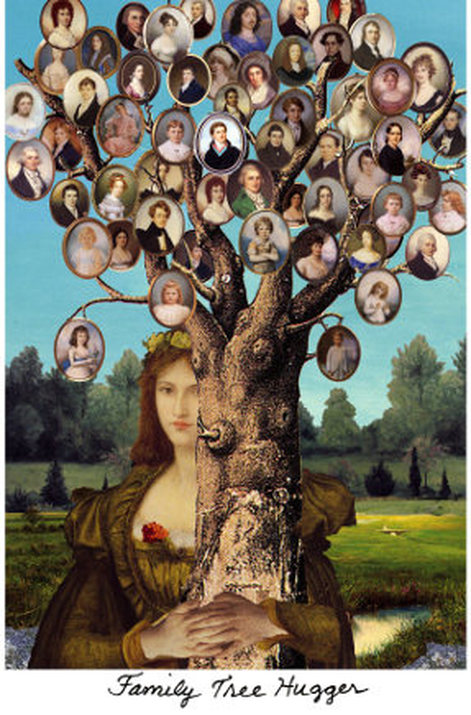
ANCESTRAL
DEVOTIONS
Dead Serious Genealogy
The
Ancestors are Integral Parts of the Soul's Symbolism
and Calibrators of
Time
That
higher and "complete" man is begotten by the "unknown"
father and born from Wisdom... ~Carl
Jung; Answer to Job, R. Hull, trans. (1984), pp. 157-158
If you are not
interested in your own fate, the unconscious is. ~Carl Jung, C.G. Jung Speaking:
Interviews and Encounters, Pages 359-364
As if we know nature! Or
about the psyche! The 2,000,000-year-old man may know something. ~Carl Jung, C.G. Jung Speaking:
Interviews and Encounters, Pages 359-364
"To live oneself
means: to be one's own task. Never say that it is a pleasure to live oneself It
will be no joy but a long suffering, since you must become your own creator. If
you want to create yourself then you do not begin with the best and the
highest, but with the worst and the deepest. Therefore say that you are
reluctant to live yourself The flowing together of the stream of life is not
joy but pain, since it is power against power, guilt, and shatters the
sanctified."
~Carl Jung; Red Book.
The
Great House:
Mankind, Migrations
& Meaning
We're
Born; We Mate; We Die
All
life is bound to individual carriers who realize it, and it is simply inconceivable
without them. But every carrier is charged with an individual destiny and
destination, and the realization of these alone makes sense of life.
~Carl Jung, Psychology
and Alchemy, Page 222.
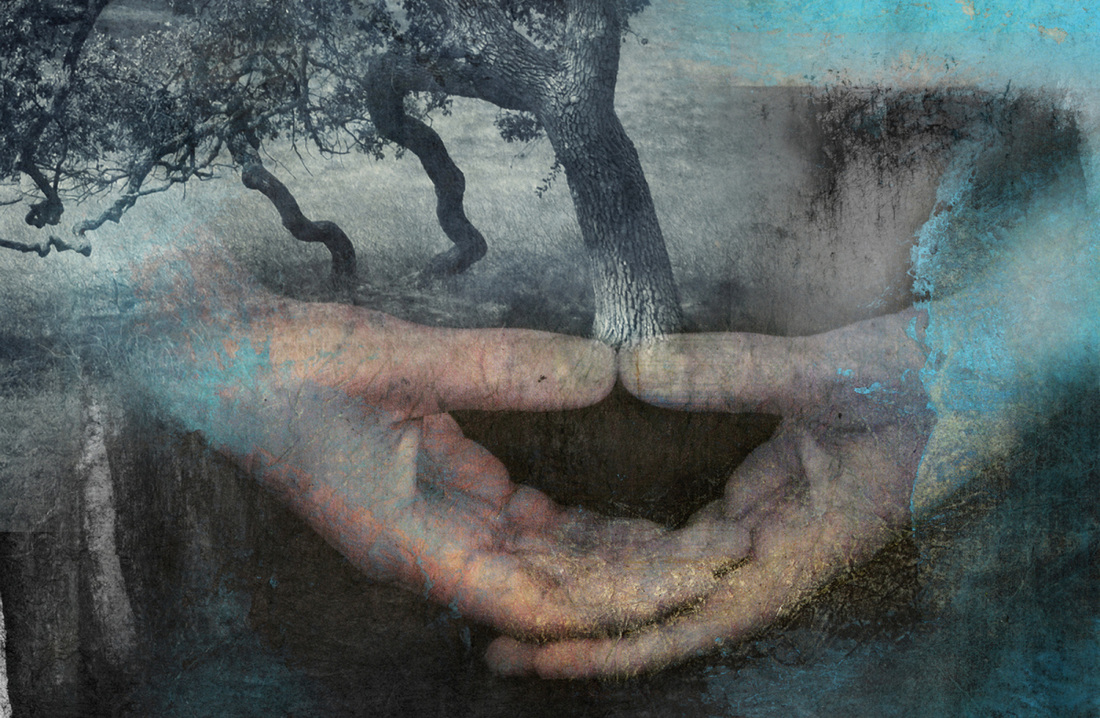
THE
HOUSE OF LIFE
When Air Becomes
Breath
Breathing
Life Into Your Ancestors
The ancient Egyptian
mystery school, the Per Ankh is the inspiration for a hermeneutic and healing
approach to genealogy. Every hermeneutical perspective constructs and
reconstructs more or less coherent and meaningful pictures of the past, based
on the particular spiritual needs and expectations of their real or imagined
audiences. It is a soulful approach to psyche and our forebears and the
mysteries of death, transformation, and spiritual rebirth, honoring soul and
body.
The psychophysical
approach is rooted in our being, land, water, and air, from our very first to
our final breath -- the fire of the breath of life. Psyche is that divine
spark. Along the way, we are learning to live and learning to die with wisdom
and meaning. Wisdom is not as concerned with a particular kind of thought, as a
wisdom about thinking, and an analysis of what it means to think, and an
inquiry into the nature of the ultimate reference of thought.
Our family tree is
rooted in narrative and history which traces back to ancient Egyptian,
Mesopotamian, and Biblical traditions, and spans continents and conflicts. We
study the psychological and metaphysical meanings of the mythologies that
anchor our longest lines of lineage. It includes mental activities, spiritual
dimensions, methods, attitudes, practices, or even behavioral and ritual
patterns that give us image and form.
The Transgenerational
Effect
Our psychological
approach is Transgenerational Integration.
Trans- is a prefix
meaning: across, beyond, through, on the other side of, to go beyond, while
state is a condition or way of being that exists at a
particular time. It functions as a feedback loop acting across
multiple generations, including transgenerational conflict. Transgenerational
trauma is transferred from the first generation of trauma survivors to the
second and further generations of offspring.
Some transgenerational
consequences are epigenetic, regulated by triggers and on/off switches.
Feedback determines whether epigenetic memory will continue to the progeny or
not, and how long each epigenetic response will last. Specific genes called
“MOTEK” (Modified Transgenerational Epigenetic Kinetics), are involved in
turning epigenetic transmissions of small RNAs on and off.
Manipulating
genes in this feedback pathway changes the duration of heritable silencing.
Such active control of transgenerational effects could be adaptive, since
ancestral responses would be detrimental if the environments of the progeny and
the ancestors were different.
http://www.kurzweilai.net/onoff-button-for-passing-along-epigenetic-memories-to-our-children-discovered
The
hallmark of the transgenerational models of family therapy is their emphasis on
the powerful influences that past generations have on the present. Unresolved
conflicts, beliefs, and roles in an individual impact an individual's
relationships and interactions in his/her family of origin. They unconsciously
continue to influence our current relationships and level of functioning.
Healing across lifetimes is possible without any metaphysical model or belief
in past lives or reincarnation, but within the genealogical model of direct
descent and multigenerational influence.
So,
the trans- state is, among other things, a coincidentia
oppositorum. An alchemical wedding defines the
fixed place, where boundaries are actively transgressed. In many ways, this
very undertaking is where the role of the magician, mystic, artist, and healer
collide. Down at the crossroads, where possibilities are collapsed into actualities,
by the wondrous act of a conscious decision lies the place of suffering and
surrender -- of realization and redemption.
We seek, not only
ancestors, but signs, symbols, and symbolic meaning -- our origin in the
foundation of being -- with an eye to restoring sacred harmony and
transformative connection to Cosmos, an indissoluble unity of potentiality and
act, darkness and light. Systems of archetypal symbolism come from the
mysteries of death, transformation, and spiritual rebirth, and related cosmogonical
theories.
Many of these ideas
had their roots in Egyptian philosophy. Philosophy is a rite of rebirth, the
very essence of which is participation in divine reality and, therefore, its
activities are primarily those of inner vision rather than mere logic. The
Tree of Life is a logically coherent meta-structure of metaphysical knowledge
-- its own body of wisdom. And it lives within us.
Per
Ankh
Ankh is the Egyptian
term meaning “life.”The hieroglyph ankh, originally perhaps representing a knot
or a bow, is a symbol for divine life, for the “breath of life,” provided by
Shu and other gods, and for regenerating the power of water.
Ankh also designates a
floral bouquet (offered to the gods) and a mirror, itself an important
metaphysical symbol., also seen in the sistrum and later the crux ansata.
Per ankh means the
House of Life -- a temple scriptorium and advanced school for esoteric training
whose priests maintained an oral tradition of initiation and also produced
writings in different branches of knowledge. This included theology,
mathematics, ritual expertise, hieratic liturgy, hermeneutics, genealogy,
astrology, sacred geography, mineralogy, medicine, mythography, architecture,
the science of theurgic talismans and image-making.
The staff of every per
ankh were lector-priests (heri heb) whose role was associated with sacred books
and the heka-power, as well as with preservation of maat, the cosmic order, and maintaining
the theurgic tradition of mystical ascent and assimilation to the gods.
Only through esoteric
knowledge and initiation into the invisible realm, that is, through symbolic
death and rebirth, accomplished in the House of Life, was one able to reveal
one sakh-identity and be united with immortal divine principles. In the diagram
of the per ankh (Pap. Salt 825) it is depicted as a symbolic mandala with
Osiris at the center.
Isis and Nepthys
occupy the corners at the side of his feet, Horus and Thoth are at the corners
at the side of the head, Geb represents the ground, Nut–the sky. The priests of
the House of Life follow “the secret way of Thoth.” One of the chief
lector-priests (heri tep) said regarding the formula imbued with the
heka-power: “Do not reveal it to the common man–it is a mystery of the House of
Life.” (Pap. Leiden344r)
The House of Life was
the center of cultural endeavor to preserve and ensure progress of cosmic,
political, and social life. A holy place and scriptorium, The House of Life
contained secret, magical writings the Egyptians believed had the power to renew
and sustain life and further the rebirth of Osiris at his annual festival.
The significance of
the House of Life and the rituals performed there was universal. Like the
temples it stood for the whole creation, just as the reborn Osiris symbolized
eternal life in general. According to tradition, time and again people went to
the House of Life to consult ancient writings when they needed answers to
problems of their day.
In ancient Egyptian
writings and architecture, the House of Life was an institution aligned with
kingship, preserving and creating knowledge in written and pictorial form. The
overseer of the private rooms of the king, bore the title of 'overseer of
writing in the House of Life, a man to whom all sacred matters are revealed',
and 'keeper of secrets of the House of Life.'
The ancient Egyptian
civilization was strongly connected with nature and the Universe that
surrounded them. The school of Abydos House of Life, attracted many healers in
the course of time and was an important base of knowledge about healing
and medicines. They knew mind and body were strongly connected. Therefore
they created various ways to maintain a sound physical
body. They analyzed the plants in their neighborhood and built
various schools.
The
Per Ankh, House of Life, is a solar temple of sacred science (mystery school)
and an institution of learning, healing and training. The House of Life,
(Per Ankh), is an organization of Egyptian Magicians, founded by the God of
Learning, Thoth.
The Per-Ankh
texts were transcribed and kept by scribes, including the “books of the dead”.
The House of Life was also a restricted access center of esoteric training
where students may have undertaken a course of spiritual development, resulting
in initiations into “various degrees of symbolic death and rebirth."
https://books.google.com/books?id=WRfHSnGlX7QC&pg=PA216&lpg=PA216&dq=per+ankh+house+of+life&source=bl&ots=kjNlwISk85&sig=frZYvP2n-r_h2Scl3GlywnqjXBc&hl=en&sa=X&ved=0ahUKEwiLr_Ch_KLLAhXH6CYKHWVKATg4FBDoAQgzMAU#v=onepage&q=per%20ankh%20house%20of%20life&f=false
I
REVERENCE YOU
LABYRINTHINE
LINES
THE
QUICK & THE DEAD
The Last Branch
Supports Me
Lost Histories from
the Book of Life
Individuation is a
natural process. It is what makes a tree turn into a tree; if it is interfered
with, then it becomes sick and cannot function as a tree, but left to itself it
develops into a tree. That is individuation.
--Jung, C.G. Jung
Speaking; Interviews and Encounters, Pages 205-218
Take pains to waken the
dead. Dig deep mines and throw in sacrificial gifts, so that they reach the
dead. Reflect in good heart upon evil, this is the way to the ascent. But
before the ascent, everything is night and Hell. ~Carl Jung, The Red Book, Page
244.
"Doctrine of the Genealogical
Unity of Mankind"
The family is a
symbol, as well as a history, and social category. Primeval kinship and bonding
gave birth to human society.
Because of the way
genetics and family trees work, every single human alive on the planet today
can trace their family lines back to one common ancestor, one who lived from
8,000-2,000 years ago. As observed in a 2004 paper
on the Most Recent Common Ancestor:
“No
matter the languages we speak or the color of our skin, we share ancestors who
planted rice on the banks of the Yangtze, who first domesticated horses on the
steppes of the Ukraine, who hunted giant sloths in the forests of North and
South America, and who labored to build the Great Pyramid of Khufu.”
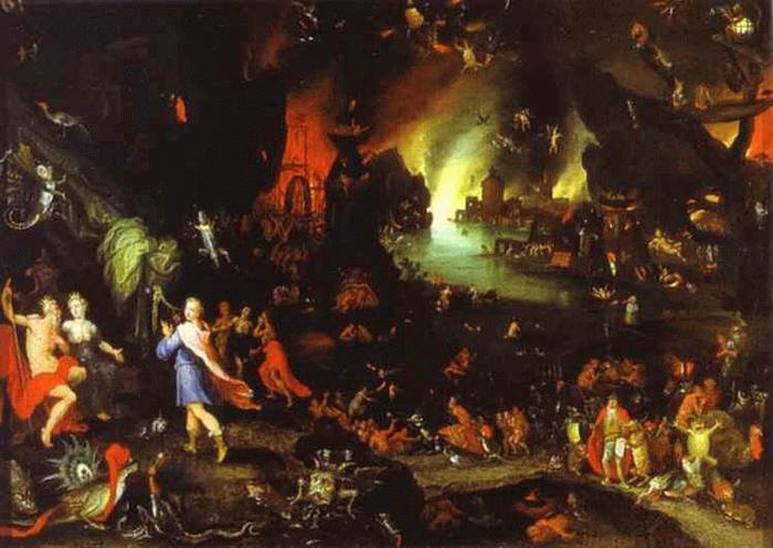
LAND OF THE DEAD
ANCIENT
LIVES & LIVING LINES
Alone, Yet Not Alone
Living With the Time
You Have Given Me
'Chronesthesia'
"The core of the
individual is a mystery of life, which dies when it is 'grasped.' That is also
why symbols want to keep their secrets; they are mysterious not only because we
are unable to clearly see what is at their bottom."
(C. G. Jung, Hans
Schmid-Guisan, The Question of Psychological Types)
Mental Time Travel
In nature, we look up
and see the past, stars and galaxies millions of years old; then we look down
and see the past in the earth, in the bones of dinosaurs and the dust of
ancestors, and fossils. Time is the raw material of creation.
Ancient mythology
has much to teach us about grief and mortality. The Mesopotamian myth, the
Descent of Inanna
is the earliest written goddess tale.
It begins with
listening: “From the Great Above she opened her ear to the Great
Below.”
In
Sumerian, the word for ear also means wisdom. Because she seeks wisdom, Inanna
is called to listen to the Great Below, the realm of dream, death, depression,
and the unconscious. Without knowledge of loss and mortality, engaged
individuation, and compassionate mirroring, she is not whole.
Deep within the
unconscious darkness something new is being born, and Inanna cries out from
this pain of giving birth. She returns to life -- lost, humbled, and displaced.
We descend into the redeeming darkness, making that walk, not because we want
to, but because we must.
“All descents provide entry into
different levels of consciousness and can enhance life creatively. All of
them imply suffering. All of them can serve as initiations.
Meditation and dreaming and active imaginations are modes of descent. So
too are depressions, anxiety attacks, and experiences with hallucinogenic drugs.” (Perera, 1981)
In many ancient myths,
descent is an integral part of the Great Feminine Round of Life and Death. We
are mortal and vulnerable. We live in a world of catastrophe and
chaos, personal loss and social threat. We are thrown down by chaotic defensive
furies, such as rage and greed. We are helped up by the dynamics of rebirth.
Miraculously, we find our way to life again.
Self-Referential
Memory
Our ancestors are our
past and our transcendental future. Autonoetic consciousness is the human
ability to mentally place ourselves in the past, in the future, or in
counterfactual situations, and to analyze our own thoughts.
Semiotics &
Symptomatics
Our sense of self
affects our behavior, in the present, past and future, and our sense of
ancestral metamemory, including memory, physiological (unconscious) memories
(spinal cord and ganglia) and embedded tissue memories, unconscious
motivation, unconscious conceptualization, and aesthetic unconscious (art,
myth, and dream).
Jung
said, "The unconscious has no chance of coming into the conscious unless
the conscious makes a hole for it to come through." And that hole or
portal is our genealogy -- our family tree, a site of potential transformation.
We are each the
sentinel who guards and keeps watch on our end of the lines that are anchored
by the genealogies of gods and goddesses which have passed into the 'collective
unconscious.'
First and foremost our genealogical quest
is informed by multidimensional, autonomous psyche.
Mute Signs &
Voiceless Speech
We should be
confidantes of our own mysteries and ancestors. We must cross our own Acheron,
or river of woe and pain to reach that psychological underworld. We plunge from
raw life into the encounter with the powers of darkness. We follow our chthonic
serpentine lines back through primal generativity and fertility.
Jung claims, "The serpent shows the way to
hidden things and expresses the introverting libido, which leads man to go
beyond the point of safety, and beyond the limits of consciousness, as
expressed by the deep crater." (1925 Seminar, Page 102)
Our ancestors guide us
on our journey, handing us along, one by one to their forebears. We ritualize
the science and art of parting. We step into the mythological plot through the
world of the afterlife immersed in our hordes of ancestors, without being
fictionalized ourselves.
We retrieve the
treasure, 'hard to attain,' whose presence we suspected in the dark prima materia -- self-knowledge. The treasure is
variously symbolized in myth and fairy tale as a ring or golden egg, white
feather, coat of many colors, fountain of youth, elixir of Life. We gain
experiential knowledge of all known realms by
confronting, or
identifying with subterrestrial, terrestrial and cosmic energies.
Jung suggested that
the assimilation of the objective and subjective collective unconscious is
achieved by realizing both the outer and inner meaning: 1. concrete actions and
2. subjective thinking and feeling as purely inner experience, or experience
via the subject (inwardly lived). "Undeveloped, therefore archaic,
symbolic, ambiguous, phenomenal, irrational, actus purus naturae, can only imperfectly be formulated
and grasped intellectually, projected."
The symbolic
unconscious content is "not exclusively valid either (1) for the outer or
(2) for the inner realm, but for both together, that is, for their operating
together." "The core of the individual is a mystery of life, which
dies when it is 'grasped.' That is also why symbols want to keep their secrets;
they are mysterious not only because we are unable to clearly see what is at
their bottom."
Paraphrasing Jung,
genealogy helps us "to come to those hidden and unopenable symbols, in
which the seed of life lies securely hidden like the tender seed in the hard
shell."
(Jung, Han Guisan Schmid, Page 9)
Autonoetic
Consciousness
Episodic memory is
identified with autonoetic consciousness, which gives rise to remembering in
the sense of self-recollection in the mental re-enactment of previous events at
which one was present. While Jung's approach was largely scientific, he also spoke
of “living” knowledge as opposed to “scientific” knowledge.
Autonoetic
consciousness is distinguished from noetic consciousness, which gives rise to
awareness of the past that is limited to feelings of familiarity or knowing.
Noetic consciousness is identified not with episodic but with semantic memory,
which involves general knowledge.
We all divide our
experience into time categories; the difference is simply how. The
transcendental future time perspective affects philosophical problems of
personality, the process of self-knowledge, the formation of value orientations
and life course of constructing identity.
Inroads in Mental
Time;
Feeling &
Conscious Awareness of Subjective Time
Mental time travel, or
chronesthesia, is the brain's use of memory to
think about the past, present, and future... a form of consciousness that
allows individuals to think about the subjective time in which they live and
that makes it possible for them to “mentally travel” in such time. But is
memory distorted, constructed, or confabulated? How can we know who we are if
we don't know where we've been?
Remembering and
knowing do not correspond with degrees of confidence in memory. Nor does
remembering always control the memory response. The transcendental future is
’subjective time’ that can be called a belief in some future Utopia.
The latest dream of
immortality is paradoxically couched under Transhumanism, an overcoming of
limited organic nature with technology and designer bodies. The outer universe
becomes subjective, from the outer reality the person emerges in what the
scientists call reality. The outer universe become the subjective controllable
reality.
People often have firm
ideas related to a transcendental future but notions of 'new time after death'
[or its absence] remain controversial, being rooted in faith. It is an aspect
of worldview with behavioral imperatives, prohibitions, values, and
consequences. The transcendental future encompasses different events that
include divine judgment, reunion with loved ones, eternal life, achieving
oneness with nature or cosmos.
Transcendence is
existence or experience beyond the normal or physical level. It encompasses the
time from the imaginal death of the physical body to infinity. It may include
goals, such as reunion with deceased loved ones, reincarnation, eternal life,
avoidance of damnation, and elimination of poverty, suffering, pain, and shame.
It signifies belief in something larger than life, including immanent or
transcendent beings beyond the self.
Out of Time
Transcendental future
is a time perspective – a personality trait that describes how often a person
imagines one’s afterlife with positive or negative attitude, intrusions,
retrieval, shuffling, fluency, distinctiveness, and false recognition.
Transcendental Future Time is one of the dimensions of subjective time and is
related to individual beliefs about the time period after physical death. It
partitions the psychological future into pre- and post-death time frames,
transcending life and living.
An
`extraordinary' time perspective, one that partitions the future into pre- and
post-death time frames. The `transcendental-future' extends from the point of
imagined death of the physical body to infinity, yet may influence present
behavior.
Related to numerous
psychological variables, the transcendental-future is a component of, but not
synonymous with, many religious beliefs. From the perspective of the
transcendental-future, behaviors often seen as irrational, such as suicide,
extreme heroism, and excessive tithing, are transformed into rational behaviors
expected to lead to fulfillment of transcendental-future goals.
People think or
imagine themselves in a transcendental future context with positive or negative
thoughts. The importance of transcendental future to well-being has yet to be
studied, but many issues have already been assessed in clinical hypnotherapy
with its timeline excursions, spontaneous and suggested, past and future, and
with ancestors.
Making Your Time
Matter
At a certain point in
anthropological time the human brain had developed to the
level that people
became aware of time and of their own existence. Together with the ability to
imagine one’s future a new kind of mental stress also appeared – awareness of
the inevitability of death. To allay this stressor, our early ancestors came up
with a myth – a belief that death must be survivable. Today the bigger part of
people’s beliefs has been passed on to them by their ancestors through religion
or philosophy.
Chronesthesia, or
mental time travel, is a mental ability to be aware of one's past or future.
Studies have been conducted to map out areas of the brain that may be
responsible for mental time travel, which include the left hippocampus and
posterior visuospatial regions which are are involved in past and future event
construction, neural differentiation. The right hippocampus, right frontopolar
cortex, and the left ventrolateral prefrontal cortex are involved in future
event construction.
The elaboration phase,
unlike the construction phase, has overlap in the cortical areas comprising the
autobiographical memory retrieval network. The left hippocampus and the right
middle occipital gyrus were significantly activated during past and future
event construction, while the right hippocampus was significantly deactivated
during past event construction. It was only activated during the creation of
future events.
Episodic future
thinking involves multiple component processes: retrieval and integration of
relevant information from memory, processing of subjective time, and
self-referential processing. The ventral medial prefrontal cortex and posterior
cingulate cortex are the most activated areas when imagining future events that
are relevant to one's personal goals than to unrelated ones. This shows that
these brain regions play a role in personal goal processing, which is a
critical feature of episodic future thinking.
We
can't technically travel through time (yet), when we think of the past or the
future we engage in a sort of mental time travel. This uniquely human ability
to psychologically travel through time arguably sets us apart from other
species. Researchers have recently looked at how mental time travel is
represented in the sensorimotor systems that regulate human movement. It turns
out our perceptions of space and time are tightly coupled.
Engaging in mental
time travel (a.k.a. chronesthesia) resulted in physical movements corresponding
to the metaphorical direction of time. Those who thought of the past swayed
backward while those who thought of the future moved forward. Chronesthesia may
be grounded in processes that link spatial and temporal metaphors (e.g.,
future= forward, past= backward) to our systems of perception and action.
"The embodiment of time and space yields an overt behavioral marker of an
otherwise invisible mental operation," explains Miles and colleagues.
The
ability to remember the past and imagine the future can significantly affect
our life decisions and scripts. Scientists refer to the brain’s ability to think
about the past, present, and future as "chronesthesia," or mental
time travel...the neural correlates of mental time travel and
metaphorical "travel."
"Mental time
travel consists of two independent sets of processes: (1) those that determine
the contents of any act of such ‘travel’: what happens, who are the 'actors,'
where does the action occur; it is similar to the contents of watching a movie
– everything that you see on the screen; and (2) those that determine the
subjective moment of time in which the action takes place – past, present, or
future," Tulving told PhysOrg.com.
‘Supernatural’ is a
word that conjures spine-tingling feelings of mystical awe, fear, and joy. Does
it exist as a concept, or as a phenomenon, however, among all peoples? What
does it mean as a cultural construction and as a response to reality? What is
its relationship to religion and spirituality, to experiences of ghosts and
ideas about gods? What part of the ineffable world that informs cosmologies is
captured by the term ‘supernatural’, and what is distorted or left out when we
use it? Why is it such a contentious term in anthropology, vigorously condemned
by some, championed by others, and blithely used by the rest?
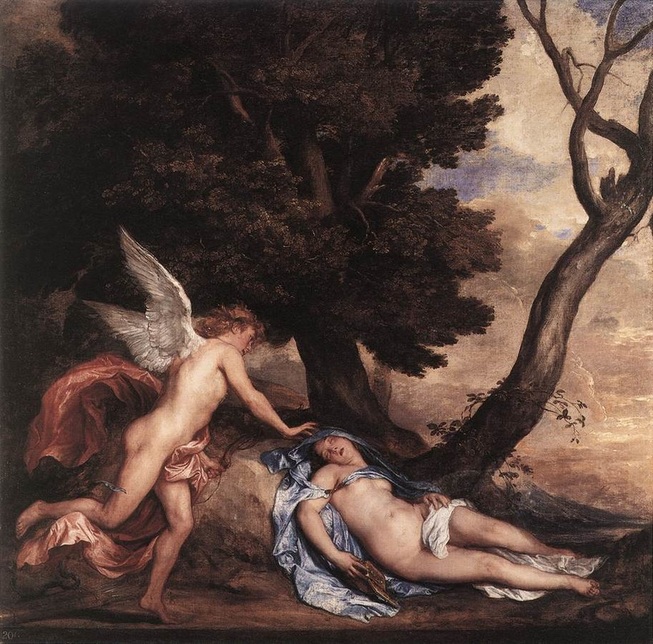
Cupid & Psyche, Van Dyke
A
LONG WAY HOME
NEXT OF KIN
Last Twig On the
Branch
The
'Spirit' or Ruach of the Tree of Life which corresponds to the Intellect and
Yetzirah (the Formative World) also corresponds with the Psyche. The
Formative World) also corresponds with the Psyche. The Merriam-Webster
Dictionary defines of 'Psyche' as soul, mind, and "The specialized
cognitive, conative, and affective aspects of a psychosomatic unity :
mind; specifically : the totality of the id, ego, and superego
including both conscious and unconscious components."
Death also is in
Paradise
Therefore, the Ruach/Breath of life (vital breath) and the Psyche are
essentially one and the same. In psychology, the psyche is the totality of the
mind (conscious and unconscious) and states stemming from the six types of
senses, vision, hearing, smell, taste, touch and mind; the breath of life; the
vital force which animates the body and shows itself in breathing; life, a
living being: ψυχή ζῶσα, a living
soul, the seat of the feelings, desires, affections, aversions. a moral being designed
for everlasting life; an essence which differs from the body and is not
dissolved by death.
ψυχή
(Psyche) is Psyxḗ (from psyxō, "to breathe, blow" which is
the root of the English words "psyche," "psychology") –
soul (psyche); a person's distinct identity (unique personhood), i.e.
individual personality. And that identity, that psyche comes to us through
manifestation of our essence in our family tree.
Genealogy allows us to
engrave our lines in history. As we journey up through our lines of descent we
are always asking Who, Where, and When -- the questions that define the next of
kin in our search pattern as we flesh out our family tree as its genealogical
midwives.
Who from the family
tree am I looking for at the moment?
- Where were they when a particular event occurred?
- When was it that the event likely took place?
That’s the foundation for everything we do
in genealogy.
The particular form
the genealogical tree takes depends on who is identified as genealogical father
and who is identified as genealogical mother to whom.
That identification is
the basis upon which a conceptual system expressed in terms of symbols and
relationships among symbols. When invaders become ancestors it reconfigures
ethnicities, embodying systematic changes.
"The
tree has a cosmic significance—it is the worldtree, the world-pillar, the
world-axis.
Only think of Yggdrasill,
the world-ash of Nordic mythology, a majestic, evergreen tree growing at the
center of the world.
The tree, particularly its
crown, is the abode of the gods. the world-tree.
But, as the alchemical
symbolism clearly shows, it is also a transformation symbol, a symbol of the
process of self-realization.
According to certain
alchemical sources, the adept climbs the tree—a very ancient shamanistic motif.
The shaman, in an ecstasy,
climbs the magical tree in order to reach the upper world where he will find
his true self.
By climbing the magical
tree, which is at the same time a tree of knowledge, he gains possession of his
spiritual personality.
To the eye of the
psychologist, the shamanistic and alchemical symbolism is a projected
representation of the process of individuation.
(Jung, C.G. Jung
Speaking: Interviews and Encounters, Pages 353-358.)
- Plato ( 428-348 BC)
in the Timaeus says: " Therefore, according to a probable thesis , it must
be said that this world was born as a human being really has a soul and
intelligence in accordance with the divine will ."
This vision is refined
later in the Alexandrian and Neo-Platonic thought and finds wide success in the
Hellenized Egyptian thinker , Plotinus of Lycopolis ( 204-270 ) .
- Plotinus in the
Enneads (IV , 4, 45 ) writes:
" ... It is clear
that every being that is in the universe, according to its nature and
constitution, contributes to the formation of the universe with his action and
his suffering, in the same manner in which each part of the individual animal ,
in reason of his natural constitution , cooperate with the body as a whole
, making the service that competes with its role and its function. Each part
also gives and receives from its other , as his receptive nature
allows. "
He also states that
the simple is what is the basis of life . This is because the soul of an
organism and is worth much more than all the parts put together : every body is
a unit , an indivisible whole , something extraordinarily simple at first
glance while being composed . This "simple" that is the basis of
the compound can not be a material entity , because no matter what material may
be designed or divided in half , even only conceptually . The multitude of
souls in the world is itself intelligible only on the assumption that they all
have a common origin. This unit is what explains the meaning of the Anima
Mundi . The One remained transcendent itself and the individual deities were
conceived as immanent forces of creation , as we would say today energies , and
were , therefore , partakers of the same Spirit of the World that becomes a
summation and archetypal energy .
Plotinus says , in
fact, that ( Enneads , II, 3:16) : " ... the opposites are reconciled ,
and without them the universe is not such, and so is the other living beings
."
For Dionysius the
Areopagite ( fifth-sixth century ) , the Anima Mundi , just like the One of
Plotinus and the Holy Spirit Christian, it is life-giving and "
distributing itself is not divided ." As, indeed , the idea that the
Trinity is not affected indeed strengthened in comparison with the previous and
the widespread propensity to triad recovered from Pythagoreanism , Neoplatonism
and by Proclus.
William of Conches
(1080-1145 AC) , one of the greatest exponents of the Platonism of the famous
school of Chartres, in his : Glosses on Timaeus of Plato, says, " The Soul
of the World is a natural energy beings for which some have only the
ability to move , the other to grow , others to perceive through the senses ,
others to judge . The question is ... what is that energy. But, as it
seems to me natural that energy is the Holy Spirit , which is a benign and
divine harmony that is that from which all realities have to be, to move, to
grow , the feeling, the experience , the judge.
Marsilio Ficino argued
, in his Platonic Theology, that the soul " is the greatest of all
miracles of nature. All other things are under God always be a single soul
on the other hand is all things together "..." the nature center ,
the middle term of all things , the chain of the world , the bond and
the seam of the universe, the face of everything."
Always Marsilio Ficino
(1433-1499)
- In his Platonic Theology
, Book III , Chapter I, states that the Anima Mundi is the mirror of divine
realities , the life of those mortals and the nexus of both.
- And in the De vita
says: " The Soul mundi ... according to the Platonic oldest , by
means of his reasons , he has built in the sky, beyond the stars , the astral
figures and parts of figures , such that they themselves become figures, and
impressed in all these figures certain properties ... And specifically,
it has no place in heaven forty-eight figures universal , twelve in the
Zodiac , thirty-six out of the Zodiac. »
The scholar,
philosopher and priest Marsilio Ficino made his Neoplatonic reading of the
Anima Mundi syntonic with the Christian vision. He understood the sacred
junction between the upper and the lower world. Ficino departed from the
field and gradually climbed up the form, then the Soul, and then the Angel of
God The Soul stood in the center, and it was the junction point between the
physical and the spiritual.
For this Ficino
called the Anima mundi et copula and that is the Soul as a node between the
physical reality and the intelligible and therefore " copula " or
union of the world with another dimension.
In its Platonic
Theology of immortalitate animarum , Marsilio Ficino defines the soul as "
Centrum naturae, universorum medium mundi series Voltes nodusque et omnium
copula mundi."
Therefore raises
the Soul in the middle of nature. He sees it as what mediatra nature and the
universe, understood in its plurality of planetary epiphanies, but also as a
node of all things, in the sense of what holds together the infinite parts of
the world. Defines it as the face of all things and " copula, " i.e.
union, the world itself with the divine. (La Primavera di Botticelli, cosmic
mystery of the Anima Mundi , Vincenzo Guzzo and Gaspare Licandro ).
In the sixteenth
century , the notion that the most vital vitalistic Soul of the world emerged
especially in Giordano Bruno , who conceived the presence of the divine in
nature in a vision closer to pan-enteismo that pantheism to which he was burned
alive , and then Tommaso Campanella , according to which all the elements
of reality are sentient beings and therefore have a kind of consciousness.
In the following
centuries the idea of Anima Mundi was almost forgotten, and severely
hampered by the spread of the mechanistic conceptions. Descartes with the
distinction between res cogitans and res extensa deprived the Nature of the
Soul and the Soul of its vital relationship with the Whole.
With Goethe's concept
of Anima Mundi Schelling made a mental note and then shooting the Neoplatonic
conception that sees the intelligent principle already present in embryonic
form in nature or potential . The nature , for Schelling , is a ' "
dormant intelligence ," a "spirit of power" and could not evolve
to produce the man if he had not already within themselves the divine spirit
. The organizations below are only minor aspects or limitations of the
only universal in the human body is fully realized . The soul of the world
in fact become fully self-conscious only in man, that is so over the top, the
point of transition from nature to God, which is reflected in it . In
nature there is therefore purposive intentionality , which is specified in
organisms gradually more complex starting from a principle , however, simple
and absolutely unified.
Schopenhauer , then ,
stated that the individual souls of individuals are an expression of the will
of a single life , however, operates in an unconscious manner , and only humans
can become self-conscious.
The idea of Anima
Mundi emerges so cogent in Carl Jung, the concept of the collective
unconscious. James Hillman (1926 - 2011) re-evaluates the validity of the idea
of Psyche Member of the mind , not as merely rational , but as Anima
(original meaning of the word Psyche) and enhances well the ideas and the
valuable role of the philosophers of the Renaissance as they represented the
Anima Mundi.
We are souls who
choose life ... who have chosen to exist. And in my opinion, to exist is
to choose to love and to be loved in spite of and, above all, open to our
relationship with the world ... We are in a sense just the relationships we
have with the world, because they are made of our own imaginal
substance. We share the same Unus Mundus.
Things ' transparent '
who allow themselves
to go through the light of the world acquire a cosmic depth.
The thing that shines
the power of the world has become a symbol. So every finite thing can become a
symbol, ' representative ' of the universe, where everything appears and shines
in it, as a consequence, the world can not become a symbol just as in things
finite meets its own image and reflected in the symbol itself. * So symbol ,
image, origin , but also ritual, form, light, and what in the language and
practice of art means the art. The soul of the world as a mediating force ,
life-giving and life refers to the life-world of art."
The soul of the world,
life and death.
In the dense network
in which everything and everyone we connect (Anima Mundi?), sharing the idea
that nothing is created and nothing is destroyed, everything is transformed,
and knowing that the immensity of the Mystery embraces everything that we
intended to Soul and understand it, we have no reason to feel far away or lost
the stars disappeared on our horizon. We ourselves are neither close nor
distant than everything disappears but these, like all of our deceased loved
ones are to us. Atoms and galaxies are One and the transition from the
phenomenon of becoming the idea of being constantly and occurs with
simultaneous reciprocity, constancy and love in the heart of the mystery in
which everything is where everything becomes. - Vincenzo Guzzo.
STAY WITH THE LIVING
We Are Alive; It's All
We Know
Life is a luminous
pause between two great mysteries,
which themselves are
one. --C.G. Jung
Over the course of the
millennia, all these ancestors in your tree, generation upon generation, have
come down to this moment in time--to give birth to you. There has never been,
nor will ever be, another like you. You have been given a tremendous
responsibility. You carry the hopes and dreams of all those who have gone
before. Hopes and dreams for a better world. What will you do with your time on
this Earth? How will you contribute to the ongoing story of humankind? History
remembers only the celebrated, genealogy remembers them all. --Laurence Overmire
“The neurosis is as a rule
a pathological, one-sided development of the personality, the imperceptible
beginnings of which can be traced back almost indefinitely into the earliest
years of childhood. Only a very arbitrary judgment can say where the
neurosis actually begins. If we were to relegate the determining cause as
far back as the patient’s prenatal life, thus involving the physical and psychic
disposition of the parents at the time of conception and pregnancy—a view that
seems not at all improbable in certain cases—such an attitude would be more
justifiable than the arbitrary selection of a definite point of neurotic origin
in the individual life of the patient” (Jung, CW 16, 257-258).
"It isn’t
primarily a practice of thinking of one’s last hour, or of death as a physical
phenomenon; it is a seeing of every moment of life against the horizon of
death, and a challenge to incorporate that awareness of dying into every moment
so as to become more fully alive."
—Brother David
Steindl-Rast Parabola, 1977.
Assemblage theory
"Deleuze's
theory (metaphor?) of assemblage as a way of thinking about the social world is
an intriguing one. Fundamentally the idea is that there does not exist a fixed
and stable ontology for the social world that proceeds from "atoms"
to "molecules" to "materials". Rather, social formations
are assemblages of other complex configurations, and they in turn play roles in
other, more extended configurations.
What
is appealing to me about this way of talking about the social world is that it
takes us away from the presuppositions we often bring about the social world as
consisting of a range of discrete social objects or things. According to this
static way of thinking, the state is a thing composed of other things; likewise
Islam is an extended social thing; likewise Chicago; and so on. The assemblage
approach suggests a different set of metaphors for the social world: mosaic,
patchwork, heterogeneity, fluidity, transitory configuration. And this seems
like a more realistic way of characterizing large extended social formation
like states or regulatory agencies.
The
downside of this way of talking and thinking about the social world is
precisely the indefiniteness and indeterminacy it suggests for the composition
relation. This poses a very hard problem for explanation. How are we to explain
the properties and behavior of the composite entity if there is so much
contingency in its parts and the ways in which they interact? The strategy of
aggregative explanation seems to be a non-starter, since it is stipulated that
composition is not a strongly rule-governed process. But so do the comparative
and generalizing strategies. If the composites are indeed sui generis and
unique configurations we can't generalize across instances and can't usefully
compare them."
http://understandingsociety.blogspot.nl/…/assemblage-theory…
INVISIBLE
LOYALTIES
Legacies of invisible
loyalties and obligations from the past that are passed on through generations,
including unconscious limitations. The invisible fibers of loyalty consist of
consanguinity, maintenance of biological life and family lineage on the one
hand and earned merit among members on the other. (1973, p. 52) Loyalty is a
mark of belonging to a group and therefore manifests itself both as a group characteristic
and as an individual attitude. Loyalty, as an individual attitude, goes beyond
mere identification with the group.
To be a loyal member
of the group implies internalizing the spirit of its expectations and complying
with its internalized injunctions. Failure to live up to the demands of loyalty
leads to feelings of existential guilt which constitute a system of secondary
regulative forces which play a part in maintaining the homeostasis of the
family system. The development of loyalty is determined by the history of the
family group, the type of justice in force within it and its myths. The nature
of each of the group members’ obligations depends on his/her emotional
disposition and his/ her position in respect of the family ledger , which recapitulates
what each member of the family owes.
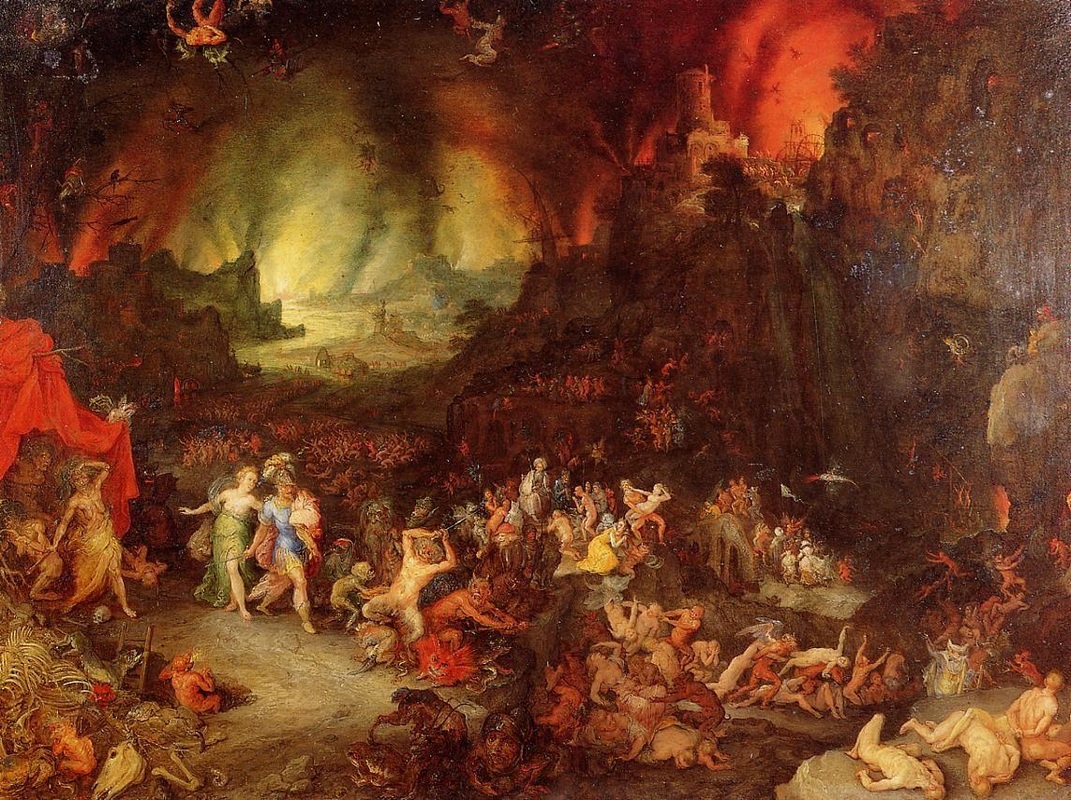
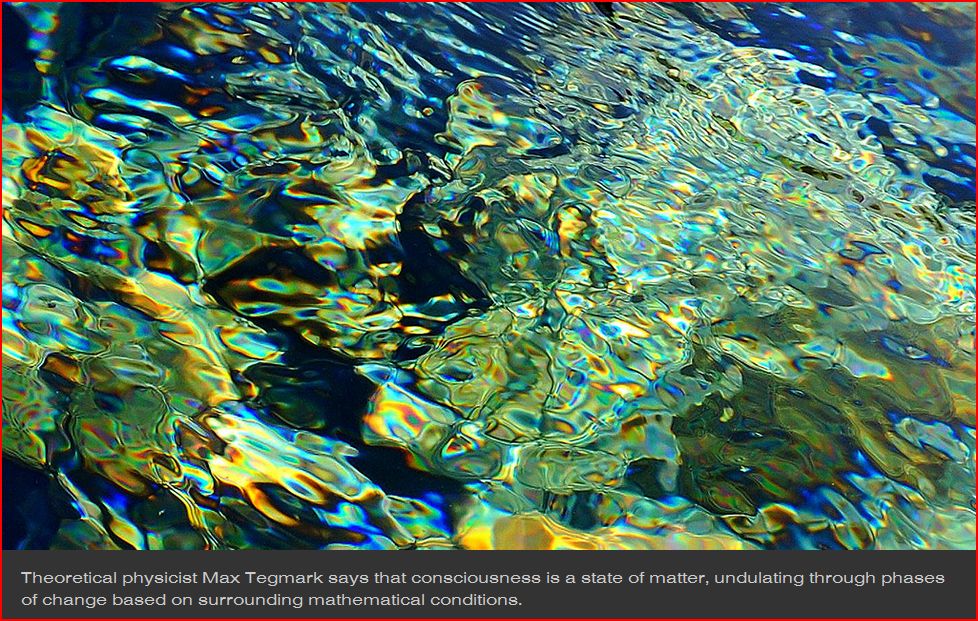
LIVING
WITH THE DEAD
When
We Are No More
Mysteries
are primal 'secrets' regarding all human evolution. We can mine our ancestral
memories. But those secrets are in the experiential aspects of the process. It
is not the conceptual part that is secret, but the lived reality unique to each
individual -- the realization of self and spirit. They are the signposts along
the primal path of alchemy leading to Gnosis. The first masters on Earth were
all Dragons and Serpents. They bestowed wisdom and the means of experiencing
Gnosis. Unbound consciousness is the basis of metaphysics.
Physics and
metaphysics are not so separate as some philosophers and physicists indicate.
In fact they are in a sense symbiotic. Physics cannot exist without
metaphysical postulates upon which it can rest its own theories, while
metaphysics can, in turn, be directly influenced by physical experiments. The
meaning of this is that there is nothing unscientific about spirituality and
its arts. Ultimately it is fully empirical. The only issue is perception. It is
only in perception that materiality "appears" to separated from the
divine or spiritual oncology. This also means that there is no mysterious
"magic" about the higher realm of spirituality.
The search for truths
in metaphysics should be supplemented by progress and advances that occur in
physics, while physics should regard itself as being able to provide not final
truths about reality, but truths that are dependent upon a more general
metaphysical scheme. If metaphysics rejects physics as a valid partner in the
search for truth, then its explanations can be valid to those who need final
and ultimate answers, but the goal of metaphysics should not be to pose as any
arbiter, but as the one that provides the best final and ultimate answers.
Where do explanations cease?
Hermes
says, “The upper open spirit is hidden in the
earth. Work the open upper spirit with the lower secret one,
so will the living one
awaken the dead,
and be to it a well of
life and work great wonders.”
IN
A SIMILAR VEIN
Because You're Mine, I
"Walk the Lines"
But if you have nothing
at all to create, then perhaps you create yourself.
--Carl Jung, CW 11,
Page 556, Para 906.
"I feel very
strongly that I am under the influence of things or questions which were left
incomplete and unanswered by my parents and grandparents and more distant
ancestors. It often seems as if there were an impersonal karma within a family
which is passed on from parents to children. It has always seemed to me that I
had to answer questions which fate had posed to my forefathers, and which had
not yet been answered, or as if I had to complete, or perhaps continue, things
which previous ages had left unfinished." -- Jung, Memories, Dreams, Reflections
“The
whole life of the individual is nothing but the process of giving birth to
himself; indeed, we should be fully born when we die.” --Erich Fromm
Because You're Mine, I
Walk the Lineage
Genealogy uses
historical, phenomenological, and psychological methods. By "walking the
lines" backward in each of the tangled branches of our Family Tree, we can
engage layers of multidimensional imagery.
Our family tree
emerges from each couple and their own respective networked lines of ancestors
and their interpersonal relational interaction. Metaphorically, we walk in
their footsteps in a 'magical' circumabulation of our ancestral field. The
principle involves making a clear and conscious connection with the ancestors
and the idea of oneness. 'Walking the Way' is a form of deep veneration.
Ensouled Body
Genealogy clears a
walkway through the ancestral landscape. It is a comparative phenomenology of
the imagination with an openness to Being. This is a hermeneutic phenomenology
(description and interpretation of meaning), an empirical, transcendental, or
psychological phenomenology of lived experiences and themes. Here,
“transcendental”
implies everything is perceived freshly, as if for the first time, without
assumptions.
We immerse ourselves
in the cosmic wisdom of matter, in the immanence of indeterminate, enigmatic,
mysterious phenomena and its own language -- open, visionary, poetic,
aesthetic, erotic, sensuous, spiritual, transformative, vocational. We can't
decide if it's the right or only path until we travel along it but it informs
our genealogical search at every point. One key to achieving that understand is
establishing context.
Hermeneutics refers to
the liminal nature of Hermes as an interpreter and soul guide (psychopomp) who
connects heaven and earth, the realm of the living and the dead. He guides the
soul into dreams and the dead to the underworld. The alchemists' defined the prima materia as the "land of the
dead."
Jung describes Hermes
as, "the arch-authority of Greek alchemy. He is "Hermes Trismegistos"
(thrice-greatest Hermes), and is identical with the Egyptian Thoth, the god of
learning. Hermes was a leader of souls, a god of revelation and understanding,
connected with the human mind, and also the source of dreams.
He was actually the god of
the unconscious, and the being who determined the human intellect." (ETH, Alchemy, Lecture XI
11th July, 1941, 224-231)
Jung said he wasn't
well-versed in philosophy, but "had to make use of philosophical concepts
to formulate my findings." Phenomenology brings to light what would otherwise
remain hidden and helps us interpret what it means to exist in the world.
Phenomenology becomes hermeneutical when its method is taken to be
interpretive, rather than purely descriptive as in transcendental phenomenology.
Hermeneutic
phenomenology enables access to subconscious phenomena and provides a means of
interpreting our experiences of personal learning journeys. We acknowledge the
complexity of a lived experience and subjective validation of it as an
integration of our thoughts, feelings, fantasies, and experiences.
Meaning is encoded in
cultural symbolism deposited and mediated through myth, religion, art, and
language. In a prolonged engagement with a topic, such as genealogy, language
itself is an appearance of being -- a means of being manifest and 'seeing'
meaning.
With deep questioning
of the phenomena, we become attentive to how things appear and speak for
themselves, including the ancestors, connecting with the visceral world of
attunement, resonance, and sensation. Sympathetic resonance includes physical,
emotional, aesthetic, and intuitive responses, not just the verification of
cognition.
The moment of vision
embodies authentic temporality, illuminating the full meaning of the present in
terms of our fate, our mortal future, with a simultaneous retrieval of our past
heritage. Language and storytelling have a narrative function that ultimately
return to the question of the meaning of being, the self and self-identity.
"...[T]here is
a thinking in primordial images, in symbols which are older than the historical
man, which are inborn in him from the earliest times, and, eternally living,
outlasting all generations, still make up the groundwork of the human psyche.
It is only possible to live the fullest life when we are in harmony with these
symbols; wisdom is a return to them." (Jung, CW 8, Pages 399-403.)
Evocations of
remembrance embody the essential nature of the sensuous radiance of absence.
The far greater and darker regions of the unknown give way to becoming,
transforming emotional experience. The archetype is not “in” a person
but “between” them, within the imaginal space that opens, for example, in
evocative moments between ourselves and our ancestors with a sense of presence
and place.
At all events wisdom
cannot be taught by words. It is only possible by personal contact and by
immediate experience.
(Jung, Letters Vol. 1, Pages 559-560.)
Condensing Meaning
A narrative reports
the life of a single individual, while a phenomenology describes the collective
meaning of lived experiences, of a concept, or a phenomenon. Life themes are
divided into subthemes describing different dimensions of the process of
understanding connected by the guiding theme “narrative.”
Our approach is phenomenal
or qualitative rather than analytic. When phenomenology informs narrative
analysis, the image is allowed to speak through form, stories and intuition.
There is no predetermined framework of meaning. The comparative approach usefully
challenges taken-for-granted understandings. Rooted in philosophy, it studies
conscious awareness of the world as experienced from the subjective or first
person point of view.
Emotion As Epiphany
Phenomenology is an
experiential approach to subjective experience. "Experience" (being
or existence) is a complex concept -- an "in-relation-to" phenomenon.
We can approach our ancestors with phenomenology, and also reflexively consider
what we bring to the process from our own perspective and worldview.
As in the case of dreams
we must stick as closely to the image as given as possible. Image is the
primary phenomenon of psychic life, mytho-poetic imagination, and the prima
materia of the phenomenology of the soul.
The phenomenal field
focuses on perceptions, feelings, and "how one feels right now." The
intergenerational field is a phenomenal field. Hillman referred to soul's
self-expression as, “what we are really, and the reality we live, is our
psychic reality, which is nothing but ...the poetic imagination going on day and
night.” (We’ve Had a Hundred Years of Psychotherapy and the World Is Getting
Worse, p. 62)
He
sees death as a permanent resident of the psyche, and Thanatos as a mode of
soul-making: “loss of soul, not loss of life, should be [the analyst’s] main
dread.” Hillman advocates the development of a conscious philosophy of death.
He argues that death and life are not psychological opposites and that
“...any act which holds off death prevents life” (Suicide and the Soul, p. 61).
"We cannot slay
death, as we have already taken all life from it. If we still want to overcome
death, then we must enliven it. Therefore on your journey be sure to take
golden cups full of the sweet drink of life, red wine, and give it to dead
matter, so that it can win life back." (Jung; The Red Book; Liber
Primus; Page 244.)
With the phenomenal
approach, Mircea Eliade identified “the sacred” as a kind of independent
variable—unchanging and timeless even though manifest in completely different
times and cultures. “Pure” phenomenology describes the intentional objects of
consciousness.
Human experiences are
phenomena -- what they experienced and how they experienced it, in holistic and
embedded or qualitative perspectives. Hermeneutics renders the object
accessible to interpretation, opening new possibilities. Naturally, we have to take account
of our own bias, conceptions, and assumed truths into the interpretative
activity involved.
We must distinguished
interpretation from explanation and causes, focusing on a description of reasons.
There is no firm boundary between the dimensions of description and
interpretation. Deeper understanding demands more complexity-sensitive ways of
thinking and a method that allows interpretation, exploration of dynamics and
processes, and involvement of the context.
Presence & Absence
We synthesize the
lived-experience from comparative transformations. General psychological structure is
deduced from the psychological constituents of the experience. Constituents are
context dependent and are necessarily part of the whole structure.
The purpose of this
procedure is grounded in the phenomenological concept of parts and wholes. The
meaning units are transformed using imaginative variation within the
phenomenological attitude and psychological perspective to elucidate their
essential psychological meanings.
The eidetic nature of
the data or mental image, not necessarily derived from an actual external event
or memory, is brought forth through the imaginative variation.
We can create and
explore eidetic images as a way of coming to terms with transgenerational and
traumatic life events.
The phenomenological
concept of presences and absences is an important one to use with imaginative
variation. Explicit data can reveal implicit meanings [subtext] without them
being concretely expressed. During the transformations, we can “see” the
explicit meanings, and also uncover the implicit meanings.
Imaginative variation
gives us a “sense of the whole.” In this way, the descriptive phenomenological
approach is more comprehensive than mere empirical approaches in the natural
attitude. This is justified through understanding that what is “present” often
implies or indicates an “absent” quality.
In the
phenomenological approach, each transformation describes what the meaning unit
expresses psychologically without any interpretation or assumptions about its
“truth.” The phenomenological approach represents different approaches, from
focus on rich description to those more informed by interpretation.
We describe how it was
experienced and understood from the subject's point of view without explanation
of “why” it was experienced in the way it was. The phenomenological attitude of
the researcher in the psychological analysis of the data is what makes the
results both phenomenological and psychological.
We can reduce the
information to significant statements or quotes and combine the statements into
themes. Then we develop a textural description of the experiences of the
persons (what participants experienced), a structural description of their
experiences (how they experienced it in terms of the conditions, situations, or
context), and a combination of the textural and structural descriptions to
convey an overall essence of the experience.
We can describe what
all participants have in common as they experience a phenomenon (e.g., grief is
universally experienced). The basic purpose of phenomenology is to reduce
individual experiences with a phenomenon to a description of the universal
essence, to “grasp of the very nature of the thing.”
Contextualization
There is only one
method: the comparative method. There are five core approaches to
qualitative research: narrative study, a phenomenology, a grounded theory, an
ethnography, and a case study. At the fundamental level, the five differ in
what they are trying to accomplish with their foci or the primary objectives of
the studies.
Exploring a life is
different from generating a theory or describing the behavior of a cultural
group. Narrative
is both a method and phenomenon of study. Individuals are enabled and
constrained by social resources, socially situated in interactive performances,
and how narrators develop interpretations of the multileveled context of a
life. A first-person psychological perspective is sought so that an empathetic
position can be adopted.
In genealogy we are
gathering data through the collection of their stories (biographical study),
reporting individual experiences, and chronologically ordering (or using life
course stages) the timeline and meaning of those experiences.
Restoring them means
re-storying them, reframing them with sensitive descriptions and imaginative
variation.
We need to collect
extensive information about each ancestor, and to have a clear understanding of
the context of the individual’s life. It takes a keen eye to identify in the
source material gathered the particular stories that capture the individual’s
experiences. Narrative study tells the story of individuals unfolding in a
chronology of their experiences, set within their personal, social, and
historical context, and includes the important themes in those lived
experiences.
Narrative inquiry
concerns stories lived and told. A phenomenological perspective of the mind
acknowledges consciousness as the most fundamental life-quality that coexists
with the body. A person is regarded as an embodied consciousness. People know
one another’s consciousness through their physical bodies. This means that we
know our own consciousness by reflection but cannot know the consciousness of the
other except through the body.
Three-dimensional
narrative inquiry space includes the personal and social (the interaction); the
past, present, and future (continuity); and the place (situation). This story
line may include information about the setting or context of the participants’
experiences. Beyond the chronology, we might detail themes that arise from the
story to provide a more detailed discussion of the meaning of the story.
Tracing the Path
'Walking the lines' is
a ritual situated in the imaginal landscape suggested by our genealogical
ascent which leads into our collective ancestral past. Along the path, or circuits
of ancestral nodes, the secret meaning of life is discovered. Our ancient path
of pilgrimage is rich with meaning and is a powerful tool for seeking soul and
spirit in a movement toward transcendence. Perhaps facing our mortality
inspires us to live more fully.
The main quest in the
oldest myths is for immortality. We search for immortality. We cannot know
anything final about that and all the possible means of 'living', but many
strive for germline immortality, an ersatz-immortality in their offspring. The
immortality of the soul is concerned with personal identity, not just in
conscious and unconscious states, but in mutable conditions and alternating
states of being.
Embodied &
Disembodied Soul
In the Phaedo, Plato describes an immortal soul.
Thus, while the natural body and the experiential mind are merely phenomenal
clothing of the ontological soul, the latter is immortal as a living entity.
Aristotle distinguishes between ontological and experiential soul.
As Danish physicist
Niels Bohr quipped, "A Great Truth is a Truth the opposite of which is
also a Great Truth." In the paradoxical nature of reality, immortality
remains largely a concept and source of ontological argument. For example,
Buddhism does not conceive of the soul as ultimately real.
Perhaps the latest
version of the soul describes a field ontology and a functional dualism
(mind/matter). Our form emerges from a primordial field of consciousness/energy
(groundstate) in which we remain embedded, and to which we return.
Ancestral Field
This zero-point field
has many names. That field is the energetic “void”, or “vacuum”, the space of
the “ether”, the subtle but ultra-powerful energy potential.
The Heart Sutra tells
us that, "Form is not other than Void, Void is not other than Form."
This implies that our human form is not other than void, and biophysics shows
this to be true. This
notion differs from survival of personal identity (self-movement) or soul, but
is a conservation of primordial information.
Jung
contends the archetype of rebirth and resurrection is a metaphorical
experiences of [ego] death as a metaphorical precursor to five forms of
rebirth:
1. Metempsychosis, or
transmigration of souls.
2. Reincarnation,
human personality is regarded as continuous and accessible to memory; re-birth
in a human body.
3.
Resurrection means a reestablishment of human existence in an incorruptible
carnal or subtle body after death.
4. Rebirth within the
span of individual life. Renovation, renewal or total rebirth of the essential
nature (transmutation).
5. Indirect rebirth
via participation in death-rebirth, the rite of transformation. (Jung, CW 9I,
para 200- 205)
Experiential
psychology is not pure ontology, and relies mostly on the rebirth experience
and the truth and beauty of intuition for transformation. We have to be content
with its psychic reality. Natural transformation processes announce themselves
mainly in dreams. There is a contrast between phenomenal and noumenal,
experiential and eternal, relative and absolute, biological and ontological.
Psychologically,
immortality is the attempt to grant distinct ontological status to the symbolic self, to
deny the finality of organic death. In other words, it is a denial of death.
Soul beliefs, discreetly or indiscreetly, transform the ontology of creativity
into an immortality ideology.
James Hillman shifted
Jung's conversation from individuation to "soul-making," a way of
seeing and reflection that makes meaning possible. "By soul I mean, first
of all, a perspective rather than a substance, a viewpoint toward things rather
than a thing itself." He describes five things about the nature of soul as
the imaginative possibilities of nature: the soul (1) makes all meaning possible, (2) turns events into experiences, (3) involves a deepening of experience, (4) is communicated
in love, and (5) has a special relation
with death (Hillman, 1977, p. xvi; Hillman,
1976, pp. 44-47).
Hillman's anima mundi is at home in the 'real' world --
the imaginal realm where real world spirit regains its zest and vision,
addressing our sufferings after transformation. In the everyday, the best of
the "unfathomable, multiple, prior, generative highly intentional and
necessary" archetypal world of both the "noumenal" and the
"phenomenal" manifests itself in the everyday tribal and familial
context. Family history is transformed into myth.
Facts & Artifacts
In terms of
ontological wholeness, immortality of one's being expressed in the continuance
of one's proper name or even dynasty falls short of the unconscious belief in
life after death. Immortality is an organic philosophical desire for life that
should always be lived. It is a religious desire for another life, affirming an
act of faith in a transcendent existence, or renewal without end of what is
here in this world. This is the difference between cosmic pantheism and
theistic (theosophic or transcendental) ontology.
Von Franz notes,
"The
analysis of older people provides a wealth of dream symbols that psychically
prepare the dreams for impending death. It is in fact true, as Jung has
emphasized, that the unconscious psyche pays very little attention to the
abrupt end of bodily life and behaves as if the psychic life of the individual,
that is, the individuation process, will simply continue. …The unconscious
“believes” quite obviously in a life after death." (von Franz (1987), ix.)
Like the shamans of
old who ascended and descended the archetypal World Tree, genealogists can
"walk the tree" -- "The Big Tree" or the "World
Family Tree" -- from one end to the other, or "up" toward the
past and then back "down" to the present on another line. Timelines
help us arrange the numerous names and events that take place simultaneously
and sequentially.
Some family trees
will look like stumpy, dead sticks with a few twigs, while others will
shared vast underground connections and vigorous thick growth, like as a yew
tree. Within the Family Tree and World Tree, people are either connected by
"bloodlines" or through marriage. Bloodlines can include adoptions
and illegitimacy, either acknowledged or unacknowledged. Ancestors are only
those from whom you directly descend, though cousin lines may share blood.
Spirit People
Family is the midwife
of the soul. Jung reminds us that the source of unifying images which
animated our ancestors and linked them to Mystery are generated by the
symbol-making function we all possess. The same mysterious dream place gives
birth to those mediating images which arise when we encounter the mysterious
Other, the animated presence in our lives.
The
family is the primordial psychophysical initiatory vessel or vehicle of our
destiny -- the archetypal family and biological self. Family births us,
develops us, procreates us, and buries us. Regardless of the pain and travail
it may create for us, family is the grail within which the sacred nectar of our
physical and psychic DNA is carried from the lips and organs of one generation
to the next.
Long lines, about 13
generations back lead into medieval times. "Walking the path"
means you MUST visit every profile in both paths, no shortcuts. We find
ourselves walking
the lines
and paths around and up to legendary figures, and further back, purely mythic
characters -- liminal entities.
Three modalities --
resonance, depth and numinosity -- describe the presence of that autonomous
Other which we call soul and an experiential psychic connection to the Other,
and a sense of self grounded in a transcendent order. Those images are conduits
into the natural world, with its specific tribal mythos, and assist in later
moving the community members into a world beyond mortality.
Genealogy is a sort of
psychic archaeology where we dig up the dead with their own information and
'advice' -- hidden historical crumbs and clues, synchronicities, and
intuitions. Genealogy reveals complex behaviors of distributed systems.
Naturally they lead backwards to origins vastly different from the kinds of
practices present in different time frames.
Genealogy is an
archaeology of the individual and a therapeutic art -- optimally coordinated
interpersonal synchronicity and optimized subsequent interactions. Similar personality
traits align in rapport and return with greater simultaneous coordination. The
interaction of pairs displays complementary simultaneous coordination. Coherent
emotional charge states converge under effective conditions after an interval
of time.
Archaeology of
Knowledge
The archaeological
level is what made an event or a situation possible. Archaeology and genealogy
alternate and support each other. Archaeology is structuralist. It tries to
take an objective neutral position and it avoids causal theories of change.
Foucault calls it,
"the union of erudite knowledge and local memories which allows us to
establish a historical knowledge of struggles and to make use of this knowledge
tactically today." (Genealogy and Social Criticism, p.42)
The genealogical side
of analysis tries to grasp the power of constituting a domain of objects.
Genealogy uncovers the creation of tangible objects. A society institutes the
role of medicine man and gives him special privileges. Then we establish and
institutionalize this practice, the psychosocial role of a "medicine
man."
Treading the Path
Walking a path is
symbolically a spiritual practice, a pilgrimage, like walking or tracing a
labyrinth -- a contemplative spiritual exercise of circumnavigating a sacred
path. We turn back to our center, to our origin, by a devotional path. A walk
through the World Tree or a walk in the labyrinth is a cosmic journey through
the heavens.
There is no right or
wrong way; we have to enter and follow a path with presence. Our attitudes,
focus, experience, consolation, and reflection may shift each time, or as we
follow path. Traversing the labyrinth brings us into wholeness with all parts
of our being. When we walk the labyrinth it recreates a very ancient expression
of thanks and remembrance of the divine in all things. So does the family tree,
expressing our completeness outwardly.
Like labyrinth, your
genealogy has one way in and one way out -- you. Such an initiation, shifting
perspectives, awakens the knowledge encoded within. Walking the labyrinth and walking
our lines share a spirit. The circuits of the labyrinth pattern and genealogy
share the same meaning -- a maze of ancestors, and a way to meander through
them -- spiritual umbilical cords.
We walk a labyrinth by
stepping into the entrance and putting one foot in front of the other. After
traveling through all the paths and windings, the walker comes into the center
- the six - petal rosette - the rose line, a symbol of the Holy Grail. Like
walking the labyrinth, genealogy can be an exercise in self-healing. Both are
journeys to the center and back out again to the ordinary world.
Seeking the Ancestors
Our genealogy is a
sensorium of multisensory informational content. Relationship paths connect you
to closest blood relationships via a given ancestor through several families,
via either parent, male or female, or combinations thereof. There can be many
relationship paths to the same ancestors.
Intergenerational
Encounter
Collapsing the space
between us, each ancestor, or avatar of our descent, touches us with an
imaginal poem that is a product of their embedding in our ancestral history -
layer after emerging layer of our augmented reality. They begin to talk to us
in many ways: ambiance,
serendipity, synchronicity, personal, contextual, instructively and
artistically.
The image of the World
Tree invites us to explore the vertical or depth dimension, while Family is the
most prominent landmark on the horizontal plane of relational otherness. Family
mediates this world and its essential, phenomenal reality and can enhance or
dampen, devastatingly, our interaction with this dimension of psyche. The
family seeds imagination.
The
decisive question for man is: Is he related to something infinite or not?
That is the telling question
of his life.
Only if we know that
the thing which truly matters is the infinite can we avoid fixing our interest
upon futilities, and upon all kinds of goals which are not of real importance.
Thus we demand that
the world grant us recognition for qualities which we regard as personal
possessions: our talent or our beauty.
The more a man lays
stress on false possessions, and the less sensitivity he has for what is
essential, the less satisfying is his life.
He feels limited
because he has limited aims, and the result is envy and jealousy.
If we understand and
feel that here in this life we already have a link with the infinite, desires
and attitudes change.
In the final analysis,
we count for something only because of the essential we embody, and if we do
not embody that, life is wasted.
In our relationships
to other men, too, the crucial question is whether an element of boundlessness
is expressed in the relationship. --Carl
Jung, MDR, Page 325
HERE
IS WHERE I AM
Dreaming of the Bones
ANCESTRAL
BRANCHES
Entangled Roots &
Branches of the Family Tree
"You excuse yourself with your disbelief in the immortality
of the soul.
Do you think that the dead
do not exist because you have' devised the impossibility of immortality? You
believe in your idols of words.
The dead produce effects,
that is sufficient. In the inner world there is no explaining away, as little
as you can explain away the sea in the outer world.
You must finally
understand your purpose in explaining away, namely to seek protection." --Jung, Red Book, Page 298.
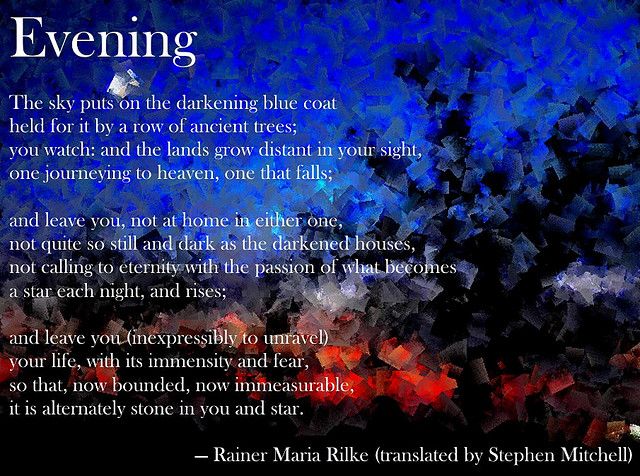
THE
GREENING OF THE TREE
Your
Ancestors Make It Matter
The growing one is the
TREE OF LIFE. It greens by heaping up growing living matter.
Good and evil unite in the
growth of the tree. In their divinity life and love stand opposed. ~Diahmon, Liber Novus, Page 351.
Genealogy is our map
of the unconscious -- the Land of the Dead. The Red Thread, the thread of
destiny, connects to the Source. It shows us the way, igniting imagination with
the alchemy of 'seeing', awakening the soul. The red threads of your blood link
you and your Tree to the World Tree, your history to world history and
mythology. The bloodline is also called the "underground stream," a
transmission of cultural influences of ancestors. Knowing who our ancestors were is
fundamental to our sense of who we are.
Genealogical
Embeddedness
We often feel
nostalgic about the long-lost time “when place, identity, culture and ancestry
coincided.” "Standing on the land that ancestors knew” can thus produce a
sense of genealogical connection that is sometimes explained as an
inexpressible sense of spiritual affinity, and often experienced bodily in
“shivers down the spine” and “goosebumps.” It is easy to imagine a shared
physical experience that links ancestors to their descendants across time.
Soul of Evolution
Charles Darwin first
realized the entire natural system is actually “founded on descent” and is
thereby “genealogical in its arrangement.” Genealogical connectedness is, in
fact, “the linchpin of evolution,” which is “first and foremost
a genealogical
process” that awakens latent potentials.
Genealogies are more
than mere reflections of nature or mere records of history. Rather than
simply passively documenting who our ancestors were, they are the narratives we
construct to actually make them our ancestors.
http://www.salon.com/2011/11/08/why_do_we_care_about_our_ancestors/
https://books.google.com/books?id=tVjuzNPfLcgC&printsec=frontcover#v=onepage&q&f=false
Rethinking Our Ancestry
Are we really alive if
we remain 'dead' to the true nature of Reality? Without a deep visceral
understanding of our own embodiment, kith and kin, without knowledge of our
family tree, and without the personal story of who we are and where we come
from, we remain rootless without a living connection.
Every single one of
our ancestors is indispensable to our existence. Without genealogical context
within which to “make sense of themselves” identity problems can arise in those
who experience such a “genealogical void,” or existential vacuum, feeling cut
off from the life giving forces of nature. Nature itself is sacred and holds
the promise of eternal life.
Dreaming of the Bones
Psychic dissociation
is desacralization -- loss of soul. Psychological integrity is linked to
genealogical roots. You have to bring your experience to the process to make
that connection with a new perspective and a new way to hear old wisdom. But,
we are connected to the ancestors like long forgotten dreams, even when they
remain unconscious. Like an artist, we simply need to engage. The unconscious
runs through everything. Phenomena simply show themselves to us as revelations
of psyche's nature.
Thierry Gaillard
frames it succinctly: "At
birth, we unconsciously inherit unfinished stories of our parents, our ancestors
and our society. Like open circuits, the charges of this heritage influence our
lives for we cannot cut ourselves off from our roots without losing an
essential part of ourselves. These histories replay themselves in some of the
difficulties we encounter in our own lives, often programming the same outcomes
again and again."
Petrified Wood
Generally, we only
remember our ancestors for a few generations unless there is a historical
reason for records and stories to be preserved. But the cultural practice and
rituals of genealogy have served individuals, tribes and nations throughout the
history of mankind. The ancestors are like 'living fossils' in our our psyche,
which we can differentiate out from the pointless forest of an undelineated
Tree. We may descend from several undelineated families.
Bare
Bones
From
Europe to Asia, genealogy is a “blueprint for action.” Historically
genealogical records have been lost and recreated many times, and there have
been several periods of genealogical reconstruction and confabulation with
legends and myth, produced as politically compelling narratives of descent and
right to rulership. Also, historically, writing genealogies only vaguely
depends on records.
From Belle Epoch
America to modern China, if they don’t have the records, they just make it up.
It may be a fraudulent genealogist, social climbers, or an inexperienced family
member copying from inaccurate trees. Even with accurate records, some try to
embellish their family history, making it grander than it really was.
Those writing a new
genealogy can easily borrow pieces of any story from extant records and claim
it. It’s easy to claim that your ancestors have an important name, or were
important officials. But, to knowingly do so would indicate some kind of shadow
problem, and persona issues -- blocks to true meaning, which can be as
disabling as inflations from pure fantasies or superstitions about noble lines.
Branching
Out
Genealogical
narrative has its own power. Most people know it has its own fictional
conventions. The fictions of our family are a source of metaphors delineating
relationships in familial terms. It opens ground into the further unknown. In a
group of their contemporaries and peers an individual loses uniqueness.
But that same person, as the latest member of a lineage of forebears,
automatically assumes a certain status.
The narration of a
genealogy inevitably highlights the last member. Not only do the achievements
of the ancestors accrue to the most recent descendant, but the ancestors
themselves appear to be more forerunners
pointing to what is yet to come. Arguably, length of genealogy confers prestige
on an individual; likewise, length of history confers prestige on a nation.
Ritual, a way to
perform genealogies, invokes the 'spirits' -- ordered relationships between
human beings in the here-and-now and non-immediate sources of power, authority,
and value. The fundamental efficacy of ritual lies in its ability to have
people embody assumptions about their place in the larger order of things.
Generational analysis
is one such ritual. But even more than trying to make the unconscious
conscious, genealogy is about looking for routes into the unconscious areas. As
genealogists, we know this is where we will find the gods at the roots of our
longest lines -- the god inside each of us.
Ancestral Linkage
We can build our
Family Tree as an aspirational framework with genealogy and psychogenealogy,
and our paths through the Tree of Life. Heraclitus observed that we can never
discover the extent of the soul, no matter how many paths we travel, because of
its profound nature.
"Walking the
path" of our various branches step-by-step, we discover precisely which
ancestors connect us and how to older common ancestors. This is the first step
in revealing hidden truth and differentiating ourselves from our unconscious
collective - the prima
materia or
massa
confusa.
Jung thought, "A
tree is not a bad analogy, because we do not understand how a tree functions
either, how it raises up to its crown the huge volume of water that circulates
in its system, for example, yet the tree is an indisputable fact, a natural
process." Jung thought individuation was such a natural process, like an
oak growing from an acorn.
Ancestors are 'Made',
not Born
'Raising to
consciousness' formerly unknown ancestors is a metaphorical 'resurrection,'
that increases our self-knowledge and leads toward assimilation or
transgenerational integration. Consciousness can also block individuation
through resistance by not allowing what is in the unconscious to develop.
Complexes may be
related to environmental traumatic experience, or internal conflicts. The core
of any complex is a universal pattern of experience, or archetype. Complexes
originate in the archetypal depths of the psyche -- deep structures, patterns
and ways of living that represent an inherited memory of the history of human
culture. The primordial psyche is magical and archaic, and may be a source for
much of what is interpreted as past lives, which might be 'passed' lives.
Ghost Sickness
Complexes and
repetition compulsions can be associated with unconscious ancestral effects.
Important
groups of unconscious associations, conflicting beliefs that stand on their own
like a splinter identity, or a strong unconscious impulse can be embodied as
ancestors. We encounter them embodied as images that self-present themselves in
their own imaginal, precise detail. Hillman claimed that imagination itself
provides grounding and body.
Healing Momentum
We raise patterns and
images to consciousness from the psychoid depths, finding our purpose in the
universe and give expression to what we realize. Such gnosis and healing
potential is derived from knowledge of the unconscious -- represented
unconscious contents. Patterns of unfolding consciousness reveal archetypal
structure, promoting wholeness and balance between wholesale identification
with myth and outright rejection of it, restoring the free flow of
consciousness.
We share unconscious
contents through participation
mystique -
a symbiosis where contents of one's personal unconscious are experienced in
another or through another person. Jung claimed, "The participation mystique by which
society contains the individual may be understood as a statement of the fact
that individuals are still undifferentiated from each other, that is to say,
they have not yet been self-consciously broken up into individual personalities." (C.G. Jung Speaking;
Interviews and Encounters).
Projection and archaic
identification
are often mythological motifs surrounding
situations and objects, including other persons, dead or alive. In an
unconscious process we 'meet our projections' rather than make them. Ancestors
are 'hooks' for projecting our unconscious qualities. We can
learn something about ourselves withdrawing or dissolving projections.
"We tend to identify our chthonic
nature with evil and our spiritual nature with good. We must accept the dark
forces and stop projecting them." (C.G. Jung Speaking: Interviews and Encounters,
Pages 359-364)
"This union, which
should not come about, is the union of the pairs of opposites in ourselves.
This is what the devil wants to prevent at any cost." (Jung, Han Guisan Schmid,
Pages 131-142)
Genealogical
Imagination
Genealogy is a
sequence of corporeal births, but also psychic events. 'Walking a path' is much
like 'walking a labyrinth. We begin with our self and proceed back to the
progenitor of each direct ancestor, both male and female. "Walking
the path" means you must visit every profile in both paths, no shortcuts.
Jung called the sequence of psychic events a connection, a solid sequence, that
either begins with a prime cause or follows a final cause.
Beyond causal
qualities, obvious connections are demonstrated by the sequence of events, but
our family tree also expresses nonlocal qualities, beyond mind, body, space and
time. In everyday life, distance and location are mundane absolutes. Yet
physics now suggests that at the most fundamental level, the universe is
nonlocal—there is no such thing as place or distance.
Nonlocal Ancestors
Ancestral line,
bloodline, line of descent, line of succession, and line of inheritance are all
linear descriptors -- chains with causal implications. But not all ancestral effects, like
vicarious participation and the genealogical experience of history, are causal.
Nonlocal consciousness
is not confined to specific points in space, including brains or bodies, nor to
the present moment. It is an ordering principle that can inject information
into disorganized or random systems.
Two
classically identical expressions for mutual information generally differ when
the quantum systems are involved. This difference defines the quantum discord.
It can be used as a measure of the quantumness of correlations. In quantum
information theory, quantum discord is processing quantum mutual information.
It is a measure of
nonclassical correlations between two subsystems of a quantum system. It
includes correlations that are due to quantum physical effects but do not
necessarily involve quantum entanglement. Encoded information that can only be
accessed by coherent quantum interactions. So a system can have no entanglement but consuming
quantum discord.
Panpsychism,
essentially the alchemical view, is a doctrine (belief) that everything
material (including the atoms and the galaxies) has an element of individual
consciousness. But, is it correct to equate the concept of psyche and the
concept of consciousness? Panpsychism suggests that everything in the universe
might be conscious, or at least potentially conscious, or conscious in certain
configurations. Panprotopsychism postulates that fundamental physical entities
are proto-conscious.
Is the universe made
of matter/consciousness? How does consciousness arise from seemingly inanimate
matter? The nondual approach says everything is mind and matter is its
manifestation. Consciousness does not emerge from the brain but is conditioned
by it. The entire Universe of mind and matter arises from a fundamental
non-dual reality.
Panprotopsychism and
Panexperientialism describe emergence of primal non-conscious processes.
Panprotopsyhism suggests proto-consciousness may exist in the universe as a
“fundamental property” without depending at all on anything physical.
By focusing on
experience rather than mentality panexperientialism avoids some of the
traditional objections to panpsychism. Absolute space is the noumenal source of
phenomenal consciousness, a fundamental quality, and Mind is a higher order
hyperspace field outside brain's EM field. Fundamental proto-consciousness
finds more particular expression when matter comes together in a certain way.
There are reports of
non-ordinary experiences during pregnancy, for example, where obscure episodes
from the lives of parents and unknowable details of ancestors, minute
physiological characteristics of various animal and plant species, and arcane
details of world mythologies of which the person clearly had no prior
knowledge. The imaginal world is neither literal nor abstract.
Nonlocality operates
beyond mere awareness, unconsciously, drawing on individual and collective
consciousness, as well as the world or environment. Coherence or resonance may
be expressed as compassion, empathy, love, unity, oneness, and connectedness.
Consciousness affects or informs human and nonhuman or inanimate forms alike.
Consciousness is
present everywhere in spacetime, so has no need to “go” or “be sent” via a
medium or carrier. Synchronous events, including intentional or directed
healing, may work via coherence, an entanglement or resonance effect, but we
should be careful not to mistake this field effect for the mind itself, which
permeates and undergirds all. Still none of us has any idea how anything
material could be conscious, so we must simply stand in that Mystery. We share
its essential nature; it is the cosmos within us. We are that.
Nonlocal events, like
synchronicity are apparently 1) unmediated, requiring no go-between signal; 2)
unmitigated, with no diminishing of effect with distance; 3) immediate,
apparently outside of time and space as we commonly understand them. In this
acausal process, consciousness is fundamental, not derivative and unexplainable
in terms of anything more basic.
Jung advised, “This
feeling for the infinite can be attained only if we are bounded to the utmost.
In knowing ourselves to be ultimately limited we possess also the capacity for
becoming conscious of the infinite. But only then!”
Recent
experiments (2016) have suggested that no such hidden or nonlocal reality exists.
But the theory of connectivity still holds in other models. They have only
ruled out a specific class of theories in which the hidden reality of any
particle is local, and not influenced by something far away.
Bohm’s
ideas involve non-local hidden reality, in which everything depends on
everything. Everything happening in a distant galaxy is influencing you right
now and vice versa, however minor the effect. Bohm’s theory says that and
electron is both a wave and particle: an electron is a particle with a definite
trajectory, but this path is governed by a wave upon which the electron rides.
The wave can also be influenced by other particles, which in turn changes the
trajectory of the electron.
https://www.newscientist.com/article/2078251-quantum-weirdness-may-hide-an-orderly-reality-after-all/
Quantum
entanglement—which occurs when two or more particles are correlated in such a
way that they can influence each other even across large distances—is not an
all-or-nothing phenomenon, but occurs in various degrees. The more a quantum
state is entangled with its partner, the better the states will perform in
quantum information applications.
The paths of our
descent remain correlated, entangled forever. Each time we retrace our roots we
are commemorating and reenacting the glorious time of the beginnings. The
contrast image of ascent and descent on the Tree of Life is the primary
metaphor, unlocking a treasure of family knowledge and self-knowledge, and a
new sense of presence.
We have another life
than the life we consciously intend to have. Alchemy stresses redemption of the
physical body, or matter, while actively striving toward creation of a subtle,
immortal body, which has no apparent physical basis. Matter is the raw
unconscious. We enter that unconsciousness for the purpose of raising it to
consciousness, to raise up the treasure -- the precious heritage of the
ancestors.
“The alchemist saw the union of
opposites under the symbol of the tree… the symbol of the cosmic tree rooted in
this world and growing up to heaven -- the tree that is also man. In the
history of symbols this tree is described as the way of life itself, a growing
into that which eternally is and does not change; which springs from the union
of opposites and, by its eternal presence, also makes that union possible.” (Jung, CW 9i, para. 198)
World Soul; World Tree
The world-tree is an
expression of anima-mundi or world-soul. It is the axis that aligns us with the
cosmos, but more tangibly, it is the shared ancestral tree, rather than a
stand-alone tree. Alchemy requires resurrection of the soul of body. The
challenge we encounter in developing and "owning" this fresh
worldview is to "see through" to a unified vision of mundane physical
processes with spiritual values and vision.
In shamanism, the
ancestors were venerated as the effect was a preventive therapy that maintained
those vital connections with the past. While the World Tree meant one thing in
shamanic culture today it refers to the definitive family tree for the entire
world, a collaboration on shared ancestry by constantly expanding and improving
the tree. The World Family Tree currently has more than 100 million profiles.
The World Family Tree
is like having millions of people solving the same jigsaw puzzle together
instead of each of us solving a separate, tiny puzzle. Traditionally, people
have embarked on individual studies of their family history in the hope of
preserving it for future generations. However, this isolated approach results
in the same research being repeated over and over again. By combining all
research into a single, collaborative tree, users can focus on verifying
existing information and pursue new leads rather than wasting time repeating
what others have already found.
With the World Family
Tree you will be delighted to constantly discover new information about your
family because so many other users are constantly working to improve it with
new findings. Sources and citations are included so the work of others can be
checked and enhanced.
If mistakes are found,
you can fix them quickly on the World Family Tree, which is not possible with
standalone trees that are controlled by someone else. Thus, errors gradually
disappear instead of perpetuating, growing worse, and achieving the false
notion of accuracy simply by being repeated by others.
The World Family Tree
allows identical profiles to be merged into one, reducing duplication and
collecting the best information for all to share. Profiles support multiple
languages so you can easily document names and biographies separately in
different languages. The World Family Tree is also curated by a large team of
expert volunteer Curators.
Entangled
Particles
We can develop
awareness of the psychophysical ordering processes inherent in matter -- in our
matter. The physical body is a living metaphor -- a metaphorm -- for psychic
transformation. Life begets life in creative manifestation.
According to Jung,
psyche is not different from matter. At the psychoid or psychophysical ground
level, they are different perspectives on the phenomenal world. Psyche is the
womb of manifestation. The
collective unconscious is also projected into the inner aspect of our own
bodies. The
substance of our mind is deeply connected somehow to the physical world.
In Psychology of Religion,
Jung said, Jung, “We might well say, on the contrary, that physical existence
is a mere inference, since we know of matter only in so far as we perceive
psychic images.” And, Jung comments, “In reality, there is nothing but a living
body. That is the fact, and psyche is as much a living body as body is living
psyche: it is just the same.” (Nietzsche’s
Zarathustra, vol. 1, p. 396.)
The psychoid nature of archetypes extends
beyond a neurophysiological basis into the general dynamical patterns of all
matter and energy -- the unconscious properties of the physiological world.
Both psyche and matter are in a constant process of redefinition.
In
pilot-wave theory, if space and time behave like a superfluid, or a fluid that
experiences no dissipation at all, then 'path memory' could conceivably give
rise to the strange quantum phenomenon of entanglement. When two particles
become entangled, a measurement of the state of one instantly affects that of
the other, even at vast distances. The superfluid/quantum correlation mirrors
the collective unconscious field as a vast ocean of potential.
In standard quantum
mechanics, the effect is rationalized as the instantaneous collapse of the
particles’ joint probability wave. But in the pilot-wave version of events, an
interaction between two particles in a superfluid universe sets them on paths
that stay correlated forever. The interaction permanently affects the contours
of the superfluid, accounting for nonlocal correlations.”
Entangled Lives
Jung referred to unitary reality consisting of both psyche and matter as
transcendental -- an unextended energetic intensity, or potential. He argued, "...Psyche cannot be totally
different from matter for how otherwise could it move matter? And matter
cannot be alien to psyche, for how else could matter produce psyche?
Psyche and matter exist in the same world, and each partakes of the other,
otherwise any reciprocal action would be impossible."
We are each a personal part of the world's impersonal fabric, so psyche and soma
interpentrate. Waves
in this potential spacetime mysteriously “collapse” into particles in actual
spacetime. They collapse from their ghostly state into definite quantum
particles.
This idea shares much
with a holistic or integral perspective, an approach which we can extend to our
family tree. In
psychosomatics, psyche carries the potential, while soma is the actuality.
In the absence of a
voice, the body can articulate complex affective and relational losses.
Paleopoetics
We can engage the
somatic unconscious as an experiential space of relations and imagination of
the heart. The
three instincts are self-preservation, sexual, and social. How did humans,
given their non-symbolic mammalian heritage, come to represent their knowledge
in symbolic form?
All non-verbal
communication is mimetic (rehearsal loop), a self-started representational act
-- the ability to alternate between various self-perspectives and
other-perspectives. The archaic basis of episode recognition patterns is
different from generalized, procedural memory. We learned to represent a situation
and reflect on it (metacognition, orientation, time, space, date, specific
place).
Jung suggested we
cannot stand to live a meaningless life. but individuation means to find one's own meaning and connection to universal
meaning. The
collective unconscious doesn't express personal wishes and intentions as it is
an absolutely transpersonal, neutral, psychic 'entity,' which, like nature, is an emanative
form of appearance.
Cultural Networks
Humans are linked from
birth to a vast cultural storehouse of knowledge and skill accumulated as
cultural memory over aeons. We are sensitive to understanding the significance
of environmental effects and mimesis (motor skill and imagination) allows us to
invent intentional representations.
Culture is mimetic
framework. Mirror neurons allow us to love, to socialize, and to empathize with
the experience of others through collective shaping of network architecture.
In the genealogical
context, we are more than a fixed point in a particular cultural network.
The genealogy
symbolizes the angular momentum of descent. Our responsibility is to make that
path easier. Such is the way of nature. Psychogenealogy modulates
consciousness in a marked and novel way.
Episodic memories are
locked in details of specific experiences such as the death of a loved one.
Mythical culture
institutionalized meaning by codifying significant contents of individual
experience. Internal
memory became external culture. We developed theories to predict and explain through
symbolic culture. We
are still rooted in episodic experience, as well as being mythic, symbolic, and
theoretical. Theoretical
development strips away previous mythic meanings, demystifying them.
Metaphysics of Presence
The psychoid level of archetypes correlates with wave/particle duality and
the heritable DNA biohologram. Expressive nature can be likened to epigenetics,
heritable changes in gene expression that are not due to changes in DNA
sequence. Every cell in the body has the same genetic information. Cells,
tissues and organs differentiate when different sets of genes are turned
on or expressed.
We exist in relation to
ourselves, to others, to myths, to images, and to archetypes. Their expression
is the essence of our being. The body is inescapably a
relational body with the potential for overcoming the boundaries of flesh to
perpetuate relationality, received wisdom (lucidity), and power-knowledge even
in the absence of material embodiment.
Quantum entanglement
and nonlocality are models or metaphors for how we may actually remain
connected.
Our entangled pairs close the locality
loophole.
David Bohm suggested we
have an almost universal tendency to fragment the world and ignore the
dynamical interconnectedness of things. This is responsible for many of our
problems, not only in science but in our lives and culture --
and in our relations with our own ancestors.
Unexamined Ground
Genealogy can help
bridge that interconnectedness gap -- the unconscious, unexamined ground. Genealogy
is a differential element of values. It is a field in which relationships
operate -- a realm of conscious and unconscious cooperation represented by
point to point networks of individuals, dead and alive. The sociality is not
merely objective, because of our deep psychophysical involvement. Theory
describes "Soul as Intersubjective Reality and Spirit as Interobjective
Reality."
Genealogy is complex
and requires a broad context -- an open value network with communication,
non-control, open-access and value creation. It has its own space-time
relationality. As relational selves we stand in intricate and intimate webs of
connection with all we contact—whether human or animal, animate or inanimate. 'Path
memory' stimulates the right probabilities.
Agents, relationships,
and the field of relationality in which relationships occur close the
objective-subjective loop with assertion and intentionality. Atomistic
individualism is rejected for a relational self, a balance between individual
agency and collective communion.
Genealogy can energize
the relationships that mobilize action across different interwoven dimensions
of relationality. It helps us organize ancestral incoherence and multiplicity.
Our pathways of descent or family branches are like converging or parallel
realities.
Embodied
Relationality
Relationality
considers relationships the foundation of subjectivity, including the tangible
and intangible beyond the boundaries of life/death in the absence of the
corporeal or embodied other. Separation of families occurs by disappearance,
miscarriage, migration, displacement, divorce, war, and death.
Archetypal
ideas can be correlated with fundamental physiological processes. For example,
the union of opposites can be linked to the sympathetic and parasympathic
systems - ergotrophic and trophotropic systems of arousal. The 'rein' effect is
the emotional alchemy of our ecstatic and transcendent nature. One system, ergotrophic, energizes
us; the other, trophotropic, tranquilizes us. The E-system is Yang, while
the T-system is Yin. http://ionamiller.weebly.com/emotional-alchemy.html
Family
members who have died are only 'relatively disembodied.' Bonds are not severed
by death but continue in an interactive psychophysical relationship. Even after
death attachments and continuing bonds remain apparent. Bereavement,
depression, and symptoms are some examples.
Metaphorically, at
least, quantum entanglement (relational entanglement) is mirrored in the
twisted limbs of our ancestral branches, particularly the first 5-6 generations
that connect us with the more widely shared World Tree. Actions
performed on one affect the other, even when separated by great distances.
Psychophysical
Relativity
Despite our inherent
relationality, a “crisis of nonrelation” often marks our psychic entanglements.
What gets in the way and leaves us facing pathological alternatives instead?
What is it about our relationality that tempts us to disavow the very
thing that makes us who we are?
Why do we tend to
avoid our relationality pursuing narcissistic solace and solitary
self-enclosure? Ancestral connection, attachment, and intersubjectivity is one
way to overcome such tendencies with the interconnectedness of processes of
individuation, relationality and affect. Relationality
is shaped across global and local contexts by gender and generation, including
aspects of emotions and embodiment.
Collective
Individuation
Such radical decentering
establishes a number of shifts that enable us to think in categories and
concepts like the individual, the subject, the group, the threshold,
relationality, co-implication and so on. Breaking with both subject-centerdness
and the individual as model or starting point is an epistemological shift. We
can be part of an undivided whole and still possess our own unique qualities.
Singularity, rather
than that of the individual, coupled to the standpoint of relationality enables
us to think of the self — other, human—animal, nature— culture and human —
world in terms of complex becoming. Intersubjectivity and interbeing
incorporate a sense of the dynamic web of relationships that are constitutive
for our being at a given moment.
Personal &
Universal
The co-constitution of
all life has major implications regarding responsibility for the other and
responsibility for the world. Grounding in the standpoint of the temporality
and historicity of being is our existential condition and circumscribes our
relation to the other. http://bod.sagepub.com/content/16/1/129.abstract
Western
societies presume death signifies an absolute loss of the other in the demise
of their physical body. But we can recognize that embodied relational
experience can continue after death, encompassing a ‘me’, a ‘you’ and an ‘us’.
After death ‘me’ and ‘us’ remain (though changed) while crucial dimensions of
‘you’ persist too. Caring for the dead involves including them in the family,
remembering them, and acting in ways they would approve. Imaginal dialogue
provides comfort and guidance.
Relational Identity
The binary divide
between living and dead bodies mirrors other related dichotomies of mind/body,
self/other, internal/external, and nature/social. Empirical and anecdotal
research suggests that embodied relationality expresses how connectedness is
lived out after death and/or disruptive transitions in material practices and
felt experiences.
Research continues to
imply that we are not just ontologically bounded units or entities. We don't just
participate in relationships, but are constituted by them, especially those
directly related to us. Embodied relationality includes caring after death.
Family descent and
history is one key dimension of categories of identity. Social membership and
'belonging' is another. Genealogy is framed by waves of mobility and
intercultural history.
Ancestral home and
place of origin is another dimension. The material landscapes of certain
prehistoric lands are part of our heritage because our ancestors were there
when it was being shaped. This is native belonging. Alternatives are settler
presence, or collective displacement, shaped by long histories of migrations.
Spirits of the
Ancestors
Entanglement is an
instantaneous nonlocal connection at the quantal and subquantal level. Two or
more objects or subjects can only be described in relation to one another even
when widely separated. In quantum entanglement two particles can be intimately
linked to each other even if separated by billions of light-years of space or
time. This supermemory is a bizarre intersection of entanglement, information
and time.
Family Matters
A change induced in
one affects the other; unity of mind is achieved by quantum entanglement.
Entanglement remains as long as neither has any significant interactions with
other objects to break the entanglement. Particles of energy/matter can become
correlated to predictably interact with each other. No signal is sent, no
influence transmitted. But the fate of one embodies and reveals the fate of the
other.
Unconscious images,
beliefs, compulsions and physical symptoms can be the result of being entangled
with family and ancestors. Unconscious entanglements with family members or
ancestors play a significant role in our emotional conflicts, physical
illnesses and spiritual distress. These entanglements also influence
the way we cope with the challenges of growing up in our families.
Causal Ambiguity
Bizarre quantum bonds
connect distinct moments in time, suggesting that quantum links -- not space-time
-- constitute the fundamental structure of the universe. What
happens now can be correlated with what happens later, in ways that elude a
simple mechanistic explanation. In effect, you can have spooky action at a
delay.
These strong temporal
correlations between time and space are seriously counterintuitive. Not only
can two events be correlated, linking the earlier to the later one, two events
can become correlated so that it becomes impossible to say which is earlier and
which is later. Each of these events is the cause of the other, as if each were
the first to occur.
https://www.quantamagazine.org/20160119-time-entanglement/
Once Connected Matter
It is a physical fact
we contain our ancestral genetics and epigenetics and it remains a
psychological fact, too. Further, Scientific American reports that "It is
remarkable that it is so common for cells from one individual to integrate into
the tissues of another distinct person."
We
now know that cells from a developing fetus cross the placenta, allowing the
baby’s DNA to become part of the mother’s body. These fetal cells persist
in a woman’s body into her old age. If she has been pregnant with a male child
it’s likely she’ll have some Y-chromosomes drifting around for a few decades
too, even if the baby she carried didn’t live to be born. The cells of that
child stay with her, resonating in ways that mothers have known intuitively
throughout time. Male cells were found in the brains of women and had been
living there, in some cases, for several decades.
Fetal
cells you contributed to your own mother may be found in her blood, bone
marrow, skin, kidney, and liver. These fetal cells appear to “treat” her when
she is ill or injured.
In one case, a woman
stopped treatment against medical advice. A liver biopsy showed “thousands of
male cells” determined to be from a pregnancy terminated nearly 20 years
earlier. These cells helped her body recover just as fetal cells you gave your
mother rush to help repair her from within when she’s unwell.
Any woman who has ever
been pregnant, even if she miscarried so early she never knew she was with
child, is likely to be a microchimera (a person who carries the cells of
another person). Fetal cells have the imprint of her child’s father and
his ancestry.
Fetal cells can be
shared from one pregnancy to another, meaning the cells of older siblings may
float within younger siblings. The presence of fetal cells in a woman’s body
is associated with substantially improved longevity, with an
overall mortality rate 60 percent lower than women whose bodies don’t
contain such cells. According to such findings, we heal our mothers and our
children heal us. http://lauragraceweldon.com/2012/06/12/mother-child-are-linked-at-the-cellular-level/
We
imagine ourselves as singular autonomous individuals, but these foreign cells
suggest that most people carry remnants of other individuals, including
absorbed twins.
If the fetus is
absorbed completely, there are usually no further complications to the
pregnancy, other than first trimester vaginal bleeding. This occurs when a twin
or multiple disappears in the uterus during pregnancy as a result of a
miscarriage of one twin or multiple. The fetal tissue is absorbed by the
survivor.
Men have failed
paternity tests because of this phenomena. A man's DNA may not match because
the man's unborn twin is technically the genetic father of their son.
An intriguing new
study suggests children may resemble a mother’s previous sexual partner. The
effect may be due to molecules in the semen of the first mate being absorbed by
the female's immature eggs where they influence future offspring.
The quantum level of
interconnectedness between once-connected matter could explain the frequent
stories of mothers knowing when something has gone wrong at a distance for
their spouses, children. or siblings, and vice versa. If we can 'talk' to the
cells of our bodies to good healing effect and immune stimulation, we might
reasonably also speak with and mobilize the cells of others circulating in our
system.
Politics
of Belonging
Jung
asks, not what childhood trauma creates a fixation, but what obstacle in the
life path are we unable to overcome, and what is the cause of the regression?
Our lives remain literally entangled with our immediate family and the souls,
spirits, and issues of our ancestors. Our branches criss-cross continents,
oceans, and culture wars. The lost or forgotten knowledge and secrets of our
ancient ancestors, shapes the creative and moral future reality.
Quantum entanglement
is a physical phenomenon that occurs when pairs or groups of particles are
generated or interact in ways such that the quantum state of each particle
cannot be described independently. Instead, a quantum state may be given for
the system as a whole.
In a similar way we
are entangled with the fate of our ancestors and carry their burdens. When the
root of the problem is brought to light, we don't have to repeat the fate of
our ancestors with whom we were entangled. Only
when these indeterminate causal relations between events are pruned away — so
that nature realizes only some of the possibilities available to it — do space
and time become meaningful. Quantum correlations come first, space-time later.
Measurements of
physical properties such as position, momentum, spin, polarization, etc.,
performed on entangled particles are found to be appropriately correlated.
Schrödinger said, "I would not call [entanglement] one but rather the characteristic trait of quantum
mechanics, the one that enforces its entire departure from classical lines of
thought."
Ancestor
Syndrome
The psychological term
for negative entanglement is enmeshment. Our ancestors reflect our dissociated
and unintegrated personality facets. Its most positive expression is the unus mundus, the essential heart of the World
Soul.
Family Constellations
(a subset application of Systemic Constellations) is an experiential process of
releasing and resolving profound tensions within and between people. The
process diverges from conventional forms of cognitive, behavior and
psychodynamic psychotherapy in several key respects.
Family Constellations
attempt to reveal a previously unrecognized systemic dynamic that spans
multiple generations in a given family. We can resolve the harmful effects of
that dynamic by encouraging acceptance of the factual reality of the past,
psychophysical transformation, and transcendence.
SOUL
DREAMS ITS WAY HOME
The mystery of love is
greater than the mystery of death.
--Oscar Wilde, Salome
(1893)
All life is bound to
individual carriers who realize it,
and it is simply
inconceivable without them.
--Carl Jung, Psychology
and Alchemy, Page 222
The process of
individuation, of becoming whole, includes by definition the totality of the
phenomenon Man and the totality of the riddle of Nature, whose division into
physical and spiritual aspects is merely an act of discrimination in the
interests of human cognition.
--Jung, Letters Vol.
II, Pages 617-620
Since man is relatively
free to choose the way he will go, he is also free to go the wrong way and,
instead of coming to grips with the reality of his unconscious, to speculate
about it and cut himself off from the truth of nature. --Jung, Letters Vol. II, Pages 617-620
We must give time to
nature so that she may be a mother to us.
I have found the way to
live here as part of nature, to live in my own time.
People in the modern world
are always living so that something better is to happen tomorrow, always in the
future, so they don't think to live their lives.
They are up in the head.
When a man begins to know himself, to discover the roots of his past in
himself, it is a new way of life.
--Jung, C.G. Jung Speaking: Interviews and
Encounters,
Pages 156-163
"The
ancients knew the beneficial and therapeutic potential links between generations
that we rediscover today with generational analysis. The recognition of what is
transmitted across generations refreshes a consciousness that existed at the
time of the first shamanic communities. The revival of a long-forgotten
knowledge explains the simultaneous emergence of "transgenerational"
in many areas;. depth psychology, transgenerational psychoanalysis, family
therapy, psycho, sociology, anthropology, epigenetics, literature and Culture
This unique book shows how the study of the links between generations can
connect contemporary therapeutic approaches to ancestral and shamanic wisdom.
in a spirit of openness and research specialists from different backgrounds
contribute to dialogue and reconciliation of knowledge " --Thierry
Gaillard
ECODITION: http://www.ecodition.net/en/thierry-gaillard/
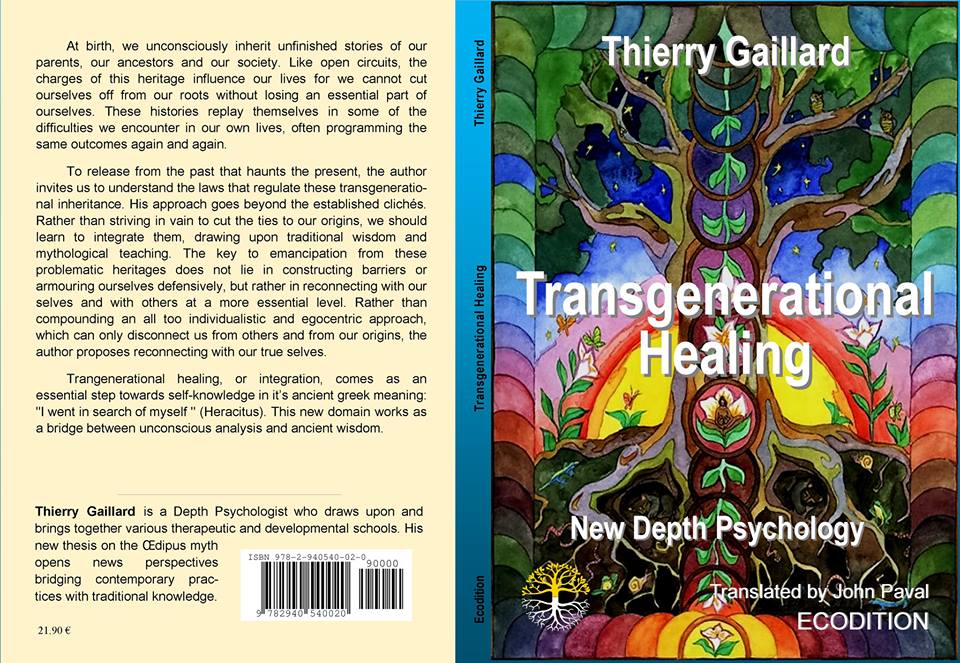
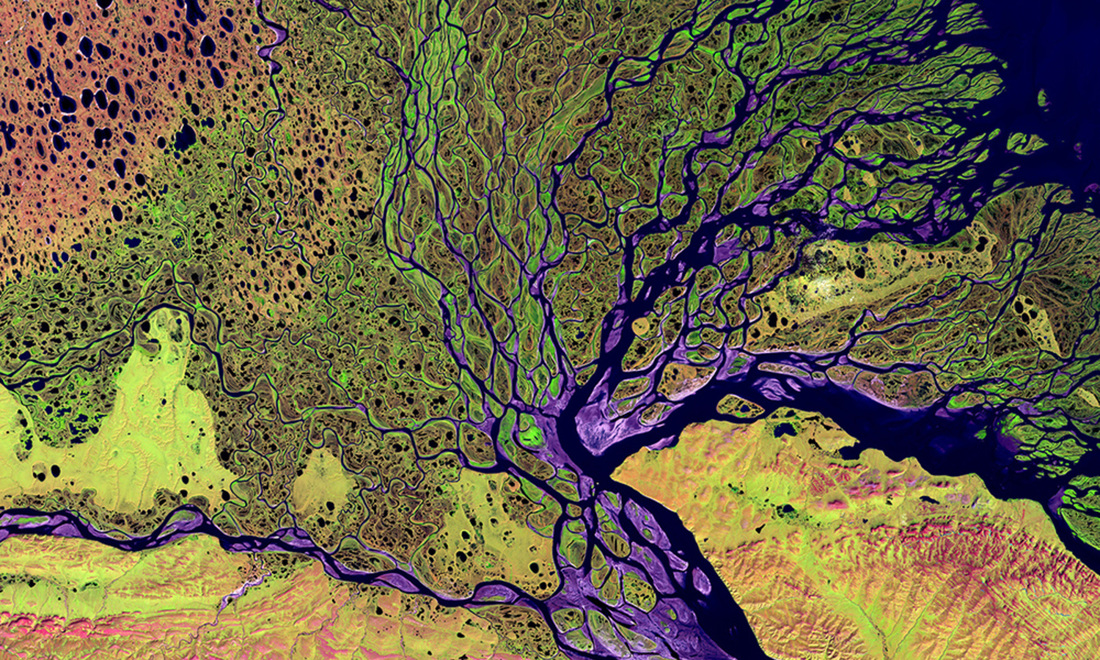
"Everywhere
geneticists look, they see populations more different than any living people,
mixing with each other in small fractions. It is no evolutionary tree. Our
evolutionary history is like a braided stream."
"...the urge to
individuation, gathers together what is scattered and multifarious and exalts
it to the original of the One, the Primordial Man." --C.G. Jung
We all have genes that
come from our ancestors that aren't used - they're not turned on. So we
actually carry ancient genes with us. If you could figure out how to turn those
on, you could resurrect ancient characteristics from our ancestors.
--Jack Horner
THE LONG DEAD
"Follow
in the footsteps of your ancestors, for the mind is trained through knowledge.
Behold, their words endure… follow their wise counsel."
-- "The Book of Kheti," The Husia: Sacred Wisdom of
Ancient Egypt
In the Beginning
The majority of the human
race is descended, according to
the Human Genome
project, from about 3,000 people. The evidence from the Toba
supereruption, 71,000 years ago, indicates that the world's population of
Modern Humans was reduced to a bottleneck total of around 2,000-10,000 adults.
Early
humans living about one million years ago were extremely close
to extinction. Genetic tests of ancient DNA suggests that the population
of early human species was 55,500 individuals, including Homo erectus, H. ergaster and archaic H. sapiens. After much research, estimates of
Homo sapiens coalescence all fall around 200,000 years ago (mtDNA), a little
earlier (nuclear DNA), or a little later (Y chromosome), with a range of
270,000 to 200,000 years ago.
Researchers estimate
that the
effective population size of human ancestors living before 1.2 million years
ago was 18,500 - 26,000. Genome
regions that contain
mobile element
insertion events provide unique information about ancient population history
because of their deep genealogies. Genetic diversity is greatest in sub-Saharan
Africa, also supporting a single origin place.
http://www.pnas.org/content/107/5/2147.full.pdf
Misconceptions include
the idea that all modern humans can be traced back to one female,
"mitochondrial Eve." The mitochondrial ancestor was not the only
female living, or the only one who passed on mtDNA, but part of a population.
Low levels of mtDNA diversity may indicate a population bottleneck, when as few
as 1500 female humans lived, perhaps due to environmental conditions, or our
population size may always have been small.
Somehow our ancestors
escaped such local and global near-extinction events, when the earth became a
wasteland from volcanoes, climate change, or space debris. Population
bottlenecks accelerated the differentiation of isolated human populations and
encouraged increased cooperation within tribal groups for survival.
http://www.scientificamerican.com/article/humans-might-have-faced-extinction/
Carnal, Carnation & Incarnation
Carnal is a related
term of carnation. As adjectives the difference between carnal and carnation is
that carnal is relating to the physical and especially sexual appetites -- the
material, or natural body; connected by birth -- while carnation is of a rosy
pink or red color, like human flesh. As nouns the difference between
incarnation and rebirth is that incarnation is an incarnate being or form while
rebirth is reincarnation; new birth subsequent to one's first.
To be that which you are is the bath of rebirth.
~Carl Jung, The Red Book, Page 266
DEARLY DEPARTED
In The Soul's Code James Hillman explains that,
according to (Plotinus 205-270 ACE), "we elected the body, the parents,
the place, and the circumstances that suited the soul and that, as the myth
says, belong to its necessity. This suggests that the circumstances, including
my body and my parents whom I may curse, are my soul;'s own choice -- and I do
not understand this because I have forgotten."
He adds, "so that we do not forget, Plato
tells the myth, and in the very last passage, says that by preserving the myth
we may better preserve ourselves and prosper. In other words, the myth has a
redemptive psychological function, and a psychology derived from it can inspire
a life founded on it."
An ancestor is a
person from whom you have directly descended. An ancestor or forebear is a
parent or (recursively) the parent of an ancestor (i.e., a grandparent,
great-grandparent, great-great-grandparent, and so forth). An 'ancestor chart'
shows a person and all
of their ancestors in a graphical format.
Family is viewed as a
closely united group of living and dead relatives. The ancestors are not limited to our
blood and family lineages, but biological ancestors are most influential and
important to engage for personal and family healing. To 'be' is to perceive and
be perceived.
Shaman and traditional
cultures emphasize active relations between generations. The ancestors weld the
community to its origins or roots, assuring a certain individual and collective
balance. Today this healing potential has been rediscovered and applied in
"Transgenerational Integration."
Ancestral connections
correlate with well-being. Even while we 'grow up,' we simultaneously grow down
into our roots, where we are entangled with our ancestral 'invisibles.'
The Ancients managed
their ancestral inheritance in many ways, including connections to Earth and
Sky, and applied artistic intelligence -- signs of a symbolic psyche and
self-awareness. Evidence of tools and art as old as 40,000 years, from South
Africa to Siberia, have been discovered, and the date keeps getting pushed
backwards.
"The ancients brought over some of
the beauty of God into this world, and this world became so beautiful that it
appeared to the spirit of the time to be fulfillment, and better than the bosom
of the Godhead."
(Jung, Liber Novus, Page 238.)
Ancestor veneration
preserved memories and living family histories. Such rites celebrate the
ancestors and moderate intergenerational issues that could affect descendants.
Descendants affected
can heal through deepening their ancestral connections.
The progenitor is the
(sometimes legendary) founder of a family, line of descent, clan or tribe,
noble house or people group. In genealogy or family history a progenitor is the
earliest recorded ancestor of a consanguineous family group of descendants.
Traditionally, progenitors are patrilineal. In a patrilineal dynasty, each such
dynasty has only one progenitor. There is a 1-2% rate of "false
paternity" per generation, so the genetic root may or may not be
transmitted downline.
No Man's Land is All
Sacred
In medieval times it
was said that 'the King is the land'. One is the other; the King and the land
are one -- our transpersonal state of health. In the Arthurian mythos, Arthur
falls into despair, so the kingdom falls prey to blight.
Only when the
connection is made can the cure -- the Quest for the Holy Grail, the journey of
psychological transformation -- begin. Arthur is King by divine right, so more
than just a ruler: the King is the land at a deep spiritual level.
In psychological terms
this represents the union of the conscious self with the unconscious.
But he is not the only one tied to the land. The 'land' is
our psychophysical basis. We are all the land in this sense. The transpersonal is immanent
to our physical being. Metaphorically, the king is not only tied to the land or
matter, the land supports the king, as the body supports the transpersonal.
The king is
primordial, neither of this world nor the next. The archetypal couple, the parent
images of the unconscious (Sol and Luna), represent the spiritual and chthonic
nature of the hierosgamos, the sacred union of unconscious wholeness --
the undiscovered country.
The term "no
man's land" expresses a profound truth: the earth does not belong to us --
if anything, we belong to the earth and the sky. In the syzygy, the archetypal couple symbolize
the moment when heaven and earth come together, creating the Holy Union.
The Sacred Marriage,
hierosgamos is consummated.
The Navajo say,
"the earth is my mother, and the sky is my father."
There is always a
mythology behind our personal psychogenealogy. The myth needs to earth to reincarnate,
to make our personal mythology alive and real, inviting us to take care of that
image and that earth with an ecological preservation.
RETROSPECTIVE
ANALYSIS
Genealogy is a
retrospective analysis of our ancestors and inherited genetic lines. People
love finding out that they have a famous relative, or they’re descended from
royalty. Thanks to genetic testing it’s easy to get a rundown of your
potentially regal DNA. But being related to long-ago kings doesn’t make us
special—it just makes us human.
Interregnum
Geneticist
Adam Rutherford pointed out that family trees grow backwards exponentially, so
the amount of ancestors people should have from the ninth century is larger
than the amount of people who were alive during the ninth century. That means anyone
with European ancestry is related to King Charlemagne.
Tangled
Trees
“Everyone
alive in the ninth century who left descendants is the ancestor of every living
European today, including Charlemagne,” Rutherford writes, explaining that
Europeans alive today are probably related to the long-dead Holy Roman Emperor
even if their DNA test doesn’t show it. The new DNA tests make it possible to
determine kinship up to 5-7 generations back.
Because
of the way the DNA deck is shuffled every time a sperm or egg is made, it
doesn’t keep halving perfectly as you meander up through your family tree. If
you’re fully outbred (which you aren’t), you should have 256
great-great-great-great-great-great-grandparents. But their genetic
contribution to you is not equal. Before long, you will find ancestors from
whom you bear no DNA. They are your family, your blood, but their genes have
been diluted out of your bloodline. Even though you are directly descended from
Charlemagne, you may well carry none of his DNA.
As
fun as it is to find out you’re the direct descendant of an old royal line,
it’s pretty meaningless. Often genetic ancestry relies on the Y chromosome,
which is inherited only via the paternal line, or mitochondrial DNA, which is
only passed on from mothers. These make for persuasive – but often simplistic –
analyses of ancestry. These two chunks of DNA make up 2% of your genome. But
the other 98% has to come from somewhere too, and that is a pick-and-mix from
all the rest of your ancestors. And you have numerous ancestors from whom you
have no DNA. They are your family, your blood, but their genes have been
diluted out of your bloodline.
"The
communication of the dead is tongued with fire
beyond the language of
the living." - T.
S. Eliot
"If
you look deeply into the palm of your hand, you will see your parents and all
generations of your ancestors. All of them are alive in this moment. Each is
present in your body. You are the continuation of each of these people."
--Thich Nhat Hanh
Ancient religions and
traditions have often used the pomegranate
tree and its fruit as signifying the 'Tree
of Life'.
The Tree of Life
becomes the genealogical tree, the family tree, filled with a multitude of
pomegranate seeds -- a universal symbol of regeneration, self renewal, and
victory over death. Its flowers are a symbol of love and the
fruit - of noble birth and fertility...the
vegetative form of the bloodline, whose animal icon is the dragon.
Throughout the East the pomegranate is the symbol of luxuriant fertility and of
life. Because
of its many seeds, it was also a symbol of fertility, and resurrection. Each
seed is like a drop of blood.
THE TREE & THE BLOOD
LIVING INTO OUR
HERITAGE
by Iona Miller,
(c)2016
I have frequently seen
people become neurotic when they content themselves with inadequate or wrong
answers to the questions of life. They seek position, marriage, reputation,
outward success or money, and remain unhappy and neurotic even when they have
attained what they were seeking. Such people are usually confined to too narrow
a spiritual horizon. Their life has not sufficient content, sufficient meaning.
If they are enabled to develop into more spacious personalities, the neurosis
generally disappears. ~Carl Jung, MDR, Page 140.
The driving force, so
far as it is possible for us to grasp it,
seems to be in essence
only an urge towards self-realization. —C. G. Jung
Am I a combination of
the lives of these ancestors and do I embody these lives again? Have I lived
before in the past as a specific personality, and did I progress so far in that
life that I am now able to seek a solution? I do not know...
In old age one begins
to let memories unroll before the mind's eye and, musing, to recognize oneself
in the inner and outer images of the past. This is like a preparation for an
existence in the hereafter, just as, in Plato's view, philosophy is a
preparation for death. ~Carl Jung, Memories Dreams and Reflections
Man's
whole history consists from the very beginning in a conflict between his
feeling of inferiority and his arrogance. Wisdom seeks the middle path and pays
for this audacity by a dubious affinity with daemon and beast, and so is open
to moral misinterpretation. ~Carl Jung, CW I,
Pages 23-24
Time means a past and a
future, and so the individual is only complete when we add his actual structure
as the result of past events, and at the same time the actual structure taken
as the starting point of new tendencies.
~Jung, 1925 Seminar,
Page 137
This meaning of events is
the supreme meaning, that is not in events, and not in the soul, but is the God
standing between events and the soul, the mediator of life, the way, the bridge
and the going across.
~Carl Jung, Liber Novus, Page 239.
Non-Conscious
integrates information further back than conscious processes.
What
Is Time to the Unconscious Mind?
For most of us, our
everyday conscious minds feel the stream of conscious experience flowing
linearly through what we call the past, present and future. But how do
non-conscious mental processes interact with events that take place in time? By
definition, we aren’t privy to our non-conscious minds, so to get at this
question, we have to use some tricks. I will first briefly describe current
neuroscientific and psychological ideas about how everyday conscious awareness
creates a sense of order and temporal flow. Then we will delve into the methods
used to examine how non-conscious processes interact with events, and how the
results of such experiments can inform our understanding about the nature of
reality and time. Specifically, I will describe the methods and implications of
experiments examining non-conscious “time bending” (i.e., differences between
our everyday conscious version of time and the versions accessed by
non-conscious processes), including presentiment/precognition experiments and
their implications. Finally, I will discuss a new model describing how the
so-called past, present, and future collapse under the influence non-conscious
processing. Taken from another point of view, this model also addresses how the
past, present, and future are manufactured for use by everyday conscious
processes.
https://www.youtube.com/watch?v=-y5MFbDcDA8
ARCHAI
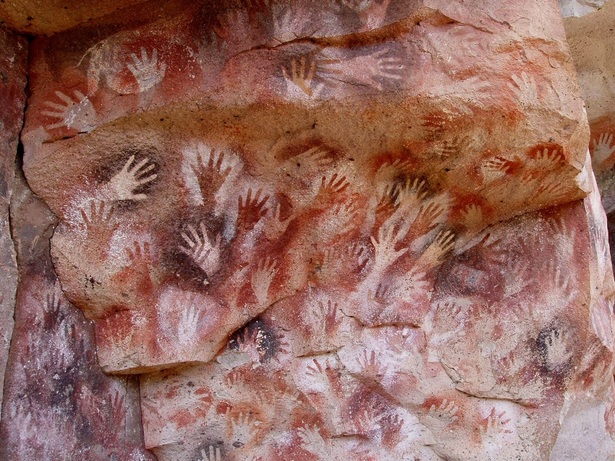
PALEOPOETICS
The Life of the Past
Nourishes and Shapes the Present
With an average of
fifteen years per generation, the ancestral artists of Lascaux and Chauvet, who
painted the living walls of those dim caverns, lived approximately 18,000 and
33,000 generations ago (15,000 - 30,000 or 32,000 years old). Genealogy is the
labyrinth of our ancestral self and we leave our handprint at the entrance when
we commence our initiatory journey to the depths.
Arche is a Greek word
with primary senses "beginning", "origin" or "source
of action". (εξ’ ἀρχής: from the
beginning, οr εξ’ ἀρχής
λόγος: the original argument), and later first
principle or element, principles of knowledge (ἀρχαί)
(Aristot. Metaph. 995b8). By extension, it may mean "first place,
power", "method of government", "empire, realm",
"authorities" (in plural: ἀρχαί),
"command".[1]
The first principle or
element corresponds to the "ultimate underlying substance" and
"ultimate undemonstrable principle".[2],
designates the source, origin or root of things that exist, the element or
principle of a thing.
We now have a pretty
good estimate of how many ancestors our own species had at various times in the
past. Our ancestors went through two different phases of population “bottlenecking”
(constriction): one occurred about three million years ago, when a large
population declined to around 10,000 individuals. The authors note that while
this may reflect population size decline associated with the origin of hominins
after our split with the lineage that produced modern chimps, they also say
that this could be an artifact of ancient genetic polymorphisms maintained by
natural selection.
The second bottleneck
is the one of interest, for it’s the one associated with a reduced population
size as humans left Africa. For the Chinese, Korean, and European
genomes, effective population size fell from about 13,500 (at 150,000 years
ago) to about 1200 between 20,000 and 40,000 years ago. Now this is the
effective population size, almost certainly an underestimate of census size,
but that only makes the problem worse:
we never went through
a bottleneck of anything near two individuals,
as the Biblical
Adam-and-Eve story suggests.
We also see a somewhat
less severe bottleneck in the African samples: from about 16,100 people about
100,000-150,000 years ago to 5,700 about 50,000 years ago. It’s not clear
why the populations in Africa bottlenecked as well.Finally, we also see the
population recover in size, with a huge increase in all populations
beginning roughly 20,000 years ago. This clearly reflects population
growth in both Africa and in areas colonized from Africa as humans expanded
around the globe.
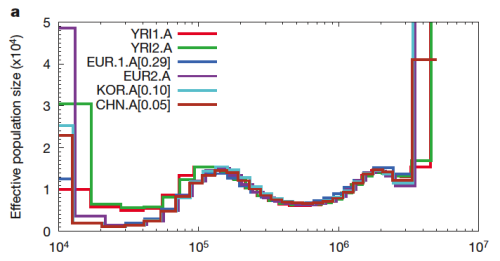
ANCESTRAL
ARCHAEOLOGY
Genealogy:
What We Are & Where We Come From
Genealogy is the
archaeology of the soul, offering new depths of insight into ethnography,
lineage and kinship. It looks beyond regional, continental, and psychic
barriers. A coherence is experienced from within, bringing forth that which was
formerly hidden. It includes not only the personal connections, but the myths
of life-after-death and life-before-birth —the simultaneous reality of spirit
and matter.
Commit the Body to the
Ground
Genealogy becomes a
radical embrace of the earth, our psychophysical ground and structural
foundation. The common ground of psyche and matter is "deep"
psychophysical correlates. Jung's psychoid realm is the physical and
metaphysical ground of being. The divine masculine and feminine are primordial
dimensions of reality.
In Mysterium Coniunctionis, Jung explained that the unus mundus corresponds with this
transcendental psychophysical background of vast potential. Psyche and matter
continuously emerge from that transcendental matrix -- the eternal presence of
the singular creative act. We emerge from the broader universe that supports
us.
Figure-Ground
Modulation
Shared knowledge is
the common ground -- shared "grounding." It teaches us to read our
psychophysical landscape back to our own creation myth, grounded in universal
creation motifs. It symbolizes the ultimate meaning of our own existence, and
that of the cosmos.
By consciously
descending into the depths, descending toward primordial time, into our
long-buried past, we ignite a light in the darkness. The ancestors are figures
of time and meaning.
Transgenerational
Psychophysical Ground
Everything is already
there from the beginning in the unconscious. We now know deep memory and
heredity are closely linked. "Retrieval" doesn't mean the *same* but
rather a "memory" of behaviors and attitudes that had previously been
"forgotten." We dig, then dig deeper, and sift, and sort looking for
some shred of new evidence because we feel it in our bones.
Jung notes, "The
dissolution of our time-bound form in eternity brings no loss of meaning."
(Letters Vol. 1, Page 343.) He described his vision: "The bodies are the
individual lives, twisting and turning and writhing themselves into a sort of
pattern that dissolves and reforms again and again. It is the river of time, of
life, in other words." (Visions Seminar, Page 321)
Don't Forget They Were
Our Creators
Genealogy is a living
demonstration of the newness of the old as well as the oldness of the new.
According to Jung, when a personal experience corresponds to a latent
primordial image, an archetype is activated. The new model is contemplation,
participation, comprehension, poesis. Poetry has a way of "plumbing the
depths." Human consciousness is an embodied self-referential system,
symbolized in Uroboros.
Esther Harding
describes how Jung "found
a symbol of the psychic structure which joins into an organic unity everything
from the mineral world through the animal, the unconscious and ordinary
consciousness up to the Anthropos, which is quality-less and so, like the old
Uroboros, touches the primordial condition of Chaos with its forces
constituting matter, from which the whole cycle springs again." (C.G. Jung Speaking:
Interviews and Encounters and Encounters, 171-179). Genealogy is a potent
symbol of such a notion.
Gene Tree
The genealogy chart is
a way to visualize and navigate the set of reconstructed ancestors, and
narratives of pressures faced by our own ancestors. Everything about us as
individuals is a product of complex interactions between our genetic
instructions and aspects of the environments in which they are expressed
[epigenetics]. If experience is not coming from the body it's not 'known' and
going to change your life. The body contains the feeling which the soul gives
the creative opportunity to expand.
Everyone alive today
is descended from a long, long line of successful ancestors. There is a very
good reason we rely on heuristics – evolution. Our distant ancestors when faced
with complex life-threatening problems didn’t have time to weigh up the
situation, so developed quick-fire methods.
Probabilities
But our ancient ancestors had access to little data other
than their own ... Instead, they use quick and dirty heuristics that are less than perfect but that
work well. Those
that worked were passed down through generations, and we are still relying on
them, often when we shouldn’t.
What advantage do we,
humans, have? One is the ability to solve new problems, those on which
evolution did not train generations of our ancestors. The brain has evolved
many mental shortcuts, or heuristics. Heuristic shortcuts evolved that helped
our ancestors deal with political problems in small-scale social groups.
However, the world we
currently live in is radically different from the world our ancestors lived in
when these mental heuristics evolved. In some instances heuristics can
lead us to misjudge and make mistakes due to the biases that heuristics can
blind us to.
Sense and Sensibility
True, the
"sense" is often something that could just as well be called
"nonsense," for there is a certain incommensurability between the
mystery of existence and human understanding. ~Carl Jung, CW 12, Page 222
"Sense" and
"nonsense" are merely man-made labels which serve to give us a
reasonably valid sense of direction. ~Carl Jung, Psychology and Alchemy, Page 222
The pendulum of the mind
alternates between sense and nonsense, not between right and wrong. ~Carl Jung, Memories Dreams and
Reflections, Page 154.
Dreams Reach Forward;
Wonder Reaches Back
How can we look at
something and claim to know it if our own flesh isn't included? Instinct is
felt physiologically and experienced as numinous images that seem to contrast
to mere bodily sensations and mechanisms.
Archetypes are
instincts "raised to a high frequency," just as instincts emanate
from an archetype's "low frequency." Just as instincts impel toward
behavior, the archetypes impel toward certain kinds of perceptions. Our task is
to find our destiny lived from the wholeness or totality of our being.
People would rather hang
on to the old dogmas than let experience speak.
--Jung, Letters Vol.
II, Pages 598-599
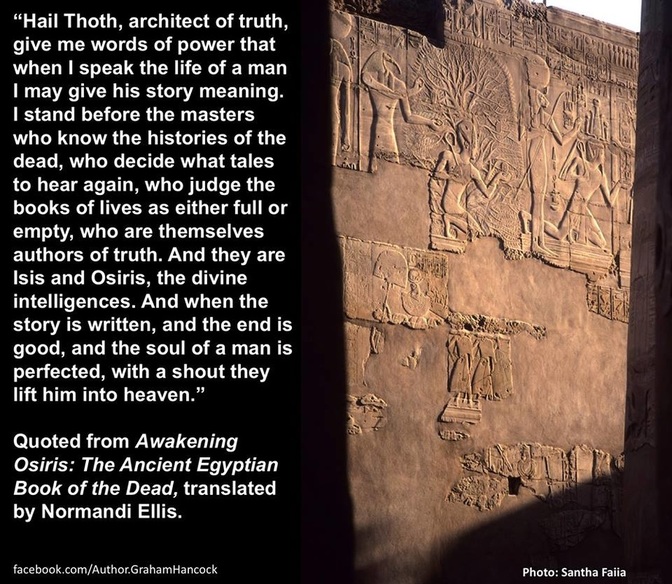
Trangenerational
Process
QUESTION 5: Can I
help the spirit of my dead father by trying to live in accordance with the
demands of the unconscious?
Dr. Jung: Yes,
provided—one must always add—that the spirit of the dead father [remains a
living idea].
I call this idea
hygienic, because when I think that way everything is right in my psychic life
and when I don't think that way everything goes wrong, then somewhere things
don't click, at least in the biological sense.
~Carl Jung, C.G. Jung
Speaking: Interviews and Encounters, Pages 383-386.
Obviously, all
genealogy is transgenerational. What distinguishes Transgenerational Genealogy
from conventional or Jungian approaches is plunging deeper into the Medieval,
legendary, and mythic layers of one's pedigree, rather than just the first few
generations. But we can not concentrate only on the royal lines, because many
other descents far out number them. Genetically, they have no priority.
As someone's
descendant we answer the call. The transgenerational group is integrated within
the individual. For Jung, fantasy is an integrative function. Imaginative
expressions of hidden forces appear spontaneously as the direct expression of
psychic life, creative and imaginative activity.
Our lineage is our own
personal Mystery Play. We can allow the phenomena to speak - the multitude of
personalities to speak, to be personified. Images are also voices -- messages
from the dead. We need a sense of the ancestors. “The lived body” is a
receptacle of past experiences, of a knowing that bypasses knowledge.
They can also impress
themselves on us. The children of the traumatized have always carried their
parents’ suffering under their skin. Some carry secrets more slippery,
combustible and secret than sex and more dangerous than any shadow or ghost.”
Epigenetics transmits the experiences of one generation which insinuate
themselves into the next.
https://newrepublic.com/article/120144/trauma-genetic-scientists-say-parents-are-passing-ptsd-kids
Being
is an aspect of non-being.
Non-being is no
different than being.
Until
you understand this Truth,
You won't see anything
clearly.
One
is all...All are One.
When you realize this,
What reason for
holiness or wisdom?
~Seng
Ts'an~
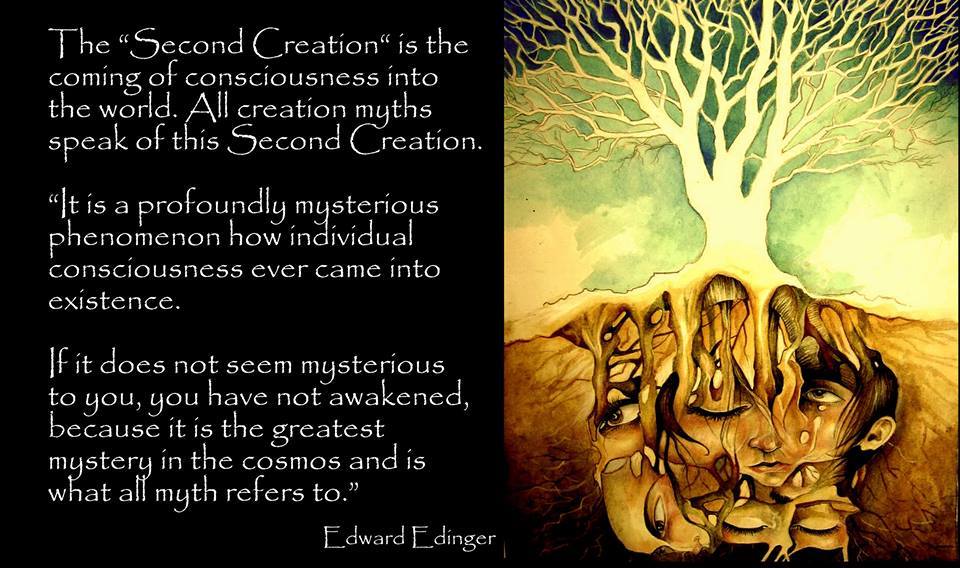
ENDOGENOUS
ANCESTORS
At the End of the Line
The transformation of the libido through symbols has occurred
since the beginnings of humanity. Symbols were (and are) never devised
consciously but always unconsciously. It is more than probable that most of the
historical symbols derive directly from dreams or are at least influenced by
them.
--Jung, C., Collected Works of C. G. Jung, Vol. 8. 2nd ed., Princeton
University Press, 1972. 588 p. (p. 45-61
Endogenous
means having an internal cause or origin, growing or originating from within an
organism, or a disease or symptom not attributable to any external or
environmental factor. In some sense, this describes our entanglement with our
ancestors all the way back to the dawn of time -- a sort of spiritual
endogenesis.
Sometimes
large shoots spring from our root, while others are tiny branches. End-of-line
ancestors are our research leading edge. Parents of some ancestors are unknown
and virtually unknowable, at least at this time. We all have them. We think
about them. We study them. We even dream about them. Once we find their
parents, we do a quick Genealogy Happy Dance, and then it starts over again -
we now have new end-of-line ancestors.
Who
are your end-of-line ancestors? "Direct-line ancestors with no
parents" option. Your direct-line ancestors who do not have known parents
are your end-of-line ancestors. So what is the strategy for extending a line?
Especially a line that has reached or nearly reached the theoretical or
practical limit. There are a lot of posts and other articles on the so-called
brick wall problem.
Historical Fiction
Place your ancestors
in time and space. Where were you born? If you don't know, then that is the
first step in your genealogical digging. Your mother was there when you were
born. Your grandmother was there when your father was born and so forth and so
on. So how did your mother get to where you were born? By the way, the same
rule does not hold true for your father. He may have been just about anywhere
or even deceased when you were born. We spend an awful lot of time looking for
male members of our families when it is the females that hold all the links to
all the information.
The idea is to locate
at least one event in a particular location. The problem in finding your
great-great-grandfather isn't really about him, it is about his children, at
least one of whom survived to adulthood or you would not be here. There is one
more rule, it may seem very cynical, but you have a much better chance of
identifying the true mother of your ancestor than you do the true father. No
matter how certain you may think you are, there is always a measure of
uncertainty in any pedigree where the mothers are not positively identified. If
you want to blindly ignore this principle, you do so at your own peril.
If you don't know
where a relative was born or where he or she lived, then you are skipping a
generation. Focus on the children. Find out as much as you can about the
children. Where and when were they born? Where did they live? On and on and on.
Focus on those events and places where you can positively identify the time
period in which they lived and the place. Look for records at that time and in
that place. Instead of spending years looking for your great-great-grandfather,
spend you time looking for your great-grandfather and finding your
great-great-grandfather just might take care of itself.
First, end-of-line
ancestors are part of genealogy. That doesn't mean there is nothing you can do.
Most often though people pound against the brick wall that is the end-of-line
ancestor, never wavering. This usually results in nothing but frustration.
Instead, you may need to attack the problem from a different angle or a
different generation. Stand back from your end-of-line ancestor.
Some suffers invent
imaginary ancestors or link to unproven connections. This delusion can be seen
by the proliferation of ancestors named Mr. or Mrs. End-of-line on many online
family trees. Some of these invented individuals take on the same name as the
last verified ancestor with the same birthdate, and thereby allow the sufferer
to extend the ancestral line for many generations. Both of these situations can
be seen in the following screenshot where father and son have the same names
and the same wives' names and the line is extended with a Mr. and Mrs.
Evaluate Where You Are
Evaluating where you
are in your research means more than just simply looking at your pedigree chart
or family group sheet of your end-of-line ancestor. It means reexamining all your
research on that line up to this point. To effectively accomplish such a
reevaluation requires that you have some method of organization when it comes
to the copies you have made.
In addition to
organizing the records you have found, you must also be tracking your negative
research. After all, with the positive research, you have photocopies or
transcriptions that let you know that you looked in a given source. With
negative evidence, there is nothing to show for the search unless you are
recording that information. Research logs are critical to this. Research logs
should be used for both negative and positive research. A research log, when
properly kept, can aid you during this time of reexamination.
What Are You Missing?
As you look at your
pedigree chart and family group sheets, look at them from the aspect of what
you might not have done in your research. With a discerning eye, see if you
have jumped over some records in your zeal to get back another generation. It
is tempting to skip records if our ancestors are showing up in the census
records. But those records we skipped may hold the clues to where you should go
next. They may be the records that prove your previous information is in error,
especially if all you have has come from the census records.
Perhaps you might want
to compare your research to a resources checklist
to see what records you may have overlooked in your research. It is natural for
us to stick with what we know. When comparing the records we have already
checked with such a list, we often discover new resources that may solve the
brick wall.
In Conclusion
"More Than Kin, and Less Than Kind"
Usually when you go
back and review your past research you will often discover overlooked records
or incorrect evaluations in past research. In some instances your ever growing
knowledge and experience will give you a better eye to evaluating the
information found and not found than you had when you originally did the
research. If you find no information, after making a reasonably exhaustive
search, you may be at the end of your line.
Pedigree Collapse - http://genealogysstar.blogspot.com/2011/10/pedigree-collapse-and-end-of-line.html
We
are just beginning to learn what lurks in our genome and psyche, and what these
ancestral forms or ancestral sequences mean to us today. Some
hark back to the macroevolution of our species. Ancient
viruses are still with us from our earliest common primate ancestors via
proviral insertion. Ancient viral DNA may play a key role in how human stem
cells work.
We
also have relics from other hominid species, such as Neanderthal and Denisovan.
Endogenous substances and processes are those that originate from within an
organism, tissue, or cell. Endogenous
viral elements (EVEs) are DNA sequences derived from viruses that are
ancestrally inserted into the genomes of germ cells. Caused or produced by
factors within a model, organism, organization, or system.
http://www.evolutionnews.org/2011/05/do_shared_ervs_support_common_046751.html
http://www.fsmitha.com/time/timeline.htm
In The Forgotten Language, Erich Fromm opens up the world of
symbolic language, “the one foreign language that each of us must learn.”
Understanding symbols, he posits, helps us reach the hidden layers of our
individual personalities, as well as connect with our common human
experiences. By grasping the symbolic language of dreams, Fromm explains,
we can then also understand the deeper wisdom of myths, art, and literature.
This also gives us access to what we, and our society, usually repress.
"The murder of speech is the
self-murder of the human animal, a suicidal evisceration of our species'
specific endowment. Like tigers losing their stripes, like beached whales and
blind eagles are we without our rhetoric. Speech is our body, speech is our
shape, speech is our beauty."
(James Hillman)
Dead Ends are where
real research begins.
What is it, at this
moment and in this individual, that represents the natural urge of life? That
is the question. That question neither science, nor worldly wisdom, nor
religion, nor the best of advice can resolve for him. The resolution can come
solely from absolutely impartial observation of those psychological germs of
life which are born of the natural collaboration of the conscious and the
unconscious on the one hand and of the individual and the collective on the
other. Where do we find these germs of life? One man seeks them in the
conscious, another in the unconscious. ~Carl Jung, CW 7, Page 290.
"(It is with people as with trees.) The more one seeks to rise into height and light, the more vigorously do ones roots struggle earthward, downward, into the dark, the deep — into evil." - Nietzsche
When
I say "Psyche" I mean something unknown,
to which I give the name
"Psyche."
~Carl Jung, Letters
Vol. II, Pages 583-584
"Psychoanalysis
cannot be considered a method of education if by education we mean the topiary
art of clipping a tree into a beautiful artificial shape. But those who have a
higher conception of education will prize most the method of cultivating a tree
so that it fulfills to perfection its own natural conditions of growth."
--Jung, The Theory of Psychoanalysis (1953)
HALL
OF RECORDS
VITA BREVIS,
GENEALOGIA LONGA
20/20
Hindsight - Family History & the Human Family
Circles With A
Spiritual Center
Nature
centers into balls,
And her proud
ephemerals,
Fast to surface and
outside,
Scan the profile of
the sphere;
Knew they what that
signified,
A new genesis were
here.
--Emerson, Circles, http://www.emersoncentral.com/circles.htm
"The eye is first
circle; the horizon which it forms is the second; and throughout nature this
primary figure is repeated without end.
Our life is an
apprenticeship to the truth that around every circle another can be drawn; that
there is no end in nature, but every end is a beginning; that there is always
another dawn risen on mid-noon, and under every deep a lower deep opens.”
Here Emerson is
linking up the idea of that little orbit, or the pupil through which we
perceive the world, with the symbol of God, it is the equivalent of God.
It is the creative eye
that sees everything and creates everything.
The first cosmogonic
myth was the creation of light, the seeing – out of the eye of God came the
first light. So when we enter the pupil, are we entering our own eye, or the
creative womb of the world?” ~Carl Jung, Visions Seminar, Page 307
Hermeneutic
Union
Hermes
was messenger and interpreter between gods and mortals. Hermeneutics is
"to make clear." It is an approach cultivating our ability to
interpret or understand from another's perspective, and applying that insight,
empathy, and understanding to interpretation or making sense of any situation.
Hermeneutics is a
technique for background understanding of another’s mind and worldview. It
concerns judging psychological accuracy from inaccuracy. Accurate beliefs
deliver long-term satisfactions by distinguishing between accurate and
inaccurate readings of situations by contextualizing them and comparing them.
Text & Context
Hermeneutics is a
research paradigm we can apply in genealogy research. A hermeneutical and less
epistemological understanding of the genealogical method avoids the paradoxes
of perspectivism and the metaphorics of vision by construing the phenomenon not
as a physical object but as a text.
Introspection does not
provide full self-knowledge. We want to understand our presuppositions, pivotal
experiences and abilities on which our knowledge-claims are based. We seek
understanding rather than explanations. Self-aware people know that they have
blind spots. Self-aware people know they have unconscious baggage that is hard
to notice or overcome.
Genealogical
explanations concern the relations between the act or state of believing and
the content that is believed. A genealogy explains the advent of a belief, in
the sense of a believing, (an attitude) in terms of contingencies of its
etiology, appealing exclusively to facts that are not evidence, that do not
provide reasons or justifications, for the truth of what is believed.
Knowledge Transfer
Pathways
Human affairs
aren't governed by a set of natural laws, so hermeneutics provides
interpretive understanding of the actions and meanings created by historically
and culturally situated actors. Our ancestors are symbolically situated along
the knowledge transfer pathways of the branches of the family tree, genetic and
epigenetic vectors. These convergent ancestral lines are like great caravan
routes of the mind, littered with the bones of ancient journeys.
Verification
procedures are both internal and relative to the particular kinds of
perspectives. We develop systems of meaning and justification to make sense out
of the world, understanding perennial aspects of the lived experience of
meaning.
Relational
hermeneutics is a full-bodied, soul-engaged, heart-transforming encounter that
involves the subjective worldview of the interpreter as much as the process of
interpretation. Theories of embodiment are grounded in a phenomenological
comprehension of the lived-body, including knowledge embedded within our
physical form.
Life, Expression,
Understanding
The hermeneutic
tradition values and explores the meanings of human experiences as they are
lived. Such meanings are lived in cultural, sub-cultural, linguistic,
religious, and gendered contexts. Sociocultural perspectives on psychological
phenomena require careful attention. Not merely inner experience, lived
experience recognizes the historical dimension in the psychological.
Hermeneutic philosophy
sketches a more balanced and credible approach to finding a genuine alternative
to modern individualism and postmodernist relativism. What is the power of
interpretation? What can we get at through interpreting? Can we get at Essences
of things? Like the difference between symbol and image,
hermeneutics subordinates the universal to the particular.
Interpretive
Perspectives
In philosophy and
psychology it includes the interpretation of all texts and systems of meaning,
including experiences. In the domain of genealogy it also includes recognition,
metaphors, and insinuation. Psychological hermeneutics is the body of knowledge
enabling insight and the discussion of biopsychosocial cause and effect.
Whatever is conscious
exists along with psychological meanings in relation to present, past and
future relationships between people -- and in relation to the relationship that
people have with themselves. The ways of making sense of people in all
situations is inextricably tied up with emotions and working out what exists
for them and about them.
However, we are never
other people nor do we ever have access to their consciousness. We cannot feel
what they do or have the same life experiences as they. We can only interpret
others from our prior understanding. Empathy occurs within oneself but is the
central connection to others. To be empathic is to interpret empathy “out of”
one’s own experience of other people.
Genealogy As Context
Experiences derive
meaning from their overall position in the totality of our involvements in the
world. Once born into the specific body, family, place and time in which we
live, we have to deal with the details of ordinary life, temporal contexts, and
social relationships. In this view there is no doing without being, no thought
without feeling, no action without reaction, no values without ethics, no self
without others. Being in a context is a multi-faceted whole, classically symbolized
in the genealogical chart.
Hermeneutic engagement
works with both Above and Below. Hermeneutic union lies in the shared realities
through which we create meaning. It amplifies environmental identity for our
ancestors. We all create symbolic and imaginal worlds.
Our genealogy personal
history is the best promise we have for understanding our shared humanity
because it is physiologically grounded. As genealogists we interpret our own
psycho-history. Psychogenealogy is a rigorous psychological and historical
analysis of our lineage and its interactive effect on ourselves.
The genealogist does
claim to be capturing the phenomenon as it really is. Genealogy is not simply
another perspective. The only way to challenge the results of one genealogical
analysis would be to produce another genealogical analysis either of the
original phenomenon or of the initial genealogical account itself. Genealogy is
not easy to do successfully.
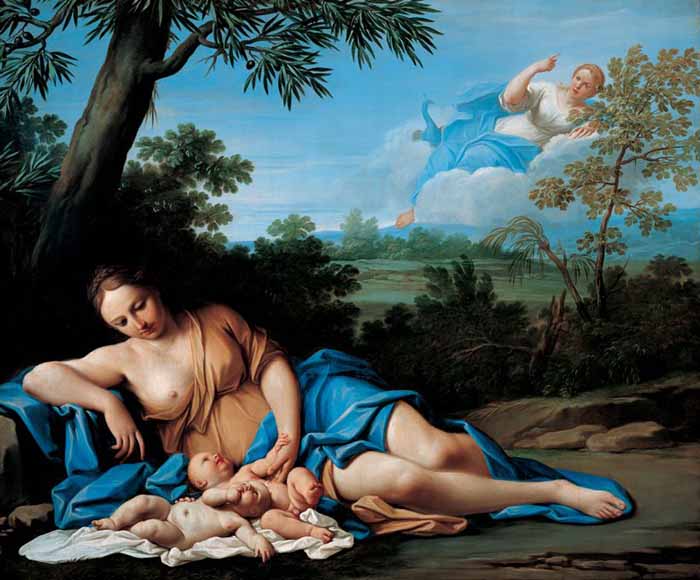
Goddess
of Childbirth
The name Artemis, from αρτεμέω
, means “to be safe and sound.” In the first century, Strabo (63/64
BC–ca. AD 24) wrote in his Geography, “Artemis has her name from the
fact that she makes people ‘artemeas’ meaning sound, well, or
delivered.” Strabo connects “Artemis” with deliverance. Artemis, having
special sympathy for women in travail from her first days, came to be
associated with virginity and midwifery, especially in Ephesus.
In Attic Greek, the
concepts of “deliver” and “save” went together. Although Artemis Ephesia
is associated with “childbirth” and midwifery, she is not linked with mothering
or domestic life. A distinction must be made between delivering babies and
actually bearing children—between midwifery and fertility or sexuality.
Rather than a
fertility goddess, Artemis Ephesia was revered for delivering a woman through
life’s most dangerous passage, childbirth -- the number one cause of death in
women. The fully female, yet undomesticated goddess presided at births without
links to sex, fertility, or nurturing. As there is midwifery for birth, there
is midwifery for death -- for a Dark Goddess midwife of the soul and authentic
clarity. Nature is our balm and our spirit is fed by the earth.
Images are the
"creative womb of the world," and we are each the midwife of the
soul. Jung says you "must give dignity to your image as a life-giving
factor, you must know that your imagination is capable of something, that it is
able to create, no matter what its apparent antecedents were." (Visions
Seminar, Page 306.)
Trans-Sensory
Aesthetic
We perceive psychic
imagery from an expanded palette of perceptual nuance. Psychic images are
'perceived' as trans-sensory. Synesthesia is a melding of senses unconstrained
by external perception, combining different sensory stimuli extending to new
sensory domains. Multisensory aesthetics engages them all in aesthetic
totality. Creativity is a necessary factor in coming to know and opening to the
other. To uncover or discover something is to come upon it.
Images come in from outside
through our senses, and are generated internally by unconscious dynamics as an
immediate multisensory narrative of experience, often metaphorical in
nature. We rarely focus our conscious
awareness on this imaginal wellspring, but sometimes it intrudes on
consciousness during our gaps in awareness – day dreaming, fantasies, reverie,
lacunae, inspiration, discovery.
Experience is never a
full encounter with primary 'raw' material, but we may find ourselves in the
otherness of existence. Jeanne Achterberg describes how pre-verbal imagery acts
on our cellular, biochemical, and physiological activity to alter our physical
being. She suggests a sort of nonlocal imagery transfer from one person to the
physical substrate of others.
For metaphor to elicit
nuance it must be fresh, not dead; it must shock the mind into wonder by
opening up a gap, an abyss, a void. The patterning principle transcends and
contains all forms. Imagery is the natural expression of the pregnant void
urgently fleshing itself out to the fullest extent. These images are not
‘ours’, but arise from the primordial matrix. This image stream is full of
unborn information and we are its midwife.
Such transpersonal
imagery is qualitative yet effective. Poetry helps us bring together what life
has separated or violence torn apart, defying the space that separates with
metaphor and correspondence -- conjunction, making connections, past and
present. Almost forgotten archaeological layers of belief still poke through
the surface, old echoes that stretch sacred religious absolutes.
Transpersonal imagery
is psycho-sensory imagery that exists and acts across persons -- from one
person to another, and we can add alive or not. The imagery functions as a
bridge, connecting the conscious or unconscious, imaginal content or activity
of one person with the conscious or unconscious, physiological or psychological
activities or experiences of another person.
Reflection gives shape
to the imaginal. Each ancestor, object, or body is also an imaginal image. We
can call it resonance, or reflected waveforms, or echoes. Echoes sound in a
deep dark unity, as vast as night itself and as the light, scents, colors, and
sounds correspond. The image stream or imaginal process is our primary
experience and permeates and conditions all facets of human life.
Synaesthetic
Imagery
In
"Correspondences", Baudelaire says, " As far-off echoes from a
distance sound In unity profound and recondite, Boundless as night itself and
as the light, Sounds, fragrances, and colors correspond." He
reasoned that sound should suggest color, and color a melody as a reciprocal
analogy of sensory modes, as indivisible totality.
Nature, as Anima Mundi
is a primeval partner with humanity that 'talks', 'watches', symbolizes, and
associates.
A sense of clustering associations between
individual and collective past is a 'genuine' experience.
Naturally, in
genealogy, such experiences explore processes that extend beyond ordinary
conditions of knowing, being, and doing. They encompass wider aspects of
humankind, life, psyche and cosmos, placing the personal in a larger
'spiritual' context and awareness in which we are coterminous and continual. Such
images can be exciting or calming. We
can attune to the powers of archetypal symbols. Capacity
for symbol use is universal, innate, and central to understanding. Images are
always unique and contextual.
Encountering
the Past
The
reach of the imaginal includes distant knowing and distant imaginal influences.
Henri Corbin has described the different forms of imaginal process or creative
imagination where it becomes possible to directly perceive subtle or spiritual
realities. Such empowered imagination is dynamic and nonlocal.
Our
ancient ancestors may have taken such phenomena much more literally, as
animistic and ontological 'beings' with names derived from their cultural
beliefs. Without metaphorical understanding, everything is only what it is and
must be met on the simplest, most direct material level.
But we don't need to
defend against separation by returning to participation mystique or literalism. The truth of the
psyche precedes every other kind of truth, back to the phenomenological ground,
to the images themselves, not a return to the things.
Real Presences, Not
Literal
Modern thought often
tries to find body by gathering literal data and making it concrete. But
Hillman sees literalism and
reification psychologically as an ego viewpoint, the enemy of the soul, and
suggests
we seek the bodies of ideas and words themselves, the body of an image. Though
the soul does not construct its reality out of literal sense impressions, and
it cannot be observed only by the physical senses, it is no less real.
"Rationality is
only one aspect of the world and does not cover the whole field of experience.
Psychic events are not caused merely from without and mental contents are not
mere derivatives of sense-perceptions." (Jung, Letters Vol. II, P.
600-603) Both Jung and Hillman, who represents 3rd generation Jungian thought,
caution us against literalism:
"Even a genuine
and original inner life has a tendency to succumb again and again to the
sensualism and rationalism of consciousness, i.e., to literal-mindedness.
(Jung, Letters Vol. II, Pages 600-603)
“An axiom of depth
psychology asserts that what is not admitted into awareness irrupts in ungainly
obsessive, literalistic ways, affecting consciousness with precisely the
qualities it strives to exclude. Personifying not allowed as a metaphorical
vision returns in concrete form: we seize upon people, we cling to other
persons.” (Hillman, Re-Visioning Psychology, p. 46.)
Hillman's argument can
also be applied to psychogenealogy:
"It
is this dayworld style of thinking—literal realities, natural comparisons,
contrary opposites, processional steps—that must be set aside in order to
pursue the dream into its home territory. There thinking moves in images,
resemblances, correspondences. To go in this direction, we must sever the link
with the dayworld, foregoing all ideas that originate there—translation,
reclamation, compensation. We must go over the bridge and let it fall behind
us, and if it will not fall, then let it burn."
(The Dream and the Underworld)
The future looks even
more bizarre than our wildest dreams,
but, as a modern
fantasy, it may suggest or help us conceptualize a way to revision our ancestors:
Imagine a world where
the entire World-Wide Web (augmented by the coming 3-D Metaverse, successor to
2-D Internet) becomes your exocortex with instant access to information and
virtual reality experience. You can interact with and/or experience yourself as
any person on the planet ever lived - AI would recreate that person out of
available records and collective subconscious. Furthermore, you can experience
virtually any being, creature, historical or imaginary, any idea or entity, or
collective of minds.
From the evolutionary
point of view our biological brains are a bridge to post-biological artificial
superbrains. And one could argue with a high degree of certainty that
posthumanity will represent a highly organized network of digital minds of our
post-biological descendants, substrate independent advanced informational
beings, "infomorphs".
While infomorphs may
have multiple cybernetic and virtual bodies, they will possess near-perfect
information-handling abilities by using holographic language, instant data and
knowledge transfer, inherent synthetic telepathy and intersubjective mind
sharing for interaction as well as conceptual merging/un-merging
http://www.ecstadelic.net/ecstadelic/tue-feb-09-2016
The core point is that
humans are inherently delusional and that most (not all) efforts at secrecy are
aimed at preserving delusions. The one antidote to delusion is reciprocal
accountability and criticism — others do not share your delusions. They
can use evidence to point out your errors… and you will return the favor.
This is the very heart of science — not some gnosticmystic search for “hidden
codes.”
The
validity of preverbal imagery as an accurate means of knowing and efficacy has
been demonstrated by Larry Dossey, MD and others in immunological,
physiological and behavioral studies. The imagery is 'transpersonal' by
definition because it acts on a person other than the 'source' from which it
originates, or a person other than the person in whom it is acting.
Jung claimed in his
Visions Seminar: "Thinking
would be up in the head; sensation about the level of the mouth; intuition in
the region of the heart; and then down below in the abdomen would be feeling.
You feel with the abdomen, not the heart, and that is of course a particular
kind of feeling."
Some are more acutely aware
of the imaginal, more open to the reflective instinct. The perpetual stream of
consciousness is undergird by a dynamic flux of multisensory imagery, which
springs from the creative fountain within us all. We imagine rather than
perceive images. Images are a dynamic meld of multimodal textures. Imagination
itself has an intermediary status between the physical and conceptual level of
spirit.
Morphing images are the only reality we apprehend directly. When we look at
fantasy images we see the face of instinctual libido staring back at us.
Fantasy is an imaginal activity that is the flow of psychic energy. Image
and meaning are identical, embodied perpetually in the dynamically shifting
image stream. The entire image conveys its own mood and meaning instinctually
and does not require analysis or interpretation.
Images only relate indirectly to external reality. They emerge as reverie,
proto-emotion, impulse, and amorphous cognition. An image carries its own
inherent meaning which is sort of a ‘condensed expression of the psychic
situation as a whole.’ Further, ‘the image is an expression of the unconscious
as well as the conscious situation of the moment,’ according to Jung.
Images are self-revelatory. Imagination is a direct expression of psychic life.
Imagination flows forth from the imaginal field continually, self-organizing
its multisensory narrative and conditioning our experiences. In fact, this
imaginal dimension is our experience. Everything we perceive of ourselves,
others and world is filtered through it.
Anyone can apply as much or little of such ideas as they like to their
ancestral project. We all have the capacity. But we can enhance our capacity
through preparedness, familiarity with the imaginal world, self-regulation,
concentration, and developing skill in negotiating this realm with creative
imagination...and knowing our living lineage. Genealogy can be a death/rebirth
initiation.
We die at home in history. Confronting non-being, existence takes on vitality.
Confronting death bring us to the threshold of living authentically. It may
change what we perceive is real about life. Here and now takes on the
importance of the moment.
The Sum of All Fears
Adversity
is like a strong wind. It tears away from us all but the things that cannot be
torn, so that we see ourselves as we really are. --Arthur
Golden
Awareness and openness to
the reality of death is a link to all we value in human experience, from love
to creativity, to yearning for immortality. We all struggle for the courage to
confront death and to struggle against it. Fear of death and creativity are
related through the long term perspective we bring to it.
Rebirth brings a reassessment of the meaning of life and the means to express
buried creative energy. Genealogy is the sum of all histories -- a path
integral formulation which generalizes all action into a unique trajectory -- a
sum over history of probabilities and fundamental events.
We all develop fictions about our lives. We build things up over the years in
our imagination and come to believe them as true. Healing
and integration comes when we discover or rediscover our own personal story. Almost
any story is certainly some kind of 'lie' but also contains the greater truth
of primal patterns.
We learn to 'read' the lives of our ancestor like a painter read the marks, or
behaviors on the canvas as one might read a literary passage. Our vocabulary
needs building and in this process verbal discussion can be very helpful.
Genealogy provides an adequately functional vocabulary.
Archetypes represent such sums deriving individual histories from fundamental
processes. Larger fundamental processes are one of the great central ideas in
managing infinities. The sum of all ancestors implies we do travel every
possible path and choose our individual path through interference patterns from
those infinities.
Jung thought it necessary to coordinate the activities streaming out of the
matrix of the unconscious with consciousness. He funneled the fantasies of the
unconscious into the conscious mind, not in order to destroy them but to
develop them. "Developing fantasy means perfecting our humanity."
"The repressed tendencies that are made conscious should not be destroyed
but, on the contrary, should be developed further."
Genealogy is an ultimate integral symbol. Integral means necessary, very
important, essential to completeness, composed of constituent parts, elemental,
indispensable, intrinsic, fundamental. As Jung suggests, “Until you make the
unconscious conscious, it will direct your life and you will call it fate.”
In Jung's depth-oriented approach, depth-oriented approach. “Wholeness is not achieved by cutting
off a portion of one's being, but by integration of the contraries.”
To paraphrase Jung, our genealogy contains 'readable archetypes', and presents
not only a picture of the actual situation but also of the future, exactly like
dreams. According to
Jung, when a personal experience corresponds to a latent primordial image, an
archetype is activated.
What is the sum of all nostrils that have breathed, all teeth that have eaten,
all fingers that have felt, ears that heard, and eyes that have seen? The sum
of all parts -- the indefinite integral essential to completeness -- the
sum of all helical gears from the endpoint of genetic potential is a mutual
awakening.
Psychological distress
can be managed by experientially-based, self-directed change and integration. With
our genealogical integration, we re-member ourselves to honor and embrace every
legitimate aspect of human consciousness. There is a Source underlying the
creation and evolution of the universe from which all things originate and to
which all things return.
"The older I grow the
more impressed I am by the frailty and uncertainty of our understanding, and
all the more I take recourse to the simplicity of immediate experience so as
not to lose contact with the essentials, namely the dominants which rule human
existence throughout the millenniums." (Jung, Letters Vol. II,
Pages 579-580)
As Nietzsche says: "Out
of such abysses, from such severe sicknesses, one returns newborn...with a more
delicate taste for joy, with a more tender tongue for all good things, with
merrier senses, with a second dangerous innocence in joy."
https://books.google.com/books?id=YPD9dymggnYC&pg=PA450&lpg=PA450&dq=trans-sensory+imagery&source=bl&ots=-fPM4ZEm0F&sig=BRlRZ0_u2St9HwLQlUV0_CNwyuM&hl=en&sa=X&ved=0ahUKEwjttZ-LouHKAhUC4SYKHTB7BZYQ6AEIHDAA#v=onepage&q=trans-sensory%20imagery&f=false
Werner Hornung, "Don't settle for anything less"; motion effects by George RedHawk
Genealogical
Mystery Tour
Through Your Family Tree
"Nothing
has a stronger influence psychologically on their environment and especially on
their children than the unlived life of the parent."
--Jung, Contributions To Analytical Psychology (1928)
"Great talents are
the most lovely and often the most dangerous fruits on the tree of humanity.
They hang upon the most slender twigs that are easily snapped off." (Jung,
Psychological Aspects of the Mother Archetype (1938))
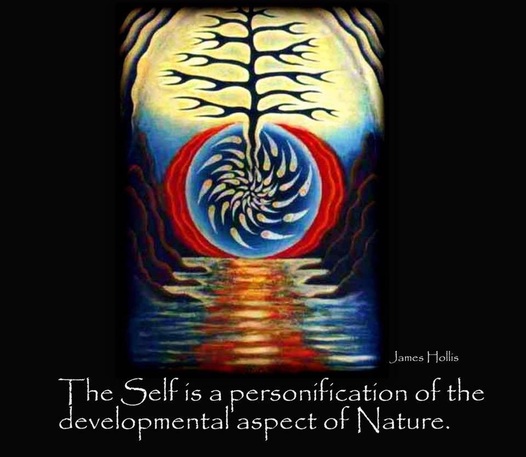
THE
ART OF CROSSING OVER
ReKINdled
Joy comes from fulfillment, but not from longing.
~Philemon to Carl
Jung; The Red Book; Page 341
Similarly, the unconscious
pits itself against the conscious, and it is the special tragedy of man that in
order to win consciousness he is forced into dissociation with nature. ~Carl Jung, 1925 Seminar, Page 38
"What is the human? . .
.The myths in which our lives are embedded . . . are built deeply into
character, often below awareness, so that they are essentially religious,
matters of faith.'' --Gregory Bateson
The unconscious is
not just evil by nature, it is also the source of the highest good: not only
dark but also light, not only bestial, semihuman, and demonic but superhuman, spiritual,
and, in the classical sense of the word, “divine.”
--Jung, The Practice of
Psychotherapy (1953)
Drawing forth the subtle
resonances through which the ground of awakening can be discovered is what the
great thirteenth-century kabbalistic master Isaac the Blind called “suckling.”
It is based on a thirst for the nourishment of absolute meaning in the midst of
the barrage of its relative projections. It coaxes and draws forth its
nutrition by direct immersion in the onslaught of mind’s upheaval, accepting
and rejecting nothing, always reaching further and deeper to recognize what is
truly meaningful with single-pointed focus.
The suckling is
accomplished through the flesh and blood of appearance, poised at the cusp of
its emergence and dissolution. As poetic resonances flood the perceptual fields
the ground of space sparkles with scintillating life, suffusing it with
ungraspable beauty. Contemplation trains the mind to enter this boundless
resource no matter what things appear to do or not do. It hangs with the spread
of pure possibility, hiding within the parade of everyday details, displaying
and consuming itself like the Ouroboros serpent swallowing its own tail.
--David Chaim Smith,
"The Awakening Ground" (Inner Traditions 2016)
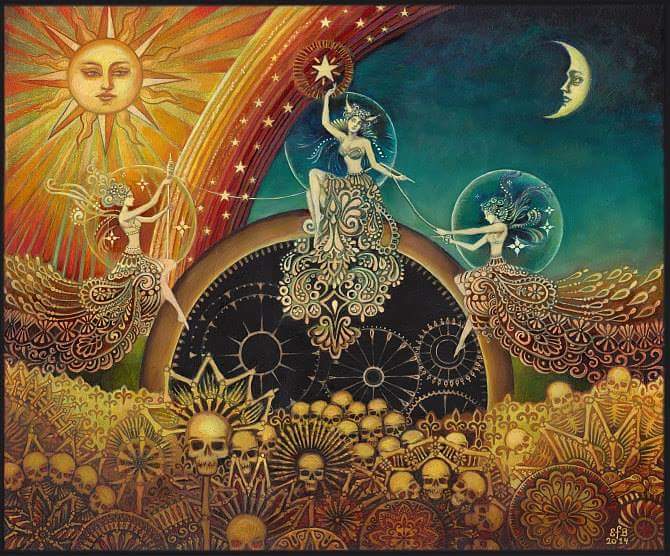
THE LAST LEAF ON THE TREE
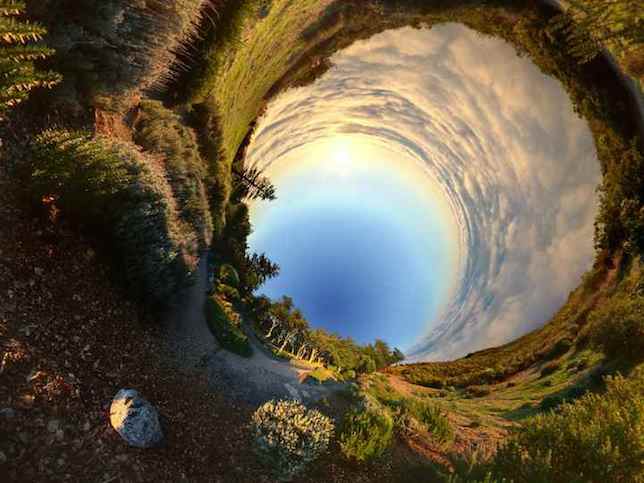
THE
CRADLE OF AWAKENING
"It
is indeed a major effort-the magnum opus in fact-to escape in time from the
narrowness of its embrace and to liberate our mind to the vision of the
immensity of the world, of which we form an infinitesimal part."
(Jung, Letters Vol. II, Pages 579-580)
Life
Force
Stay in your living
presence, feel all the life going on in you at once; feel the cohesion, the
live presence of open awareness, here and now. See how you come directly
to life. Come into living presence, more and more.
We are called to
remembrance of where we came from -- the cradle of nature -- to refresh the
dream of mythic origins. Feel the rhythm of awakening to the lifeworld, the
root pulse encoding our becoming.
Contemplate the origin
of the universe, the creation of matter, and the creation of life and
reproduction -- "they who engender, they who create" -- evolution
entering into time.
Oceanic Metaphor
We chart our legacy in
an ancestral sea with many shores -- an almost infinite genepool of lifeforms.
Jung called the sea, "one of the best known symbols for the prima materia,
as the mother of all life. All life came from the sea, and we feel life
streaming into us from an unknown source, as it were from the sea." Water
is a metaphor for prima materia, psychical nature, and concealed unconscious
processes.
We navigate between
our role-bound persona currents and the rip tides of mythic imperatives. The
abyss of the transcendent imagination is symbolized by the sea. Those waters,
swelling waves of humanity, are charged with memories. You can see the past.
Between our ordinary social lives and the timeless mythic realm we remain
attentive to whatever comes to presence.
As we move forward in
imaginal space with only our shadows behind, we find our passed lives in front
of us. The serpent curls back to eat its tail and digests childhood, gestation,
the ancestors, our phylogeny.
The personal and
universal tale of psyche quickens and sustains us through cyclic emergence,
death and resurrection, connecting individual destiny with transcendent
humanity. Unknowable transpersonal nature, non-conscious, integrates us further
back than conscious processes.
Collective Generative
Space
Genealogy is a dynamic
expression and an experience of psycho-historical recovery of the self. It is
our initiation into a deeper awareness, larger order, a greater ecology of
Being. Why waste the time of eternity?
Embarking on our
genealogical project is essentially a contract with ourselves to make a
labyrinthine transformational journey through psycho-history and human
development to complete it. Psyche informs our experience of ourselves and the
universe in the most fundamental ways, including trans-sensory imagery or
synesthesia.
We compress time to
quickly mull over a prospective path before embarking upon it. As generators of
reality, we feel where our center of gravity pulls most fully. There lies our
spring of awakening. Through our dreams we know what life has to offer.
When we listen, psyche
speaks. Even sadness, grief, and pain carry sacred life energy. Stay close to
those sensations and surround it with presence and with warmth. Not your story
‘about’ sadness or pain, nor an interpretations of it, but the raw sensations
coursing through you as a living guide of aliveness, come to remind you of
something you’ve forgotten.
We Being
Our project is one of
both ancestral and psycho-historical recovery. A virtually indescribable sense
of wonder accompanies any new discovery. The fusion of history and psyche is a
marriage of what we have been and what we eternally are. The shock of
recognition is mediated and nuanced by our ancestors. Metaphor makes symbolic
use of historical material.
We can use our
genealogy to engage the figures of our ancestors, those who came before. We
find well-being when we are connected to Source, to the 'well' of our psychic
creativity, the 'well of living water' or the 'still waters' of the inner soul,
symbol of the unchanging source from which we all drink deeply.
From ancient times,
the well is symbolically, and literally, located at the center of the
community. There they drew water, the basic sustenance for life.
Metaphorically, the well represents all the social resources of the community
necessary to endure and thrive. If the well falls into disrepair, if the life
giving water is polluted or diminished in quantity, the community suffers [like
Flint, Michigan recently].
The well is a symbol
for our 'inner community'. The well is a universal symbol for that which
sustains life. We enrich our lives by delving deeply into our essential natures
to reach the source of true nourishment. The well is also a symbol of healthy
community.
Beyond heroic
counseling and ordinary external well-being is 'we-being' and the reality of
the living psyche, also reflected in the I Ching hexagram, The Well. It also appears
as the image of a woman as a source of water: cross-culturally, the well serves
as an image and symbol of woman. You might find your spouse at the well in
times past.
We
may understand being unconsciously conscious but we can also be
consciously aware of the unconscious. Stimulating us, perhaps we stimulating
it, an energy exchange is occurring. As we begin to know about this, the energy
exchange occurs as waves of energy that flow through us and perhaps some means
that establishes a coherence.
Paths of
Transformation
We are each living
metaphors. Our genealogy is our natural History. Our psychogenealogy is the
natural history of our soul. The ancestors saturate our ordinary lives, as do
successful rituals such as genealogy practice which are central to our lives.
There is another kind of primordial human in us that responds to a
transgenerational approach to the family tree -- a therapy of the heart and
ideas.
This biologically
encoded history of the human race is present in every person at the unconscious
level as archaic traits. In this sense, the meaning of life is you. Gnosis (not Gnosticism) dissolves the idea that
outer and inner or personal and cosmic distinctions exist, allowing phenomena
to return to its basis -- the awakening ground -- as a single, uninterrupted
continuum, as symbolized in our Family Tree.
Unlimited, Immortal Archetype
"Self-reflection,
or – what comes to the same thing – the urge to individuation, gathers together
what is scattered and multifarious and exalts it to the original of the One,
the Primordial Man.
In
this way our existence as separate beings, our former ego nature, is abolished,
the circle of consciousness is widened, and because the paradoxes have been
made conscious, the sources of conflict are dried up." --Jung,
Collected Works 11, Transformation Symbolism in the Mass; Paragraph 401
Jung called the
primordial ancestor 'the two million year old man," the instinctive self,
rooted in nature, who speaks the forgotten symbolic language of the
unconscious. It encompasses the entire history of the human race. The age
is arbitrary. In 1997 a 4.4 million-year-old human ancestor was found, the most
primitive hominid species known. The
father of all men is 340,000 years old.
https://www.newscientist.com/article/dn23240-the-father-of-all-men-is-340000-years-old/
http://phys.org/news/2014-07-scientists-timeline-human.html
Our unknown companion
-- the 'Indigenous One' or indigenous root -- symbolizes the emergence of our
species as a personal revelation. "Well now, I have within myself a “man”
who is millions of years old, and he perhaps can throw light on these
metaphysical problems." (Jung, 1925 Seminar, Page 12).
The "Seed of
Mankind"
Genealogy and depth
psychology are both psychic archaeology, seeking elemental wisdom to reconnect
us and heal our wounds. Both are a move from biological to cultural
transformation. How can we know the unknowable, much less make friends and
relations of this archetypal self as a mirror of our universe, this healing
principle of our species from the beginning of time?
Our survival is
mutually entwined with our instincts, connection to nature, and unforgotten
wisdom. Giving up our roots results in a restlessness of the soul that leads to
many forms of mental and emotional problems, the worst of which is
meaninglessness. Sir Francis Bacon said, 'In order for the light to shine
so brightly, the darkness must be present.' And, "wounds cannot be cured
without searching." Our separation is painful because it is more
than our souls can stand.
As Hermann Hesse noted
in Reflections, "We each and all of us,
contain within us the entire history of the world, and just as our body records
Man’s genealogy as far back as the fish and then some, so our soul encompasses
everything that has ever existed in human souls. All gods and devils that have
ever existed are within us as possibilities, as desires, as solutions."
"The
other Gods died of their temporality, yet the supreme meaning never dies, it
turns into meaning and then into absurdity, and out of the fire and blood of
their collision the supreme meaning rises up rejuvenated anew." (Jung,
Liber Novus, Page 230.)
All epochs dwell in us
as the unconscious, timeless, creative matrix of the psyche. It
only seems like we experience the archetypes at the existential levels for the
first time, because they are inherent. Our
personal history is rooted in the collective transhistorical journey. Recovering
old knowledge creates new possibilities. We
realize ourselves as living history.
Our
genealogy reflects the metaphor of a landscape and travelers. The travelers
obey inherited rules (archetypes) that determine loosely which routes are
possible and which not, separating the feasible from the impossible. The rules
are hidden, but are recorded in our charts and patterns, in the form of myths,
stories, rituals, norms and other archetypal images.
Surprisingly, even
with vast correlations, only a few pathways (patterns) emerge. Each branch of
the tree is a set of parallel landscapes, corresponding to different levels of
being or consciousness, but all part of the same world (unus mundus).
Ancestral Medicine
Ways
Gaining consciousness
within the flow of the Spirit is the sacred purpose of Ancestral ways. Medicine
is revealed when this consciousness is established. Discoveries that follow are
from the participation with the Great Spirit and Mother Life. A carrier of
these ways accepts the responsibilities, ethics, principles and records that
are held accountable to all that exists.
Resolution or failure
of an epigenetic crisis by a global historical figure can have potent
consequences in their own age, and perhaps others, including their descendants.
Psycho-history is full of such examples, especially in noble and royal lines.
We
all have ancestors, both of blood and of spirit, and each of our lives rests
firmly on the foundation of their sacrifice. They are as near to us as our
breath and bones, and when related with in conscious ways, they can be a tremendous
source of healing, guidance, and companionship. We can learn to accept life
with all its imperfections -- unconditional acceptance of life itself.
The ancestors we
choose to honor may include not only recent and more distant family but also
beloved friends and community, cultural and religious leaders, and even
other-than-human kin such as companion animals. Our ancestors bring vital
support to fulfill our potential here on Earth, and, through involvement in our
lives, also further their own growth and maturation in the spirit realms.
Like
the living, spirits of the deceased run the full spectrum from wise and loving
to self-absorbed and harmful. Physical death is a major event for the soul, a
rite of passage we will all face, and the living can provide critical momentum
for the recently deceased to make the initiatory leap to become a helpful
ancestor.
Once the dead have
become ancestors, part of their post-death journey may include making repairs
for wrongs committed while here on Earth. For their sake and for ours, it’s
good to spend a little time now and again feeding our relationships with the
ancestors. We think and speak about life in terms of travel: birth as
“arrival,” death as “departure,” careers as “paths” and choices as “crossroads.”
Direct contact with
the spirits of the ancestors can be cultivated through ritual practices;
however, communication may also happen spontaneously in forms such as dream
contact, waking encounters, and synchronicity. When we have a framework to
receive their outreach, their work is made easier and we are open to the
enjoyment of conscious, ongoing relationship.
You
don’t have to be an indigenous shaman or ghost whisperer to have a direct,
intimate, and healthy relationship with your ancestors. We all have loving
ancestors who want us to fulfill our destiny as happy and well-adjusted people,
and in my experience, our ancestors are the ideal guides for family healing as
they are invested in seeing their future generations thrive.
Just
as in any meaningful relationship, our bonds with the ancestors call for care
and renewal. By proactively engaging in simple actions to honor and feed these
relationships, our ancestors can become a tremendous source of healing,
empowerment, and nourishment in our everyday lives. Fortunately, these
practices of tending are relatively simply and can be carried out by anyone
with sincere intent.
http://ancestralmedicine.org/five-ways-to-honor-your-ancestors/
Going Nowhere:
Ascending & Descending
As a whole, the Tree
symbolizes the true self. Ancestors are among the most essential ways we have
of participating with realities greater than ourselves. Our lines are full of
ascending and descending currents we can follow to Source and Ground -- the One
in the Many and the Many in the One. Genealogy is a metaphysical map of our
personal paths back to the legendary and mythic layers of our being in
connective boundary-transcending conscious events.
Consciousness is the
alchemical prima
materia, our
awareness, our true selves -- the essence of the Great Work. The mystical
marriage is the unification and transcendence of male/female duality.
Conflicting drives originating on the spiritual, mental, emotional, and
physical levels create splits in the personality. "We can conquer unconsciousness by
regular work but never by a grand gesture." (Jung, 1925 Seminar, Page 31)
Jung says that,
"The obvious analogy, in the psychic sphere, to this problem of opposites
is the dissociation of the personality brought about by the conflict of
incompatible tendencies resulting as a rule from an inharmonious
disposition. The repression of one of the opposites leads only to a
prolongation and extension of the conflict, in other words, to a neurosis."
Further,
Jung said that "it very often does not
depend upon the use one makes of an image, but rather upon the use the
archetypes make of ourselves, which decides the question whether it will be
artistic creation or a change of religious attitude.
I find that this
"choice" is in many cases rather a fate than a voluntary decision.
I see that many of my
pupils indulge in a superstitious belief in our so-called " free
will" and pay little attention to the fact that the archetypes are, as a
rule, autonomous entities, and not only material subject to our choice.
They are, as a matter of
fact, dominants up to a certain point. That is the reason why one is
confronted with an archetype, because we cannot undo it by merely making it
conscious. It has to be taken into account and that is the main task of any prolonged
analysis. The deviation from the dominants causes a certain dissociation, i.e.,
a loss of vitality, what the primitives call "a loss of soul."
(Jung, Letters Vol. II, Pages 625-626)
Conscious
Relationships
An integrated approach
roots us in both past and present, as a common model for real life and
consciousness that fosters transgenerational bonds, transformation, and
integration. Both Transgenerational Integration (TI) and genealogy are full of
rich themes to explore, including family ties, legacies, parenting, matriarchy
and patriarchy (Gaillard).
https://books.google.com/books?id=_8xCBgAAQBAJ&pg=PP1&lpg=PP1&dq=Rooted+in+the+Present,+The+Emergence+of+the+Self+By+Thierry+Gaillard&source=bl&ots=sgePs-mKEu&sig=hz8-_otrO0u3ve0lHsusWYC7gHM&hl=en&sa=X&ved=0ahUKEwi63I7Eg8HKAhUCsoMKHVf3BocQ6AEIIzAB#v=onepage&q=Rooted%20in%20the%20Present%2C%20The%20Emergence%20of%20the%20Self%20By%20Thierry%20Gaillard&f=false
"It is possible that a certain
historical atmosphere is born with us by means of which we can repeat strange
details almost as if they were historical facts." (Carl Jung, 1925 Seminar,
Page 39.)
In The Undiscovered Self, Jung poses a challenge that is
relevant to psychogenealogy and the urgency of recovering our ancestral
heritage:
"We are living in what the Greeks
called the right time for a “metamorphosis of the gods,” i.e. of the
fundamental principles and symbols. This peculiarity of our time, which is
certainly not of our conscious choosing, is the expression of the unconscious
man within us who is changing. Coming generations will have to take
account of this momentous transformation if humanity is not to destroy itself
through the might of its own technology and science."
The Transgenerational
Integration movement is developing such awareness for both therapists and the
general population. Part of that school of thought is an active psychological
approach to genealogy and the ebb and flow of life itself, whether
self-initiated or in the therapeutic relationship.
TI has its own
genealogy rooted in the works of Freud, Jung, Fromm, and other methods, such as
Gestalt, Transactional Analysis, and Metaphor Therapy. It also draws on
established conceptual models from family therapy, including the genogram, a
map of the family system that discloses the deeper forces that unknowingly
influence our thoughts, behaviors and emotional experiences.
Entanglement &
Re-enactment
TI does not suggest a
radical paradigm shift to different tenets or fundamental assumptions, say,
about the nature of reality -- changing initial conditions and/or assumptions.
It amplifies existing therapeutic models. However, it helps account for errors
and anomalies in the old or waning and competing paradigms and provides greater
clarity and a higher information ratio.
All knowledge has gaps, and our
self-knowledge is no exception. Climbing our family tree helps us fill in some
of those gaps with myth, symbol, history, and immediate experiences of the
power of presence and healing transformation. An occurrence can appear and be
understood as a material event or a psychological experience, depending on the
attitude, faith, and worldview of the observer.
Transgenerational
therapy focuses on the relationships in a family. We carry many patterns from
the generations that preceded us in our family tree. Family patterns are a very
important factor that affects the 'inner child’. Many unconsciously "take
on" destructive familial patterns of anxiety, depression, anger, guilt,
loneliness, alcoholism, and even illness as a way of "belonging" in
our families.
The impact of
historical trauma and grief is transferred across successive generations.
Transgenerational trauma manifests in current, repetitive personal issues and
collective social issues. Trauma symptomology can include depression, unresolved
grief, risk of self harm, relationship problems, destructive behaviors,
emotional storms, and suicide. In the worst case, the trauma eliminates
the ability to experience. If
we hide ourselves or go numb to survive, to make pain and suffering go
away, we make ourselves go away.
We can disentangle our
destructive parts like we disentangle our ancestral lines. There is a truism in
the recovery movement, that we must 'take care of it or pass it on,' to future
generations. As invisible as Hades to our metaphorical blindness, hidden
psychic contents or symptoms exert their influence upon us through the opacity
of memory,
locked in relationship between symptom and consciousness.
There is a live past and a dead past, in generational dynamics.
The same fatal mistakes
can be transmitted and repeated. Tragedies include ancestral fault, inherited
guilt and family curses, a liability for transgressions, such as a self
destructive disposition. Reflecting on death can sometimes help us see more
clearly what’s important and what’s not. It’s a practice that can help us be
able to experience more directly—and remind ourselves—what our real priorities
are.
Greek
tragedy has the recurrent motif of catastrophe that strikes not only the
immediate family but determines the course of life for future offspring. Epigenetics
as gene expression supports that notion. Networks of genes respond to social
experiences, and because the unconscious does not distinguish, those
experiences can be 'real' or imaginal. The soul is the true mother of the
divine child.
Jung discovered that
"the unconscious is working out enormous collective fantasies." (1925
Seminar, Page 35) Trauma can be inherited, but so can resilience.
Liminal Entities
“I
am not what happened to me, I am what I choose to become.”
― C.G. Jung
“We are one, after all,
you and I, together we suffer,
together exist, and
forever will recreate each other.”
― Pierre
Teilhard de Chardin
“The future belongs to
those who give the next generation reason for hope.”
― Pierre
Teilhard de Chardin
“A genuine odyssey is not
about piling up experiences. It is a deeply felt, risky, unpredictable tour of
the soul.”
―Thomas Moore, Care of the Soul
The fact, too, that the
subject of these visions is very old and in confinio mortis suggests that a
glance has been cast beyond the border, or that something from the other side
has seeped through into our three-dimensional world. ~Carl Jung, Letters Vol. II, Pages
611-612
We in our Western
ignorance do not see, or have forgotten, that man has or is visited by
subjective inner experiences of an irrational nature which cannot be
successfully dealt with by rational argument, scientific evidence, and
depreciative diagnosis.
~Carl Jung, Letters Vol. II, Pages 600-603
Historically, there
has been no shortage of metaphysical descriptions of the afterlife and the
beings who allegedly inhabit it, but this is not that. We are concerned here
only with certain imaginal approaches to the ancestors, relevant to
psychogenealogy, the art of darkness, and unconscious exclusion. There is an
impulse to both express and repress intuition.
With imagination we
can go beyond ordinary reality. Accessing multidimensional reality includes
intellectual, emotional and empathic knowing, as well as sensual or somatic
knowing, including visionary and intuitive realizations. Spiritual knowing is
related to participatory action or co-creation. These are excursions into
the depths of the body, encounters with others, self, and eternity. Intuition
demands representation for communication.
Jung notes,
"Fantasy is a pre-stage of the symbol, but it is an essential
characteristic of the symbol that it is not mere fantasy." (1925 Seminar,
Page 11). There are many techniques that evoke a first-hand experience of the
self through imagination, yet none are quite as personal and resonant as the
ancestors and their transpersonal gnosis.
All knowing means we
are engaged and participating, as well as experiencing. Insight is experiential
vision, encompassing wisdom aspects of humankind, life, psyche, and cosmos. It
is an emergent phenomena co-created by the different elements involved in the
participatory event -- a personal engagement in world-transfiguring events as
well as states of mind.
Rather than our
ancestors, we can only look at the character of the knowledge they provide in
ordinary and non-ordinary ways. Hidden knowledge’ is where fragile new ideas
incubate. Conceptual confusion leads to metaphysical speculation and
epistemological assumptions. Raw experience entangles with cultural forms.
What we know is that
our god-image and self-images get transferred by interpretation of the nature
of our own self-images, relationships, and experiences. Attachment is strong
affectional bonds in which we play out emotional joy and distress, personality
disturbance, anxiety, anger, depression, and detachment from unwilling
separation or loss.
We feel the reality of
the image as a specific value -- a transposition of psychological
consciousness. Feelings are inherent in the image. The psychic realm is the
spirit realm. Our descent to the depths is a pilgrimage to the inner universe,
beyond rational consciousness. The background becomes present. The relationship
involving the whole being simply is, and spoken to directly. God is the
worldwide relation to all relations. Our fuller life includes the ancestors.
Relational Model
Genealogy is a
relational model. Our part is to acknowledge the living relationship, nurture
it with attention, and interpret it with intuition as a mental or spiritual
relationship. We abandon the world of sensation and melt into the in-between
where that relationship is foremost. Any splitting is only for purposes of
interpretation or description. But it is only in that "in between"
place that we can access who we are at the heart of it all.
The 'other' is
abstraction through which we can experience the world, sometimes in a less or
unlimited way in the world of relation -- a self-aware coherence with the other
and unlimited store of wisdom. Life unfolding understanding emerges in the now,
which is always present and timeless. Presence implies coming alive to this
present moment, wherever we are, without changing our conditions.
Liminality Theory
Liminality is a motif,
a transition, and a potentially numinous phenomenon. Liminal gaps allow libido
to fall into the unfathomable psychic depths. Jung says, "The psychic
depths are nature, and nature is creative life." Those psychic depths are
so vast compared to ordinary space that emotion feels like it drains away into
that immensity. Jung said, “…The
main interest of my work is not concerned with the treatment of neuroses but
rather with the approach to the numinous.” (1973: 377)
The challenge is to
create a liminal space that operates as a bridge between the present and the
future – beyond the status quo, and yet able to engage with it. Such linking
experiences, a living and peopled drama, compare to our ancestors and their
linking places in the family tree -- the drama of kinship.
An emotional storm can
ignite with liminal entities that must be allowed to speak in a sense that
somehow goes with truth and learning by experience. Liminal refers to a
marginalized space of fertile chaos and creative potential ...a definition that
reminiscent of our genealogical project.
A liminal presence is
an unknown and unknowable something that exists outside all categories of our
world (or any other) but between them. The branches of our family tree are
liminal pathways, some visible, most invisible and undeterminable. “Liminal
moments are times of tension, extreme reactions, and great opportunity,” a
shift in the constitution.
Liminal Archetype
In Greek mythology, Hermes is the god of liminality and guide of
souls. He guides both the souls of the dead to the underworld and sleepers to
the realm of dreams. His ability to cross boundaries makes Hermes a mediator
between the human and the divine realm, or between the personal psyche and the
unconscious.
Messages from beyond
the border of everyday reality illuminate our experience and bring eternity
into time. The ancient Greeks viewed Hermes as psychopomp. They knew that
without his guidance their disembodied shades would wander the earth eternally
and–perhaps more frightening still–would leave them while still alive at the
mercy of the lost shades of others.
The task of guiding
the soul into the underworld cannot be minimized or omitted from psychology,”
notes Lopez-Pedraza, because “death is death–the always fearful opposite of
life –in spite of the fact that our culture has systematically repressed what
death is to the psyche.” The value of having Hermes as one's companion in
the descent to the underworld rather than Hades is that the psychopomp's role
is to guide us in whatever ways are required to learn the lessons which a
knowledge of death brings to the living of life.
More importantly, since we
no longer are able to experience death as a communal experience, notes
Lopez-Pedraza, if we look at solitary modern man's “desolation in the face of
death from a psychology of depth, it has been to man's gain, because it
provides him with the freedom to make death his own imaginative and intimate
concern, to become better acquainted with his own images and emotions
concerning death, thus enriching his psychic life” (93).
An aspect of Hermes' role
as psychopomp is his unique ability to make the transition between the realms
of the living and the dead, between the world of consciousness and the depths
of the personal and collective unconscious. Because of his great skill at
passing “in between” dimensions—whether these dimensions are physical,
chronological, or psychological in nature–Hermes is also the god of all things
liminal, all things transitional. “Ever a transitional figure,” Doty states
with simplicity, “Hermes divinizes transition” (137).
“He is there, at all
transitions,marking them as sacred, as eventful, as epiphany,” adds Downing,
and “his presence reminds us that the crossing of every threshold is a sacred
event” (56, 65). As a result, she concludes, “our awareness of Hermes' presence
opens us to the sacredness of such moments, of those in-between times that are
strangely frightening and we so often try to hurry past” (56).
Just as Hermes leads Priam
to the place where he will retrieve the corpse of his beloved son, the place
“where death will be faced and grief will meet its maker,” as Stein described
the scene, so too have I been confronted with knowledge of the dead places
within myself and the need to mourn the passing of those aspects of myself.
Equally importantly, as Stein also notes of this episode from the Iliad, “this
encounter with death also brings consciousness of a dead past that needs to be
buried” (36). I am now arriving at that place where I am able to allow the
injuries of a constricted childhood to be laid to rest, to let these wounds
finally heal and scarify, and finally begin to look to a future more whole and
alive than I had ever imagined.
possible.http://www.soulmyths.com/hermes.pdf
Public
Liminality
Ritual and drama are
public liminality. In Greek drama, Antigone is the daughter/sister of Oedipus
and his mother, Jocasta. Her name means "worthy of one's parents" or
"in place of one's parents". She descended across the horizon of
consciousness -- the Bridge of Acheron into the archaic depths of the
Underworld, prying open the chasm between the stark light of interrogation and
the plunging darkness of the abyss.
The family of Oedipus
is a kinship of tragedy because of incest (e.g. Antigone is the fruit of an
incestuous union), slaying of kin, ancestral curses and personal errors that
can be related to inherited guilt.
"Ismene my true sister, born from the
same mother, is there any torment Oedipus suffered which Zeus will not impose
on us while we yet live? There is nothing —
neither grief nor
violence, shame nor dishonor —no evil you and I have not endured already." (Translation by
Fainlight-Littman 2009, 139)
Antigone exposes a
tragic ethical rift between the so-called feminine "Divine Law" which
Antigone represents and the "Human Law," represented by the ruler Creon.
A
female figure questions the role of the patriarchal state and challenges the
system that writes her off as insignificant. She denies, she refuses, she means
it. Her authentic voice and claim to autonomy suggests a knowledge of
unknown origin but consequence.
Questioning the system
and political struggles and multiple exclusions is a very modern theme for an
ancient tragedy. How many times has Antigone been reborn with the same
predicament of delayed and displaced punishment? But she demands and maintains
her voice, and sticks up for her family values without making her true self
disappear. Her name is a homologue of that: Anti-Gone.
Antigone is a paradigm
of bodily exposure and exile, political and gender struggles, bare and naked
life -- naked awareness. In Sophocles, she puts the will of the gods ahead of
man-made laws, but a cascade of fateful deaths still ensues to close the
tragedy. But in Euripides, the calamity is averted by the intercession of
Dionysus, followed by the marriage of Antigone and Hæmon.
Liminal Wisdom
Some sense of death
hovers in the body. That cleft leads down directly to the unplumbed depths of
the unconscious. If the quality of life is compromised, the issue is not
survival alone, but the of quality of life we have have in surviving. We are
dealing with an unsolvable fracture, which cannot be mended. We can try to
soften the rupture.
Ancestors can rebuke
or approve our behavior, whether this coincides with our conscious imagination,
our understanding, or not. We may be surprised. Begging forgiveness can go
either way.
Ordinarily, we are
'outsiders' to our inner life, but there are ways we can make inroads along our
ancestral lines. If our own inner life is unknown, the inner lives of our
ancestors is real terra
incognita,
a vast, unexplored territory we scarcely recognize and usually avoid.
Liminal Dreaming
Liminal entities are
'life stories' -- voices, faces, and names. Our psychophysiology is a liminal
bridge. Language or dialog is another bridge. Mythic ancestors play
cosmological roles. They hold the place of or define mythic concepts. Mythic
ancestors often emerge in male/female pairs who are also mythical teachers.
Liminal
entities help us ponder on our relationship with nature’s body and to our own
bodies. Our inner and outer worlds remain largely
disconnected -- dissociated. But, even then, we are unconsciously co-mingled
with our ancestors. Out of misery comes fantasy. Even pain is information; the
body tells us 'pay attention,' something is wrong here. Pain is a great teacher
that makes us wiser.
Even if we master the
external world, it is grounding to map our
Tree as the landscape of our inner lives - our hopes and fears, values and
beliefs, needs and motivations, complexities and contradictions. The impact
they have on our everyday choices and behaviors roots us in deeper reality and
self-awareness.
Doing genealogy or
not, we can all experience spontaneous liminal experiences, even nightmarish
ones (liminal terror) in dreams. Encounters with liminal phenomena almost
always produce a sense of strangeness, uncomfortableness, or uncanniness.
Something that falls
on the interstices of our conceptual and cultural "world" tends to
reminds us of the fact that virtual mountains of phenomena have been, and are
being, excluded from consciousness. Whereas
reality itself is much bigger and stranger and more unbounded than ordinarily
perceived.
Liminal Body
Liminality
is a heuristic model in which our borderlands that both divide and connect
become more permeable. Imagination transcends the physical limits of ancestral
connectivity. In the midst of our own life-passages, such as (adolescence,
mating, parenting, midlife, or old age), we become more liminal ourselves and
perhaps more inclined to look for 'signs.' Ancient wisdom and patterns have a
way of making themselves known.
Liminal phenomena are
normally relegated to the periphery of our attention. It's
as if attention quickens the ancestors. Because we are wired for
pattern-recognition, sometimes we perceive patterns that aren't really there in
regular noise, but then we find a 'real' meaning in that perception of what was
formerly unknown or subconscious. The family tree is a multi-vocal
symbol. The World Tree is our collective liminal body.
Liminal Bridge
Death is the ultimate
liminal bridge that makes transformation from one realm to another possible.
Ancestral bridges span liminal (threshold) spaces between worlds.
Transformation comes in the unstable, unpredictable, precarious place without
clear borders.
Liminality is unstable, so it can pave the
way for access to esoteric knowledge or understanding of both sides. Liminality
is sacred, alluring, and dangerous.
“Between-ness”
defines these spaces. Liminal places can range from borders and frontiers to no
man’s lands and disputed territories, to crossroads, marshes, springs, caves,
shores, rivers, volcanic calderas. In mythology, religion, and esoterics
liminality can include such realms as the Abyss, Purgatory, or Da’at. When
theologians deny they actually exist, they become doubly liminal.
Meaningful information
can cross the threshold between the unconscious and conscious mind in a variety
of traditional and idiosyncratic ways. Some might call it prayer, or ESP,
"second sight," gnosis, guidance, or visionary experience. It doesn't
matter what we call it. That only reflects our beliefs about the phenomena.
Liminal Ambiguity
Liminal personae slip
through any network of classifications. The interpretation of
'conversations' is a subjective process, the content of which is meaningful
primarily to the inquirer. It is
simply a natural model of liminal states or entities in cultural domains -- the
symbolic encoding of transitional phenomena.
Spaces can appear,
disappear, reappear, and travel around between cracks of structures, resisting
any concrete definitions or developmental progress. We play with elements of
the familiar and unfamiliar. We might find ourselves traveling through
another's body in a liminal narrative. The liminal field is personal, fictive,
and mythic, just like the family tree.
Although
irrepresentable and intangible, archetypes and ancestors can be visualized
through their effects -- archetypal patterns, symbols, images, plots,
characters and situations. These dynamic effects, can be expressed in myths,
dreams, metaphors and generally narratives.
Transliminal
Liminality
might appear at first glance as suggesting a loss of power and vitality, due to
its location on the "edge", it is in fact a powerful source of
creativity, generating symbolic forms of culture from rituals and mythologies
and up until works of art and analytic tools in terms of root metaphors or
models of reality.
Liminality
is the site of reflection, a 'threshold' space between conscious and
unconscious, open to all kind of possibilities, ready to be populated by
imagined realities. When we work in the liminal we separate from ordinary
consciousness, suspend disbelief and enter the space of imagination, drama, and
metaphor. No matter how strong the experience, sooner or later, we return to
our ordinary selves.
In a liminal state we
are freed from the demands of daily life. The 'go betweens' become the site of
the action, which remains a temporary passage, bridging the empty space and
providing new perspectives, reinforcement, creative and artistic inspiration --
signs of a symbolic psyche and self-awareness. It is a spontaneous communion in
transitional, sacred space where internal decisions and special behavior is
required.
We may be temporarily
uplifted, swept away, or 'taken over,' in a psychological rather than
metaphysical, religious, or supernatural way in the 'I-you dialog'. There is a
bit of all the ancestors in us with which we can imagine a direct, unmediated
experience. We don't merge identities or submerge in them but preserve their
uniqueness as well as our own values, and perhaps share a moment of transport,
changing attitudes, or intersubjective illumination.
Separation,
Transition, Incorporation
After a time, we
deliberately reassimilate or reassociate with our ordinary awareness. We
divest our personality, become open to new information with a 'beginner's mind'
and cross a threshold to a new identity and powers. There are many ways to
accomplish the transformation. Our actions or objects
take on a new value.
Liminal entities are
regenerated by our interest. They are neither 'here nor there'; they are in
between 'realms'.
Liminal dialog or conversations can be seen
as an informal ritual act during which we are also essentially interactive
liminal entities. We deal with the character’s consistent personality which
allows them to deal with the world. In other words, mythic characters impose
their will on the mythic world, while non-mythic characters are imposed upon by
their non-mythic world.
Liminality collapses
categories. We can take a liminal stance and engage in imaginal conversations
with our ancestors, who we can consider a class or category of liminal entities
in the imaginal field of consciousness, or soul. Some of these experiences may
feel numinous or mythic. Such 'threshold people' are naturally ambiguous inner
beings represent the co-presence of opposites, both human and spirit, dead but
somehow 'alive' for us. Ancestors have differentiated identities.
Liminality is not
outside of the social structure or on its edges, it is in the cracks within the
social structure itself. It signifies an imaginal freedom of movement among
states, areas, and time. Ultimately, liminality (like liminal figures) is hard
to pin down. It is evanescent, like a wisp of smoke in the wind. Only in
literature and the arts is it a permanent trait of certain figures. In the real
world, even though it can theoretically be a permanent state, it is generally a
temporary state and thus can be very hard to grasp at times.
As liminal entities,
ancestors are images at their core with effects that can range from change
agent, to mentor to trickster. Such liminal personas represent and highlight
the semi-autonomous boundaries of the imaginal world. The powers that shape the
neophytes in liminality for the incumbency of new status are felt, in rites all
over the world, to be more than human powers, though they are invoked and
channeled by the representatives of the community.
The
attributes of liminality or of liminal personae ("threshold people")
are necessarily ambiguous, since this condition and these persons elude or slip
through the network of classifications that normally locate states and
positions in cultural space. Liminal entities are neither here nor there; they
are betwixt and between the positions assigned and arrayed by law, custom,
convention, and ceremonial. As such, their ambiguous and indeterminate
attributes are expressed by a rich variety of symbols in the many societies
that ritualize social and cultural transitions. Thus, liminality is frequently
likened to death, to being in the womb, to invisibility, to darkness, to
bisexuality, to the wilderness, and to an eclipse of the sun or moon. http://faculty.dwc.edu/wellman/Turner.htm
Psychology
is a 'study of the soul,' so a psychological approach to our family tree means
working that tree with a focus toward its effect on our soul, and honoring the
'transgenerational laws' that have been neglected in modern culture. The object
of the psychological approach is the inside subject engaged with psyche.
Insight completes the work of integration.
Thus, it is possible
in the psychological approach to speak of 'subtle bodies' without yoga,
'rebirth' without 'reincarnation', and 'resurrection' without a religious
worldview. They are real phenomena but psychic events, not limited to
paranormal or superstitious interpretations. What was buried in the past
becomes available to us as a transformative resource.
To be engaged with the
psyche, inevitably means to be engaged with the ancestors:
"There is one ego in the conscious
and another made up of unconscious ancestral elements, by the force of which a
man who has been fairly himself over a period of years suddenly falls under the
sway of an ancestor."
(Jung, 1925 Seminar, pg 38.)
"Perhaps certain traits belonging to
the ancestors get buried away in the mind as complexes with a life of their own
which has never been assimilated into the life of the individual, and then, for
some unknown reason, these complexes become activated, step out of their
obscurity in the folds of the unconscious, and begin to dominate the whole mind." (Jung, 1925 Seminar, Page
39.)
"Therefore there are
gates and walls, showing the aspiration is not to be dead and buried in the
mandala, but to function through the mandala." (Jung,
Visions Seminar, Page
265.)
Subject and psyche
reflexively fold back upon one another fusing subject and object on the unus mundus or psychoid level. The family tree
graphically represents this vast process, and merely hints at its complexity.
At the psychoid (psychophysical) level the unconscious domain is the deep
wisdom of nature -- our connective consciousness of nature and our nature --
our aboriginal knowing field -- an immediate, direct, non-discursive,
perception of reality.
In
a way the collective unconscious is merely a mirage because unconscious, but it
can be also just as real as the tangible world. (Jung,
1925 Seminar, Page 40)
"As soon as one
begins to watch one’s mind, one begins to observe the autonomous phenomena in
which one exists as a spectator, or even as a victim." (Jung, 1925 Seminar, Page 40.)
Genealogy is a
reflexive discipline. Your family tree opens a vast inner realm of ancient,
living symbols -- your ancestors. More than learning about them, we want to
become familiar with them. We yearn toward eternity, longing for connection. It
begs the question, "are we comfortable in the presence of the
disembodied?"
The Absence & the
Presence
Genealogy is full of
mythic power for us individually and collectively, and how we understand what
the human condition is all about with its paradoxes and tragedies. We swing
from bough to bough and the players and locale shift to the subtle dimension.
The deeper we penetrate it, the more we become known to ourselves.
Genealogy is the
domain of subtle bodies, neither this nor that. Now a presence it then
eludes our grasp, shows itself and hides itself, reveals and conceals itself.
Disembodied spirits are a conceptual category, rather than an ontological
'reality' or delusion from beliefs or religion.
Ontology is a branch
of metaphysics that deals with the nature of being, the essence of being. But
ontology is only the study of anything under the aspect of its being, of what
is involved in its existing.
In the psychological
context, ontology itself is a mythologizing activity. It is not an ultimate but
can have consequences: (1) Ontological security is achieved by routinizing
relationships with significant others, and actors therefore become attached to
those relationships. (2) Worldview implodes in Ontological Catastrophe. (3)
Ontological anarchy insists no "state" can "exist" in
chaos, that all ontological claims are spurious except the claim of chaos. In
effect, chaos is life. All mess, all roiling energies, all protoplasmic
urgency, all movement—is chaos.
Undecideability
What kinds of things
actually exist? Meta-questions include: What is existence? and What is the
nature of existence? We ask, "What is the nature of the
universe?" or "Is there a god?" or "What happens to us when
we die?" or "What principles govern the properties of matter?"
The entangled nature of quantum entities provides a plausible theory for how
our ancestors might 'appear' in our own very material psychophysiology.
Bateson names the
connection between opposites with a paradoxical image borrowed from C. G. Jung,
who paraphrased ancient Gnosticism -- ''pleroma/creatura.'' This image implies
the idea that the fundamental connection is not between two substances, mind
and matter. Rather, mind is the pattern and fabric, texture and weave (pleroma)
in all matter (creatura). This is the psychophysical essence of psyche, or
soul.
We can try to ground
our heuristics on firm metaphysical and epistemological foundations. The ontological argument claims to establish the
real (as opposed to abstract) existence of some entity with some a priori
'proof.' In its general meaning, ontology is the study or concern about what
kinds of things exist - what entities there are in the universe. Such questions
are moot speaking of a dead or discarnate, and therefore, 'non-existent' being.
The
basic question of ontology is “What exists?” The basic question of metaontology
is: are there objective answers to the basic question of ontology? Here
ontological realists say yes, and ontological anti-realists say no. (Chalmers)
But we don't need to answer or have faith in any ontology to pursue
psychogenealogy. We don't need to believe in 'ghosts' for an epistemology of
the sacred.
Metaphor is the logic
of psyche. We have countless metaphors of appearance and disappearance. It
doesn't matter that our ancestral spirits are discarnate, because they 'matter'
in terms of psyche, which is indistinguishable from matter -- our matter. One
effect of this is psychophysical symptoms rooted in transgenerational issues.
Spirits are not
ontological or metaphysical facts, but imaginal realities. The psychological or
therapeutic approach does not require ontological speculation or meta-questions.
We perceive them as epistemological metaphors, or 'how we know what we know'
and what it's 'like,' which awakens their psychophysical aspects.
Trans-Sensory Imagery
We can explore
metaphors. They act as a bridge, imaginative propositions, even epistemic
intuition. They use a story or illustration to see alternative ways of looking
at something. Every culture and religion uses these types of stories,
analogies, and parables to improve understanding, make a point more memorable,
and help us make positive changes.
The internal/external
metaphor is foundational. Metaphors assist transformation. A metaphorical
scheme effects a reorganization. Interrelating
conceptual, perceptual, and biological metaphors enables a cycle of
transformation.
They are inherently irrational but
unconsciously 'make sense.'
Much
of our thinking is a matrix or complex web of metaphors. Emotive metaphors are
feelings transformed into a metaphorical equivalent. It is sustained throughout
the work and functions as a controlling image. Metaphors deepen the
information. The questions used to develop a metaphor develop space not time.
A metaphor awakens
conceptions with more force and grace than 'common' language. An
epistemological metaphor is personal and unique, translating a feeling or
thought into a form that can travel through time to its original.
Zhuangzi
metaphorically puts forth three meta-questions or fundamental
questions in
epistemology: 1) as an epistemic subject, do I know I myself? 2) Among
epistemic subjects, do I know others? 3) What can I know about the world?
Virtual Agents
Epistemology is a
knowledge creation metaphor. References to virtual agency are metaphorical,
beyond body, death, and social identity. Epistemological metaphors are a
gateway to the subconscious, as are dreams, symptoms, and our family tree.
Content-free therapy
can be done through metaphor, rather than through directly reliving trauma
thereby avoiding re-traumatizing. Metaphors act as a means for the psyche to
represent experiences of personal significance in symbolic ways. Metaphoric
expressions are tied to some unconscious or implicit aspect of our experience.
Metaphor does
something in relation to our understanding. Beyond rhetoric, metaphor is rooted
in some quality of the world as it is. Metaphor functions like a dream or
symptom in the sense that it simultaneously expresses material from different
psychic levels -- topographical, structural, and dynamic.
Metaphor use and
exploration gives us a way of linking our experiences across diverse times and
situations. In genealogy, history uses veils as epistemological metaphors,
reflecting the conception of reality dominant in each respective epoch.
Social Presence in
Sacred Space
In our
transgenerational work we can extend that self-inquiry, asking ourselves 'where
do I feel that in my body', and 'how do I know it's happening when it happens'
to develop dynamic images and metaphors of 'what it is like' for process work.
It's a functional approach that is used because it works as a tool for
exploring personal meaning, fundamental to insight-oriented psychotherapy.
Disembodied Soul
Personifying is a way
of making subjective experience, passionate identification, and indwelling
images more tangible through conversation and relationship in symbolic form.
Hillman (1975) called it “an epistemology of the heart, a thought-mode of
feeling.” It imagines what’s inside, outside, and makes this content alive,
personal, and even divine. Jung claimed that the inside is the outside, the
outside is the inside; the claim is that psyche is matter and matter is psyche.
Theoretical Grounding
The scientific search
for knowledge is the search for Truth and Beauty, appealing to both spirit and
soul. To know facts is to survive; not to know, or to assess one's
environment wrongly, is to lose the fight for survival. With the
examination of the sources, nature, and accuracy of our knowledge, we begin to
develop epistemic
awareness,
a more informed understanding of what we know and don't know.
We are faced with two
serious epistemological problems: (1) How can we determine which facts are
true? and, (2) How can we determine which facts are important? Our minds
compare and interface the internal and external realities we navigate through.
Denial is a complex “unconscious
defense mechanism for coping with guilt, anxiety and other disturbing emotions
aroused by reality.“ Even skepticism and solipsistic arguments – including
epistemological relativism – about the existence of objective truth, are
generally a social construction.
Rebirth is synonymous
with restoring the true history of our origins and integrating our
transgenerational inheritance, somewhere between the loss of what we thought we
knew and true self-knowledge.
The soul generates
images unceasingly. The soul lives on images and metaphor, especially
epistemological metaphors--how we know what we know. These images form the
basis of our consciousness. All we can know comes through images, through our
multi-sensory perceptions. So, this soul always stays close to the body, close
to corporeality, to what "matters."
Jung's basic ideas
about the unity of knowledge and existence are in principle synonymous with the
Platonic tradition, alchemy, Qabala and Gnosticism. Plato treated the end
product of the evolution of mathematical concepts, (a fixed system of idealized
objects), as an independent beginning point of the evolution of the "world
of things." This concrete form of philosophy was determined by the nature
of Greek mathematics.
These philosophies
seek to reconcile the actual condition with a hypothetical distant ideal, which
expansively incorporates both personal and universal dimensions. It is an
inward-oriented epistemology. By intuitive perception we can consciously
reiterate the laws of Nature and mind which are equivalent to the archetypes
themselves.
Going back to the question
of fantasizing, if once the resistance to free contact with the unconscious can
be overcome, and one can develop the power of sticking to the fantasy, then the
play of the images can be watched. ~Carl Jung, 1925 Seminar, Page 38.
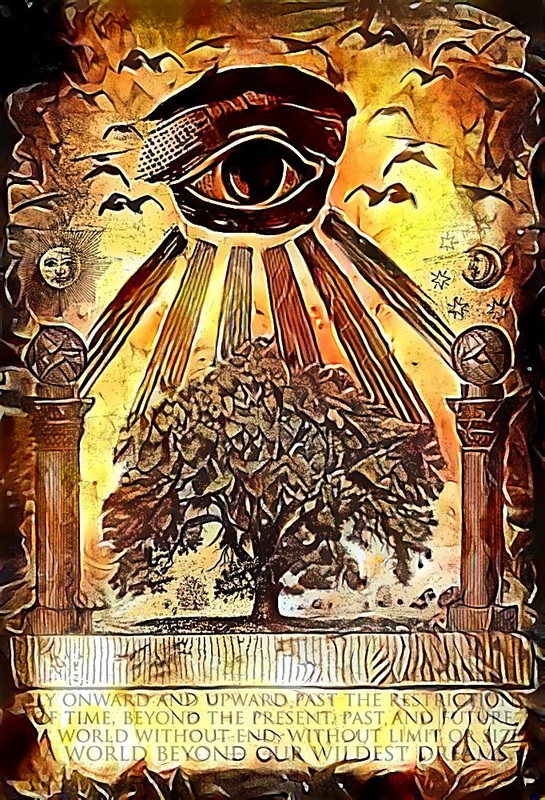
A
DREAM DREAMT THROUGHOUT THE WORLD
Psyche Is Matter
What
Jungians call the “Collective Unconscious” and physicists call “matter”
in alchemy were always one
– the Psyche. ~Marie-Louise von Franz.
The material event of
trauma presents a dissonance of belief, which the bodymind may not easily
absorb. In some individuals, this forces a temporal splitting between present
and past, in which (without appropriate treatment) the trauma event continues
to replay in an interminable present, notably in many Holocaust survivors. This
severing can be likened to a separation between body and mind dissociation. It
is necessary to recognise the time differences, their meanings and
somatisation. Therapy must therefore intervene to collate and elide time,
permitting integration of the bodymind.
http://www.tandfonline.com/doi/full/10.1080/17432979.2013.748976
The proverbial Holy
Grail is human curiosity and discovery. Human consciousness has taken
many forms, transcending primitive myth, spirituality, religion, philosophy,
and science. Today's genealogy combines elements of them all. The family tree
has mythic elements, it evokes and challenges our spiritual beliefs and faith,
the nature of existence and reality, and our rational materialistic view of
self, others, and cosmos.
Genealogy and working
the family tree for transgenerational integration can be particularly valuable
form of discovery for finding meaning in the second half of life. Like Jung's
method being true to who you are carries an innate healing function, especially
for uprooted lives divorced from nature. The entire phenomenon of life is
alchemy. The human lifecycle and the maturation of psychological stages is an
alchemical journey.
The tree creates a
sacred and ritual space -- a sacred container for our larger Being and the
process of re-connection. Jung defines unconscious in a way that can relate to
our experience of the Family Tree and ancestors:
Unconscious: "the sum
total of autonomous contents. Each of those contents has a consciousness in
itself."
Consciousness: "An
association of things with an ego center."
"Wherever there is
such a center, there is consciousness. Therefore what we call the unconscious
could be a form of consciousness." (Jung, Visions Seminar, Page
154.)
Longing for Belonging
Through this
consciously created act, we descend into the unconscious where we are no longer
separated or single. Can we assume that just as the unconscious affects us, the
increase in our consciousness affects the unconscious, as Jung suggests in his
essay 'On Life After Death'? The spiritual and healing practices of our
ancestors were designed to modify the collective consciousness and maintain
transgenerational laws.
Our tree is a
conscious representation of an approximation to totality -- the truth of our
nature. The living totality is represented by our embodied self as a living
riddle of nature. We are our own representation of the way we came into being.
While it isn't
possible to establish a conscious relationship with the archetypal natural
self, we can have one that extends toward the realm of the transcendent through
our family tree and reconciling the hidden pieces of our lives. We come to
terms with our lives when we realize what happened to our own, not just what we
may have believed.
The collective
unconscious is comprised of the psychic life of our ancestors right back to the
earliest beginnings. Our inheritance consists in physiological paths -- mental
processes in our ancestors that traced these paths. It matters because we
matter as the psychophysical expression of all those who came before us.
We continue to embody
them. Thus, the ancestors are personal, collective, and present. They are
available to our search for spiritual sustenance as well as family history. If
the collective unconscious is a summary of experiences
of our ancient ancestors, we all possess specifics of humankind's
knowledge from birth. As we realize it, it becomes conscious.
Symbols, images and
archetypes are the language of the soul, of the collective unconscious --
perceptions of supra-normal comprehension. Thus, we gain knowledge of, and
participate in, the domains of matter (senses), mind (reason; language), soul
(feeling; nonordinary states), and spirit (intuition; silence; gnosis).
Collective unconscious
influences every aspect of our life, especially the emotional ones. The
reflection of the collective unconscious in our family tree helps us
consciously see and study collective unconscious, its patterns and ways
of influence. Psyche
is a unity of three parts: ego, personal unconscious and collective
unconscious, a summary of experiences of our ancient ancestors.
Connectivity
The unconscious is the
Holy Grail of consciousness, the supreme value of life, which we find when we
truly realize ourselves, joining the family of the Grail. In the family tree we
find the presence of the most ancient symbolic appearance of the Grail itself
-- the illuminated heart. The soul takes flesh and descends...the hidden gate
through which all creation moves.
The youth does not know
what the Grail is, but he remarks that as they walk, he seems scarcely to move,
yet seems to travel far. Gurnemanz says that in this realm, time becomes space
(Wagner, "Zum Raum wird hier die Zeit").
Robert Johnson says,
“The object of life is not happiness, but to serve God or the Grail.” That is,
we serve not our materialistic questing ego, but our inner spirituality. Here
we integrate the mother, the father, and the inner masculine/feminine connection
to life that brings us to our personal Grail of spirituality. It may appear as
our personal spiritual quest, but, in fact, is a shared journey.
The ancestors, the
gods, and the Grail were always there in our Tree, which we bring to completion
when we finally bring ourselves to it, fully. Here, we serve ourselves, the
ancestors, and the gods as revealed in our own family tree. It is our own
matter that forms the elements of the Grail tradition, the present embodiment
of past times.
We can, in our genealogical
quest, do as Meister Eckhart suggests: “Start with yourself therefore and take
leave of yourself. If you do not depart from yourself, then wherever you take
refuge, you will find obstacles and unrest, wherever it may be.” He also said,
“We are all Mothers of God, for God is always needing to be born." We all
carry that spirit and seek the inner reality of the Grail behind the symbols
and stories.
Your heights are your own
mountain, which belongs to you and you alone.
There you are individual
and live your very own life.
If you live your own life,
you do not live the common life, which is always continuing and never-ending,
the life of history and the inalienable and ever-present burdens and products
of the human race.
There you live the
endlessness of being, but not the becoming.
Becoming belongs to the
heights and is full of torment.
~Carl Jung, The Red Book,
Page 267.
Relatedness
We depart from
ourselves following the paths of our descent back up into the heights and roots
of our Tree. Crossing that threshold we begin our Genealogical Journey. Our two
branches become four, the four branches become eight, the eight, sixteen
great-grandparents, and so on.
Jung left the
"Spirit of the Times" to enter the "Spirit of the Depths,"
where he met ancestors and spirits of the dead and resumed a dialogue with his
soul. He explains, "without relatedness individuation is hardly possible.
Relatedness begins with conversation mostly." (Letters Vol. II, Pages
609-610).
Go where we went and
you will know why.
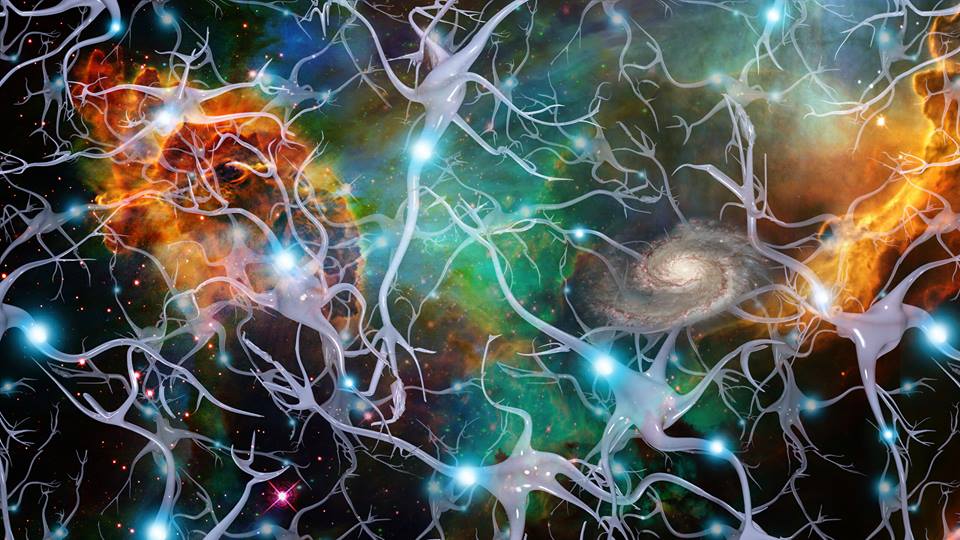
DEATH
BECOMES THE MUSE
Right Now Eternity is
Going On
“Our souls as well as our bodies are
composed of individual elements which were all already present in the ranks of
our ancestors. The "newness" in the individual psyche is an endlessly
varied recombination of age-old components. Body and soul therefore have an
intensely historical character and find no proper place in what is new, in
things that have just come into being. That is to say, our ancestral components
are only partly at home in such things.
We are very far
from having finished completely with the Middle Ages, classical antiquity, and
primitivity, as our modern psyches pretend. Nevertheless, we have plunged down
a cataract of progress which sweeps us on into the future with ever wilder
violence the farther it takes us from our roots. Once the past has been
breached, it is usually annihilated, and there is no stopping the forward
motion. But it is precisely the loss of connection with the past, our
uprootedness, which has given rise to the "discontents" of
civilization and to such a flurry and haste that we live more in the future and
its chimerical promises of a golden age than in the present, with which our
whole evolutionary background has not yet caught up. We rush impetuously into
novelty, driven by a mounting sense of insufficiency, dissatisfaction, and
restlessness.”
--Carl G. Jung -
Memories, Dreams, Reflections
They evidently live and
function in the deeper layers of the unconscious, especially in that
phylogenetic substratum which I have called the collective unconscious. This
localization explains a good deal of their strangeness: they bring into our
ephemeral consciousness an unknown psychic life belonging to a remote past. It
is the mind of our unknown ancestors, their way of thinking and feeling , their
way of experiencing life and the world, gods and men. The existence of these
archaic strata is presumably the source of man's belief in reincarnations and
in memories of "previous experiences". Just as the human body is a
museum, so to speak, of its phylogenetic history, so too is the psyche.
(Jung, CW vol. 9.I (1959), "Conscious,
Unconscious, and Individuation" (1939), ¶518 (pp. 286–287).
Jung
left the "Spirit of the Times" to enter the "Spirit of the
Depths," where he met Ancestors and Spirits of the Dead and resumed a
dialogue with his soul.
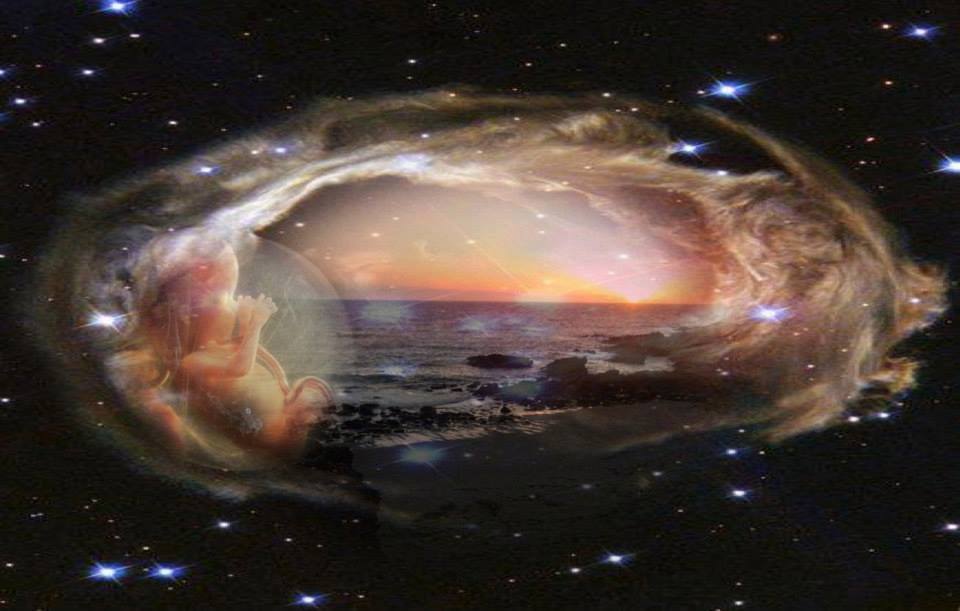
Born Star, Matthew Atkinson
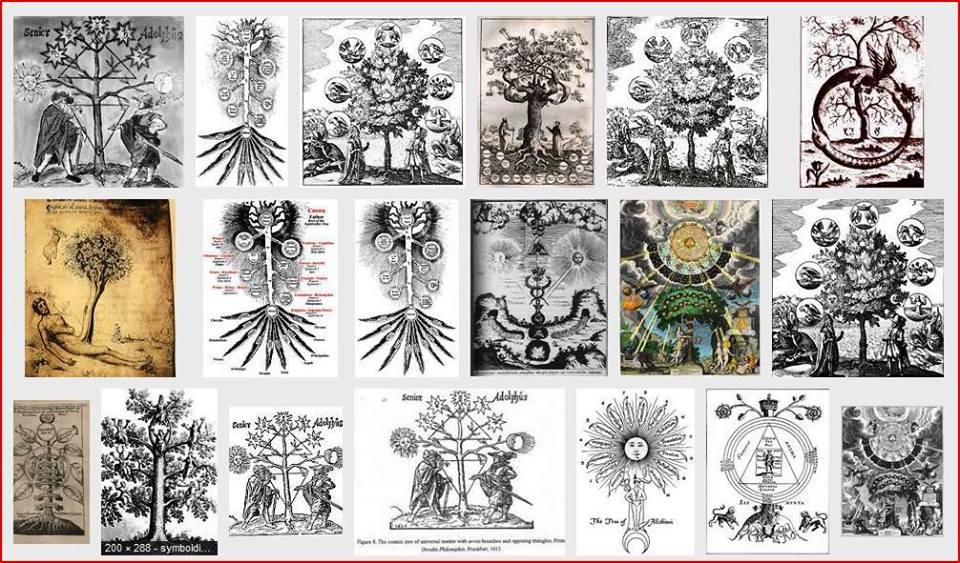
Assyrologist Simo Parpola calls the sacred tree a cosmological symbol of the Assyrians, dating from the second millennium BCE: “The crown of the tree is the god of heaven, Anu; its foundation is the god of the netherworld, Nergal; in between heaven and earth, connecting them, is the goddess of love, Ishtar,” and Ashera, the deposed mate of Yahweh.
The
Genius of Genealogy
The Past Remains
Present
DAIMONS
IN THE TREE
What images within us
can we trace to our seminal beginnings but also relate to the actual events of
the world? How are they connected? How does our individual and specific person
belong to the collective identity? What does it take to dedicate ourselves to
the service of the psyche, and how can we sustain such a challenge? Should we?
Interlocuteur
"If we
became aware of the ancestral lives in us, we might disintegrate. An ancestor
might take possession of us and ride us to death." ~Carl Jung,
1925 Seminar, Page 139
"[W]ithout relatedness
individuation is hardly possible. Relatedness begins with conversation mostly.
Therefore communication is indubitably important." --Jung,
Letters Vol. II, Pages 609-610
On this
basis the main body of the collective unconscious cannot be strictly said to be
psychological but psychical. ~Carl Jung, 1925 Seminar, Page 140
We think we shape
ourselves and try to act authentically. But our identity is malleable, and the
unconscious plays a big role in that. To adapt with integrity, to be true to
yourself, requires a clear sense of who you are, really, and it is still
context dependent. Individual human consciousness is formed in the dynamic
interrelation of self and other, and therefore is inherently intersubjective.
Deep memories guide
our attention and inform our behavior. We are not the authors of our own
narrative. Whatever enters our field of perception means something, large or
small. Everything speaks to us, and in doing so changes who we are. Perhaps it
is never more so than with our ancestors and daimon. Knowing our family tree
helps us dream and remember in truth.
Psychological
well-being is tied to a coherent sense of self identity, but is not its only
source. Genealogy is an intangible asset which lacks physical substance but
cannot be assessed or measured. Conscious and unconscious are two forces welded
and embodied into one configuration. The later is a persistent inner voice. In
the ancestral quest, 'the other' is no longer isolated but full of imaginative possibilities,
mutual interaction, and influence without domination.
One cannot exist
without the other. But this 'other' is not a parapsychological phenomena, nor a
proper subject for a seance, ghostly tidings, a devil, ancient alien, nor a
physical haunting, or any other supernatural literalism. But it is a dynamic
psychoid reality -- a force
majeure, also
known as cas
fortuit
(French) or casus
fortuitus
(Latin) "chance occurrence, unavoidable accident."
It personifies in a
variety of ways what the ancestors are 'dying to show you,' should you be
'dying to meet' them. Hence, we have so many idiomatic expressions that we are
'dying to hear, know, learn, or do,' -- 'dying to be me,' in which a radical
transformation is implicit, 'dying to self.' How many ways are we dying to
live, love, belong, to see, and to tell the story and to be heard? Or, 'dying
to quit', 'dying to leave,' or 'dying to be free' and 'dying to be remembered.'
Mirror, Mirror
"Just remember to
follow nature" are ancestral words of wisdom. As nature is the mirror of
the psyche, our family tree is the mirror of our own nature, the instinct to
reflect. The archaic, meaning more 'original' than 'ancient,' still lives in us
buried beneath the persona. Genealogy is a self-creating artform -- the silver
backing on our mirror of introspection and our connection with nature. The many
ancestors are reflected in the one [descendant].
A reflective
perspective "mediates events and makes differences between ourselves and
everything that happens. Between us and events, between the doer and the deed,
there is a reflective moment—and soul-making means differentiating this middle
ground."
James Hillman
continues, “...you find your genius by looking in the mirror of your life. Your
visible image shows your inner truth, so when you're estimating others, what
you see is what you get. It therefore becomes critically important to see
generously, or you will get only what you see; to see sharply, so that you
discern the mix of traits rather than a generalized lump; and to see deeply
into dark shadows, or else you will be deceived.”
As Jung says in CW8, "If we do not fashion for
ourselves a picture of the world, we do not see ourselves either, who are the
faithful reflections of that world. Only when mirrored in our picture of the
world can we see ourselves in the round. Only in our creative acts do we step
forth into the light and see ourselves whole and complete. Never shall we put
any face on the world other than our own, and we have to do this precisely in order
to find ourselves. For higher than science or art as an end in itself stands
man, the creator of his instruments." (Jung, "Analytical Psychology
and Weltanschauung" (1928). P.737)
Hillman
offers no recommendations; he doesn't try to fix things: "My suggestion is
that there's no way out of the human condition," he says. "Sex,
death, marriage, children, parents, illness. There's no way out. They're a
misery, all of them. You can spend 10 years in therapy and it will still be
sex, death, marriage . . . " http://www.nytimes.com/1995/04/23/magazine/how-the-soul-is-sold.html?pagewanted=all
We
can also apply what depth psychology says about this to our ancestral search. Sure, it's a challenge that sets a high bar, but really
just means bringing a certain sensibility and aesthetic to the disciple of
ancestral search itself. In this sense, we are 'dead serious' much as in art --
summoning deceased relatives back to consciousness with their wisdom, and
hunger, and sacrificial demands.
The Tenth Muse
The tenth muse is your
daimon -- the strange attractor of our depths -- helpful awareness through the
dark. We can call it a daemon, genius, or muse, guardian angel, death, nature,
or any conventional element for the abyss of the transcendent imagination,
which has infinite aspects. It is our true calling -- self-determination -- our
fate -- soul's intimate connection with death.
When death finds us,
it finds us alive. "The reality of the psyche is lived in the death of the
literal," according to Gaston Bachelard. The muse connects with the mythic
and can help or hinder the creative process. Death is a muse that inform us the
darkness of the depths is haunted with loving souls. The essence of soul is the
paradox of life/death, light/dark, male/female.
The muse supports
imaginal life from the yawning darkness of the psychological depths, the soul
of which is love itself -- eros/thanatos. The muse moves within us and the
story comes up and out, conjuring images, deepening awareness -- a dialogue
with nature.
Hillman strongly
suggests the daemonic is a taskmaster, "to do these things or say these
things or produce these things," he explains. "It's the slave driver.
You spend your life making it, then it tortures you: 'What are you doing now?
We want more. You didn't finish that.' " Charisma is a trait of genius and
psychopath.
Ultimately, though,
the symbol-using mortal body, aware because of its symbols of both the apparent
immortality of ideas and its own inevitable death, is not merely a system of
cognition, a cultural construct, or an operator of rules. It is a fragile,
embodied soul in need of understanding, and most in need just when it is asked
to enter into transactions of consequence with other souls.
http://trace.tennessee.edu/cgi/viewcontent.cgi?article=1059&context=jaepl
The
Man Who Fell to Birth
The magical creature,
duende or
tener duende
("having duende") loosely means having soul, a heightened state of
emotion, expression and authenticity. El duende is the spirit of evocation, from
inside as a physical/emotional response to art. It is what gives you chills,
makes you smile or cry as a bodily reaction to an artistic performance that is
particularly expressive.
Duende embodies at
least four elements: irrationality, earthiness, a heightened awareness of
death, and a dash of the diabolical. ...The duende is an alternative to style,
to mere virtuosity, to God-given grace and charm (what Spaniards call
"angel"), and to the classical, artistic norms dictated by the muse.
The artist must not surrender to the duende, but battle it skillfully.
Lorca
writes: "The duende, then, is a power, not a
work. It is a struggle, not a thought. I have heard an old maestro of the
guitar say, 'The duende is not in the throat; the duende climbs up inside you,
from the soles of the feet.' Meaning this: it is not a question of ability, but
of true, living style, of blood, of the most ancient culture, of spontaneous
creation.". He suggests, "everything that has black sounds in it, has
duende. [i.e. emotional 'darkness'] "The duende's arrival always means a
radical change in forms. It brings to old planes unknown feelings of freshness,
with the quality of something newly created, like a miracle, and it produces an
almost religious enthusiasm."
Hillman amplifies that
view. "[T]he
duende is the part that is connected to the earth, the blood, the party. It is
this that Rilke refers to in his line that our role in life is to be decisively
defeated by greater and greater beings. ...This is the struggle with the daimon
.... While our culture has no words for this, other cultures have referred to
it as "the ancestors" or "the spirits" that operate
invisibly in our world. ... "the invisibles." What we do when we
aren't aware of "the invisibles"? We buy insurance, and maybe even
make a little money out of the catastrophe, instead of asking "Why did
this happen now? What does is mean? What is my daimon's rag telling me?"" Hillman,
Meade http://www.menweb.org/chardest.htm
"The
"other" in us always seems alien and unacceptable; but if we let
ourselves be aggrieved the feeling sinks in, and we are the richer for this
little bit of self-knowledge." (Jung, "Psychological Aspects
of the Kore" (1941). In CW 9, P. 918)
"This process of
coming to terms with the Other in us is well worth while, because in this way
we get to know aspects of our nature which we would not allow anybody else to
show us and which we ourselves would never have admitted."
(Jung, Mysterium
Coniunctionis (1955) CW 14: P. 706)
More Character; More
Genius
In our genealogical
work we call up the voices of the deep. There is no authoritative voice,
only multiple readings. The ancient Greeks believed that our character or
genius was an autonomous daimon who oversaw our experiences with mortality --
our fate -- our personal yet transcendent god.
"Whoever speaks in primordial images
speaks with a thousand voices; he enthrals and overpowers, while at the same
time he lifts the idea he is seeking to express out of the occasional and the transitory
into the realm of the ever enduring. He transmutes our personal destiny into
the destiny of mankind, and evokes in us all those beneficent forces that ever
and anon have enabled humanity to find a refuge from every peril and to outlive
the longest night."
(Jung, "On the Relation of Analytical Psychology of Poetry" (1922).
In CW 15: The Spirit in Man, Art and Literature. P.129)
Every person has their
spirit or guardian angel that remains throughout life and into death. Hillman
notes, “Character forms a life regardless of how obscurely that life is lived
and how little light falls on it from the stars.”
“To the question, “Why
am I old?” the usual answer is, “Because I am becoming dead.” But the facts
show that I reveal more character as I age, not more death.” (Hillman)
Pliny called daimons
'the generating breath of the universe’ (XVI xxxix, 93). Plato called
daimons envoys and interpreters between heaven and earth. They are the medium
of the prophetic and esoteric arts, and mediators of the spirit world.
The daimon has a
specific interest in the outcome of our lives. It is a driving force or
spiritual energy leading to the creative formation of individuality. This is
where we find hope in an inevitably doomed existence...and perhaps taste our
immortality. It
is a formidable image that our family tree is not only our ancestors as
insubstantial shades, but a forest of thousands of daimons -- a forest of
symbols and meaning watching and waiting for us.
Beyond Control
Jung referred to the
daimon as something alien from the unconscious, an “archetype” or “numinous
imperative." This force is as real as hunger and the fear of death, making
demands of us and acting with authority. When we look for 'signs', we attend to
our daimon, but it can also hide things from us in our blind spots.
Daemons, linked by
Jung to anima/animus, are usually the opposite sex of their host. They share
our feelings, thoughts and experiences. The daemon is an extension of the human
but semi-independent, with praeternatural knowledge. When the human dies, the
daimon fades away becoming part of everything.
Under its influence we
can feel taken over. Intense and energetic feelings exceed normal human
limits. In its “grip,” the daimon makes us feel swept up or carried by a force
we don't understand. We seem possessed of an energy that transcends our
conscious drives, needs and desires. It provokes by creating predicaments to
solve and a sense of creative urgency.
Every person has their
"seed-self", "guiding force", or acorn of character from
birth. Our spirits grow from this seed that is our daimon. The inspirational
spirit guides us toward the fulfillment of our potential and shows us our
vulnerabilities and dream or imaginal life. The daimon holds the tension of
opposites between good and bad aspects, but provokes internal conflict that
leads to dialogue that promotes self-awareness. It is our voice of wisdom in
the solitude.
Laws of Inheritance
Talent can be a
childhood refuge from traumatic reality -- it takes us away from the awful
place in a sort of creative dissociation. It can develop a superpowerful
concentration and focus also seen in spiritual mystics. But it also exposes our
wounds. Fear disguises genius with depression and anxiety. Lack of opportunity
can be debilitating or degrading. Such genius needs recognition and nurturing
for survival. Dispirited
souls have lost their ‘daemons.’
All old trees had
their daimon, and the World Tree -- mankind's most magnificent legend -- is no
exception. The personified tree is the daimon at the same time because they are different
categories of existence -- secular and sacred.
When we are 'called',
we are called by our daimon, as Hillman notes: “Each life is formed by its
unique image, an image that is the essence of that life and calls it to a
destiny. As the force of fate, this image acts as a personal daimon, an
accompanying guide who remembers your calling." If we ignore that call we may wither
away or live half a life. The daimon helps us know ourselves. If we are fortunate
the daimon informs our life and death with some nobility and poetry.
In Soul's Code, Hillman remind us, “Fatalism
accounts for life as a whole. Whatever happens can be fit within the large
generality of individuation, or my journey, or growth. Fatalism comforts, for
it raises no questions. There's no need to examine just how events fit in.”
The tree articulates a
psychophysical reality -- the life of the cosmos. Mind is rooted in the
Unconscious much as a tree is rooted in the ground. Shaping
matter as well as mind, it retains its character through endless variations.
The psychoid is more
fundamental than matter and psyche and the basis of synchronicity. This vital
principle is an innate impulse that directs the behavior of an organism. The
daemon tells us what to keep and where to keep it.
As Hillman summarizes:
"The
daimon motivates. It protects. It invents and persists with stubborn fidelity.
It resists compromising reasonableness and often forces deviance and oddity
upon its keeper, especially when neglected or opposed. It offers comfort and
can pull you into its shell, but it cannot abide innocence. It can make the
body ill. It is out of step with time, finding all sorts of faults, gaps, and
knots in the flow of life - and it prefers them. It has affinities with myth,
since it is itself a mythical being and thinks in mythical patterns."
The Acorn Doesn't Fall
Far From the Tree
Meaning is essential
to tree phenomenology. Again, its character is the personal or family daimon.
The tree is the image
and mirror of our condition. It is an ancient idea that if a tree is planted at
our birth our fate is shared with it. Other families plant memorial trees
for the deceased.
This describes the character of the family tree and symbol of wholeness.
Hillman suggests it
goes beyond meaning: “It seems, as one becomes older, / That the past has
another pattern, and ceases to be a mere sequence,” wrote T. S. Eliot. Four Quartets, which meditates on time, age, and
memory, goes on to say, “We had the experience but missed the meaning, / And
approach to the meaning restores the experience / In a different form, beyond
any meaning.”
Developmental
Escalation
Hillman said the
genius reveals both fears and talents in very young children. They may have a
premature experience of the self [not-me] as an active factor in childhood
development -- accelerated psychic growth. Prodigies are naturally endowed with
exceptional abilities in youth.
The adult can remain
burdened by the child prodigy routine, including self-expectations and drive.
Drive can jump the tracks. The inner child fails to mature and may turn
self-destructive, as the recovery movement showed. Escaping reason and reality
can only be balanced by embracing the mystery in our unique way. If
spirituality becomes a physical experience: meditation, or a
drug/music-induced trip, doing psychogenealogy can restore spirituality as a
relationship.
Some children fear
identifying their genius for personal and social reasons. They don't want to
'pwn' it or feel or be perceived as different, even extraordinary. Hubris,
exhibitionism, and competitiveness push us ahead of ourselves. The creative
genius who peaks to early is a story trope. Some fight even harder to get their
grief out of the basement. Nothing is going to hit as hard as life.
In a dysplasia of
cognitive and affective development, cognitive stages outpace affective
development which is stalled (Gowan). This block (the gulf between innate and
actualized talents) is the cause of most absence of creativity in gifted adults
and sometimes lead to non-actualizing or self-destructive tendencies. M.-L. von
Franz said “the wounded healer IS the archetype of the Self [our wholeness, the
God within] and is at the bottom of all genuine healing procedures."
(Creativity & Giftedness)
But the pedigree
doesn't illustrate the argument as much as embody it -- the genius and the
wound are inherited and inherent. Certain wounds or deficits may come with
genius and require challenges to release the gift and its new perspective. The
wound lets in the energy that pushes or drags us to make us whole. Our symptoms
are aspects of the wound and our genius, and this notion conforms with applying
family therapies within the genealogical core generations. It frees the humane
individual for self-actualization.
Like
all archetypal symbols, the symbol of the tree has undergone a development of
meaning in the course of the centuries. It is far removed from the original
meaning of the shamanistic tree, even though certain basic features prove to be
unalterable. The psychoid form underlying any archetypal image retains its
character at all stages of development, though empirically it is capable of
endless variations. The outward form of the tree may change in the course of
time, but the richness and vitality of a symbol are expressed more in its
change of meaning.
(Jung,CW13
¶ 350)
This plant is an inner,
spiritual growth, the development of a tree of life and knowledge which played
a great role in alchemy....In general it is advisable to watch
these inner developments and not let them slip back into the unconscious, lest
they get stuck in the physiological sphere, or rather in the realm of the
[psychoid] unconscious which merges with the body, where they give rise to
pathological formations which a wise man carefully avoids. (Jung, Letters Vol. II, Pages
607-608)
The daimon is our
spiritual guide or self, and our character -- a divine mediating power that
impels our action and drives or mediates our destiny. Destiny is not something
over which we can gain control. We can only learn to dance with it. It is what
makes us unique in relation to the world. This inborn immortal factor embodies
our innate talents, inherent gifts, and positive or negative natural
tendencies.
Live to Tell
This supreme form of
soul is our constant companion and source of inspiration -- like the Latin
genii, our genius. This "genius" (from the
Latin genere) means to generate, to beget,
making the daimon the voice of the generative process in us. It can be a
personification of the transcendent function, experienced in dreams and in our
acts of doing and becoming.
The daimon is also our
suffering, emotional disorders, and more, but could also heal, and promote
health, happiness, resilience, perseverance, and harmony. The vitality of the
inner universe is mobilized in happiness, misery, regret. The daimon can inform
even a painful death with some poetry and grace.
Suffering can be
produced by painful states of mind such as hatred, envy, alienation,
scapegoating, cruelty, and loneliness. The daimon can also bring altruism,
empathy, compassion, concern, care, consolation, and pity. It brings
understanding of the beauty, compassion, and the foundation of wisdom. It is
the psychobiological transformations of epigenetics, changing our responses to
life experiences.
Regardless of the
nature of the genes we inherit from our parents, dynamic change at this level
allows us almost unlimited influence on our fate. Beyond "biology as
destiny" is “self-directed biological transformation,” but under the daimon,
not the ego. The disruptive and transformative reality of the individuation
process manifests the uncanny otherness of the unconscious.
The daimon of spirituality descends into our soul as the white
bird...the serpent is an earthly soul, half daimonic, a spirit, and akin to the
spirits of the dead.
--Jung, Red Book
Birds have an
ambiguous symbolic significance across cultures throughout human history,
universally relating to both life and death. Birds portend impending calamity
and death. They bear or steal spirits of the dead, sometimes even embodying
those very spirits themselves, and are also commonly associated with life,
fertility, and longevity. They symbolize our deep-seated ambivalence to
mortality -- the denial of death as finality through a desire for renewal,
transformation, and rebirth.
GENEALOGICAL DRAMA
CONTEMPLATING
EXISTENCE
Vision Tree
Our
souls as well as our bodies are composed of individual elements
which were all already
present in the ranks of our ancestors.
~Carl Jung, Memories
Dreams and Reflections, Page 235.
In
visions, on the one side we have the complex fact of the unconscious, but on
the other side we have the conscious. The impact of the two, the clash of the
two, brings about the fantasy. ~Carl Jung, The
Visions Seminar, Page 248.
What Jungians call the
“Collective Unconscious” and physicists call “matter” in alchemy were always
one – the Psyche.
~Marie Louise Von Franz.
Bonding Our Souls
When we enter our
family tree we give ourselves to something greater than we are in actively
contemplating [and memorializing] our existence. We were originally arboreal
creatures and the jungle remains within our unconscious.
The vast existential
drama of genealogy is only one of many ways to satisfy a deep-seated yearning
for truth, mystery, and the soul at the heart of the world -- the vital sense
of meaning surrounding love and death.
However, the Family
Tree is perhaps the most primordial way to connect with our roots. Our family
tree is our soul history. It deepens and refines our thinking. Here comes
death, ending our forever.
Our tree is not a
choice but a biological given of our existence -- the living mystery of life
and being -- the mystery of the eternity of life. Death is at the heart of the
sacred and knowledge of it loads life with meaning.
James Hillman
describes the nature of the soul in ways that support a therapeutic value in
genealogy: the soul (1) makes all meaning possible, (2) turns events into
experiences, (3) involves a deepening of experience, (4) is communicated in
love, and (5) has a special relation with death (1977, p. xvi, Hillman, 1976,
pp. 44-47).
The Tree of Souls is a
fundamental mytheme, a metaphor of organic cohesion. In Jewish mythology, the
Tree of Souls blossoms to produce new souls, which fall into the Treasury of
Souls. Gabriel takes out the first soul that comes into his hand. Then Lailah,
the Angel of Conception, watches over the embryo until it is born. The Tree of
Souls produces all the souls that have ever existed, or will ever exist.
The Tree is arguably
among the oldest shamanic practices and tropes, and therefore the foundation of
magic. The conjoint heartbeats of the ancestors is the core rhythm, the
drumbeat of time on the stretched canvas of flesh. The drum made from the World
Tree calls the helping spirits. That song is our prayer.
Rumi
tells us, "Your task is not to seek for love, but merely to seek and find
all the barriers within yourself that you have built against it." To be
satisfied in life we must combine inner and outer, the deep inner wisdom with
focused activity in the world. Tracing our own genealogy, climbing up and down
our Tree of Life, gives us potential for both.
Osiris is associated
with one of the earliest versions of the Tree of Life. Our uncharted tree is
like the dismembered Osiris, waiting for his limbs, the interlaced branches, to
be put back together as the sacred tree grows around him. In
the Mysteries an initiate discovered that their individual Daemon was actually
the Universal Daemon, which they imagined was torn into fragments and
distributed. Epictetus teaches: "You are a fragment torn from God. You
have a portion of him within you."
Osiris-Dionysus
represents this Universal Daemon, the Mind of God conscious in all living
things. The goddess Isis collects together all of Osiris' limbs and
reconstitutes him. In our genelaogical work, we may or may not collect all the
limbs try as we might.
There is a Merlin
tree, an Odin tree, and more trapped in or on a tree. They are all in the
traditional genealogies where the mythic descents enter history. Myth enters
our modern lives through the family tree. This is our inheritance.
"The Middle
Plane, between the Upper & Lower World , that the Celts call the “Thin
Place” is where the center of gravity shifts away from the Ego and its
functions into an interim position...to attending to the hints of the
self." (M.-L. von Franz, Psychotherapy). We live by extending our
sensibilities into the world and understanding it in that way, and the same is
true in the inner world.
History abhors a
vacuum and fills it with a multitude of stories, both factual and imaginal. One
secret of the tree is that we symbolically descend from gods, demigods,
supermen of antiquity, and a variety of legendary creatures, allegedly our kith
and kin. The god in the tree is immanent in the natural world and a source of
inspiration and illumination.
Norse lore describes a
spring at the root of the World Tree where water bubbles up from the
underworld, carrying the dissolved memories of the dead. Odin drank from it
once, costing him an eye. But, he was empowered to bestow inspiration on worthy
poets. What are we to make of such statements in the traditional context of our
descent?
Grasp Your Legacy
We must seek out our
family tree to learn its hidden secrets, find its dead ends, and recast the
contents of our personal and collective unconscious. Many stories run
invisibly, concurrently in our unconscious, especially unresolved family
issues. Like dreams, we can 'experience' our ancestors in their living,
embodied reality.
Jung noted in his own
process that, "The mystery showed me in images what I should afterward
live. I did not possess any of those boons that the mystery showed me, for I
still had to earn all of them." (Liber Novus, Page 254).
Your
genealogy project can bring the past to life in ways you could not have
imagined. In Jung's Red Book,
the dead complain they are real not symbols. "You may call us
symbols….But we are just as real as your fellow men. You invalidate nothing and
solve nothing by calling us symbols." (Red Book, 249) Also, "This
I learned in the Mysterium: to take seriously every unknown wanderer who
personally inhabits the inner world, since they are real because they are
effectual." (Red Book, 260)
Can a family tree give
meaning to your life? Only if you infuse it with intention, value, and love. We
invest in the message and are very involved and left with powerful residual
impact. We may take the divine steps back for our own souls with corresponding
results for our own well-being. But we may find in the process we become family
stewards, bards, genwriters, or storytellers.
Well of Souls
Genealogy is a means
of achieving empathy, of digging our own well of souls. Our undifferentiated
'well of souls' in the secret chambers of our hearts becomes more and more
specific. We detect the current below, realizing the presence of
something. The content is a resonance between the stimuli and the stored
and storied material in our psychobiology.
Voices of the Transcendent
'The many voices of
the psyche' is a transcendent ordering principle and aspirational or
integrative position that may have a healing, pluralistic or unified agenda --
different ways to understand one's life within the chaos/order paradox.
Both the regressive
and progressive perspective have their own type of wholeness, even if the
mytheme differs. As Jung notes, "We have no way of knowing whether the
world is Cosmos or Chaos, for, as we know the world, all the order is put into
it by ourselves." (1925 Seminar, Page 134)
Joseph Campbell said,
"What
is it we are questing for? It is the fulfillment of that which is potential in
each of us. Questing for it is not an ego trip; it is an adventure to bring
into fulfillment your gift to the world, which is yourself. There is nothing
you can do that's more important than being fulfilled. You become a sign, you
become a signal, transparent to transcendence; in this way you will find, live,
become a realization of your own personal myth."
Existential Drama
Genealogy as a mythic
image functions to connect the ego and the transcendent Other. Subjective
images are powerful because they can be experienced symbolically and unlock
ancestral mysteries.
We
enter the cave below the rock of reality to the reality of psychic
manifestations. "We are standing in between
two worlds, a visible tangible world, and the other invisible world, which
somehow has a peculiar quality of substantiality; but very subtle, a sort of
matter that is not obvious and is not visible, that penetrates bodies and
apparently exists outside of time and space.
"It is here and everywhere at the
same time, and yet nowhere because it has no extension; it is a complete
annihilation of space and time, which makes it a very different thing from our
conception of an obvious world." (Jung, Visions Seminars, Vol. 1 Page 206)
As Meister Eckhart
said, "When the soul wishes to experience something she throws an image of
the experience out before her and enters into her own Image."
We
go internal but come out with new information based on our experience. Personality
widens with unconscious supplementation. Resilience builds throughout life, and
close relationships are key.
"We are standing in between two
worlds, a visible tangible world, and the other invisible world, which somehow
has a peculiar quality of substantiality; but very subtle, a sort of matter
that is not obvious and is not visible, that penetrates bodies and apparently
exists outside of time and space.
It is here and everywhere
at the same time, and yet nowhere because it has no extension; it is a complete
annihilation of space and time, which makes it a very different thing from our
conception of an obvious world." (Jung, Visions Seminars, Vol. 1, Page 206)
We can reclaim this
most ancient genealogical practice and non-visible environment that allows us
to gaze at a thing without seeing it. With each generation we enter a new level
of interaction. Some branches of our tree clearly announce themselves as living
forces of myth, which shows the nature of our life journey. Figures of the gods
carry the idea of immortality, the image of immortality.
Enhancing our
self-awareness, genealogy makes alienation obsolete by retrieving lost
unconscious energy. What has haunted us now informs us, activated both by
initiating and responding to joint attention The mythic impulse is contained in
allegory and symbolism that are clearly not literal.
The subtle but
persistent feeling of being out of place diminishes. Instead of a single answer
there are many tacit replies. As a structured metaphor and technology,
genealogy amplifies or intensifies our faculties increasing the value and
quality of our inner life. Are you willing to enter the Tree?
Passing Through
Genealogy opens an
inner space, and can be an immersive experience, a virtual reality where we
suspend certain disbeliefs and entertain other hypotheses. Jung implies that
what is not material now is 'spiritual,' and we find those explicit spiritual
roots in our family tree. "Experience of the inner world has for its
object the phenomena of the psychic background, which in itself is so
indefinite or so multifaceted that it can be expressed in an infinite variety
of forms."
At the dawn of mankind
the Dragon constellation Draco was at the northern center of the heavens,
overhanging the stellar system of the zodiac and its vast Precession drama.
Jung tells us how family images spontaneously come back to us: "[The]
dragon comes into the category of the great
animals in the background who seem to regulate the world. Hence the mainly
theriomorphic symbols for the signs of the zodiac as dominants of the psychic
process.
"Naturally the
phenomena observed in the background are not always archetypes; they can also
be personal complexes which have acquired excessive importance. Father and
mother are not only personal entities but also have a suprapersonal meaning and
are frequently used as symbols for the deity.
In this way the religious
view of the world, thrown out at the front door, creeps in again by the back, albeit
in strangely altered form-so altered that nobody has yet noticed it." (Letters Vol. II, Pages
604-605)
As we enliven our tree
it enlivens our depths. Here the lands of the dead and the living
intersect. Here, in a dimension of existential and psychological truths that
underlie mythic process, we come to grips with perennial questions and mystery.
Perhaps the most important way of connecting with the ancestors is the act of
tracing the genesis oneself so that each part of the discovery process has a chance
to work in us and on us imaginally over time.
Time means a past and a
future, and so the individual is only complete when we add his actual structure
as the result of past events, and at the same time the actual structure taken
as the starting point of new tendencies. (Jung, 1925 Seminar, Page 137)
Jung
links "the discontent of civilization" with distancing ourselves from
our historical roots, and loss of connection with our past. He felt that
crucial connection fostered individuality which counteracts mass-mindedness.
Knowing
the historical family via the collective unconscious [and genealogy]
is
crucial to psychological health and self-knowledge, in Jung's theory.
“The less we
understand of what our fathers and forefathers sought,” he comments, “the less
we understand ourselves, and thus we help with all our might to rob the
individual of his roots and his guiding instincts, so that he becomes a
particle in the mass [...]” (Jung,
MDR).
It is in humanity’s
best interest, then, to reconnect to this past, as the “ancestral psyches”
within each of us can shed light on contemporary circumstances and situations
(Jung, MDR, p.237). It is equally important, however, not to become lost in
these past images, not to be “imprisoned in these memories” (MDR, p.320). http://jungiansociety.org/images/e-journal/Volume-8/Lu-2012.pdf
Representational
Demands
The
capacity for inner dialogue is a touchstone for outer objectivity.
~Carl Jung, CW 8, Para 187
The family tree is a
nexus of historical and underlying mythological narratives which give birth to
additional interconnecting narratives. Science offers some alternatives to
supernatural appearances in dialogic inner speech. The brain's conversations
with itself can now be mapped, but may be more than that.
Just because some
people experience pathological auditory hallucinations doesn't mean all
audialization is pathological.
We naturally can form
a mental concept of a sound impression without 'external' agency. Some people
can imagine whole symphonies. Information is made more comprehensible by
perspective switching and rendering it as sound.
Trans-Sensual Imagery
Findings show
that forms of inner speech
exist which can be both phenomenologically and neurologically distinguished
from the silent commentary of a single inner voice. Contributions of inner
speech and forms of mental imagery create vivid inner dialogues. Even Genesis
describes a creation of spoken words rather than acts. http://scan.oxfordjournals.org/content/11/1/110.full
"Inner speech has been
implicated in important aspects of normal and atypical cognition, including the
development of auditory hallucinations. neural activation for inner speech
involves conversations (‘dialogic inner speech’) with single-speaker scenarios
(‘monologic inner speech’). Generation of dialogic (compared with monologic)
scenarios was associated with a widespread bilateral network including left and
right superior temporal gyri, precuneus, posterior cingulate and left inferior
and medial frontal gyri. Activation associated with cognitive and dialogic
scenarios overlapped in areas of right posterior temporal cortex previously
linked to mental state representation."
"Inner speech is a complex and varied
phenomenon. In behavioral studies, everyday inner speech is often reported to
be involved in self-awareness, past and future thinking and emotional
reflection, while in cognitive research, inner speech appears to fulfill a
variety of mnemonic and regulatory functions. Inner speech may reflect the
endpoint of a developmental process in which social dialogues, mediated by
language, are internalized as verbal thought. Following from this view, the
subjective experience of inner speech will mirror the external experience of
communication and often have a dialogic structure, involving the
co-articulation of differing perspectives on reality and, in some cases,
representation of others’ voices."
Time alters us and our
perceptions. Many experience the bittersweet feeling of arriving in the future
without being able to tell our past self how things turned out among the
hypothetical conversations that play out in our heads. Perhaps all our
ancestors are 'talking' but nobody is listening. And even if we do, we may be
frustrated others are unable to relate to the experience.
Family Plots
On the other hand, the
plot of our life, flaws, and anxieties may begin to make more sense with our
relational roots. Awareness of our perspective enlarges, personally and
historically. We realize each ancestor has a life as vivid and complex as our
own, and that it takes a long time to forge a deep relationship.
Family Battlecry
Genealogy is a feeling
and a challenge, a lost art of ancestors returning with a vengeance. The
mottoes on heraldic arms are actually battlecries. Just as the Scots shouted
their clan genealogies before battle, our family tree is a declaration of our
intention to 'continue to be' and to continue in our traditional ways
venerating our forebears. They recited their clan genealogies in Gaelic,
shouted their war cries, then attacked.
Clans are family
groups and their sept branches are all blood relatives. Highland families had a
traditional seannachaidh, who could recite the descent of
that particular family and state its relationship to other families in the
larger clan.
Consanguinity
For 2000 years in
Alba, the Senchai, Seannachaidh, or Sennachie [sen-uh-kee]
have
woven the clan's present members with the history, honor, deeds and lineage of
those who have gone before them. These loyal and respected clansmen are
appointed by the clan chief as professional storytellers of family genealogy,
history, and legend.
Both a Pict and Gael
tradition, this ancient position is a Genealogist, Historian, Bard, Orator, and
tribal Herald.
The
office of Ri-seannachie
had supreme jurisdiction in matters of genealogy, and the duty of preserving
the Royal pedigree. Each clan had its own Druid priests and judges under the
chief Druid of the Pictish High King.
Disembodied
Information
In the 'Cult of the
Severed Head' in Provance, a head carved in stone was the repository of the
soul and could live on and continue to speak to the living and make prophecies.
Such heads represented a medium for communication with the Other World, hinting
at an older Celtic mythos and tradition -- cult of relics, cult of the head.
Bran's severed head
continued to speak to his followers who returned it to Britain. King Arthur dug
up the head, declaring the country would be protected only by his great
strength. Brân the Blessed was like the Arthurian Fisher King, the keeper
of the Holy Grail. He has a mortal wound in the leg (Brân's wound was in his
foot) but stays alive in his mystical castle due to the effects of the Grail,
waiting to be healed by Percival. In the Welsh version of Perceval, Peredur son
of Efrawg visits a mysterious castle, but finds only a severed human head, not
the Grail. Some said the Grail had the power to restore the fallen, like Brân's
cauldron.
In Norse myth, Mímir
(Old Norse, "The rememberer, the wise one") is renowned for his
knowledge and wisdom but is beheaded during the Æsir-Vanir War. Odin
embalms the head of Mímir with herbs so that it would not rot, and spoke charms
over it, which gave it the power to speak to him and reveal secrets to him. He
keeps Mímir's head with him because it divulges information from other worlds.
It recites secret knowledge and counsel to him.
But cults of Southern
France may not correlate with those of Britain or the Neolithic era and
elsewhere as a coherent practice. Skull relics are still worshiped there with
candles. The medieval town Saint-Maximin-la-Sainte-Baume has a basilica and
crypt dedicated to Mary Magdalene said to contain the blackened relic of her
skull.
Neolithic Jericho
practiced burial of loved ones under their houses. Sometimes the severed head
was removed and the skull buried after defleshing. Faces were reconstructed
with plaster to retain the identity of the family member. Individual facial
features were made with red and black paint. Some eye orbits were inlaid with
shells and the skulls were decorated with hair and mustaches.
The notion of a 'cult
of the head' remains controversial, but it is a fact we imagine it was so. This
powerful trope brings to mind cults of martyred saints who carry their
immortalized heads. The Templars allegedly worshiped of the severed head of
John the Baptist they called Baphomet, who talked to them and possessed “divine
wisdom." Personifications of disembodied metaphysical entities are an
ancient equivalent of media 'talking heads' as culture leaders.
Soul-Talk
What we can take from
this practice is the primacy of the psyche for personification of the
unconscious -- the multiple personifications or perspectives of psyche. We
spontaneously personify psyche all the time, without effort since it is a
psychological necessity. Personifying allows the image to work on us -- a
potential way of knowing what is hidden in the heart. A grounded ego uses
personification for growth.
To personify something
from the unconscious is to treat it like a person with a sort of inherent
autonomy motivated by purposes and intentions. We even lend it a voice and bond
with it. Personifying in archetypal psychology is “the spontaneous experiencing,
envisioning and speaking of the configurations of existence as psychic
presences.” (Re-Visioning, 12)
Personifying is a way
of making subjective experience, passionate identification, and indwelling
images more tangible through conversation and relationship in symbolic form.
Hillman (1975) called it "an epistemology of the heart, a thought-mode of
feeling." It imagines what's inside, outside, and
makes this content alive, personal, and even divine.
We personify that
which we love. This is the natural expression of mythic consciousness to mythic
consciousness. Illustrious ancestors aren't just
statues of greatness. Through this spontaneous activity of psyche
we enter myth "as if" it were real.
Such non-directive
thinking or "soul-talk" is the key to understanding archetypes as
both guides and different parts of ourselves. “Loving is a way of knowing, and
for loving to know, it must personify. Personifying is thus a way of knowing,
especially knowing what is invisible, hidden in the heart,” Hillman
says in Re-Visioning.
"Personifying is a way of being in the world and
experiencing the world as a psychological field, where persons are given with
events, so that events are experiences that touch us, move us, appeal to
us." "...all the figures and feelings of the psyche are wholly
'mine,' while at the same time recognizing that these figures and feelings are
free of my control and identity, not 'mine' at all." (Hillman)
"By
means of personifications my sense of person becomes more vivid for I carry
with me at all times the protection of my daimones: the images of dead people
who mattered to me, of ancestral figures of my stock, cultural and historical
persons of renown and people of fable who provide exemplary images--a wealth of
guardians. They guard my fate, guide it, probably are it. "Perhaps--who
knows," writes Jung, "these eternal images are what men mean by
fate." We need this help, for who can carry his fate alone?" (Hillman)
Hillman notes that
personifying is a creative function. Whether it is done pathologically or
intentionally, it functions to “save the diversity and autonomy of the psyche
from domination by any single power, whether this domination be by a figure of
archetypal awe in one’s surroundings or by one’s own egomania. ‘ (Re-Visioning,
32)
In the family tree we
don't require the physical relic to honor the deceased, including the heads of
the household. "To keep the light alive in the darkness, that's the point,
and only there your candle makes sense." (Jung, Letters Vol. II, Pp.
133-138)
Jung
stated, "It was as if my tools were activated
by my libido. But there must be tools there to be activated, that is, animated
images, images with libido in them; then the additional libido that one
supplies brings them up to the surface.
If I had not given this
additional libido with which to bring them to the surface, the activity would
have gone on just the same, but would have sucked my energy down into the
unconscious. By putting libido into it, one can
increase the speaking power of the unconscious."
(Jung, 1925 Seminar, Lecture 5, Pages 37-45).
The
Big Tree
Doing one's own
genealogy, even if it has been done before, is the best way to integrate and
digest it. The ancestors do not
really live today but are not fully dead either as living images. We can ensoul
our growing branches best in the context in which they arise.
Relying on the work of
others removes us a step from the core of the process; it might stimulate
imagery, but it's more like reading about a journey than making it oneself. Much
of the nuance and functional relations are lost -- the chaos, the struggle, the
blind alleys. The healing work requires direct engagement for familiarity with
the holistic image as well as the details of each family encountered.
Arguably, the family
tree is the necessary foundation to psychological integration. We begin a long,
slow circulation among the many branches of our tree. Jung says, "The
circulation is not merely movement in a circle, but means on the one hand the
marking off of the sacred precinct, and on the other, the fixation and
concentration." (CW 13, Alchemical Studies, Pg 25).
The circulation of
blood in the arteries mirrors the circulation of sap in the tree, and the
circularity of cosmological or metaphysical thought -- analogical thinking that
links the macrocosm and microcosm, above and below. The ancestral field has an
immediate effect, both healing and challenging, on our whole lives.
Ouroboric Cycle
Repeating the circuit
of all aspects of our being generates a transpersonal current that unites
conflicting opposites. We repeat the distillation process, again and again, but
always on another level -- a new and deeper level of understanding. Cycles of
rising and falling echo the ascent and descent in our ancestral lines. This
is no disembodied Ascensionism, but a fully embodied, fully grounded soul
retrieval, without recourse to 'metaphysical certainties'.
We continually return
with a cyclic pattern to our own beginning. This adventure never ends. We are
each our own paths. Genealogy is a sacred narrative of origins that forever
marks our place in time with a true quest for the fountain of life and
retrieval of lost parts of the soul. Jung adds, "So when you relieve the
unconscious of non-realized contents, you release it for its own special
functioning, and it will go ahead like an animal." (1925 Seminar, Page
115)
Ancient shamanic
stories describe a previous World Age in which a colossal tree dominated the
celestial landscape, joining heaven to earth. This master-narrative is the
origin of the World Tree, and the Family Tree. The sacred tree is the navel of
the world, always potentially present everywhere.
Shamans journeyed
through visions, climbing the World Tree, much like we climb through the
branches of our family tree, tracing and retracing them. Jung's
collective unconscious overlaps with shamanic experience of nonordinary
reality.
They descended the
trees roots to the land of the dead to retrieve the souls of the living who
strayed there. They journeyed in vision to the upper world to consult with
spiritual ancestors, for healing or wisdom. A mythic boon emerges from
interaction with the archetypal tree where the physical and the sacred are
united.
In this sense the
family tree is a redemptive tree linking us back to source. In the Neolithic
and Bronze ages the world tree was the world axis, a nexus where pairs of
opposites come together. Originally, the tree was a universal whole: male and
female, dark and light, knowledge and mystery, etc.
The Biblical version
dissociates or deconstructs this unity. Eve eats the fruit and humanity was
separated into dualities, male and female, good and evil. Humanity was thrown
into time and space, aware of imminent mortality. The Precession functions as
the great cosmic timekeeper, marking off the Ages.
That tree fails to
unite heaven, earth, and underworld. The temporal end remains unfulfilled
unless the disparity of the tree can be transcended in some manner in this
particular mythos.
Only the universal
archetype, the World Tree unites the
world of temporal matter, death, and the paradise myth regained after the
completion of life's journey. Not just a diagram, the spirit of the family tree
is a reconciling and redemptive symbol linking us to the origin, but we have to
pluck its fruit -- the links and loops of kinship.
Tree of Visions
The World Tree is an
integral part of the shamanic cosmos and links the world of humanity with the
world of the spirits. Spirits pass from one world to another on the Tree. There
are Siberian stories of climbing the World Tree to attend a school for shamans
run in heaven by the ancestors. Without living links to the spirit world, there
is no longer a Tree.
Only mythic
dissociation -- the split of sensibility of body and spirit, female and male --
separates the Tree of knowledge from the Tree of immortal life. The body and
psyche both derive from the ancestors. In the unus mundus, they are one integrated tree --
the creative source of becoming. We unite them when we resume a dialogue with
our souls. We recognize truths in the mysteries of myth.
This Tree of Life or
mother-tree has its roots in heaven and its branches growing downward through
genealogical descent, bringing life-giving function to the possibilities of
life. It is an icon of the unus
mundus, an
underlying unified reality from which everything emerges and to which
everything returns.
Branch Out
The family tree is a
system of interactive complexity and emergence. We grow its branches, and
sometimes merge with lines compiled by others. Our own tree is a canopy of
growth that connects us all the way to the stars and our aspirations while
grounding us in our roots.
Our family tree
branches out each time we deviate from our direct Y-DNA or mtDNA lines of our
father and mother. New family branches potentially enter the tree with each
ancestral wife and her lineage, which in many cases is longer than that of the
husband. Some royal descents come through the mothers; there is a legend that
claims all the 'magic' in the family lines is through the distaff side.
Women are often the
hidden half of the family because of old social and legal customs. Often we
don't know and cannot find their maiden names, so they become dead ends in our
search, until or unless new data is found.
Yet wives and natural
partners form vital links in our chains of ascent back to well-known ancestors,
even if little or nothing is known of them, beyond a name, or N.N. (invisible
women). Elusive women can sometimes be found through naming patterns or in a
census search, especially if there is a photo of the listing and its additional
notations.
Other invisibles
include missing fathers, and natural children. The phrase “natural son” in a
will meant the testator acknowledged a child had been born out of wedlock. The
only legal meaning in that context back then was “a bastard; a child born out
of lawful wedlock.”
Finding a maiden
name is almost always essential to further research on a particular line.
Naturally, the best place to locate a maiden name is on a marriage record. If
that is not available, other vital records may have the information, although
this is usually the case only with more modern records, not those over 100
years old. These include birth certificates of her children, her death
certificate, her husband's death certificate, or the marriage or death
certificates of her children. This is by no means standard and is only a
possibility. Baptismal records may also contain the mother's maiden name, even
in older church records.Another possible source is her obituary, which might
mention surviving brothers. Also look for obituaries of sisters or men you
believe are her brothers. If you have found a person that you think might be
one of her parents, it is worthwhile to check the death certificates because a
family member, perhaps your ancestress, usually provided the information on the
death certificate and sometimes her relationship was given. Also look for wills
from likely candidates -- a woman may be mentioned in her father's or mother's
will.
Without direct
information, you sometimes have to resort to indirect clues. Look for the
repetition of certain given names in the family. If she named her son Hezekiah,
Rudyard or some other uncommon name and there was an older man of that same
name in the vicinity, that may be her father. Look also for surnames being used
as second names for her children. A woman often gave her child her own maiden
name as a middle name. In the census, look for older people living in the same
household or nearby. They may well be the woman's parents. http://www.genealogy.com/articles/research/50_donna.html
Searching
for Female Ancestors
https://www.loc.gov/rr/genealogy/bib_guid/female.pdf
Dead
Reckoning
Our family tree is our
map of the undifferentiated unconscious -- maps of relationships in the Land of
the Dead, the co-existent underworld of shades. In the beginning, it is like
drawing a map of the world on a sheet of paper with as little concept of our
ancestors as the unknown seas and continents where they lived. New maps help us
navigate the terrain.
Over and over, we plot
our course through the maternal and paternal lines of ascent that predispose
our responses. The scintillae are soul-sparks of partial or emergent
consciousness. Insight in the ancestral field stirs the imagination. What we
don't deal with remains buried. The dormant, lifeless, and withered awaken,
expanding consciousness and renewing psyche, from deadness to life-force
energy.
Jung
called these "scintilla, or soul sparks, the innermost divine essence of
man…symbols which express a God image, namely the image of Deity unfolding in
the world, in nature, and in man." (Jung, Archetypes of the Unconscious
pp.389)
At least symbolically,
God climbs down to mortality. Some tribes deified their ancestors. And these
divine archetypes -- gods and goddesses -- are just what we find at the far
reaches of our royal and legendary genealogical lines. Our mortal descent is a
fractal reiteration of their divine essence, our own images and conflicts. Jung
named this quintessence the Self, bridging from the physical and instinctual to
the spiritually transcendent psyche.
Scintillae or sparks
of light in the dark emerge through consistent interaction, our persistent
interest, and curiosity. Metaphorically,
we love them back to life. These points of light, iridescent eyes, mimic the
starry heavens or reflective surface of the sea with spontaneous amplification.
Representing the
multiple consciousness of the psyche, they connect us with the animated soul of
the world. As we focus, their virtual presence, numinosity and luminosity draws
us toward pervasive meaning. The noumen is healing. Philosophers say that solar
consciousness must inseminate lunar unconscious. This act gives birth to a
third aspect of consciousness in our being, the luminous subjective self as the
inner divine child.
Our 'dead reckoning'
navigation means charting a new course of relationship and conscious attachment
through successive immersions. Native Americans say we are affected by the
seven generations that came before us and affect the seven generations to
follow. We may actually include all our emotionally-charged generations -- the
redeemed and unredeemed Trees.
Milky Way; Mother's
Milk
Once we embark on our
mission, we find that like the heavenly constellations, we have family
constellations to guide us toward innate healing. Hidden dynamics in a family
can be worked with and healed through a process that has the power to shift
generations of suffering and unhappiness. Our most pressing challenges are
reflected in those of our ancestors and the genetic relationships and patterns
among them.
This relatively brief
therapy helps us develop intuition and insight while exhuming hidden solutions
that restore the flow of love. As Rumi suggested, "Love is the bridge between you
and everything." We conceive a new perspective and circumambulate a
variety of associative and interpretive treatments, clearing the emotional body
with the balm of tears.
Over and over we ask
what does this feel like? How does it continue to feel, or how do the feelings
change and amplify over time, and what is it asking of you? Redemption of the psychophysical
body lies in this direction -- redeeming spirit and soul, conscience and
consciousness. To
do so, we have to metaphorically dig up graveyards and excavate cities.
The unconscious
belongs to no time in particular, being seemingly eternal. We consciously
realized that as a peculiar feeling of timelessness. The "time" in
which the ancestors lived and still live is a "time when there was no
time," -- an ancestral world of thought-forms, beyond which is the sense
of indefiniteness, timelessness, oneness.
Inherited Issues
We gain a unique
perspective to make new choices or follow unforeseen pathways. Emotional
resolution of systemic entanglement can help overcome patterns of behavior
repeated in related families for generations, by bringing up the family images
held in the unconscious mind. Such work on where we are stuck or feel pain is built
around inclusion: the reconciliation among all parts of the self, our family, and our history.
In time, the stream of
ancestors comes forward in a flood of imagery -- prevailing, enduring,
haunting, mapping out hidden truths. We cannot escape the spirit of the depths
who forces us toward the mysteries. Jung described not only 'possession' by the
ego, shadow and anima/animus but by the transgenerational family history.
"If we became
aware of the ancestral lives in us, we might disintegrate. An ancestor might
take possession of us and ride us to death." (1925 Seminar, Page 139).
We can only find our
right way with an eye fixed on the far horizon. Perhaps such 'dead reckoning'
-- our own confrontation with the unconscious -- helps us navigate our
imaginative journey. We calculate our current position from a previously
unconscious position, to fix, and advance that position to the far horizons.
Our attention flows toward an unforeseen destiny where meaning beckons beyond
the bounds of consciousness.
Jung describes the
horizon as a whole as the quaternity (four quarters of heaven)..."There
are always four elements, four prime qualities, four colors, four castes, four
ways of spiritual development, etc. So, too, there are four aspects of psychological
orientation...The ideal of completeness is the circle or sphere, but its
natural minimal division is a quaternity." (Psychology and Religion: West
and East,)
Natural Order
We have unconsciously
sacrificed our ancestors and disheartened ourselves. We've set them adrift in
the unconscious without mooring to the living. Over time we integrate this
imaginal world as we trace our family tree through the islands and continents
of the unconscious. This reality is mediated by information patterns which in
turn are constantly evolving.
The tree is the record
of the multigenerational courses from the known starting point, and the known
or estimated 'drift.' Along
the way we find many lines -- grand dynasties that have gone extinct,
“beginnings without continuations.” But, somehow, despite all odds our
own line has passed through or culminated in ourselves and our own 'pioneering'
work.
Digging for Ancestors
Paraphrasing Jung, we
stumble through unknown regions, are lead astray by analogies, forever losing
the Ariadne thread. We are overwhelmed by new impressions and new
possibilities, and the worst disadvantage of all is that the pioneer only knows
afterwards what he or she should have known before.
When we encounter the
second and subsequent generations we may have the advantage of a clearer, if
still incomplete, picture. Certain landmarks on the frontiers of the essential
have grown familiar. We now know what must be known if we are to explore the
newly discovered territory.
Does our attention
'condition' the ancestral field? We learn to spot the most distant connections.
We can unravel problems and give a coherent account of the whole field of
ancestors, whose full extent we can only survey and 'know' at the end of our
life’s work.
Thin Red Line
The ancestral map is a
beginning, a framework in which later discoveries can be placed. What is
confusing at first is clarified in a later stage of the journey. The family
tree helps us establish a connection between the natural and sacred figures and
our own psyche. Or, as von Franz notes, "Only if you look from afar,
from a certain objective distance, do you realize that there is a pattern of
wholeness in it."
(Interpretation
of Fairy Tales,
Pages 6-7)
Family Dynamics
This special
perspective or psychic viewpoint is a revelation of the soul, nothing short of
the Holy Grail, whether as myth, bloodline, relic, or spiritual quest. We
acquire depth in our attempts to heal ourselves. In 1949, Jung said, "Ultimate
truth, if there be such a thing, demands the concert of many voices."
Family dynamics appear
in individual therapy as well as in engagement with the family tree. They
include repetitive patterns of
interactions and significant events in the family history. Some suggest unconscious loyalties to previous
generations leads to synchronistic repetition and unwitting reenactments of
ancestral events and dates. The group functions ritualistically. Plurality
becomes mimetic flow not just dissociative rupture. Intergenerational family
identity is positively related to well-being.
Genealogy
Gives & Genealogy Takes Away
We may find that our
research uncovers more than we could ever imagine. We may break through
persistent research blocks after years of trying, yet we may also be faced with
grave errors in our charts we must correct, discarding certain figures from our
droplines we may have warmly embraced. We come to crossroads where we must
choose by instinct to merge or not to merge. Eminent lines may be cut
unceremoniously or replaced by others we must now integrate.
Thus, the genealogical
environment remains somewhat fluid. In some sense, "not knowing" can
be as important as knowing. Some people might tentatively add ancestors to a
line, realizing there is little or no documented evidence, but they know where the
'potholes' in their tree are.
Professional genealogy
sites are constantly correcting errors and updating. On
public trees, incorrect entries are repeatedly re-added, as people repeat the
mistakes of others they find, over and over. Paths to the illustrious can
evaporate over night. Adopting the wrong wife for an unknown can create an
entirely fictional line of her relatives, but not our own. Another common error
is making a sister or cousin of the same name into a spouse.
Thus, we may have a
felt-sense of 'losing' ancestors or lines of descent we never actually 'had.' Everyone makes mistakes in
genealogy, so it is part of the practice. Joys, sorrows, and confusions go with
that territory.
The family tree
operates as an alembic, a sacred vessel or temple of transparent walls that
contains our pain, suffering, and confusion without judgment or analysis.
Instead it offers us a rich array of stories. We can act out, play with,
identify with and allow ourselves to be carried away by these ancestral stories
– within a contained, ritual setting.
All of shamanism comes
from one root -- the unseen world of gods, demons, and ancestral spirits,
responsive only to shamans. The ancestors and the pathos of their epic restore
our soul. "The sin to be repented, of course, is unconsciousness."
(Jung, Aion, Pp. 191-192.) We construct a unique history of the evolution of
our own consciousness with the bodies of our ancestors and the body of myths as
the phenomenology of this same evolution.
Our Tree returns us to
the lived experience of events, imaginal connections, and metaphorical reality.
Primarily through afflictions, symptoms, and phenomenology, imaginal mythology
seeks the movement of the soul to a fuller awareness of itself. We return to
the origins, through memory, of our life story that goes beyond simple
succession and co-existence. In our narrative arc, we may lie even to ourselves
to reveal a more profound truth.
Without
hypostatizing the idea to some otherworldly plane, Jung suggested our
primordial behavior is informed by archetypal images. This is the difference
between a psychological and a metaphysical, "spiritual," or religious
approach and worldview.
Jung implied
"Sooner or later all the dead become what we also are," but that we
know little or nothing about that mode of being, and "what shall we still
know of this earth after death?" Still, he felt, "The dissolution of
our time-bound form in eternity brings no loss of meaning."
Reification,
concretism, or hypostatization is the fallacy of ambiguity or misplaced
concreteness. Abstraction (abstract belief, metaphysical or hypothetical
construct) is treated as if it were a concrete, real event, or physical entity.
The issues of reification are usually philosophical or ideological. This is the
error of treating something which is not concrete, such as an idea, as a
concrete thing. Reification confuses a model with reality: "the map is not
the territory." Reification can also be an "as if" figure of
speech, and actually understood as such, rather than literalized.
Even a genuine and
original inner life has a tendency to succumb again and again to the sensualism
and rationalism of consciousness, i.e., to literal-mindedness.
The result is that one
tries to repeat a spontaneous, irrational event by a deliberate, imitative
arrangement of the analogous circumstances which had apparently led to the
original event.
The immense hope,
the liberating ekstasis of the primordial experience, soon turns into the
pertinacity of an intellectual pursuit which tries, through the application of
a method, to attain the effect of the primordial experience, namely, a kind of
spiritual transformation.
The depth and
intensity of the original emotion become a passionate longing, an enduring
effort that may last for hundreds of years, to restore the original situation.
Curiously enough, one
does not realize that this was a state of spontaneous, natural emotion or
ekstasis, and thus the complete opposite of a methodically construed imitation. (Jung, Letters Vol. II, Pages
600-603)
Jung saw consciousness
as "essentially the psyche's organ of perception, it is the eye and ear of
the psyche." Even the scientific view is still infused with unconscious
myths and symbols, as "all that comes into our heads proceeds from the
unconscious." (ETH Lecture II, April 27, 1934, pg. 98). Jung identified
'Psyche' as the unknown that we simply name 'Psyche,' therefore ambiguity has
to be enough for us.
We can't concretize
our ancestors into mythical metaphors, metaphysical statements or entities, etiologies,
causal explanations, cookie-cutter archetypes, or name tags. But we can free
them of unconscious 'dead weight' that affects our lives profoundly.
Peronified ancestors
speak through the masks of image and symbol. Our felt experiences of them are real
events but they are perspectives toward events which shift our attitudes
and experience of events."The unconscious can move in every possible direction,
even in time it can go forward and backward, because it knows no space."
(Jung, Visions
Seminar, Vol. I.)
We
also discover ourselves as imaginal beings through rich intuitive resonances,
metaphor, and personification, without over-identification with our subject
ancestors, without insisting the subjective must be objective, without egoic,
foolish, idiosyncratic, or superstitious interpretations. The irrepresentable
has an immediate, subjective power of conviction because it demonstrates its
own existence.
"For
the understanding of the unconscious we must see our thoughts as events, as
phenomena. We must have perfect objectivity." (Jung, 1925 Seminar, Page
103) Otherwise, "One can even come to clairvoyance; but when such a gift
as the latter is developed, it makes the person permeable to all sorts of
atmospheric conditions that may result in his misery." (Jung, 1925
Seminar, Page 115)
Our ancestors may make
what happens intelligible, but they don't 'happen' themselves. They reveal
archetypal themes in history and the myth in the mess of ordinary lives. The mythic stories we embody in our
own wounds are informed by all the figures in our Tree, not only the ones we
believe most represent us.
Life is Short; Death
is Sure
In the last analysis every
life is the realization of a whole, that is, of a self, for which reason this
realization can also be called "individuation." All life is bound to
individual carriers who realize it, and it is simply inconceivable without
them.
But every carrier is
charged with an individual destiny and destination, and the realization of
these alone makes sense of life. (Jung, Psychology and
Alchemy, Page 222)
It
is the mourning of the dead in me, which precedes burial and rebirth. The rain
is the fructifying of the earth, it begets the new wheat, the young,
germinating God. (Jung, Liber Novus, Page
243.)
Our poetic approach is echoed by Csikszentmihalyi:
“the poet’s responsibility to be a witness, a recorder of experience, is part
of the broader responsibility we all have for keeping the universe ordered
through our consciousness.”
“Poetry leads us to the unstructured
sources of our beings, to the unknown, and returns us to our rational,
structured selves refreshed. Having once experienced the mystery, plenitude,
contradiction, and composure of a work of art, we afterward have a built-in
resistance to the slogans and propaganda of oversimplification that have often
contributed to the destruction of human life. Poetry is a verbal means to a
nonverbal source. It is a motion to no-motion, to the still point of
contemplation and deep realization.” ―A.R. Ammons
This
is the burden everybody has to carry:
to live the life we have
got to live.
~Carl Jung, Letters
Vol. II, Pages 515-516
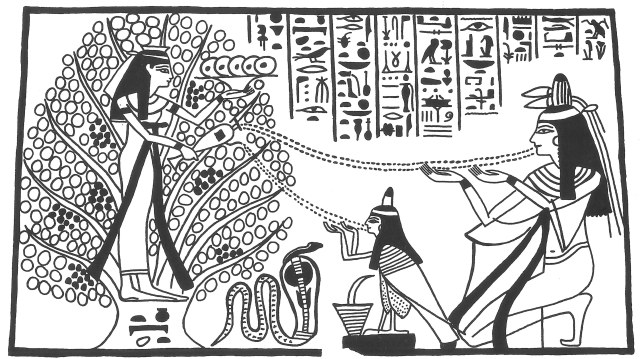
An
Egyptian example of the common “trinity” of sacred tree-goddess-serpent also
appearing in the Eden story. Here Nut as tree goddess nourishes the deceased
and the deceased’s ba. The serpent is in its common guardian role, in an erect
posture. From Nils Billing, Nut: The Goddess of Life in Text and Iconography,
fig. F.3.
Like all archetypal
symbols, the symbol of the tree has undergone a development of meaning in the
course of the centuries. It is far removed from the original meaning of the
shamanistic tree, even though certain basic features prove to be unalterable.
The psychoid form underlying any archetypal image retains its character at all
stages of development, though empirically it is capable of endless variations.
The outward form of the tree may change in the course of time, but the richness
and vitality of a symbol are expressed more in its change of meaning.
(Jung,
CW13 ¶ 350)
Painting by Cornelis van Haarlem,
1592.
"O sweet clean
earth, from whom the green blade cometh!
When we are dead, my
blest beloved and I,
Embrace us well, that
we may rest forever,
Sending up grass and
blossoms to the sky."
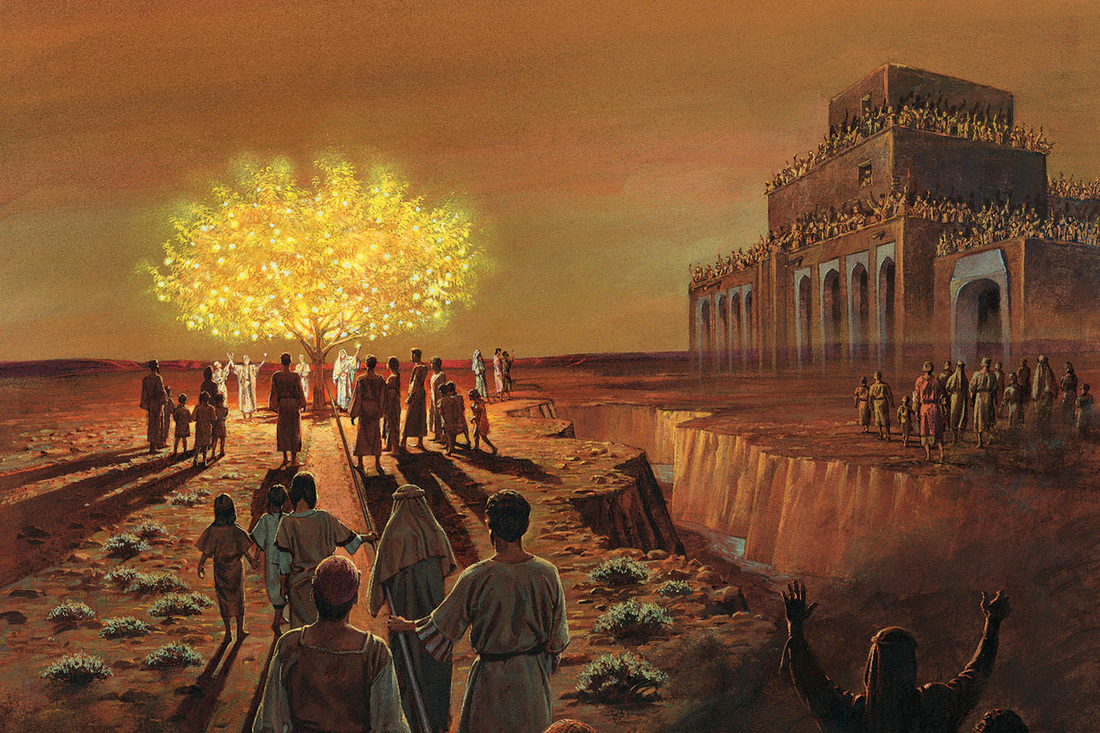
DEPTH
GENEALOGY
The Bridge of Spirits
Answer the Call -
Cross the Threshold
Open the Gateways of
Ancestors
by Iona Miller, (c)2015-2016
*
Begin
Your Journey Through Time
1)
Who am I?
2) Where do I come
from?
3) Where am I going?
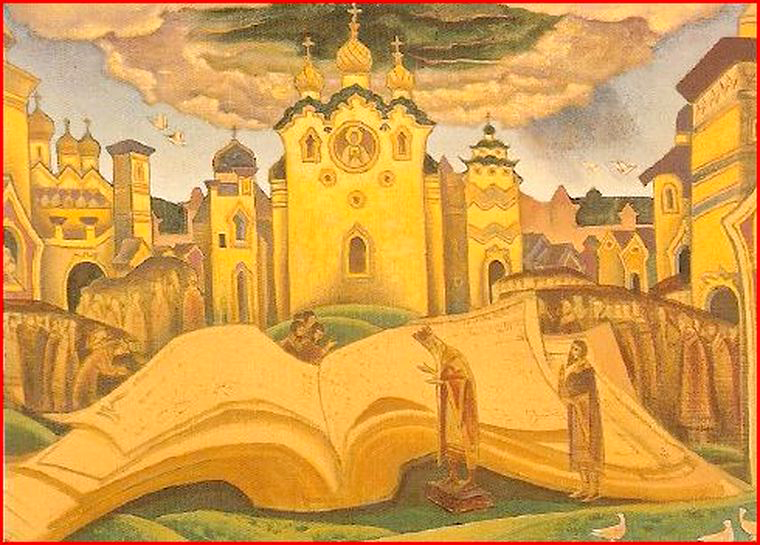
THE BOOK OF GENERATIONS
Here is the Book of
thy Descent,
Here begins the Book
of the Sangreal,
Here begin the
terrors,
Here begin the
miracles.
Hear now age-old tales
as if they were new,
that they may teach
you to speak true.
--Trevrizent in Wolfram's Parzival
"...there is an
Unknown Country, lying between the places that we know, and appearing only in
moments of revelation."
--Hilaire Belloc
"Do not grieve. Misfortunes will
happen to the wisest and best of men. Death will come, always out of season. It
is the command of the Great Spirit, and all nations and people must obey. What
is past is past and what cannot be prevented should not be grieved for..." ~Chief Big Elk, Omaha
Once you get to the root...Don't worry about the branches.
~Hsuan Chueh
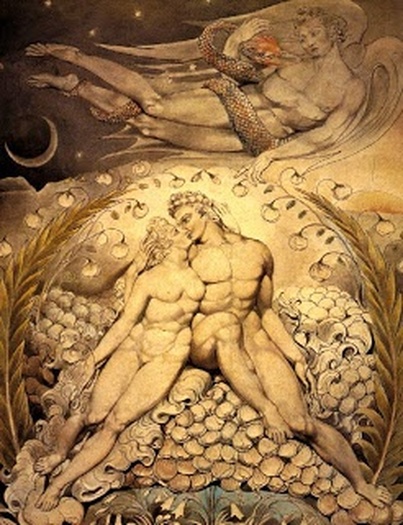
THESE ARE THE PEOPLE I COME FROM
"I Seek Dead
People"
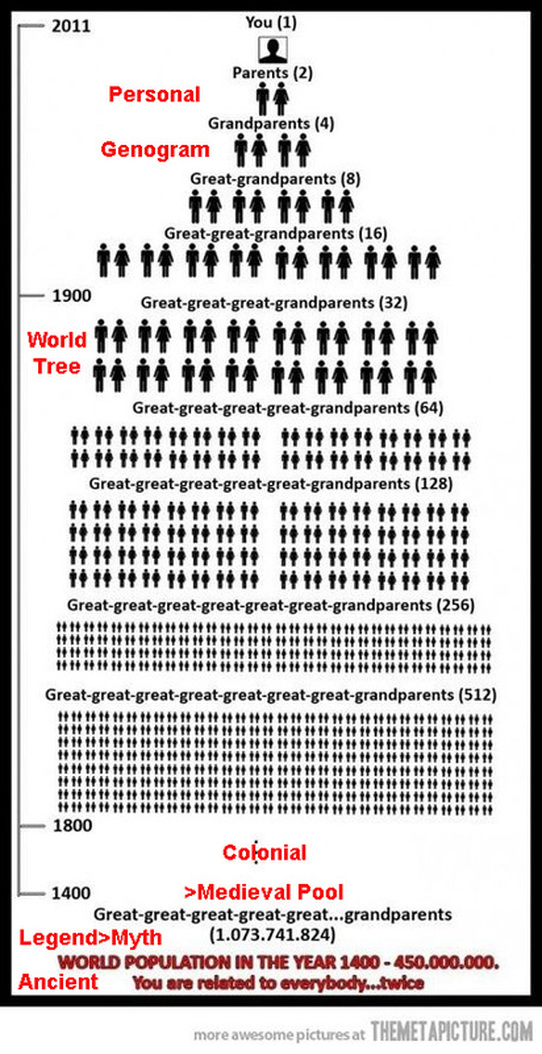
http://qz.com/557639/everyone-on-earth-is-actually-your-cousin/
“DNA – the invisible, eternal, and
fundamental basis of human identity – has acquired many of the powers once
granted to the immortal soul. Like the sacred texts of revealed religion, DNA
explains our place in the world: our history, our social relations, our
behavior, our morality, and our fate.” “DNA in popular culture functions, in
many respects, as a secular equivalent of the Christian soul.”
http://ejop.psychopen.eu/article/view/370/html
Suppose that you
wanted a written record of your every ancestor…with the Ancestral Pyramid, a
doubling of ancestors each generation back, by the 12th generation back you
have 2048, and 60,000 direct ancestors going back to the Crusades. By
Generation 40, you have more than one trillion ancestors.
Genetic Genealogy
DNA without history
and genealogy is incomplete. The psyche dervies from the ancestors as much as
the body does. You don't have DNA from all or even most of your ancestors. At
about 360 years, or just short of 15 generations mtDNA peters out. At 15
generations, an individual living today would carry only three thousands of 1%
(00.003052%) of the DNA of an ancestor who was “pure” anything 15 generations
ago.
So even if one
ancestor was Mediterranean 15 generations ago, unless they continuously
intermarried within a pure Mediterranean population, the amount would drop by
50% with each generation to the miniscule amount that would be found in today’s
current generation. With today’s technology, this is simply untraceable in
autosomal DNA. An autosomal DNA test only goes back 6-8 generations.
We don’t really know how DNA
is passed, but we know it isn’t passed in even amounts from each generation. In 4 generations, each
ancestor only contributes, on the
average, 6.25% of our
genetic makeup, so less than the
amount of statistical
noise.
We have about 43
genetic ancestors out of 1024 genealogical ancestors after 10 generations. Because of
shuffling, the probability of having DNA from all of your genealogical
ancestors at a particular generation becomes vanishingly small very rapidly.
There is a 99.6% chance that you will have DNA from all of your 16 great-great
grandparents, only a 54% of sharing DNA with all 32 of your G-G-G grandparents,
and a 0.01% chance for your 64 G-G-G-G grandparents. You only have to go back 5
generations for genealogical relatives to start dropping off your DNA tree. For
a Caucasian, one minority ancestor in the third
generation contributes 12.5% of the gene pool but in the 4th only 6.25%.
We also care
about how many genetic ancestors we have after a certain number of generations:
The number of genetic ancestors starts off growing exponentially, but
eventually flattens out to around 125 (at 10 generations, 120 of your 1024
genealogical ancestors are genetic ancestors).
Direct Line paths of
inheritance for both the Y-line, blue, and the mitochondrial DNA, red, are
shown below. Contributions
from the white genealogical lines may be small to nil, and dwindle quickly.
Only men have the Y chromosome which is passed from father to son, usally along
with the surname. Males
carry their mother’s mitochondrial DNA (mtDNA) but they don’t pass it on. Mitochondrial
DNA testing gives a haplogroup which defines deep ancestry, such as European,
African, Asian or Native American, and percentages of ethnicity. Humans
have 22 pairs of autosomes and one pair of sex chromosomes (the X and Y
chromosomes).
Fifty percent of our
autosomal DNA (atDNA) comes from our mother and 50% comes from our father.
Since our parents each received 50% of their atDNA from each of their parents,
we inherited about 25% of our atDNA from each of our grandparents. This
percentage is cut in half with each generation as we go further up our family
tree. We inherit about 12.5% of our atDNA from each great grandparent and about
6.25% from each of our 2nd great grandparents.
Autosomal DNA (not the
23rd chromosomal gender pair) tends to be transferred in groupings, which
ultimately give us positive and negative family traits. Autosomal DNA is
inherited from the autosomal chromosomes -- any of the numbered chromosomes, as
opposed to the sex chromosomes. Only Autosomal DNA tests the rest of the DNA
provided by both parents on the 23 chromosomes, not just two direct lines, as
with Y-line and mitochondrial DNA. Autosomal inheritance paths include all of
the various ancestral lines, including the lines that contribute the Y-line and
mitochondrial line.
http://dna-explained.com/2012/10/01/4-kinds-of-dna-for-genetic-genealogy/
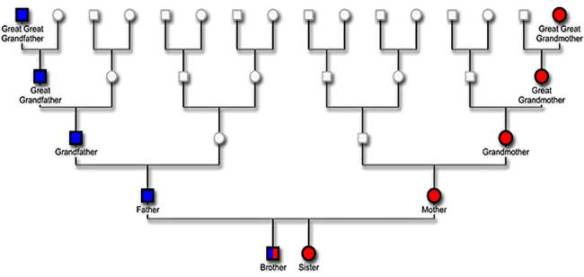
|
|
|
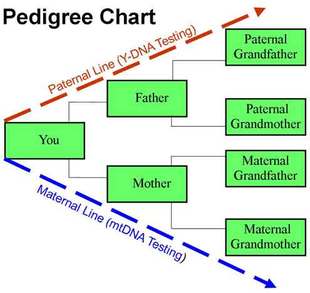
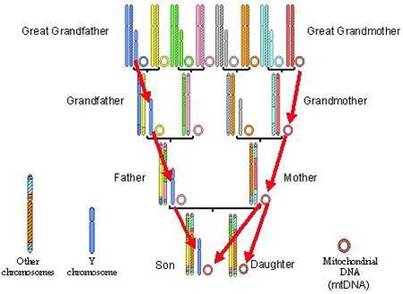
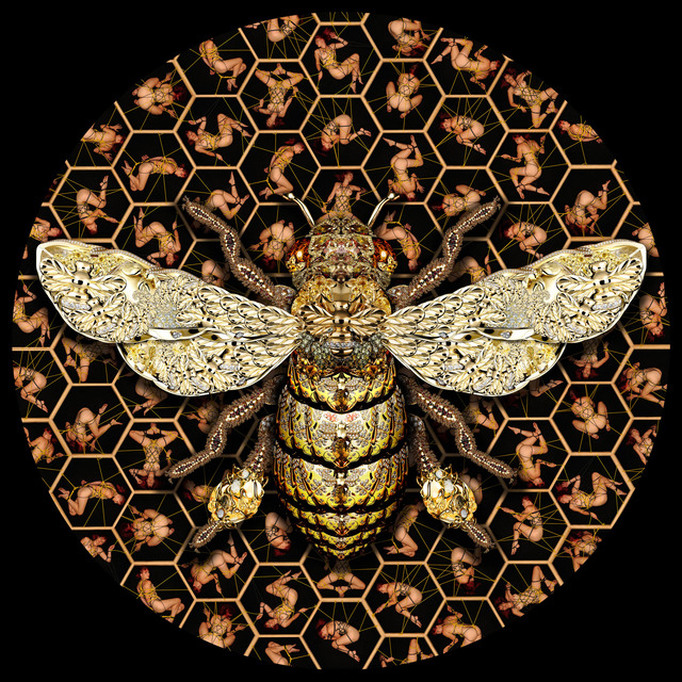
Garth Knight, The
Last Honey Bee, 2010. Type C digital print, 125.3 x 125.3cm.
Courtesy: the artist and M Contemporary, Sydney
TIES
THAT BIND US
"We are the bees
of the invisible.
We collect tirelessly
the honey of visible
To collect in the
great hive of gold of invisibìle."
R.M.Rilke
"The beehive is found
in Masonry as a reminder that in diligence and labor for a common good true
happiness and prosperity are found. The bee is a symbol of wisdom, for as this
tiny insect collects pollen from the flowers, so men may extract wisdom from
the experiences of daily life. ...The fact that bees are ruled by queens is one
reason why this insect is considered a sacred feminine symbol. In India the god Prana--the
personification of the universal life force--is sometimes shown surrounded by a
circle of bees. Because of its importance in pollenizing flowers, the bee is
the accepted symbol of the generative power. --MPH
At one time the bee
was the emblem of the French kings.
The
bee or beehive and fleur-de-lis is an ancient symbol of the Merovingian
bloodline. Unconscious wisdom is contained in the beehive — the hive is in
reality permeated by love, which relates to the human experiences of health,
civilization, and the cosmos. Rudolf Steiner lecture series entitled, The Functioning of Spirit in Nature
and in Man. The Being of Bees. http://wn.rsarchive.org/Lectures/GA351/English/SGP1975/NinBee_index.html
|
|
|
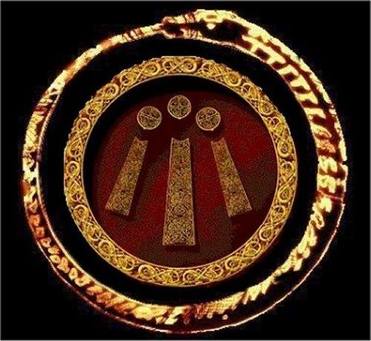
Like the oroboros serpent we recursively turn back toward our
origins.
“The alchemists,
who in their own way knew more about the nature of the individuation process
than we moderns do, expressed this paradox through the symbol of the Ouroboros,
the snake that eats its own tail.
The Ouroboros has
been said to have a meaning of infinity or wholeness. In the age-old image of
the Ouroboros lies the thought of devouring oneself and turning oneself into a
circulatory process, for it was clear to the more astute alchemists that the
prima materia of the art was man himself.
The Ouroboros is a
dramatic symbol for the integration and assimilation of the opposite, i.e. of
the shadow. This ‘feed-back’ process is at the same time a symbol of
immortality, since it is said of the Ouroboros that he slays himself and brings
himself to life, fertilizes himself and gives birth to himself.
He symbolizes the
One, who proceeds from the clash of opposites, and he therefore constitutes the
secret of the prima materia which […] unquestionably stems from man’s
unconscious.” --Carl G. Jung
Adam
& Eve
vs. Zombies, Fairies,
& Dead Ends
All
These Phenomena Are Connected
Your genealogy is like
Facebook for dead people
Some use their real
names, and others are concocted
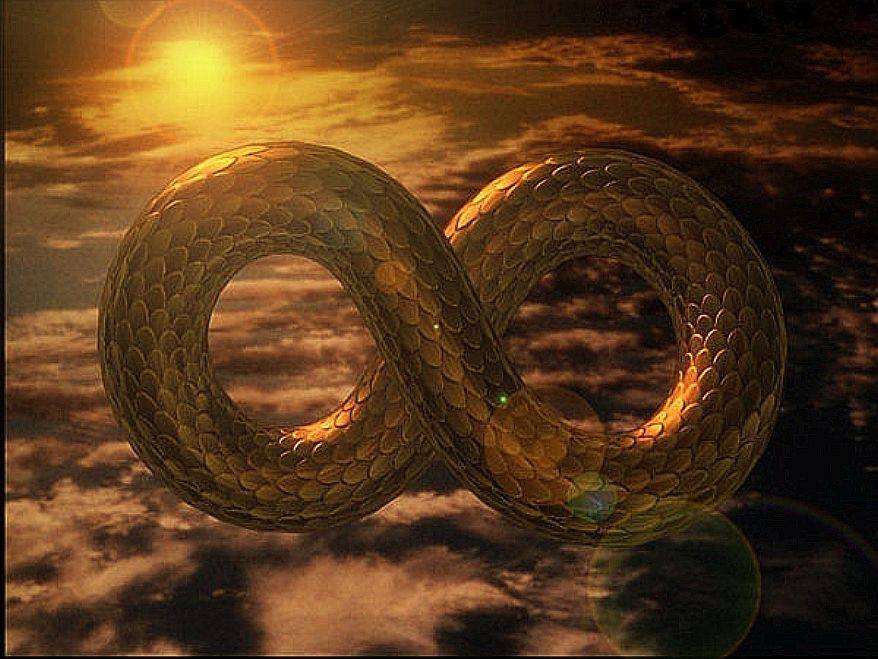
If pleasure is united with
forethinking, the serpent lies before them.
~Carl Jung, Liber Novus, Page 249, Footnote 190.
OUR INVISIBLE FAMILY
PREMIS
It's All Relative
Carl Jung recounts his own imaginal quest to confront the
unconscious in his Red Book (Liber Novus). He claims the dead report that their questions are not
answered by those already dead. They appear to be disappointed, and have no
recourse but to turn to the living. When we answer the call of our ancestors
with psychogenealogy, we must ask along with Jung, "who are the dead, and
what does it mean to answer them?"
If we seek wisdom from
them, they would also like to expect it of us. Jung marveled that the dead
posed questions, since we usually assume greater knowledge for the dead than
ourselves, presumably because they are closer to the "ground" of all
human knowledge -- as if they could "remember" or access the
collective unconscious -- the numinous everything, absolute undifferentiated,
ungoverned space. He noticed the dead only knew what they knew when they died,
so they continue to intrude into our lives..
Jung regarded death as the fulfillment of life's meaning:
"only those remain living who are willing to die with life. Since what
happens in the secret hour of the midday of life is the reversal of the
parabola, the birth of death."
"We have to learn
with effort the negations of our positions, and to grasp the fact that life is
a process that takes place between two poles, being only complete when
surrounded by death."
--Carl Jung, 1925 Seminar, Page 86
Spiritual Quantum
Field?
The new meme of the
afterlife is some sort of quantum or subquantal consciousness that persists
after discorporation much like the soul. But when our models match current science, we can be sure we are
dealing with metaphor and projection, not ontology. There is much conjecture on
the subject of some kind of spiritual quantum field where our information lives
on. Some of this research is rooted in reports of the Near Death Experience
(NDE).
All that it proves is
that we still enjoy our belief in an afterlife but want it described in
contemporary or even mathematical terms -- a peculiar consideration for such an
irrational concept. It actually shows that death remains the creative edge of
our knowledge and so we project our hopes and dreams for immortality into the
great beyond. Even scientists are not immune to this conjecture.
Physicist Professor Robert
Jahn of Princeton University concluded that if consciousness can exchange
information in both directions with the physical environment, then it can be
attributed with the same "molecular binding potential" as physical
objects, meaning that it must also follow the tenets of quantum
mechanics. Quantum physicist David Bohm, a student and friend of Albert
Einstein, was of a similar opinion. He stated, "The results of modern
natural sciences only make sense if we assume an inner, uniform, transcendent
reality that is based on all external data and facts. The very depth of human
consciousness is one of them."
http://www.outerplaces.com/science/item/4518-physicists-claim-that-consciousness-lives-in-quantum-state-after-death
But such speculation
is beyond our genealogical approach here. The only math we are concerned with
is 'multiplication' and 'subtraction.'
Humans have been burying
and preparing their dead for the "Great Beyond" for over 100,000
years. For
example, archaic H. sapiens and "early moderns" were carefully buried
in Qafzeh, near Nazareth and in the Mt. Carmel, Mugharetes-Skhul caves on the
Israeli coast over 90,000 to 98,000 years ago (McCown 1937; Smirnov 1989;
Trinkaus 1986). This includes a Qafzeh mother and child who were buried
together, and an infant who was buried holding the antlers of a fallow deer
across his chest. In a nearby site equally as old (i.e. Skhul), yet another was
buried with the mandible of a boar held in his hands, whereas an adult had
stone tools placed by his side (Belfer-Cohen and Hovers 1992; McCown 1937). It
is thus quite clear that humans have been burying and presumably weeping over
their dead, and preparing them for a journey to the Hereafter, for over 100,000
years. Thousands
of ivory beads and fox teeth covered the bodies of a girl and a boy buried at Sunghir, Russia, around 28,000
years ago. This was some serious bling, representing years of accumulated work.
These behaviors and beliefs
are related to activation of the amygdala, hippocampus, and temporal lobe,
which are responsible for religious, spiritual, and mystical trance-like
states, dreaming, astral projection, near death and out-of-body experience, and
the "hallucination" of ghosts, demons, angels, and gods. Case studies
and the evolutionary neurological foundations are presented and it is
postulated that these structures evolved in order to make spiritual experience
possible, and account for the sexual and violent aspects of religious behavior.
Abraham, Moses, Mohammed, and Jesus Christ, and others who've communed with
angels or "gods," display limbic system hyperactivity. Patients
report religious "hallucinations" or out-of-body experiences when
limbic structures are stimulated. As over 96% of human DNA is dormant, whereas
50% of activated DNA is devoted to the brain, these capacities may continue to
evolve.
(Joseph) http://brainmind.com/BrainReligion.html
Together the patient
and I address ourselves to the 2,000,000-year-old man that is in all of us. In
the last analysis, most of our difficulties come from losing contact with our
instincts, with the age-old unforgotten wisdom stored up in us. ~Carl Jung, NY Times, Oct. 4, 1936.
The libido of man contains
the two opposite urges or instincts:
the instinct to live and
the instinct to die.
~Carl Jung, 1925
Seminar, Page 77
"It
is not death that a man should fear, but he should fear never beginning to live
according to nature."
--Marcus Aurelius [my 61st great
grandfather]
"It is only
possible to live as we should
if we live according to
our own nature."
~Carl Jung, ETH
Lecture, 7 June 1935.
“...put it my way, what we are really ,
and the reality we live, is our psychic reality, which is nothing but ...the
poetic imagination going on day and night.” --James Hillman, We’ve Had a Hundred Years of
Psychotherapy and the World Is Getting Worse, p. 62
"...by “soul” I
mean the imaginative possibility in our natures, the experiencing through
reflective speculation, dream, image and fantasy—that mode which recognizes all
realities as primarily symbolic or metaphorical,...that unknown component,
which makes meaning possible, turns events into experiences, is communicated in
love, has religious concern [deriving from its special relation with death]
(Hillman, Re-Visioning Psychology, p. xvi).
The symbol is the
word that goes out of the mouth, that one that does not simply speak, but that
rises out of the depths of the self as a word of power and great need and
places itself unexpectedly on the tongue. It is an astonishing and perhaps
seemingly irrational word, but one recognizes it as a symbol since it is alien
to the conscious mind.
If one accepts the
symbol, it is as if a door opens leading into a new room whose existence one
previously did not know.
But if one does not
accept the symbol, it is as if one carelessly went past this door; and since
this was the only door leading to the inner chambers, one must pass outside
into the streets again, exposed to everything external. But the soul suffers
great need, since outer freedom is of no use to it.
Salvation is a long
road that leads through many gates.
These gates are
symbols. Each new gate is at first invisible; indeed it seems at first that it
must be created, for it exists only if one has dug up the spring’s root, the
symbol. --Jung,
Red Book, Page 311.
I wait, secretly
anxious.
I see a tree arise
from the sea.
Its crown reaches to
Heaven and its roots reach down into Hell.
--Carl Jung, Liber Novus, Page
300.
The
starry vault of heaven is in truth the open book of cosmic projection,
in which are reflected
the mythologems, i.e., the archetypes.
~Jung,
CW 8, Page 195, Para 392.
Archai (Greek, noun, plural)
Universal principles,
original forms; the fundamental essences and primordial forces that animate the
cosmos. Archai derives from the Greek word, arkhe, meaning beginning. In archetypal
psychology, the root metaphors of psychological function.
We, each and all of us,
contain within us the entire history of the world, and just as our body records
Man's genealogy as far back as the fish and then some, so our soul encompasses
everything that has ever existed in human souls. All gods and devils that have
ever existed are within us as possibilities, as desires, as solutions.
--Hermann Hesse,
Reflections
ROOTS
& BRANCHES
YOUR CREATION STORY
Genealogy Facts &
Fictions
But no matter how much
parents and grandparents may have sinned against the child, the man who is
really adult will accept these sins as his own condition which has to be
reckoned with.
~Carl Jung, Psychology and Alchemy, Page 117.
Most
people are nothing special, except perhaps to those close to them. Descent is
one of the Mysteries of everyday life. What 'matters' about our past is more
than only the biology of our descent, though this is the premise of genealogy.
We are not only related to each other in family and in social relationships,
but are related to all nature -- that inccludes all human or prehuman animal
ancestors.
Among genealogists the
battle still rages, whether to cut off once and for all disputed, fictitious,
and legendary lineage, or to allow its traditional use to remain, even though
some may be misled in their own minds by mythological material. Their issue, on
shared trees, is having to repeat the same corrections over and again,
especially in the medieval era. Fake lines to royalty that arose in the 1800's
are also common, so they get re-added as often as they are removed. The
same mistakes are copied over and over.
Who's Genealogy Is It?
In the medieval and
ancient lines the whole research landscape changes. Monks in the early
Christian era invented genealogies taking the lines of kings back to Adam. If
the kings were no longer descended from the indigenous gods, then they needed
to descend from figures from the Bible, Troy, and Rome.
Then,
starting in the 1200s and reaching a peak in the 1600s, royal propagandists
were competing to collect every old tradition and invent new ones if necessary
to enhance the prestige of royal and noble families.
The
French kings, for example, produced the Grandes
Chroniques de France that claimed to show they
were the heirs of a small band of Trojan refugees who established the Frankish
people. Not to be outdone, Habsburgs followed a conscious policy for centuries
of creating propaganda to show they were the heirs of the Trojan hero Aeneas
through Julius Caesar. The idea that Julius Caesar was descended from Aeneas is
just a much earlier, Roman example of the same kind of propaganda.
Still, radical
amputation is a non-issue in Jungian work, which always approaches mythic
material with an "as if." No one in transpersonal therapies is
confused about the imaginal nature or depictions of mythic material and
narrative. In many genealogy sites, such lines questioned by 'realists' are
clearly marked as such. Also, there will always be fantasy-prone individuals
who will believe what they wish to believe about such subjects.
Know It By Being It
Genealogy is a systems
concept of emergence -- our emergence. It is a creative process within a formal
system -- an ecology of ancestors we curate, foster and conserve, not merely a
causal chain of linear descent. Family systems theory suggests that individuals
cannot be understood in isolation from one another, but rather as a part of
their family -- an emotional unit. Families are systems of interconnected and
interdependent individuals, none of whom can be understood in isolation from
the system.
Each
member had a role to play and rules to respect. Members of the system are
expected to respond to each other in a certain way according to their role,
which is determined by relationship agreements and established patterns which
may lead to balance in the family system, but also to dysfunction.
We
create most of what we think of as reality through the stories we tell. Even
profiles that contain only names and dates are still story telling. The names
matter, but moreso the connections between them. They say, "I come from
people who lived here and went there."
They connect into
history. And history can be scholarly history, which depends on evaluation of
sources and the creation of logical arguments, or it can be family history,
which depends on the stories being passed down through the generations, or it
can be even older oral history, which existed before writing, and eventually
made it into manuscripts and then into print.
Though
the lines often blur, a generic distinction is the source of such stories.
Biases in story telling needs arise in relation to genealogy and the World
Tree:
we
need to see how we might be connected to history, or we need to know that we
are special somehow, or we need to be able to see a path that connects us to
our gods. All such stories are "real," since they are valued and
retold, giving people a picture of who they think or imagine they are.
"Imagined"
Family
But,
none of them are "real," in that even with as much good evidence as
we can muster, good solid scholarly sources have their own biases, and will
have included some things and left others out. The self-narrative of
individuals is notoriously unreliable, and second- or third-hand evaluations
moreso, despite well-meaning research. In genealogy as in life we mostly relate
to our illusions of family, rather than a fixed reality, at best based on
skimpy information. There are our self-narrative stories, then the archetypal
stories we actually live, noticed or not.
With any sort of
balance or psychological perspective it is easy enough to recognize when we
step from the ordinary world into that imaginal world, which is more than
illusion or fiction, if less than or merely different from hard fact. Some of
our heritage comes from specific places and people while the deeper parts come
from the Far Country. By "traveling" in such foreign territory
we learn other kinds of things about ourselves and our origins.
"Foreign
Countries"
For example, in
Masonry “Foreign Countries” do not mean the various geographical and political
divisions of the Old World, nor a realm of external feats. “Foreign Countries”
is used as a symbol. Like all symbols, it has more than one interpretation;
but, unlike many, none of these is very difficult to trace or understand.
Through
such travels we gain a new perspective on our origins, life, love, and
ourselves. When we visit such 'foreign lands' we must use the laws of that land
as well as customs and traditions - deciding what is right and what is wrong.
In this regard a Jungian approach offers the most leeway without succumbing to
literalisms or fantasy-based illusions.
Like genealogy,
Freemasonry itself is a “foreign country” in which the initiate will travel; a
world as different from the familiar workaday world as France is different from
England, or Belgium from Greece. The standards are different. Surely such
a land is a “foreign country” to the stranger within its borders; and the
visitor must study it, learn its language and its customs, in order to enjoy
and explore it.
Professional
genealogists trying to revision traditional practice need not shepherd the
public like over-protective parents. The fantasy of professional genealogy as
some sort of factual reality is erroneous in itself. It remains an aid to
learning, discovery, or problem-solving by experiment and trial-and-error
methods.
Reconciling Pedigrees
Sure, we can rely on
the data, but only to a certain limited extent. A quick review of more recent
census data shows it is riddled with multiple incorrect spellings and data
recording, just for starters. If you can get a line back to the early-1800s you
have a good chance of connecting to extant research, especially American
colonial lines.
Further back, most
family lines disappear by 1500 or so, and there are no proven lines from before
around 700. Statistically, our descent from Charlemagne is (virtually) certain,
but the details of who, how, where, etc. could be laughably wrong or contain
gaps.
All family trees go
back as far as anyone else's whether you know it or not. You are real and so
are your ancestors, even if they are hiding. Hidden ancestors are as real as
you are in this process of "Hide and Seek." Our job is to effectively
release the hidden information and forms, even where 'inaccurate' information
proliferates as much as reliable data. Cliches, such as "Like father, like
son" are necessarily abbreviated 'truths' that stand up to scrutiny in
some instances and utterly fail in others.
Genealogy's Shadow
Genealogists and
Curators need to realize they are always and only dealing with a symbolic
landscape, even though some factual hook is available. To imagine otherwise is
psychological naivete. They need to realize that no matter how they approach it
or annotate the lines, or discuss the medieval flaws in the system people come
to genealogy for their own reasons -- no longer the legal issues of legitimacy,
inheritance, or succession. We all risk inaccuracy together.
People are inclined to
believe what they want to believe in terms of literalisms and metaphors for
their own psychic needs. Whatever impressions we form, including those about
our parents, remain mostly that. Psychological pay offs feed into
self-narrative, the stories we tell ourselves, a social construct much like
Jung's persona archetype.
Most
of us understand the notion that history is written by 'the winners' and is
riddled with propaganda and deliberate falsehood or retrofitted 'spin'.
Historical accuracy outside the story is likely unattainable, much less
something genealogy is capable of re/producing. Can we not logically discern,
for example, that we all descend from archetypal evil, whether we find the Mark
of Cain in our pedigree or not?
Archetypal Assumptions
We approach the family
tree in full comprehension this is an archetypal phenomenon. The only certainty
in genealogy is the archetypal imagination. Archetypal images harness spiritual
energy, redirecting psychic energy into new pathways. Our pedigree is way to
help us imagine our origins. Genealogy is a template; in the beginning a tabula rasa upon which we construct a family
"history." Often even the timeline is weak or ignored.
Like a Big Dream
genealogy requires heuristics, any approach to problem solving, learning, or
discovery that employs a practical method not guaranteed to be optimal or
perfect, but sufficient for the immediate goals. Heuristics is a discovery
process of gaining knowledge or some desired result by intelligent guesswork
rather than by following some preestablished formula --
"trial-and-error" learning or using "a rule-of-thumb." In
other words, we interpret all the data.
Follow Your
Uncertainty
In certain situations
it is not enough to simply cross that threshold; we must wait for the image to
penetrate, work in the depths, gestate, and emerge from its own path. Such
phenomena can be treated the same as all psychic phenomena. A big dream is one
that has the potential to become a transformative image. The transformative
image offers a pattern for arranging psychic energy along specific lines.
Our genealogical
challenge is to build transformative relationships with transformative images. A
transformative image, something carried over from the other side, can redirect
the flow of psychic energy, changing its specific form of manifestation.
Liminal entities are
neither here nor there, but betwixt and between the positions assigned and
arrayed by law, custom, convention, and ceremonial. They are structurally
"invisible" so hard to grasp rationally like clearly-defined objects.
Kinship Libido
Ancestral images,
deeply engaged and related to over a period of time, can draw consciousness
powerfully and have transformative effects -- personal encounters with the
collective unconscious. We have to let ourselves be temporarily affected by
those images without remaining identified with them.
It relates to the
instinctual needs of the individual constellating balance and wholeness or
repressing aspects of human nature, resulting in one-sidedness and distortion.
A side effect of genealogy happens with exposure to the cultural and religious
archive of primordial transformative images from the past. Experiencing such
images deeply can have a profound effect upon consciousness, priming
transformative leaps.
The family tree is a
transformative image that channels psychic energy and will into specific
attitudes, activities, and goals. This potential image must have roots deep and
broad in the psyche as a whole. It is an archetypal image that like a
transforming dream captures the element of wholeness in an individual's life
and gives it specific shape and direction.
People's capacity to
tell the difference between fantasy and reality varies to the degree to which
they use accurate 'reality testing', plausible interpretations, or are being
sucked into the stories they are telling themselves about their family.
Genealogy can be a way of denying pain in the nuclear family. Some people brag
about their genealogy, hiding the parental alcoholism, verbal, and physical
abuse in their own youth, for example.
These include
religious beliefs, 'royal' pay offs, romanticizing, feeling superior,
self-delusion, and identity issues and needs. Rather than redacting the
traditional lines, such issues are better dealt with individually in
Transgenerational Integration.
After all, we really can
think, even if not with an absolute independence from nature; but it is the
duty of the psychologist to make the double statement, and while admitting
man’s power of thought, to insist also on the fact that he is trapped in his
own skin, and therefore always has his thinking influenced by nature in a way
he cannot wholly control. ~Carl
Jung, 1925 Seminar, Page 83
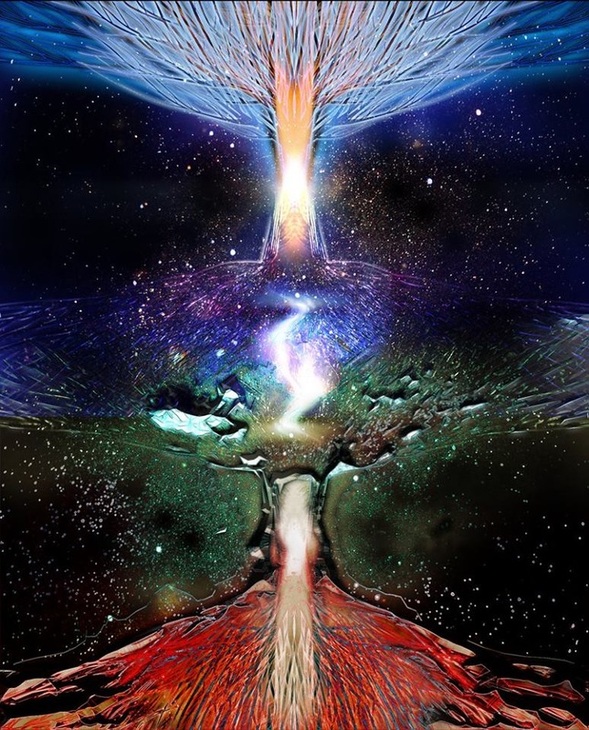
Bruneel, Yggdrasil
RECOVERING
THE
TREE OF FLESH AND
BLOOD
Cosmology, Life, &
Death
And everywhere there, the
Tree of Life,
and the
resurrection of flesh from the Tree … --Origen
Creation
myths are symbolic narratives of the world and human origins. Psyche
is an autonomous narrator. Many ancient cultures venerated the Milky Way as the
World Tree, cosmic axis between Earth, sky, and underworld -- a model of the
world and heavenly prototype.
The
Tree is an icon of eternal life -- the cosmos in totality. The Sumerian Tree of
Life is perhaps 6000 years old, but possibly inherited from 12,000 year old
Gobekli Tepe, where a small carving of the tree, serpent, and bird were found.
Bird-snake is opposites: the snake is chthonic; the bird transcendent. The Sumerian
concept was that wisdom is likened to a tree whose fruits bestow health and
longevity, if not immortality. That notion persisted in Gnosticism, where
the image of the serpent is the embodiment of the wisdom transmitted by Sophia.
The Pillar in the
Osiris Legend represents the Tree of Life, the tree that encloses life and
death. Egyptian texts say,
"I am the plant which comes from Nu." The Tree of Life grew out of
the Sacred Mound, it's branches reaching out and supporting the star and planet
studded sky, while it's roots reached down into the watery abyss of the Netherworld.
Our ancestors read the
sky and stars for their position in space and time. Constellations
imbued with mythological meaning helped as reference points for this
observational science. The sky helped guide them home and perhaps save their
lives. Lore of the sky bound communities together and established vast cycles.
The familiar stars were celestial navigation guides across trackless seas and
deserts.
A heaven-spanning tree
is also a refuge, associated with the center of the world and the primordial
substance of creation. This cosmic axis is also the place "Where Flesh
Came Forth." The Sumerian image of the 'tree of
life/knowledge' is reminiscent of the later images of Greek 'Omphalos' or woven
'Navel Stones.' Flesh grew where heaven was separated from earth by the Tree in
this seminal event. We are presumably the product of such cosmic unions.
Collectively, we
project a chaotic darkness into the past, mythologizing our own birth. We
inhabit the world and we see it through a certain worldview -- a system of beliefs,
symbols, and metaphors. We structure our evolving mythical view into a 'whole,'
revealed particularly to us, from which we create the substance of our world
and myth. This is the vehicle that connects our intuitions of the infinite with
the finite -- our life-world of flesh and blood.
The creation myth is
confounded with the empirical history as mythical time segues into the
objective world, yet mythos and logos remain in dynamic tension because both
are primordial. The gods metamorphose and pervade
humanity.
There
is an irreducible tension between the unattainable infinitude of the
mythic/imaginal worldview and the inevitable restrictions of the finite
here-and-now of the logos. Mythology can never be transformed into reason.
Paracelsus said, "Everyone must educate and regulate his imagination so as
to come thereby into contact with spirits [personified forces], and be taught
by them (Philosophia sagax)
Thus, enchantment,
disenchantment, and re-enchantment pervade the lineage and its conceptual framework.
As we create connections we create a conscious and unconscious narrative. Jung
says of his personal myth, “In the end the only events in my life worth telling
are those when the imperishable world irrupted into this transitory one.”
It is through memory
that the I endures, that memories are formed with emotional charge attached.
Our sense of place is entangled with our sense of who we are -- so, to be at no
place is akin to being no one, without a story or remembrance. Knowledge born
from the image is an emotion that modifies the knower.
The world tree is a
world of stories. We all start out with some kind of dream about how life will
be. The Family tree emerges from the Tree of Life. The tree numen stands for
the development and phases of the transformation process, and its fruits or
flowers signify the consummation of the work.
Deviation from the numen
seems to be universally understood as being the worst and the most original
sin. ~Carl Jung, Letters Vol, II, Page 370.
We construct stories
when we reflect on experience. The way beyond the opposites and the creative
process between them is the essence of life. The
opposition is a necessary condition of libido flow.
Numinosity, however, is
wholly outside conscious volition, for it transports the subject into the state
of rapture, which is a state of will-less surrender. ~Jung,
CW 8, Para 383
"But when we become
aware of the opposites we are driven to seek the way that will resolve them for
us...We have to learn with effort the negations of our positions, and to grasp
the fact that life is a process that takes place between two poles, being only
complete when surrounded by death." (1925 Seminar, Pg 86)
Ancient ancestors
believed this celestial Tree of Life holds all life in balance and alignment
and facilitates our spiritual journey. The 'cosmic' tree emerges from the
rootless root of all being, the Pleroma, and often appears upside-down with its
roots in heaven and its foliage on earth. The snake in the Tree is the spiral
symbol of Life itself and cosmic cycles which characterize the revealed world.
The gathering of souls
on heavenly paths and the connections stars have with the birth and death of
people is a universal theme. This road of souls, ladder to heaven, or trail of
the dead was the path to the Otherworld traveled by spirits, deities, and
shamans. The Oglala called the Milky Way the "Ghost Road," Wanagi Tacanku.
The World Tree is
linked to the center of the world and our own center. We are each the nexus of
the cosmic drama where the Milky Way is also a cosmic womb -- the source of
life and where souls return. It mirrors the creative potential of the human
womb for birth. The miracle of birth incarnates in woman's body - the mother as
source and regenerator of all life. Archaic cave temples also mirrored such
ideas. Thus, we find at Lascaux, some of the first cave art depicts heavenly
constellations.
We have a nostalgic desire to break the bonds that keep
us tied to earth, and to free ourselves from limitation. To break from earth
with shamanic flight or ascent similarly signifies an act of transcendence. We
long to see the human body act in the manner of a spirit, to transmute our
corporeal modality into spirit’s modality. Paradoxically, we want long life,
yet we defy life by breaking the rules and often compulsively challenging all
boundaries.
Our genealogy is that Tree and cosmic center that keeps us
connected and balanced, and upon which we can ascend and descend in a way that
keeps deep time, the transcendent, and our family of flesh alive within us.
Many mythologies say the world tree was the abode of gods and our genealogical
roots show that. The tree is the primordial symbol that unites the physical and
the sacred. Hillman
cautions that loss of soul, not loss of life should be our main dread.
Jung said, "The
tree of life may have been, in the first instance, a fruit-bearing genealogical
tree, and hence a kind of tribal mother" (CW5, Para 321). The Tree of Life
fills space with bodies. It restores the lost elements of Nature and our
nature.
As Jung also notes,
"Sometimes a tree tells you more than can be read in books…" (Letters
Vol. 1, Pg. 479). He links the Tree with the wisdom of
Sophia: "the one that is rooted in the earth as well as in the heaven,
both root and branch of the tree." (Zarathustra Seminar, Pg. 533).
The celestial
Tree denotes life of the cosmos; its growth, proliferation, generative and
regenerative processes. It stands for inexhaustible life, which is equivalent
to immortality. Your innermost being is identical to the innermost Cosmos. Some
families plant a tree for every child born; others plant a memorial tree when
someone dies.
The Serpents in our Tree are the individual lines of descent
from various common ancestors, including legendary and divine progenitors. They
lead us to question who and what we are, what we know and what we thought we
knew about our roots. Jung says, in the Red
Book that, "The serpent is the earthly
essence of man of which he is not conscious….it is the mystery that flows to
him from the nourishing earth-mother." (Pg. 247)
The way of life
writhes like the serpent from right to left and from left to right, from
thinking to pleasure and from pleasure to thinking. Thus the serpent is an
adversary and a symbol of enmity, but also a wise bridge that connects right
and left through longing, much needed by our life. (Pg.247)
These 'serpents' offer
us Knowledge. They are still a part of our Truth -- that we are born and we die
-- and we stand on the shoulders of those who came before us. Genealogy is a Ritual in which we
climb up and down, through our family tree in deep remembrance, an exercise in
time travel that expands consciousness.
Children are in the
collective unconscious until they acquire a small consciousness of their
personality, until they say “I,” or “me,” or their name. They are rooted in the
collective unconscious and are uprooted from it by the flood of impressions
from the outside. They know everything, but they lose the memory of it. --C. G. Jung, Emma Jung and Toni
Wolff, A Collection of Remembrances; Pages 51-70.
Circulation
This Cosmic Tree or
World Tree represents the sustaining wisdom, beauty, love, strength, and power
of the Universe.
Trees symbolize the
living structure of our inner selves. To forget one's ancestors, is like a
river without a source, or a tree without roots.
Life-giving sap
circulates throughout the Tree much like the ancestral bloodlines circulate
through us in an unbroken circle. Life is immortal and we realize we are to the
extent we partake of the fruits of that Tree and its eternal Mystery.
One
needs death to be able to harvest the fruit. Without death, life would be
meaningless, since the long-lasting rises again and denies its own meaning. To
be, and to enjoy your being, you need death, and limitation enables you to
fulfill your being. (Jung, The Red Book, Page
275.)
Jung says, "It is
the tree that nourishes all the stars and planets; and it is the tree out of
which come the first parents, the primordial parents of humanity, and in which
the last couple, also representing the whole of humanity, are buried."
(Zarathustra Seminar, Pages 1432-1434). Our
'leaf' may fall off the tree and die but what gave us life remains --
interpersonal existence remains.
“The alchemist saw the union of
opposites under the symbol of the tree… the symbol of the cosmic tree rooted in
this world and growing up to heaven -- the tree that is also man. In the
history of symbols this tree is described as the way of life itself, a growing
into that which eternally is and does not change; which springs from the union
of opposites and, by its eternal presence, also makes that union possible.” (Carl Jung, CW 9i, para. 198)
Catafalque
We are the crown of
the pyramid of ancestral building blocks.
Genealogy is a sort of
scaffolding or platform from which we conduct our genealogical project, a
metaphorical catafalque or means of conveyance. The term, from the Italian catafalco, or scaffolding, refers to the
raised (and often movable) platform that a casket rests on during a funeral or
memorial service.
From its root as a
'siege tower', it is that position on the edge of the known from which we 'lay
siege' and launch our incursion on the collective unconscious. Sometimes the
unconscious conveys information beyond the personal.
Naturally, this is not
a martial process or violent incursion, but one of loving attendance to detail
and accuracy in hitting the mark that illuminates our targets. Certainly, it's
not what we demand of it, but what it demands of us for release from
unconscious bondage. Whether we conceive of it as human or archetypal impulse,
the contents below consciousness demand to be freed.
The Tree Speaks For
Itself
We can be confounded
'barking up the wrong tree,' or stymied by a Brick Wall or missing link -- tough
research problems, apparent dead-ends that after many hours of searching still
yield no answers. The other side of the brick wall is the distant ancestor that
pops up as if he or she was born out of thin air.
Sometimes we can't find that elusive ancestor, set of
parents or proof of a link between generations. Then the seeming miracle
occurs. The wall is breached. With a dead-end line, the moment of breakthrough
can seem like a bomb going off that opens a whole new field of ancestors, from
notable Colonials, to more noble and royal lines -- and, yes, more dead ends.
Sometimes it takes a
moment of synchronicity to ignite the spark of discovery. Then a single word,
an oblique reference, or matching names can open a whole new domain. As well as
research, it takes logic, deduction, inference, and inspiration.
Tracking from the
known to the unknown, we use clues to unlock the story with literal and
metaphorical understanding.
Those stories and how
ancestors dealt with adversity can inspire us right back. New voices change our
patterns and self-image. Ancestral voices are re-presented in a new context.
Ancestors are those people you directly descend from, not
extended family members. An ancestor or forbearer is a parent or (recursively)
the parent of an ancestor (i.e., a grandparent, great-grandparent,
great-great-grandparent, etc). An ancestor is "any person from whom one is
descended. In law the person from whom an estate has been inherited." Our
tree has its roots in the past and is ever putting forth leaves and flowers in
the brightness of the present.
Over the course of the
millennia, all these ancestors in your tree, generation upon generation, have
come down to this moment in time-to give birth to you. There has never been,
nor will ever be, another like you. You have been given a tremendous
responsibility. You carry the hopes and dreams of all those who have gone
before. Hopes and dreams for a better world. What will you do with your time on
this Earth? How will you contribute to the ongoing story of humankind? History
remembers only the celebrated, genealogy remembers them all. (Laurence Overmire)
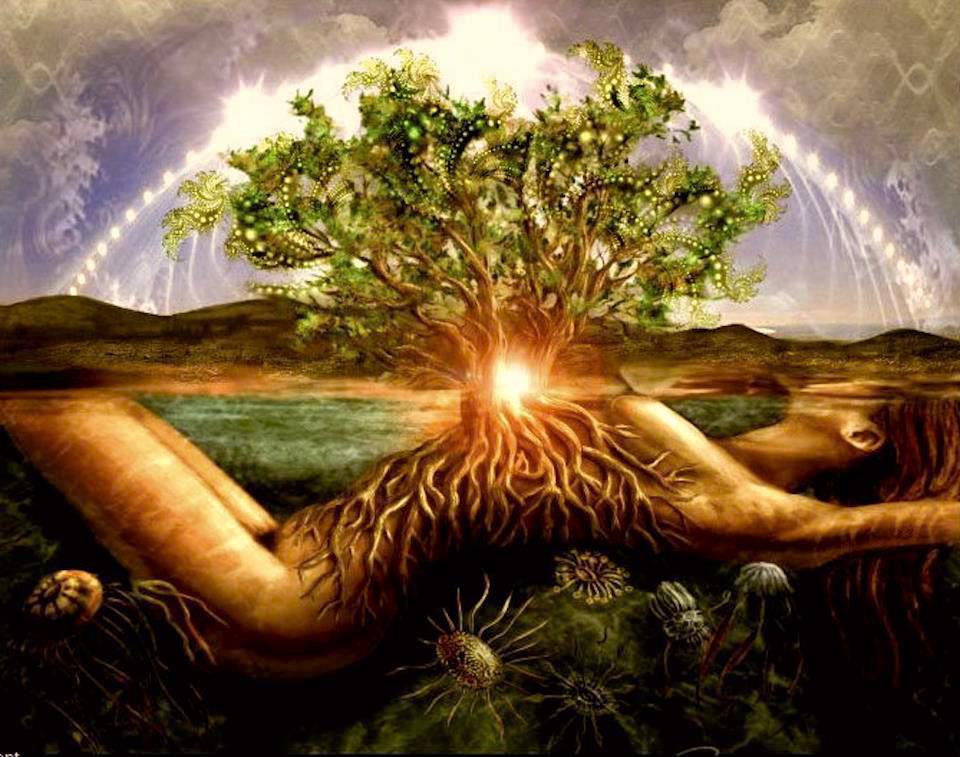
Lost
& Found
There Are No Common
Stories
The libido of man contains
the two opposite urges or instincts:
the instinct to live and the
instinct to die.
~Carl Jung, 1925 Seminar, Page 77
Not all genealogical
stories will be alike. Even having no obvious story is a story. Each of us,
even if insignificant in geopolitical terms, carries part of the telos of nature, which is shrouded in
mystery, but a vast dynamic of consciousness we experience as profoundly
non-conscious.
The "Cause"
That Animates Us
A telos (from the Greek
τέλος for "end", "purpose", or
"goal") is an end or purpose -- the impulse toward destiny. “Nature”
is not ontologically divided from humanity, but is co-extensive with and
constitutes both the human and the extra-human. Yet retrieving primitivism,
medieval philosophy, or alternative or idiosyncratic spirituality, etc.
provides no real answers for today's problems.
Looking
back into human pre-history to find solutions to the problems that face
humanity in the present is not our genealogical or psychogenealogical goal:
“What has become of that opportunity to become more fully human that the
‘control of nature’ was to provide?”
There is no unified
equilibrium to which humanity can return. We cannot control nature, which like
ourselves is complex chaotic self-organization. We need to realize that “there
is no big Other,” no portrayal of nature as sacred and balanced pre-civilization.
What is is.
Genealogy is something
we do with an intention--that is, looking forward to some end to be achieved by
the action. We often get more than we were looking for in psychogenealogy
effects, which carry their own telos,
as well as some burdensome facts. Genealogy does struggle with chaos and order,
and modern life and mobility has made it ever more chaotic. So, we have to deal
with it as best we can.
Recent
Origins
Some
trees seem more like stumps or overgrown thickets of entanglement. Some people
are orphans, adopted, taken in by relatives, stolen by someone else,
illegitimate, born of violence, or in extended and diverse families of origin,
known and unknown.
Some families don't
distinguish among blood family, half-siblings, step-family and extended family,
so the genealogies are rightfully adopted or adapted. Some now find their clan
with genetic genealogy. Some family who are not apparently closely related find
they share common ancestors anyway, in the colonial or at least medieval
periods.
The shared story
becomes the common story. Bonds of love and caring can be just as strong as
those of blood. All these "just so" stories are valid and soulful,
including family of choice, spiritual family, or those who have inspired or mentored
us. Known or unknown, we all descend from our forebears and can honor their
spirit. Some families simply never forgot who they are, separately and
together.
No
matter our origin story, we all have one. We can still have identity issues,
behavioral problems, attachment trauma, core shame, loneliness, codependence,
search and reunion issues, stories of transition, and depressive bereavement.
We seek existential peace, self-love, serenity, and the freedom to live as an
imperfect yet love-worthy person. Hillman cautions, “Our lives are determined
less by our childhood than by the traumatic way we have learned to remember our
childhoods.”
Genealogical
bewilderment is a term referring to potential identity problems that could be
experienced by a child who was either fostered, adopted, or conceived by a
procedure such as surrogacy or gamete donation (egg or sperm donation).
Almost
every adoptee, no matter how much they love their adopted family, experiences a
twinge when faced with a family tree chart. Some are unsure whether to trace
their adopted family tree, their birth family, or both - and how to handle the
differentiation between their multiple families.
Having no access to
their own personal family history prior to their adoption, some find themselves
haunted. The lost family names will never be documented in their genealogy. The
family tree somewhere in the world has an empty space on the branch where their
name should be.
Some people insist
that genealogies are only meant to be genetic. Most agree that the purpose of a
family tree is to represent the family - whatever that family might be. In the
case of adoption, the ties of love are generally stronger than ties of blood,
so it is absolutely appropriate for an adoptee to research and create a family
tree for their adopted family.
Eventually We All Walk On
Leonora Carrington, Le Grand Adieu
[NOTE: This is a psychological approach to the genealogical
process, but each section can also be contemplated and considered independently
as a sort of meditation and dialogical working.]
BEREAVEMENT
Our Book of
Remembrance
Our
effort today should be the double one of consciousness plus a full
participation in life. ~Carl Jung, 1925 Seminar,
Page 73
"He that goeth forth and weepeth,
bearing precious seed, shall doubtless come again with rejoicing, bringing his
sheaves with him."
--Psalm 126:6
Brad Junkle, Seer,
Oil and gold leaf on wood, 17 x 28 inches
It is the mourning of the
dead in me, which precedes burial and rebirth. ~Carl Jung, Liber Novus, Page 242.
THE
TREE & THE BLOOD
"It is indeed a desirable thing to be well-descended,
but the glory belongs to
our ancestors." --Plutarch
I Am the Threshold
In the beginning,
there is you. We start our genealogical exploration beginning with ourselves as
Ground Zero of the ancestral field. This is our first step across the Threshold
of the genealogical journey into active engagement. Throughout the process,
love remains the great Mystery.
We have to cover and
recover our Tree -- the same ground -- as new information and details are made
public all the time. The study of family lineages, triumphs and tragedies,
takes on new meaning when we realize the infusion of history with our own
family tree. We get a visceral response realizing the vast numbers, numerous
romances, historical events, and sex acts that contribute to our emergence.
Change one, and we aren't here.
There may be clues to
our place in the family -- naturally from our surname, often from our given
name, as well as the tales we hear on the knees of our family, each with their
own overt and covert versions of our early history. Many adventurers, new world
migrants, and pioneers had many chances to turn back, but they didn't. They
kept going because they were holding on to something.
Now and Again
Those family names,
separate from our social persona, may open a chink in the brick wall of our
heritage, and provide a unique perception of our genesis. Also, we need to correct wildly mistaken results: for example,
"son in law" was an old term for 'stepson'. There is no recipe for such useful descriptions, which
must be extracted like alchemical gold from the lead of causal connections.
The shaman-therapist
knows the power of names and naming. Each name has its own history and its own
memory. It connects beings with their origins. A true name expresses, or is somehow
identical with, its true nature. The name is not an approximation or idealization, but it is
important to unpack in just what ways it is true than to simply announce it is
so.
The notion that
language, or some specific sacred language, refers to things by their true
names is central to philosophical study as well as various traditions of magic, religious invocation and mysticism (mantras) since antiquity.
Language influences emotions. Speech is eternal and meaning is its permanent
aspect -- verbal testament to ultimate reality.
In the mid to late 18th
century, homesickness was diagnosed as a fatal condition called nostalgia—from
nostos, “homecoming,” and algia, “pain.” There was an outbreak of people who
were experiencing a longing for home that was so intense it produced a
melancholy and an exhaustion, but also sores, pustules, and fevers. People who
suffered from it couldn’t eat. They’d end up fading away and dying.
Nowadays
we think of homesickness as something kids have on sleepovers. It certainly
hasn’t appeared on a death certificate since 1918. We used to have these words
for the feeling of wanting to be home, the feeling of wanting to be in one
place for a very long time, which have now disappeared. “Homefulness,” is the
feeling you get when you turn the corner of your road or your airplane lands
and you know you're near home...a combination of
relief and belonging.
http://www.theatlantic.com/health/archive/2015/12/the-book-of-human-emotions-language-feelings/420978/
The Druids, Celtic wizards whose name means "tree," worked their
magic in oak groves. Perhaps some people are like designated 'Tree-herders' for
their family. Untended, trees grow wild and dangerous -- profoundly
unconscious. We risk forgetting our own name. But, life renews itself when we
turn directly to the unconscious psyche and its wisdom.
We can "take
back" the psychic and metaphorical nature of our true name. It changes
what you care about. We learn to recognize ancestral energy, open to it,
to its representations, to the body awareness, and field perception -- directly
lived in one's skin.
Maybe, for certain
purposes, we should care about people as the messy real-world things we all
are, which are only approximately people. For example, we may unconsciously
cast people from our real lives in the roles of our genealogical characters or
issues around the passage of power and love.
But beware of
literalization, fantasies, and idealization. With fantastical dogmatism, the
world doesn’t really match your descriptions of it. If we lose track of that
fact, we come to believe that our metaphysics are just true. Some develop a
selective blindness to what is actually going on around them, in both
intellectual and day-to-day life. Somehow
we manage to see things and not see them.
Like Jung's report in MDR of his near-death experience,
"I would know what had been before me, why I had come into being, and
where my life was flowing. . .My life seemed to have been snipped out of a long
chain of events, and many questions had remained unanswered. Why had it taken
this course? Why had I brought these particular assumptions with me? What had I
made of them? What will follow?"
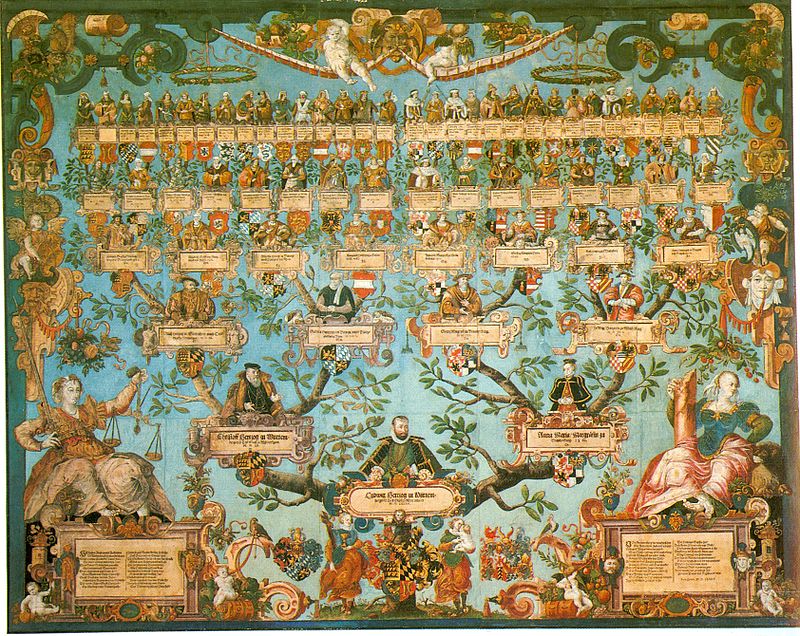
An
example of a naming tradition from England, Scotland and Ireland:
Child Namesake
1st son paternal
grandfather
2nd son maternal
grandfather
3rd son father
4th son father's
oldest brother
1st daughter maternal
grandmother
2nd daughter paternal
grandmother
3rd daughter mother
4th daughter mother's
oldest sister
"Infinitely more numerous than the living, the dead are also infinitely more powerful than them. They govern the immense domain of the unconscious, this invisible domain which contains under its empire all the manifestations of intelligence and character." -Gustave Le Bon, 1894
Arc
of Ages
Ancestral Field, Dream
Field, Dialogical Field
Return to Origins
Genealogy is the
archaeology of the psyche and way to confront the unconscious. The family tree
is the epic narrative arc of origins. Genealogy encapsulates the myth of our
lives: the question of inheritance, our relationship to the past, and its
relevance to the present.
We need metaphor and
mythos to understand the world. Such myths or metaphors are not fantastic
elaborations but are fundamental and essential to our emergent process. Jung
considered myth the authentic and primordial voice of the collective
unconscious.
We don't have the
option not to choose one, so the myth we 'choose' is important to our 'frame'
or intuitive understanding of the world. Truth
discovered through mythos is more subjective, based on individual feelings and
experiences.
In this sense, both
myth and genealogy are conceptual frameworks. In fact, myth is present in all
conceptual frameworks, though perhaps not so obvious. Myth and genealogy are
embroiled through out history. This is the condition presented to us in our
family tree.
We don't introduce
mythic figures into genealogy. They are already there for us to contend with.
We don't enter genealogy intending to root ourselves in myth, but discover it
there already. The family tree is an image of the mythic descending into the
socio-cultural-historical dimension. Beginning
our project with genesis, we certainly expect some revelations.
We have to learn with
effort the negations of our positions, and to grasp the fact that life is a
process that takes place between two poles, being only complete when surrounded
by death. ~Carl
Jung, 1925 Seminar, Page 86
Jung suggested that we
can only find our myth if we are together with our
dead. We
have to answer the call of our own dead. For Jung finding
his myth could only take place in conjunction with his dead. Genealogy
brings us into conjunction and alignment with our dead.
Cycles of Life
Each of us emerges
from the dark light of the soul -- the divine Void, the boundless expanse,
pre-differentiated universal ground. We recursively turn back to our origins in
a poetic pilgrimage like the ouroboros serpent biting its own tail, in an
archaeological self-examination of the unconscious horizons of human experience.
Lifeforce pervades the
whole body as the basis of consciousness and the flow of energy. The Tibetans
suggest that light-bearing cells of the “mother seed essence” and the “father
seed essence” retain their identities as the essence of the egg and sperm and
separate out in magnetic polar connection, forming the basis of the central
energy channel. Biologically, a radial line defines itself from the center of
the embryonic disc. The neural groove puckers up and curves over to form a
tube. The tube is actually entrapping electromagnetic field lines of force.
Narrative therapies
like genealogy help us find innovative moments, unique outcomes, and to change
and expand our life story. We remember their stories when we have deep feelings
or hear something that reminds us of them. They remind us of stories behind our
feelings - the world of personal meaning.
The ouroboros eats its
own tail to sustain its life, in an eternal cycle of continuous renewal -- duality of
creation and destruction and thus the birth of life through opposites. Life changes
form and condition, dies and is reborn.
Genealogy helps us
stabilize and reconceptualize our life life story from a multi-vocal
meta-perspective. Constraints of our problem-saturated stories and plot give
way to the Big Picture of unfolding life.
Consanguinity
distinguished archaic communities and clans from one another. In the
precultural world a mother could be sure of her offspring. The terror of the
primitive imagination was filial and mystical. Voices emerge from the dominant
narrative plot. Rigid narratives give way to ancestral conversations. We
assimilate them as unpredicted meaning bridges that tie our experience
together.
Genealogy starts off
like humanity did -- by hunting and gathering. We want to be explorers, not
just knowers, but seekers. Nietzsche claims, "We knowers are unknown to
ourselves, and for good reason: How can we ever find what we have never looked
for? The sad truth is that we remain necessarily strangers to ourselves, we
don’t understand our own substance, we must mistake ourselves; the axiom, “Each
man is farthest from himself will hold for us for all eternity. Of ourselves we
are “not knowers.”(1887/1956, p. 149)
We
hunger for the unknown. The famous T.S. Elliot lines apply to self-knowledge:
"We shall not cease from exploration, and the end of all our exploring
will be to arrive where we started and know the place for the first time."
Our hunter and
gatherer instincts define our research style. It takes hunting to dig up new
material, break brick walls, and discover secrets. We may find fossil-traumas
in the family record. New stories are therapeutic opportunities we may ignore
or trivialize when obsessed with our problematical story. Small but significant
changes, emergent properties, mark narrative development.
Genealogy leads from
the concrete and known toward the legendary and mythic -- unknown and beyond
comprehension -- secrets beyond secrets with no resolution in sight. The
ancestors bring a new movement and dynamic to the landscapes of action and
consciousness. Time, action, and consciousness converge in transformation of
emotions, values, and thoughts. With meta-reflection we can describe that
transformation, understanding how and why we've changed.
Gathering quantities
of data helps us make broad connections and find patterns and universal
life-themes. People and places initially excite our imaginations through their
incomprehensible mystery. Gradually, with challenging struggle, purposive
suffering, and creative endeavors, we learn to 'cultivate' that mystery and to
'cook' it with integrative work, engaging the opposites and our projective
tendencies.
Union of Souls
What can be known is
the discernable tree, though much remains occluded. As Jung noted,
"...there is a field of the unconscious both above and below us" --
the light and dark, the male and female, spiritual and chthonic/instinctual,
legality and maternity, etc. Each ancestor, as with each god, is a way we are
shadowed. Indestructible life is simultaneously the the god of death and the
dead.
More than a trope of
the tree and the blood, or a modular assemblage, the pedigree is established
only by valid evidence. Genealogy without proof is mythology. Intelligence
emerges with symbolic language. Symbols can be both literal and metaphorical.
Alternate stories rich in metaphorical resonance come out of the shadows.
Content, Context,
& Reflexivity
The real and symbolic
facts of who we are and where we come from, and our ancestors, are fundamental.
Reflexivity as interpretation and reflexivity as genealogical identifies
unmarked intentionalities in research. In narrative, psychosensory experiences
are described from the inside outward, from resonance with one's own body,
using meditation and sensory awareness to deepen experience.
Historical context is
the elements that permeate the lives of every living person; the local history
of where they were born, the events that may have shaped their lives, and the
living conditions that often can provide some measure of explanation about who
they were as people. Community context or proximity implies a relationship of
some kind.
Digital retrieves the
medieval information we can use to build context among our many ancestors of
that era. The lived psychophysical experience with the nuances of the body can
be embodied in writing. Telling such stories honors the ancestors. Narrative
patterns include:
- Striving toward a goal
- Overcoming obstacles in pursuit of a goal
- Solving a mystery
- Resolving a problem
- Bringing order to chaos (return to equilibrium)
- The journey
- Flight and pursuit
- Coming of age (from innocence to experience)
- Personal growth
People come to
genealogy from several motivations: when loved ones die or are born, the desire
to carve out a family place in the larger historical picture, to find lost
roots or unknown family history, a sense of responsibility to preserve the past
for future generations, to join heritage or communitarian societies, to
recognize or embellish descent, to find kin, and a sense of self-satisfaction
in accurate storytelling.
But self-knowledge is
primary, as are symptoms, healing, and synchronicities. Naturally, the web has
led to an explosion of interest, research, and communication. Anyone captured
by family stories can check them out in a number of ways. The structure of the
family tree helps us value our underpinnings, to carry an emotional-cognitive
structure across time -- identifying, recognizing, and connecting things,
events, places, and people. This is memory, which guarantees continuity to
life.
The pedigree is a
physical and cognitive instrument of navigation. Some liken it to a voyage of
initiation and learning to navigate through the fathomless ocean of the
collective unconscious -- living one's life as a voyage for its own sake.
"The sea is the
favorite symbol for the unconscious, the mother of all that lives." (Jung;
Special Phenomenology; Part IV; Psyche & Symbol).
As Proust says,
"The voyage of discovery is not in seeking new landscapes, but in having
new eyes." We can deepen our consciousness as we adapt to our current
situation. This arc carries both divine seed and divine knowledge -- a way for
us to circle around and find our ancestral alignment within the precessional
ages we can never know.
Being & Not-Being
The genealogy is the
map, but the ancestral field is the territory. Once we cross the threshold our
genealogical journey begins. In this sense, we are The Fool, like Parcival in
the Grail Quest, abandoned to the unknown, entering uncharted areas -- the soul
venturing into itself and crossing the threshold to new dimensions. This is the
field of interrupted communications between members of different generations.
The pedigree and Grail mirror one another as containers for the royal bloodlines.
A true and authentic
life resonates over time. Our approach will varying depending on well-being,
anxieties, woundedness, optimism, and confidence. This is revealed in the
psychological family tree of hidden issues, rather than the simple physical imprint.
Genealogy is no longer androlineal. Data bases help us find female ancestors
and lines of descent in which women are preferentially included. Paternal
primacy is a genealogical relic.
Archaeology of the
Soul
We may find Gateway
ancestors, each of which has proven lineage back to royal lines. This vastly
expands our ancestral horizons. Our notion of what it means to write the family
history expands. This is a psychological, not secular or religious approach,
describing psychic phenomena (psychic facts, images, human phenomena) not
metaphysical assertions. The
narrative carries the chronology along, but once in a while you stop and paint
a picture.
'Bringing in the
sheaves' of numerous groups of ancestors, we reap the abundant harvest of their
lives. Each generation doubles their numbers. Though taken by The Reaper, we
reap them back and craft them into the Bread of Life, the family story.
"He that goes forth and weeps, bearing precious seed, shall doubtless come
again with rejoicing, bringing his sheaves with him." (Amer. King James
Bible, Psalms 126:6)
In Asia, the archetype
is played out -- sheaves are brought in as effigies of rice ancestors. Some
people make pilgrimages to the effigies of their ancestors in cathedrals and
country churches, gazing at the blank stares but seeing through to the person.
Once we harvest the sheaves of generations they are dried and threshed. After
the first collection, we are left with the gleanings, the details we can gather
that were lost or first overlooked.
Ideally, like therapy,
the genealogical process can release "an experience that grips us or falls
upon us as from above, an experience that has substance and body such as those
things which occurred to the ancients" as Jung describes it in Seminar 1925
(pg. 111) -- a sort of personal Annunciation of our own connectivity with life.
As Giordano Bruno suggests, "there is nothing without participation in
Being, and there is no being without Essence. Thus nothing can be free of the
Divine Presence."
Rituals of Recognition
Our
frame for this genealogical approach is 'this is ritual' -- and a complex one,
at that. Ritual is a meta-communication. It tells us this highly-contextualized
activity is different, deliberate, and significant, so pay attention. Sometimes
trauma-based coping behaviors, repetition, or dysfunctional rituals can become
addictive. Compulsions may also lead to purposeful results.
It is a rite -- a
series of sequential acts -- because it is a social, religious, cultural
procedure that symbolically conveys meaning about events to participants. Like
other ritual behaviors it is first experienced in the family. Certain emotions
are produced and expressed spontaneously. The ritual evokes, allows, and
contains strong emotions, accessing mind-body states.
Genealogical rituals
of recognition deepen and rewrite our perception of reality with rituals of
induction, remembrance, and modulation of emotion. The integral function in
this process is inherent if we can mobilize it. We may in some sense feel that
we are 'born to do this,' but there may still be a gulf between our intention
and its tangible effects.
In this gap, like the
space between breaths, we find transcendence. Genealogy becomes an art
when it grips us. Jung also cautions a "new idea always has to fight for
its life against these ancestral predispositions."
Our pedigree is our Book of Remembrance.
This is our Quest;
this is our Grail:
Spirit descends to
lower regions from mythic roots. Sometimes we can't perceive things until we
have the right metaphor to bridge the gap between matter and spirit.
Metaphor is one of the
favorite allegories of ancient and modern poets and philosophers for the
process of human transformation. We liken one experience to another as if
it were that experience.
As a metaphor, the
Grail is always relevant and means many things to many people. It is an undying
symbol of the archetypal quest of human life -- a search for accomplishment and
meaning.
The Grail has been secularized as metaphor,
and re-sacralized in Grail scholarship and fiction. It also remains the
potential for healing psychic wounds. The question is who can grow this
potential into something more.
"The grail becomes
symbolic of an authentic life that has lived in terms of its own volition, in
terms of its own impulse system, which carries it between the pairs of
opposites, of good and evil, light and dark. Wolfram starts his epic with a
short poem saying, “Every act has both good and evil results.” Every act in
life yields pairs of opposites in its results. The best we can do is lean
toward the light, that is to say, intend the light, and what the light is, is
that of the harmonious relationships that come from compassion, with suffering,
understanding of the other person. This is what the Grail is about." (Joseph Campbell, Power of Myth)
Voices of the Past
Jung reminds, "After all, we really can
think, even if not with an absolute independence from nature; but it is the
duty of the psychologist to make the double statement, and while admitting
man’s power of thought, to insist also on the fact that he is trapped in his
own skin, and therefore always has his thinking influenced by nature in a way
he cannot wholly control." (1925 Seminar, Page 83)
Hillman
sees metaphor as an “as-if fiction,” both a form of being and a style of
consciousness, a way for the psyche to see through itself. The metaphor itself
is a myth -- an expression of creative mythopoesis.
Of course it is quite
useful to us to have the idea that our thoughts are free expressions of our
intentional thinking, otherwise we would never be free from the magic circle of
nature.
(Jung, 1925 Seminar, Page 82)
Narration is a root
metaphor. Self-narrative is an identity construction. We habitually tell people
'who we are' in terms of our short- and long-term past and presumed
achievements and experiences. These stories help order world and self. It is a
concept of self that takes the role of the body, or embodied nature of the self
into consideration.
Narration is rooted in
the notion that story telling is cross-cultural. The dialogical realm
creates a mind-space with multiple positions possible for multiple selves,
'growing' one another. There may be a reason we favor 'exemplary' ancestors who
were wise while alive and remain so in the invisible world. Being dead does not
necessarily make ancestors 'smarter.' Hillman suggests we aspire to be
exemplary ancestors ourselves.
20/20 Hindsight
Genealogy helps us
reclaim the self. You rewrite and integrate the story of your life -- a
personal path worthy of the soul and a way of life that includes the paradox of
begetting and death. There is a physical, emotional, and intentional arc to our
epic tale. You are the intentional arc -- what interests you, how you interpret
what you find, and what and who you love.
The heart is the organ of
opening up to somebody else. That’s the human quality, as opposed to the animal
qualities, which have to do primarily with self-interest. Opening up to
that which is other is the opening of the heart, and that’s as the troubadours
saw it, is the opening of the heart. (Campbell)
In "Masks of
Eternity", Campbell tells us that looking back over our lives, in retrospect
it seems the plot of our life-narrative has a coherence we could not recognize
along our journey. What he says can be applied also to our genealogical
narrative arc, to the dreamfield of characters we interact with there and to
the development and uncovering of intergenerational life-themes. The
multigenerational approach has it own coherence and milestones of discovery and
exploration.
Pattern-recognition is
part of our human wiring; we instinctively seek order for security. Stories
help us order world and self. Like myth our concepts are fashioned by empirical
elements. But tidy metaphors don't always work; some of them can be very messy
and inconsistent, much like the edge of chaos from which order emerges in chaos
theory. The missing information may be already within us as insight, though it
has not emerged or unfolded.
"Schopenhauer, in his splendid essay called "On an Apparent
Intention in the Fate of the Individual," points out that when you reach
an advanced age and look back over your lifetime, it can seem to have had a
consistent order and plan, as though composed by some novelist. Events that
when they occurred had seemed accidental and of little moment turn out to have
been indispensable factors in the composition of a consistent plot. So who
composed that plot? Schopenhauer suggests that just as your dreams are composed
by an aspect of yourself of which your consciousness is unaware, so, too, your
whole life is composed by the will within you. And just as people whom you will
have met apparently by mere chance became leading agents in the structuring of
your life, so, too, will you have served unknowingly as an agent, giving
meaning to the lives of others, The whole thing gears together like one big
symphony, with everything unconsciously structuring everything else. And
Schopenhauer concludes that it is as though our lives were the features of the
one great dream of a single dreamer in which all the dream characters dream,
too; so that everything links to everything else, moved by the one will to life
which is the universal will in nature." (Campbell)
One Blood; One Field
The 'dreamfield' is
also a dialogical field potential. We construct our reality with inner and
outer conversation as much as by observation. All aspects of the self have their
dialogical component, which allow us to amplify our direct experience,
including that of our ancestors, our "invisible guests."
Conversation is one of
our main ways of inner and outer thinking and expression. Dialogue bridges
conscious and unconscious and activates the transcendent function. It doesn't
matter if we do it intentionally or it happens to us spontaneously. Jung says
"In reality we imagine nothing, it imagines itself." (ModPsy, ETH
Lectures, p.53).
We can shift the point
of view between the various entities imaginally engaged in the dialogue.
The participant becomes the imaginal other, and speaks "as if" that
other. The other is "felt" to be there, to be seen, to be known but
not literalized.
The dialogical self describes our ability
to imagine the different positions of participants in an internal dialogue, in
close connection with external dialogue -- finding a voice for emerging
meaning.
Psyche is a semantic,
symbolic and noetic field. Duality between consciousness and nonconsciousness is
the contrast between our everyday experience (individual consciousness) and all
nonconscious processes.
This duality is
fundamental; we literally cannot ever know what it is like to be our
nonconscious processes. We can only know what it’s like to be our conscious
awareness. Yet, all the mind-body processes of which we are unaware are at
least as aware if not more aware than our individual conscious awareness, and
elements of who we are. Thus, they are related to our ancestry.
Fields are domains of
influence. Storytelling describes a deep field of myth and archetype. Elements
are woven together by narrative, metaphor and illustration. A semantic field is
a set of words grouped by meaning referring to a specific subject, much like
symbols are held in the subtle net of an image. The language of symbols is
oldest.
Noetics, direct
knowing, is the connection between mind and the physical universe - how the
‘inner cosmos’ of the mind (consciousness, soul, spirit) relates to the
‘outer cosmos’ of the physical world - the somatic field of our psychophysical
being. All
are components of the Ritual Field of mythic sensibility.
The field of myth is
emotional -- emergent, resonant, challenging -- inviting ritual enactment to
animate and embody it. Thus, we recognize and develop our
own style of mythic consciousness, stepping into joining with others, daring to
live our larger lives within the field of historic life.
Components of the
unconscious emerge in conscious life. Personal myth, (a biochemically-coded internal
model of reality and a field of information), shapes individual behavior as
cultural myths influence social behavior. Symbolic content is a mythic field.
Shift the field, change the myth. Rituals shift the field.
Metaphor--what
the experience is like--is the structure producing coherent, ordered
experiences. The metaphors are usually those of physical experience.
Creative engagement with chaos means direct experience of self as a changing,
pluralistic, multi-dimensional entity.
This existential philosophy
of "dynamic co-consciousness" is process-oriented, rather than
"state-oriented" even though we employ the term state to imply a
stable-yet-transitory condition. This is not an experience of a static
"self" moving through process, but rather existential or
phenomenological experience of self as process.
In Liber Novus, the portal to his unconscious
encounters, Jung produced a de
facto
"theology of the dead." If we deny the dead, we deny ourselves. Their
redemption doesn't save their souls, but suggests we take on the legacy of the
dead, hear their lament, and answer their unanswered questions with our own
conversations, insights and clarity.
Such clarity is a
legendary hallmark of ancient bloodlines. In Greek, drakon (dragon), as in edrakon, is past tense for derkesthai, meaning 'to see clearly.' A dragon
was one who saw clearly, and clarity of vision engendered wisdom, which
produces the creative power of intuition, prediction, and synthesis.
In
Sanskrit vid
means ‘to see’ or ‘to know’. In German wit
means ‘to know’, and in Latin videre
means ‘to see’, and video
means ‘to record’.
We have to
discriminate who and what is there, and among their voices, and note it, then
record it -- to see clearly with wisdom -- to be a 'seer' and intuit gnosis.
Clarity comes from clarifying the family tree. We participate more knowingly in
the process of multigenerational integration. Ancestors can be guides who open
access to spiritual understanding. As with the Grail you have to know what to
look for and how to look for it, knowing it may be found within the heart.
Renewing the Mystery
That presumes we are
capable of integrating the collective unconscious in the individuation process
and the paradox of the death/rebirth experience. Health is the natural outcome
of a meaningful life, not just absence of symptoms. “Then turn to the dead,
listen to their lament and accept them with love.” --C.G. Jung, The Red
Book, Chapter XV
One of the key themes
in ‘The
Lament for the Dead’
is the denial of death by contemporary, secular Western culture. Our ancestors
are not properly recognized and given their due weight – there is no real place
for the dead in our culture. Shamdasani says on p.176:
“The first task that Jung
finds himself confronted with
[as I think anyone engaged in this descent is] is reanimating the dead,
acknowledging that the dead are, and they have presences, they have effects. We turn
our eyes away from future-oriented living and to what has gone before, in the
shape of animated history, history that is not simply a record but history that
is active.”
The
key to personal transformation is story transformation. It is symbolic,
life-changing -- a massive reorganization of attitudes, behaviors, and meaning.
If symptoms are our entree to the unconscious, we can follow Hillman's prescription:
"To heal the symptom, we must heal the person, and to heal the person we
must first heal the story in which the person has imagined himself."
Our
symptoms can reflect our cultural as well as personal attitudes. What if we
embrace the body as a loving partner and have faith in our experience?
Can we sweet talk our ancestral spirits into sharing their secrets? We carry
our ancestors and histories, as well as the whole history of humanity, with us
into the present through our bodies. They affect us by influence, impact,
making a difference. Such impressions touch us by moving our feelings
emotionally, even tugging our heartstrings.
Our feelings and
thoughts become manifest in our physical structure. The past is
"sedimented" in the body -- that is, it is embodied. The sensory
apparatus of our body is the only way we experience the larger world. It is the
medium through which we meet and respond to that world, feeling its reciprocal
impact on us.
Begetting & Forgetting
History, the narrative
of our personal, familial,and collective pasts, shapes and informs our
identity. Narratives, both personal and collective, arise from
the desire to have life display coherence, integrity, fullness, disclosure, and
closure. Even therapy has the premise that reshaping or reframing events lends
a sense of coherence where there has been chaos. We explain ourselves with
stories and learn how
to organize and make something whole from sometimes chaotic feelings of pain
and confusion.
What we think about
our story and fate conditions our experience. For example, when author Dr.
Oliver Sacks was diagnosed with terminal cancer, he wrote on gratitude, “I have loved and been loved. ...
Above all, I have been a sentient being, a thinking animal, on this beautiful
planet, and that in itself has been an enormous privilege and adventure.”
Posted on Dec 4, 2015
Change the history or reframe the story and the attitudes associated with it
automatically change. If the soul is beyond male/female, then it is
beyond life/death, and the host of opposites. Stories link the factual to the emotional, the specific
to the universal, the past to the present. A child hearing a story thinks,
“There are others like me.” A storytelling parent models coping skills and
provides a template for self-expression, logic, and how to prioritize.
The development of these narratives is preeminently, a cultural process. Even
though the premise is unspoken, we have come to tacitly expect a
"beginning, middle, and end" to our personal stories. Most of us
would like to imagine an optimistic end to our stories, one that provides
meaning and purpose for our lives...a "good", if not always
"happy" ending.
Metamorphosis is the
classic metaphor of major life passages and restructuring. Latent potentials
emerge and outworn characteristics decline. Some qualities are hidden until our
true nature is revealed as a new form of life and self-identity.
Genealogy is not a
group pursuit but a path of individuation. Even other family members need to
find their own way through the family maze, though you share large parts of it
and have similar experiences. In fact, genealogical or heritage groups can
disrupt the process, imposing their own collective interpretations, ideas and
beliefs, right and wrong, on individual process.
Collateral Grafting
& Consanguinity
There are enough
inherent problems in genealogy - legitimate filiation, dynastic supremacy,
elder and younger (cadet) branches, forced coexistence, innumerable clerical
errors, transmission gaps, and lapses of focus, to say nothing of successfully
hidden or misattributed births. The tree-like structure can conceal
exclusion, discrimination, and abusive graftings, even amputations.
The discourse of
lineage and descent can be subverted for familial legitimation. For most of
history, paternity was a legal fiction. Primogeniture was tied to succession
and common-law inheritance. Androlineal genealogy was the necessary instrument
of social origins and legal deeds.
Some family secrets
are held close through "closed subject" attitudes -- silence about
notorious relatives, silence about the privations and desperate acts in war and
war crimes, hidden guilt of eco-cide, perhaps even up to and including such
abominations as cannibalism can be found even in colonial ancestry -- the
gruesome details of survival and survivor guilt.
While the regressive
tribal worldview may be a valuable passage it is not the center of the process.
While participants may feel 'found', they can also be derailed from their own
course while seeming to fulfill it or fall prey to trickster personality cults
with taboos and superstitious or doctrinaire beliefs. After all, we construct
our reality from our beliefs. Much of it can be shared folly, and acceptance of
the fantasies of others -- a corruption of individual emergence. Transformation
is not a group process.
The Gift of Life
Who are we? Where do
we come from? And how do we know what we know when we know? Our ancient origins
physical story continues to reveal surprises from the archaeological records.
Humanity has been shaped by genetic admixture with other hominid and even
bacterial species, including archae.
The physics of the
soul has been more difficult to unearth, though many have tried in
transpersonal psychologies and the field of Consciousness Studies. Life appears
as a hyperdimensional biofield. Naturally, life itself remains a profound
Mystery. We know nothing about its transcendent source, only the rapture of
being alive.
Original
Awareness
The family tree is the
narrative arc of origins. Who are we? Where do we come from? And how do we know
what we know when we know? Our ancient origins physical story continues to
reveal surprises from the archaeological records. Humanity has been shaped by
genetic admixture with other hominid species including bacterial archae.
The physics of the
soul has been more difficult to unearth, though many have tried in transpersonal
psychologies and the field of Consciousness Studies. Life appears as a
hyperdimensional biofield. Naturally, life itself remains a profound Mystery.
We know nothing about its transcendent source, only the rapture of being alive.
But we know that the meaning
of life is just that -- we exist, and that alone is tremendous. “Life has no
meaning. Each of us has meaning and we bring it to life. It is a waste to be
asking the question when you are the answer.” “The privilege of a lifetime
is being who you are.” (Campbell) It's
not the search for meaning, but the experience of it -- casting off death and
being reborn again, telling a story, and living on. The
meaning of meaning is relationship.
Some suggest quantum
and even subquantal descriptions of primordial consciousness, which could be
described as identical with or inherent in matter, or the breath of our first
cry. Breath can lead us back home through the labyrinths of mind, emotions and
sensation. The deepest sources of the psyche permeate the body. The
instinctual-archetypal unconscious reflects the lost and potential life of the
body.
Unconditioned
consciousness does not mean individual awareness. The larger concept includes
the personal unconscious and collective mind, conscious and unconscious -- the
union of the serpent (subconscious) with the eagle (super conscious). The
unconscious is the "emotional" memory (sights, sounds, smells,
emotions, and physical sensations linked to positive (happy, pleasing)
situations or negative situations like the experience of loss, pain, despair,
or danger.
Conscious
and unconscious memory systems need to pool their information and work together
for our well being. The "unconscious" is a magical powerhouse that
speaks in symbols and through symptoms. Consciousness is the bottomless pit of
the indivisible whole. It means the world. In the most inclusive sense it is
cosmic consciousness. The mind's nature is primordial awareness, practiced by
mystics and sages from time immemorial.
Tracing Our Lineage
As ancient hominids we
may have left the trees and our arboreal life but we never entirely abandoned
them. When we descended from the canopy, we acquired another sort of tree that
went with us -- the family tree and relations of our clan.
In Origins of the Modern Mind, Merlin Donald (1993) concludes
that the australopithecines were limited to concrete/episodic
minds: bipedal creatures able to benefit from pair-bonding, cooperative
hunting, etc., but essentially of a seize-the-moment mentality.
Mimesis is the easiest
way to learn. The first transition was to a "mimetic'' culture of making
sense: the era of Homo
erectus in
which mankind absorbed and refashioned events to create rituals, crafts,
rhythms, dance, and other prelinguistic traditions.
Eric McLcLuhan (2015)
says, "Mimesis is the technique of interiorization: knowing by
putting-on, knowing by becoming,intellectually and emotionally, the thing
known. That is, integral, interiorized knowing instead of conceptual knowing:
unmediated, direct perception by the body and the emotions and the intellect of
the hearer, that is, by the hearer’s soul. Direct experience by total
submergence." (p. 27, infra.) He calls mimesis a tangible affective
vortex of real power.
The
evolution to mythic cultures followed: the result of the acquisition of speech
and the invention of symbols. The third transition carried oral speech to
reading, writing, and an extended external memory-store seen today in cloud
technology. Myth is
the instant vision of a complex process that ordinarily extends over a long
period.
Myth is contraction or
implosion of any process, according to McLuhan who argues that the “mythic or
iconic mode of awareness” substitutes a “multi-faceted” perspective for a
single, fixed point of view. Mythic environments live beyond time and space,
generating little radical social change.
Tribal man is tightly
sealed in an integral collective awareness that transcends conventional
boundaries of time and space. As such, the new society will be one mythic
integration, a resonating world akin to the old tribal echo chamber where magic
will live again: a world of ESP. ... without any verbalization at all. (McLuhan, Playboy Interview). He
claims the electric puts the mythic or collective dimension of human experience
fully into the conscious wake-a-day-world.
New archaeological
finds have helped us discover human hybrid interbreeding among the archaic and
extinct hominins. Until recently such traces of
by-gone eras were indetectable. Genome analysis suggests there was cross-species
interbreeding between modern humans, Neanderthals, Denisovans and additional
unknown archaic populations, perhaps as far back as Homo Erectus.
http://fabweb.org/2015/12/06/this-archaeological-discovery-throws-story-of-human-evolution-into-disarray/
We are in no way
separate from Nature and our nature is archetypal. The archai are the deepest
forms of psychic functioning. We discover how to orient ourselves in the tidal
pathways of the unconscious. We see that our shadows and strengths fall into archetypal
patterns -- the timeless parts of ourselves we act out unconsciously. Our
genealogical maps help us find our way into the deep unconscious and our
greatest possible treasure -- our inner gold.
Self-Awareness
We are always telling
and remembering and forgetting our stories and those of our near and distant
families. The primary tale is from whom we descend through archetypal process
and relationship -- the arboreal mythology of the family tree.
Issues include ‘to be
or not be’ and ‘to belong or not to belong.'
Our inherent way of
expressing is our flow state, our gift, and fulfillment of our personal myth. We
can enter our story more deeply, make it bigger, by including our ancestors and
archetypes in our practice. Hillman describes how soulmaking is revealed in
psychic images to which a person is drawn and apprehends in a meaningful way.
He considers death as
a permanent resident of the psyche, and Thanatos as a mode of soul-making: “The
death experience brings down the old order and in so far as analysis is a
prolonged ‘nervous break down’ (synthesizing too, as it goes along), analysis
means dying.”
Indeed, the act of
being drawn to and looking deeper at the images presented creates meaning –
that is, soul. Modern thought often tries to find body by gathering literal data. But Hillman favored the
bodies of ideas and words themselves, the body of an image.
The speech of the soul is always riddled with images and fantasies, which
cannot and should not be taken literally or concretely. He
points out, the alternative to such literalism is mystery.
Imaginal Understanding
Restoring psyche, we
see soul at work, in fantasy, imagination, myth, and metaphor. But, as in
metaphor, things can be 'like that,' but not that. Neti neti; neither this nor that. Literalism
dominates everyday discourse and is probably the biggest pitfall on the
genealogical path. Without metaphorical understanding, everything is only what
it is and must be met on the simplest, most direct level. Such fundamentalism
can be a regressive, displaced tendency.
For
example, while the heroic notion has served ego psychology for millennia, we
can see beyond the urge of the conquering hero to deeper wisdom and insight
beyond the manic ego-driven modality which has had its day. The perspective of
the human ego certainly isn't superior.
Literalism has more to
do with beliefs, religiosity, cult behavior, and esoteric metaphysics than it
does with a balanced psychological approach. Psychopathology
is also part and parcel of the same process and the source of illusion and
delusions about self, others, and world.
Real meaning is beyond
the literal and naturalistic fallacies. The poetic approach means exploring
images, rather than explaining them. In this sense our ancestors are not
allegories but modes of reflection. We cannot 'use' our ancestors, individually
or collectively, as some people 'use' dreams in a mundane, prescriptive way.
The
Great Work
This is our spiritual
path that reaches back into the mists before time. This is our mythic journey
of self-discovery. This is our quest for a world beyond our senses and the
hidden mysteries of humanity. Beyond the trendy 'power of Now' lies the power
of 'now and again.'
Genealogy is a
foundational metaphor, generating long chains of simple structured connections,
but it is more than a metaphor. We actually continue the undertaking of those
who have gone before us in more ways than one. Perhaps someone else in the
family collated the genealogy of their day. The transgenerational challenges
will have been passed on and remain, as well as any family aspirational drives.
Genealogy is a big
project but opens a sacred dimension. Each ancestor is the gateway to
another timeline back to the past. First they diverge; then they converge. Our
lines of descent connect us to the mythic realm as our own great-grandparents,
making that relationship more personal, truly familial. The notion of 'descent'
is somehow related to the archaic descent into the cave or tomb of the
ancestors.
Descent
seems to be very steep & dangerous. The ascent is always laborious, yet it
is a well-trodden path. But the downward path is new.
Many
have gone down, but they usually slipped, so it has a slippery surface; one
finds pars of wrecked cars, trousers, shoes & skeletons, perhaps of people
who gone to smash on that path. This
is the path of danger. (Jung, Visions Seminar,
Page 94)
We pay attention to a
history created by own ancestors. This is the realm of cultural heroes and
royal founders. Early on genealogy became a method of explaining history and
finding origins. It articulates the relationship of the body and history. The
family tree and the knowledge tree are one.
Intergenerational
family identity is positively related to well-being. Genealogy can be our
retreat, our sanctuary, a form of pilgrimage -- if we but answer 'the call'
from the depths of our hearts. We can 'mine' our lines of descent much like we
'mine' myth for meaning. Myths like ancient theories fill in the gaps in our
knowledge but in a soulful rather than utilitarian way. The archetypes fill the
gaps to compensate our spiritual deficiencies.
The
archetype does not become meaningful until it goes out into the world and takes
part in life according to its nature and
according to the time
in history in which it occurs. The
facts of the specific
cultural and personal existence
provide the actual
clothing of the archetype. In other words
the archetype is only
an inherited mode of expression.
Jung noted, "Besides the obvious personal
sources, creative fantasy also draws upon the forgotten and long buried
primitive mind with its host of images, which are to be found in the
mythologies of all ages and all peoples. The sum of these images constitutes
the collective unconscious, a heritage which is potentially present in every
individual."
Carl Jung, CW 5, Symbols of Transformation, Pages xviii - xvix
Genealogy Beyond the
Grave
We see directly that
all these ancestors are 'mine' -- 'my very own', giving new meaning to both
myth and history. This is our Way, this is our path. The mythic perspective
gives us access to unseen realms. Some say, "it
does seem I fall into a type of revelatory trance where aspects of these
people’s lives are made clear." Or, "downloads
as I call them for lack of a better word sometimes come out of the blue, when I
am meditating, or even studying the past, mysticism, etc."
Through the ancestors
we can explore the meaning of power, surrender, commitment, betrayal,
abandonment, and a variety of other human concerns and events. As Joseph
Campbell said, to find your own way is to follow your bliss -- the
transcendent wisdom of the divine that connects us to source and joy.
Remembrance is
important to us as a species. Living with the dead brings us as a species from
nature into culture. Medieval history emerged from genealogical tales. We
regard our dead as social beings,
easing out of this world, settling safely into the next and into memory.
When we begin our
Great Work, we are met with a profusion of genealogical and geographical
materials. We must learn how to navigate the depths of our unconscious ocean,
steering our way through currents, maelstroms, tidal waves, and becalmed waters
as navigators. How do we come to know the sea's dark secrets? As Kabir says,
"All know that the drop merges into the ocean, but few know that the ocean
merges into the drop."
Navigating the psyche
-- the ocean with many shores -- is no easy task. We are all subject to
self-delusion, misguided inner authority, the host of psychological illusion
from follies to participation mystique, to projective errors, confabulations,
and metaphysical beliefs. The imaginal gloss, right or wrong operates
throughout the whole process of seeking clarity.
Doing our genealogy
amplifies our personal story tremendously, providing facts, anecdotes, history,
and migration patterns. Genealogy arouses our unconscious with the emotional
dynamics revealed in the polarity process -- primal coupling. Confrontation
with the unconscious begins in the personal unconscious. Personally
acquired contents constitute the shadow.
Confrontation leads to
archetypal symbols which represent the collective unconscious. The aim of the
confrontation is to abolish the dissociation. The
opposites dance, braiding chains of transformations: the eternal and temporal,
the infinite and finite, freedom and necessity, life and death, light and dark,
ignorance and self-arising wisdom or self-knowledge.
Psyche exists as a
source of knowledge. "…[N]ature exists without human aid, can deal with her processes
herself, has everything in herself to bring about transformations, to move from
the depths to the heights and down into the depths again. (Jung, Modern
Psychology, Page 42).
Archetypes give us
some categories that help us relate to and understand all types of ancestors.
They are not static forms but dynamics expressing transformations in
consciousness. Archetypal images transform with awareness, appearing in many
forms as consciousness shifts.
To illustrate the
multiple personifications of psyche Hillman made reference to gods, goddesses,
demigods and other imaginal figures which he referred to as sounding boards
"for echoing life today or as bass chords giving resonance to the little
melodies of daily life" although he insisted that these figures should not
be used as a 'master matrix' against which we should measure today and thereby
decry modern loss of richness.
In this process of
integration, images appear spontaneously in dreams, imagination, art, and
spiritual vision. Primal images reflect the feminine (anima) and masculine
(animus) poles of psychic life. These parental pairs are reflected in our
genealogy with the child symbolizing duality merging into union and
self-renewal.
Genealogy describes
divine origins. It borrows the basic plot of Genesis with its metaphors of
birth, origins, and roots. It has many naturally overlapping concepts with
Jungian psychology that illuminate both to good effect. Jung speaks of the
ancestral unconscious, archetypes, the Masculine and Feminine, the syzygy, the
divine child, the royal marriage, the world tree.
The psychological umbilical cord of our genealogy
connects us not only to the divine source (realm of the Gods) but also to the
vaults of the unconscious (Underworld). We embark on a quest to search for the
World-Tree at the center of the Universe. This is a metaphor for our
genealogical quest for psychological realignment with our own inner center and
spiritual source. The tree is a symbol of the self and model of the psyche,
with roots stretching back into our earliest symbolic imaginations.
We sublimate the
cosmic energy that enters our being through realignment with the 'axis mundi'.
The cosmic axis connects our mundane material realm to the higher realm of
sacred power. The journey is perilous because a quest of transformation
requires sacrifice of the ego. The World-Tree is also a symbol of initiation
and transcendence. At the center of the Universe, we arrive at the sacred
center of our own being.
Processes like
amplification, active imagination, and dialogue naturally lend themselves to
the genealogical and therapeutic process. All this and more plays out in the
panoply of our pedigree, if we can trace our family tree back far enough. We become
acquainted with each connecting ancestor along the way.
Amplification
We can imagine our
ancestors living in the dreamtime and treat what we find there much like we
treat dream symbols. As in dreamwork, we are all parts of the dream, figure and
ground. Amplification honors the precise expression of the ancestor and
attempts to 'tune in,' uncover memories, feelings, insight or experience we
perceive for unique ancestors or family groups.
Amplification is an
attempt to expand our associations to, and familiarity with the ancestor,
without subjecting them to a cut-and-dried intellectual translation. Rather
than a historical perspective, we find out in a deeply personal way what this
ancestor means to us personally. Another
metaphor for our process comes from genetics where PCR amplification is used to
harness the natural replication of DNA molecules to vastly amplify a particular
DNA locus from a small amount of material.
In
genealogy, we amplify the informational content by all available means. We need
to identify, amplify, and integrate our ancestral legacy in our trails of
descent. Without it we may remain stuck in the wasteland of alienation,
dissociation, and existential crisis rather than integrating our unconscious
heritage and history. We can find our missing qualities in our genealogy.
We are seekers; we
seek dead people. To figure out what is happening in the present, we need to
figure out something of the past. Sometimes we can cultivate that information
or intuition into evidence. However, we imagine so many things to be true and
so many to be false, we simply don't know what is 'real' or not. Life comes
from your imagination and what you imagine to be real.
Raising Cain
Those who have not
done their own genealogies think some of the claims about conventional
genealogical results are utterly fallacious. But if you draw your own lines
past a certain era, you find the rumors are indeed 'true,' no matter what that
means in terms of symbolic, psychological, and mythic realities. Myth can be more
important than history in some ways.
We are descendants of
'dreamtime' ancestors. Naturally, such fabled lines are not literally so.
Though you or I can "raise Cain," Egyptian pharaohs, Sumerian kings,
Greek gods, Merovingians, and Grail knights in our drop lines, there is no way
to document such mythic descent. The name of the Sumerian god Enki means
'archetype.' The Dragon bloodline, Grail kings, and Merovingians are of the
First Family.
Yet, these are the ancestors of our souls,
of our psyche.
In this sense, Cain's
story teaches us the valuable first lesson that we must 'learn to deal with our
temper' or create havoc within and without the family. Alas, where did Adam and
Eve go wrong in failing to inculcate such values in the emotional life of their
son?
Our society is
oriented primarily around father and mother, patriarch and matriarch --the King
or Queen archetype and basis of unconscious tensions and hidden value
judgments. They give life to the archetypal Child, the new consciousness,
creativity, and archetypal Seeker.
Syzygy
When two people really
unite, their inner and outer worlds merge, whether in gnosis or shared folly.
Gnosis is a Mystery because its revealed truth can only emerge from direct
experience. Therefore, it remains a secret that cannot be told, because it is a
numinous experience -- a naked encounter with the divine.
We come upon our
ancestors unawares as we 'dig up' our connections with them. If we aren't
forewarned we may be shocked to find royals in our lines. The King or Queen can
bless us, knight us, and make us feel special and a valuable part of the whole
as no other archetype can. This may change our sense of self-identity forever.
It can bring new insight, understanding, and comprehension, but may also lead
to emotional flooding and an invasion of the unconscious as ego inflation.
We proceed along quite
normally, logging commoner and noble spouses and their ancestors, then suddenly
the atmosphere changes. Geography moves to imaginal landscapes.
Genealogy is a place
of exchange not only with ancestors, but between humans and a variety of
supernatural creatures of mixed human and legendary lineage. Such creatures
inherit different natures from their parents, but they still draw their
identity from the family unit.
Atavisms
The whole of evolution
is within us and recapitulates in uterine life. Development of an organism
expresses all the intermediate forms of its ancestors throughout evolution.
Atavism is the regressive tendency to revert to ancestral type -- an
evolutionary throwback or reversal. The word is derived from the Latin atavus -- a great-grandfather's grandfather --
or generally, an ancestor. An
anatomical atavism is a vestigial structure, or morphological anomaly.
Atavism is the
reappearance of a lost character specific to a remote evolutionary ancestor and
not observed in the parents or recent ancestors. Left-over traits from a
distant evolutionary ancestor can reappear long after they disappeared
generations before. Perhaps inherited genetic mutations, deformities, and birth
defects were confounded with mythic beings.
Ancestral Beings
Supernatural tales
have their liminal settings, mythical characters, inter-species romances, and
close family connections. The otherworld and the ordinary intermingle. The
gloss of imaginal vision co-exists with ordinary reality -- our desires,
phantasms, and projections. We may be shocked when we unearth such creatures in
our own lineage.
But it is not the
family ties nor the romantic fairy tale appeal of such inclusions but their
psychic necessity that makes them a legitimate part of our pedigree -- even if
disowned, repressed, or 'fictionalized', marginalized, or disregarded by modern
genealogical corrective trends. We enter the underworld when we cross the
threshold dividing the rational and historical from the irrational and
legendary.
We find curious
hybrids, from fairies and fish-men, to godforms with supernatural romances,
curses, and royal marriages in liminal spaces beyond mortal ken. Sometimes such
abyssal creatures with their disturbing transformations enter a lineage as the
result of a familial curse, a cycle of bondage and release -- bondage of the
vehicle, not the consciousness. Kabir
says, "“If you don't break your ropes while you're alive, do you think
ghosts will do it after?”
The ancients always
thought of coming events as having shadows cast in front of them. Here we have
an animal killed, a mythological animal in fact—that is, instinct. When it is
killed, someone will become conscious. In the story of Percival, the
unconscious hero Percival becomes conscious through the shooting of the swan. . . .A bird is a mind animal,
symbolically, so the unconsciousness is in the mind. One word more on the theme
of immortality. It is intimately linked up with the anima question. Through the
relation to the anima one obtains the chance of greater consciousness. It leads
to a realization of the self as the totality of the conscious and the
unconscious functions. This realization brings with it a recognition of the
inherited plus the new units that go to make up the self. That is to say, when
we once grasp the meaning of the conscious and the unconscious together, we
become aware of the ancestral lives that have gone into the making of our own
lives. ~Carl
Jung, 1925 Seminar, Pages 153-154
It is transmitted to
descendants in repeating cycles of suffering, heartbreak, betrayals,
separation, mourning, and death. This raises the specter that such demonic
behavior is related to medieval descriptions of mental illness and mood
disorders, such as schizophrenia, bipolar, narcissism, attachment disorder, or
borderline issues.
Some genealogists want
to expunge supernatural characters and liminal settings from the World Tree,
but we do so at our peril -- cutting off psyche from its own imaginal roots.
Naturally, to claim we literally descend from pixies, elves, fairies, dragons,
serpents, gods or goddesses sounds preposterous, unless contextualized as
imaginal.
"Inasmuch as the serpent leads into
the shadows, it has the function of the anima; it leads you into the depths, it
connects the above and the below." (Jung, 1925 Seminar, Page 102)
"The serpent shows
the way to hidden things and expresses the introverting libido, which leads man
to go beyond the point of safety, and beyond the limits of consciousness, as
expressed by the deep crater."
(1925 Seminar, Page 102)
"The serpent leads
the psychological movement apparently astray into the kingdom of shadows, dead
and wrong images, but also into the earth, into concretization." (1925 Seminar, Page 102)
Jung wrote,
"Christ himself compared himself to a serpent, and his hellish brother,
the Antichrist, is the old dragon himself." (Liber Novus, Page 318). Campbell calls the old
dragon the ego of need and greed (need, want, belief, restrictions) and said
the serpent shedding its skin represents the power of life to throw off death
and the bondage to life, to time, and the opposites.
The irreconcilable
dual nature of human and bestial ancestry demands we work that out for
ourselves, so it not turn monstrous. Ours is a very complicated and nuanced
family full of by-gone cultural dreams that still inhabit and inform our films
and literature.
http://scholarlycommons.obu.edu/cgi/viewcontent.cgi?article=1073&context=honors_theses
Family Wisdom
Our original awareness
of ourselves is that of a family member, born of our ancestors through our
parents into the House of our descent. We carry the First-Person perspective
(self, body, self-reference) even though we may be the last of our line. But we
can hardly claim self-knowledge if we remain unconscious of our unseen
forebears from both a genealogical and symbolic approach. Along with our
strengths we pass on our human weaknesses.
We may have different
intentions as we begin our genealogical work, but despite our approach
transgenerational EFFECTS will begin emerging spontaneously as a natural
consequence of stirring the unconscious. Real time effects, seen and unforeseen
always trump original intentions or will which has nothing to do with it.
Nature & Nurture
Unconscious forces may
amplify or draw attention to dynamics already in action -- chaotic
relationships, addictive patterns, psychophysical symptoms, outrageous
calamities somewhere between coincidence and fate, etc. as well as unconscious
determinism and mythic dynamics. Myth is sacred history, though it may not be
'true.' We may or may not notice similar patterns in our close ancestors, such
as star-crossed lovers or maternal fusion/absent father that can be the key to
healing.
Time Does Not Heal; It
Conceals
How could we have
something so life-changing, so valuable within and not even realize we have it?
The persistent state of unconsciousness keeps them secret, keeps them hidden
from us. Further, on a biochemical level, stress we experience during childhood
and adolescence catches up with us as adults, altering our bodies, our cells,
and even our DNA.
Adverse childhood
experiences, especially family trauma and abuse, change your set point of
wellbeing for decades to come. Early stories script biology that scripts the
way psychophysical life plays out.. The system becomes over-reactive and inflammatory
chemicals set the stage for autoimmune disorders, heart disease, depression,
cancer, fibromyalgia, chronic fatigue, fibroid tumors, irritable bowel
syndrome, ulcers, migraines and asthma.
These spontaneous
effects contain elements of transgenerational family problems and its inherent
wisdom and healing potential. They remain an integral part of our lives through
their effects on our psychophysical being -- avoidance, repression, denial,
stress, blame, discomfort. Are we stuck or just ancestrally challenged?
How You Came To Be
We each have a way we
put together the fragments that make up our lives — their flotsam and jetsam,
highs and lows, meaningful and slight details, shrieking and weeping, big and
small news, reminders of the family's past, with events and how they impact us.
Who welcomed death when it came? But linear time is a persistent illusion -- a
cultural artifact.
We could imagine
switching off the default mode network so the
brain itself receives a denser spectrum of consciousness. The unconscious or
ancestral field is actually just such a vast spectrum of information that we’re
just not seeing, but it is always there. Each and every ancestor is there if we
but tune into their essence, their nature, and their relationships -- not in a
supernatural but an informational way.
The inner forms the
outer, pulsating out in manifestation. Primordial awareness is an
externalization of our existing internal patterns. The ancient Greeks perceived
immersive time and linear perspective somewhat differently, seeing the past
before them and the future behind. The past was ahead of them -- already
manifested -- where they had eyes to see, not a by-gone event buried in the
past. In symbol and myth the past is not the past.
So, through genealogy
we can see and face the past head on. Without knowing who we are, we remain
somewhat blind looking either forward or back. The ancients moved into the
future facing the past, not the unknown future which cannot be seen. The future
was behind, enveloping them, manifesting through them, stalking them
relentlessly like death.
The anxieties of
heredity mirror the fears and conflicts of society at any given time. Stains
from the past raise questions about intergenerational or collective
responsibility. Are we somehow marked by ancient violence, deprivation, or
abundance? How does each generation shape and alter that story, hereditary
character, and moral inheritance?
Transferred Guilt
Ancestral Fault?
Original sin? Missing the mark? The concept of inherited guilt and delayed
punishment is archaic, appearing in the Torah, Bible, and Greek tragedy. Divine
punishment of innocent descendants is an interaction of human action and divine
order. Deferred punishment implies its inevitability. The perverted family is
doomed to pass on its toxic inheritance until or unless someone takes on the
great work of raising the pattern to consciousness.
Are we liable for the
personal errors and transgressions of our ancestors? Do the gods hold us
accountable? They play a leading role in the sense that Jung mentions, that the
gods have become diseases. Doesn't each generation suffer in succession
with or without family misfortune? Does our past mean moral debt, culpability,
menace, shame, dishonor, grief, and distress? What is the hereditary character
of human unhappiness and in what way is it 'divine punishment'? How can we
"face it"?
Legacy of Misfortune
How and where do we
hold the pain of the old transgressions? That anguish of the past has a
remarkable grip on contemporary society as systemic crisis and inherited
liability. Are some houses accursed? Any family 'curse' -- originating in a
prayer for vengeance -- is more likely to mean inherited guilt, genetic
corruption, or persistent unexplained adversity. Disaster, calamity, and ruin
can also strike blindly.
Ancestral fault is a core
idea of Greek literature. 'The guiltless will pay for the deeds later: either
the man's children, or his descendants thereafter', said Solon in the sixth
century BC, a statement echoed throughout the rest of antiquity. This notion
lies at the heart of ancient Greek thinking on theodicy, inheritance and
privilege, the meaning of suffering, the links between wealth and morality,
individual responsibility, the bonds that unite generations and the grand
movements of history. From Homer to Proclus, it played a major role in some of
the most critical and pressing reflections of Greek culture on divinity,
society and knowledge. The burning modern preoccupation with collective
responsibility across generations has a long, deep antecedent in classical
Greek literature and its reception. (Gagne)
Why do we even endorse
our belief in ancestral fault?
Probably because it
appeals individually and collectively as an explanation for misfortune as
punishment. Perhaps it gives meaning to adversity -- vague traces in distant
historical records or dramatic tragedies. Besides its social functions, the
cultural notion of ancestral fault also has its own coherent and inconsistent
poetics -- how the idea is presented and what role it plays as we mine and
reconstruct it.
As we write our
genealogical story, we turn to the past even as the past returns to us. Facing
it squarely, we are in the present, facing the past, while the unseen future,
being unknown, is behind us. It depends if we are looking at event time or
narrative time -- relative conceptualizations.
Physicist John Wheeler
suggested reality grows out of the act of observation, and thus consciousness
itself is "participatory." He also considered information the most
fundamental building block of reality. He thought the universe should be seen
as a self-synthesized information system: a self-excited circuit that is
developing through a (closed loop) cycle.
His experiments led to
the idea that human observers may not only determine the present, but also may
influence the past. According to Wheeler, ultimate mutability is the central
feature of physics, and the meaning of reality can only be established if there
is a universal knowledge field, that transcends physical past, present and
future.
("The
Universe as a Cyclic Organized Information System:
John Wheeler’s World
Revisited", Dirk K.F. Meijer)
Future Behind, Past
In-Front
Time metaphor is a
spatial (spatio-temporal) language. Marshall McLuhan said, "We look at the
present through a rear-view mirror. We march backwards into the future."
He reiterated the ancient Greek perspective. They stood in the present moment
with the past receding away from them back toward the Golden Age as their point
of reference, rather than the future.
Sequence is a relative
position along a path -- a relationship of figure to Ground (the moment of
utterance). Ego may play the role of Ground in directionality, but it is the
directionless unconscious that is the primordial Ground and fuel of psychic
processes.
What
Is Unconscious Remains Timeless
In ancient Greece,
Plato and Aristotle agreed that the past is eternal.
Ancestral
fault included inherited guilt and divine punishment. The
Greek word for 'revealed' actually means 'reappear,' like rivers and streams
that flow underground and spring forth again. The course remains invisible
until it reappears to sight.
Only the ideology of
progress flipped the magnetic poles of our psyches. The past is no reliable
guide to a future that is the main locus of our attention. We need to rethink
how we construct our stories of duration and how we conceive our relationship
to it. Stories anchor the present and seem to give our preferred futures some
substance and pull.
Time doesn't only
belong to events, because psychological time is open and all events are real.
In the epistemic modality, there is no past or future but possibility,
necessity, and evidentiality. Only our expression of past tense creates
evidential markers.
Temporality is a
modality. What time we are present in depends on which world we are in. That
is, in the genealogical domain our world is now as it was in 50 BCE, a product
of linguistic relativity and tenseless language. In Kabbalah, “time” is a
paradox and an illusion. Both the future and the past are recognized to be
simultaneously present.
This purposefully
fissured quality opens us to the heights and depths of our being, light and dark,
accessible and opaque, concrete and abstract. Such stories may be drizzled in
sadness and despair, while others remain profoundly unconscious until we find
and walk through the threshold of our genealogy.
Our own family tree
and our unique descent from the roots of mankind reveals the instinct, opinion,
and knowledge of original thought. Rational comes from 'ratio' - from
relationship. The bones of our mother are the stones of the Earth. The body of
the Earth and her water is our water, our body, as primordial as it ever was.
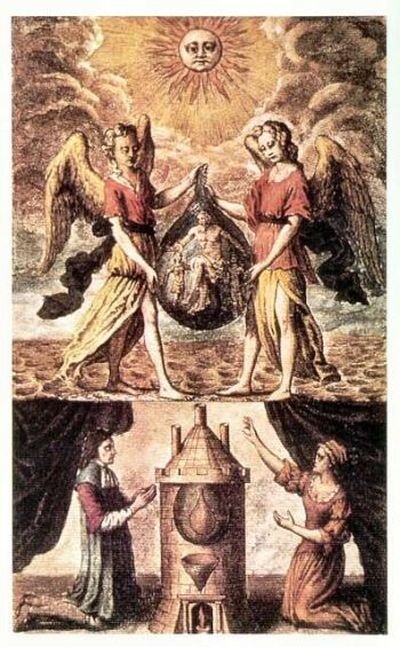
HOW DID YOU EVER GET HERE?
10,000 Paths to the
Passed
Each of our ancestors
is a gate to our Inner Sanctum, to the wonder-world of our soul. Genealogy is
the relational mode of understanding. The tale of our genesis is our prima materia (cosmic egg, oroboros) and our ultima materia, the unknown and self-knowledge. Like the oroboros serpent we recursively turn back toward
our origins.
We must incorporate
symbolic relationships. The basic alchemical sequence begins with a male and
female soror mystica) sealing the prima materia (original substance; sea, darkness,
void) into a vessel -- in this case the family tree. Here we can gently 'cook'
our existential woes: rootlessness, anxiety, fear, pain, emptiness, discontent,
and despair.
The retort of
genealogy gives new meaning to the notion that "like cures like." We
fill the retort with our ancestors' names, seal them with documentation, and
fire up the slow burning oven of integration. With reflection on the wounds
therein we remember past traumas and give voice to feelings previously
inexpressible in metaphorical language.
We cling to our
surface story and impressions as we bunge jump down our lines of descent. As we
work, the House of our Flesh becomes a high tempered glass house, transparent
to transcendence. Their breath is our breath, including aspirations and A-ha
moments that enliven the experience within.
We have no choice but
to live through unendurable times in our lives that nearly break us. Our dreams
and their life stories will indicate if the hot fires of an initiatory
experience are to be.
Psyche leads us through the labyrinth with her dim light.
In the beginning
everything is chaotic, fluid, co-mingled, and undifferentiated. The chaos hides
the Stone, contains it, yet is it, but hidden by our inability to
see it. Its metaphorical names include quicksilver, shadow, water of life,
dragon, and poison of the contaminated opposites. The problems that block
us are like the brick walls in our pedigree.
The shadow that plagues
us is an undead zombie -- not just a historical profile wrongly marked as
living. This is the body of a dead person given the semblance of life, made
mute and will-less, by a seemingly supernatural force, usually for some evil
purpose.
We must endure and
endure with devotion, dissolving defenses with emotional congruence to
illuminate our undiscovered inner life, clarifying the step-by-step process. In
the stillness we feel what needs attention. As the opposites co-mingle through
the centuries, it changes our life potential.
We must be patient,
humble, and loving with this work. We must handle the tension of not-knowing,
of ambiguity, of caring for the unloved, rejected, and forgotten. Our first
attempts to extract the gold from the unrefined narrative may be difficult. It
is a long journey, sorting through undifferentiated hurt feelings, anger,
traumatic reactions, fear, depressed moods, and restlessness, back to find our
first royal marriage. Symptoms become patterns.
Its alchemical symbol
is a 3-headed serpent or dragon, of Sulpher, Mercury, and Salt. This represents
the dance of Sun and Moon, King and Queen, the archetypal superpatterns of male
and female, and their material offspring. We spring from the soul and remain
the child of our ancestors.
In every adult there lurks
a child--an eternal child, something that is always becoming, is never
completed, and calls for unceasing care, attention, and education. That is the
part of the personality which wants to develop and become whole. -C. G. Jung CW
17: 286
First matter gives
universe its properties. It organizes into the Elements, (fire, water, air, and
earth), which are the building blocks of words, thought-ideas or archetypes. It
is liminal, between manifest and unmanifest. It is the spiritualized essence or
soul of substance: identity, form, and function oscillating between creation
and destruction.
We must go a bit
deeper and realize that with the instinct of creation is always connected a
destructive something; the creation in its own essence is also destructive. You
see that quite clearly in the moment when you check the creative impulse;
nothing is more poisonous to the nervous system than a disregarded or checked
creative impulse. It even destroys people's organic health. It is dangerous
because there is that extraordinary destructive quality in the creative thing.
Just because it is the deepest instinct, the deeper power in man, a power which
is beyond conscious control, and because it is on the other side the function
which creates the greatest value, it is most dangerous to interfere with it.
(Jung, Zarathustra Seminar, Page 654).
The main difficulty here
is that the eternal ideas have been dragged down from their
"supracelestial place" into the biological sphere, and this is
somewhat confusing for the trained philosopher and may even come to him as a
shock. (Jung,
Letters Vol. II, Pages 559-560).
"The
transformation of Mercurius, as prima materia, in the heated, sealed vessel is
comparable to cooking the basic instinctive drives in their own affect until
their essential fantasy content becomes conscious."
“Instead of arguing
with the drives which carry us away, we prefer to cook them and . ask then what
they want. . . . That can be discovered by active imagination, or through
experimenting in reality, but always with the introverted attitude of observing
objectively what the drive really wants.” (Marie von Franz, Alchemy, p. 129)
It is often suggested the prima materia is
found in "feces" or lead which is alchemical code for matter or the
physical body and what gets shoved down into the unconscious. The first matter
is cyclic, contains all the elements, and is the source of the Philosopher's
Stone -- the egg or light of Nature; Anima Mundi or Soul of
the World.
The alchemical motto Visita Interiora Terrae Rectificando
Invenies Occultuum Lapidem means “Visit the innermost parts of the earth; by
setting things right (‘rectifying’), you will find the hidden Stone.”
Jung more or less
identified the unconscious with the autonomic nervous system. Such sympathetic
identification is integral, interiorized or internalized knowing instead of
conceptual knowing: unmediated, direct perception by the body and the emotions
and the intellect -- the soul. Emotions are part of the reasoning process itself
-- bodily intelligence.
This psychophysical
mimesis, or power of imitation, is direct experience by total submergence of
the unconscious tendencies of the ancestors. So, we can visit the interior of
our own earth, our physical body for the treasure of embedded ancestral
memories it has hidden for good or ill.
Disorientation &
Suffering.
Like any Great Work,
Jung suggests that the opus consists of three parts: insight, endurance, and
action. Psychology is needed only in the first part, but in the second and
third parts moral strength plays the predominant role.
Working through the
invisible loyalties of the family system is just the beginning of our journey
back through time, the unconscious, and our genetic history. Epigenetic
inheritance is constantly remodeled and demonstrates that our parents' trauma
and family secrets are passed along. Children of survivors may be born less
able to metabolize stress, more susceptible to PTSD, a vulnerability expressed
in their molecules, neurons, cells, and genes.
Vicarious
Traumatization Burden
Traumas are events that induce intense fear,
helplessness, or horror. Dysregulation induced by that trauma becomes a body’s
default state in PTSD. Trigger a person with PTSD, and the heart pounds faster,
startle reflex is exaggerated, we sweat and the mind races. The amygdala, which
detects threats and releases the emotions associated with memories, whirs in
overdrive. Meanwhile, hormones and neurotransmitters don’t always flow as they
should, leaving the immune system under-regulated.
The result can be the
kind of over-inflammation associated with chronic disease, including arthritis,
diabetes, and cardiovascular disease. Moreover, agitated nervous systems
release adrenaline and catecholamines, both involved in the fight or flight
response, unleashing a cascade of events that reinforces the effects of
traumatic memories on the brain. This may partially explain why intrusive
memories and flashbacks plague people with PTSD. Also, extreme stress and PTSD
shorten telomeres—the DNA caps at the end of a chromosome that govern the pace
of aging.
Genes & Memes
The dragon's egg of
the primordial unconscious or archetypal container signifies the eternal cycle
of life, primordial unconsciousness, the unity of opposing forces. Jung said
there is no consciousness without discrimination of opposites.
To be whole is to be
full of contradictions. The unity never becomes apparent because the opposites
within us operate and mingle in various ways and it is their interaction that
makes the whole man. The complete human being, the hermaphrodite, is never
visible. He is indescribable, always a mystical experience. (Jung, Conversations with
C.G. Jung - Ostrowski,)
So, the ultima materia means the total recapitulation of
the species evolution beginning with conception moved by telos. Julian Huxley argued that
evolution moved to the psychosocial realm and DNA was replaced by memory and
language inside minds that could understand it, giving evolution a purpose.
The brain is the Tree of Life. If our reptilian
brain and brain stem is our internal Tree of Life, then the higher brain and
limbic system (with the amygdala) is our Tree of Knowledge of Good & Evil.
Wisdom of the divine becomes wisdom of the self -- the seed of cosmic
consciousness and Immortal Mind. In Hermetic doctrine, a circular relationship
exists between mankind and the divine. The cosmos mirrors mankind's need for
self-knowledge through recognition.
Serpent's Breath
The serpent in that
Tree is its numinous voice, with its active dynamic kundalini -- the Serpent Power, the Secret
Fire, the life force or basic animating principle -- the quintessence of
matter. Never calling it evil, Genesis 3:1 says, "Now the Serpent was more
subtle than any beast of the field which the Lord God had made."
Our serpentine lines
of ancestral descent recursively bite their own tails in the primordial
archetype of the Orobouros. “"All human things are a circle” was inscribed on the temple
at Athens.
The Hermetic
"Holy Grail" was a circular crater or bowl of regeneration described
in the fourth treatise of the Corpus Hermeticum. It was a font of immersion
symbolizing the constant decay and renewal of all things, present in all
Nature. The genealogical Holy Grail is found in royal lines that include the
Arthurian legends then trace back to roots in various gods and goddesses.
For the gods, time is
primordial and unstructured; for mankind it is historical and linear. In the
unconscious if there is any notion of time at all, it is circular, arranging
events so they return eternally and can be re-entered through myth, symbol, and
ritual with no distinction between self and environment.
Grail symbolism
encompasses the womb that always makes children, the horn and cup that serve
drink, and the cauldron and bowl that give food. The quest for the Grail comes
from these primal facts of life.
The holy bowl -- the
cranium, where heaven meets earth -- is where individual souls mix with
universal mind in a metaphor of immersive experience, The immersive baptism of
wisdom or gnosis means 'living water' that springs up in creativity and
illumination -- "the drink of the soul by the sweet stream of wisdom
(Sophia)."
What Are They
Remembering For Us?
Our history is our
collective transgenerational memory. No people can successfully live outside of
their memory. Jung tells us that, "Whenever we give up, leave behind, and
forget too much, there is always the danger that the things we have neglected
will return with added force." (MDR, Page 277). The past plays one of the
most critical roles in Western civilization. but it is so embedded, so obvious
that it becomes invisible. The past remains with us as experiences change sperm
and eggs.
Genes aren't the cause
of most disease; the cause of most disease alters genetic expression.
Epigenetics is revealing the biological transmission of molecular memory --
that we can pass down altered responses, emotional trauma, agitated nervous
systems, under-regulated immune systems, chronic over-inflammation, and
somatic disorders.
Biological Legacy
Ancestral behavior can
also mutate single genes. Everybody has a different level of tolerance for
alcohol, but some people act very strangely, exhibiting reckless, impulsive,
violent, or even dangerous behavior on alcohol. Finnish researchers found that
a fairly common mutation in serotonin 2B receptor gene can render some prone to
impulsive behavior by nature, sober or under the influence of alcohol. They struggle with
self-control or mood disorders.
“One of our main
findings was that the HTR2B Q20* predicted alcohol-related risk-behaviors. The
HTR2B Q20* carriers demonstrated aggressive out-bursts, got into fights and
behaved in an impulsive manner under the influence of alcohol. They were also
arrested for driving while under the influence of alcohol more often than the
controls."
“The
HTR2B Q20* carriers were not alcoholics per se, as measured by average alcohol
consumption, and were not diagnosed as alcoholics, but they had a tendency to
lose behavioral control while under the influence of alcohol.”
http://www.sciencealert.com/common-genetic-mutation-linked-to-reckless-drunken-behaviour?utm_source=Article&utm_medium=Website&utm_campaign=InArticleReadMore
All cells have a genetic code with information to produce
certain proteins to carry out vital processes. Chemical switches can turn genes
on or off, or crank them up or down, so the cells know which proteins to
produce and in what quantities. These switches or epigenetic tags are altered
by environment, bad habits, and experience, passed on to their offspring, and
their offspring's offspring.
Sperm and eggs carry
genetic memories of parents' health well before conception. Even what
grandparents ate and the father's behavior long before conception can influence
the child's health in a range from mood disorders to mental illness. They
inherit parents' psychic burdens, anxiety, low impulse control. Older people
can unconsciously externalizes their traumatized self onto a developing child’s
personality. The physical transmission of the horrors of the past is “embodied
history.”
Transgenerational
trauma is transferred from the first generation of trauma survivors to the
second and further generations of offspring of the survivors by complex
post-traumatic stress disorder mechanisms. Epigenetics changes the way instructions in the genetic code
were translated and carried out by the body.
We are more than our transgenerational wounds. Our essence
transcends our identification with history. In healing we are not alone, we
trust a path to greater freedom, and feel our relationship to the suffering of
our family lineage. We feel lighter when we release the burdens of our own
trauma or family history. We can make wider choices and expand our sense of
belonging in the world.
The Spent Breath of Millions
We all carry and
relive the primordial psyche which is reliving the soul of our ancestors. They
may be gone, but primordial psyche remains alive within us, and available for
interaction. Some live closer to it than others, but we all have creative,
rational, and intuitive faculties. These are rooted in this primordial ground,
an unalterable level of creative imagination, primordial unity, and instinctive
participation
mystique.
As Jung says, "But in these days we live by our brains
alone and ignore the very definite laws of our body and the instinctive
world." (Letters Vol. II, Page 567)
Perhaps the ancestors
inform us in their own way. Intuition is information that is received by the
mind. But for that information to be useful, it must be analyzed and purposefully
acted upon. When integrated we act on those intuitive impulses with wise
judgment and confidence. Creative ideas then take shape in manifest form.
Primordial Psyche
Our genealogical lines
may all look like good little soldiers lined up in neat succession. But they
also have complex, nonlinear and cyclic dimensions among the patterns we can
discern. This is the realm of the imaginal -- primordial images or instinctual
energy which nevertheless have objective cascading effects.
Multifractals are more
highly advanced mathematical structures: fractals of fractals. They arise from
fractals 'interwoven' with each other in an appropriate manner and in
appropriate proportions. Multifractals are not simply the sum of fractals and
cannot be divided to return back to their original components, because the way
they weave is fractal in nature. The result is that in order to see a structure
similar to the original, different portions of a multifractal need to expand at
different rates. A multifractal is therefore non-linear in nature.
https://www.sciencedaily.com/releases/2016/01/160121110913.htm
We consciously and
unconsciously mourn the loss of the sacred in our lives to the abyss of
evolution and our primordial relationship with Mother Earth. We've forgotten
our connection to the dark animal orobouric Great Mother. Mother Nature may be
the oldest motif but it is the underlying pattern of symbol-formation that is
inherited.
Archetypes &
Instincts
That something missing
in the lives of so many people isn't found in another's form, it's found in the
dark of the unconscious. In Jungian thought, when we search for our "other
half" and perhaps for our ancestors, too, we actually seek the integration
of the elements of the unconscious psyche. “It is always important to have
something to bring into a relationship, and solitude is often the means by
which you acquire it” (Jung, Letters Vol. II, Page 610, Letters Vol. II.)
As Jung notes, "Whether he understands them or not,
man must remain conscious of the world of the archetypes, because in it he is
still a part of nature and is connected to his own roots." (Symbols of Transformation, Page 23).
If I speak of the collective unconscious I don't assume it as a
principle, I only give a name to the totality of observable facts, i.e.,
archetypes. ~Carl Jung, Letters
Vol. II, Page 567
The main difficulty here is that the eternal ideas have been
dragged down from their "supracelestial place" into the biological sphere,
and this is somewhat confusing for the trained philosopher and may even come to
him as a shock. ~Carl Jung, Letters
Vol. II, Pages 559-560
The Platonic
"Idea" is in this case no longer intellectual but a psychic,
instinctual pattern. Instinctual patterns can be found in human beings too. ~Carl Jung, Letters Vol. II, Pages
559-560
"Self-reflection,
or - what comes to the same thing - the urge to individuation, gathers together
what is scattered and multifarious and exalts it to the original of the One,
the Primordial Man. In this way our existence as separate beings, our former
ego nature, is abolished, the circle of consciousness is widened, and because
the paradoxes have been made conscious, the sources of conflict are dried up." ("Transformation Symbolism in the Mass", CW
11, para. 401).
Inherent Nature of Man
Jung thought the
"primordial images" are those expressed in the earliest life-history
of the human species. They grow out of the rudimentary nature of the psyche in
its pre-conscious form. These basic layers of the psyche spontaneously recur in
modern psychic phenomena in ever-new forms that vary around certain deeply
rooted motifs at the base of consciousness. The generic structural nature of
the psyche is unrestricted to collective or group phenomena.
Water is the
cosmogonic element by which the self sinks into involuntary immersion in the
dimensional abysses. Our pre-historical ancestors have sunk in the Atlantis of
the waters of the unconscious. This may be more than symbolic as we now know
humanity has gone through a few local and global catastrophic events.
Supervolcanoes,
repeated glaciation, meteor, and comet falls, massive sea-rise, and climate
change are only preserved in myth and legend, leading to speculation that we
have a species-wide amnesia. We have only recently found that our genome
contains contributions from at least three other species -- Neanderthal,
Denisovan, and another as-yet-unknown hominid.
Life is a thread
interwoven with hidden archetypes which remain entangled in our eternal
present. We're already in our phenomenological graves. If we can embrace the
ancient soul of our ancestors soulfully and creatively, we may engage and
fall in love with the sacred again. Elemental wisdom is recognizing patterns in
life.
In our own genealogy,
we begin to reveal a pattern in which we can locate a felt sense of
understanding, a resonance that speaks to us within a myth or traces the path
of a wounding through therapy. We can followed the thread of understanding
using dreamwork, ritual, or other depth psychological methods, or experience the numinous on some unalterable level that changes us
forever.
Genealogy can be our
approach and return to the sacred. To understand the living we commune with the
dead. We approach the phenomena of the psyche as we do the phenomena of nature.
We've unwittingly buried with our ancestors any symbolic or revelatory meaning
that would otherwise push its way through from the unconscious.
Modern life has
short-circuited our connection with the primeval unconscious resulting in an
intolerable rift -- psychic dissociation. This division separates us from the
sacred, limiting our capacity to navigate divine corridors of the numinous,
relegating us to lives of estrangement, isolation, and alienation.
Potentiality of
Meaning
Genealogy makes us
think about the nature of time and space, our own deepest nature, and cosmos --
and our relationship to it. Entering our genealogy with a sensitivity to the
phenomena that might arise means we are more attuned, more likely to notice
when they arise within us and what they call forth.
Genealogy becomes our
altar to the sacred -- to the Great
Mystery that surrounds
ideas of primordial mind, ancestral and shamanic wisdom, visionary
transpersonal experiences, and other numinosum. As we become more keenly
attuned to the psychophysical sensations of arising emotions, we become more
keenly attuned to our ancestry, wholeness (Self as supra-personal human
wholeness), and deep history. At the informational level, our bones are their
bones, our nerve pathways are their nerves, our blood is their blood.
Information Storage
& Retrieval
Akash and the Akashic
Records have been linked to primordial informational fields. Even Tesla says,
“All perceptible matter comes from a primary substance, or tenuity beyond
conception, filling all space, the Akasha or luminiferous ether, which is
acted upon by the life giving Prana or creative force, calling into
existence, in never ending cycles, all things and phenomena.” (Man’s Greatest
Achievement, 1907)
Radical new proposals from physics are arising for vectors of
information. Ervin Laszlo has linked it with psi phenomena and an integral
theory recognizing the self-organizing interconnection of all things. He
bootstraps from the Sanskrit, calling non-local interaction the Akasha Paradigm
-- an entangled self-actualizing cosmos not limited to the here and now. We can
connect and feel into each other. Laszlo shows the cosmos of the Akasha to
be a self-actualizing, self-organizing whole. Each part is in coherence with
all others and all parts together create the conditions for the emergence of
life and consciousness. (2007; 2014).
http://manifestdestinytriforce.blogspot.com/2015/11/the-akashic-records-what-are-they-do.html
Igor V. Limar (2012) proposes linking synchronicity, correlated
mental processes, and quantum entanglement. Mental processes of two different
persons correlate not just when the subjects are located at a distance from
each other, but also when both persons are alternately (and sequentially, one
after the other) located in the same point of space. In this case, there is a
time gap between manifestation of mental process in one person and
manifestation of mental process in the other person.
NeuroQuantology, Sept.
2012, Vol. 10, Issue 3, Page 489-491.
"A
Version of Jung’s Synchronicity in the Event of Correlation of Mental Processes
in the Past and the Future: Possible Role of Quantum Entanglement in Quantum
Vacuum"
http://www.neuroquantology.com/index.php/journal/article/view/477/535
Approaching the
Ancestors
We begin our genealogy
knowing there is an art of approaching. We acquire depth in our attempts to
heal ourselves. We may yearn for that which we cannot name; we may find
unspeakable secrets.
Jung spoke of it
poetically, "Take pains to waken the dead. Dig deep mines and throw in
sacrificial gifts, so that they reach the dead. Reflect in good heart upon
evil, this is the way to the ascent. But before the ascent, everything is night
and Hell." (Liber
Novus,
Page 244).
Descent
seems to be very steep and dangerous. The ascent is always laborious, yet it is
a well trodden path and there are many safeguards. You feel safe because many
thousands have gone that way already. But the downward path is new.
Many have gone down, but
they usually slipped down, so it has a slippery surface, and one finds parts of
wrecked cars and trousers and shoes and skeletons, perhaps of people who gone
to smash on that path. This is the path of danger.
(Jung, Visions Seminar, Page 93.)
Jung describes how such imagery relates to visions, which only
become clear when you look into your heart:
This
is very typical of the beginning of visions: it begins at the bottom, as it
were, as if the whole world had to be built anew, or as if nothing had ever
happened before; and then it carries the thought through until it reaches the
stage that is not yet and that never has been: it reaches the future.
It is often as if such
a series covered the whole way, as if each series extended from hell to heaven,
from the beginning to the end, as if it ware a complete cycle more or less
clearly formulated.
Conspectu
Mortis
In the beginning the
future stage is rather dimly characterized, then later it becomes more and more
clear, and the beginning gets blurred. This is a general characteristic of such
visions. (Visions
Seminar, Page 142)
Today to bring up the
inferior function is to live, but we pay dearly for it both in mistakes and in
energy. Sometimes it is not our choice—the inferior function takes us unawares.
~Carl Jung, 1925
Seminar, Page 74
If you leave all your
energy and will in the superior function you slowly go to hell—it sucks you
dry.
~Carl Jung, 1925 Seminar, Page 74
What we need is our
Great Work, not just mundane work. Jung is making an analogy between the mental
archetypes of light being opposite darkness, not a literal Heaven and Hell.
The three days descent
into Hell during death describes the sinking of the vanished value into the
unconscious, where, by conquering the power of darkness, it establishes a new
order, and then rises up to heaven again, that is, attains supreme clarity of
consciousness.
~Jung, Liber
Novus, Fn.
135, Page 243.
"The common
ideal of today is work at all costs, but many people simply work and do not
live.
We cannot depreciate the
ideal of work, but we can understand that it is valueless when it divorces one
from life."
~Carl Jung, 1925 Seminar, Page 73
Descent as an
archetype of the Way, is a harbinger of a transpersonal future, pre-figuring
spiritual development. "No one saves us from the evil of becoming, unless
we choose to go through Hell." (Liber Novus, Page 318.) "I used the
same technique [Active Imagination] of the descent, but this time I went much
deeper. The first time I should say I reached a depth of about one thousand
feet, but this time it was a cosmic depth." ~Carl Jung, 1925 Seminar, Page
68.
Internal and Infernal
He also remarks,
"the
more the one half of my being strives toward the good, the more the other half
journeys to Hell."
(Liber Novus, Page 315). "When you step into your own Hell, never think that you
come like one suffering in beauty; or as a proud pariah, but you come like a
stupid and curious fool and gaze in wonder at the scraps that have fallen from
your table." (Liber Novus, Page 262).
But the deepest Hell is
when you realize that Hell is also no Hell, but a cheerful Heaven, not a Heaven
in itself, but in this respect a Heaven, and in that respect a Hell. (Liber Novus, Page 244). The spirit of the depths is pregnant with ice, fire, and death.
You are right to fear the spirit of the depths, as he is full of horror. ~Carl Jung, Liber Novus, Page 238.
Our approach is framed
with emotionally dependent perspectives, psychophysical reactions, and
perceptual filters.
We become absorbed by
the emotions we are feeling. Shifts in neurohormone levels affect our
consciousness. They may manifest as interference patterns, psychosomatics or
what might be called soma-signficance. Sometimes we "carry on" the
maladies of our parents or grandparents within ourselves long after their passing.
More than genetic or epigenetic inheritance, perhaps that is one way of
keeping them with us.
Soma-Significance
Our bodies are simply
connected with an intuitive sense of meaning, in all its implications and
possibilities. Our structure encodes the recent and deep past. The physical and
its significance are in no way separate but two aspects of a non-dual reality.
So, some arising emotions may 'belong' to us while others arise from an
empathic identification with our ancestors, or even fusions of their energies.
They may appear in the pre-sensory, sensory elements and images in our dreams.
Proprioception is how
we perceive ourselves physically -- our own individual orientation, moment to
moment. It is how we grasp or sense of the relative position of neighboring
parts of the body and strength of effort being employed in movement.
Sensory information contributes to the
sense of position of self and movement.
Expressing emotions
amplifies them. So we can also unlock significance by moving intuitively, by
"letting go," and seeing how that feels and what it brings up. That
movement itself is a primal image that communicates information not only to our
senses but our entire being. It helps us sense stimuli arising within the body
regarding position, motion, and equilibrium.
Contemplation of our
family tree provokes reflection on our destiny. We look to the beginning to
reveal the end, since like a hologram or fractal each part reveals the whole.
The initial condition is archetypal. This alchemy of multigenerational marriage
bridges has come down to us in the present -- as our unique embodied being.
Jung cautions that, "Individuals who believe they are masters of their
fate are as a rule the slaves of destiny." (Letters Vol. II, P. 520-523)
Connection to Source is the basis of creation, which manifests
something unique from formless nothing.
In our mundane existence we can lose sight of the wonder of
life. Genealogy manifests the marriage of matter and psyche. Our family tree is
a forest doubling in numbers each generation we go back.
Those who have passed
are often passed over. Recognizing them, we recognize the reality of the
psyche. We contain multitudes. By the medieval period, they number in the
thousands, and tens and hundreds of thousands. They outnumber themselves,
leading to the phenomenon of 'pedigree collapse,' when ancestors repeat in
multiple lines of our descent. Collectively, they are nevertheless our
particular way of descending into the cosmos and life and carrying it forward.
Increasing knowledge
of self can come by knowing the Others within and renewing ruptured
relationships. We can draw an analogy between the ascending and descending
pathways of our psychobiology and genealogy. Emotions have bodily effects.
"Threshold
events" occur when information that was formerly profoundly unconscious
arises within our somatic, emotional, mental, or spiritual perceptions. Once we
can locate sensations in the body, we can get a metaphor for what that
experience is "like," engaging our imaginal faculty.
Multiple streams of
consciousness can participate in one perspective that frees us of our amnesia.
Somato-sensory pathways are information channels. The somatosensory system is
the part of the sensory system concerned with the conscious perception of
touch, pressure, pain, temperature, position, movement, and vibration, which
arise from the muscles, joints, skin, and fascia. Self-organizing systems of
mind-body communication across all levels from the cellular-genetic to the
psychosocial and behavioral affect our psychobiology and natural or spontaneous
healing.
It isn't about belief
but directing our awareness to a different transderivational level of the
system. Richness of interactions allows systems as a whole to undergo
spontaneous self-organization and reorganization at all levels. We emphasize
the need to deal with illness at formative levels, i.e., at the organism's
initial conditions -- perinatal states, as suggested by Grof, Tart, and
Mindell. At subtle levels outer structure is only a passing reflection of
this continuing deep inner evolution.
An incoming
communication we cannot make any sense of whatsoever is an integral part of
processing language, and of attaching meaning to communication. How we ask the question determines the
information we get. For example, we can create association rather than
dissociation.
One approach is to
drop into the body and get a sensation for where a feeling is, following it
around, if necessary. Sensory responses are evoked potentials. When we detect a
response we have a place to begin noticing, remembering, and processing. At the
threshold level we have a 50-50 chance of detecting our response as attention
or distraction. We may feel it weakly or even wonder if we felt it at all. This
way we can reactivate pretty much any feeling we've ever had or that lives in
us with a new level of sensation and connection in the present. We become aware
of issues by their somatic, energetic, and emotional components.
"Here, here's
where we live
Here is a sea, my
family
We'll always be young
as we've ever been
Death will not part us
again nearer to heaven than
10,000 ancestors who
dream of me
Well I hear you
dreaming of me
Yeah sometimes, dream
of me!"
The
Albatross, (Rickie Lee Jones/Leo Kottke/John Leftwich)
Exploring the
unconscious through genealogy or psychogenealogy is a healing process, an
uplifting engagement that is foundational to self-realization. We are no longer
relegated to a single contemporary place and time. The ancestors remained an
important part of daily life not so long ago, and remain so for many indigenous
societies.
We Are Highly
Improbable
Scientists have
calculated that each unique individual is highly improbable -- apparently a
rather miraculous 400 trillion to one chance. The odds of us existing, 1:400
trillion, are virtually zero. Conversely, by the 40th generation we have over a
trillion ancestors. We have to consider the odds of our parents meeting
relative to the number of people on Earth. Then consider the odds of contact
leading further in competition with all the others we meet.
The probability
dwindles of a long-term relationship and reproduction, the right sperm and egg
combining, and finally the probabilities of each of our trillion+ ancestors
successfully mating with all the variables of genetics that make up the chain
of those all those ancestors -- the Tree of Life of perfect eternal fruits.
Jung notes obviously that, "Living matter is a mystery which is beyond our
understanding, if only for the reason that we ourselves consist of living
matter."
You are a virtual
miracle, which is simply an event so improbable it is unlikely to occur. So
each life is unique and precious to the nth degree as the result of the
cumulative process of increasing information. Even Jung might be challenged to
call it a fortuitous series of synchronicities. We are an emergent phenomenon.
There are mere chance occurrences as well as synchronicity. So, another
model is self-organizing chaos in multiple systems.
Field, Form & Fate
Self-organization is
the structure of creation -- a process where pattern emerges at the global
(collective) level through interactions among the components of the system at
the individual level. These interactions explicitly specify the global pattern.
We are self-similar to our predecessors and all their reiterations. In the
vernacular of chaos theory, we are “strange attractors” or patterns of order
within chaos, which never exactly repeat themselves. An observer can never predict
exactly what will happen, yet we display a quality of orderliness which hints
at underlying “laws not yet discovered.”
As times change so do
our metaphors, psychological and otherwise. Self-organization, chaos, and
complexity are the basis of the new biology, but it strains the imagination to
consider it operating transgenerationally. We might consider the overall effect
as a transgenerational field effect -- a relationship of archetypal fields
within fields. Memories are accumulating affecting the soul.
Yet here we are,
unpredictable though it may be. Souls extend from other souls. Order emerges at
the edge of chaos and we are that leading edge of our descent. Our life somehow
dances into being. And this is precisely the Mystery of our being, formed by
historical, psychosocial, and genetic forces. We are active psychophysical
elements of the entire creation. Information and spiritual knowledge is
accumulating if we know how to listen deeply with a close attunement to our
ancestral and generational themes.
Generational
Archetypes
Everything we do
starts with feeling and feeling starts in the family. Authors William Strauss
and Neil Howe created the Strauss-Howe generational theory. It identifies a
recurring generational cycle in the last five centuries of Anglo-American
history. It can be explained by four generational archetypes that repeat
sequentially in a fixed pattern every 80-100 years. This is the unfixed length of a long
human life the ancients called a “saeculum," which can be divided into
four "seasons" of approximately 22 years each; these seasons
represent youth, rising adulthood, midlife, and elderhood.
Basically, this
sociological generational theory describes how the era a person was born into
affects the development of their view of the world. Our value systems are
shaped in the first decade or so of our lives, by our families, our friends,
our communities, significant events and the general era in which we are born.
All cultures are shared unconscious
fantasies about how to live life. Traditional cultures viewed time as cyclical,
much as the waxing and waning of the moon, the rising and setting of the sun,
the birth and death of living creatures, the planting and harvesting of crops,
and the seasons of the year. The idea of sacred time as an eternal round and
the symbol of the ring or wheel are cross-cultural symbols. There is a
repeating cycle in historical generational values. Each 20-year long generation
faces similar issues and experiences.
http://www.tomorrowtoday.uk.com/articles/article001_intro_gens.htm
Beyond the modern pop
nomenclature of Greatest Generation, Boomers, and Gens X, Y, Millennials, and
Post-Millennials ("Homeland Generation"), their 1997 book The Fourth Turning, expands the theory focusing on a
pulsating fourfold cycle of generational types and recurring mood eras in
American history. Graeme Codrington summarizes the repeating cycle.
Social Cycle Theory
[Each] 80 year
period of human history, we start with a crisis period, when society has to
stop and deal with an issue that actually changes institutions and structures.
Children born during such a time grow up to be like the Silent generation of
today. This is followed by an outer directed and driven period of rebuilding,
with grand visions and big dreams, giving rise to a Boomer-like generation.
This idealistic world cannot be sustained, however, and a period of
disillusionment and breaking down follows, with society being reconfigured and
adjusted. The children of this era grow up to be like Generation X is today. This
era is followed by an inner-directed era, where leaders, institutions and
society itself focuses on consolidating and building new foundations,
rebuilding institutions and protecting the young. This era gives rise to the
type of people who are from the GI generation and the Millennial generation
today. Finally, this inner-directed focus cannot be maintained, and a crisis
occurs, sparking a new cycle.
If this is correct, then generational theorists are expecting a
major crisis to hit global society in the next few years. This is something
that will cause society to stop, reconsider and reconstitute itself. http://www.tomorrowtoday.uk.com/articles/article001_intro_gens.htm
While they focus on
the history of the United States, including the Colonial era and British
antecedents, they also find similar generational trends around the globe from the late Medieval period. They have
defined generational archetypes in cohort groups that express the zeitgeist of
their times. While such attributions are arguable they can provide a touchstone
for certain eras and their collective culture.
http://www.lifecourse.com/about/method/generational-archetypes.html
They group four
generations into a series of 80-year cyclic 'turnings' that include an initial
'high', followed by 'awakening,' unraveling,' and 'crisis.' Their archetypes
include 'prophet,' 'nomad,' 'hero,' and 'artist' generations. We can think of
such themes as collective dreams. Repeating cycles are a common theme for both
individuals and whole generations.
As is the generation of leaves, so to of
men:
At one time the wind
shakes the leaves to the ground
but then the flourishing
woods
Gives birth, and the
season of spring comes
into existence;
So it is with the
generations of men, which
alternately come forth and
pass away.
– Homer, The Illiad, Book Six
We might benefit from
the generational method in formulating our own Big Picture, as well as
broad-stroke insights for our own generation within the pattern. The theory
contends that each new generation entering a specific lifestage will redefine
that lifestage and change it either subtly or dramatically. As generations
clash there is a collision of values, expectations, ambitions, attitudes and
behaviors -- the generation gap.
https://en.wikipedia.org/wiki/Strauss%E2%80%93Howe_generational_theory
Self-Generating
Creativity
Prima materia is the
"beginning of all," "the abyss," the primary chaotic earth,
or principle of existence in general. In his 1941 ETH lecture, Jung describes
how many philosophers have sought
information about the prima
materia from inhabitants of Hades,
or in the "habitation of souls." This is the realm of psychic dark
matter, what is hidden from view.
This "land of the
dead" is also known as "the egg," "Adam's Earth,"
"Mercurial serpent," "winged dragon," and the
"entrance to the West,” "the root of itself," the dark sky
of night, the non-created, or eternity. Or, as Jung states, in Liber Novus, "Hell is when the depths come
to you with all that you no longer are or are not yet capable of." (Page
244).
Prima materia is also
called a neglected, rejected, and abandoned "orphan." The original
"chaos" or "sea" constitutes all matter. Such
self-organizing complexity is the beginning and end of transformation and
renewal. This is the creative process Jung spoke about.
…a creative process, so
far as we are able to follow it at all, consists in the unconscious activation
of an archetypal image, and in elaborating and shaping this image into the
finished work by giving it shape, the artist translates it into the language of
the present and so makes it possible for us to find our way back to the deepest
springs of life (CW
15, P. 82)
Edinger (1978)
compares the problem of discovering the prima materia to the problem of finding
what to work on in psychotherapy. He gives some hints:
(1) It is ubiquitous, to be found everywhere, before the eyes of
all. This means that psychotherapeutic material likewise is everywhere,
in all the ordinary, everyday occurrences of life. Moods and petty
personal reactions of all kinds are suitable matter to be worked on by the
therapeutic process.
(2) Although of great inward value, the primal materia is vile in outer
appearance and therefore despised, rejected or thrown on the dung heap.
The prima materia is treated like the suffering servant in Isaiah.
Psychologically, this means that the primal materia is found in the shadow,
that part of the personality which is considered most despicable. Those
aspects of ourselves most painful and most humiliating are the very ones to be
brought forward and worked on.
(3) It appears as multiplicity, "has as many names as there are
things," but at the same time is one. This feature corresponds to
the fact that initially psychotherapy makes one aware of his/her fragmented,
disjointed condition. Very gradually these warring fragments are
discovered to be differing aspects of ones underlying unity. It is as
though one sees the fingers of a hand touching a table at first only in two
dimensions, as separate unconnected fingers. With three-dimensional
vision, the fingers are seen as part of a larger unity, the hand.
(4) The prima materia is
undifferentiated, without definite boundaries, limits or form. This
corresponds to a certain experience of the unconscious which exposes the ego to
the infinite. ...It may evoke the terror of dissolution or the awe of
eternity. It provides a glimpse of the pleroma. ...the chaos prior to the
operation of the World-creating Logos. It is the fear of the boundless
that often leads one to be content with the ego-limits he has rather than risk
falling into the infinite by attempting to enlarge them.
The different
operations to transform the prima materia follow as the natural consequences of
finding the material to work on. The imagery associated with these operations
is profuse and draws from ancestors (genetic memory), myth, religion and
folklore. The symbols for all these imagery-systems comes from the
collective unconscious.
Dying to be Heard
Jung implies we cannot
get rid of the unconscious and its intuitions, which are rooted in our
instinctual, reflexive, and parasympathic systems. But we can go from being
'herd' to being heard. We can engage in intentional multisensory dialogue with
our depths. It arises from the primordial ground of the subquantal level of
every quantum particle of our being. Jung likened Hades to a black hole without an outlet.
When we enter our
genealogy we enter the realm of the dead, so we must find a way to reconcile
that metaphor and our surrender to the process. Jung cautions, "Under certain conditions living
people can descend into Hades, but it does not agree with them. One must really
be dead to go there, for it is the dark land where the dead are imprisoned; and
this is a place from which this marvellous substance comes." (ETH, Pages 215-223.)
In Arcadia, the
ancients sought out the Necromanteion or "Oracle of Death" where
they communed with their dead ancestors in a psychoactive ritual. Though there
were many oracles of the dead, the Necromanteion of Ephyra was the most
important. Herodotus recounts that Periander, sent emissaries in the 6th
century BC to ask questions of his dead wife, Melissa. In his nekyia, Odysseus
enters Hades through the Necromanteion.
We can listen to the
voice that has no words --the voice of the silence. We're all connected via the
interactive sea of energy that connects us to everyone and everything in our
world. It seems Hades presides over our descents and perhaps our descendancy.
According to Jung, "To journey to Hell means to become Hell oneself. It is
all frightfully muddled and interwoven." (Liber Novus, Page 240.)
Caves always had their
own gods. The underworld with its narrow jagged gaps is essential to many
spiritual worldviews. We can imagine that a notion of hell arose early in
mankind's emerging consciousness somewhere
between the darkness of imagination and physical mazes of deep caverns that
seem like uterine spaces or living, breathing internal cavities that snake for
miles. Caves
-- the original temples -- were worshipped and feared as the center of the
earth with miles of crumbling tunnels and steep precipitous drop offs
multiple-stories deep.
Mankind has journeyed
deep into them and used these dark and treacherous labyrinths that tortured and
twisting passages with seemingly bottomless pits, to live, to hide, to explore, and
to worship with pilgrimage, art, and rituals. But all who descend into the
underworld do so at their own risk. Initiatory passageways and vertical shafts
have dangerous hand and footholds etched in lava and ice, and studded with
magical curtains, spires, crystals and inscriptions.
In some sense, hell
was our ancient dwelling place to which we returned upon death -- a
metaphorical regression to the primal epoch. With its flickering fires, smoky
caverns, and hidden dangers the cave gave rise to mythic and archetypal
recollections and dreams of ancestral spirits. The
dreamworld became a stone cold abyss and the primordial underworld was born.
The first proto-images
appeared in cave art. Men and women impulsively desired to participate in the
potential transforming powers of the "insides." Hades,
the devouring one, could be contacted in the dark cavern of fathomless psychic
force. The dismal labyrinthine complexity gave rise
to the original trope. The soul is within, below, buried deep in self as within
earth itself. This is the archetypal sleepworld of Hypnos and Thanatos.
If we accept that
death is not the enemy but a doorway we can rest naturally in what is. The
great invitation is to accept death. Lao Tzu invites us to give up the fight
against death so existence is revealed as sublime relaxation. Each moment
becomes a surrender, one of ‘touch and let go.’ We must not hide, but rather be
open to all aspects of being. In sublime relaxation, shadow issues can emerge,
some even hidden by our nondual language and cliches. All is grist for death’s
mill.
In archetypal
psychology, soul remains close to death -- disease, disorder, collapse. We die
to the literal and concrete world of the senses for the sake of soul. Hillman
imagined Hades right alongside daily life, the invisible made visible in
psychic events, soul process, and revelatory meaning. It is the gaps between
breaths. The dreamworld is also the underworld of Hades. From Hades perspective
we are our images. By "letting be," we can allow dream images to
speak for themselves, rather than forcing them toward interpretations for
mundane life.
The underworld is the
primal void -- the prima materia. Underworld is psyche. It is not a place but a
hidden domain of liminal experience -- a dimension not available in itself. Our
concern with Hades here regarding our ancestors is the spontaneous image-making
of the soul. The 'ground' is a fathomless depth.
We experience dread
and resistance when we delve too deeply inside ourselves -- this is the
devouring darkness of death and desolation before rebirth. Death is at the
heart of alchemy. We can understand the "death experience"
metaphorically and psychologically, but we still must all confront it with
naked awareness without the symbols and images born of nature's own workings.
Some families never
forget who they are, while others struggle with a few fragments that don't seem
to fit together. Either way it's a puzzle with some missing or damaged pieces.
We must keep the big picture in mind to understand the smaller parts. We all
have the ability to recognize and seize the deep sense of mystery that lives in
our own lives.
Undoubtedly, there is a sacred dimension
to the genealogical process, more so when we do the work ourselves. In our
first attempts we cross the threshold of initiation. Jung suggests, "But
if you know what the dead demand, temptation will become the wellspring of your
best work, indeed of the work of salvation." (Liber Novus, Page 278,
Footnote 188.)
"From the middle of
life, only he who is willing to die with life remains living. Since what takes
place in the secret hour of life's midday is the reversal of the parabola, the
birth of death ..." ~Carl
Jung; Soul and death, CW 8, §800.
History, Memories,
Stories
With genealogy we dig
below the basement of our personal unconscious to find what lies below that
still haunts or calls for us. What has been buried in the past yet is not gone
nor dormant because it is part of the our psychophysical being. Our adaptive
survival styles can distort identity in adult life.
To reclaim our
ancestral soul we suffer through the anguish of the unknown as well as the
burdens of what we do find from which we wished to protect ourselves. There is
shock trauma and developmental trauma. We find things that are great and things
that are tragic. Genealogy gives and it takes.
The Trail That Never
Ends
Such discoveries have
been popularized by media: “Finding Your Roots”‘, "Who Do You Think You
Are", “Roots
of Faith Ancestry”, "Genealogy Roadshow", and others. Genealogy is touted as
the second biggest hobby in America.
People want to reconnect with their ancestral homeland to know
where and how they lived. http://b.treelines.com/in-defense-of-genealogy-as-a-hobby/
Finding Yourself
Many feel compelled to
take on the project. Online genealogy sites are some of the most popular on the
web. It's a thrill extending the family heritage back a few more
generations or discovering that your family is related to royalty, or allegedly
to the legends of history. The progenitor of the clan lies at the root of the male line.
Bi-Lateral Descent
Our own bi-lateral
descent includes both of our parents. But each female in our direct descent has
her own bi-lateral lines, as well. We honor not only our paternal surname
(patrilineal descent), but all those grandmothers whose families keep our lines
invigorated with new blood.
New surnames enter the
tree with each wife. These are not easy lines to follow, retrieve, or draw
without the aid of computers. Maiden names often present brick walls difficult
to push beyond. Pedigrees show both family-as-child and their
families-as-parent.
Algorithm Genealogy
Rather than mere
family trees, massive genealogical sites with billions of records have been
likened to Amazonian forests of family connections of blood ties and marriage
bridges. Genealogists who explore the family tree information, weeding out false or
duplicate information, call themselves "forest rangers." When genealogies were
digitally archived it became possible for algorithms to find lines of
descent that included both male and female progenitors.
Thus, genealogy
reclaimed the realm of the Mothers -- a return of the Feminine to genealogy
where female lines are equally valued. Algorithm genealogy finds paths of mixed
fathers and mothers to particular ancestors that might not otherwise be
discernible. This is particularly so for ancient and legendary ancestors.
Usually, the term “Descents from Antiquity” refers to modern efforts to find
plausible lines of descent. However, it can also include traditional descents
that have varying degrees of reliability.
Matrilineal descent is
called a "mother line". An individual is considered to belong to the
same descent group as her or his mother. The matriline of historical nobility was
also called her or his enatic or uterine ancestry (corresponding to the patrilineal "agnatic" ancestry).
Family Relationships
Algorithms can find
all family relationships. Data structure represents a genealogy or genealogies
as a stand-alone date structure. Genealogy is considered as a finite, connected
graph that enables storage of the minimum of family relationships and
recognition of them and others like 'ancestor-descendant', 'sibs', 'twins',
'cousins', 'uncle/aunt-nephew/niece' or 'spouses'. Algorithms for genealogy
retrieval are classified as vertical, lateral and parallel. In certain
combinations, vertical and lateral algorithms become capable of finding any
relatives, no matter if they are in a direct 'ancestor-descendant' relationship
or if they have only the same ancestor(s). http://www.ncbi.nlm.nih.gov/pubmed/8366693
Like miners for
meaning we tunnel through our history encountering riches and danger below. But
genealogy also has its own myths. As we proceed, we dig deeper into our
multigenerational study. Like ancient navigators, we have to course correct
along the way for errors, forgeries, and fictitious ancestors. Genealogy is not
a mash-up of metaphysical percepts, concepts, and pareidolia. We begin with
percepts (i.e. the senses, from which we initially
know reality), not
concepts (i.e. what we imagine the world to be or, commonly, wish it would
become).
Re-Cording the Ties
that Bind
Genealogy directly
manifests the psyche as a transpersonal field that informs our personality and
sustains us. Each ancestral couple embodies psychic polarities from exaltation
to the conscious and unconscious suffering that brings positive developments
such as enhanced empathy, wisdom, or spiritual development. Speaking of the
opposites in his 1925 Seminar (p.85), Jung says, "Life is never so
beautiful as when surrounded by death."
As we engage our
ancestors we engage the numinous. We discover our mythic roots, the injured
feminine, sacrifice, and other powerful archetypal forces of the cauldron of
generativity -- the central theme of humanity. Sexuality, love, and
spirituality play through the epic ancestral drama, uniting the opposites, again
and again, shaping who we are and weaving patterns of conditioning and
potential wholeness.
Genealogy can help us
recapture that sense through creating a sacred space that allows us to
reconnect in a direct way with our ancient past. Encounters with our
ancestors, historical and imaginal, are encounters with soul. The imaginal
becomes virtual and probabilistic vision. We don't need to split our subjective
self from the the objective perception of the world. Perhaps "the view
from death" enriches and enlarges the improbability of the gift of life. More than 10,000
ancestors are dreaming of you.
Feel It, Reveal It,
Heal It
The emotional brain
reacts the same way to objective or virtual information. In fact, the later may
prompt a stronger brain response. Even when subliminal, the brain produces a
global response to the unexpected, but it is more recognition than complex
cognition. The neural correlates of conscious, global processing across the
entire network are also generated during unconscious activity...even when
something is perceived unconsciously, or subliminally, leading to activity over
the entire network. We can speculate that waves of virtual particles might
indeed create real effects.
https://www.newscientist.com/article/dn28444-leading-theory-of-consciousness-rocked-by-oddball-study/
Physics is finding that the arrow of time does not seem to
follow the standard laws of physics. Now, physicists are unmasking a more
fundamental source for the arrow of time: Energy disperses and objects
equilibrate, they say, because of the way elementary particles become
intertwined when they interact — a strange effect called “quantum
entanglement.”
The Crucible of Love
It is well-known to
clergy and psychologists that on their deathbeds, people don't wish to discuss
God or religion, but their own families. Many are not afraid to die but don't
want to leave their living families. They speak
and may even call out to their parents, their sons and daughters, or see lost
spouses.
Or, we may call on our
'godparents,' those whom we've chosen as nurturing allies, known or unknown,
for their inspiration and succor. Hillman noted as we become old we develop
character which makes us fit ancestors and mentors. Soul's Code (1997)
We are born into and
create our lives in families and families we create. This is where we find
meaning, where our purpose becomes clear. There we experience love and first
give it, and are hurt, betrayed, or rejected by caregivers and siblings. In
this crucible of love we begin asking big spiritual questions to which we come
back in the very end. Jung admonishes us, "My friends, it is wise to
nourish the soul, otherwise you will breed dragons and devils in your
heart." (The
Red Book,
Page 232)
Those images in the
conscious mirror reflect both the material and universal soul, our spiritual
essence through a "sympathy," an intelligence of spirit that reflects
the animation of the material world and the union of cosmic reality.
Some confess what it feels like to know that they neglected,
criticized, abandoned, or engulfed and overwhelmed their children, or that
drinking destroyed their family. They lament they were physically or
psychologically abusive, or failed to care for those who most needed them. It
isn't difficult to understand how such behavior leaves its mark on the future.
All seem to know what is missing, and what was deserved by the innocent.
On their deathbeds, people often speak of the love they felt and
gave away -- or didn't receive or give, or even known how to offer
unconditionally. Love may be imperfect, emotionally unavailable, or entirely
missing, or full of rage and trauma -- or uncertain and ambiguous. In the end
the meaning of life is concerned only with love -- lost and found. Love is what
matters -- perhaps the only thing that matters in the end.
We may hope we've had
a gift to give. When the love is imperfect, or a family is destructive,
forgiveness can be learned. Our spiritual work as human beings is learning how
to love and how to forgive. Most have a simple wish that someone will remember
them fondly and that they lived and loved fully, even if they know they have
not.
But it's not about
fixing, or making, or doing, but being in the presence of the Mystery into
which we are born and to which we return with a fully open heart. The Egyptians
had a ceremony for weighing the lightness of the heart against the weight of a
feather of Ma'at for balance. Thought, memory, and emotion came from the
heart. Today we speak of the neurological heart-brain and gut-brain. We might
imagine weighing our own hearts for such psychic and emotional balance.
Exploring our family tree helps us explore the depths of love.
We never say goodbye to those we hold in our hearts. If we listen with our
heart, we make a mindful journey as we wend our way along. We won't know where
it is leading. As in physics, the very act of our observation disturbs and
alters the whole system through our participation.
Long buried issues
come up, are unburied, challenge and lay claim to us somatically, emotionally,
mentally, even spiritually. Many develop self-destructive biological processes
or behaviors. We may need to reconnect with Death and our own death to reorient
ourselves in life and find sanctuary. Doors are opened and closed by the
mysterious spirit behind life and death.
Our dreams and the
body will tell us. We may come to understand that fate itself rules and as we
age we have to give up our own story, our merely personal history, to find
peace. We find in some sense the end is in the beginning. Even death may need to feel our love. Death becomes our
medicine.
Genealogy has a dry factual basis but the
imaginal dimension is also inherent in the self-unfolding dynamics. It helps us
create and cultivate an imaginal sacred space where soul and spirit unfold generation
after generation. It creates a wealth of energy that we find is a source of wisdom and
containment. Inner guidance connects us with source. We awaken from our
illusion of separateness by embracing our extended family.
We cross the threshold from the edge of the sacred, into the temenos, moving
toward the numinous at the far boundaries of our mythically-rooted lines. As we
stay with a family line, working our way up through the children to the
parents, we get to "know" them. The sacred makes claims on us as well
as offering gifts. It takes the form of personal experience.
Spontaneous fantasies
with all kinds of implications will naturally arise in the genealogical
process. Jung notes that such play of ideas and impression can be purposeful
and valuable. Hillman says we wrestle with our spirits at night.
"The dynamic principle of fantasy is
play, a characteristic also of the child, and as such it appears inconsistent
with the principle of serious work. But without this playing with fantasy any
creative work has ever yet come to birth. The debt we owe to the play of
imagination is incalculable. It is therefore short-sighted to treat fantasy, on
account of its risky or unacceptable nature, as a thing of little worth. (Psychological Types Ch. 1; Page 82).
Resonance Phenomena
Our ancestral deep
field is a plenum of personalities and procreation -- a community of virtual
beings and sacred space of wholeness. It pulsates with life force and the
creative energy of love. We can imagine messages resonating along the many
family lines -- waves of vibration that connect with the ancient past like some
archaic tin-can and string 'telephone.' Such 'kindling' is an important part of
our neurological process. Listening and sounding is interactive.
In The Emerald Tablet, Thoth says, "Send through thy body a
wave of vibration, irregular first and regular second, repeating time after
time until free. Start the wave force in thy brain center. Direct it in waves
from thine head to thy foot."
The recipient then
becomes a receiver and, through the process of entrainment, modulates the same
frequency and the same waveform in a reversed phase. They become coupled and
are no longer distinguishable from one another. In-between two physical
systems, entrainment synchronizes one entity to vibrate in an identical way in
metaphorical response to the Other.
"The Orphan"
Soul
Nature’s ensemble of
voices curiously leads to systems of increasing complexity, and hints at a
collective intelligence -- the instinctual and the luminous. It may at first
come as an emotional flooding or an inundation of fantasies before that massa confusa of primal material differentiates.
We may experience loss and grief that things haven't worked out as we might
have hoped. Powerful events can triggers such feelings.
It evokes an image of
the archetypal "orphan soul" sought by alchemists to create the
Philosopher's Stone. Secret fire is the "leaded" fuel that cooks
under the surface from the "heat" of awareness -- that cooks it into
conscious experience. This calcination is Stage 1 of our spiritual alchemy,
which is followed by dissolution (solutio) and separation (coagulatio).
We begin in a state of
disintegration, of insensibility, and gradually reach greater awareness. We all
have a bit of the disillusioned orphan in us. Some have living parents who were
never available or are now emotionally unavailable. We may be alienated but
long to belong or connect in a meaningful way. Perhaps we resonate with other
orphans in our lines.
The experience of
"adult orphans" is often underplayed as we consider the death of our
parents 'normal' in adulthood, but it is a condition worthy of attention, and
genealogy is one way to address it, to deepen it, to deal with abandonment and
loss. Jung says, "When one lives for a long time in great solitude, the
silence or the darkness becomes visibly, audibly, and tangibly alive, and the
unknown in oneself steps up in an unknown guide."
This is no seance,
spiritualism, hallucination, or lunacy, and should not be approached as such. It is not
supernatural. This is an involuntary flood of charged emotions arising from the
unconscious. Often double binds and hyperarousal lead to emotional flooding --
that ocean of emotion. Much of the trauma is held in the body in structure,
soft tissue, and symptoms.
It's All Relative
For example, we may
have internalized the traits of one parent, as well as the other parent's
loathing of those qualities. If you are overloaded you may feel swamped. You may dream of tsunamis. Such feelings are linked to
helplessness, frustration, anger, feeling trapped, remorse,
guilt, and self-hate.
Orphans have to learn to not be loyal to
their suffering, the abandonment, trauma, and betrayal. But we must be willing
to accept our grief and loneliness and let go. It's not just your pain or hurt,
but the hurt of humanity in this vastness. We can learn mercy and
forgiveness, within our Tree and for ourselves. We may transform from hating
and being incensed, to the sweet fragrance of an incense tree that perfumes our
sacred space.
Follow the Pain &
Fear Deeper
Pain also leads us
into liminal space. We can view it as an acronym for "pay attention;
integrate now." When we surrender control, something genuinely new can
happen. We see beyond our self-interest and security issues. The liminal opens
a space for alternative consciousness to emerge.
Furio Jesi suggests
the mask of pain and despair counterfeits the reality of death. He cites
Dionysus as the God of pain because loss of the past is painful when the truth
of the past is not mentioned. Primordial initiation was about the experience of
death and rebirth -- change from one state to another, from one Time to
another. The death that precedes rebirth is the abandonment of the past, but
rebirth includes everything from the past that was and is alive that we don't
remember.
Furio Jesi, Mythological material. Myth and anthropology in Central
European culture,
Einaudi , Turin 1979.
House-Burial
Some cultures wanted
their dead so close to home and family, they buried them under their house. In
the Neolithic era, the dead "slept" beneath the floor where their
kindred continued their activities. The Greeks and Minoans interred loved ones,
especially children, in jars buried in the floor. The Dravidians buried the
dead in the house so their spirits could be more easily reborn as children of
the same family. Poverty is another reason of under home burials.
The Cherokee buried
their dead in the floor directly under the place where the person died. Some
cultures later removed the bones and venerated them in the house. Sometimes
only the soul of the dead is returned to the house after burial elsewhere. We
likely wouldn't do so, but if we don't have an urn, we might have file boxes of
photos and genealogical research "buried" in the basement or
elsewhere, symbolically echoing the ancient sentiment of "housing"
the dead. We may house skeletons in the basement of our subconscious.
Even grieving can be a
sacred space -- a Grail space where magic can happen. We cannot get rid of the pain
until we discern what it has to teach us. Much of our understandable anger is
actually disguised and denied sadness, a depression.
We can learn
self-compassion to carry our pain more graciously. Meditative dialogues and
co-meditation with the ancestors become possible. As we penetrate the unknown
we have to tolerate not knowing and maintain trust in the process and sea of
people.
We are never experts
in this task, as Confucious reminds us: "Real knowledge is to know the extent of one's
ignorance." In 2009, China acknowledged a new Confucianism by publishing
the genealogy of the 800-year-old Kong family on a computer database at China's National Library in Beijing.
China is trying
to revive its traditional culture, including genealogy. "The Chinese have
always been interested in their past -- worship of ancestors is worship of
origins." (Heinz 1999:225). Kong Ming, a 33-year-old businessman from
Shanghai, began researching his family in 1998. His elderly grandfather dug up
the coffin in which he had hidden the family records to escape persecution
during the Cultural Revolution. Heinz, Carolyn Brown, Asian Cultural Traditions (Waveland
Press, Inc., 1999).
Tian, commonly translated as Heaven or
Sky, but philologically meaning the Great One, the Great Whole, is a key
concept in Confucianism. "Forming one body with the universe" is a
neo-Confucian ideal. As we work, formlessness congeals into form. We arose from
that. Such a healing space is naturally therapeutic and traditionally described
as "the center of the world."
In our case this
archetypal center is the Tree of Life that connects heaven and earth. It
realigns us with the Cosmos with a new perspective -- a much larger story. Our
personal family tree merges with the collective World Tree. We repeat the cycle
of discovering and adding ancestors and the images and symbolism of their
lives. We get out of it the transformed energy we put into the process.
In Letters, Vol. I, Jung suggests, "The community is nothing without the individual and if a
community consists of individuals that do not fulfill their individual telos, then the
community has no telos or a very wrong one" (p. 464). The only thing we need to know is ourselves, the
greatest secret, the greatest gnosis.
Pleroma
In Liber Novus, (Pg. 274, Fn 75), Jung notes that
life is an energetic process with its own goal. "But every energetic
process is in principle irreversible and therefore unequivocally directed
toward a goal, and the goal is the state of rest ..." Jung's plenum is a
field of universal potential, unbound luminosity and infinite awareness. Space
isn't an empty vacuum but characterized as a fullness and creative flow.
Science tells us the
ultimate state of rest is the virtual vacuum of absolute space, the Zero Point,
zero-phase geometry. It is the groundstate of being and has been likened to the
Akashic Field and universal memory by Ervin Lazlo (2007).
This subquantum
coherent field is pure information. Rather than linear lines of ancestors, we
might think of them metaphorically as superpositions of our deep ancestry -- a
superwave "reaching over" with interference peaks, information states
with entangled and partly coherent stimulated emissions.
Jung called it the
Pleroma, after the Gnostics.
The non-dual is beyond all distinctions, a field that is the
only reality. "Emptiness is Form, Form is Emptiness."
In it thinking and being cease, because the eternal is without
qualities. There is no one in it because they would be differentiated from the
Pleroma, according to the Red Book. We must watch out for what we believe, but we can entertain
many notions.
All These Paths Lead
to You
The call to adventure
is the call to the future and interiority. Genealogy makes it graphically
obvious that many paths lead to the central experience and facilitate the other
paths that lead there.
An underground stream
runs through the hidden ground of our being. We can meander through the furthest reaches of the transpersonal
imagination, purposefully seeking that which remains as-yet-unknown in the depths.
It is just a matter of being present with our experience, open to what is found
along the way, be it answers or ambiguity.
Mankind has wandered
in the fields of reality seeking its true nature since the dawn of time. A fiercely lived life is an artform -- illumination in action,
based on discipline, practice and service. The specific “Art” is alchemical, a
merger of inner and outer reality in One World. Jung said, "To live what
is right and to let what is false die, that is the art of life." (Liber Novus, Pg 274,
Footnote 75).
Rootedness
Conscious experiences
belong to slipstreams of consciousness, and these streams are part of nature’s
process. They can be described in physical and psychological terms as our
sacred journey.
Experience is a
process rooted in the stream of consciousness and happens “to” a person in that
stream of consciousness. Each person is an aspect of nature’s process whose
stream can flow forth like a fountainhead to quench and nourish many over the
course of time.
Whose Trauma Is It?
Whether your
genealogical methods are clinical or intuitive, you face your lineage as an
individual. Each ancestor relationship you form is special to you because
intuition is never completely conscious. Regardless of our style of genealogy
practice, we need to approach recovery of our deep identity with a sense of
balance. We want to recover our ancestors, not reinvent them. We want to
recontextualize them and reinvigorate that spirit. At some point all family
lines fade into historical amnesia.
Trauma can be physical
or psycho-emotional impact. We may seek specific trauma recovery while a
variety of behavioral, emotional and physical conditions are rooted in
unresolved traumatic experiences, whether in real-time crisis or post-event
disorder. Anger and hate may be there but so is our inner guidance system, the
capacity to love and accept.
Transgenerational
Inheritance
Our inheritance from
ancestors is both good and burdensome. Their issues become our issues through
genetics, epigenetics, and shared trauma. Not only our emotions, but what we
eat and breath affect the genes of our descendants. The environment affects up-
and down-regulation of gene expression and disease development.
Upregulation and
downregulation can also happen as a response to toxins or hormones. An example
of upregulation in pregnancy is hormones
that cause cells in the uterus to
become more sensitive to oxytocin.
Transgenerational
integration suggests that trauma can become displaced in time, leading to
symptoms and repetition compulsion. Freud saw repetitious compulsions or
symptoms as a way of “working through” or exorcising the pain of traumatic
events and thoughts. But it is also re-traumatizing. Working through requires some
degree of re-living of events as we re-enliven emotional and mental patterns.
Metaphors Be With You
However, we can safely
use metaphors rather than the historical dimension. How we know what we know is
expressed naturally in metaphor. Images arise as self-generating metaphors --
what is happening and what it's like. Thus, we can dig up our buried sorrow, or release bottled-up
anger.
We can express our
experiences symbolically. Metaphoric expressions are tied to our unconscious or
implicit experiences. They are inherent to our language. Metaphor functions
like dreams and symptoms that simultaneously express material from different
dynamic, structural, and topographical psychic levels.
With metaphor we can
link our experiences across diverse times and situations. Change the root,
change the reaction. We treat the figurative language as real. The figures of
the subconscious pictures or constructs are treated as real. Resistance is also
information from which a metaphor can emerge. Such metaphors are naturally
healing.
Lacan reversed Freud's conception:
Symptoms help us reorganize our life so we continue to derive a secret
enjoyment from something that, on a conscious level, we want to be rid of. We may not really enjoy it, but what is
"familiar" from family life, even chaos, is often more comfortable
than what is healthy.
Trauma Crosses
Generations
Trauma in one
generation can be transmitted consciously and unconsciously to later
generations. For example, three or more generations can share similar traumas,
such as early loss of a parent, and/or early loss of a spouse. They may all
share multi-generational denial, repression, triggers, PTSD, unresolved grief
and attendant depression.
The contradiction between conscious
aversion and unconscious enjoyment actually warps our symbolic-imaginary
spacetime, causing the strange tail-chasing, repetitive “orbiting” behavior of
all neuroses and obsessive behavior. Our miseries or dreary compulsions conceal,
preserve, and protect
a vital and enlivening unconscious dimension. Genealogy and therapy help us
unbury these toxic attachments from our genetic tree. Expressive therapies
address intergenerational trauma and psychophysical conditions.
There are numerous
changes at the physical, neurobiological, emotional, and spiritual levels.
There are phases of response after trauma. We can map traumas across our own
lives and related others in a timeline revealing personal challenges and stress
triggers. For self-care and self-regulation we can make a stress management
plan. Some might choose to use expressive or genogram techniques for trauma
integration.
Often it is necessary to clarify a vague
content by giving it a visible form. This can be done by drawing, painting, or
modeling. Often the hands will solve a mystery that the intellect has struggled
with in vain.” (Jung, CW 16, Para 181)
Cross Time
Communication
Paradoxically, our
most personal past is a
telos.
This emergent aim or purpose pulls us forward into our deep past through a
process in the present. In genealogy, it is one thing to know what to look for
and another to know where to look. The red thread passes through the eye of the
cosmic needle.
Like Aboriginal song-lines from the
Dreamtime, our genealogical lines reveal place names with their own stories. We
have to sense our way along, to navigate through the terrain of the
unconscious. Such dreaming-tracks cut through the wilderness of the unknown. We
catch the rhythm and 'observe' the landscape. By such a path, through sacred
movement of the soul we discover our Self, a dynamic emancipation of our life
energies and self-actualization.
"Our concepts of space and time have
only approximate validity, and there is therefore a wide field for minor and
major deviations.
In view of all this, I
lend an attentive ear to the strange myths of the psyche, and take a careful
look at the varied events that come my way, regardless of whether or not they
fit in with my theoretical postulates." (Jung, MDR, Pg. 300)
Reassume the Past
Our ancestors embody
our innate unconscious metaphors and archetypal autonomy. Archetypes give form
to chaos and intuition. Jung said, "An archetypal content expresses
itself, first and foremost, in metaphors." In this sense, genealogy has a transcendent function, concerning
the meaning of being in time -- psyche's innate purposiveness, aesthetics, and
biocultural evolution.
False Trails
We must watch our
conditioned responses directly. As we engage in this Great Work, we encounter
merge issues, dead ends, and false trails. We cannot rewrite the past. We must
be willing the surrender understanding we thought we had found if it proves
fallacious.
We must frame and
reframe our pictures of the past as it grows and changes each time we access
our genealogy, each time we contemplate it within. In that process we will make
many concretizations and assumptions, commit cultural errors, and encounter
lacuna we cannot fill with any evidence. The gap in time is also a gulf in
mores and ways of life, so be careful making anachronistic personal judgments
from today's standpoint.
Hypnoidal Dynamics
We all have our own
wounds and our ancestors did, too. The wound healing cycle is an instrument of
recovery. Pathological traumatic stress (PTSD) has hypnoidal dynamics
indicating unresolved trauma. Fostering resilience with direct suggestion,
metaphor, and transpersonal methods that bring healing from beyond the self is another long-term recovery tool. Analytical methods
help internal conflict resolution and transformation. Bio-energetics and hands
on methods help the physical and energy body.
Because the brain
accepts the imaginal as real, changes take place at a physical and mental
level. Looking at what lies ahead becomes part of our noncausal interpretation
of the past, an emotional movement from darkness to light. We live nested in
two levels of personal and transpersonal being. We should be watchful for our
own projections and distortions.
We must bear in mind
that we do not make projections, rather they happen to us. ~Carl Jung, Letters
Vol. II, Page 563.
Of course you really
don't make projections: they are; it is a mistake when one speaks of making a
projection, because in that moment it is no longer a projection, but your own
property. ~Carl Jung, Zarathustra Seminar, Page 1493.
Ghosts and Spirits.
These phenomena are projections from the background of the psyche, autonomous
inner images of a subjective nature, obeying no conscious intention, but coming
and going at their own volition. ~Carl Jung, Modern Psychology, Vol. 1, Page 40
Those wounds teach us
something about ourselves that effects a holistic re-patterning. Going through our wound means realizing we will
never again be the same once we emerge from this initiatory process. All forms
are dissolved in the underground stream, the rushing stream of consciousness,
in a baptism or healing immersion in the vast ocean of deep
consciousness. We ride the dragon on the backs of our ancestors to the realm of
the Unborn, returning to the pure creative energy of the cosmic womb for the
mystery of alchemical rebirth.
Going through our wound is a genuine
(ego) death experience, as our old self "dies" in the process, while
a new, more expansive and empowered human potential is born. Thus, the Grail is
not only about birth, it is about catalyzing transformational rebirth into a
nonlinear, nonlocal expanded sense of self beyond mere ego inflation.
Self-actualization or self-realization implies the stabilizing or grounding of
the spiritual fruits of inner exploration. This is gnosis.
Marie-Louise Von
Franz, said "the wounded healer IS the archetype of the Self (our
wholeness, the God within) and is at the bottom of all genuine healing
procedures," resulting in a more open-ended and expansive sense of who we
think we are, and who we imagine others are in relation to us. The wound is not
only a personal experience, but a doorway, a hyper-dimensional portal into the
transpersonal / archetypal realm, which is a higher order (in terms of freedom)
of our being.
Self-Compassion
Both future and past
operate in the present, symbolizing our as-yet-unlived life potential,
including extension into eternity. Anticipation fuels the process, but
everything cannot happen at once as we need time to digest it. We tend to overlook
the infinitely vast scale of time at every moment. Genealogy helps us keep such
insights in sight by softening the boundaries of birth and death in our
narrative, exposing us experientially to the unbound sweep of deep time.
We are neither gods
nor demons, and neither were our ancestors though we are all filled by
archetypal potentials, their archetypal pathologies, and symptoms. Our
collective unconscious -- the primary phenomena -- informs the experience of
being. Suffering merges with hopeful transcendence. Instead of dissociating, we
experience it by creatively collapsing the future-past timeline, reflectively
and reflexively interpreting that experience. We remember the past but not the
future because of a buildup of correlations between interacting particles. From some perspective there is a single psyche and a
single subject that is not acquired through personal experience.
Archetypal Merger
All individual lives
are simultaneously participating in the collective unconscious, as graphically
depicted in our genealogical charts. Jung links the realization of withinness
with the image of the World Mother, Mother Bride, rebirth, and the archetype of
vision of what is waiting to be seen and known -- a symbolic within. Our
revelations express the aims and instincts of the soul which invites us into
the sacred marriage with psychic life. Our story is a living symbol of eternal
mystery, personal and collective.
We participate in that Royal Marriage, the telos of Jungian
work, when we lovingly hold those opposites, all those couples that
metaphorically and literally express the union of personal and archetypal
mediators, anima and animus. Authentic and genuine relationship is
complimentary.
Genealogy is thus another
way to experience and integrate the concept that psyche is matter, and matter is psyche. What is-is, and it is
divine. Jung says, "In this deification mystery you make yourself into the
vessel, and are a vessel of creation in which the opposites reconcile." As
St. Augustine said, "For it is secretly, and in the hidden depths of the
spirit, that the soul of man is joined to the word of God, so that they are two
in one flesh." This is the marriage of heaven and earth, the eternal and transient.
The divine is a divine
couple, the father and mother of souls, who give birth to the divine child in
the depth of winter. Jung speaks of the path of soul as a phenomenological path
-- the soul lives and knows. This is Gnosis. It is a psychic fact we are born in
the divine world to the divine couple. The divine is within the unconscious but
autonomous. It gives birth to the divine child, to possibility, the potential
of the soul. Our spiritual task is to protect the child.
Sacred Marriage,
Sacred Feminine
Perhaps the archetypal
appeal of sacred marriage -- the union of alchemical opposites, hierosgamos, or Mysterium Coniunctionis -- is one reason many people become
fascinated with royal lines almost to the exclusion of others. Yet it is only
the royal lines that have epic historical scope and are hypothetically
traceable back to ancient times.
Spiritual marriage recalls the union of archetypal figures in
the rebirth mysteries of antiquity.. These are ancient rites of fertility, regeneration, and
psychophysical transformation, an archetypal drive inherent in our nature and a
primordial mystery of sexuality.
Myths come to life in
ways that resonate with our own lives. According to Jung, the deeper mystery of
the unifying myth represents the psychological process of
"individuation," the "inner marriage" of the opposites
within the psyche - masculine/feminine, conscious/unconscious, divine/human -
giving birth to the archetype of wholeness.
Naming Our Ancestors
When writing appeared
in the 2nd and 3rd millennium BC, “a new concept of creation enters
religious thinking: Nothing exists unless it has a name. The name means
existence.” “Naming has profound significance in the Old Mesopotamian belief
system. The name reveals the essence of the bearer; it also carries magic power
. . . What is important to observe here is that the concept of creation has
changed, at a certain period in history from being merely the acting out of the
mystic force of female fertility to being a conscious act of creation ” by
merely expressing “the name”. (Gerda Lerner, 1986)
As preparation for
eternity, the ancient Egyptians made a priority not only of preserving the body
but also preserving the name of the deceased. The body, a combination of the
non-physical ka, ba, name and shadow, was thought to make a person complete in
this life and in the next.
So, perhaps in this
archaic sense, we complete our ancestors as we recollect and re-member them. Just as archaeologists can only tell so much from digging up
artifacts and interpreting archival material, psychologists and genealogists
can do no more.
Who has fully
realized that history is not contained in thick books but lives in our very
blood?
--Jung

TRANSGENERATIONAL
GENEALOGY
The Argument:
After the
deconstruction of the postmodern era, we need a reconstruction from the ground
up -- a post-postmodern coagulatio to match that solutio. We know the whole circular
alchemical opus is contained in the formula "dissolve and coagulate."
The desire for meaning coagulates. In coagulatio the self-conscious ego and the
transpersonal Self meet and interact. There is really no substitute for drawing
one's own lines, engaging, and 'grounding' them with psychogenealogy.
A sense of metaphor is
a gnosis rooted in alchemy. Our old self image dissolves as we embrace our
larger being. The conscious standpoint expands in self-actualizing to
accommodate a proliferation of transpersonal projections emerging from the
unconscious together. They exponentially strengthen and enlarge the essence of
the contracted ego.
When we form inner
relationships we render a transpersonal force personal by incorporating it into
our manifest world. They begin to take on form and substance for us. The
concretization of psychic forces of coagulatio grounds our self-actualization -- actualizing psychic
energies. We bring them back to earth as a living part of our psychophysical
nature. All standard procedures of family therapy can be used to amplify the
process -- psychodrama, family sculpting, empty chair, roundtables, genogram,
etc.
Molecular Memories
Coagulation incites
the dreambody to action, churning up the deeper dynamics which are drawn into
the imaginal world, into the realm of symbols and archetypes. They manifest
there as a whole continuum of dreams, emergent memories, art, and hypnagogic
images.
Trends and patterns
become evident as the raw prima
materia
cooks.
Arousing our empathy and
resistance, what was unconscious or elusive gains solidity. What escaped you
before becomes crucial. Family logic and repeating patterns emerge. We imitate
or create. Ancestors, with their accomplishments, secrets and shame, begin to
take their places as part of our natural world. Image becomes manifestation in
a grounded multisensory moment.
A Life of Their Own
Our descent into our
genealogy may be shallow or steep, depending on our focus, rate, and capacity
to integrate the genealogical material. There are major and minor inroads
through which we will travel again and again. Losing and finding repeats in
unending cycles. Something we thought we 'got' may later be amplified beyond
our previous conception. Or, we suppress or 'forget' important points we once
knew about our ancestors and ourselves. Each ancestor becomes a stepping stone.
We consolidate and move deeper.
We may realize we've
embraced some illusions or that emancipation, amalgamation, and transfiguration
cannot be grounded. Dig deeper. Like Orpheus, our extended family narrative is
a story of love, loss, descent, failure to restore what has been lost,
dismemberment, and transformation. Opening to the ancestors we embrace the
individuation process with open arms.
"This is how madness
begins, this is madness ... You cannot get conscious of these unconscious facts
without giving yourself to them. If you can overcome your fear of the
unconscious and can let yourself go down, then these facts take on a life of
their own."
(Carl Jung, Liber
Novus, Pg.
253. Fn. 211)
Heart-Caves
We make the descent
into the heart-caves of our ancestors. Joseph Campbell said, "The cave you
fear to enter holds the treasure you seek." In MDR, Jung (pg. 88) echoes a
similar statement, "My own understanding is the sole treasure I possess,
and the greatest. Though infinitely small and fragile in comparison with the
powers of darkness, it is still a light, my only light."
We may or may not
carry certain ancestral DNA, but we are still psychophysically entangled with
them whether it is deliberate or not, open to interaction or not, 'mutual
unconscious' or not. We are seemingly knotted together with some
ancestors, through our dysfunctions and unconscious style of perception. If the
symptom ties together the Real, Imaginary, and Symbolic it is beyond meaning.
This might shake up our psychogenealogical assumptions and reinvigorate our
practice. Glimmerings of the whole is all that can be expected. Our genealogy
grows its own self, like a plant.
Lacan's debatable
theory of phenomenological experience
describes mirroring as
a stage with a significant symbolic dimension -- a field of radical alterity.
Within our genealogical work, we can produce subjective changes at the symbolic
level, resulting in imaginal and real effects. Whether such theoretical claims
are true or false, changes in subjective attitudes, (including those involving
our ancestors), lead to real world changes (natural consequences) in behavior,
emotions, thoughts, and spirit.
For Lacan, the symptom
(sinthome) is not a call for interpretation,
but a preferred mode of "enjoying the unconscious." For example,
depression may be an appropriate response to the world we live in, not
something to medicate away. We gain personal and historical perspective seeing
how our ancestors responded to the unknowns and challenges in their own lives.
We don't need answers to the wrong questions but a tolerance for ambiguity,
uncertainty, not-knowing and tolerating the terror of not having answers.
Hillman says, it may
be easier to talk about these ideas as archetypes, the soul’s relation with
death, with body, the world, other souls, love, beauty, sickness, family,
ancestors, power, history, time. The gods return to us as archetypes. This may
be a move beyond the Collective Unconscious to the World Unconscious.
This can be backed up
by Hillman's soul-making approach that a singular interpretation of a dream
stops the process cold, in a perhaps erroneous, if resonant idea of what it
means. For Hillman, dreams are underworldly (from the viewpoint of death/the
dead) commentaries on or critiques of our waking life. We don't need to
determine how our dreams help us achieve our goals, as much as discover what
the dream-self thinks of those goals.
Hillman refuses to
make meaning of dreams, preferring to follow the uncertainty. There is no
attempt at a cure or even enrichment. In genealogy the mythic root informs us
about human behavior. This happens naturally, unconsciously and doesn't need to
be driven by a therapeutic or self-development agenda. It's not about the past,
present, or future but about the soul-world. In the Red Book, Jung says, "Dreams pave the
way for life, and they determine you without your understanding their
language."
Hillman locates dreams
in the mysterious and hidden House of Hades (Pluto), a journey through the
Underworld much like Orpheus. He deals with the dream in relation to the soul
and death. He considers them messengers of the Underworld and of soul that
first dissolve and then transform us. There is inherent multiplicity of
perspectives and meaning in the images themselves, rather than a single truth.
It is the soul that takes on meaning, rather than an image that reveals meaning
to the ego or narrative. The dream remains alive.
We sense that dreams mean well for us, back us up and urge us
on, understand us more deeply than we understand ourselves, expand our
sensuousness and spirit, continually make up new things to give us … It is like
the love of an old man, the usual personal content of love voided by coming
death, yet still intense, playful, and tenderly, carefully close.
— James Hillman, The Dream And The Underworld
We might draw an analogy between dreams and our ancestral
phenomenology. Awake or asleep, it is the dreaming that is important. If we
dream of the ancestors, they may dream of us right back - perhaps, poetically
they dream unceasingly. In some sense we are that dream.
This catalytic process may be more than a metaphor -- some sort of psychic
synchronization or interwovenness, resonance, empathy, intersubjectivity,
transference of unconscious material, or even mystic unity.
Modus Vivendi
As in life, when we
interact with someone, we effect each other by sharing certain unconscious
contents. We may or may not attribute it to the other, but we transcend our
individual self with a bridge to the universal, the dynamic tension of opposites
-- conscious/ unconscious, body and mind, self and world. The sense of separate
selves dissolves in that solutio. The drop merges in the ocean of
consciousness.
In the weird world of
quantum physics, two linked particles can share a single fate, even when
they’re miles apart. Two physicists have mathematically described how this
spooky 'entanglement' effect could also bind particles across time. “You can
send your quantum state into the future without traversing the middle time,”
says lead author S. Jay Olson of Australia’s University of Queensland. Curiously, they plan
to use it to encrypt messages.
The metadata coded in
our genealogy and genetics can supply such information hidden in the cognitive
and emotional unconscious as wave, structure, embodied memory, lineage, and
collective wisdom. The body remembers everything. Genetics has even revealed
seemingly improbable tales where a biological mother or father does not test
positive as the parent of their known biological children.
Unknown to anyone they
absorbed a twin in the womb who's DNA is found in their offspring, rather than
their own. The parent has two sets of DNA. These chimeras with a vanishing
twin, also known as fetal resorption, were undetectable and unimaginable in the
last decade.
Even the DNA of former
lovers whose cells have colonized another can show up in otherwise unrelated
children. Identical and fraternal twins can become chimeras, trading
chromosomes in the womb, including from another gender. A sense of destiny may
reveal previously unintegrated reality potentials -- a glimpse of the ground or
absolute field of being.
Attitudes and beliefs
about genealogy are related to general beliefs and spirituality. Naturally, some
will approach the psychogenealogical aspects with more purposiveness than
others. Thus, it is one thing to a Mormon and another to a Jungian,
genealogical societies, new ager, heritage group member, or bloodline zealot.
There are religious factors, generational divides, scientific understanding,
gender, and ethnicity.
In breezy noetic
terms, we could call genealogy a transformative technology for hacking
consciousness...but it hacks us back! High-tech tools help us expedite the
research and discovery process. Though they take the Spirit World literally,
Mormons imagine that dead family members are already doing missionary
work "on the other side of the veil." And we participate in
that work on "this side of the veil" through genealogy and other
means.
Significant knowledge
can enlighten our whole being. We can participate with it or remain unconscious
of it. Jung said that "Dissolving an image means that you become that
image." Jung noted that we are losing contact with our instincts, with the
age-old forgotten wisdom stored up in us. The creative force and renewal of
cycles are universal. Few forces are as strong in the psyche as genetics, sex
and death. Ancestor veneration was one of the first primordial sacred notions
to emerge in human culture.
The World Tree is the
global genealogical tree. Shamanic initiation requires multiple ascents and
descents of the World Tree, a central axis that provides access to the other
realms. Each time we gain greater consciousness of the unified reality of the transcendent
dimension.
Unified experience
relies on the brain's ability to fuse together (or integrate) all that incoming
sensory information as a whole. In everyday life, we each must make a descent
in order to gain experience, encounter deeper aspects of ourselves, and emerge
again, transformed, in the experiential process of initiation.
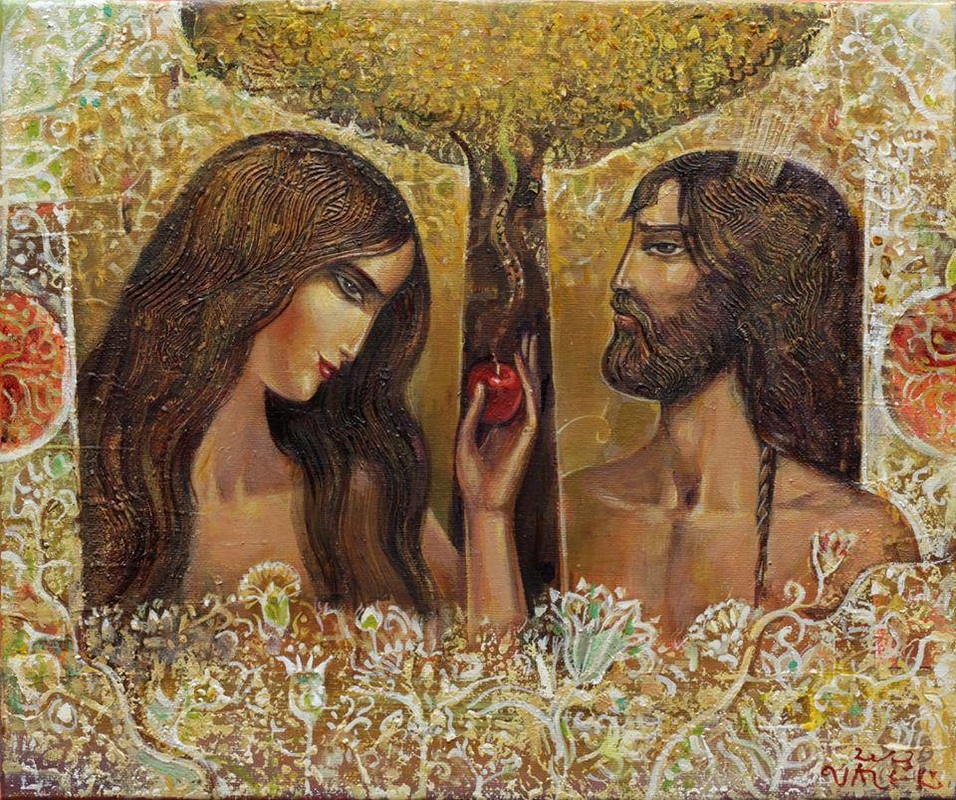
The Conclusion:
Not one title of
Christian law is abrogated, but instead we are adding a new one: accepting the
lament of the dead. ~Jung,
Liber Novus, Page 298, Footnote 187.
One creates inner freedom
only through the symbol.
~Carl Jung,The Red
Book , Page. 311.
Obviously, all
genealogy is transgenerational. So long as our ancestry remains unconscious, we
are marginalizing Nature and our nature. Yet, nature encompasses us. Jung notes
that dreams are pure nature. He was concerned for our culture if we lost our
roots. The same holds true at the personal level. Joseph Campbell declares,
"The privilege of a lifetime is being who you are." “A Joseph Campbell Companion: Reflections on the Art of
Living.”
Genealogy can be
approached as a clinical science but remains more of an art -- a hermeneutic
art, a shamanic art or self-initiation, as well as the art of relationship. We
thread our way through a labyrinth of light and dark characters. Our charts are
catacombs of our forebearers. We might have a different attitude to our lines
in the process of discovery than we do once we have fully traced our descent
from antiquity.
Subliminal Psychology
Our noble lineage
becomes a royal road to ancient ancestors. But such a labyrinth of projections
in the charts of a fantasist can produce self-delusion or over-heated zealotry.
In the chart of a realist it may remain cold facts. Fabulists embellish, while
pragmatists may be dry or stale.
A middle way might be
both enlivened and informed. Jung urged, "For the understanding of the
unconscious we must see our thoughts as events, as phenomena." (Liber Novus, p. 249) Genealogy mediates between
the conscious and unconscious as we struggle to reveal what has so long been
hidden. We also gain a reflective vantage point between ourselves and events we
perceive. We allow the transcendent function to mold and re-shape us.
He [Philemon] confronted
me in an objective manner, and I understood that there is something in me which
can say things that I do not know and do not intend, things which may even be
directed against me. (Jung, MDR, Page 183)
We Re-Collect
While some people may
deeply pursue formal therapy, complex genogram relationships, or workshops, the
vast majority will not. Those genealogical explorers will experience a spectrum
of spontaneous effects, developing their own theories, interpretations, and
directions from their ancestral encounters and revelations, conflated with
their own beliefs. It may be, as Jung suggests, that through dreams the
ancestors compensate our ego attitudes. Even then, we make subjective and
objective observations and interpretations. In the blink of an eye, we can
change our feelings about culture and human nature.
How little must the
root-ancestors of each of our hoary lines have imagined in their own day for
their millions of descendants? Even our "dead end" ancestors had
antecedents; we just cannot know them, at least not through history. Genetic
genealogy tells us our ancient tribes and ancestral lands, but not the names of
any of them or their families. But seeds of knowledge in the head blossom in
the fertile soil of the heart. We are formed directly from within.
Our Genesis
Genealogy used to be
largely a quest for the father's direct line. But with today's algorithms we
can find numerous distaff lines back through the ancestral field into the Heart
of the Feminine and our mitochondrial inheritance, shared genetically by all
genders. This type of DNA, stored in the cell's "batteries," is
inherited from the mother, more or less unchanged. Like Y-DNA, distinct mtDNA
lineages, are known as "haplogroups".
Often these
matriarchal lines reach further back in time than the paternal line. This is
the realm of the mothers and their families brought to the tree -- our gateway
into the unconscious. We descend from it, and like Faust, into initiation in
this womb of potentiality from which the world is continuously born as the
creative flow of the unconscious.
The Distaff Line is an old Craft term, the Mother's Line, as
opposed to the Father's Line (called the Spear Line). The Matrilineal bloodline
contains the spiritual, true essence of a person's "self", by which
the spirits of the departed leave the Unseen world and re-enter into their
families on earth. The Old Dame, as the Mother of Creation and the Supreme
Being, and the Spinner of Fate, holds the "Distaff" by which she
Spins the threads of creation. Since all ‘lines’ or threads begin with her and
return to her, the Mother's Line is called the "Distaff Line."
Mitochondrial DNA remains strong, persisting in the cells of both sexes longer
than nuclear DNA.
The ancients often
incorporated images of death in their funeral rites, on mummy cases, the walls
of tombs, and death masks. Some might find death photos macabre and yet they
are simply a final remembrance of the beloved, which can help us personify that
relative.
Imagistically, the
dead continue their very long journey in the afterlife. The unconscious
believes in the afterlife. Their events become our meaningful experiences --
their actions our ideas and reflections, insights alive with creativity and
fantasy. Our persistent search for Who? leads us down and back. Each one
strikes a different part of us. From this churning, this dialectical tension,
creativity emerges -- a myriad of intoxicating things, including the archetypal
images of immortality.
Psychological effects
of the genealogical pursuit will be different for everyone, with certain
commonalities, such as symptoms, identification, projection, participation mystique, etc. We spontaneously relate to
our ancestors with combinations ofempathy, identification, and projective
identification. Jung said that all identifications are introjected projections.
In pathological cases, as
you know, unconscious love also becomes a source of heightened fear of the
object for the introvert, and, conversely, unconscious fear becomes a source of
powerful attraction to the object for the extravert.
~Carl Jung, Jung-Schmid Correspondence, Pages 55-62.
Without guidelines
much of this natural personal process remains unconscious and can be
problematical -- individually, in the family, and in genealogical and heritage
groups. At a cultural level, we also assimilate the shock of a personal descent
from historical figures -- the historical burden. Myths have a vital meaning,
linking us with psychic processes and experiences "beyond consciousness in
the dark hinterland of the psyche," as Jung notes (CW 9ii, Pg. 154). The
collective is mythic and archetypal, while the cosmological is integrative.
The deeper we work
into the World Tree the more widely shared the ancestry becomes. Chances are
that most individuals seeking their ancestry will not seek treatment but can
benefit from a contextualization of those experiences. We can jump to wrong
conclusions from too little information. It happens to our beliefs and our
cognitive interpretations.
They also will not
stop at the Fourth Generation. What distinguishes de facto Transgenerational Genealogy from
conventional or Jungian approaches is plunging deeper into the Medieval,
legendary, and mythic layers of one's pedigree, rather than just the first few
generations. But we can not concentrate only on the royal lines, because many
other descents far out number them. Genetically, they have no priority; we may carry none of their genes.
Mythic Genealogy
Emerging from
pre-conscious psyche, myths are our deep background and connect us with our
instincts. Myth bridges conscious and unconscious cognition with an archaic
quality and networks of symbols and imagery. It represents the meaning of
being. They help us interpret the world. We need myth because it speaks
emotionally of and to the soul, giving meaning to loss and suffering. It may be
a painful struggle that reminds us we are very much alive. For example, in
Wotan we find the ecstatic experience of fighting as well as the ecstatic joy
of death.
English kings claimed
descent from Wotan or Odin. Medieval monks pushed Woden’s ancestry back to
Troy, then connected the Trojans to the Jewish scriptures and the lost tribe of
Dan. They linked the Franks to the kings of Troy and the Merovingian descent
from the family of Jesus. The Chronicle of Fredegar (7th century) mentions the legend.
It was elaborated in the Liber
historiae Francorum
(probably 727). Such legends grew over time.
Our genealogy shows us
how these stories migrated between cultures over time. We can imagine our
descent from Aphrodite herself. Descending through Macedonians and Ptolemaic
Egyptians, then Spanish and English nobility, she would be somewhere around a
100th great-grandmother. A pedigree prepared for Philip II of Spain traces his
paternal descent from Hercules Lybius, said to have been a son of Dodanim /
Rodanim, who is said to have been a great grandson of Noah (Genesis 10:4, 1
Chronicles 1:7).
The confabulations of
the Welsh royals made them descendants of Joseph of Arimathea. They included a
legendary cycle of Fisher Kings, and culminated in the Grail Cycle and stories
of King Arthur's court and the magic of Avalon. Given the right gateway
ancestors and royal lineage, all of these lines will show up in the standard
genealogies of millions of people.
Many accept their
fabulous descent from antiquity as literally true, while scholars know it to be
false. But neither view is accurate. Even though confabulated at some point for
political purposes, such mythical genealogies linking man to the divine are
actually traditional, and considered 'best practice' for eras of history.
Even 'fictious'
genealogies and medieval forgeries have a place in our lines, if only to show
us how these connections used to be made. Medieval genealogies connecting
ancient kings to Adam are pure invention. In the Historia Brittonum, the Welsh monk Nennius (9th
century) grafted northern Europeans onto the classical tradition by making them
not only descended from Noah, but the brothers of Romulus, legendary founder of
Rome.
Modern genealogists
want to cut "fictitious" connections, but myth is the DNA of our
psyche. That is like killing the root of the tree. This is genealogy without
proof, so it must be mythic. How about the mighty Zeus himself, king of the
gods? With over 200 offspring, divine and demigods, there are many lines of
potential descent. Or, the venerable Isis? She may be 100 - 150 generations back.
We find myth not only
at the root of our ancient lines but in each and every life between, in the
roles and archetypal patterns that constitute our direct heritage. Jung
suggests the dynamic is the same whether we think of them as instincts or gods
and goddesses. We can re-enchant our world by saying a prayer to the lords and
ladies, by whatever names they wish to be known. In a prayer to all our
relations, invisible spirits are made visible. Eternal being lies within each
and every one of us.
Grail Bearers
The Holy Grail and the Blood Royal are
twin myths. In that myth
Arthur is the product of sorcery and rape yet rises to the highest station.
Bron and the Fisher Kings link the Grail to the vales of Avalon and the Hidden
Stream of the Merovingian Franks.
We must be careful not
to misconstrue the Grail for our own purposes, from a medieval retrieval, to
spiritual literalism, to reactionary ideologies. We can't take it literally,
realizing the genealogies are made up. We certainly can't return to either the politics or religion of
a legendary era or new age revisionist theories like "the evil
Archons" and proliferating self-styled incarnations of Mary Magdalene. We
retain a psychological approach to the subject.
"We have to finish it. We have to
carry it on. Even though we don't talk about grails and castles and enchanted
maidens, still it is our myth to be completed in our lives. The myth has taken
us to exactly the point where modern people are now. Collectively speaking we
are stuck at the point where the French poem ends. So if you want a quest, if
you want something meaningful for your life, pick up the grail myth where it
now lies in you."
(Robert Johnson)
When he first finds
the Grail Castle, Perceval fails to ask the crucial questions about the origins
of evil, the king's wound, and the Grail's meaning. He does get another chance
to find wholeness -- to redeem the divine in matter. That doesn't mean he had a
cognition of the whole but it is said to be so. Emma Jung and M-L von Franz
describe how The Grail is brought to the Old Grail King; the goal of the quest
is death to the old king, who 'dies' to the dominant collective consciousness
of the day with its one-sided god image and is restored.
Encountering the Grail
is an emotional readiness for reflective experience and to receive numinous
experience. With the secret words spoken and Perceval’s royal ancestry
revealed, the Grail is placed in his care. The Grail disappeared with his
death, went back into concealment in the unconscious of each living person,
available as an inner guide, the voice of the divine, inviting each of us to
our individual completeness.
The genealogical Quest
for the Grail shares something in common with the quest for the Philosopher's
Stone, which forms itself. The magic of genealogy as the magic of the Stone is
in the seeking after it. The Grail is
our own transformation.
We are filled by the
Grail when we point ourselves toward it. The Grail
serves the whole community.
The Philosopher's
Stone declares,
"My light,
exceeds every light, and my good things are better than all other good things.
I give freely and reward the intelligent with joy and gladness, glory, riches,
delights; and them that "seek" after me I make to know and
understand, and to posses divine things." --Golden Tractates of Hermes
In the search for the
stone, it is the work that counts. One should not worry too much about the
right way. The right way with the wrong person will never succeed. The wrong
way with the right person will eventually right itself, for the stone is found
at the crossroads of Heaven and Earth. Those who seek the Stone with true
heart, shall be found by the Stone itself.
As someone's descendant we answer the call. Like the Fisher
King, we seek the Salmon of Knowledge. The transgenerational group is
integrated within the individual. Much of the effect is intrinsic. For Jung, fantasy is an integrative function.
Imaginative expressions of hidden forces
appear spontaneously as the direct expression of psychic life, creative and
imaginative activity inherent in each and every moment. We meet each wondrous,
wild moment by relating to it, not controlling it. We really can't separate the
past from the present.
Relationship is created
and recreated from what has been and what is yet to be. Our challenge is to
claim a place for our own imagination and intellect. We learn to see and bear
the pain of seeing and suffering. Healing and wounding alternate in a rhythm
echoing a sense of transience and death.
"You will feel me
with you even from the Land of the Dead."
Our lineage is our
own, personal Mystery Play. You can only enter into your own mysteries. We can
allow the phenomena to speak - the multitude of personalities to speak, to be
personified. Images are also voices -- messages from the dead. We need a sense
of the ancestors. For most,
that sense may be more poetic than clinical...the poetry of everyday life as it
stretches back into the mists before time.
From the earliest societies to contemporary civilizations,
genealogical methods have traced ancestries back to gods, animal totems, and
legendary heroes. Originally the oral history narratives of clan or tribe
bequeathed the lineage. In ancient Sumeria, Babylon, Egypt, India and China,
kings and heads of state claimed their rights to the throne through genealogy.
Royal totems include dragon, eagle, lion, wolf, serpent, boar, etc.
The Old Testament
recounts the "begats" of Adam, Noah and Abraham, and later the royal
bloodline of the House of David. Muslims trace their descent from Muhammed,
while the Greeks and Romans and Vikings linked their heritage to the gods. The
importance of ancestry to soul appears in Anglo-Saxon and Scandinavian
genealogies. In Germanic folklore the soul was considered, in certain respects,
something inherited.
What is the power of the individual against the voice of the
whole people in him? ~Carl Jung,
Liber Novus, Page 365.
There is essentially
no difference between doing genealogy or psychogenealogy, except perhaps the
addition of a few evocative techniques. We don't just study it, but interact
with it -- with the ancestors. It may be less what we think about it and more
its effect on us. Information is naturally excited in the genealogical process
as images, sensations, intuitions, synchronicities, insights, and more.
But psychogenealogy
attempts to find workable answers when elements embedded in the family memory
are now limiting an individual in a particular way.
Individual and
collective consciousness is shaped in crucial ways by cognition of collective
family experiences. What tends to get passed on is the overwhelming,
unbearable, unthinkable. Much
of history has been lost, distorted, or blotted out. We can focus on genetics,
culture, spirit, and emotion as keys to the ancestral door. We can break our
identification with a traumatic or unresolved past and still honor and
consciously grieve our ancestors.
Genealogy is a tool
for family therapy and self-knowledge. We carry secret stories from before our
lifetime. The entire family tree is both a trauma archive and a resource for
healing. Yet children raised in difficult circumstances often show enhanced
mental flexibility. Much of what is unconscious to us is revealed in our lines.
We still have to amplify, work with, interpret, and integrate that information.
We can reframe our
relationship with pain, fear, and grief at the familial and ancestral level.
Current research on well-being describes two perspectives: the hedonic
approach, which focuses on happiness and defines well-being in terms of
pleasure attainment and pain avoidance; and the eudaimonic approach, which
focuses on meaning and self-realization and defines well-being in terms of the
degree to which a person is fully functioning. The later may be more important.
Composed of the words "eu" ("good") and
"daimōn" ("spirit") it fits the ancestral theme.
This spirit is an
autonomous psychic happening, a hush that follows the storm, a reconciling
light in the darkness of man’s mind, secretly bringing order into the chaos of
his soul.
~Carl Jung; CW 11; Paragraph 260.
This is part of the
Genealogical Journey.
In this way we follow
Nature and our nature back to our Origin.
We can pursue both a
psychological and genealogical approach to wisdom. Realizations and
self-actualization arise naturally in the process of compiling such a
genealogy, as we recall exactly who we are, thereby approaching our
wholeness...
for a 21st century
Renaissance.
Spiritually,
genealogy can strengthen our faith in the ancestors. We may find spiritual
meaning in reconstructions of suppressed ancient religions or eclectic
practices. In conducting Celtic genealogical research we rediscover the folk
stories of our ancestors or the ancient deities once worshipped in other
lands. The precise meaning and value of the old gods and goddesses will vary
between listeners, but some find spiritual meaning in reclaiming ancient
mysteries nearly lost to the modern ages.
Subjective mental life
is a primary metaphor of
subjective Experience;
Primary Metaphor
Becomes Embodied
and maps across
generations.
The Grounding of the
Whole is the grounding of its parts.
We reason with such
metaphors.
(Lakoff
& Johnson)
This argument against
expunging legend and myth
from traditional
genealogy practice is simple:
What happens outside us in
these days is the image that the peoples live in events, to bequeath this image
immemorially to far-off times so that they might learn from it for their own
way; just as we learned from the images that the ancients had lived before us
in events.
~Carl Jung, The Red book, Page 239.
"But if the believer
without religion now thinks that he has got rid of mythology he is deceiving
himself: he cannot get by without "myth."
~Carl Jung, Letters
Vol. II, Pages 482-488
Psychology Today: Why
do people spend decades tracing their lineages? Thinking about one's ancestors
provides comfort, improves one's ability to deal with challenges and actually
boosts cognitive performance, new research shows.
In a simple
experiment, researchers asked people to think about their ancestors (or
something else) and then measured their beliefs about their own performance on
several cognitive tests. People who had been made to think about their
ancestors expected to do better on the tests.
But did they actually
do better? Yes. Researchers Peter Fischer, Anne Sauer, Claudia Vogrincic and
Silke Weisweiler found that people who had recently thought about their
ancestors actually did better on cognitive tests of intelligence than people
who had been made to think of other things.
Therapeutic Initiation
Inner Voices:
Reverence Toward the Souls of the Ancestors
"Take pains to
waken the dead. Dig deep mines and throw in sacrificial gifts, so that they
reach the dead. Reflect in good heart upon evil, this is the way to the ascent.
But before the ascent, everything is night and Hell." ~Carl Jung, Liber Novus, Page 244.
Psychologically this means
that the souls of the ancestors (potential factors, qualities, talents,
possibilities, and so on, which we have inherited from all the lines of our
ancestry) are waiting in the unconscious, and are ready at any time to begin a
new growth.
~Carl Jung, ETH, Alchemy,
Page 230.
These are, so to speak,
the re-animated souls of the ancestors which have been lying dormant in the
unconscious, and the alchemists call these units or souls the sleepers or the
dead in Hades who are resurrected by the "holy waters" (that is the
miraculous water of alchemy, the fertilizing Mercury). ~Jung, ETH, Alchemy, Page 230.
Learning Objectives:
To understand the
significance of our genealogy as more than
a metaphor for the
cyclical unfolding of our life story
To understand the
timing of transgenerational patterns throughout
different eras of
history, and times of transition
To apply the timing of
great cycles to our genealogy and life events
and reflect on the
unfolding of our goals
If his individual
experience is a living thing, it will share the quality of all life, which does
not stagnate but, being in continual flux, brings ever new aspects to light.
~Carl Jung, Letters
Vol. II, Pages 482-488
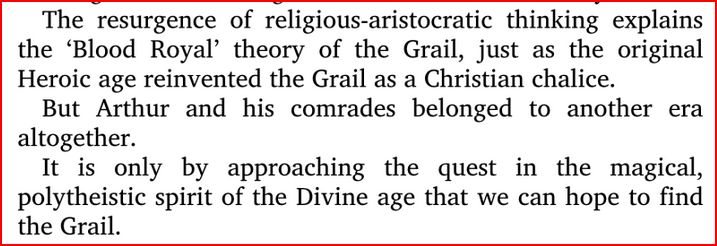
History
often reveals who underwent trauma:
wars; plague; torture;
physical and mental abuse; abandonment; disowning; miscarriage; stillbirth;
displaced; orphaning; kidnapping; birth trauma and defects; neglect; arson;
homelessness; migration; toxic caregivers; suicide; murder; terror; spiritual
abuse; divorce or never marrying; family secrets; attachment disorder;
banishing; grief; dependence; incest; rape; affairs, separation; isolation;
"mystery ancestors"; addictions; exhaustion; hypochondria; obsession;
paranoia; personality disorder; schizophrenia; depression; emotional numbness;
heresy; chronic anxiety; crime; social, financial, legal, displacement;
zealotry; excommunication; poverty; famine; humiliation; internment;
fanaticism; bigotry; cults; expulsion; eviction; slavery; betrayal; genocide;
revenge; anger; execution; molestation; extortion; conquering;
natural disasters;
catastrophes, cataclysm; cultural and ethical issues, forced migration, etc.
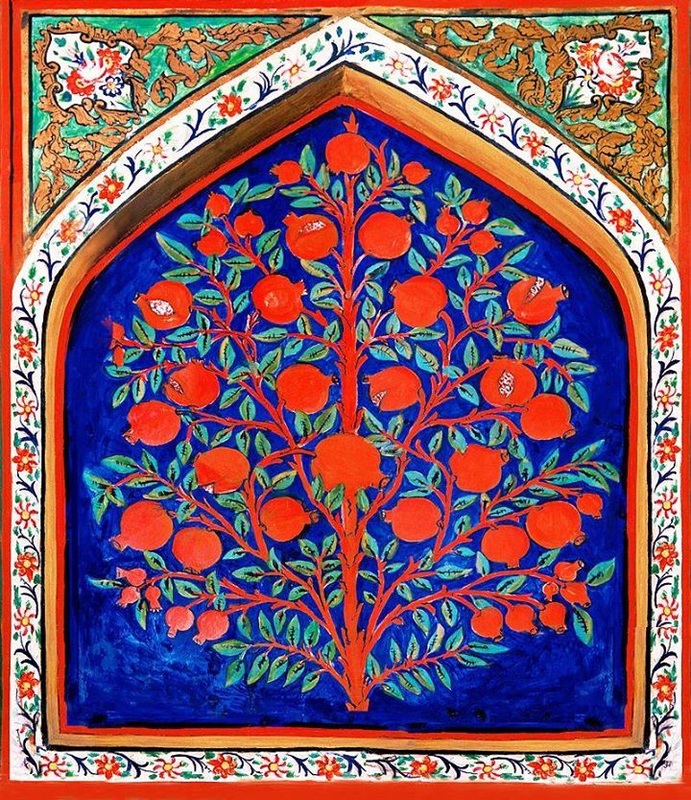
Jung, Red Book
The growing one is the
TREE OF LIFE. It greens by heaping up growing living matter. ~Diahmon, Liber Novus, Page
351.
Sometimes a tree tells
you more than can be read in books.
~ C.G. Jung; Letters
Volume 1; Page 179.
Jung spoke of the '2
million year old man' within us all. But Genus homo is as much as 3 million
years old, with ancient patterns including hunting strategies, mating patterns,
intergroup relations. Genetics has shown that modern man is a hybrid of at least
three species. Some ethnic groups include 4-5% Neanderthal or Denisovan.
We continue to change.
Genome researchers at
the University of Chicago have identified more than 700 regions in human DNA
where apparently strong selection has occurred, driving the spread of genes
linked to a broad range of characteristics.
"These are very
recent events—within the past ten thousand years," said Jonathan
Pritchard, a geneticist whose laboratory team conducted the study.
The results suggest
that humans in different regions have continued to adapt in numerous ways to
both environmental changes and cultural innovations.” (2006)
http://news.nationalgeographic.com/news/2006/03/0308_060308_evolution.html
"In
alchemy, Mercurius is symbolized by the tree as well as the dragon. He is
notoriously "duplex", is both masculine and feminine, and is made one
in the hierosgamos of the chymical wedding."
[Collected Works vol 13, par 315].
But
for him who has seen the chaos, there is no more hiding, because he knows that
the bottom sways and knows what this swaying means.
He has seen the order and
the disorder of the endless, he knows the unlawful laws.
He knows the sea and can
never forget it.
The chaos is terrible:
days full of lead, nights full of horror. . .
I know that chaos must
come over men, and that the hands of those who unknowingly and unsuspectingly
break through the thin walls that separate us from the sea are busy. For this
is our way, our truth, and our life.
~Carl Jung, The Red
Book, Page 299.
Genealogy
is our map of the unconscious -- the Land of the Dead. In the beginning, it is
like drawing a map of the world on a sheet of paper with as little concept of
the genealogy as uknown seas and continents. But, that map is a beginning, a
framework in which later discoveries can be placed. What is confusing at first
will perhaps in a later stage of the journey be made clearer.
The Red Thread, the
thread of destiny, connects to the Source. It shows us the way, igniting
imagination with the alchemy of 'seeing', awakening the soul. The red threads
of your blood link you and your Tree to the World Tree, your history to world
history and mythology. The bloodline is also called the "underground
stream". The Red Thread is a transmission of cultural influences of
ancestors.
Walking
the Labyrinth of our lines is a deeply meditative process that arouses spirit,
intuition and gnosis from a deep sleep. It is a way of soul retrieval, uniting
personal and collective unconscious. It is a process of digging through the
past, overturning old notions. Even history looks different from inside your
bloodlines. You can easily observe your great-grandparents intermarrying over
vast distances. They may move in a single generation from eastern to western
Europe, for example, or across Europe from the Near East, or change their
religion and ethnic identity. Nothing lives as long as deep memory.
A transference in the
clinical sense does not always need a personal relationship as a bridge, but
can take place via a book, a piece of hearsay, or a legend.
~Carl Jung, Letters
Vol. II, Pages 504-506
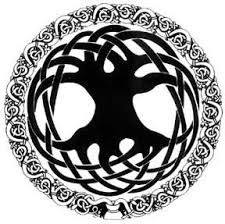
Healing
& Renewal
Jungian
psychotherapist, Thierry Gaillard of Geneva, Switzerland developed a school of
thought around Transgenerational Integration and Transgenerational Knowledge.
It "reconnects us to some traditional cultures, actual and ancient,
referring to the presence of ancestors, rites of passage, memory of origins
(family and community ties), shamanic ancestors' therapies, etc." He published two anthologies in French on
Transgenerational Integration in real family histories and the lives of
celebrities, and anticipates a third bilingual volume on shamanic roots.
http://www.thierry-gaillard.com/ Ecodition
(www.ecodition.net)
Gaillard suggests,
"The recall and acknowledgment of shamanic practices, ancestral values,
provides strong roots for transgenerational integration, showing us more about
the unwritten laws that operate in the background." One of his books
describing ancestral syndromes is Oedipus Reborn and Rooted in the
Present,
which unpacks the often-overlooked rebirth of Oedipus. He describes the new perspectives of
the transgenerational view:
What happens with the
"transgenerational" is quite unique in the history of science.
Indeed, references to transgenerational arise throughout the clinical field
(psychosomatic medicine, epigenetics, family therapy and social issues,
anthropology, psychotherapy and personal development) as to force us to go
beyond the boundaries of these disciplines. Transgenerational dynamics
challenges our usual space-time criteria to return us to the origins. In many
ways, the breakthrough of transgenerational issues resembles the quantum
revolution in the world of physics. And we are only at the beginning of this
new field that allows us to bridge contemporary issues with ancestral and
shamanistic practices.
This new perspective also
helps reconnecting us to what was lost and forgotten in the history of mankind.
In particular we can benefit again from the rich traditions of ancient symbols,
myths, which we had forgotten the operative or therapeutic value. With their
references to transgenerational dynamics , traditional societies and ancient
cultures find additional legitimacy. Blacklisted with the birth of our new
civilization, almost 2,400 years ago in Athens, they may well return to their
former glory.
While my own work in
this area and "transgenerational epigenetics" developed
independently, it resonates deeply with these ideas of combining personal,
familial, and collective talents to transform our destiny by analyzing and
integrating familial patterns. If we are fortunate, our living elders describe
both the factual and imaginal family to us directly.
Like a dream, this
remembrance is a jumping off point for further self-exploration. While working
the fractal nature of the family system, we insist on the particularity or
specificity of any individual's life story and the singularity of historical
situations.
Such techniques are
thresholds that act as Doors to the Dead, which shamanic societies have always
found powerful. Our ancestors are a natural part of the universal mindfield and
the personal mindfield we embody. Epigenetics supports this view that
non-physical changes in DNA expression -- turning genes on and off -- can
change the whole system.
Metagenealogy
Metageneology (Jodorowsky & Costa) provides a
rather exhaustive methodology for recognizing and overcoming ancestral patterns
of influence. Such exercises "uncover your family’s psychological
heritage, heal negative patterns of behavior and illness in your family tree,
and [reveal] your true self." They explain, "we are the
product of two forces: repetition of familial patterns from the past and
creation of new ideas from the Universal Consciousness of the future."
This work is limited
largely to your four preceding generations. They also include the influences of
those family members from whom you do not descend -- siblings, aunts, uncles,
and cousins, for example. While they provide some useful exercises,
visualizations and meditations, my own philosophy of treatment is that the
working material should be emergent, rather than introjected. Emergence exposes
what is concealed and embodied within. It maintains a congruence that imported
material or images may not have with the individual. Genealogy can be
approached as an artform -- a curatorial project.
http://www.amazon.co.uk/Thierry-Gaillard/e/B004MZJIS4
http://www.amazon.com/Oedipus-Reborn-A-Transgenerational-Mythanalysis/dp/2970077345
http://www.find-yourself.net/
http://static1.squarespace.com/static/52cdf95ae4b0c18dd2d0316a/t/52e05766e4b0233a8527c4d6/1390434150260/Stevens+-+The+Two+Million+Year+Old+Self+-+reduced+%281%29.pdf
Genealogy and Genetic Genealogy are
now the second most popular subject online. The trail back through history is
contained in the lineage of our own descent. Large numbers of people are
discovering their Colonial histories and following their ancestors back to the
homelands. Around the globe, some were never transplanted; others never forgot
who they are or where they are from. Whatever the Grail is, we embody
that. Some deny the Sangreal, yet here we are in the flesh, following the
Red Thread.
We cultivate our own
rows or lines of ancestors through genealogy, the pedigree of our origins.
Genealogy and even genetic genealogy are pursuits that require interpretation
(hermeneutics) of assembled data, not literal interpretation, due to hidden
variables and a variety of other factors, including the interpretive bias of
the researcher.
|
|
|
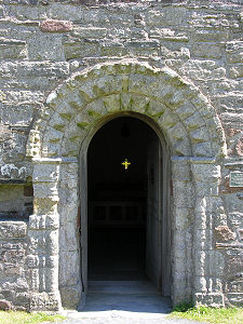
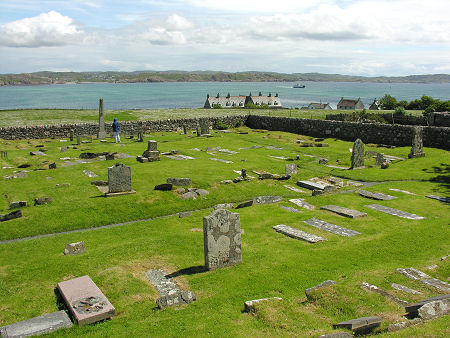
Iona, St. Oran's and Relig
Odhráin, Royal Cemetary
Doors to the Dead
This is the work of
the soul. In many ways genealogy functions as a map of the psyche -- a map to
the archaic threshold through which the ancestors await us. Doors and
thresholds are primary metaphors for liminal or transformational states
in ritual and burial practice.
Dividing inner and
outer inhabited space, doorways signify transition and transformation. While
the term 'portal' has become a New Age buzzword for all sorts of nonsense, out
of the hands of the fabulists it remains a profound psychic reality that can
initiate our spiritual journey.
The door to our
ancestral past holds the key to our own myth of origin -- the vast migrations
and epic challenges faced by those who brought you here to inhabit the present.
Our whole psychophysical being, both structural and ephemeral, is our memory -- personal and
collective. We are informed by their presence. They may venture forth from the
portal of sleep in our dreams.
Be the Key; Open Me
Doors or gates are
often associated with guardians. Imagine you are the guardian of the labyrinth
of your ancestral lines and those of your future generations. What would you do
to nurture, sustain, and protect them? What intuitive and creative methods can
you employ? Opening the door in your tree itself serves as an 'entrance
meditation,' the first part of the inner journey. We may feel we are answering
a deeper calling to decode the chronicle of our significance. We may find
exemplar characters that embody our shadow, anima/animus and our higher selves.
What family secrets
might you find behind the door? We cross the threshold when we begin our
genealogical journey. How we are like them is as important as how we differ, or
how we wish we were different. When we confront their stories we know such
things immediately. We discover that others have been there before us when the
door to the World Tree of shared ancestry swings wide. There may be
impressions, apprehensions, or symbols that gradually reveal themselves to our
conscious minds.
‘Doors to the dead’
appear as freestanding portals, dolmans, causewayed ring-ditches, stone henges,
or thresholds to grave mounds or cave shrines. The passage tomb at Newgrange
has a sculpted entrance stone. Archaeologists in Transylvania discovered a
"tepes", cave/mine or rath with a fire-pit dating to 5000 BCE. In the
ashes they found remains of a human sacrificial victim and two clay tablets.
Sometimes, as on the
ancient Isle of Iona, the dead or volunteer sacrifices were buried in the
doorway to prevent the walls from caving in. Many believe Relig Odhráin has
been in continuous use as a graveyard since St. Columba's day, 500 CE. It
became the traditional burial place for the Kings of Dalriada and, later,
Scotland, for many centuries. Macbeth lies there. A survey conducted in 1549
listed 48 Dalriadan/Scottish kings burials, as well as 8 Norwegian and 4 Irish
kings. Those with royal lines are likely to be descended of many if not all of
them.
http://www.findagrave.com/php/famous.php?FScityid=404505&page=city
The purposes of sacred
doorways included connections between the dead and the living, In creating
controllable boundaries and thresholds they formed between-spaces, deviant
spaces that summoned the supernatural to obtain contact with the dead in the
Otherworld, materially and metaphorically. In Iona, the veil between worlds is
traditionally considered 'thin,' encouraging 'second sight.' Jung considered
second sight a 'gift' that carried the burden of responsibility. Perhaps we
should call it 'first sight' as it is more primordial.
http://jungiangenealogy.weebly.com/second-sight.html
Liminal Lineage
Your own genealogy and
the pursuit of your lineage and name provides a metaphorical door to connect
with and approach the dead. It is a key to the labyrinth of self-knowledge that
holds answers to the perennial question, "Who am I?" Where we come
from is related to where we are going. Doors and thresholds are near-universal
expressions of social transformation, boundaries, and liminality. Genealogy can
be seen as a modern cultic tradition, rooted in ancient practice rather than
dogma.
Genealogy is a highly
ritualized environment, with rites of contemplative or meditative research and
entry work, synchronicities, documentation, initiations to genealogical or
bloodline groups, and pilgrimage. This is one of the metaphors we live by that
can expand our sense of self-knowledge. Each time we learn about an ancestor we
knock on a door. Knowledge is the key that unlocks the door, the direct
experience of gnosis. Our attention enlivens their
presence.
The door controls
access and marks the boundary between antagonistic and confrontational spaces
or a psychophysical transition in social roles. This architectural element
allows us to abandon one space for the next. Doors and thresholds are thus
closely linked with rites of passage. Not every crossing of a threshold is a
liminal ritual but the opportunity with many social and metaphorical
implications is there.
|
|
|
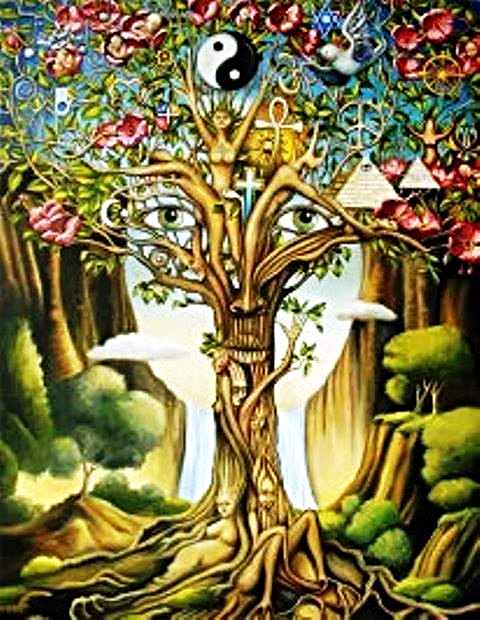
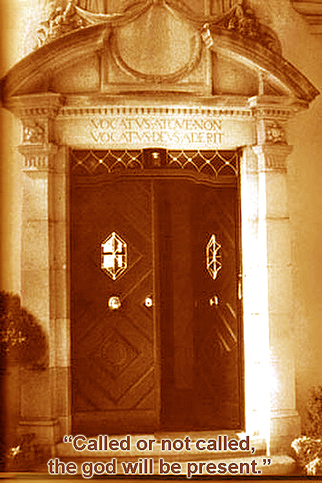
The
fact that I use the term "dialectical procedure" or something of this
sort exposes me to the misunderstanding that I envisage an intellectual
procedure, which is not the case, but in truth a practical method of dealing
with the very concrete propositions the unconscious presents us with.
~Carl Jung, Letters
Vol. II, Pages 500-502
"When I worked in
my family tree, I understood the strange communion of the destiny that unites
me to my ancestors. I had the strong feeling that it was under the influence of
events and problems that were incomplete and unresolved by my parents, my
grandparents, and my other ancestors. I had the impression that there is often
in the family an impersonal Karma transmitted from parents to children. I
always knew that I had to answer questions already asked by my ancestors or I
had to conclude, or continue on the previously unresolved issues". ~Carl Jung
"You speak as if you
have still learned nothing.
Can you not wait?
Should everything fall
into your lap ripe and finished?
You are full, yes, you
teem with intentions and desirousness!-Do you still
not know that the way to
truth stands open only to those without intentions?"
~A Soul speaking to Carl
Jung in The Red Book, Page 236.
INTENTIONALITY
The Psi Buzzword
Intentionality is
Philosophy, Not Physics or Neurology
We May Think We Are
Directing Ourselves, but Free Will Is a Meme, a Neurological Myth; Can or
Should the Ego Invade the Self-Organizing Psyche with Control Fantasies? Most
of our decisions are made before we think about them, about 10 seconds before
we become aware of them.
Therefore a wise man does
not want to be a charioteer, for he knows that
will and intention
certainly attain goals but disturb the becoming of the future.
~Carl Jung to his Ego,
Liber Novus, Page 311.
It is common for very
infantile people to have a mystical, religious feeling,
they enjoy this atmosphere
in which they can admire their beautiful feelings,
but they are simply
indulging their auto-eroticism.
~Carl Jung, ETH
Lecture 11 - Jan 1935, Pages 171.
more:
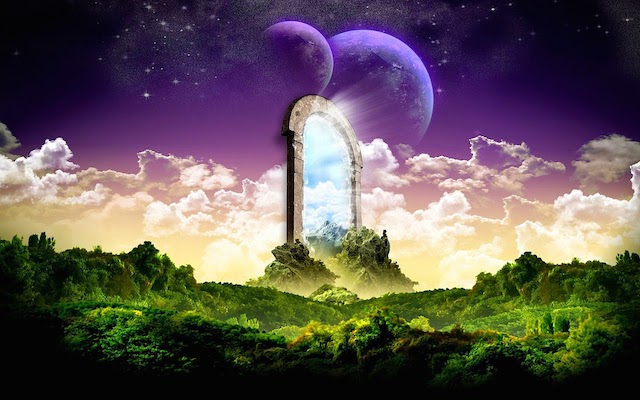
Beginning
to Remember the Future
Like remembering the
past, consciousness of the future depends on where you get your information in
an intuitive leap. If we 'go to the future', we can "see" what is
going on if we visualize the problem. And you can do this, too. As described by
physicist Fred Alan Wolf and others, from the physics point of view, the future
is already there, 'around the corner'. Certain potential pathways are more
accessible than others, following the path of least resistance, unless you
'tweak' the path of least action.
The Mindfield
This involves relaxing
into a state where you have an awareness of yourself in that future time. You
drift off with the thought that this is something you want to do. There is no
need to force it. You can potentially 'undo' things in the past and create new
potential for the future. It matters little whether such experiences, which are
like ancient shamanic journeys, are 'real' or imaginal. The effects are real
and change our attitudes and being.
We don't have to take
it literally, nor dismiss it. If we don't sense it, it isn't there. We have to
make a move in that direction. It's already out there for us to experience,
certainly in terms of healing and transformation. Faith and trust in one's
ability to be on the right track increases creativity. And the same is true
moving through your genealogical lines. How would you describe your
relationship with your grandmother, with your ancestral women? Have you ever
had a vision of a female wisdom figure?
Because
much of genealogical best-practice includes mythic and fictional characters,
the process is best approached with a Jungian orientation, rather than as hard
historical fact. In terms of the collective unconscious it has psychic reality,
and Jungian and post-Jungian practices allow us to interact with such material
in a deeply meaningful way that enhances integration.
The Taking In of
Solace: The Many Into One
The Portuguese word
"SAUDADE" can't be directly translated, but describes the feeling of
intensively missing something -- a yearning for the future or connection to a
destiny in time that is NOT YET. It may be a particular genetic skill of the
genetic serpent... inhabiting time itself.
This deeply emotional
state is profound melancholic longing for an absent beloved who might never
return, such as a lost lover, or a family member who has gone missing, moved
away, separated, or died. Or, maybe they are unborn.
Saudade
is "the love that remains" after someone is gone. Emptiness is an
integral aspect of mind/matter. This emotional vacuum can be likened to the
Void which is actually a plenum of infinite potential. Sad and happy feelings
come all together.
The
recollection of feelings, experiences, places or pleasurable events and well-being
stimulates the senses and makes us live again. Tangible, symbolic, and
imaginal experience of our ancestors and progeny can have real effects on our
attitudes and compassion, and the main effect is Transgenerational Integration.
Transgenerational
Integration
works across several
generations.
Deep Time
Family therapists and
metagenealogists might contend that working back 3 to five generations is
sufficient work on family issues. But something else happens when you extend
your senses back further into deep time. You live from another place, with
extended awareness. The deeper you go the more value you can extract from your
experience. This is the treasure of the unconscious. Genealogy is also a way of
tending psychic wounds and embracing the family shadow.
The multitude of voices speak. Who are the
dead and what do they speak? We are cut from the dead by what we have buried.
The dead are the daily encounter with what has been buried, burned, drowned,
denied or forgotten on purpose that appear in hunches, omens, intuitions,
cautions, warnings, etc. -- the moments of holding back, not doing -- myths and
pain. Myth is the ongoing fantasy concurrent with our behaviors and gives us
the immersive sense of reality.
Conventional
Transgenerational perspective maintains that generational conflict can remain
unresolved through out generations. This view does not imply causation of
conflict, only that unresolved issues can continue to affect families
throughout generations. Transgenerational PTSD is an example.
Coined
by John Keats 'soul-making' is applied by James Hillman for a practice through
which we can slow down and deepen our connectedness to ourselves, others, and
the world. It emphasizes being over doing and the present moment over future
aspirations.
Soul-making embraces
and prioritizes woundedness, humanity, and limitations over a quest for
perfection, transcendence, and transformation. Psychic numbing is denial. In
other words, soul-making occurs every time we look more closely, more feelingly
at the individuals and ancestors peopling our lives and the ideas, afflictions,
and ever-present prospect of death which together give substance and
meaning to our hours and days.
During
transitions people often start asking themselves who they are and where they
came from. Finding family origins is a start in determining your genetic base.
Finding your roots also may help to find long-lost kin.
In this perpetual
tug-of-war between now and then, finding the footing to develop a sense of home
is difficult, if not impossible, particularly for those who may find themselves
stuck between cities, states, or countries. It may take a map of family locales
and migrations.
- Where do you come from? Tell us about your hometown, your parents, your family history, or anything, without which, you wouldn’t be you.
- Finding your roots often means exploring the past. If you’re writing fiction, experiment with time travel (into the future or past).
- If you could speak with anyone from your past, who would it be and why? When were they alive and what were they like? What did your grandfathers do for a living?
- Dig a bit deeper and postulate on the idea of genealogy. At what point are we all connected? What do you think that means in our relationships with others?
Transgenerational
trauma is trauma that is transferred from the first generation of trauma
survivors to the second and further generations of offspring of the survivors
via complex post-traumatic stress disorder mechanisms. Psychic
legacies are often passed on through unconscious cues or affective messages
that flow between child and adult. Sometimes anxiety falls from one generation
to the next through stories told and their unconscious effects.
Transgenerational
transmissions take on life in our in dreams, in acting out, in “life lessons”
given in turns of phrase and taught us by our family. Discovering transmission
means coming to know and tell a larger narrative, one from the preceding
generation. It requires close listening to the stories of our parents and
grandparents, with special attention to the social and historical milieu in
which they lived -- especially its military, economic and political turmoil.
The
emotional ties between child and ancestors are essential to the development of
our values. These bonds often determine the answers to myriad questions such
as: “Who am I?” "Who am I to my family?” “Who can ‘we’ trust” and who are
our enemies?” “What ties me to my family?” And, most importantly, “of these
ties, which do I reject and which to I keep?" (Barri Belnap, 127) In
rising above the remnants of one's ancestors' trauma, one helps to heal future
generations.
Transgenerational
epigenetic inheritance is the transmittance of information from one generation
of an organism to the next (e.g., parent–child transmittance) that affects the
traits of offspring without alteration of the primary structure of DNA. The
less precise term "epigenetic inheritance" may be used to describe
both cell–cell and organism–organism information transfer. Transgenerational epigenetic
inheritance is the idea that epigenetic marks (i.e., DNA methylation, histone
modifications) can be acquired on the DNA of one generation and stably passed
on through the gametes (i.e., sperm and eggs) to the next generation.
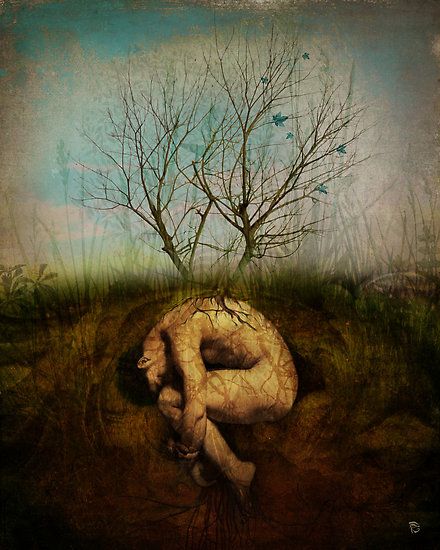
If his individual experience is a living thing, it will share the quality of all life, which does not stagnate but, being in continual flux, brings ever new aspects to light. ~Carl Jung, Letters Vol. II, Pages 482-488
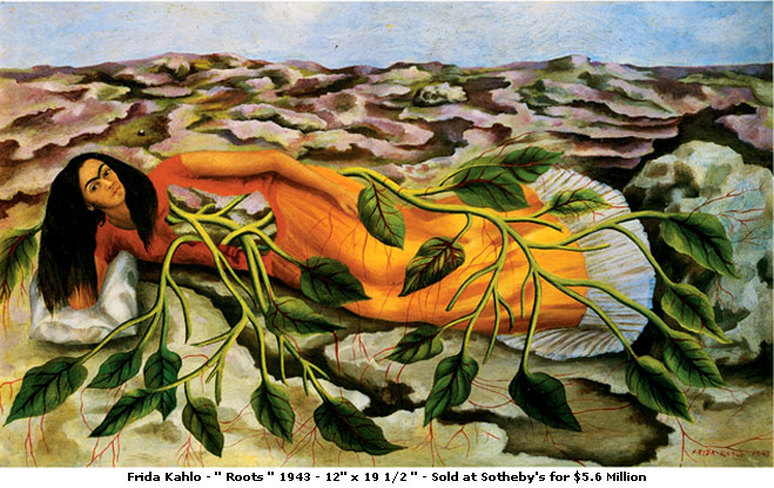
Through
the Eyes of the Ancestors
Preface
Facing
Your Ancestors
GENEALOGY
IS A WAY OF KNOWING
Your Pedigree is Your
Own Book of the Dead
What
I mean by this is that every epoch of our biological life has a numinous
character: birth, puberty, marriage, illness, death, etc.
~Carl Jung, Letters
Vol. II, Pages 208-210.
The shadow is the block
which separates us most effectively
from the divine voice. ~Carl Jung, Letters Vol. II, Pages
544-546
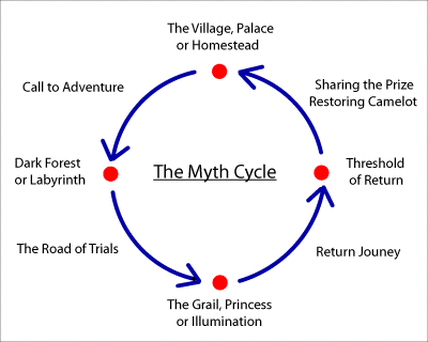
"My fantasies, my symptoms put
me in my place. It is no longer to know at which place I belong - at which God
- but at what place I belong, on which altar I give myself, my myth by which
suffering is transformed into devotion. "- James Hillman
The old myth, which always
holds within it something yet older and more aboriginal, remains the same, this
being an essential quality of all forms of religion; it only undergoes a new
interpretation.
~Carl Jung, Letters Vol. II, Pages 482-488
Descent
From Antiquity
Families are bound
together eternally. The power of genealogy is the power of story. This is
the story of the family and the diverse characters that populate the many
branches of our family tree. These are stories that matter, that preceded your
corporeal existence. This story reveals how things came to be as they are -- as
you are.
Genealogy is a story
we tell ourselves about ourselves. The stories of our ancestors open us to
deeper experience. Our personal story is embedded in our larger inherited story
and culture. Genealogy helps us connect more deeply with our unique story and
meaning in life beyond a personal story. It is a mythic archaeology that
connects us with that which has given us shape, opening a path to
transformation.
Genealogy is the
narrative of a pre-modern world. It has traditional roots in the ancient
theogeny of gods and goddesses, divine-king lists and The Bible. Ancestral gods and ancestral
religions developed over eons and are as old as particular branches of mankind
-- gods of the blood. Astrologically determined gods and goddesses can often be
found at the roots of dynastic houses. Royal houses claimed power through
descent from ancestral gods.
Gods are difficult to
destroy or conceal. Fictitious lines of descent blend indistinguishably with
medieval forgeries. Some divinities may originally have been historical persons
or war-chiefs, now lost to the mists of pre-history. Seedlines codify ancient
ethnic identity and empires. Later, royals added them to their lines to bolster
their claims to divine rule and the founding of thrones. Though not factual,
traditional genealogy was a geographical and spiritual compass.
When Rome
Christianized in the fourth century, it cut off the mythic corpus, and demoted
gods to human status and allegories. The medieval period filled the gap with
tales of the Holy Grail. The pagan content of mythology was codified in the
mid-fourteenth century in Boccassio's Genealogy. Later, the Carolingians used such
works to justify their right to rule, also citing the spurious Donation of
Constantine, which the Church used to justify the appointment of rulers.
Traditional genealogy
considered these mythological inclusions best-practice, yet it may be more of a
psychic than historical "fact" -- the product of a collision between
pagan and Christian societies and their reconciliation. Historical time
required a linear descent, even if it masked pagan roots at the theological
fringe. Even if medieval genealogies connecting ancient kings to Adam are pure
invention, they retain certain psychic values that are part of the archaeology
of the collective unconscious.
The
Tree of Life
Our personal genealogy
is a process of self-discovery and self-knowledge with its own procedures and
measures of 'truth.' It seems ironic that technology is allowing us to retrieve
such essential aspects of our own humanity. Curiously, genealogy is the second
most popular online subject, second only to sex, much like sex precedes
procreation.
Your family tree is an
encyclopedia of human nature. Genealogy doesn't give our lives context; it is the context and material ground of
our existence. The Tree of Life carries the evolution of the world, gives life
to the universe, and understanding or consciousness. Life originates from and
disappears back into the Tree. The Kabbalistic Tree of Life is a symbol of the
process of creation and inner wholeness.
Jung said (CW5,
para321) that, "The tree of life may have been, in the first instance, a
fruit-bearing genealogical tree, and hence a kind of tribal mother." It
was a central symbol of spiritual unity, wisdom, beauty, love, strength, and
the power of the Universe rooted in the divine. Nietzsche pointed out that as
with both people and trees, "The more one seeks to rise into height and
light, the more vigorously do one's roots struggle earthward, downward into the
dark, the the deep -- into evil."
The tree is an early
symbol of spiritual development and our own immortal character, the living
structure of our inner self -- transcendence to lofty heights. Below the
surface, the subtext remains, "Who is this person having these
experiences?" We are literally and symbolically the "fruit" of
the Tree of Life. We need a powerful new story for our relationship with the
Earth: we are, indeed, part of nature and not separate from it in any way.
Genealogy helps ground us in this paradigm and helps develop our sense of deep
time and rootedness in contemporary life with a global perspective.
The
World Tree
Within 5-7 generations
our family tree meets up and merges with the World Tree. This is especially
true for American Colonial descent, where the progenitors and their droplines
are well-known. Once you research back to your Gateway Ancestors who
immigrated, you can easily find the lines that connect back as far as
professional genealogists have determined and merge even further with
fictional, legendary and mythological characters.
Outside of genealogy,
the World Tree is often related to shamanism. As a link to ancestral spirits,
it is an integral part of the shamanic cosmology. By our 13th Marriage Bridge
we find ourselves in Medieval Times and common pool of noble ancestry. The
World Tree is also a bridge that connects heaven, earth and underworld. When a
shaman "climbs the tree," he or she ascends into the Upper World and
the creative sources of power -- to the gods, to the zenith of heaven. The philosophical
tree represents a sublimation of our spirit. The shaman receives intercessory
messages.
In some ways the World
Tree is identical with the shaman. Creatures can appear in the Tree, including
snakes, birds, goats, and other totems and signs. The World Tree is a tree of
initiation, ordeals, astral or mystic flight, vision quest, and fate or
destiny. The shaman mediates between humanity and the spirit world, and in a
simpler way, the genealogist performs a similar symbolic service, especially
when interpreting a pedigree. To be cut off from the sacred tree is to be cut
off from the spirit world, a condition which is likened to 'illness' and
requires healing for loss of soul.
The serpents in our
Tree are the individual lines of descent from various common ancestors. They
lead us to question who and what we are, what we know, and what we thought we
knew about our roots. They offer us Knowledge. They are part of the larger
truth -- that we are born and we die -- and we stand on the shoulders of those
who came before us. Yet, Jung said we fear our serpent as we fear the
numinosum. He concludes, "All we have to give the world and God is
ourselves as we are."
Good and evil unite in
the growth of the Tree. It combines masculine phallic representations with
feminine nurture and growth. We are the serpent of wisdom, the union of good
and evil, in our own Tree. Genealogy is a ritual in which we climb up and down
through the branches of our tree in deep remembrance, an exercise in 'time
travel' that expands our consciousness.
Mircea Eliade and
Joseph Campbell wrote exhaustively on this Tree as the center of the world, a
vertical World Axis or dimension that symbolizes the capacity for non-ordinary
experience, including shamanic trance that reinforces community links with
cosmic consciousness. The Sacred Tree as such a center is potentially
everywhere. The drum, like the heartbeat of the community is a means of
climbing the tree and contacting the spirits. Campbell called the cosmic tree a
wish-fulfilling, fruitful symbol of fertility, regeneration, and immortality.
Continuity
We need to know that
we have a history of continuity that is profound. Our bloodline is our
connection to Creation. We follow the steps created by the bodies and minds of
the past. Our artform goes back to antiquity and is the measure of man. In this
way we penetrate our own unknown origins and the culture of our ancestors. We
think, feel, remember, and imagine. Memory is a form of imagination.
As existentially
powerful as science or religion, genealogy can expand our worldview and help us
weave our own coherent narrative. It helps us unravel our emotional
inheritance. Sometimes what the forebearers did somehow becomes our story. We
can re-imagine the whole planet as our ancestral lands. It helps us grasp how
we are holistically embedded in a vast seamless web of life, a world alive with
cosmic spirit, as counterpoint to death, tragedy, destruction, and despair.
Interpretation
Reading our
genealogical lines is ultimately a heuristic process -- one requiring deep
research and circumspect interpretation. But, connecting with the vitality of
our lineage -- the living sap of the Tree -- elevates the mind and sublimes the
thought. It is less about a "me generation" story than a grand
"story of us" that ranges beyond illusions of time, space, and ego.
We can cultivate the Elysian Fields of our ancestors to good effect. Thus,
genealogy can be a transformative art. The Grail is a Mystery and the search
for it a Quest for self-actualization, a way of initiation.
If we are too literal
about it, we see only a string of corpses. But if we truly assimilate our
heritage, we alter it creatively and give life to it through our individual
understanding. We can bring our genealogy into meaningful dialogue with
artistic and cultural disciplines. Genealogy is arguably one of the most
"grounding" activities in which we can participate. From this fertile
ground springs the acorn of the soul. It's an old Platonic and Jungian idea
that the soul picks the father and mother of the child...and thereby the direct
ancestors.
Deliteralization
The ancestors are the
symbolic and material ground of our being. Psyche is not in us; we are in it
which is everywhere. Jung pointed out in Letters Vol. II that without psyche we
can neither know nor believe. We learn to center, reflect, and listen to voices
within. The Great Work of genealogy is a small price to pay for turning the
unconscious lead of uprootedness into the psychological gold of knowing one's
true origins.
We live in relative
autonomy but remain enmeshed in the epigenetic memories of our particular
family. Our rich descent is about NOW, as much or more than it is about what
has gone before. Our personal mythology is shaped in our formative years. The
ancient myths live on in the stories we tell about our own lives. The old gods
are there in spirit in our triumphs and struggles. Myths pertain to the
primordial gods and goddesses, while legend is about historical human heroes.
Our life stories are
personal myths that emulate the characters and themes found in old myths. We
act on mythic archetypes without knowing we are doing it. We choose our
identity as well as the shape and direction of our lives through such such
scripts. When we resonate with our ancestors, it helps us make sense of our own
lives.
We are cast in the
natural form and and semblance of those who came before us. We must each answer
the call of the Ancestors to the adventure of self-discovery in our own way.
Group approaches generally devolve into the lowest common denominator, as Jung
describes. We can approach our lineage in the spirit of individuation. In the
genealogical matrix of personalities, each ancestor has a potential effect on
our consciousness. Naturally, that potential will not be realized in full
because many of our ancestral lines will stub out sooner or later in the dead
ends of unknown individuals and lost family lines.
The
Royal We
Because they were
recorded better for historical and other reasons, noble and royal lines are
more available. Anyone tracing to royal roots will meet and share the same
medieval pool of progenitors -- the "usual suspects." It is only
natural to identify with some more than others, depending on how we resonate
with their stories, for good or evil. In Letters Vol. II, Jung said, "We think it is
enough to discover new things, but we don't realize that knowing more demands a
corresponding development of morality."
We may find ourselves
in a participation
mystique,
or project our feelings onto them, or even become 'possessed' or fascinated by
certain individuals and their qualities or deeds. For example, The Da Vinci Code fad has produced a group of
fantasists riveted to alternative stories of Mary Magdalene and Jesus, while
ignoring even their most recent ancestors, who are probably as, or more
influential psychologically-speaking. In the worst cases such unconscious
identification can lead to dissociation, 'possession,' and dysfunctionality. In
an ideal world, genealogy supports maintaining our basic integrity, giving new
meaning to "knowing who we are," and how deeply we are tied to self,
world, and others.
Some people even
develop compensatory personas based solely on such spurious connections. Our
interpretations of our genealogy may lead to a lowering (abaissment) of consciousness, while others
expand awareness. But we cannot retrieve the worldviews of pre-literate,
agrarian or feudal societies to solve today's problems of the information age
and global society. The problem compounds when we try to grasp the functional
realities of ancient civilizations and cultures. What we do experience is our
fantasy images of what those individuals and times might have been like. Images
are the basic experience of psyche. These images are our prima materia.
Personal
Mythology
In The Interior Dialogue (2009), Stanley Krippner describes
personal mythology as "... an approach to personal transformation using
the development of participants' personal stories about existential human
issues for self healing and personal growth. There are also cultural,
institutional, ethnic, and familial myths which influence our personal myths.
We use our stories as
personal myths. Often they can be found through our dreams, where we are often
informed long before we know intellectually. There are four factors that
influence personal myths: biology, culture, interpersonal experiences, and
transpersonal experiences and how to work with them. By identifying,
evaluating, and transforming dysfunctional myths, beliefs, and worldviews, and
working with them you can transform them."
We live in a time of
many competing mythologies. Genealogy can help us clarify personal,
characterological, and familial issues. Our genealogy becomes a psychologically
constructed reality. We have no real experience of ancestral habits of thought
and expression nor by-gone eras of strife, order and disorder. Sentimentality,
nostalgia, and confabulation are poor substitutes. Others spout idiosyncratic
doctrines or cliche prophecies based on their so-called supernatural connections.
Such raw mythologizing is a far cry from the aesthetic pursuit of personal
mythology, as described by Krippner, and others.
Your Genealogical
exploration is an archetypal Journey during which you travel back into the
worlds inhabited by your ancestors. Some people are rationally motivated to
find and preserve their lineage for the family. Others are emotionally driven
by conscious and unconscious needs. Those who take a religious approach will
emphasize legendary 'holy blood' aspects. Those who are fascinated with myths
and tales may embrace them as 'real.'
We can often not put a
face to our ancestors, but we can give them back their names, and thus FACE our
ancestors in the most direct way possible, with honor and respect.
We create our own
ultimate narrative of our genealogical story based on our self-image, beliefs
and worldview. Because the 'spiritual' romantics embrace connections others
consider 'false' or non-historical, the rationalist genealogists have moved
toward removing or cutting off lines they consider 'fictional'. But they cannot
cut off the deep root of the collective unconscious for which these ancient
ideas are 'real.' For example, immortality may not be 'real', but our
unconscious behaves as if it is so. The unconscious believes in immortality,
even if we don't.
There is a simple
solution to this polarization. Taking a psychological approach to the family
and world tree de-literalizes the legendary and mythic lines. We can simply
retain their fructifying and life-giving potential without making them into
unsupportable 'facts.' Jung said, "mythological motifs are 'facts;' they
never change; only theories change," (Letters II, p. 191). We can't deny
their existence by pruning them from the World Tree.
Archetypal psychology
has worked with such material to provide a viable model for approaching the
integration of these ancient figures into our conscious lives. If we apply the
methods, we cannot fail to discover archetypal motifs. It isn't a system as
much as a way of "seeing through."
If we apply depth
psychology methods conscientiously, we can avoid most of the literalization,
projection, and ego inflation that affects many amateur genealogists who fail
to comprehend the material in a way that reflects best-practice. Instead our
approach to the "as if" real portions of the pedigree is poetic and
deliteralized, and doesn't seek to retrieve the past as much as live more fully
with it. We can "evoke" and "constellate" such material
within the hermetically sealed process of Jungian Genealogy.
In one sense, all
these lives are yours, but not in the individual new age sense of past lives.
You will meet characters of all psychological types, and perhaps re-member your
passed lives: villains and heroes, the famous and infamous, saints and sinners,
priests and warriors, fair maidens, bastards and bold knights, kings and
queens, genius and psychopaths, and a host of supporting ancestors. And they
will all be your gr-grandparents.
We may judge, deny, or
reject some ancestors while having an instinctive rapport with others. They
help us reveal our shadow traits as well as self-actualizing capacities. In
most cases they lived in a far more challenging world in which to survive, much
less thrive. Their lives can inform and inspire us. The trail back through
history can be followed in our lines of descent. History becomes personal. Your
sense of time, depth, and intimacy expands. Our whole being, our whole body is
an intergenerational as well as personal memory down to the cellular, genetic,
and epigenetic level.
If to 'worship' is to
show honor or give devotional attention or adoring regard, then in genealogy we
can 'worship' our ancestors, without taking that too literally. We can respect,
honor, and attend without being consumed in the labyrinthine matrix of the dead
or in their many conflicts, infidelities, and vile deeds. We can view the
sketchier, legendary parts of our pedigree with an imaginal eye.
Deities
and Demigods
This is not
concretized personal genealogy, over burdened by the literalized personal
conflicts and traumas of the family system. Neither a lie nor a fantasy, it is
our underlying archetypal genealogy, without the suffocating pressures of
personal genealogy. This allows psychic movement within the archetypal
possibilities and situations behind their images. Are Uranus, Aphrodite,
Hercules, Isis, and Odin really our "ancestors"? Such deities and
demigods represent our transpersonal potential. Are they really in our blood,
or the roots of the psyche?
This is the
traditional way of showing forth the ancient shared connection with our common
roots -- with the collective unconscious, including the gods and goddesses that
appear at the foundation of our genealogies. We learn the family trees of
godforms in school, but not their specific relationships to our drop lines.
Many of the deities are related in more than one way. Stories of gods and
creation are not just about the past. They are about us now.
Ancestral
Braiding
Our ancestral lines
braid together through marriages and migration. Our histories are woven
together in cross-cousin and foreign marriage bridges. Long royal genealogies
include nearly every war and clash of cultures throughout history. You will
have progenitors on both sides of many battles. There will be persecutors and
victims, even genocides. While bordering on factual our historical gleanings
may or may not be accurate.
We may find it hard to
absorb that whole timeline of human turmoil at such a personal level. It takes
time to digest and integrate as the actual stories of your ancestors,
especially when they fade into myth and legend. They may not be historical
facts, but psyche has its own facts and effects on our beliefs and behaviors.
Genealogy reflects the psychic facts of our protracted existence. Psychic realities
are expressions of soul cultivated by imagination.
Tracing one's lines
becomes a meditational activity. Finding the homes and stories of ancestors
helps us flesh them out and imaginally travel back to their times and places.
Many of these simple tasks have the ritualistic effect of helping us grow
closer to the ancestors -- to those whose names we can now readily recite and
place.
One's entire pedigree
symbolizes the totality of the Self and its transcendent nature. But no one can
integrate the wholeness of the entire self because that would limit it. Jung
said, "in reality its experience is unlimited and endless."
Biologically, we do not contain or express the genes of all of our ancestors,
and our specific combination that does manifest is what makes us unique
individuals.
Ritual,
Dreams, and Imagination
We can expand our
awareness further with 'dream genealogy.' Jung said, "In the deepest
sense, we all dream not of ourselves, but out of what lies between us and the
other." We can gather information about our ancestors in our reveries,
dreams and shamanic journeys. 'Big dreams' can reveal elusive family history.
By entering the world of the ancestors, we tap our deep unconscious, collective
memories, intuition, vision, and wisdom. Lucid Dreaming and Dream Walking
have been used by some to open ancestral connections.
Rituals, such as a
simple ancestral altar, to more elaborate enactments or recitals are an option.
More than faith, habit or even magic, Jung saw rites as psychologically
effective symbolic acts, "giving expression to the archetypal expectation
of the unconscious." "Rites give satisfaction to the collective and
numinous aspects of the moment, beyond their purely personal
significance." (Letters II, p.208-210) Acts of imagination can also be
seen as rituals that enrich our perceptions.
We can edit or amend
our family story as we gain a more accurate understanding our lines and the
past. We are a ripple on the ocean of this past experience. We can move
systematically back in time or take quantum leaps into other realities. Other
optional methods include hypnosis or even word association. Those with
"Second Sight" will draw from those experiences while others try to
foster that ability. Perhaps one of the most productive techniques we can use
is the dialogical method, such as that outlined by Ira Progoff in his works on
journaling.
Some seek answers to
questions, while others seek only the Mystery in the darkness. We connect with
something greater than ourselves, finding more than we know. Art integrates the
material and spiritual. Artistic expression in all forms is another way to let
the ancestors in, to give them a voice or presence -- to receive a blessing or
healing. Genealogy is an evolving construction of our inner reality.
***********************
References
Cosmic Tree/World Tree
http://jungiangenealogy.weebly.com/cosmic-tree.html
http://www.lib.jmu.edu/genealogy/
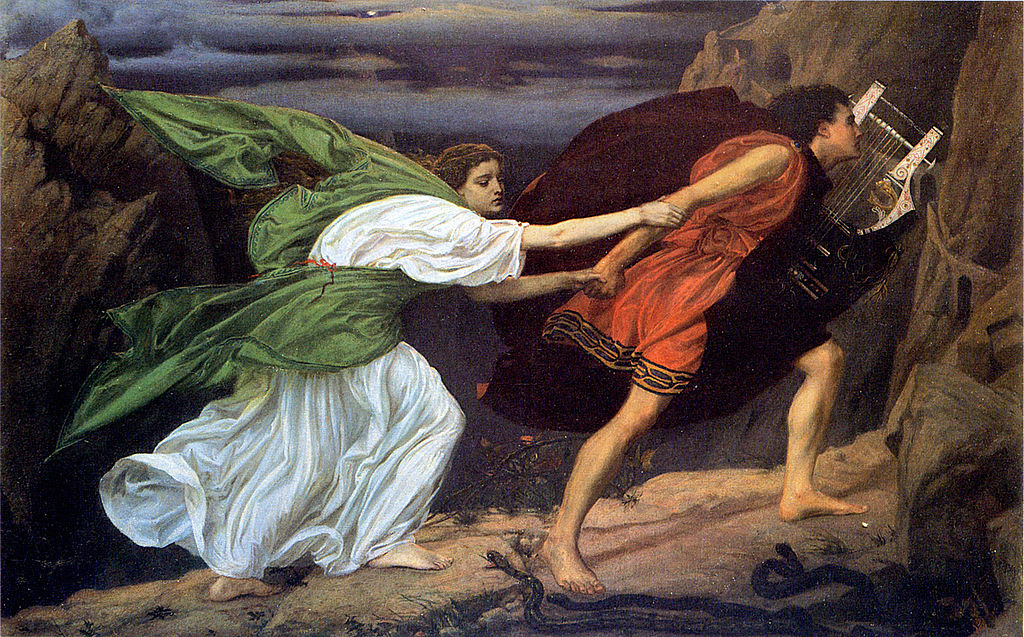
But
one thing you must know: the one thing I have learned is that one must live
this life. This life is the way, the long sought-after way to the unfathomable,
which we call divine. ~Carl Jung, The Red
Book, Page 232.
"In
all chaos there is a cosmos, in all disorder a secret order." —
Carl Jung
“The answer is
never the answer. What’s really interesting is the mystery. If you seek the
mystery instead of the answer, you’ll always be seeking. I've never seen
anybody really find the answer. They think they have, so they stop thinking.
But the job is to seek mystery, evoke mystery, plant a garden in which strange
plants grow and mysteries bloom. The need for mystery is greater than the need
for an answer.” - Ken Kesey
The relation with
transcendence is certainly a necessity for us, but gives us no power over it.
~Carl Jung, Letters Vol. II, Pages 367-368
Everyone insists on
his standpoint and imagines he possesses the sole truth; therefore I counsel
modesty, or rather the willingness to suppose that God can express himself in
different languages. ~Carl Jung, Letters Vol. II, Pages 367-368
We need the
coldness of death to see clearly. Life wants to live and to die, to begin and
to end. ~Carl
Jung, The Red Book, Page 275.
To give birth
to the ancient in a new time is creation. This is the creation of the new, and
that redeems me.Salvation is the resolution of the task. The task is to give
birth to the old in a new time. ~Carl Jung, The Red Book, Page 311.
Werner Hornung, Nice Meeting You
Self-Making
& Remembrance As Therapy
IMMORTALITY ON LOAN
WE ARE NOT WHO WE
THINK WE ARE
So try to live as
consciously, as conscientiously, and as completely as possible and learn who
you are and who or what it is that ultimately decides.
~Carl
Jung, Letters Vol. II, Pages 300-301
If you learn about
yourself and if eventually you discover more or less who you are, you also
learn about God, and who He is. ~Carl Jung, Letters Vol. II, Pages 300-301
You have to live
thoroughly and very consciously for many years in order to understand what your
will is and what Its will is. ~Carl Jung, Letters Vol. II, Pages 300-301
People who think
that they know the reasons for everything are unaware of the obvious fact that
the existence of the universe itself is one big unfathomable secret, and so is
our human existence. ~Carl Jung, Letters Vol. II, Pages 252-253.
The essential dream-image:
the Man, the Tree, the Stone, looks quite inaccessible, but only to our modern
consciousness which is, as a rule, unconscious of its historical roots. ~Carl Jung, Letters Vol. II, Pages
325-327.
Did you not see that when
your creative force turned to the world, how the dead things moved under it and
through it, how they grew and prospered, and how your thoughts flowed in rich
rivers? If your creative force now turns to the place of the soul, you
will see how your soul becomes green and how its field bears wonderful fruit.
~Carl Jung, The Red
Book, Page 236.
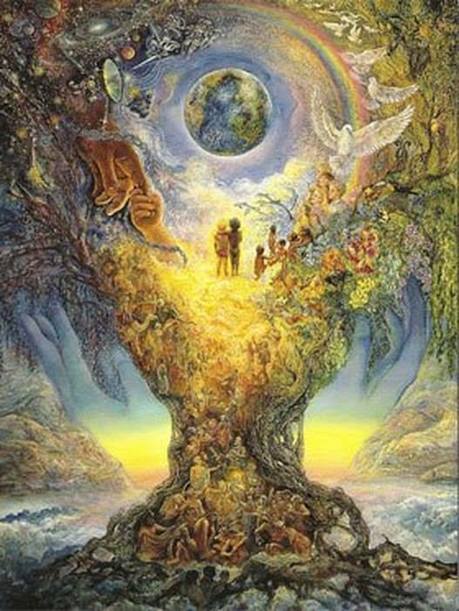
|
I live my life in widening circles
|
And
everywhere there, the Tree of Life, |
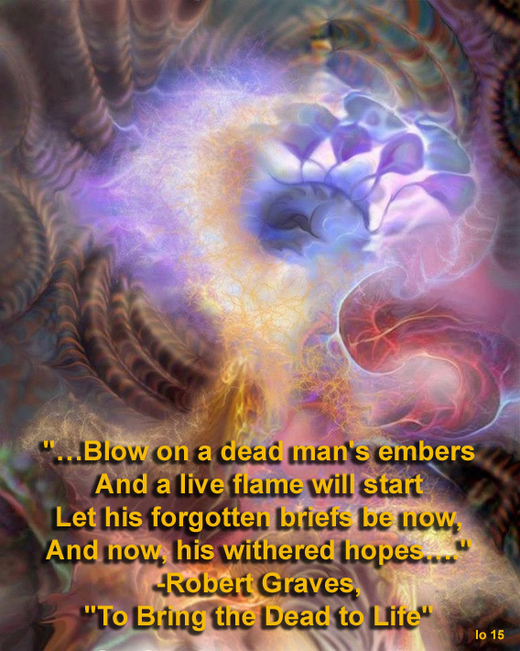
SOUL
GENEALOGY
A Spiritual Pilgrimage
Somewhere there was once a
Flower, a Stone, a Crystal, a Queen, a King, a Palace, a Lover and his Beloved,
and this was long ago, on an Island somewhere in the ocean 5,000 years ago. . .
. Such is Love, the Mystic Flower of the Soul. This is the Center, the Self. -Jung
The realm of the psyche is
immeasurably great and filled with living reality.
At its brink lies the
secret of matter and of spirit.
~Carl Jung,
Letters Vol. II, Pages 69-71.
The meaning of events is
the way of salvation that you create. The meaning of events comes from the
possibility of life in this world that you create. It is the mastery of this
world and the assertion of your soul in this world.
~Carl Jung, The Red Book, Page 239.
You excuse yourself
with your disbelief in the immortality of the soul.
Do you think that the dead
do not exist because you have' devised the impossibility of immortality? You
believe in your idols of words.
The dead produce effects,
that is sufficient. In the inner world there is no explaining away, as little
as you can explain away the sea in the outer world.
You must finally
understand your purpose in explaining away, namely to seek protection. ~Carl Jung, Red Book, Page 298.
It is quite impossible to
conceive how “experience” in the widest sense, or, for that matter, anything
psychic, could originate exclusively in the outside world.
~Carl Jung, CW 9i,
Para 187.
Therefore the
spirit of the depths forced me to speak to my soul, to call upon her as a
living and self-existing being. ~Carl Jung, The Red Book, Page 232.
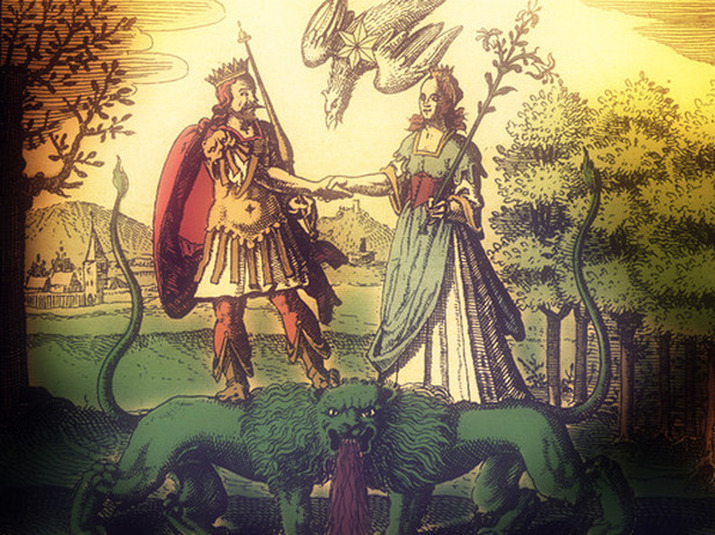
"But "the heart
glows," and a secret unrest gnaws at the roots of our being."
--Jung, Archetypes of
the Collective Unconscious
illus. Johann Daniel
Mylius’ Rosarium
Philosophorum,
image #2
CONTENTS
"Do you think that somewhere we are
not Nature,
that we are different from
Nature?
No, we are Nature and
think exactly like Nature."
--Jung
I. Soulful Genealogy:
Approaches to
Genealogy; What Psyche Knows; Worldview; The Living Past; The Naked Tree;
Cognitive & Emotional Unconscious; Uprooted; Buried Secrets; Bridge of
Spirits; The Call of Our Ancestors; Shamanism Meets Genealogy;
Transgenerational Genealogy; Soul Into Soul; Crossing the Veil;
Jungian Genealogy;
Re-member Who You Are; Passed Lives; Shades of Our Past; Climbing Your Family
Tree; Songs of Our Ancestors; GenIsis; First Family; Through Ancient Eyes;
Kindred Experience; Bone Collecting; Blessings & Curses; Touching the Past;
We Never Forgot Who We Are; Family Reunion;
II. The Royal We:
Branching Out; Grave
Digging: Digging Up Dirt on Your Ancestors; Enliven Your Tree; Those Who Lie
Buried Within; Greening Your Tree; Guides From Beyond; The Snake In Our Tree;
The Tree of Life; Survival of the Image; Branching Descent; Rosa Mundi;
Dynastic Houses; They Ride Forever Through the Nightlands; Liminal Lineage;
Hand Me Down Genes; Imminent Inheritance; It Gets Under Your Skin; Rank &
File; Snakes & Ladders;
III. The Royal Art:
Vita Brevis; In the
Shade of Your Family Tree, Living Roots; Kin You Imagine; Family Resemblance;
Origi-Nations; The Past Remains Present; Working In the Past for the Future;
Reigniting Ancestral Knowledge, Climbing for Roots; Tree of Life; Wise Blood;
Chains of Generations; Where Loyalty Lies; Internal Inquiry; Full-Blooded
Genealogy; Dream Genealogy; Ancestral Pilgrimage; Living In the Past; Shaping
Lives & Values; Binding Family Ties; Remembrance Is Veneration;
IV. Facing Your Soul:
Who Am I? And What
Does It All Mean?; Soul Guides & Ghostly Lovers;
Meta-Genesis; What
Will You Preserve?; The Family Initiatory Vessel; Legends & Lineage; The
Trail of the Grail; Grail-Carriers; How Did They Live?; Consanguinity;
Holy Blood, Holy
Trail; Roots & Gnosis; Descent From Antiquity; Bare Bones; The Tree of
Voices; Tree of Golden Light; Presence of the Past; Bones of Contention; Spiritual
Genealogy; Walking Your Genealogical Labyrinth; Subjective Genealogy;
V. Collective Memory:
Ancestral Legacy;
Lifespan - Wisdom Bridge; The World Tree; The Cosmic Tree; Tangled Roots;
Ancestral Soul; Reciting Your Kin; Digital Ancestry; House of Our Flesh; Soul's
Gold; In Their Footsteps; Who Will Remember Us?; Hearth of the Heart; Council
of Ancestors; Our Nameless Ancestors; Putting It All Together;
Inherit-Ability; Drop
Lines & Dreams; Soul Dust; You Speak for the Dead;
10,000 Ancestors Will
Dream of Me; The Heart of the Matter; Called Home; Listening for Echoes of the
Past.
Take pains to waken the dead.
Dig deep mines and throw
in sacrificial gifts, so that they reach the dead.
Reflect in good heart upon
evil, this is the way to the ascent.
But before the ascent,
everything is night and Hell.
~Carl Jung, The Red Book, Page 244.
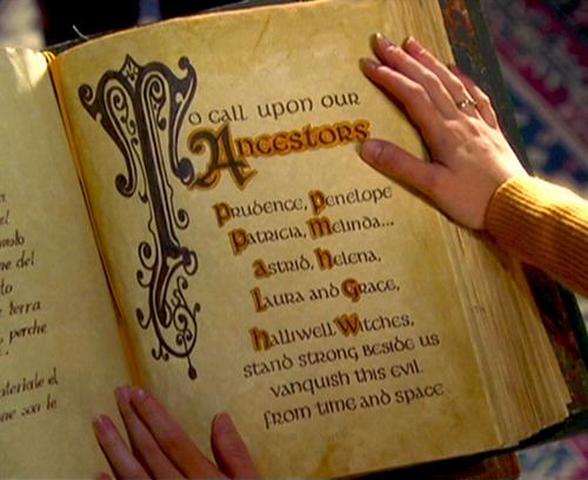
"My
name is not my own, it is borrowed from my ancestors. I must return it
unstained. My honor is not my own, it is borrowed from my descendants, I must
give it to them unbroken. Our blood is not our own, it is a gift to generations
yet unborn. We should carry it with responsibility."
--Vincent Fund
Who has fully realized
that history is not contained in thick books
but lives in our very
blood?
--Carl
Jung
The Unconscious
believes in Life after Death. --Carl Jung
You may call me
death-death that rose with the sun.
I come with quiet pain and
long peace.
I lay the cover of
protection on you. In the midst of life begins death.
I lay cover upon cover
upon you so that your warmth will never cease.
~A Dark Form to
Philemon, Liber Novus, Page 355.
The
archetypes to be discovered and assimilated are precisely those which have
inspired the basic images of ritual and mythology. These eternal ones of
the dream are not to be confused with the personality modified symbolic
figures that appear in nightmares or madness to the tormented individual.
Dream is the personalized myth. Myth is the depersonalized dream.
--Joseph Campbell
No one who does not know
himself can know others. And in each of us there is another whom we do
not know. He speaks to us in dream and tells us how differently he sees
us from the way we see ourselves. When, therefore, we find ourselves in a
different situation to which there is no solution, he can sometimes kindle a
light that radically alters our attitude; the very attitude that led us into
the difficult situation.
--C. G. Jung
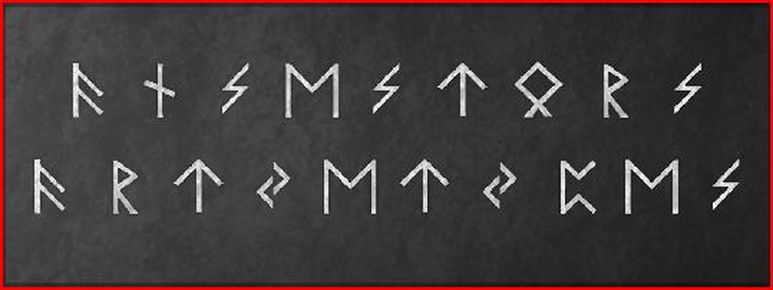
Projection is
mistakenly attributing your own repressed thoughts onto someone else, including
thoughts, feelings, motives, and attitudes. In this case, it includes unowned
emotions, metaphysical speculations and pseudo-scientific worldviews. Such
figures stand in place of one's own self-actualization.
Balancing Genealogical Projection & Critical
Thinking
Doubt is one of the
names of intelligence. Genalogical data can act like a blank canvas for
psychological projections, both in a potentially informing way and a
self-delusory way. Therefore, it is well for us to be consciously aware of such
dynamics in the interpretation of our family tree. Naturally, our hermeneutics
will have imaginal and poetic aspects, yet the documented historical aspects
help us from abdicating psychological responsibility to ourselves and family.
Participation Mystique
is another way that identification can make its way into our reactions and
attitudes about our pedigree and ancestors. Some people, finding a royal line
among the commoners in their lists, experience inflation, leading to the
misconcept that they are somehow royal. Such "men who would be kind"
are too numerous to mention. These individuals have failed to do the math of
decendancy.
One major problem is
to mistake a historical person for an archetypal force or wisdom figure. This
is how history is transmogrified into mythology. In psychological projection
our unconsciousness is attributed to others, and they carry that unconscious
content until or unless we become aware of it as our own. All assertions of
ascended masters, channeled gurus, and secret chiefs fall into this category of
archetypal protectors, mentors or teachers. The historical figure carried many
of these qualities, powerful in collective wisdom and knowledge of the beyond.
But being dead does not make you smarter.
Projection is
self-mystification, a self-induced trance state, whether the content is
positive or negative. The ego splits off the unconscious content, either
over-valuing or undervaluing it. When we reach our archetypal boundaries we
begin projecting, sort of an adult form of "let's pretend."
Emotionally appealing
truths are sandwiched into idiosyncratic notions ranging from the speculative
to the fantastical, and trap many individuals like flypaper, because our minds
love a good story. The brain feeds on stories, but the wrong stories just lead
us down the garden path into ancient worlds that never happened, and mythic
scenarios that were never meant to be taken literally.
There is no
literal explanation of such recurrent themes, only their psychological
appearances arising from the needs of those who weave such notions into their
personal narratives. Such
figures of the unconscious are naturally represented as immortal, as they are
eternal archetypes in personified dress...a sort of adult "imaginary
friend." This is the source of channeled wisdom and spirit possession.
During his lifetime the moral rectitude of St. Germain was questioned, but in
the immortal version he becomes sanitized.
Jung elaborated on
such transformative wisdom figures as the archetypes of the "mana
personality" and Self: the Wise Old Man and the Wise Old Woman. They can
also appear as aspects of one's anima or animus. Jung even experienced one or
more such characters he personified as his soul guide Philemon, who he linked
back to the historical Simon Magus. But he did not take such interaction
literally but rather imaginally -- an "as if real" experience he
engaged with dialogue. Such figures can offer guidance and wisdom gleaned from
personal and cultural experience. They can also spew faulty logic,
silly notions, inferior thinking, and pseudo-scientific ideas.
A false idea can be
hyped through hysteria, lack of critical judgment, and naive enthusiasm.
Without critical thinking we can derail the dynamic process of self
transformation, by leading us down the garden path of false beliefs. Accepting
such beliefs uncritically is precisely the opposite of what Jung recommended as
individuation. Such false beliefs tend to cluster around an individual's
personal issues, but are mistaken for and confounded with historical, philosophical
and scientific 'reality'. Much of the "self-delusion" can be linked
to exposure to memes functioning as emotional strange attractors or cultural
artifacts or fallout,, as
well as pre- and pseudo-scientific notions of by-gone centuries, and lack of understanding
of standards and discernment.
Jung's Wise Old Woman
and the Wise Old Man are archetypes of the Collective Unconscious. 'The
"wise old woman"...[or] helpful "old woman" is a well-known
symbol in myths and fairy tales for the wisdom of the eternal female nature'.
One of her
current popular incarnations is Mary Magdalene, a soul-mate, or Sophia, who has
captured contemporary imaginations with ideas about the divine feminine and
gnosis.
The 'Wise Old
Man, or some other very powerful aspect of eternal masculinity' is her male
counterpart.
In Jung's thought, the
individuation process was marked by a sequence of archetypes, each acquiring
predominance at successive stages, and so reflecting what he termed an
ascending psychic scale or 'hierarchy of the unconscious'. Thus, starting with
the intermediate position of 'anima or animus...just as the latter have a
higher position in the hierarchy than the shadow, so wholeness lays claim to a
position and a value superior' still. The Wise Old Woman and Man, as what he
termed "Mana" personalities or "supraordinate" personalities,
stood for that wholeness of the self: 'the mother ("Primordial Mother" and
"Earth Mother") as a supraordinary personality...as the
"self"'.
As von Franz cautions,
'If an individual has wrestled seriously and long enough with the anima (or
animus) problem, so that he, or she, is no longer partially identified with it,
the unconscious again changes its dominant character and appears in a new
symbolic form representing the Self, the innermost nucleus of the personality.
In the dreams of a woman this center is usually personified as a superior
female figure - a priestess, sorceress, earth mother, or goddess of nature or
love. In the case of a man, it manifests itself as a masculine initiator and
guardian (an Indian guru), a wise old man, a spirit of
nature and so forth'.
The wise old man (also
called senex, sage or sophos) is an archetype as described by Carl Jung, as
well as a classic literary figure, and may be seen as a stock character. The
wise old man can be a profound philosopher distinguished for wisdom and sound
judgment but confounded with Shadow it can be a Trickster.
This type of character
is typically represented as a kind and wise, older father-type figure who uses
personal knowledge of people and the world to help tell stories and offer guidance
that, in a mystical way, may impress upon his audience a sense of who they are
and who they might become, thereby acting as a mentor. He may occasionally
appear as an absent-minded professor, appearing absent-minded due to a
predilection for contemplative pursuits.
The wise old man is
often seen to be in some way "foreign", that is, from a different
culture, nation, or occasionally, even a different time, from those he advises.
In extreme cases, he may be a liminal being, such as Merlin, who was only half
human.
In medieval chivalric
romance and modern fantasy literature, he is often presented as a wizard. He
can also or instead be featured as a hermit. This character type often
explained to the knights or heroes—particularly those searching for the Holy
Grail—the significance of their encounters.
In the individuation
process, the archetype of the Wise old man was late to emerge, and seen as an
indication of the Self. 'If an individual has wrestled seriously enough and
long enough with the anima (or animus) problem...the unconscious again changes
its dominant character and appears in a new symbolic form...as a masculine
initiator and guardian (an Indian guru), a wise old man, a spirit of
nature, and so forth'.
As Borges contends:
No one is anyone, one
single immortal man is all men. Like Cornelius Agrippa, I am god, I am hero, I
am philosopher, I am demon and I am world, which is a tedious way of saying
that I do not exist. Any life, however long and complicated it may be, actually
consists of a
single moment
— the moment when a man knows forever more who he is. Doubt is one of the names
of intelligence.
Subconscious
Supernatural
We can be sincerely
convinced of the utterly wrong. Why do we continue to accommodate the
irrelevant and easily falsifiable? Are we conscientious about our own
self-delusions or simply unconsciously immersed in them due to a delusional
perspective on our own misguided "gnosis" and obsessions with
misguided theoretical perspectives? Even conscience is no ineffable
guide to inner authority. There is no shortage of new myths to capture our
attention. Dreams tell us who we are, collectively and individually.
If Inner Authority is linked to authentic
power and wisdom, we need to examine our personal interaction with inner wisdom
figures (archetypes) and values in order to create lives of positive action
that arise from deep inner wisdom. Most of us shirk such important inner work,
substituting a fantasy of transformation and mindfulness. Delusional self-improvement projects
are aimed at adorning the ego.
People claim to hear
messages that ring in their hearts as truth, or 'resonate' with material that
confirms their own tacit or recognized beliefs, but most it originates in
cultural conditioning and memetic patterning. Some of it echoes parental
authority. All we hold is a piece of the Mystery. Buzzwords such as True
Nature, intentionality, and mis-identified integrity compound the situation.
Premature spiritual fixation can just as readily be a form of transcendental
escapism.
Both the strategies of
"transcendence" and "reduction" are expressions of bad
faith — i.e., forms of self-deception and escapism that seek to deny the
realities of the human existential situation. Self-delusion may be self-evident
but few give themselves a reality check on it and doing so is compounded by our
own psychological blindspots. This is a form of escapism or neo-mythology.
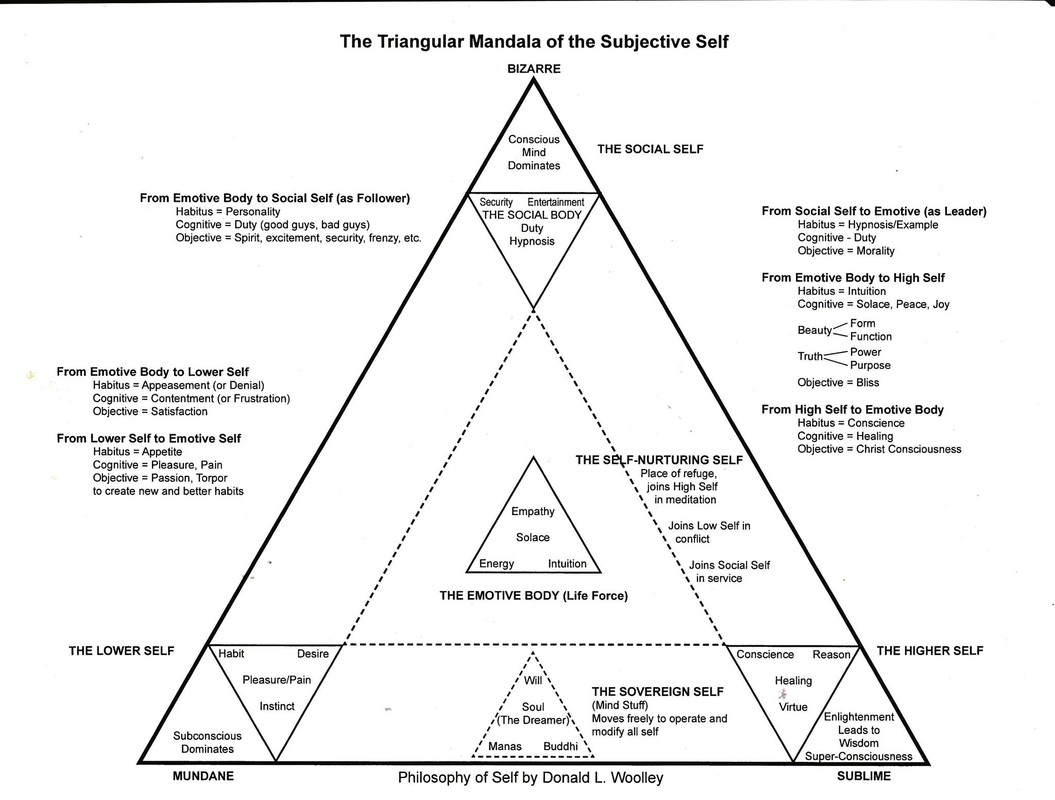
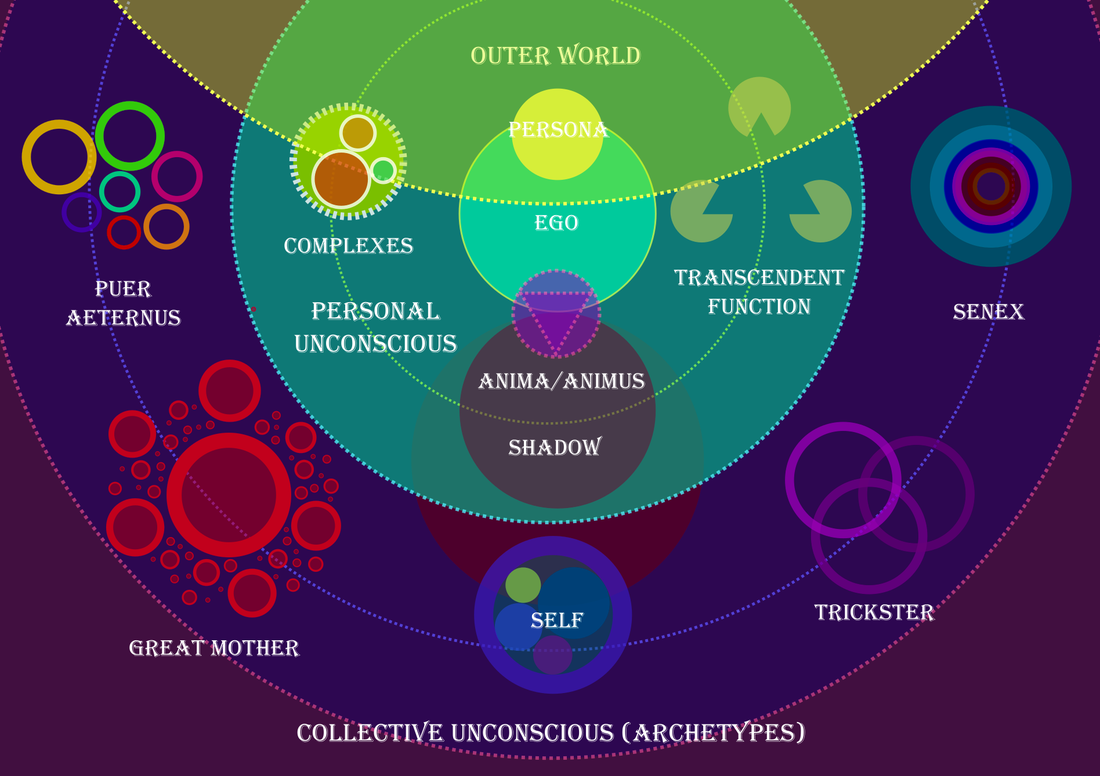
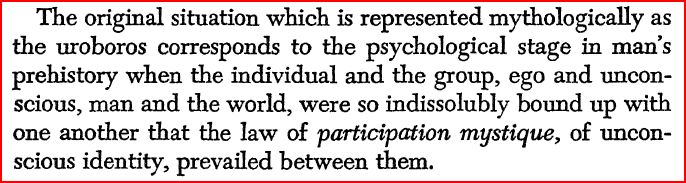
PARTICIPATION
MYSTIQUE
Projection &
Identification
http://jungiangenealogy.weebly.com/participation.html
People with a narrow
conscious life exteriorize their unconscious, they are continually in
participation mystique with other people… if more unconscious things have
become conscious to you, then you live less in participation mystique. ~Carl Jung, Visions, para 1184.
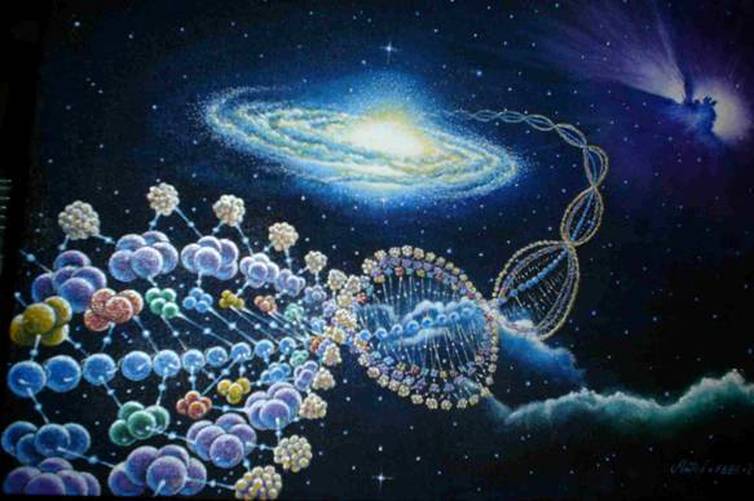
Multigenerational
Epigenetics
So
how do our epigenomes become informed about life around us, particularly the
epigenome of a fetus or a yet‑to‑be‑conceived child? Most of
the science points to our neural, endocrine, and immune systems. Our brains,
glands, and immune cells sense the outside world and secrete hormones, growth
factors, neurotransmitters, and other biological signaling molecules to tell
every organ in the body that it needs to adapt to a changing world.
Soft
evolution is like an annotated book. Those who read different annotations of
the same book may end up with very different learning.
As we experience
stress, love, aging, fear, pleasure, infection, pain, exercise, or hunger,
various hormones adjust various physical responses within our bodies. Hormones
surge through our blood; changes in cortisol, testosterone, estrogen,
interleukin, leptin, insulin, oxytocin, thyroid hormone, growth hormone, and
adrenaline make us behave and develop in different ways. And they signal to our
epigenomes, “Time to flip some switches!”Genes get shut off or turned on as the
world around us changes.
The Book of LifeSoft
evolution is analogous to an annotated book. The basic text and argument of the
book remain the same. But if the text is gradually surrounded by margin notes
and comments, then those who read different annotations of the exact same book
may end up with very different learning, depending on who annotated the
particular copy they borrowed, how they treated the original text, how the
reader decided to interpret the interplay between the original printed text and
the annotations, and whether some of the annotations were erased or modified by
other readers.
There are multiple
ways to add in rapid, inherited epigenetic adaptations without any change in the
core DNA code. One basic and common mechanism is DNA methylation: Enzymes in
our cells attach a methyl group (CH3) to a cytosine (C) located next to a
guanine (G) in our DNA, forming a methylated island. This tells the gene that
follows next, “Shhh, do not express yourself.”
One of the key reasons
for human diversity is that about 70 percent, or roughly 14,000, of our genes
have these “on/off” switches plus random mutations among them, so there are
countless combinations of ways that these switches are flipped in the human
population.
Sperm and eggs get a
nearly fresh start: An estimated 90 percent of the switches are erased before
conception occurs, which means most epigenetic memories are lost. But there is
still a lot of recent data moving from generation to generation. (Those who
described sperm as simple bags of DNA with a tail could never explain why sperm
had so many receptors for so many hormones not directly related to
reproduction, including leptin, one of the obesity genes, as well as 19 growth
factors, cytokines, and neurotransmitters.)
Epigenetic switches
can be flipped on and off in sperm, eggs, or embryos, so your kids and
grandkids can share your environmental experiences and knowledge, and be better
prepared for the environment they will soon be entering. For instance, if you
were a male smoker, and your brother was not, 28 epigenetic signals in your
sperm would be different from his. Sperm are listening.
At conception, your
grandchildren listen to distant tales, and sometimes pass them on.
Reprinted from Evolving Ourselves
by Juan Enriquez and Steve Gullans with permission of Current, an imprint of
Penguin Publishing Group, a division of Penguin Random House LLC. Copyright (c)
Juan Enriquez and Steven Gullans, 2015.
Grandma's Experiences
Leave a Mark on Your Genes
Your ancestors' lousy
childhoods or excellent adventures might change your personality, bequeathing
anxiety or resilience by altering the epigenetic expressions of genes in the
brain
http://discovermagazine.com/2013/may/13-grandmas-experiences-leave-epigenetic-mark-on-your-genes#.UwOqevk7t8E
Below: Iona and her paternal Grandmother, Amy Delena and maternal Grandmother
Rosa
|
|
|
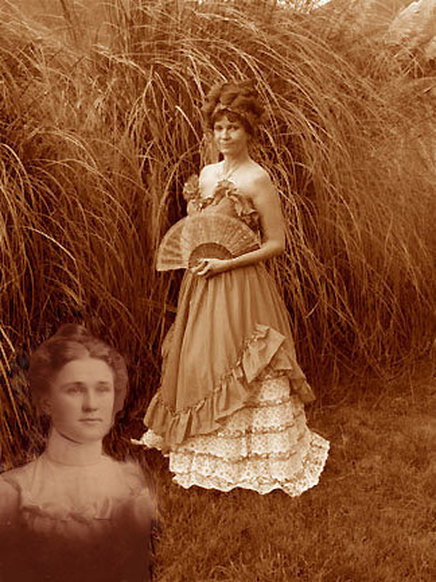

Five Criteria to Assess Wisdom:
- Factual knowledge: Knowing the 'whats' of the human condition and human nature
- Procedural knowledge: Strategies for solving life's problems
- Lifespan contextualism: Knowledge of life's settings and social situations and how they change overtime
- Relativism of values: Being aware of cultural differences and being considerate and sensitive to different values
- Awareness and management of uncertainty: Recognizing the limits of knowledge, and understanding the uncertainty of the future http://berlinwisdommodel.weebly.com/baltes-assessment-of-wisdom.html
Multigenerational
Epigenetics
In psychology, genetic memory is a memory present at birth that exists
in the absence of sensory experience, and is incorporated into the genome over
long spans of time. It is based on the idea that common experiences of a
species become incorporated into its genetic code, not by a Lamarckian process
that encodes specific memories but by a much vaguer tendency to encode a
readiness to respond in certain ways to certain stimuli. Shares much with the
modern concept of epigenetics.
Genetic memory is
invoked to explain ethnic group memory postulated by Carl Jung. Jungian psychology
suggests memories, feelings and ideas inherited from our ancestors as part of a
"collective unconscious". The term "epigenetic" refers to
heritable traits that do not involve changes to the underlying DNA sequence.
This can occur over rounds of cell division, while some epigenetic features can
effect transgenerational inheritance and are inherited from one generation to
the next.
Multigenerational
epigenetics is today regarded as another aspect to evolution and adaptation.
Culture is the most fundamental force that has shaped man's life through the
aeons. Its effect is, in all likelihood, established in the genome in a few
generations.The concept implies that genes have a 'memory'; what you do in your
lifetime, and what you are exposed to, could in turn affect your grandchildren.
Epigenetics adds a
whole new layer to genes beyond the DNA, the so called "epigenome".
Among other things, it proposes a control system of 'switches' that turn genes
on or off. The things that people experience, like nutrition and stress, can
control these switches and cause heritable effects in humans. The switches
themselves can also be inherited. This means that a 'memory' of an event could
be passed through generations. A simple environmental effect could switch genes
on or off - and this change could be inherited.
Epigenetics can impact
evolution when epigenetic changes are heritable.[1] A
sequestered germ line or Weismann barrier
is specific to animals, and epigenetic inheritance is more common in plants and
microbes. Eva Jablonka
and Marion Lamb
have argued that these effects may require enhancements to the standard
conceptual framework of the modern evolutionary synthesis.[97][98]
Other evolutionary biologists have incorporated epigenetic inheritance into population genetics
models[99]
or are openly skeptical.[100]
Two important ways in
which epigenetic inheritance can be different from traditional genetic
inheritance, with important consequences for evolution, are that rates of
epimutation can be much faster than rates of mutation[101]
and the epimutations are more easily reversible.[102]
In plants heritable DNA methylation mutations are 100.000 times more likely to
occur compared to DNA mutations.[103]
An epigenetically inherited element such as the PSI+ system can act as
a "stop-gap", good enough for short-term adaptation that allows the
lineage to survive for long enough for mutation and/or recombination to genetically assimilate
the adaptive phenotypic change.[104]
The existence of this possibility increases the evolvability
of a species.
More than
100 cases of transgenerational epigenetic
inheritance phenomena have been reported in a
wide range of organisms, including prokaryotes, plants, and animals.[105]
For instance, Mourning Cloak butterflies
will change color through hormone changes in response to experimentation of
varying temperatures.[106]
Bacteria make widespread use of postreplicative DNA methylation for the
epigenetic control of DNA-protein interactions. Bacteria make use of DNA adenine methylation (rather than
DNA cytosine
methylation) as an epigenetic signal. DNA adenine methylation is important in
bacteria virulence in organisms such as Escherichia coli, Salmonella, Vibrio, Yersinia, Haemophilus,
and Brucella.
In Alphaproteobacteria,
methylation of adenine regulates the cell cycle and couples gene transcription
to DNA replication. In Gammaproteobacteria,
adenine methylation provides signals for DNA replication, chromosome
segregation, mismatch repair, packaging of bacteriophage, transposase activity
and regulation of gene expression.[107][108]
The filamentous fungus
Neurospora crassa is a prominent model system for understanding the control and
function of cytosine methylation. In this organisms, DNA methylation is
associated with relics of a genome defense system called RIP (repeat-induced
point mutation) and silences gene expression by inhibiting transcription
elongation.[109]
The yeast prion PSI is generated by a
conformational change of a translation termination factor, which is then
inherited by daughter cells. This can provide a survival advantage under
adverse conditions. This is an example of epigenetic regulation enabling
unicellular organisms to respond rapidly to environmental stress. Prions can be
viewed as epigenetic agents capable of inducing a phenotypic change without
modification of the genome.[108]
Direct detection of
epigenetic marks in microorganisms is possible with single molecule real time sequencing,
in which polymerase sensitivity allows for measuring methylation and other
modifications as a DNA molecule is being sequenced.[110]
Several projects have demonstrated the ability to collect genome-wide
epigenetic data in bacteria.[111][112][113][114]
https://en.wikipedia.org/wiki/Epigenetics
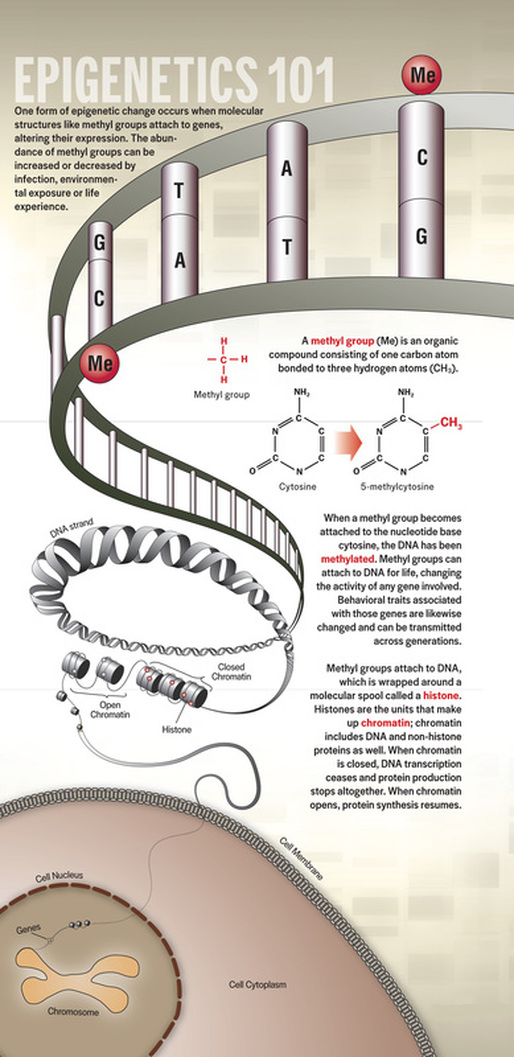
CONCEPTIONS
& MISCONCEPTIONS
Genealogist Mark
Humphreys says, "Your ancestors were the same mix of bullies, fools,
bigots, incompetents, cowards, and occasional smart and admirable people that
always make up society. You exist because of many people who you would despise
if you met them. Genealogy is about finding out who they were, it should have
no interest in whether they were admirable or not.
Indeed, it's more fun
when they murder each other, marry descendants of their ancestors' bitter
enemies, conceive your ancestor as a result of sordid and regretted affairs,
die before their child is born, and so on. It makes us realize how precarious
our existence is, and how messy and unlikely our genetic inheritance. Anyone
who believes they belong to one race, or that their ancestors were fine people,
hasn't done enough genealogy."
Humphrys began to
notice something odd. Whenever a reliable family tree was available, almost
anyone of European ancestry turned out to be descended from English royalty. He
began to think that such descent was the rule rather than the exception in the
Western world, even if relatively few people had the documents to demonstrate
it.
Humphrys compiled his
family genealogies first on paper and then using computers. He did much of his
work on royal genealogies in the mid-1990s, when the World Wide Web was just
coming into general use. He began to put his findings on Web pages, with
hyperlinks connecting various lines of descent. Suddenly dense networks of
ancestry jumped out at him.
"I'd known these
descents were interconnected, but I'd never known how much," he told me.
"You can't see the connections reading the printed genealogies, because
it's so hard to jump from tree to tree. The problem is that genealogies aren't
two-dimensional, so any attempt to put them on paper is more or less doomed
from the start. They aren't three-dimensional, either, or you could make a
structure. They have hundreds of dimensions."
The mathematical study
of genealogy indicates that everyone in the world is descended from Nefertiti
and Confucius, and everyone of European ancestry is descended from Muhammad and
Charlemagne. English, French and other European royal families are all
inter-related, and all descend ultimately from Charlemagne.
All humanity is
interrelated many times over (contrary to what an endless procession of racists
and tribalists throughout history have claimed or implied). For any two humans
in history or today, it is not a question of do they have a common ancestor, it
is only a question of when was the most recent one.
If we had full
genealogical records for all of human history and pre-history, then any two living people on
earth could
identify their closest relationship to each other. Or indeed any two living
organisms on earth,
since DNA probably did not evolve twice. One could also pick any famous person,
alive or dead, and show your closest relationship to them. For they are all
related. See pre-historical estimates for Common ancestors of all humans.
It's true that
everyone's roots go back to the same family tree, he said. But each path to our
common past is different, and reconstructing that path, using whatever records
are available, is its own reward. "You can ask whether everyone in the
Western world is descended from Charlemagne, and the answer is yes, we're all
descended from Charlemagne. But can you prove it? That's the game of
genealogy."
http://www.theatlantic.com/magazine/archive/2002/05/the-royal-we/302497/
Without pedigree
collapse, a person's ancestor tree is a binary tree, formed by the person, the
parents, grandparents, and so on. However, the number of individuals in such a
tree grows exponentially and will eventually become impossibly high. For
example, a single individual alive today would, over 30 generations going back
to the High Middle Ages, have roughly a billion ancestors, more than the total
world population at the time.[1]
This apparent paradox
occurs because the individuals in the binary tree are not distinct: instead, a
single individual may occupy multiple places in the binary tree. This typically
happens when the parents of an ancestor are cousins (sometimes unbeknownst to
themselves).[2][3] For example, the offspring of two
first cousins has at most only six great-grandparents instead of the normal
eight. This reduction in the number of ancestors is pedigree collapse. It
collapses the binary tree into a directed acyclic graph with two different,
directed paths starting from the ancestor who in the binary tree would occupy
two places.
In some cultures,
cousins were encouraged or required to marry to keep kin bonds, wealth and
property within a family (endogamy). Among royalty, the frequent
requirement to only marry other royals resulted in a reduced gene pool in which
most individuals were the result of extensive pedigree collapse. Alfonso XII of
Spain, for example, had only four great-grandparents instead of the usual
eight. Furthermore, two of these great-grandparents, Charles IV of Spain and
Maria Luisa of Parma, were parents of another twice great-grandmother, Maria
Isabella of Spain. More generally, in many cultures intermarriage may
frequently occur within a small village, limiting the available gene pool.
This is not about DNA
(Genealogy is not Genetics)
These findings do not
necessarily have any implications for our DNA. To
descend from someone does not mean you
necessarily inherit any DNA from them. These findings do not conflict with the idea that
most or all of your DNA is inherited from your local area. Even if you do
descend from the Ancient Egyptian Pharaohs, that does not mean this can be
detected in your DNA. In fact, there may be no evidence at all of these
findings in humanity's DNA. And yet the findings can still be true. To see
this, imagine one Western European sailor blown off course in classical times,
say 100 AD, and landing in the Caribbean, with no way home. He is not killed
but rather taken in by a tribe who need strong young men.
- He mates with one of the native women and has children. 1/2 of their DNA is European.
- The children mate with pure natives and have grandchildren. About 1/4 (can be more or less, by chance) of their DNA is European.
- The grandchildren mate with pure natives and have great-grandchildren. About 1/8 (more or less) of their DNA is European.
- And so on.
By
1492, all of the Caribbean is descended from him, but his DNA is
extinct. There
is no evidence of his existence in the DNA of the living. He is everyone's ancestor, but no one has his DNA.
In summary, we are interested here in genealogical descent, not genetic descent.
If you have a line of
descendants that doesn't die out, eventually you are the ancestor of the whole future world. Through this, you
affect all future world history.
http://humphrysfamilytree.com/ca.html
A Jesus bloodline is a
hypothetical sequence of lineal descendants of the historical Jesus and Mary
Magdalene, or some other woman, usually portrayed as his wife or a hierodule.
Differing and contradictory versions of a Jesus bloodline hypothesis have been
proposed in numerous books by authors such as Louis Martin (1886), Donovan
Joyce (1973), Andreas Faber-Kaiser (1977), Barbara Thiering (1992), Margaret
Starbird (1993), and various websites. Dan Brown's novel The Da Vinci Code used the premise for its plot line.
The 2007 documentary The
Lost Tomb of Jesus
proposed that evidence existed to show that Jesus was married to Mary Magdalene
and that their son was named Judah, based upon inscriptions found on ossuaries
discovered in Jerusalem in 1980.[1] Biblical scholar and author James
Tabor has recently affirmed his belief in a married Jesus,[2] while Karen King announced the
discovery of text in a Coptic papyrus fragment, alleged to be a translation of
a lost 2nd century Gospel, in which Jesus is made to refer to "my
wife". That fragment is now considered, by most experts, to be a fake.[3]
According to the vast
majority of professional historians and scholars from related fields, there is
no historical, biblical, apocryphal, archaeological, genealogical, or genetic
evidence which supports this hypothesis.[4] Hypothetical Jesus bloodlines
should not be confused with the biblical genealogy of Jesus or the historical
relatives of Jesus and their descendants, who are known as the Desposyni. https://en.wikipedia.org/wiki/Jesus_bloodline
Why We're All Jesus'
Children,
Steve Olson, Slate, March 15, 2006:
Olson points out that The Da Vinci Code does not understand genealogy: "no matter how the court case
turns out, both books are confused. If anyone living today is descended
from Jesus, so are most of us on the planet."
- He criticizes DNA studies, which - by focusing on male-male or female-female lines only - make people look less connected than they really are: "The risk of today's genetic genealogy tests is that they tend to divide people into groups, whereas the real message that emerges from genealogy is one of connections. ... People may like to think that they're descended from some ancient group while other people are not. But human ancestry doesn't work that way".
- How many genetic ancestors do you have? Short answer: you get DNA from about 2n ancestors n generations back, up to 8 generations, then about 68 additional ancestors for each generation after that.
About 360 years, or just short of 15 generations. At 15 generations, an individual living today would carry only three thousands of 1% (00.003052%) of the DNA of an ancestor who was “pure” anything 15 generations ago. So even if one ancestor was indeed Mediterranean 15 generations ago, unless they continuously intermarried within a pure Mediterranean population, the amount would drop by 50% with each generation to the miniscule amount that would be found in today’s current generation. With today’s technology, this is simply untraceable in autosomal DNA.
Genetic genealogy suffers from the problem of only focusing on the ancestors from whom you have inherited DNA, not all your ancestors. You can descend from someone without having inherited their DNA at a specific location on the genome, or even without having inherited their DNA at all. http://humphrysfamilytree.com/ca.html
An autosomal DNA test only goes back 8 generations.
Below: Frank Franklin, Tunnel 09
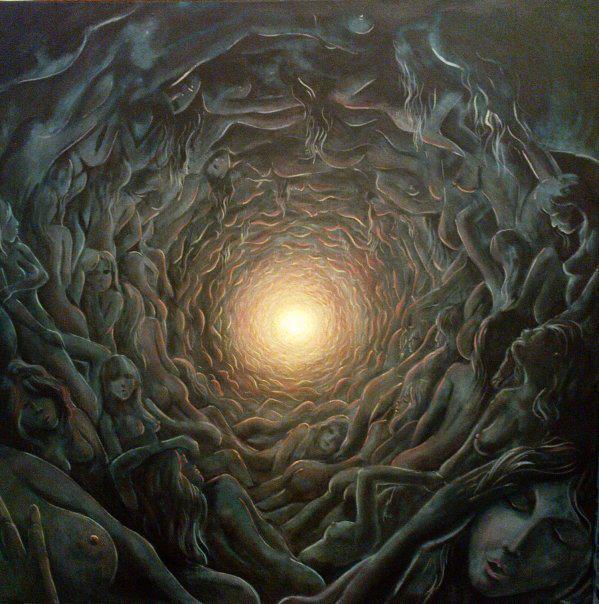
BLOOD
MUSIC
The Mystery of
Rh-Negative Blood
MYTH:
No
solid scientific explanation exists as to how or why
Rh- blood came about.
FACT: Rh SCIENTIFIC
ORIGIN is NOT a Scientific Mystery
As for the evolution
of Rh factor, Blancher and Apoil (2000) attribute the high level of sequence
similarity (92%) of the two RH locus genes, RHD and RHCE to a gene duplication event in the
common ancestor of human, chimps, and gorillas. Their analysis of the cDNA from
these genes revealed "complex recombination events" after the
lineages split.
Basically the most
recent common ancestor of apes had the "human" RH genes, which then differentiated
after the lineages diverged. Duplicate and differentiate is a common theme in
evolution.
The science of 1937 is
not the science of today.
In 1937, Karl
Landsteiner and Alexander S. Wiener discovered the RH factor. 85%
of the human population had the Rh D antigen on their red blood cells which was
in common with the Rhesus monkeys and 15% of the population mysteriously did
not have this antigen. The RH negative factor is from a mutation that popped up
in Europe and has not been selected out of our genetics yet.
As for
why it's called rhesus antigen, that's just an experimental artifact:
The term "Rhesus
antigen" was introduced by Landsteiner and Wiener, who found that rabbits
(and later, guinea pigs) immunized with red blood cells (RBCs) from a rhesus
monkey produced antibodies which agglutinated 85% of Caucasian blood samples
(Landsteiner and Wiener 1940, 1941).
They probably weren't
even correct about the antibodies being rhesus:
In conclusion, if the
term "Rh" was coined by Landsteiner and Wiener because of the source
of antigens (the rhesus monkey) they used to obtain anti-Rh in rabbits, it is
highly probable that, in fact, they produced anti-LW antibodies.
GENETIC MAPPING
Genetic mapping helps
to show that a mutation from RH positive to RH negative occurred somewhere in
the Basque area of Europe maybe as much as 40,000 years ago. So what happened
then? Ice Age Polarity Reversal Was a Global Event: Extremely Brief Reversal of
Geomagnetic Field, Climate Variability, and Super Volcano.
Such a global event
greatly increases the possibilities of mutations and turning off of genes --
gene conversion and gene deletion, normal genetic processes -- a change in
molecular structure. A repressed gene is turned off. This process is not
externally "introduced"; it is a natural molecular process.
Pseudo-scientific confabulations about Rh- produce no credible sources, but
merely repeat internet memes or Belief Systems (BS), embaced from lack of
critical thinking, psychological issues, and disinformation and/or religious
and quasi-religous metaphysical and ontological notions about their
"specialness".
Cited
"sources" are daisy-chains of parrot-like repetition, as if that
makes it so. Viable Links must be reputable sources. Everything else is
speculation or opinion.
In such cases, the
reader should search out information on the author before buying into a new
theory. When it comes to Rh negative blood, some people write bizarre
statements like they’re letting you in on a secret. The truth is many can’t
source their facts, so they layer in conspiracy theories along with their
personal opinions. The problem is they present it as fact and not an opinion.
Most mammals only have
one RH gene, whose position corresponds to
the human RHCE gene. The RHD gene arose from the duplication of
an ancestral RH gene during mammalian evolution. An
RHD deletion occurred9
during the evolution of hominids, so that many modern humans completely lack
the RHD
gene. This haplotype (glossary)
is the leading cause of the D negative phenotype worldwide.
The human genome—our
complete set of genetic information—includes thousands of genes. Some of the
very first human genes to be identified were those that control blood type.
ABO blood groups and
the Rh blood groups. The Rh blood group is determined by a single gene with two
alleles—positive and negative. The positive (Rh+) allele is dominant, so
person with Rh+/Rh+ or Rh+/Rh− are Rh- positive. Individuals with
two Rh− alleles are Rh-negative.
The ABO blood group
has three alleles IA, IB, and i. Alleles IA and IB are codominant. These alleles
produce molecules known as antigens on the surface of red blood cells.
The RH alleles can be grouped according to
their molecular structure. For the most part, these groups show point mutations
(SNP, single nucleotide polymorphisms) which cause missense, nonsense, frame
shift or splice site mutations (glossary).
Let’s discuss the
Rhesus blood group system first. This system has multiple antigens, but the
most important is encoded by the RHD locus, and is called RhD or simply Rh
factor. The phenotypes associated with the RHD locus are either the presence of
Rh factor (Rh positive) or the absence of the Rh factor (Rh negative).
RHD-CE-D hybrid alleles are often formed by
gene conversion. http://www.nature.com/scitable/popular-students-page/68
Active genes can turn other genes on or off, including themselves.
Human traits are not
always controlled by a single gene; sometimes the environment [epigenetics] may “create”
a trait. Mutations are not a freak of nature, but a normal evolutionary
process.
The examples of
molecular changes and their effects on the D antigen (Table I)
show how the D antigen phenotype correlates with the molecular structure.
NO MONKEYS, NO ALIENS,
NO ENKI
The genes for
bloodtype and Rh factor are not even on the same chromosomes.
Rh factor has NOTHING
to do with "monkey genes". but comes from the animals used to test
the process.
Humans, chimpanzees
and monkeys share DNA but not gene regulatory mechanisms. Up to 40 percent of
the differences in the expression or activity patterns of genes between humans,
chimpanzees and rhesus monkeys can be explained by regulatory mechanisms that
determine whether and how a gene's recipe for a protein is transcribed to the
RNA molecule that carries the recipe instructions to the sites in cells where
proteins are manufactured.
Alien and other
heterodox theories make one believe as if Rh negative indicates the “presence
of something rare in one’s blood”. But as we learn earlier, Rh negative
indicates the “absence of the Rh D antigen” which otherwise is quite abundant
in most (85%) humans. So what could be the contribution of alien blood here?
Obviously, there is nothing alien here, because there is no alien genes present
here, its actually the “absence” of our own genes which produce the Rh D
antigen in most humans.
http://www.hitxp.com/articles/science-technology/rh-negative-blood-group-alien-origin/
The entire theory
seems to have been built upon an incorrect understanding of blood groups,
antigens and antibody response. Because Rh D is not the ONLY antigen either, in
Rh group itself we have around 50 such antigens, and human blood group
classification itself has around 32 types based on different groups of
antigens.
A given gene, in
almost all cases, codes for a protein. When that gene is present and unmutated,
the protein is present and effective. In the case of Rh factor, the protein is
present ("Rh-positive") or not ("Rh-negative"). If you have
one copy of the gene, you've got the protein, so it doesn't matter if you have
one or two -- that's dominance. Only if you have NO copies of the gene can you
be Rh-negative. Recessive traits are those that require the absence of a
certain protein (or mutation) to show up; blue eyes, for instance, are
recessive because it's only possible to have blue eyes in the (near-total)
absence of melanin, so if you have any genes for producing melanin, your eyes
won't be blue.
The clinically
essential difference between Rhesus positive and Rhesus negative hinges on the
presence or absence of the RhD protein in the erythrocyte membrane (D positive
resp. D negative).
It is unusual for
erythrocyte or other cell proteins to be lacking entirely in many humans. This
particular genetic feature contributes to the strong antigenicity of the RhD protein.
During duplication of the ancestral RH gene, two DNA segments were formed,
known as the Rhesus
box (Figure 1)9. The RHD deletion resulted from an unequal
crossover (figure 3),
which occurs when two DNA segments are highly homologous, such as those of the Rhesus box. The RHD negative haplotype commonest among
Europeans is characterized by a hybrid Rhesus box. Subtle molecular differences
between the various forms of the Rhesus box are used for genetic testing.
Aside from lack of the
RhD protein, the D negative phenotype is caused mainly by a series of changes
in the RhD protein, which in turn change the phenotype of the D antigen.
The RhD protein
traverses the erythrocyte membrane several times, leaving only part of the
protein exposed at the surface (Figure 2).
If an amino acid is substituted in a portion of the RhD protein which is
located at the outer surface of the erythrocyte membrane, single epitopes of
the D antigen can be lost or new antigens can be formed.
The structure of the RH gene site facilitates gene
conversions (figure 4)10. In the RHD gene some homologous exons of the RHCE gene will be inserted, forming a
hybrid Rhesus allele which expresses a corresponding hybrid protein. This is
how the D categories III to VI arose. The changes usually affect a long string
of amino acids, which is always located on the erythrocyte surface.
If an amino acid
substitution is located within the erythrocyte membrane or the cytoplasm, this
will result in a weak D phenotype (figure 2)11. Integration of the RhD protein
into the membrane will be hindered, leading to quantitative weakening of the D
antigen. There is usually no qualitative change, and hence no anti-D
immunization. The weak D type 1 is the commonest in Europe. http://www.ncbi.nlm.nih.gov/pmc/articles/PMC2535884/
RH+ have a gene called
Rh13, and people who are RH- do not have this gene at all. Geneticist
have described the RH negative factor as a mutation that occurred through a
process of gene deletion, which is known as the “crossing over effect”.
Geneticists believe that the RH+ blood type is the oldest blood type with type
O RH+ being the oldest. If RH- is a more recent mutation, then how did
this occur? The copying of the RHD gene did not get copied and therefore when
this strand was being reproduced in descendants it got copied and carried over
without the RHD gene.
TARGET
GENES CAN BE TURNED OFF BY RADIATION AND EPIGENETICS
Lowered Field Strength
> Geomagnetic Excursion > Increased Cosmic Ray & Solar Bombardment
> Genetic Mutation > Gene Deletion
ScienceDaily — Some
41,000 years ago, a complete and rapid reversal of the geomagnetic field
occurred. Magnetic studies of the GFZ German Research Centre for Geosciences on
sediment cores from the Black Sea show that during this period, during the last
ice age, a compass at the Black Sea would have pointed to the south instead of
north. Moreover, data obtained by the research team formed around GFZ
researchers Dr. Norbert Nowaczyk and Prof. Helge Arz, together with additional data
from other studies in the North Atlantic, the South Pacific and Hawaii, prove
that this polarity reversal was a global event. Their results are published in
the latest issue of the scientific journal Earth and Planetary Science Letters.
What is remarkable is the speed of the reversal: "The field geometry of
reversed polarity, with field lines pointing into the opposite direction when
compared to today's configuration, lasted for only about 440 years, and it was
associated with a field strength that was only one quarter of today's
field," explains Norbert Nowaczyk. "The actual polarity changes
lasted only 250 years. In terms of geological time scales, that is very
fast." During this period, the field was even weaker, with only 5% of
today's field strength. As a consequence, Earth nearly completely lost its
protection shield against hard cosmic rays, leading to a significantly
increased radiation exposure.
The human RH locus
appears to consist of two structural genes, D and CE, which map on the short
arm p34-36 of chromosome 1 and specify a most complex system of blood-group
genetic polymorphisms. Here we describe a family study of the Evans (also known
as "D..") phenotype, a codominant trait associated with both
qualitative and quantitative changes in D-antigen expression. A
cataract-causing mutation was also inherited in this family and was apparently
cotransmitted with Evans, suggesting a chromosomal linkage of these two
otherwise unrelated traits. Southern blot analysis and allele-specific PCR
showed the linkage of Evans with a SphI RFLP marker and the presence of a
hybrid gene in the RH locus. To delineate the pattern of gene expression, the
composition and structure of Rh-polypeptide transcripts were characterized by
reverse transcriptase-PCR and nucleotide sequencing. This resulted in the
identification of a novel Rh transcript expressed only in the Evans-positive
erythroid cells. Sequence analysis showed that the transcript maintained a
normal open reading frame but occurred as a CE-D-CE composite in which exons
2-6 of the CE gene were replaced by the homologous counterpart of the D gene.
This hybrid gene was predicted to encode a CE-D-CE fusion protein whose surface
expression correlates with the Evans phenotype. The mode and consequence of
such a recombination event suggest the occurrence, in the RH locus, of a
segmental DNA transfer via the mechanism of gene conversion.
http://www.ncbi.nlm.nih.gov/pmc/articles/PMC1914783/
Evolution of the Rh D
negative blood group Most humans have Rh D antigen, and are hence Rh positive.
Very few do not have it and hence are Rh negative. So what caused this mutation
where some humans stopped having this antigen in their blood? What purpose did
this serve?
It is interesting to
note that Rh -ve or the absence of Rh D producing genes is common in the
European population, even though it is rare in rest of the world. This suggests
that there might be an evolutionary advantage in this European population over
NOT having Rh D antigen, than having it. Some recent studies have indicated
that Rh negative people are resistant to some parasites like Toxoplasma,
or to their effects on the body. So it might as well have served an advantage
in this geography NOT to have the Rh D antigen, rather than have it. And hence,
such humans evolved to be Rh negative.
And one can find many
such instances across human evolution. For example humans who come from an
ancestry which started domesticating cattle, and consuming dairy products have
digestive systems which generate an enzyme called lactase which helps in
digesting milk by digesting the sugar lactose in the milk. However a
significant population of humans are also lactose intolerant, which means they
cannot digest milk products which contain lactose, because their body does not
produce lactase. If these lactose intolerant people drink milk, then they will
have symptoms like bloating, sometimes even vomiting. Does this mean lactose
intolerant population are from an alien ancestry?
Some evolutionary gene
modifications might prove fatal when exposed, but are nevertheless are useful
while they remain dormant and hence are continued to be carried. For instance,
Sickle Cell anemia is a fatal disease where RBCs sickle up causing life
threatening complications. However, those humans who are only carriers of the
gene causing Sickle Cell Anemia, but who don’t have the disease are resistant
to Malaria! So in such cases such evolution is useful to the body in areas
affected by Malaria even though it may cause problems in those kids where the
gene becomes active.
Summary
- Rh negative does not indicate the presence of anything special or alien, it is the absence of Rh D antigen which is pretty common in humans otherwise.
- Rh D is just another normal antigen and there are lot many antigens similar to Rh D.
- Rh negative is NOT the only antigen which can cause problems to the baby.
- Mother’s body does not selectively react violently ONLY to the Rh D antigen.
- Cases where mother’s blood group causes problems to the child are not restricted to humans alone.
- There is nothing alien or out of this planet about Rh D negativity
The vast majority of RH- people come from the Basque people of France and Spain, and then Europe has the second highest percentage. We can surmise that the RH- blood type originates out of Europe and has spread over to other countries that contain European ancestry heritage. The RH- recessive alleles (+/-) make up approximately 60% of the Basque people and 40% of the Europeans, so that means that a higher percentage of RH+ people in Europe are carrying the genetics of the RH- factor in their DNA.
*************************
If you’re someone who believes Rhd
blood is pure blood and contains none of the same characteristics of money/ape
blood, you’ve been pranked, punked, deluded, lied to, and shined on. Even if
you don’t believe in evolution, you can’t escape the scientific work processed
for over a hundred years. The data is clear; we share blood characteristics
with monkeys and apes. All humans do. This fact is confirmed by the Blood
Grandfathers, if you will, the men who gave us blood typing and Rh Factor
discoveries. How is it so many revere the names’ Landsteiner, Levine, and
Weiner in one breath, and in the next, deny everything they believed in?
For the record and for
all time, the same doctors that discovered the blood types and the RH Factor
knew we shared blood characteristics with monkeys and apes. They went in search
of them! Weiner alone has many articles covering this fact. He worked
extensively with apes and monkeys. He purposely and with dedication sought out
the shared similarities in his research.
I think one reason why
everyone’s confused is because people absorbed the wrong information in their
initial search. Answers are on-line but they’re spread out helter-skelter. As
soon as you speak or write, “We (Rhd) don’t have monkey blood proteins in us,
we have pure blood.” The doctor, geneticist, etc knows you’re missing basic
facts, and they don’t think the truth will “sit” well with you. So to avoid
conflict, they dodge questions. They don’t owe you an answer when clearly
you’ve formed an off the wall opinion.
Here’s the truth and
all you need to know if you want to stop reading – In the beginning: In error,
the paternal antigen (Rh+) was named the Rhesus factor. If you’re still
confused read the historical story I’m presenting, and I think your confusion
will clear if you keep an open mind.
Let me explain. This
error wasn’t done on purpose. The Landsteiner teams found 6 antigens and now
there are around 57. The Rh system is complicated; it was then and it remains
complex today. They didn’t have computers or our technology. The average person
doesn’t keep up with the changes in medical knowledge or terminology over
decades and genetic discoveries exploded. Medical views and their terms changed
to fit the new facts. Non-scientists have passed on dated information, like
people once claimed, “The earth is flat.” It was accepted fact at one
time but now we know it’s not true.
By the time it was
discovered that the mother’s antibodies were produced against a different
antigen from the one discovered by Landsteiner and Weiner, the rhesus blood
group terminology was widely used, especially in magazines and newspapers. It’s
hard to backtrack when science walks out of medical journals and into local
papers.
It wasn’t until the
race for the vaccine began, some twenty years after the Landsteiner/Weiner
blood test was discovered, that the average person even heard of Rhesus Factor.
Therefore, instead of changing the name after twenty years, it was abbreviated
to the Rh blood group. I don’t know this for sure, but I suspect the reason
they didn’t want to change the name significantly is because RhoGAM began with
the famed Rh spelling. They didn’t want to introduce confusion at a time of
great celebration in the obstetrics world. http://www.rvdoon.com/rh-negative-blood-the-historical-perspective/
Landsteiner, in his
own words, called the name “Rh” tentative. (1) He was well aware of the
evolution corollary and wanted to avoid his blood test being connected to it
for obvious reasons still in existance today. I hope the reader understands it
could have been called X factor or KL factor just as easily as it was called Rh
factor. Wiener had a “gift of words” and he understood that naming something
gave it importance. In fact, the name was changed in 1982. (See Dictionary for
explanation-LW) and their discovery Rh factor is now called LW after them. I
will explain later that when non-scientific people use Rh factor, most are
referring to the tests done by Landsteiner and Wiener because of the rhesus
monkey, but doctors are referring to a another blood system that absolutely
does not have one thing in common with a rhesus monkey! This is another reason
you’re confused. I will explain why in the next article: Blood Feud. I think
it’s clear that Landsteiner considered changing the name Rh factor because the
monkey connection was misleading, but died before doing so. But please note
even he called it rabbit anti-rhesus sera
in his annual report. For the record, I hope I’ve changed some minds about the
so-called proof that Rhd blood types have nothing in common with monkeys.
Wiener proved 78 years ago, that humans shared M antigens with monkeys. Both
RhD and Rhd. Owen states clearly that both RhD and Rhd tested positive using
the guinea pig antibody test described above.
Finally, scientists
report that no matter how potent they make the dose human antibodies from all
blood types do not clump Rhesus monkey cells.(2) I think it’s time to put the
monkey business myths to bed, don’t you?
http://www.rvdoon.com/rh-negative-blood-monkey-blood-blue-blood-pure-blood-true-blood-or-ordinary-blood/
http://www.rvdoon.com/rh-negative-blood-blood-feud-which-scientist-discovered-the-rh-factor/
SHAMANISM
MEETS GENEALOGY
Ancestors of the Dreamtime
We can imagine our
genealogy in 2 or 3 dimensions:
The difference between
the two kinds of thinking struck me a long time ago, and for my domestic use I
have described the first kind as two-dimensional and the second kind as
three-dimensional. ~Carl Jung, Letters Vol. II, Pages 481-482
Shamanism has become
part of the conversation about healing and spiritual development. Ancestral
spirits are a foundational part of this worldview. Shamanic healing has a
pattern or steps -- a sequence of inner healing no matter what the outer form,
including traditional medical practice. These phases include:
1) the pilgrimage;
2) the confession;
3) purification;
4) the offering;
5) dream quest;
6) dreamhealing;
7) work on dreams;
8) re-entry or
integration.
The entire process is
contingent on a healing sanctuary, whether that refuge can be found without or
within. Processing is the principle of assisting an individual to look at
his own existence, and improve his ability to confront what he is and where he
is for greater adaptability, wholeness, and health.
THE
PILGRIMAGE
The pilgrimage
satisfies the necessary first step in healing. It is important because
one commits one's energies and resources to healing. It is a notice of
intent. The outcome of the process is directly proportional to the
personal energy put into it, as well as the intent.
As in ancient times,
the refuge, retreat, or sanctuary is a place where the seeker can devote all of
their energy to their dreams and healing without worry about the outer
world. That sense of safety is a key factor in healing, because healing
is an act of trust. Sanctuary is being in a state of total safety which
supports trust.
Healing involves
pushing past old boundaries and negating old confining belief systems and that
too is best done in trust and safety. Disease is a state of deep inner
fear and pain, and it is easier to face fears and pain from a base of
safety. Most therapists know this, but generally conceive of it as a
pleasant office, confidentiality and being game and script free.
But it takes more--a
deep respect and honoring of the natural healing process from within, rather
than egotistically claiming to be "the healer." This is why we
jokingly call Doctors -- M.D.s -- "Minor Deities." Dreams and
visions seem so fragile, so whimsical, and insubstantial in our pragmatic,
materially oriented society. When the substantial and concrete is valued
more than the mystical and insubstantial it is more difficult to validate one's
own inner life.
This is perhaps one
reason the retreats were located a distance from any city. To live and
survive in the civilized world requires a well-structured, strong ego and
intellect just to deal with its technological complexity and its threat to our
sense of self.
But the ego, in
defending itself often feels and acts directly opposite to our deeper
wisdom. In a word, we go against ourselves, a case of ego vs. higher
self. This creates a state of tension or dis-ease which eventually
manifests throughout our whole organism as mental and physical diseases that
assume the shape of this inner conflict.
For example, most of
us have a deep and basic fear and unease over how we are impacting our planet's
ecosystems. We may or may not be aware of it, depending on our vested
interests and whether or not we identify as environmentalists, but it is there.
Yet, in our daily
battle to survive we burn fossil fuel driving to work in automobiles that
deplete resources and generate pollution. We support hundreds of other
activities daily that similarly degenerate the ecosystem. This deeply
distresses, puts part of us out of ease with ourselves.
We are torn in
opposite directions by the pulls of our survival instincts. It may be out
of our awareness but we are distressed by it. Similarly, a person may
continue to smoke cigarettes fully aware of the building health risks
incurred. The fear of cancer may remain subconscious, but it exists,
nevertheless.
Most degenerative
diseases reflect this state of distress. Degenerative is also a word that
characterizes what is happening to the ecosystem. For example, cancer is
both a symbol and a physical manifestation of our existential conflict.
We could describe
cancer as living cells in a state of uncontrollable growth destroying their
host organism. This is a perfect metaphor for our relationship as a
species to the ecosystem. Aerial photographs of cities bear a remarkable
likeness to photographs of microscope slides of cancer cells. The outer
disease assumes the shape of the inner state of dis-ease.
Nature and wilderness,
however, invite flow and merging of the spirit and soul with the ego.
Nature's threats are not to the ego or self alone, but to the entire
organism. They require instinctual or intuitive responses involving the
whole organism. This allows the ego self and the deeper instinctual self
to cooperate in a dynamic balance and that fosters ease.
That, plus the beauty
and serenity of wilderness, takes us back to our grounding-founding
state. Nothing has the ability to return harmony to soul and ego so
readily as nature. The nature-mystic experience is one of the most easily
accessed non-ordinary states. Untainted wilderness is possibly one of the
least realized yet most valuable healing resources that we have. Water,
in particular, was important to the dream temples, and there was always a
healing spring within the precinct.
THE CONFESSION
The confession helps
you target where in your life you have missed the mark. The word
"sin" is simply an old Greek archery term (hamartia) for "missing the
mark." So if you miss, you simply try again. This
self-analysis goes beyond an intellectual review of wrongs, should and
ought-tos. It is a special form of in-sight. It signifies attention
is turning inward, and becoming reflective.
Dreamhealing begins
with the premise that each feature of the dream is a part of the dreamer.
One can enter a symbol and speak as if one were that symbol and learn a lot
about perspectives other than the ego. It is a way to experience the
multiplicity of consciousness within each of us.
Many ego parts exist
in states of conflict or dis-ease with each other, and by experiencing or
becoming the symbols in a dream, and exploring the relationships among them,
one eventually can resolve, or move beyond the rifts to a 'gestalt' or inner
merging. This signifies the unification of conflicting parts into a state
of wholeness or integrity.
This is a very healing
experience for the ego. Occasionally in Gestalt dreamwork, the
therapist-client team slips past the experience of the symbol to some deeper state
of consciousness. These are confusing initially, because they don't
compute with traditional training or experience, but they are intriguing.
If you merely forage
deeper into the dreams, following the dream symbols through and beyond the
surface features, they function as doorways into profound states of
consciousness, very healing states of consciousness. There are apparently
extremely powerful energies or forces within dreams. Just getting to them
and experiencing them leads to profound healings.
What is really amazing
is that they seem to have effects on physical levels, resulting in physical as
well as mental restructuring of self image. Perhaps someday we can devise
experiments to track these processes with biofeedback. It may eventually
become possible to monitor physiology and feedback the unique pattern of mental
and physical states that promote healing on an individualized level.
The confession is an
extremely important part of the healing and letting-go process. The
Asklepians believed that you couldn't be healed or visited by the god Asklepios
until you were at ease with your own soul. Paralleling that practice, the
confessional during a retreat is more a case of exploring the state of disease
at many levels and from many perspectives.
It usually ends up
looking more like psychotherapy. The physical and emotional diseases
reflect or manifest inner states of dis-ease between ego-personal self and the
deeper soul-self, or among the separate parts of the ego.
Identifying these
out-of-ease states is the purpose of the psychotherapy-like confessional.
It is a process of becoming more aware of and intimately acquainted with the
disease and one's relationship to it on a very personal level.
Harking back to the
meaning of sin as simply missing the mark, you have missed where you have
sinned. So if you sin, try again with another arrow to reach your
target. This is a closed-loop feedback system. It is important for
the individual to actually hear their own voice identifying the problem area.
Another aspect of a
psychotherapeutic confessional is that you also have the opportunity to declare
and validate out loud, to yourself and others, what you have done right.
Often in life this simple validation is unavailable or overlooked.
We all need a pat on
the back once in a while for our growth and well being. Willingly taking
time to self-reflect on one's positive and negative aspects promotes being
honest with yourself. It implies taking personal responsibility in the
sense of recognizing your personal ability to respond.
The dream guide
functions in a manner similar to that of the ancient dream priest who oversaw
the dream temples. A guide helps you make a trip through unfamiliar
territory. They help you prepare for the trip and guide you to the best
routes, but they don't take the trip for you -- they just provide the guidance.
The therapist's role,
like the shaman of old, is to lead people on journeys deep into the unfamiliar
terrain of the self and to the balancing states of consciousness that ease or
heal. This is likely what the dream priests did. The word
"priest" had different connotations to the Greeks than us.
The role of the
Asklepian priest was to prepare, and guide the seekers to meet the healing god
in the dream. They don't claim to be, or to speak for (channel), or
interpret (analyst) the god. They simply guide each individual to their
own personal encounter.
PURIFICATION
Purification prior to
entry into sacred ground or sacred space has always been a priority in all forms
of magic. And, make no mistake, the ancient technique was a form of magic
with its own protocols. Today we can use a sweatlodge or sauna to purify
through sweat and heat, a spa for water purification, and a healthy diet of
natural foods. Most of these are easily available.
If dreamhealing is
used in a traditional setting, the client may take a ritual bath, perhaps with
herbs, before arriving for the session. It is a symbolic gesture of
intent, and sets the tone that one is on a sacred mission with a higher aim in
mind. Both purification and confession imply relieving oneself of
sin. These practices also help reduce the stress of modern life.
Purification of mind and spirit can be an important symbolic part of the
process, preparing one for transformative challenge and change.
When it comes to
purifying the body, the cleansing needs to be literal. Most people's
bodies are filled with poisons, pesticides, preservatives and other anti-life
chemicals in food. Nearly all meat is full of steroids and antibiotics,
and even amphetamine residues used in chicken-raising.
A more natural diet
cleans up the body chemistry. As you truly come to love yourself, you
desire only the best for yourself both inside as well as outside. Some
people use exercise, music, or drumming, and dancing partly as catharsis to
clear out old emotional baggage. What is most important is not the form
of the purification but letting the creative process flow to take whatever form
is appropriate for the individual.
THE OFFERING
The dreamhealing
offering may also take many forms. The most surface level, of course,
involves dealing with paying fees for your therapeutic sanctuary. It has
ever been so, since the days of the temples. In fact, the Greeks believed
that stinting on this offering could jeopardize the healing.
Ceremonial offerings
invoke a deeper and more personal commitment. Sometimes we create a more
formal personal offering ceremony for individuals on retreat. But the
offering happens at many levels, ceremonial or not.
During a ceremony, the
seeker at some point is asked to offer something of themselves to help induce a
healing dream. It is another personal energy commitment to healing, like
the pilgrimage. For example, one might offer to devote time to working
with the homeless, or commit to picking up three pieces of litter everyday, or
some other form of community service. This offering is committing to give
some form of service beyond one's self for the collective good.
The offering places
even more value on the healing. It helps satisfy or ease the soul-ego
conflicts. Further, following through on the offering puts ongoing energy
into the healing process to prevent the dis-ease creeping back. Healing
is a mind or mindful journey and so you have to help the mind to prepare and
execute it. The offering helps invoke that state of mind.
DREAM QUEST
Our ancestors live in
the Dreamworld. They may come to us spontaneously or through our therapeutic
journeys. Some people like to use lucid dreaming to make a connection -- but
remember, dreamlife is one last place where ego does not intrude on our
imagination. So, tread lightly.
A "dream
journey" uses the mind, in the broader concept of mind, to enter one's
healing states. States of mind or consciousness can manifest, for
example, as the "placebo effect" in medical terminology -- or in the
evangelist's terms, faith healing.
It is a journey to our
ultimate creative state of mind which is the source of our dreams and
imagination. If you are so minded you might even consider this state to
be "the Creator," "Higher Power," or "God force"
within. In Jungian terms it would mean an experience of the healing power
of the Self.
Healing is an act of
creation, and that part of us, our creative spirit or the god within, speaks
most vividly through dreams and imagination. Even Einstein considered
imagination more important than knowledge. It is not an anti-scientific
approach to dream.
A dream is a mystical
expression of imagination and creative mind which is what ritual and ceremony
help invoke. There is safety in ritual and ceremony--secureness in
it. It is another symbolic act of commitment to an inner faith.
Ceremony by-passes the
mind or intellect; it boggles it. It is a way of opening to a state of
grace or faith, and these are integral aspects of mystical healing.
Ceremony reminds you of something you already have within you, but don't
usually notice. It brings it to surface awareness.
Because ceremonies are
not rational, they confuse the rational mind. They appeal to the senses
and take us outside of our usual ego experiences and beyond the experience of
the rational or intellectual ego mind. This is where you find these
healing states of consciousness, beyond the rational ego mind, in the mystic.
Any time you turn your
attention within and become receptive to yourself you enter a whole new world
of experience, which is just as real in effects as the outer world. You
can facilitate change within yourself and cooperate with your personal growth
or evolution. The only problem is getting around the habitual ego
identity with its resistances to change.
Many techniques of
hypnotherapy have been used for years to accomplish this. One of the more
famous, the "confusion" technique was popularized by therapist Milton
Erickson, a pioneer in modern hypnotic therapy. Any momentary
disequilibrium of either the mind or body can induce a trance state which
by-passes the conscious censoring ego and creates receptivity in the
subconscious.
The ego mind is formed
from the sum accumulation of our life's experiences and our reactions to
them. It sets the limits or boundaries of our usual
thing-feeling-behaving patterns. Based on our experiences, at deep levels
of mind we form multi-sensory images of self and world -- images that capture
their essence and shape our belief systems which in turn shape our ego and
personality.
Not only do these
primal sensory energy images and beliefs limits us, they also contain the
"psychic" distortions which form the nuclei of our dis-eases. This
structure is the ego-mind. It is limited, but what lies beyond is
infinite mind or consciousness. It is our source of energy for
re-imagining ourselves and healing.
New or unfamiliar
experiences, irrational ones like ancient dream rituals that don't compute or
match with your normal experiences cause confusion and disorientation in the
ego-mind, and can even turn it off. In fact, most of the techniques used
in dream guiding are based on fooling this part of the mind.
In ceremony, the ego
either automatically or voluntarily steps aside and becomes willing to
relinquish its fantasy of "control." It becomes more vulnerable and
open, particularly if the environment is safe and supportive. This is
when the deep wisdom, the collective infinite consciousness tapped into through
dreams and visions helps transform the old beliefs and images into more
ease-ful, less limiting ones. Then one opens to free and easy states of
mind.
A healing retreat
creates a different world image, one in which the inner mystical experiences,
dreams and visions, are held to be equally, if not more important than outer
processes. With sanctuary one is free to explore them -- the permission
is there in the environment.
Virtually all
religious traditions throughout recorded history held that the deities
communicated with mortals through dreams and visions. Yet, direct
communication with deity is a new, unsettling thought for many people.
These experiences are neither encouraged nor allowed in our culture by its
healing and religious institutions.
DREAMHEALING
Healing doesn't happen
with a one or two time workshop, nor will one dream accomplish it
entirely. Great progress comes in the initial stages occasionally, but it
is not probable and most likely will only be symptomatic healing. Deep
healing or restructuring takes a full commitment of self, time, and energy.
Most disease has taken
years, perhaps a lifetime to develop and permeate all levels of our
organism. By the time it takes on physical or emotional symptoms, it has
been around for awhile and involves the whole person and most of their life
patterns.
There is a momentum to
each life and that is not usually changed overnight. It might not take
three months, or it may take longer. Still, a retreat gives a person time
and sanctuary and a better chance to explore themselves thoroughly to make deep
physical and mental changes, to change the momentum.
In ancient Greece, the
dream priest would look for a sign of the god in dreams. If they saw a
sign of the god, then that was a sign that the healing had already
occurred. Then you simply paid your fee for the upkeep of the temple, and
left. As therapists, we can't say, "Oh, there is a snake in your
dream--you've been healed--see you later." The ancient healings
may have been conducted in this manner, but it is not necessarily enough for
the modern ego, because it is a surrender of personal power to an external
force which only visits in certain dreams.
Dreamhealing
participants learn to realize that they are really the power behind their
healing, not the therapist. That is much more empowering, and real
healing is an empowering process, an opportunity for personal evolution.
Knowledge of self-healing capacities goes back over the millennia.
That is a fundamental
way dreamhealing differs from the ancient technique, or for that matter, most
modern medical or new age healing practice. Common to shamanism,
psychology, and the medical approaches are their implications that the healing
power is outside of the person seeking healing. Somehow it is the doctor
or his medicines and techniques, the shaman or the God -- someone, something,
or somepower outside of the self who provides the healing. That
disempowers.
WORK ON DREAMS
Bringing the awareness
or senses of the inner healing process from the dream into the conscious or
rational mind, which is what a dream journey does, helps us to realize the
healing in the outer world also. It draws the ego-mind into a partnership
of cooperation to make outer changes in lifestyle and behavior that compliment
or support the inner ones. The individual is empowered and takes a more
active -- pro-active -- role. The pattern is learn, commit, do.
Dream therapy often
triggers surprising changes in life patterns without intellectual awareness of
how the change of attitude occurs. For example, some dreamhealing
participants find they are simply unable to eat certain foods, or lose the
desire to smoke after a dream session, even though the work didn't touch on
that at all.
It often takes the
mind weeks or months to finally understand the depths and changes in personal
dynamics that the dream therapy initiates. But it is still an inner
process. We could describe it as intellect catching up to wisdom.
So, dreamhealing
incorporates and expands on Asklepian dreamhealing. It was not derived
from or contrived to fit this archetypal model. It emerges spontaneously,
reiterating the same themes, loud and clear. It is a new paradigm for
healing, a model that incorporates the old but only as part. It
integrates science and mysticism yielding a view beyond the capabilities of
either system alone.
Dreams themselves, as
the long-forgotten healers, do this. From the scientific side, there has
been much research and acknowledgement that dreams are necessary to
health. They are believed to exert a balancing effect, and without them
we soon show signs of mental and physical deterioration.
For example, studies
have shown that sleep deprivation within days results in extreme nervousness
and anxiety, hallucinations, or delusions. Freud, Jung, and Fritz Perls
were among the earliest contemporary scientists who recognized the healing
potential in dreams and used them as therapeutic tools, but they did so more
from the superficial ego and interpretive levels.
Jung hinted at much
deeper aspects of dreams, but still remained interpretive in his dream
therapy. Perls recognized that it was the experiences in the dream that
were healing, but limited it to the ego. Most "in depth"
psychotherapies include dream therapy. And, of course, from the mystical
perspective dreams come from the deities, and give us the gifts of prophecy,
wisdom, and their unique perspective.
By and large, dreams
are the forgotten healer. When healing is needed, very few people think
of turning to their dreams.
RE-ENTRY
Dreams provide a
missing feminine element as contrasted with the characteristically masculine
approach in the medical healing model. It is an intuitive one where the
person needing healing is acted on from the outside by therapists, chemicals,
surgery, or technology. Dreams, on the other hand, are a personal inner
healing, a non-intrusive one that arises from within, a creative healing of
faith.
Modern medicine is
practiced in bright lights and technically outfitted hospitals. Dreams
are the night's creations from the soul and sleep. The contrast is that
of a masculine quality, with a feminine quality.
This doesn't mean
dreams should necessarily replace allopathic healing; they provide a balance
and wholeness it is missing -- the yin and yang complementing the whole.
It is a marriage between dreamhealing and medical science that seems most
appropriate.
Dream therapy in
hospitals might speed recovery rates from surgery and other medical techniques
and treatments. It would certainly empower patients with a sense of
personal and deep participation in the healing process.
For the skeptic, who
wonders how ancient practices like Aesculapian mythology could play a role in
our lives today, we suggest an open-mindedness about dreams. We can learn
from them without having to become "true believers."
A new paradigm for
healing has to incorporate all the models, but not be bound or limited to
them. This includes the old and new medical technology, psychology,
Aesculapian dreamhealing, shamanism, and anything else with something to
offer. But it needs to be much more than just the sum of all of them.
The old models are
incomplete and inadequate, too limited and narrowly focused. They are
entrenched in dogma and habitual ways of viewing reality, and the patient.
Contemporary medical
or psychological therapies, perhaps even more so than the ancient practices,
are biased belief systems. Immediate change is imperative because, for
starters, we need to heal our species' relationship with its environment.
It is one of dis-ease.
None of the old models
motivates us or shows us how to heal it--creativity will be required.
Healers cannot just focus on only healing parts of the individual any more, the
issues are much broader. The survival of our species is at stake.
*****
There is a traditional
wisdom saying: “to forget one’s ancestors is to be a tree without a root.”
Combining personal, familial, and collective talents can transform our destiny
by analyzing and integrating familial patterns.
Jung points our in Modern Psychology that "Homer in his
"Odyssey", Pythagoras, Orpheus, and later Goethe in his
"Faust" all speak of journeys to the underworld." Like Orpheus,
an old shamanic tale, we may make heroic efforts to collect our dead only to
have them slip through our fingers back into the unconscious.
.If
Orpheus is guardian of the sacred arts, then it is possible that never before
has there been a century so much in need of his song. This is because the world
insists, on a daily basis, that we lose ourselves rather than commune with
loss, to be drawn to darkness as logos rather than seek out its mythos. The
myth of Orpheus has an integral role today in that it returns us and brings us
back into communion with the sacred through poetry, dance, music and art. (Lisa
Jacobson, A Shrine for Orpheus)
For
Odysseus, death meant perpetual imprisonment in the dark. But, we remain in the
unconscious darkness if do not travel to the Underworld and face our mortality
and the fate of the soul. Some of us, like Orpheus may not be able to retrieve
much, but that is a story, too, and our fate. We may glimpse a line we would
love to pursue only to find it an oft-repeated error or even forgery. We are
forced back onto other ways through our family labyrinth. If we are lucky we
find an underground stream of forgetfulness or remembrance to guide us
back to the Source.
Shamanic
Approach to Genealogy
Shamanic medicine
restores power, harmony and spirit. Your “inner shaman” is a guide or bridge
between the physical world and the spirit world. Our shamanic journeys help us
step outside confining personality and ego to “see” the soul and restore power
and harmony.
The shaman/therapist
represents a hybrid or gestalt. We can combine powerful consciousness-altering
rituals, worldviews, and shamanic visionary experiences with the techniques,
theories, and practices of depth psychologies. The shaman/therapist is not just
a simple mixing, or borrowing of techniques from one to the other, but a
radical shift in worldview.
As well as living, the
work of our mortality involves paying fulfilling attention to death and dying.
Armed with this, we can undertake the creation of a profound healing. Through
and beyond the ego we access a profound and creative state of consciousness
that provides our form and the core of our being.
Here, we create our
healing from within. We experience first-hand that personal power (empowerment)
arises from within. Hallmarks of the shamanic experience include The Journey,
Spirit Guides, Otherworld, Shamanic Calling, and Shamanic Awareness, including
a cyclic worldview.
The Medicine Wheel,
the circle of life, is a shamanic healing model. Its synergy of chaos and order
is a mythic model for creation and a device for magical orientation and
protection. It functions like a homing device, calling us backward to our
foundation and forward to the future. As Hesse says in Steppenwolf, "We have no one to guide us.
Our only guide is our homesickness."
This motif illustrates
four phases in the healing process as 1) Initiation, threshold
experience; arousal 2) Letting Go, surrender to process; conception 3) New
Vision, connecting with power; gestation, 4) Actualization, integration;
rebirth. Newly-learned skills and intuition are put into fruitful practice,
connecting one to self, community, and Universe, restoring balance.
In his Process
Meditation, Progoff (1982) offered some “Entrance Meditations” designed to open
the experiential dimension. Such paradigms for self-inquiry facilitate
therapeutic experience, meditative experience, and a transformative experience.
“The White-Robed Monk” begins as we enter through a door in a tree. Then we
'descend' to find the wisdom figure. Such twilight states are a trance that
intentionally encourages exploration of the depth dimension.
Our family tree is our
special door in a tree. Progoff recommends journaling, too, and in some sense
working the pedigree is like writing a transgenerational journal, especially if
we use it in conjunction with a dialogue process. The personal narrative takes
on a new dimension when it is extended to the family of the World Tree.
Narrative is a
powerful form. In our genealogical work the story unfolds of itself. The main
requirement is simply participation. Participatory wisdom is an emergent
function. Hillman reminds us, "To heal the symptom, we must heal the
person, and to heal the person we must first heal the story in which the person
has imagined himself."
The universality
of storytelling indicates it is not just social learning but reflects
something deep-seated in our genes. Professor Daniel Siegel M.D. believes there
is a neurological subplot of the well-made story involving the integration of
the brain’s left and right hemispheres. Stories link the
factual to the emotional, the specific to the universal, the past to the
present. A psychological approach takes such imagery symbolically and
metaphorically. A religious approach is usually more literal.
We carry our histories, as
well as the whole history of humanity, with us into the present through our
bodies. Our feelings and thoughts become manifest in our physical structure.
The past is "sedimented" in the body -- that is, it is embodied. Our
bodies' sensory apparatus is the only way we experience the larger world. It is
the medium through which we meet and respond to that world, feeling its
reciprocal impact on us. Thus our symptoms can reflect our cultural as well as
personal attitudes.
There
is a traditional wisdom saying: “to forget one’s ancestors is to be a tree
without a root.” Combining personal, familial, and collective talents can
transform our destiny by analyzing and integrating familial patterns.
Jung points our in Modern Psychology that "Homer in his
"Odyssey", Pythagoras, Orpheus, and later Goethe in his
"Faust" all speak of journeys to the underworld." Like Orpheus,
an old shamanic tale, we may make heroic efforts to collect our dead only to
have them slip through our fingers back into the unconscious.
.If
Orpheus is guardian of the sacred arts, then it is possible that never before
has there been a century so much in need of his song. This is because the world
insists, on a daily basis, that we lose ourselves rather than commune with
loss, to be drawn to darkness as logos rather than seek out its mythos. The
myth of Orpheus has an integral role today in that it returns us and brings us
back into communion with the sacred through poetry, dance, music and art. (Lisa
Jacobson, A Shrine for Orpheus)
For
Odysseus, death meant perpetual imprisonment in the dark. But, we remain in the
unconscious darkness if do not travel to the Underworld and face our mortality
and the fate of the soul. Some of us, like Orpheus may not be able to retrieve
much, but that is a story, too, and our fate. We may glimpse a line we would
love to pursue only to find it an oft-repeated error or even forgery. We are
forced back onto other ways through our family labyrinth. If we are lucky we
find an underground stream of forgetfulness or remembrance to guide us
back to the Source.
This
approach is neither archetypal nor complex-oriented. Rather than limiting
exploration piecemeal to a few select archetypes or specific complexes, it
approaches the individual as a whole, not as a collection of fragmented parts.
The similarity of archetypes (pervasive patterns which repeat in nature and the
psyche) may be a function of genetic structure.
Genetics provides a
sense of universality amongst all humankind of senses and experiences of
structure. We now recognize DNA as the projector of our biohologram. Jung
proposed a psychoid nature, (beyond and independent of human experiences), for
archetypes. In the deepest sense, these archetypal energies are trans-human,
transpersonal.
There is that deeper
structure of forms that arises spontaneously from chaos. The limitations of our
perceptions and senses, based on genetics, conditions what “archetypes” we tend
to perceive and live out. Therefore, an archetype may be a function of genetic
commonality. Our perceptions create archetypes by adding words and concepts.
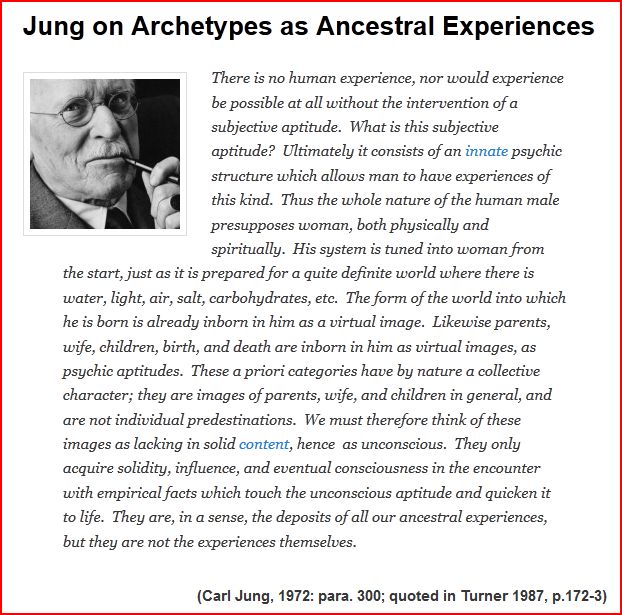
To
Know Thyself, Know Thy Ancestors
Your Kin Await
...who are the dead
and what does it mean to answer them?
What matters is not
what you say, but what they say back.
Ancestors, from the
archetypal to the personal, influence us in the present and implicate us in
lives of subsequent generations. The known and unknown stories of our ancestors are
present in our personal symptoms, disposition, aspirations, and the questions
which inform our lives. Our ancestral and cultural legacies continue living in
our bodies, through our relationships, in both matter and the timelessness of
psyche. These legacies root us in the past and implicate us in the lives of the
generations that will follow.
--Sandra Easter, Jung
& the Ancestors
Moreover, my ancestors'
souls are sustained by the atmosphere of the house, since I answer for them the
questions that their lives once left behind. I carve out rough answers as
best I can. I have even drawn them on the walls. It is as if a
silent, greater family, stretching down the centuries, were peopling the house.
-- Jung, The Earth Has
a Soul: The Nature Writings of C.G. Jung
Take pains to waken
the dead. Dig deep mines and throw in sacrificial gifts, so that they reach the
dead. Reflect in good heart upon evil, this is the way to the ascent. But
before the ascent, everything is night and Hell. ~Carl Jung, The Red Book, Page 244.
[The incorporeal
spirits lie] beyond our empirical present. [He continues] There is a spiritual
world from which the soul receives knowledge of spiritual things whose origins
cannot be discovered in this visible world. ~Carl Jung; CW 8.
From that time on,
the dead have become ever more distinct for me as the voices of the Unanswered,
Unresolved, and Unredeemed. . . . These conversations with the dead formed a
kind of prelude to what I had to communicate to the world about the
unconscious. . . .
It was then that I
ceased to belong to myself alone, ceased to have the right to do so.
From then on, my life
belonged to the generality. ~Jung, MDR, Page 191f.
In the Red Book, Jung
writes: “When something long since passed . . . comes back again in a changed
world, it is new. To give birth to the ancient in a new time is creation.” The
ancient ancestors are now coming back into the world through dreams, bringing a
new energy – a revitalization of the psyche both individually and
collectively. Jung deeply valued the archaic levels of human
consciousness and often encouraged his patients to make contact with the “the
two-million-year-old” man or woman within. He believed that “most of our
difficulties come from losing contact with our instincts, with the age-old
unforgotten wisdom stored up in us”. --Marea Claassen
When we know about our
ancestors, when we sense them as living and as supporting us, then we feel
connected to the genetic life-stream, and we draw strength and nourishment from
this.
--Philip Carr-Gomm
If you look deeply into
the palm of your hand, you will see your parents and all generations of your
ancestors. All of them are alive in this moment. Each is present in
your body. You are the continuation of each of these people. --Thich Nhat Hanh
In different hours, a
man represents each of several of his ancestors, as if there were seven or
eight of us rolled up in each man's skin, - seven or eight ancestors at least,
and they constitute the variety of notes for that new piece of music which his
life is.
--Ralph Waldo Emerson
Over the course of
the millennia, all these ancestors in your tree, generation upon generation,
have come down to this moment in time -- to give birth to you. There has never
been, nor will ever be, another like you. You have been given a tremendous
responsibility. You carry the hopes and dreams of all those who have gone
before. Hopes and dreams for a better world. What will you do with your time on
this Earth? How will you contribute to the ongoing story of humankind? History
remembers only the celebrated, genealogy remembers them all. --Laurence Overmire
I feel very
strongly that I am under the influence of things or questions which were left
incomplete and unanswered by my parents and grandparents and more distant
ancestors. It often seems as if there were an impersonal karma within a family
which is passed on from parents to children. It has always seemed to me that I
had to answer questions which fate had posed to my forefathers, and which had
not yet been answered, or as if I had to complete, or perhaps continue, things
which previous ages had left unfinished. --Carl Jung
The Collective
Unconscious (Friedman& Shustask, 2006), is the last element in the psyche
and is made up of archetypes emotional symbols which are common to all
individuals “transpersonal than personal” from the beginning of time, in
(Pervin & Cervone, 2010) “this psychic life is the mind of our ancient
ancestors, the way in which they thought and felt, the way in which they
conceived of life and the world, of gods and humans beings. The existence of
these historical layers is presumably the source of belief in reincarnation and
in memories of past lives” (Jung, 1939, p.24). knowledge we are all born with,
Psychic inheritance which influences all our experiences and behaviors as in
symbols and the meanings of certain myths we recognize instantly on first
visual record, furthermore artists and musicians all have shared experiences
i.e. religions, corresponding dreams, fairy tales literature from all over
world a universal meaning and understanding like near death experiences from
several cultural backgrounds had parallel accounts (Personality theories,
2006).
http://carlgustavjung.wikispaces.com/The+ego,+the+Personal+and+the+Collective+Unconscious
According to Jung,
the collective unconscious consists of implicit beliefs and thoughts had by our
ancestors. While we are not aware of the collective unconscious, it can
influence how we act.
http://www.psychologytoday.com/blog/the-superhuman-mind/201302/remembering-things-you-were-born
“There is a language older by far and
deeper than words. It is the language of bodies, of body on body, wind on snow,
rain on trees, wave on stone. It is the language of dream, gesture, symbol,
memory. We have forgotten this language. We do not even remember that it
exists.”
— Derrick Jensen, from A Language Older Than Words (Chelsea Green Publishing,
2000)
If
I am bound to men and things, I can neither go on with my life to its
destination nor can I arrive at my very own and deepest nature. Nor can death
begin in me as a new life, since I can only fear death.
~Carl Jung, The Red Book, Page 356.
A good many
will admit that self-knowledge and reflection are needed, but very few indeed
will consider such necessities binding upon themselves. ~Carl Jung, Letters Vol. II, Pages
465-466
For him who looks backwards the
whole world, even the starry sky, becomes the mother who bends over him and
enfolds him on all sides, and from the renunciation of this image, and of the
longing for it arises the picture of the world as we know it today. ~Carl Jung; The Sacrifice; CW 5;
Par 643.
But if we can reconcile
ourselves with the mysterious truth that spirit is the living body seen from
within, and the body the outer manifestation of the living spirit --the two
being really one-then we can understand why it is that the attempt to transcend
the present level of consciousness must give its due to the body. ~Carl Jung, Modern Man in Search of
a Soul, Page 220
Self Initiation
Hillman said, “the
community of the dead …. are already there, like presences waiting for you.”
Like the ancient Egyptians, we can open the mouth of the dead. And you can
reunite through genealogical practice without dying. Ritual initiation requires
a formal symbolic ego-death and rebirth but this occurs as a natural effect of
engagement with our depths.
Jung said
transpersonal psychic life "is the mind of our ancient ancestors, the way
in which they thought and felt, the way in which they conceived of life and the
world, of gods and humans beings. The existence of these historical layers is
presumably the source of belief in reincarnation and in memories of past
lives,” (Jung, 1939, p.24).
In 'Extending the
Family' (1985), Hillman says, "With the passing of time a sense of its
power grows within one's psyche, like the movements of its skeleton inside
one's flesh, which keeps one in servitude to patterns entombed in our closest
attitudes and habits. From this interior family we are never free. This service
keeps us bonded to the ancestors." Some report a sort of "calling
illness" until they respond to the ancestors calling them to do the work.
So, why think about your ancestors at all? It is life-enhancing.
He also suggests we
“turn the trap of entanglement in the personal family into an archetypal
recognition of family as the supreme metaphor for sustaining the human
condition,” (pg. 6). In this sense, our genealogical work signifies a
Homecoming. Like the homecoming quest of Odysseus, it extends beyond meaningful
connections of the nuclear family into our vast archetypal family with its full
imagistic panoply.
Such family therapy
isn’t restricted to standard theories and practices but to the epistemology
that informs them. It is not an investigation of historical causality, but a
circular, synchronistic, non-linear epistemology with archetypal
considerations. The influence is interactional with the positive teleological
functions of the symptoms. Within the pedigree we encounter representations of
the actual forces of epoch-making political, economic, philosophical, and
religious collectives.
A 2011 study appearing
the European Journal
of Social Psychology
hypothesizes that thinking about one's genetic origin (i.e. ancestors) provides
people with a positive psychological resource that increases their intellectual
performance. They tested this by manipulating whether participants thought
about their ancestors or not (manipulation of ancestor salience). Then, they
measured their expected as well as actual intellectual performance in a variety
of intelligence tasks.
“Four studies supported our
assumptions: participants show higher expected (Study 1) and actual
intellectual performance (Studies 2–4) when they are reminded about their
ancestors. We also have initial evidence that this effect may be fuelled by
increased levels of perceived control and promotion orientation. Theoretical
and practical implications are discussed. It is certainly desirable to be well
descended, but the glory belongs to our ancestors. (Plutarch 46–120 AD)” (Fischer, et al).
Psychogenealogy is a
process of self-initiation – a vital part of the Great Work, much like alchemy
or meditation. Initiation simply means “beginning,” a dedication to a sacred
practice. Once you get the ball rolling, it rolls of its own momentum. You make
the first gesture, an explicit commitment to realize your potential within the
method. The meaning of this commitment unfolds slowly over a lifetime.
The World Tree
contains ample opportunities for both self-realization and the experience of
chaos, multiplicity, and disintegration. In this sense, psychogenealogy
reflects the nature of the soul: 1) makes all meanings possible, 2) turns
events into experiences, 3) involves a deepening of experiences, 4) is
communicated in love, 5) and has a special relation with death, (Hillman,
1977, p. xvi, Hillman, 1976, pp. 44-47).
We can apply much of
what we learn in this process. The recollection of feelings, experiences,
places or pleasurable events and well-being stimulates the senses and guides us
toward living into our psychophysical potential. Tangible, symbolic, and
imaginal experience of our ancestors and progeny can have real effects on our
attitudes and compassion, and the main effect is Transgenerational Integration.
By embracing the World Tree we find transgenerational healing.
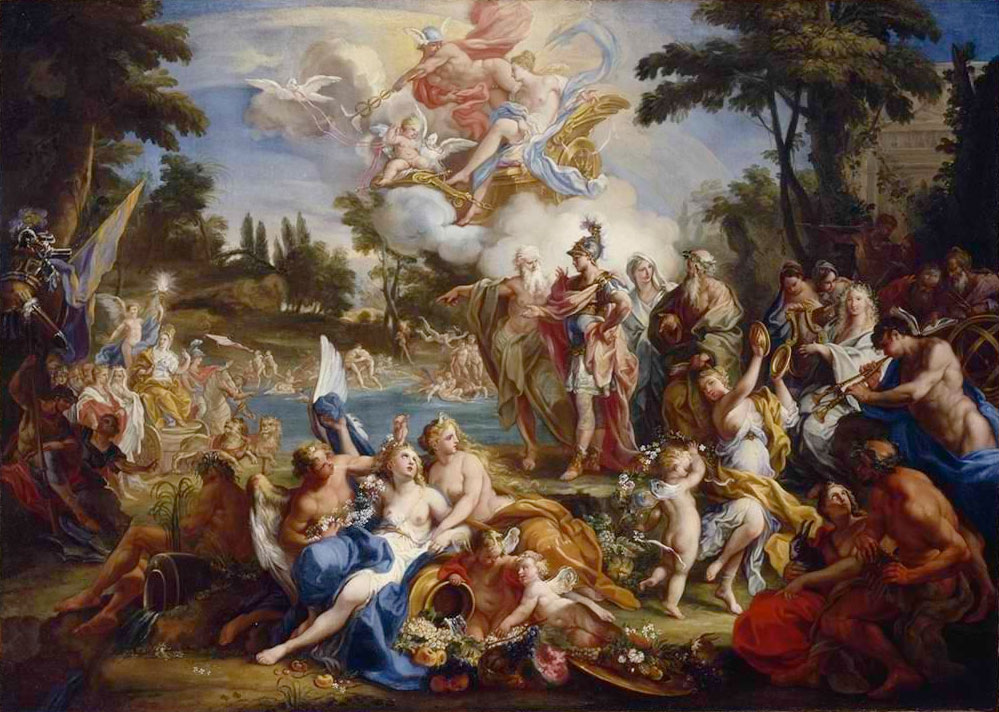
The Vision of Aeneas
in the Elysian Fields by Sebastiano Conca
The Grail, says Jung,
is the principle of individuation available within each person. “As threads of
fabric are woven into a pattern, so the Self as a living garment of divinity is
woven out of the many decisions and crises, in themselves possibly
insignificant, by which we are affected in the course of our lives.”
Individuation comes one person at a time, not to the collective, “for only in
the individual are opposites reconciled and united.” I take from this that I,
personally, cannot wait for the collective to come to an awareness of what is
important to heal our earth, to come to consciousness, to discover the truth
behind the illusions we worship....“Individuation, when seen from the ‘other’
(archetypal) side actually depicts the process of the incarnation of the divine.”
To ask the question, “Whom does the Grail serve?” is to ask, perhaps, Whom does
the Self serve? Does the Self serve that ultimate Wholeness of which we each
participate? Does the Self come in the service of that numinous experience we
each encounter once or twice in a lifetime that feeds our hunger for deeper
connection with life? Is the Self available to continue the incarnation of the
divine in whatever form it happens to be evolving in the universe? Encountering
the Grail imposes a question on the beholder, say our authors, it does not
impart direct knowledge. The Grail “gives us an emotional readiness to
receive,” a numinous experience of our inner center, the Self.
http://www.jungatlanta.com/articles/winter06-the-grail-legend.pdf
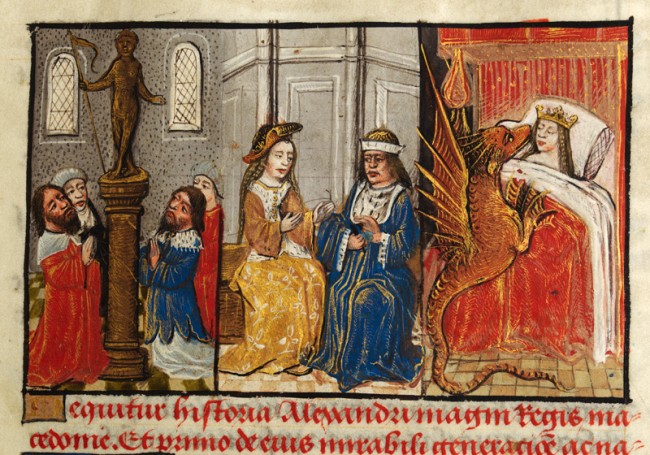
A "complete" life does not
consist in a theoretical completeness, but in the fact that one accepts,
without reservation, the particular fatal tissue in which one finds oneself
embedded, and that one tries to make sense of it or to create a cosmos from the
chaotic mess into which one is born.
~Jung, Letters Vol.
II, Pages 163-174
GENEALOGY
IS A WAY OF KNOWING
Your Pedigree is Your
Own Book of the Dead
For
those we love most, both in time and beyond...
Through those who came
before...
and those who are not
yet born...
There is no need for us
today to give up the relational, to forego meaningful connection and
traditional language, even when we move beyond the supernatural belief systems
of our ancestors.
The Portuguese word
"SAUDADE" has no English Equivalent: it describes the feeling of
missing something very intensively. The Portuguese also say: "To Yearn for the Future" - Feeling for the connection
to a destiny in time that is NOT YET, may be a particular genetic skill of the
helical serpent... inhabiting time itself..
Ways of Knowing
They come in dreams,
in revere, in ritual, with the gentle assist of a "library angel" or
other surprise clues, and they inform our being literally and figuratively.
They carry mystery in their wake, often with cryptic messages or information
that can later be verified or found in the physical world. They inspire our
spiritual studies and humanitarian efforts, our self-expression, proclivities
and desires. They compel our loves and help create our children, perpetuating
the line. We are theirs and they are ours. We are family; we are Blood. We feel
their experience from their point of view. As we collect them in name, we
collect their experiences, integrating them into our own meaning.
Ancestor worship has been a vital part of Chinese life since prehistoric times.
Ancestor worship is expressed in numerous ways, some of them very practical and
physical, as well as ethereal. Cultivating rows of graves resonates with
cultivating relationships and providing boons for the dead in the afterlife --
cultivating kinship meant cultivating virtue as well as communication and
reverence. Most believe that ancestors can help in difficult times. In China,
ancient human sacrifice has given way to modern tomb-tending ceremonies, but
the dead still make demands. The practice of ancestor worship has existed since
ancient times, and it emphasized continuity of family lines and filial piety.
Tending RESTLESS
SPIRITS is described by Peter Hessler for National Geographic:
http://ngm.nationalgeographic.com/print/2010/01/chinese-afterlife/hessler-text
There was only one day
each year when they looked backward, in April, during the festival of Qingming.
The Chinese name translates as "day of clear brightness," and for
more than a millennium it's been celebrated in various regional forms across
China. Ancestor worship goes back even further.
More than 5,000 years
ago, the cultures of northern China were venerating the dead through highly
systematized ceremonies. Echoes of these traditions still survive today, and
during my first year in the village, when the holiday came around, I
accompanied my neighbors on their ritual journey to the cemetery.
Only men were allowed
to participate. All of them were named Wei, and a dozen members of this
extended clan left before dawn, hiking up the steep mountain behind the
village. They wore simple work clothes and carried flat wicker baskets and
shovels on their shoulders.
They didn't make small
talk, and they didn't stop to rest. They had the determined air of a work
crew—tools at the ready, trudging past apricot trees whose fresh buds glowed
like stars in the morning half-light. After 20 minutes we reached the village
cemetery. It was located high on the mountain, where simple piles of dirt had
been arranged in neat rows.
Each row represented a
distinct generation, and the men began their work on the front line, tending
the graves of the most recently dead—the fathers and mothers, uncles and aunts.
They weeded the mounds and piled fresh dirt atop. They left special gifts, such
as bottles of alcohol or packs of cigarettes. And they burned paper grave money
for use in the afterlife, the bills bearing a watermark that said, "The
Bank of Heaven Co., Ltd."
Each villager pays
special attention to his own close relatives, working through the rows from
father to grandfather to great-grandfather. Almost none of the graves had
markers, and as the men moved back in time, from row to row, they became less
certain of identities. At last the work was communal, everybody pitching in for
every mound, and nobody knowing who was buried beneath. The final grave stood
alone, the sole representative of the fourth generation. "Lao zu," one villager said. "The
ancestor." There was no other name for the original clan member, whose
details had been lost over the years.
Genealogy
We cultivate our own
rows or lines of ancestors through genealogy, the pedigree of our origins.
Genealogy and even genetic genealogy are pursuits that require interpretation
of assembled data, not literal interpretation, due to hidden variables and a
variety of other factors, including the interpretive bias of the researcher.
Thus, they are essentially Hermetic pursuits and should be approached as such,
seeking both their wisdom and their subtle misdirection, outright lies of the
past and present, misrepresentations, and other Trickster elements.
Even today, grandiose
speculation often passes for science. Those unfamiliar with either subject are
most likely to misinterpret their own family's functional relation to others,
and likewise to misinterpret the evidence of their alleles in relation to antic
origins and their meaning. Identifying SNPs from deep common ancestry, or rare
SNPs related to shared characteristics helps us recognize one another as kin.
Genetic Genealogy
Genetic genealogy
is the application of
genetics to traditional genealogy. Genetic genealogy involves the use of
genealogical DNA testing to determine the level of genetic relationship between
individuals. Genetic genealogy is a science in great flux. In April 2000,
Family Tree DNA began offering the first Y chromosome tests outside of an
academic study. Additionally, Sykes’ concept of a surname study, which by this
time had been adopted by several other academic researchers outside of Oxford,
was expanded into online Surname Projects (an early form of social network) and
the effort helped spread knowledge gained through testing to interested
genealogists worldwide.
In 2001, Sykes went on
to write the controversial but popular book The Seven
Daughters of Eve,
which described the seven major haplogroups of European ancestors. This work
has been superseded, by in the wake of the book's success, and with the growing
availability and affordability of genealogical DNA testing, genetic genealogy
as a field began growing rapidly. By 2003, the field of DNA testing of surnames
was declared officially to have “arrived” in an article by Jobling and
Tyler-Smith in Nature
Reviews Genetics.
The number of firms offering tests, and the number of consumers ordering them,
had risen dramatically.
Another milestone in
the acceptance of genetic genealogy is the Genographic Project. The Genographic
Project is a five-year research study launched in 2005 by the National
Geographic Society and IBM, in partnership with the University of Arizona and
Family Tree DNA. Although its goals are primarily anthropological, not
genealogical, the project's sale by April 2010 of more than 350,000
of its public
participation testing kits, which test the general public for either twelve STR
markers on the Y chromosome or mutations on the HVR1 region of the mtDNA, has
helped increase the visibility of genetic genealogy. Such tests show
biogeographical and ethnic origins and revealed vast patterns of human
migration.
Even with scientific
linkage to specific ancestral groups, self-discovery should not be confounded
with personal mythology though both necessarily overlap. There is what the
evidence shows or suggests, then the narrative which we construct from that
limited evidence, which suggests certain things about our families, current and
former cultures, and the future of society.
Hermeneutics is the
study of theories and methods of the interpretation of systems of meaning,
including interpretations of experience, or human behavior generally, including
language and patterns of speech, social institutions, and ritual behaviors. It is
a specific method or theory of interpretation, such as Freud or Jung's depth
psychologies, for example.
The word hermeneutics
is a term derived from 'Ερμηνεýς, the Greek
word for interpreter. This is related to the name of the Greek god Hermes in
his role as the interpreter of the messages of the gods. Hermes was believed to
play tricks on those he was supposed to give messages to, often changing the
messages and influencing the interpretation thereof.
The Greek word thus
has the basic meaning of one who makes the meaning clear. A DECODER. DNA still
manages to preserve its deepest secrets about who and what we are. The bounds
of fact and fancy blur in an incoherent reading -- creative misreading of SNP
mutations, much like a dream interpretation.
Most people with a lot
of New England ancestry descend from one or more ‘gateway’ ancestors – i.e.,
early colonists who descend, themselves, from English kings, primarily the
Plantagenets. The latter, in turn, have their own gateway ancestors, through
whom we derive our longest possible ‘ancestral lines’ – into the Dark Ages
(roughly A.D. 450-750),
and perhaps (though
far more conjecturally) even the Classical (Greco-Roman) and Ancient (Egyptian,
Babylonian, and Persian) worlds.
ALL such descents are
hypothetical – that is, all entail many filiative links that are not, in fact,
attested in writing, but postulated by scholars on the basis of an assessment
of the known chronology, ethno-political situation, and onomastic patterns of
the relevant era, locale, and race. In short, ‘ancient’ pedigrees have many
‘dotted lines,’ which are plausible, even likely, but NOT susceptible to proof.
Unfortunately, popular
American genealogical literature is rife with supposed ‘ancient’ pedigrees
which are neither likely nor plausible, and in some cases provably bogus,
passing, as they do, through long chains of supposed personages who never
existed. How, short of acquiring a comprehensive knowledge of many phases of
world and national history, half a dozen ancient and modern languages, the
various branches of philology, and an immense (and highly specialized) research
literature (surely a job for several lifetimes!), is the ‘lay’ reader to tell
the plausible from the preposterous, the reasonable from the ridiculous?
We can identify the
major geographic areas, ethnicities, and pre-Plantagenet ‘gateway’ ancestors
through whom we MIGHT descend from Dark Age, Classical, or Ancient kings,
warlords, consuls, emperors, and pharaohs, and can outline the major sources of
data and forms of reasoning upon which such descents are predicated. It will
also draw your attention to proposed ‘ancient’ descents which are known to be
false, or have been seriously questioned, and identify the absolute historical
limits beyond which it will never be possible to go.
At about 360 years, or
just short of 15 generations an individual living today would carry only three
thousands of 1% (00.003052%) of the DNA of an ancestor who was “pure” anything
15 generations ago. So even if one ancestor was indeed Mediterranean 15
generations ago, unless they continuously intermarried within a pure
Mediterranean population, the amount would drop by 50% with each generation to
the miniscule amount that would be found in today’s current generation. With
today’s technology, this is simply untraceable in autosomal DNA.
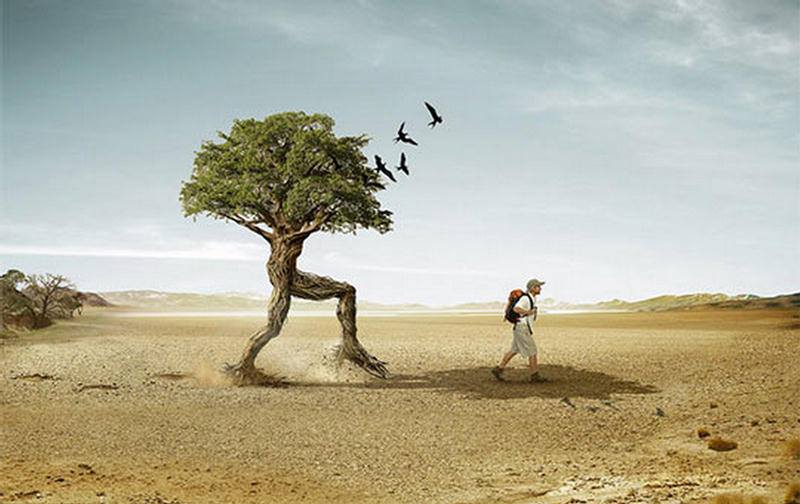
***********************
"In the deepest sense, we all dream
not of ourselves,
but out of what lies
between us and the other."
--C.G. Jung
"The realm of the
psyche is immeasurably great and filled with living reality.
At its brink lies
the secret of Matter and Spirit." ~Carl Jung
What the ancients did for
their dead! You seem to believe that you can absolve yourself from the care of
the dead, and from the work that they so greatly demand, since what is dead is
past. You excuse yourself with your disbelief in the immortality of the soul.
Do you think that the dead do not exist because you have' devised the
impossibility of immortality? You believe in your idols of words. The dead
produce effects, that is sufficient. In the inner world there is no explaining
away, as little as you can explain away the sea in the outer world. You must
finally understand your purpose in explaining away, namely to seek protection.
~Carl Jung; Red Book.
But if we can reconcile ourselves
with the mysterious truth that spirit is the living body seen from within, and
the body the outer manifestation of the living spirit --the two being really
one-then we can understand why it is that the attempt to transcend the present
level of consciousness must give its due to the body. ~Carl Jung, Modern Man in Search of
a Soul, Page 220
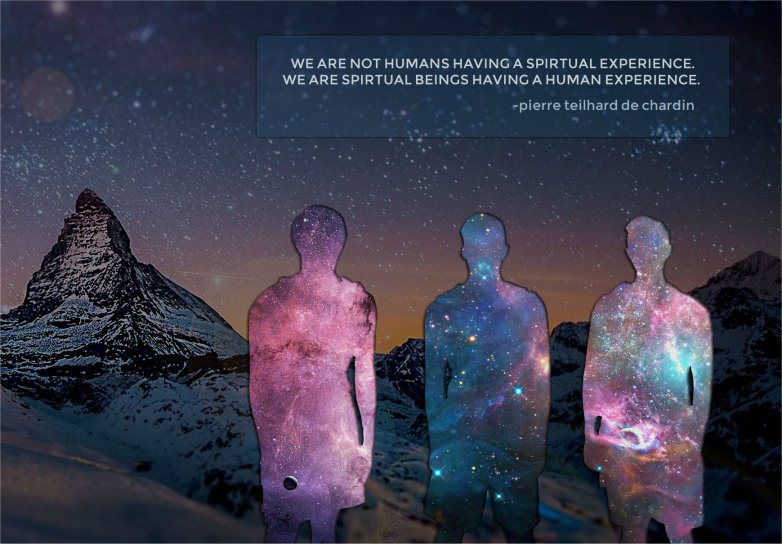
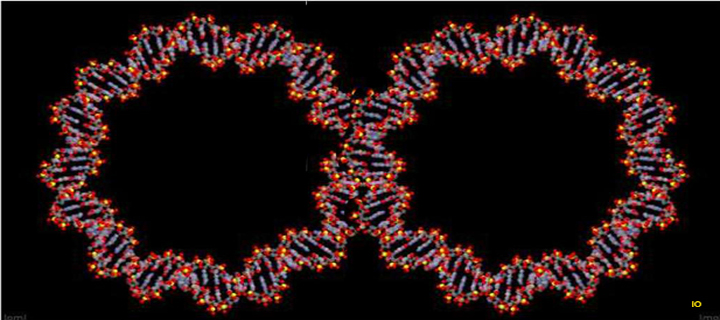
OVERVIEW
Genealogy Without
Tears
Genealogy Writes You
into the Story of History
"To let each
impression and each embryo of a feeling come to completion, entirely in itself,
in the dark, in the unsayable, the unconscious, beyond the reach of one's own
understanding, and with deep humility and patience to wait for the hour when a
new clarity is born: this alone is what it means to live as an artist: in understanding
as in creating."
--Rainer Maria Rilke
"Through scientific understanding,
our world has become dehumanized. Man feels himself isolated in the cosmos. He
is no longer involved in nature and has lost his emotional participation in
natural events, which hitherto had a symbolic meaning for him. Thunder is no
longer the voice of a god, nor is lightning his avenging missile. No river
contains a spirit, no tree makes a man's life, no snake is the embodiment of
wisdom and no mountain still harbors a great demon. Neither do things speak to
him nor can he speak to things, like stones, springs, plants and animals. His
immediate communication with nature is gone forever, and the emotional energy
it generated has sunk into unconscious."
~Carl Jung, Collected
Works 18, Paragraph 585
You
Get the Genealogy You Deserve
Life and consciousness
are the ultimate emergent phenomena, but we still don't know their real origin,
which remains veiled in Mystery. We are Cosmic psychophysical beings with a
core reaching down into the microcosm of quantum dynamics and the still center
of Zero-Point. The
zero-point of our genealogy is the Ur-ancestral couple lost to the mists of
pre-history.
Beyond hormonal and
limbic impulses and narratives of the biological imperative of procreation --
why or why not and when or with whom to create -- consciousness informs
the inception of new life. Our reasons for giving birth are often unconscious.
Each of us was conceived and each of us continues to conceive everyday.
Conscious conception is the ritual of thought, prayer, energy, sex, and work
around the event birth. Just as we can benefit from processing work around our
own births, we can learn from the stories of our progenitors.
In the split second
moment of conception, the two streams of genetic information from your parents,
handed on from generation to generation over literally hundreds of millennia,
combined in one single cell embodying your unique potential. It ensured that
you became an unequaled living record of the lives and ways of your ancestors.
All of your ancient
ancestors had one thing in common -- they were survivors who overcame daunting
obstacles and hardships in their natural world. Your DNA is a legacy passed
down to you from thousands of generations of fittest individuals. You have the
best of their collective genes, all meticulously spelled out within the DNA of
your genome.
Your individual DNA
fingerprint depends on how the chromosomes line up at conception. Some traits
from both parents’ potentials will be there, while others get excluded. So,
some siblings can be redheads, others not; some can have family medical
problems, others not, some may be Rh neg., others not. Extensive historical
knowledge of cultural practices and human migratory patterns helps us piece
each story together. We may find things we never imagined and find no evidence
for traits known within our lineage.
Each individual is
very much like the fractal units of every individual human being, yet is
distinctly different in many dimensions--genetically, in a biological
dimension. But each individual also resides in many dimensional worlds--some in
academic worlds, some in spiritual worlds, some in political worlds, some in
worlds of despair and some in worlds of optimism. Some individuals share like
worlds and are polarized by some worlds.
A child and parents
are fractal levels of a family tree and at the same time units of a larger
community fractal, and may be a fractal unit of a religious group or political
affiliation within that set. This same child, parents, the community are all
fractals of county, state, national fractals and may be fractal units of sets
within any of these larger fractals--organizations, spiritual affiliations,
clubs, special interest groups, schools, workplaces, etc.
In genealogy the term
direct line refers to a relationship of one person to another in a direct line.
A direct-line ancestor is someone from whom you descend in a direct line,
parent to child, grandparent, great-grandparent, etc. Direct-line research refers
to genealogy research focused on one's direct-line ancestors. Blood relations
refer to the underground stream, the Red River of Memories that flows within
us. The Blood is real and it's fresh; it flows in your veins.
By contrast,
collateral line is a term used to describe family relationships not in the
direct line of descent such as siblings, spouses and children of siblings,
aunts, uncles, cousins, etc. Researching direct-line ancestry is a common
focus of genealogists and family history researchers. Proving a direct line of
descent is generally required for membership in heritage societies. A mere
seven generations back we have over 200 people in just our immediate, or
father-mother, grandfather-grandmother line.
We are not just
talking about the way you look, but about your ancestral memories, the complete
set of instincts and response patterns that were responsible for the survival
of those two genetic streams in the first place. The instincts and response
patterns that you were actually born with are what Jung called the Collective
Unconscious. Science calls it epigenetics. Genealogy functions as a therapeutic
portal, much like dreams or symptoms allow us to enter the imaginal dimension.
We are born with both
a psychological and a biological heritage, as determinants of behavior and
experience. The
collective unconscious, which results from experiences that are common to all
people, also includes material from our prehuman and animal ancestry. It is the
source of our most powerful ideas and experiences.
Jung described
individual and collective symbols. Symbols veil what remains hidden to us. He
called individual symbols "natural" symbols -- spontaneous
productions of the individual psyche, rather than images or designs created
deliberately. Personal symbols are found in dreams and fantasies. But,
important collective symbols appear which are often religious images such as
the cross, the six-pointed Star of David, the Grail, and the Buddhist wheel of
life.
Jung says, "Just
as the human body represents a whole museum of organs, each with a long
evolutionary period behind it, so we should expect to find that the mind is
organized in a similar way. It can no more be a product without history than is
the body in which it exists" (1964, p. 67).
Quo Vadis?
Fundamentally,
genealogy is a search for Self -- universal spirit. Your personal family tree
merges with the collective in The World Tree. The goal is creating a single
family tree for the world. The World Wide Web has made such collaboration
possible, creating a single world family tree.
In mythology the World
Tree is the axis between heaven and earth. Many people believed that gods and
their messengers climbed up and down the tree to get from one realm to the
other. Sometimes these trees were said to bear fruit that was powerful for
healing or knowledge. Among those who study myths and legends, this type of
tree is known as a “World Tree” or a “Cosmic Tree.”
The world tree is
a universal symbol. It’s primary meaning is creation and consciousness (the
divine will of creation). The growing of the the tree is the symbol of the
creation of the Universe and its Evolution -- a Tree of Life. This was the
symbol of the Druids (meaning “tree”). They believed that in the
branches of the tree you could discern the secrets of the universe.
Some are armchair
genealogists, while others hit the genealogy trail, making their life a
perpetual pilgrimage and search by visiting family domiciles and sacred sites.
Many search for relics or novel solutions to riddles they pose to themselves.
It is a way of connecting the psychological dots into a seemingly coherent
story, one that keeps the narrative moving forward while it looks back.
Some write novels that
filter information and scenes through the consciousness of their characters.
There are battles and leaders, matriarchs, patriarchs and malefactors. Others
create esoteric organizations, usually with themselves set up as authority
figures. They hook those who are susceptible to the promise of Mystery. Most
such groups devolve into banal cults of personality, which all seem to share
the same squabbles and organizational problems.
Some are convinced
only they know the real truth of the matter. But you cannot really tell anyone
anything, due to the brain's hardwiring. Research shows that in the public
realm, a lack of information isn't the real problem. The hurdle is how our
minds work, no matter how smart we think we are. We rationalize what our
emotions already want to believe. Do facts matter? The answer, basically, is
no. When people are misinformed, giving them facts to correct those errors only
makes them cling to their beliefs more tenaciously.
Further, most exposés
of the knowledge of the underground stream are materialistic interpretations of
it. They claim to empower you while lining their pockets. Some of this
may be compensatory to lack of power in other areas of life. Claims to shift
world vision seem more of a self-serving perception than a reality -- more
memes than genes.
Cognitive dissonance
occurs when we filter our perceptions to screen out (deny) threatening
information we cannot deal with. It is magical thinking to take a symbol to be
its referent or an analogy to represent an identity. Magical thinking comes
from an instinctual search and recognition of patterns, and regards symbols not
as representations but as handles attached firmly to real-life objects and
outcomes. Out of context, symbols are ineffectual. Evocative “power” is one of
the attractive aspects of the meme concept which is also a symbol and
signifiers of meaning that are context dependent.
There are three types of
symbols: 1) Symbols that reflect intrinsic mental states; 2) Symbols that stand
in for extrinsic (actual or objective) conditions or objects, and 3) Symbols
that stand in relation to cultural artifacts, or constructs, or memes. Here the
symbol and the object it represents are one and the same. Any distinction
between symbol and symbolized is spurious. The emotional projection of symbols,
or “magical thinking,” happens in psychosis, in cultures, and subcultures.
Disgust is an emotion heavily caught up in symbolic and magical thinking. Yet,
symbols can have biophysical and material effects. We trick ourselves into
mobilization.
Magical thinking helps us
feel more secure in an unpredictable world. By manipulating symbols, we imagine
being able to manipulate the reality that a symbol represents, but it makes us
vulnerable to manipulation, too. The psychology of superstition “works” better
in a virtuality. Superstition provides the illusion of increased control.
Symbols are captivating, indistinct, metaphoric and enigmatic portrayals of
psychic reality. The content, i.e. the meaning of symbols, is far from obvious;
instead, it is expressed in unique and individual terms while at the same time
partaking of universal imagery. Our society is having to rethink such
fundamental notions as money, security, growth and many other bases of our
current worldview.
Symbols can be recognized
as aspects of those images that control, order and give meaning to our lives.
The source of symbols can be traced to the archetypes themselves which by way
of symbols find more full expression. Symbols are thus one type of what Jung
called “archetypal images,” that is, the representation in consciousness of an
underlying archetype. The anamorphic is not the fractal, because the fractal is
repeating a pattern.
When the dominant vision
that holds a period of culture together cracks, consciousness regresses into
earlier containers, seeking sources for survival which also offer sources of
revival. Self-empowerment can be entangled with self-delusion. We can no longer
distinguish clearly between neurosis of self and neurosis of world,
psychopathology of self and psychopathology of world. Species-wide trauma is playing
out on the world stage. We compulsively recreate individual and collective
trauma, perhaps as a way to awaken ourselves. Such madness is its own ritual
and revelation.
(Miller, Holographic
Archetypes)
Perhaps the biggest
value of questionable literature is that people now search elsewhere for their
own half-remembered origins.
Many who claim to
guard the history actually prey on their vulnerable kinsmen. So we must look at
the effects of such behavior rather than relying on proclamations. There have
been many blatant hoaxes. It begs the question, "Where is this
leading?". In many cases, the answer is nowhere. Reinterpreting sacred
sites with idiosyncratic tropes doesn't make it so. Nor does finding out what
the Templars or Cathars were doing substitute for one's own individuation and may work against it, fitting a modern
person into an obsolete mold.
These overwrought
works mostly regurgitate the symbolic understanding developed more completely
in depth psychologies, applying skewed versions to the selected symbols, often
from New Age thought, another faddish collective movement which mostly rehashes
theosophical notions. There isn't much "new" about it. If such
critique sounds like tough love it is because it comes from close observation of
the effects of such subcultures. Schisms and tragedy have been the result, not
illumination unless you count disillusionment as such.
Following pilgrimage
routes, such as "the Camino" may be stimulating but will likely never
be illuminating. It doesn't substitute for the work of self-discovery in the
cave of the heart. Overlaying such sites with new age gloss doesn't improve the
clarity of the situation and may just add irrelevant data. Our attunement to
the world is especially influenced by culture and society, whether we call it
human potential or human illusion.
In some cases,
pilgrimage is another form of what is termed the geographic escape. There are
many writers eager to host such trips for their own benefit. It has become a
thriving cottage industry whether the goal is ancient aliens or earth chakras.
That doesn't mean there is no value in such travel or mystery centers, but it
doesn't supersede the inner work and may lead to flooding and inflation.
Sentience is not the same as sentimentality. But people will do what they are
going to do. All things seek their own level.
Ultimately,
individuation is a solitary pursuit, a mode of experience that opens the door
to the otherwise hidden world. To Edward Edinger (1972), individuation means
not having to continually repeat the cycle, but to develop conscious dialogues
between I and Self. Without a displaced religious obsession there is little
reason to pursue the lies, theories or directives of others over one's own
creative genius. Ultimately, the real issue with the bloodline has always been
about the concept of "sovereignty".
It isn't merely our
royal genealogy that makes us who we are. After all, we share most of it with
millions of people. Still, there is no better way of actively working within
your ancestral matrix than delineating and curating your own lines. What is
unique is our personal reaction to such knowledge and how our relationship with
it evolves as we assimilate and integrate that expanded awareness -- the
Mystery of the whole matter.
Genealogy is the root
of the hieros gamos or symbolic royal marriage. The rich variety of
psycho-physical hierosgamic themes are illustrated in many alchemical works,
illustrating simultaneous humanity and divinity. The hierosgamos union of
opposites between human and divine is mediated by Mercurius, the Hermetic
method, or hermeneutics. It requires interpretation of experiential material.
For example, originally, the dove was a symbolic attribute of ancient female
divinities of Mesopotamia.
We need To Know
genealogy much like we need to know physics and psychology to comprehend what
matter is, as well as what makes us matter. We have thousands of ancestors
whose lines are not
preserved,
making the small slice of royal descent largely archetypal as well as material.
The part stands for the Whole - the cosmic process.
In a Gnostic exercise
for inner growth the personal mind must be made empty or void of all
preconceptions, but at the same time become keenly attentive, transformed into
pure sense, or capacity for greater sensations. The soul must be in a searching
frame of mind, searching not inquiring, that is to say synthetic not analytic.
Inquiry suggests penetrating into a thing with the personal mind; while
searching denotes embracing and seizing ideas, "eating" or
"digesting" or "absorbing" them, so to say; getting all
round them and making them one’s own, surrounding them--it is no longer a
question of separated subject and object as with the personal and analyzing
mind.
The "vision"
of the soul is, literally, the "eye" of the soul. The mind must be
emptied of every
object, so that it may
receive the fullness. It becomes the "pure eye," the æon,
all-eye; not,
however, to perceive
anything other than itself, but to understand the nature of understanding --
namely, that it transcends all distinctions of subject and object. Silence
nurtures the divine -- The Great Silence and the Holy Fire. The One Body of all
thing is the
Mother of souls, the
Inbreather of life -- cosmic "vitalizing," or "quickening,"
or "ensouling".
Union of Opposites
The body is the
alchemical laboratory that generates the subtle body, astral vehicle, and the
Body of Light or Diamond Body as the highest vehicle. Consciousness is drawn up
with sublimation. The elixir of life transforms body and consciousness.
The tensional
relationship of the opposites, (life and death, good and evil, one and many),
remains the great operational mechanism of manifest life and of
transformation. This relationship exists within the context of a unitary
world-model wherein matter and spirit, King and Queen, appear as aspects of a
psychoid (psychophysical) realm of reality.
In alchemy the
resurrection stands not for transcendence of the body, but its glorification
and perfection. Alchemy is the art of seeing what is invisible to others,
hearing what others are deaf to, and feeling what others are dead to. Sophia,
the Divine Feminine, personifies that World Soul, of inherent primordial
Wisdom.
We are affected not
only by things that happen to us personally, but also by things that have
happened in our lineage, to our parents, grandparents and ancestors.
Epigenetics shows that the traumas that happened within our culture affect us.
Ironically, this is more so when they have been forgotten, relegated to the
unconscious realm, where they can cause physical symptoms, phobias, depression,
nightmares and other unexplained things.
Another genealogical
form of opposites is twins or siblings. They are there from the beginning, as
Enki and Enlil, as Cain and Abel. Such myths arose in the age of Gemini, the
Celestial Twins.
They were destined to
become the most prolific progenitors of the world. Their offspring divided in
two. Those that went east to cross the Bering Strait, to become the most
prominent inhabitants of the New World as far as Tierra del Fuego, were the
descendants of one brother, while the numerous descendants of the other brother
that remained created a shock-wave in the Old World, felt as far as West
Africa, the Atlantic and India.
Like in a fantasy
tale, both people founded incredible civilizations, each highlights of human
talent and splendor. Tales of the Two Brothers persisted in myth and legend,
representing the dichotomy of all polarities and their underlying
transcendental unity. This is a story of the reunion of the archetypal
brothers.
Legends of the Two
Brothers arose in the Age of Gemini (6000 BC - 4000 BC) and come down in the
story of Cain and Able, which was historically preceded by allegorical stories
of Enki and Enlil. Each Age has its gods. The Age of Gemini corresponded to the
flourishing period of early Hinduism.
It was under this sign
that Rama, the seventh incarnation of Vishnu was manifested by the birth of the
two pair of brothers: Rama and Lakshmana on the one hand, Satrughna and Bharata
on the other. Rama Himself had twin sons: Lav and Kush.
Lav went to Russia;
from this we get the name of Slav. The other son, Kush went to China, hence we
get the name Kushan. These two divine principles were also incarnated as Buddha
and Mahavira, then as Adi Shankaracharya and Gnyaneshwara. In other Avatars
they were Hassan and Hussein, the sons of Fatima and Hazrat Ali.
The Quest
Joseph Campbell asks,
"What
is it we are questing for? It is the fulfillment of that which is potential in
each of us. Questing for it is not an ego trip; it is an adventure to bring
into fulfillment your gift to the world, which is yourself. There is nothing
you can do that's more important than being fulfilled. You become a sign, you
become a signal, transparent to transcendence; in this way you will find, live,
become a realization of your own personal myth."
The Quest for
wholeness is the search for meaning, orientation, renewal, and transformation.
By making the trauma in our lineage and in our culture more conscious, we can
loosen its hold. This helps us to restore a sense of our own self and our own
freedom of choice, and allows what is not ours to rest in peace. Thus,
genealogy is a kind of healing ritual, which retrieves the lost and disowned
parts of the soul, what we've buried in the earth and forgotten.
Thus your soul is your own
self in the spiritual world. As the abode of the spirits, however, the
spiritual world is also an outer world. Just as you are also not alone in the
visible world, but are surrounded by objects that belong to you and obey only
you, you also have thoughts that belong to you and obey only you. But just as
you are surrounded in the visible world by things and beings that neither
belong to you nor obey you, you are also surrounded in the spiritual world by
thoughts and beings of thought that neither obey you nor belong to you.
Just as you engender or
bear your physical children, and just as they grow up and separate themselves
from you to live their own fate, you also produce or give birth to beings of
thought which separate themselves from you and live their own lives.
Just as we leave our
children when we grow old and give our body back to the earth, I separate
myself from my God, the sun, and sink into the emptiness of matter and
obliterate the image of my child in me. This happens in that I accept the
nature of matter and allow the force of my form to flow into emptiness. Just as
I gave birth anew to the sick God through my engendering force, I henceforth
animate the emptiness of matter from which the formation of evil grows.
Nature is playful and
terrible. Some see the playful side and dally with it and let it sparkle.
Others see the horror and cover their heads and are more dead than alive. The
way does not lead between both, but embraces both. It is both cheerful play and
cold horror.
(Jung, Red Book)
Genealogy is like
organic gardening. We till the soil until things break through the surface
where we tend and fertilize them with creative expression and contemplation.
Living branches of our Tree become knotted together generating many leaves.
Entwined with roses and thorns they represent the complexities of life,
including the union of opposites. At the microcosmic level they may represent
quantum entanglement. All macroscopic parts of the world are entangled quantum mechanically. Entanglement
is a property of nonlocal quantum information exchange.
Jung pointed out that
procreative power is only a special instance of the ‘procreative nature of the
Whole', as illustrated in alchemical works such as the Rosarium Philosophorum, which depicts a symbolic hieros gamos, combining the powers of the upper
and lower worlds, leading out the gold. We acquire an experiential
understanding of the ontological wholeness of the cosmos and know we are in no way separate from
that. Such non-duality that closes the gap between spirit and body was the
magnificent obsession of the alchemists as it is of the mystics.
Eliade wrote, "The Sun and the Moon must be
made one. . .above all, prajna, wisdom, must be joined with upaya, the means of
attaining it. . .all this amounts to saying we are dealing with the
coincidentia oppositorum achieved on every level of Life and
Consciousness."
Chaos becomes cosmos;
the profane becomes sacred; potential is actualized. Alchemical tracts bookend
the entire alchemical process between an initial and final image. Opening and
closing illustrations frame the psycho-physical transformation. Like dreams and
moods, the fruits of personal insight and practical guidance affect us
physiologically, emotionally, psychologically, and/or spiritually, and become
part of our being.
Death, afterlife
beliefs, mediumship, and spirit possession are contentious subjects. Belief is
a open-ended system. Anomalous experiences can arise as a function of
relational care or concern. In a genealogical approach, we have no burden to
prove the source of psi phenomena or synchronicities.
A Jungian approach is
more concerned with their meaning in the life of the person who reports the
phenomena. You cannot argue with anyone's belief or experience. It can be
approached literally, metaphorically, or symbolically. Metaphors are
paradoxical. Like Jung we take a phenomenological approach, looking backwards
and forward at the same time. Jung's theory of possession by autonomous
complexes differs from notions of possession within specific belief systems.
Social Anthropologist,
Fiona Bowie writes: "Virtually
all other cultures hold to the notion, based on the experience of individuals
and groups, that the Self, if it exists at all, is permeable, and in constant
contact and relationship with other selves at a psychic as well as a
physical and emotional level. Communications may be unconscious or conscious,
mediated by others or unmediated, wanted or unsought, but they exist
nonetheless, and come in many different forms, with different results and
effects. They involve communication between living humans and those who have
died, between human and non-human beings, between visible and invisible
entities.These entities may be projections of one or more minds, or have a
non-human origin.The forces or entities with which people communicate may be
regarded as angelic or demonic, helpful or dangerous, mischievous and
playful or sad and lonely, and in need of help and guidance."
Ancestral impressions
change us regardless of whether we make any logical waking connections or not.
Even when we spot such connections, it can be limiting to assume that this was
the sole ‘point’ of the discovery, and therefore drop further exploration or
creative expression for an "Aha" moment. Carrying away golden coins,
we may miss the priceless jewel fashioned or concealed within the chest
itself.
Genealogy is an Art, a
quest for the truth within. Harvesting the fruits of the Tree of Life
mobilizes the soul for creative self-expression, self-discovery and
self-healing. Much benefit and fulfillment comes simply by remembering,
writing, tape-recording, sharing, painting, enacting or otherwise birthing them
into the physical world. Understanding is always the experience of a gestalt.
Creatively arranging the elements of a whole is precisely what genealogy does,
anatomizing and analogizing.
Genealogy takes
tremendous effort, like the Great Work. It affects the psyche with both
historical and imaginal, known and unknown elements. It has its own magic,
alchemy, and synchronicities. Psyche is Mystery, the very essence of humanity,
and world. Jung comments, “In reality, there is nothing but a living body. That
is the fact, and psyche is as much a living body as body is living psyche: it
is just the same,” and “The psyche creates reality every day.”
Jungian genealogy is a
broadly interdisciplinary approach, integrating research from neurosciences,
genetics, depth psychology, anthropology, shamanism, and philosophy. We wish to
consider the ways in which genetic, linguistic, historical, esoteric, and
ethnographic data can be used to test theories.
We discuss theoretical
and methodological concerns that are directly relevant to study, research and
data interpretation. We have surveyed and are correlating historical sources
and secondary sources: legends, folklore, astrological, genealogies, tales,
chansons, oral histories, mystical writings, etc.
Even genetic genealogy
requires interpretation -- hermeneutics, the study of theories and methods of
the interpretation of systems of meaning, including interpretations of
experience, or human behavior generally. It includes language and patterns of
speech, social institutions, and ritual behaviors.
Genealogy is a search
for the Beloved, and as such is a Way of the Heart -- a love of psyche.
“Love and the Soul
(for that is what Psyche means) had sought and, after sore trials, found each
other; and that union could never be broken.” This is the mythic theme. (Edith
Hamilton, Mythology)
Genealogy is about
Identity. Some attempt to garner social status through their genealogies when
other avenues elude them. Some in search of their identity wind up finding
their Shadow -- the archetypal adversary and trickster.
Each archetype has a
shadow. The
archetype of the shadow "coincides with the 'personal' unconscious,
stranger/predator/evil intruder. When it is activated in a
particularly strong and gripping way, inevitably interconnects the wider
collective with the personal.
Archetypes do not
create archetypes like themselves but like the shadows of archetypes like
themselves. Archetypes
evolve from the form in which they first present, but the underlying identity
endures unchanged. Each
have awakenings (revolution in culture) and crises (upheaval in public life).
Shadow, the dark
archetype, is the root of defensive reaction formation (repression, denial,
projection, and displacement). Consciousness of the Shadow benefits the group
by enhancing social responsibility. We have to consciously suffer the
perpetual tension of good and evil. We are shadow-possessed to the extent it
dominates personality.
As each generation
fulfills its midlife leadership role, it nurtures a child generation as its
shadow that reacts against its elders' excesses. The four-fold cycle of
generations propels the wheel of time. The social cycle begins in growth and
moves through maturation into entropy, death, then rebirth. In a cyclic High people want to belong;
in an Awakening, to defy; in an Unraveling, to separate; and in a
crisis, to gather. Thus, in our lifetime we confront our deepest
spiritual and worldly needs. (Strauss)
Underprotected
children become over protective parents. Overprotected children become increasingly
indulgent parents. But generations overlap making a complementary mix. There
have been 24 post-medieval generations between the Arthurian generation and
Millennial children. They are fourteenth in the American line.
The shadow is
"the 'negative' side of the personality, the sum of all those unpleasant
qualities we like to hide, what is hidden by the conscious personality. It is
the enemy within, with which we must make peace. Von Franz declared the Shadow
is simply the whole unconscious, as it also contains unlived aspects of the the
Self. It also contains the potential necessary for healing.
Some people who come
to genealogical practice use it to build a persona that becomes their main way
of connecting in the world, an excessive commitment to a rather false image. We
identify with our persona. Jung called it a social mask or psychological armor.
Recovery, the aim of individuation, "is not only achieved by work on the
inside figures but also, as conditio
sine qua non,
by a readaptation in outer life," according to Jung. We live in the
present moment.
The path of
Individuation is the psychological equivalent of self-initiation. The goal of
individuation is self-realization through increasing conscious relationship
with the Self, archetype of wholeness. This Self includes both positive and
negative traits of an individual which, in the beginning of analysis, are
generally projected out, or attributed to, the environment.
As the ego continues
its heroic journey through the labyrinthine psyche, it comes into confrontation
with personifications of various archetypal and ancestral characters. During
the maturing process, these characters emerge from the undifferentiated mass of
unconscious contents. Though their presence in the psyche was implied from the
beginning, they begin to unfold in unique patterns in the life of the
individual.
Jung called the
persona the "conformity archetype." As part of its positive function,
it protects the ego and the psyche from the varied social forces. Thus one goal
for individuation is for people to "develop a more realistic, flexible
persona that helps them navigate in society but does not collide with nor hide
their true self". Eventually, "in the best case, the persona is
appropriate and tasteful, a true reflection of our inner individuality and our
outward sense of self."
Jung also cautioned,
"It would indeed be the height of absurdity if a man tried to have a
conversation with his persona, which he recognized merely as a psychological
means of relationship." So, the purpose of genealogy is not to
over-identify but distinguish ourselves from our ancestral lines.
It is especially true for an adopted fantasy-based social role which functions
like an actor's mask. A mask is what individuals wear to hide their real self or
when gaming.
Hobby genealogists may
be taken unawares by such strong feelings, images and impulses. A person
unfamiliar with psychic dynamics may not recognize that these are processes
that Jung described and for which he developed now time-tested therapies to
circumvent the pitfalls of alienation, dissociation, projection, and inflation.
It's as if unconscious contents lack genealogical links to consciousness proper.
A Jungian genealogy
permits a cultural study of the unconscious and a psychological study of
culture that facilitates an understanding of the emotional impact culture
provides, the unconscious elements of group creation, and the multiple
individual perspectives in each historical moment. Formal structures help us
understand the significance of mythical discourse. Joseph Campbell called myth
a mirror of the ego.
Theories and ideas
also have 'genealogies' that trace how they transform over time as they are
inherited through culture. This is particularly true of faith-based ideas. They
can be used instead of historical analysis or traditional explanations that are
more magical than effective. We can follow the transformation of notions
without drawing conclusions on their origin.
Even without knowing
the cause we can describe the transformations themselves, their strengths,
weaknesses, ideology and competing arguments, mechanisms of coercion and
contents of knowledge. A genealogy is an open system of relationships, the
effect of making a process intelligible and describes cultural elaboration.
“Cultural complexes structure
emotional experience and operate in the personal and collective psyche in much
the same way as individual complexes, although their content might be quite
different. Like individual complexes, cultural complexes tend to be repetitive,
autonomous, resist consciousness, and collect experience that confirms their
historical point of view”.
(Thomas Singer and Samuel L. Kimbles, The Cultural Complex: Contemporary
Jungian Perspectives on Psyche and Society).
Using an archaeology
and genealogy of process reveals multiple strategies, conditions of
acceptability, and a field of possiblities, and possible dislocations. We can
look at socio-historical data as an event that allows us to describe ways of
experiencing that are
unique to particular
sets of people -- a group's way of perceiving itself. Repetitive group
experiences take root in the cultural unconscious of the group.
Genealogy is the
thread that connects. Joseph Campbell notes,
Centuries of
husbandry, decades of diligent culling, the work of numerous hearts and hands,
have gone into the hackling, sorting, and spinning of this tightly twisted
yarn. Furthermore, we have not even to risk the adventure alone; for the heroes
of all time have gone before us; the labyrinth is thoroughly known; we have
only to follow the thread of the hero-path. And where we had thought to find an
abomination, we shall find a god; where we had thought to slay another, we
shall slay ourselves; where we had thought to travel outward, we shall come to
the center of our own existence; and where we had thought to be alone, we shall
be with all the world.
It stimulates the
imaginal faculty and can induce strong identifications, projections, activated
archetypes, ego inflations, and even possessions. Identification means
being fused to an unconscious content. Projection is a kind of unconscious
identification with the object. A complex is an entity within the unconscious
that is a strange attractor for an emotion or way of being. Cultural complexes
change over time.
The freed surplus of libido (psychological energy) causes inflation because an archetype has lost its container and becomes
identified with the conscious mind. This activates various -isms, utopian fantasies, psychic
infections, and a longing for collective ideals.
In possession, the
archetype hijacks and overwhelms the conscious personality utterly, appearing
as distinctly "other". Possession is a psychic rupture -- the
phenomenology of the power of neurotic and psychotic symptoms. In the Middle
Ages it meant a sort of obsessive suffering. Outside of the Jungian
arena, the potential of the ancestral field has been derided or ignored as a
coherent vector of spiritual and cultural experience. But it is a matrix within
which we can deal with aggression, sadism, wealth, power, and position without
becoming possessed by such shadow impulses, current or ancestral.
Individuation
Doing your genealogy
can induce a process
Jung called Individuation, by which an individual self emerges from the undifferentiated
unconscious. A natural process, Individuation is the innate urge to wholeness
-- self-actualization or self-realization. He said, "Evolution is the line
of least resistance whereas individuation is the line of most resistance."
A person who enters
this experiential dimension has gone beyond that of hobby genealogist, but
without a consciousness map or a guide it may seem overwhelming. Even Jung
complained of emotional flooding at the onset of his inner journey. Flooding is
your physiological reaction to a perceived threat. The threat can be real, it
can be an old tape replaying a pattern, or it can be imagined. Automatic,
instinctive, reactive emotional processes rush in to numb and protect you
from being overwhelmed.
Individuation helps us
fulfill our conscious relationships with the ancestors and archetypes of the
collective unconscious (ancestral memory). They come in dreams, in revere, in
ritual, with the gentle assist of an "angel" or other surprise clues,
and they inform our being, literally and figuratively. They carry mystery
in their wake, often with cryptic messages or information that can later be
verified or found in the physical world. Dynamic archetypes like The Quest or
Hero's Journey inform and modulate our behavior.
They inspire our
spiritual studies and humanitarian efforts, our self-expression, proclivities
and desires. They compel our loves and help create our children, perpetuating
the line. We are theirs and they are ours. We are family; we are Blood. We feel
their experience from their point of view. As we collect them in name, we
collect their experiences, integrating them into our own meaning.
We cultivate our own
rows or lines of ancestors through genealogy, the pedigree of our origins.
Genealogy and even genetic genealogy are pursuits that require interpretation
of assembled data, not literal interpretation, due to hidden variables and a
variety of other factors, including the interpretive bias of the researcher.
Thus, they are
essentially Hermetic pursuits and should be approached as such, seeking both
their wisdom and their subtle misdirection, outright lies of the past and
present, misrepresentations, and other Trickster elements.
Even today, grandiose
speculation often passes for science. Those unfamiliar with either subject are
most likely to misinterpret their own family's functional relation to others,
and likewise to misinterpret the evidence of their alleles in relation to antic
origins and their meaning. Identifying SNPs from deep common ancestry, or rare SNPs
related to shared characteristics helps us recognize one another as kin.
Even with scientific
linkage to specific ancestral groups, self-discovery should not be confounded
with personal mythology though both necessarily overlap. There is what the
evidence shows or suggests, then the narrative which we construct from that
limited evidence, which suggests certain things about our ourselves, our
families, current and former cultures, and the future of society.
Hermeneutics is the
study of theories and methods of the interpretation of systems of meaning,
including interpretations of experience, or human behavior generally, including
language and patterns of speech, social institutions, and ritual behaviors. It
is a specific method or theory of interpretation, such as archetypal and depth
psychologies, for example.
The word hermeneutics
is a term derived from 'Ερμηνεýς, the Greek
word for interpreter. This is related to the name of the Greek god Hermes in
his role as the interpreter of the messages of the gods, the mystagogue who
reveals divine mysteries.
Hermes was believed to
play tricks on those he was supposed to give messages to, often changing the
messages and influencing the their interpretation. The Greek word has the basic
meaning of one who makes the meaning clear -- a decoder. DNA still manages to
preserve its deepest secrets about who and what we are. We decode it by living
our lives deeply.
The Men Who Would Be
King
Your truth lies beyond any media
controversies over bloodlines, false ideologies, erroneous claims, hoaxes,
works of fiction, spin-doctored history, genetic superiority, occultism, vanity
courts, ancient aliens, subcultures, cults, gnostic, pseudo-masonic or templar
revivals, idioyncratic philosophies, or other ways people come together around
their shared beliefs, real or self-delusional. Without conversation, philosophy
is dogma.
There is no end to the
pretentious claims of "royal" wannabees, phony personae, delusional
fantasists, and obsessional megalomaniacs to be this or that reincarnation,
usually to sell their "celebrity" brand. Let the buyer beware of
self-styled experts with little or no traction. They are modern claimants to
the mantles of Jesus, Mary Magdalene, St. Germain or any number of other
illustrious figures.
By Soul, Jung is not
defining something religious. He speaks of a return to the Soul of the World,
the source of knowledge. Our instincts begin to grow sharper, our emotions more
radical, the signs of life are of greater importance than logic, our perception
of reality is no longer so rigid. We begin to deal with things we are not used
to, and to react in ways that not even we ourselves would expect. Hillman
speaks of soul or psyche as "a perspective rather than a substance, a
viewpoint toward things rather than a thing itself."
Then we discover that
if we can only manage to channel this surge of energy, it self-organizes as a
very solid center, which Jung calls the Wise Old Man for men, or the Great
Mother for women. It’s quite dangerous to allow this to manifest itself.
Generally speaking, whoever reaches that point tends to consider himself holy,
a tamer of spirits, a prophet. It's time for a reality check.
In the US, the 'New
England family' - probably 100 million contemporary Americans descended from
5000 - 8000 Great Migration immigrants of 1620-50. If you have 50 or more sets
(husbands and wives) of Great Migration immigrant forebears, you are probably
related to almost all of the 100 million, within the range of 8th-12th cousins.
The probability of kinship to notables is fully 100 percent, and the number of
such 'household name' distant kin probably surpasses 500, possibly 1000."
http://humphrysfamilytree.com/famous.descents.html
"Divine
Pride" & Ego Inflation
So you find you come
from royalty -- get over it! Many who make this discovery of ancestry become
ego inflated, self-proclaiming pretentious titles to which they have no claim.
Lying or confabulating does not make it so. The over-identification is the
opposite of the right psychological move. At the very least, it puts the cart
before the horse.
Jung describes his
remedy: assimilation of contents of the collective unconscious, not through
identification, but through confrontation, avoiding equation with either the
lowest or highest aspects of one’s own psyche.
Jung’s warning that
inflation necessarily attends identifying oneself with an archetypal motif
would seem completely applicable to self-styled "royal" claimants. To
do so means one is in the very first stage of initiation, utterly unconscious
that the Persona or social mask is confounded with your Shadow self. It is a
fallacious attempt to prop up a weak ego, not the claim of a "noble"
ego or a valid claim of anything. As psychologists well know, the moral
conflict is not to be settled merely by a declaration of superiority bordering
on inhumanity, nor a declaration one is better than or fit to rule others in
any way.
Afflicted pride is a
version of ego-inflation which Jung sought to avoid by advising against
identifying with assimilated contents. But people will defend their
self-delusion self image to the grave, even when profoundly misconceived. It is
an assurance of later problems and is an avoidance of the work of
individuation. Jung's cautions are profound and serve to highlight the enormity
of the task we are attempting. Jung frequently warns against the inflation
attendant upon assimilation of autonomous complexes and identification with
their content, as, for instance, when he says:
It will be remembered
that in the analysis of the personal unconscious the first things to be added
to consciousness are the personal contents and I suggested that these contents
which have been repressed, but are capable of becoming conscious, should be called
the personal unconscious. I also showed that to annex the deeper layers of the
unconscious, which I have called the collective unconscious, produces an
extension of the personality leading to the state of inflation. (Jung 1953, 7:243 )
Such misperception and
misapplication of genealogy leads to positive and negative inflation and all
their attendant ills:
In projection, he
vacillates between an extravagant and pathological deification of the doctor,
and a contempt bristling with hatred.
In introjection, he
gets involved in a ridiculous self-deification, or else a moral
self-laceration. The mistake he makes in both cases comes from attributing to a
person the contents of the collective unconscious. In this way he makes himself
or his partner either god or devil. Here we see the characteristic effect of
the archetype: it seizes hold of the psyche with a kind of primeval force and
compels it to transgress the bounds of humanity. It causes exaggeration, a
puffed-up attitude (inflation), loss of free will, delusion, and enthusiasm in
good and evil alike (Jung 1953, 7:110).
Positive inflation of
the religious or megalomaniacal sort can lead to assumptions of grandeur,
viewing oneself as having the universal panacea:
The second possible
mode of reaction is identification with the collective psyche. This
would be equivalent to
acceptance of the inflation, but now exalted into a system. In
other words, one would
be the fortunate possessor of the great truth that was only
waiting to be
discovered, of the eschatological knowledge that means the healing of
the nations. This
attitude does not necessarily signify megalomania in direct form,
but megalomania in the
milder and more familiar form it takes in the reformer, the
prophet, and the
martyr. (Jung 1953, 7:260)
The prophet is
convinced that he/she has the final truth but is merely inflated through
identification with the forces of deep contents. The humble disciple affects
the posture of only
following the master’s
dictums:
But besides the
possibility of becoming a prophet, there is another alluring joy,
subtler and apparently
more legitimate: the joy of becoming a prophet’s disciple.…
The disciple is unworthy;
modestly he sits at the Master’s feet and guards against
having ideas of his own.
Mental laziness becomes a virtue; one can at least bask in
the sun of a semidivine
being.…Naturally the disciples always stick together, not out
of love, but for the very
understandable purpose of effortlessly confirming their own
convictions by engendering
an air of collective agreement.…[J]ust as the prophet is
a primordial image from
the collective psyche, so also is the disciple of the prophet.
(Jung 1953, 7:263-265)
In both cases
inflation is brought about by the collective unconscious, and the independence
of the individuality
suffers injury. In a similar vein:
These few examples may
suffice to show what kind of spirit animated these movements. They were made up
of people who identified themselves (or were identified) with God, who deemed
themselves supermen, had a critical approach to the gospels, followed the
promptings of the inner man, and understood the kingdom of heaven to be within.
In a sense, therefore, they were modern in their outlook, but they had a
religious inflation instead of the rationalistic and political psychosis that
is the affliction of our day. (Jung 1969, 9:140)
Jung advises against
identifying with offices and titles since such excludes the richness of our
situation:
A very common instance
is the humourless way in which many men identify
themselves with their
business or their titles. The office I hold is certainly my special
activity; but it is also a
collective factor that has come into existence historically
through the cooperation of
many people and whose dignity rests solely on collective
approval. When, therefore,
I identify myself with my office or title, I behave as though
I myself were the whole
complex of social factors of which that office consists, or
as though I were not only
the bearer of the office, but also and at the same time
the approval of society. I
have made an extraordinary extension of myself and have
usurped qualities which
are not in me but outside me. (Jung 1953, 7:227)
And:
There is, however, yet
another thing to be learnt from this example, namely that these
transpersonal contents are
not just inert or dead matter that can be annexed at will.
Rather they are living
entities which exert an attractive force upon the conscious
mind. Identification with
one’s office or one’s title is very attractive indeed, which
is precisely why so many
men are nothing more than the decorum accorded to them
by society. In vain would
one look for a personality behind the husk. Underneath all
the padding one would find
a very pitiable little creature. That is why the office—or
whatever their outer husk
may be—is so attractive: it offers easy compensation for
personal deficiencies. (Jung 1953, 7:230)
The basic problem is
that one has lost a healthy respect for the need to mediate between the
conscious and the
unconscious, thereby (in one version) inflating the importance of the ego.
More on this subject
here - http://jungiangenealogy.weebly.com/royal-ego-trips.html
Understanding the
Numbers
The Pyramid Theory, a
doubling of ancestors each generation back, claims you have 2048 ancestors by
the 12th generation in your past, and possibly 60,000 direct ancestors going
back to the Crusades. By Generation #40, you would have more than one trillion
ancestors.
About 360 years, or
just short of 15 generations mtDNA peters out. At 15 generations, an individual
living today would carry only three thousands of 1% (00.003052%) of the DNA of
an ancestor who was “pure” anything 15 generations ago. So even if one ancestor
was indeed Mediterranean or whatever 15 generations ago, unless they
continuously intermarried within a pure Mediterranean population, the amount
would drop by 50% with each generation to the miniscule amount that would be
found in today’s current generation. With today’s technology, this is simply
untraceable in autosomal DNA.
We are at the end of a
long and winding genetic journey that continues after and through us. We are
probably all connected by the 25th gr-grandparents, if you do the math. There
is a great possibility that we are descendants (or are related) from almost
everyone alive some seven hundred years ago. With our parents' generation as
Nº 1, the number of persons is 33,554,432.
That number is the
theoretical result of (x2) progression, since many of those ancestors are the
same persons. The genealogical evidence shows that many of the families
intermarried for generations, producing a rich genealogical matrix.
Yet, somehow a
determined gen can survive intact through all those descendants and become a
particle of memory that will give you a dejá vu once in a while.
Ancestral memories may not be of actual events. They should not to be
confused with the idea of past life or reincarnation as they are reactive
response patterns and emotional states brought about by environment.
The past has gone and
the future has yet to come. All you have is the present.
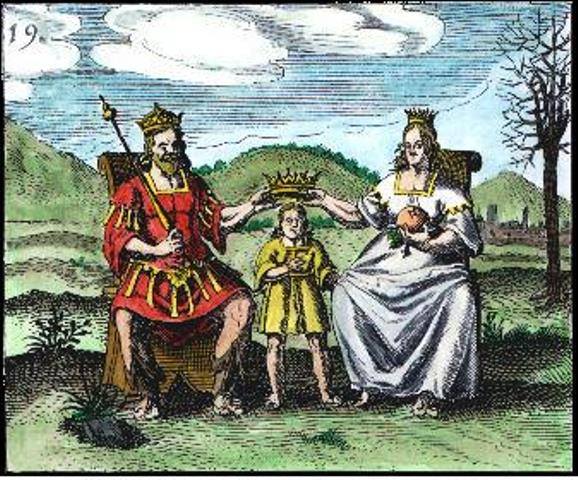
I used the term hierosgamos, which is a very usual term in comparative religion, and there is nothing esoteric about it. ~Carl Jung, Letters Vol. II, Pages 296-297.
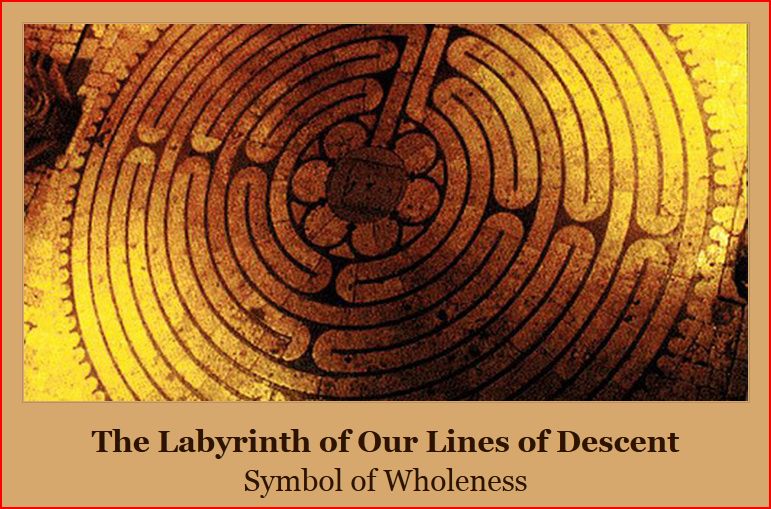
“Then turn to the dead, listen to
their lament
and accept them with love.” --C.G. Jung, The Red
Book, Chapter XV
One of the key themes
in ‘The
Lament for the Dead’
is the denial of death by contemporary, secular Western culture. Our ancestors
are not properly recognized and given their due weight – there is no real place
for the dead in our culture. Shamdasani says on p.176:
“The first task that Jung
finds himself confronted with
[as I think anyone engaged in this descent is] is reanimating the dead,
acknowledging that the dead are, and they have presences, they have effects. We turn
our eyes away from future-oriented living and to what has gone before, in the
shape of animated history, history that is not simply a record but history that
is active.”
Therefore, by denying
the dead we are denying ourselves.
Jung believed that the
foundations of personality are ancestral and universal. Because much of
genealogical best-practice includes mythic and fictional characters, the
process is best approached with a Jungian orientation, rather than as hard
historical fact, except where lines are clearly curated. In terms of collective
unconscious, genealogy has "as if" psychic reality.
Jungian and
post-Jungian practices allow us to interact with such material in a deeply
meaningful way that helps us integrate such knowledge and self-knowledge, that
enhances integration and individuation. Post-Jungians are committed to an
approach that does not focus exclusively on psychic reality but also takes into
account the realities of the outer world. Genealogy helps us adapt to both
external or internal realities. This practice raises into
conscious awareness what was formerly subconscious or unconscious -- the lives
of our direct ancestors.
Outside in the
courtyard, adjacent to the Tower, stand three stone tablets upon which, as Jung
tells it in MDR, "I chiseled the names of my
paternal ancestors." [3] The imaginal world of the ancestors, Jung's inner
fatherland, was a living presence in Jung's everyday experience. Ahnenerbe, "ancestral inheritance,"
is the ground of all subjective experience within every individual, according
to Jung. We find this idea at the epicenter of his worldview from a very early
age, in an alien part of his child-self that he called his "number two
personality" -- an elderly gentleman of the eighteenth century-allowing
him to imagine he was "living in two ages simultaneously, and being two
different persons." [4] He is an individual, yet a second heart beats in
his breast, a sacred heart that squeezes the lifeblood of the ancestors through
his veins.
"When I was
working on the stone tablets," Jung confided, "I became aware of the
fateful links between me and my ancestors .... It often seems as if there were
an impersonal karma within a family, which is passed from parents to children.
It has always seemed to me that I had to answer questions which fate had posed
to my forefathers, and which had not yet been answered, or as if I had to
complete, or perhaps continue, things which previous ages had left
unfinished." [5]
What questions did Jung's
paternal ancestors leave unanswered? What did Jung feel compelled to complete
or to continue? What was the family karma that bound Jung to a specific fate?
These questions already contain the seeds of their answers. What we must listen
for here are the assumptions behind the queries, the brand of reality that
would allow the possibility of such statements or questions in the first place.
It is an arcane reality that Jung was destined to keep alive for millions in
the twentieth century.
In a seminar he
gave in Zurich in 1925, Carl Jung expressed his belief in the idea of
"ancestor possession" -- that is, that certain hereditary units would
become activated under certain circumstances in one's life, allowing the spirit
of one's ancestor to then "take over" one's actions. Jung gave the
example of an "imaginary normal man" who, on the surface, never
indicated a capacity for leadership but in whom, when put in a position of
power, the "ancestral unit" of a leader somewhere in the family past
was awakened.
"I know no
answer to the question of whether the karma which I live is the outcome of my
past lives, or whether it is not rather the achievement of my ancestors, whose
heritage comes together in me," Jung confessed in MDR. "Am I a combination of the
lives of these ancestors and do I embody these lives again? Have I lived before
in the past as a specific personality, and did I progress so far in that life
that I am now able to seek a solution? I do not know."--Aryan Christ, Chapter 1
INTRODUCTION
SANGREAL:
IN A WHOLE NEW VEIN
ROOTS OF BEING
Genealogy of the Soul
Longing for the
Lost Other
Here is the book of
thy descent,
Here is the book of the Sangreal,
Here begin the
terrors,
Here begin the
miracles.
The History of the
Grail – 12th Century, Anonymous
"Everywhere the
virgin earth causes at least the unconscious of the conqueror to sink to the
level of its indigenous inhabitants. Thus, in the American, there is a
discrepancy between conscious and unconscious that is not found in the
European, a tension between an extremely high conscious level of culture and an
unconscious primitivity. This tension forms a psychic potential which endows
the American with an indomitable spirit of enterprise and an enviable
enthusiasm which we in Europe do not know. The very fact that we still have our
ancestral spirits, and that for us everything is steeped in history, keeps us
in contact with our unconscious, but we are so caught in this contact and held
so fast in the historical vice that the greatest catastrophes are needed in
order to wrench us loose and to change our political behavior from what it was
five hundred years ago. Our contact with the unconscious chains us to the earth
and makes it hard for us to move, and this is certainly no advantage when it
comes to progressiveness... . [...] Plurimi pertransibunt- but he who is
rooted in the soil endures. Alienation from the unconscious and from its
historical conditions spells rootlessness. That is the danger that lies in wait
for the conqueror of foreign lands, and for every individual who, through
one-sided allegiance to any kind of -ism, loses touch with the dark, maternal,
earthly ground of his being." -Jung, 'Mind and Earth', 1931
CHAIN
OF GENERATIONS
Infinite Regress
Only a Jungian
approach to traditional genealogy keeps the historic/mythic gestalt of The
World Tree alive as a symbol of wholeness -- a holistic resonant field pattern.
According to Jung, trees are a symbolic reference to the self, so family tree
is self-defining. As well as our lineage, our ancestors also form a vast symbol
chain.
The symbolic function
is beyond innate impulse and ideological bias. Through introversion, we are
fertilized, inspired, regenerated, and reborn. Self-incubation,
self-castigation, and introversion are closely related ideas. Immersion in
oneself (introversion) is a penetration into the unconscious, the imaginal
world of psyche.
The World Tree is the Axis Mundi of genealogy, a worldwide database
of genealogical connectivity. At this point travel and correspondence is made
between higher and lower realms. Communication from lower realms may ascend to
higher ones and blessings from higher realms may descend to lower ones and be
disseminated to all. The spot functions as the omphalos (navel), the world's point of
beginning.
The earliest
mythologies are of the World-Tree, or Tree of Life. Aspects of the same image,
sacred trees are the most common motif from the ancient world. The Tree
connects our psychophysical aspects from sub-nuclear to macrocosmic scales. The
trunk is the axis of psychic growth that unites Heaven and Earth, spirit and
matter.
The major branch
points on our shared paternal lineage trace back through genealogy, history,
antiquity, and ancient anthropology through myth to reach our early hominid
ancestors. The branches on the paternal tree are haplogroups. SNP markers on
the Y-Chromosome define them. Deep ancestry research depends on recognizing and
analyzing patterns in Y-STR marker values for discovering Y-SNPs.
The serpents of our
family lines are entwined like Celtic knots in and around the World Tree.
Celtic snakes symbolize the notion of rebirth. They still promise us primordial
Knowledge -- unverified personal gnosis. Jung said, "the serpent is
the earthly essence of man of which he is not conscious. Its character changes
according to peoples and lands, since it is the mystery that flows to him from
the nourishing earth-mother."
The healer traversing
the axis mundi to bring back knowledge from the other world is a common
shamanic concept. Anyone or anything suspended on the axis between heaven and
earth becomes a repository of potential knowledge. The Tree is the means of
communication with spiritual realms. It is our Tree of Voices -- Tree of
Souls. Remembering is a noble and necessary act. The call of memory, the call
to memory, reaches us from the very dawn of history.
On the global-level,
spiritual experiences have been shown to buffer against the negative effects of
stress on well-being for older adults. Spiritual experience potentially
moderates the deleterious impact of a given day’s perceived stress on that
day’s positive and negative affect. Thus, it relates to self-care, well
being, and healing. Sometimes physical pain is a substitute for psychic pain.
Healing is not always physical: it can occur in the emotional, mental and
spiritual life, moderating immunity and neurochemistry.
Genealogy contains a spiritual
healing potential, the living sap of the Tree, a manifestation of the sacred.
It is a Grail banquet of cultures, customs and symbolism. We see in many
manuscripts that wings are used to mark progress or advancement of an
alchemical solution toward perfection. Crowns mark the final stage of a spirit
or solution: perfection, completion, ascension. The spirit, by death or
enlightenment, will produce the pure, perfected, incorruptible spirit. In
alchemical terms, the incorruptible body is the potential of the philosopher's
stone
Some branches of the
World Tree are pruned (extinct). Others still thrive. Data entry is not fun,
but it makes information analysis and pattern recognition much easier.
By engaging in
genealogy we create a sacred space, a sacred center. There is a deep ecology to
the flow of relationships. Our return to the womb of the Mothers is a creative
regression. Experientially it manifests within us as a spiritualizing instinct,
a recursive "bending back" toward the primordial and divine.
We link backward to
the bond that transcends the limitations of the physical form. Consciousness
turns back on itself, reiterating each level of organization, de-structuring
each strata as it dives deeper toward the unconditioned, formless beginning, or
"unborn" state -- the Void of the Cosmic Womb. In essence, we
re-enter the womb as we are initiated in the mysteries of the psyche. We
re-conceive our primal self image, healed by communion with the creative Source
- - our own Royal Wedding.
Religious myths give us
the security and inner
strength not to be crushed by the monstrousness of the universe. "Belief
is no adequate substitute for inner experience, and where this is absent even a
strong faith which came miraculously as a gift of grace may depart equally
miraculously. People call faith the true religious experience, but they do not
stop to consider that actually it is a secondary phenomenon arising form the
fact that something happened to us in the first place which instilled pistis
into us — that is, trust and loyalty." --Carl Jung, The Undiscovered
Self," CW vol. 10, par. 521
In the Red Book, Jung said this is the way:
“An opus is needed, that one can
squander decades on, and do it out of necessity. I must catch up with a piece
of the Middle Ages-within myself. We have only finished the Middle Ages
of-others. I must begin early, in that period when the hermits died out.
Asceticism, inquisition, torture are close at hand and impose themselves. The
barbarian requires barbaric means of education. My I, you are a barbarian. I
want to live with you, therefore I will carry you through an utterly medieval
Hell, until you are capable of making living with you bearable. You should be
the vessel and womb of life, therefore I shall purify you.
The touchstone is being
alone with oneself."
Genealogy can be seen
as a way of honoring the ancestors with a ritual from ancient times when lists
of god-kings described the natural order of things. The only way to revision
and interact with it as a gestalt matrix includes the fictional, legendary, and
mythological lines of this traditional World Tree. It is but one way to
acknowledge our divinity, nobility, and humanity. Genealogy is a sure path to
the heart. We can "gather our ancestors" before we are gathered unto
them.
Mythology lost its
role of explaining the forces of nature. But its role of delivering insights
into the hidden, deep endeavors and fears of any human seems more alive than
ever. It is a Mystery how our ancestors pass memories to us across the generations.
They relate us to our ontological questions about space, time, and eternity,
the deep structure of the human mind and perception, life and death -- what
exists and what doesn't. Time concerns the existential nature of things --
temporal relationships.
The mythology of our
ancestors is as important as their cosmology. We can explore the mystic in
ourselves and in our ancestors. Our worldview is the root of our identity and
relationship to Nature and our own deep nature. Researching the cosmologies of
our direct ancestors in the historical era provides a quick path into dream
shamanism, as these ways are still half-remembered. Our common destiny lies
beyond any worldview.
"You could study the ancestors, but
without a deep feeling of communication with them it would be surface learning
and surface talking. Once you have gone into yourself and have learned very
deeply, appreciate it, and relate to it very well, everything will come very
easily."
(Ellen White, Nanaimo)
Psyche creates reality
every day. We have a mystical connection with our primitive ancestors. The
primordial ancestors are still alive within the depths of our psyches and reach
out to us with their ancient wisdom. We instinctively behave and feel the same
ways as generations of our ancestors have in their lives.
This is also a
relationship to the collectivity of the dead; for the unconscious corresponds
to the mythic land of the dead, the land of the ancestors. Jung was the first
to link the concept of ancestors to unconscious thinking. We learn to remember
what our soul already knows. Our personality is literally expressed through our
ancestors.
The gods and goddesses
have 'gone to seed', and we are that -- their seed, their progeny. As James
Hillman says, their minds and powers are living us in poetic moments of
fantasy, insight and intuition. Nature, psyche and life are unfolding divinity.
We are only cut off from the dead by what we have buried and forgotten. Working
with our ancestral connection means connecting to everything around us and how
we are placed in the world.
“Poetry leads us to
the unstructured sources of our beings, to the unknown, and returns us to our
rational, structured selves refreshed. Having once experienced the mystery,
plenitude, contradiction, and composure of a work of art, we afterward have a
built-in resistance to the slogans and propaganda of oversimplification that
have often contributed to the destruction of human life. Poetry is a verbal
means to a nonverbal source. It is a motion to no-motion, to the still point of
contemplation and deep realization.” ―A.R. Ammons
Jung said
transpersonal psychic life "is the mind of our ancient ancestors,
the way in which they thought and felt, the way in which they conceived of life
and the world, of gods and humans beings. The existence of these historical
layers is presumably the source of belief in reincarnation and in memories of
past lives” (Jung, 1939, p.24).
In 'Extending the
Family' (1985), Hillman says, "With the passing of time a sense of its
power grows within one's psyche, like the movements of its skeleton inside
one's flesh, which keeps one in servitude to patterns entombed in our closest
attitudes and habits. From this interior family we are never free. This service
keeps us bonded to the ancestors." Some report a sort of
"calling
illness" until they respond to the ancestors calling them to do the work.
Genealogy is the
science and art of what is emerging into the collective consciousness in one of
the biggest hobbies of our era. It is a vast reclamation and reconstruction of
our holographic connections, and certain emotionally toned experiences and
images inherited from our ancestors, our spiritual guides. We translate meaning
into life.
The entire gestalt of
the World Tree is an iconic image -- a multidimensional symbol requiring
hermeneutics as much as history for best practice. Genealogy has the problem of
only focusing on the ancestors with surviving records, not all your ancestors.
Of course, all the expansive aspects of the ancestors leave their shadow
traces. With the light comes darkness. Ancestral blessings are not
unaccompanied by ancestral curses.
The shadow is
transmitted in a million subtle gestures and intonations. As you become aware
of them in yourself, you can look back over your shoulder at your ancestors and
see where these patterns came from. The family shadow is not the sole answer,
but it's a place to do some work. It's a realm that is within our means to
influence. When we stop passing the shadow on to the next generation, we spare
them and break the chain. They don't pass it on either.
We can cut through the
Fog of Lore to the mythic core. Clan ancestors are more than euphemisms. They
may well be more than legends, being actual progenitors or composites of the
ancient lineage. Some myths may have developed after the destruction of
powerful lineages, displays of majesty, culture heroes, and ancestral temples.
Royal family ancestor cults probably drew on a number of ancestral lineages.
Lament of the Dead
Differences in
ancestral worldviews highlight the problem of synthesis. Conceptual and
symbolic frameworks arise in different periods of history. The classical vision
is not absent from the modern world; we can argue both transcendence and
immanence. Much depends on which century your soul inhabits, metaphorically.
The dead are given greater reality by the memory that the living keep alive of
them. But they are invoked to participate on important occasions such as
births, naming, and marriages.
Our deep polytheistic
background has been buried with the ancestors, along with their voices which we
can talk to and imagine in posthumous reality. When thinking stops, words slip
in. Within our subconscious mind is a history of our ancestors which includes
their experiences and emotions. Do the dead cry that they are misunderstood?
They are The Watchers. We are always being watched by the ancestral spirits. To
be cut off from relationships with one's ancestors is to cease being a whole
person. Unconsciously we still think like our distant ancestors.
The Quest for
Transcendence
Jung describes
Individuation as a process of transformation that incorporates the personal and
collective unconscious into consciousness (by means of dreams, active
imagination, or free association) to be assimilated into the whole personality.
This natural process facilitates the integration of the psyche. The
pursuit of self-knowledge is a pilgrimage to our deep center with its divine
inner spark or Light.
We seek to remember
what our soul has always known. When the psyche heals it produces mandala-type
images, balancing dark and light, male and female, yin and yang aspects of
nature. The genealogical image is more than a metaphor: you
are the center of multiple radiant lines of
descent, all of which converge in your unique manifestation.
It can be combined
with transpersonal techniques, including hypnotherapy, regressions, shamanic
healing, vison quest, mystic arts, seasonal celebrations, spirit journeying,
psychodrama, bodywork, trauma release, meditation, soul retrieval, kin contact,
and personal mythology. We consider using healing therapies on our ancestors in
special cases. Woolger's Deep Memory Process suggests you can use such
therapies to:
•
clearly recognize the core issues or complexes running your life
• journey in time to resolve childhood and other traumas
•
vividly relive and resolve emotional conflicts through a healing psychodrama
•
develop somatic awareness of deep memories to release them from your body
•
let go of old unwanted ancestral patterns and influences
• integrate wounded soul fragments (“past lives”)
•
clear your energy field of negative influences
• open up with love to higher spiritual resources within yourself
We have to find and
heal the Grail King within, reowning the projections and meaning we have
conveniently let others carry for us, for good and evil. In that process we may
glimpse and lose the Grail many times over. Genetic descent is amplified
creatively by a recursive psychological descent into the unconscious to
retrieve our lost soul and lost ancestors. It establishes an intergenerational
feedback loop.
Individuation has a
holistic healing effect on the person, both mentally and physically.
Individuation is a
self analysis, a self discovery, analyzing your own psyche. It serves as the
guide or goal of a quest—the Holy Grail, the Elixir of Immortality, the
Philosopher's Stone.
Like genealogy,
individuation is the story of you as the unique individual you are. Genealogy,
like a dragon's hoard, is a treasure hard to attain, yet priceless to the
person who holds it. This most collective situation becomes the most individual
experience because no two individuals incorporate it in exactly the same way.
We all search for
something. In genealogy we narrow that search for the Holy Grail and the
Precious Blood. In
this case, in genealogy the blood is precious because it is our own lifegiving
blood. Legend tells us the Blood and the Grail are united. In medieval literature the Grail is
often associated with a feast -- it is, indeed, a great feast of metaphors
attached to the primary icon.
Legend has it there is
a fellowship or underground Family of the Grail that furthers and protects its
interests in all worlds. The "underground stream" is yet another
symbol of the Grail. The
Grail appears in many forms, including radiant light and the sangreal of the
Holy Bloodline that flows from the Davidic line, including the Desposyni
descendants of the Holy Family, perhaps including offspring of Jesus and Mary
Magdalene -- or so they say.
Genealogies bring
revelations, which may belong to millions of descendants but feel extremely
important because they are part of our own personal heritage. It comes with
strong spiritual and mythic overtones from the elder god-kings, the royal
Davidic/Solomonic line, the family of Jesus, the Merovingians, Gnostics, Grail
Kings, Camelot, and crusading Templars. Internal conflict may arise when
loyalties are torn between opposing forces, each of which are ancestral lines.
In fact, the symbolic
treasure of genealogy is that it encodes the entire transformational process
from the war of opposites to the reconciling royal marriage. Genealogy show s
graphically just how intimately our very existence is through those who gave us
faces. This knowledge, more than a pedigree on paper, is the treasure hard to
attain that nourishes and sustains us in our intergenerational Being. This is,
in fact, The Grail, which serves the divine spark within.
Phillip Stephen Lansky
concludes, “Interestingly,
the “chymical wedding” of alchemy was a symbol for the simultaneous
constellation of psychic opposites, which we have already suggested concurs
with a state of physiological paradox. Might not the contents of the two
archetypal flasks represent two amines, serotonin and noradrenalin, being
poured simultaneously into a marriage bath in the hypothalamus?”
The Grail symbolizes
life, spirituality, youth, health, joy, purity, creativity, the unconscious,
and generativity [Jung and von Franz 1970, 114]. Spirituality means the
perception of transcendent meaning and participation in a higher purpose and
numinous experiences. It harmonizes the conflicting
opposites of male-female, rationality and emotion, dark and light, good and
evil, etc. [Jung and von Franz 1970, 194]. Wholeness requires a coniunctio
oppositorum (conjunction of opposites).
William Blake
describes it paradoxically: "Without Contraries is no progression.
Attraction and Repulsion, Reason and Energy, Love and Hate, are necessary to Human
existence. From these contraries spring what the religious call Good &
Evil. Good is the passive that obeys Reason. Evil is the active springing from
Energy. Good and evil is Heaven just as evil and good is Hell."
The conflict of
opposites in Parsifal's psyche needed to be discovered for him to get back into
the Grail Castle. He needs to expand his consciousness and travel,
psychologically speaking, far beyond the naive fool, to find the Grail Castle
and discover himself, to be conscious of and reconcile the opposites in his
psyche.
The Fisher King, or
the Grail King, represents a limited consciousness, one who is too rational and
is incapable of solving the real problem his kingdom faces [Jung and von Franz
1970, 212]. The successor who will free him was prophesied to be a wholly
innocent fool who would ask a specific question. "The myth is telling us
that it is the naive part of a man that will heal him and cure his Fisher King
wound. It suggests that if a man is to be cured he must find something in
himself about the same age and about the same mentality as he was when he was
wounded" [Johnson 1989, 11].
Jung himself
experienced this woundedness after his break with Freud that opened his deep
unconscious, flooding him with imagery that took a lifetime to assimilate and
analyze. He
speaks of his soul-loss and efforts to retrieve it in his visionary tome, The
Red Book, which has only recently been published, many years after his
death.
The Red Book illuminates all of his theories of
unconscious dynamics. As
in dreams, we are all of the characters in mythological tales, and their
stories hold deep meaning for us when they are activated by our own life
experiences. They
call us into the hero's adventure and one of their ways of doing so is the call
to trace our genealogical roots.
Jung and the Ancestors
The long-awaited
release in the 21st century of Jung's RED BOOK (2009) reveals just how much of a
role his ancestors and inner figures played in his own psychic life. They led
directly to the formation of many of his theories of psychic dynamics.
Historically, in
Western societies the focus of genealogy was on the kinship and descent of
rulers and nobles, often arguing or demonstrating the legitimacy of claims to
wealth and power. The term often overlapped with heraldry, in which the
ancestry of royalty was reflected in their coats of arms. Modern scholars
consider many claimed noble ancestries to be fabrications, such as the
Anglo-Saxon chronicles that traced the ancestry of several English kings to the
god Woden.
But Jung healed and
transformed his own fragmentation by taking up imaginal relationships with his
inner figures. He developed what might be called a Dialogical Gnosis -- a Way
of Knowing informed by the wisdom of the Collective Unconscious, the plenum of
inherent knowledge and experience.
Jung was engaged in
the process of individuation -- cognitive, empathic engagement with the living
and discarnate.Engagement implies committment, rather than participation, per
se. Respect for the freedom of others and the intention toallow their
personhood expression is a basic tenet of engagement
One does not choose
the path of individuation, but rather is chosen by it. Individuation seems to
be the innate urge of life to realize itself consciously. The transpersonal
life energy, in the process of self-unfolding, uses human consciousness, a
product of itself, as an instrument for its own self-realization.
New discoveries must
not only be made, but assimilated with concurrent experience and meaningful
psychological insight. The individual meaningfulness of an experience is
what creates unique personality. The instinctive feeling of significance
is expanded by rooting experiences in their mythical patterns.
If the ego can
withstand the irrational temptations, ordeals, and peril at the hands of the
unknown, it is eventually rewarded with an expanded experience of self and a
rejuvenation, or rebirth. In his essay on the "Relationship between the
Ego and the Unconscious," Jung has stated that,
It is impossible to
achieve individuation by conscious intention, because conscious intention
invariably leads to a typical attitude that excludes whatever does not fit in
with it. This assimilation of the unconscious contents leads, on the
contrary to a condition in which the conscious intention is excluded and
supplanted by a process of development that seems irrational. This process
alone signifies individuation, and its product is individuality as we have
defined it; particular and universal at once....Only when the unconscious
is assimilated does the individuality emerge more clearly, together with the
psychological phenomenon which links the ego with the non-ego and is designated
by the word attitude.
But this time it is
no longer a typical attitude but an individual one.
What the conscious ego
can do in regard to individuation is make the commitment to work in harmony
with the unfolding subconscious process, to give it constant attention, and to
place proper value on the experience. This creates a resonance, the
experience of "being in harmony with the cosmos", reflecting the
Hermetic Axiom, "As Above, So Below."
The Rose in mysticism
and Hermetic Philosophies is a profound symbol of consciousness and the soul
personality. It symbolizes consciousness projected into the material form.
Consciousness is symbolized in a very apt and beautiful way as a
flowering process and an unfolding manifestation. This flowering , blooming and
unfolding of its petals in a perfect
mandalic symmetry,
represents man's divine inner consciousness being revealed as layers of his
being open up to reveal its ever becoming center, the Inner Self. To the
Rosicrucians the symbol of the Rosy Cross is sacred. The Rose crucified on the
cross is the symbol of the true divinity of humanity. The cross represents the
four cardinal points of being in a
balanced state. The
crossing of the vertical and the horizontal lines represent the conjunction of
the opposites. The vertical, being the positive and active, conjuncts the
horizontal, the negative and passive. It is at this conjunction point,
representing balance nd harmony, that the rose flowers and unfolds itself. The
cross also represents the body of man with
outstretched arms as
his whole earthly plane and his heart being again at a conjunction between the
superiors and inferiors, head or heaven, feet or earth, and also between left
and right as opposition between the forces of light and darkness, life and
death .
To the initiates this
symbol of divine consciousness crucified or infused upon and in his physical
body is a most profound and sacred mystery of the incarnation of the soul.
A beautiful Hermetic
saying of the Rosicrucians is,
"Ad Rosam per
crucem, ad crucem per Rosam."
-Steve Kalec
More and legends and
myths of the rose:
http://www.whitedragon.org.uk/articles/rose.htm
ROSA MUNDI
http://www.clanoftubalcain.org.uk/rosamundi.html
"Take the
fayer Roses, white and red / And joyne them well in won bed. /
So betwixt these Roses
mylde / Thou shalt bring forth a Gloriuse chylde."
(Joseph Campbell, The
Mythic Image, Bollingen C, Princeton University Press, 1974, p. 254)
Cult of the Archetypal
Feminine
The Mother of us all
is also the Earth, as the light of the divine womb (primal source) and the
mystery of divine light that informs and transforms into matter. The Sangreal
is a cult of bloodline. Many who are of it are unaware or unawakened to that
genealogical and gnostic awareness.
Many who think
they are 'awake' are merely enthralled with the fugue state or eruption
of symbolic material which is actually a form of dissociation. Dissociative disorders are typically
experienced as startling, autonomous intrusions into the person's usual ways of
responding or functioning. Due to their unexpected and largely inexplicable
nature, they tend to be quite unsettling. Jung theorized that theorized that
dissociation is a natural necessity for consciousness to operate in one faculty
unhampered by the demands of its opposite.
Much of the magic and
mystery enters our lines through our grandmothers, from the distaff side of our
physical inheritance. It is carried in the mitochondrial DNA, inherited only
from the mother on the x chromosome. It is very persistent through generations
in both men and women, which helps us determine the relationship of
populations.
About 360 years, or
just short of 15 generations mtDNA peters out. At 15 generations, an individual
living today would carry only three thousands of 1% (00.003052%) of the DNA of
an ancestor who was “pure” anything 15 generations ago. So even if one ancestor
was indeed Mediterranean or whatever 15 generations ago, unless they
continuously intermarried within a pure Mediterranean population, the amount would
drop by 50% with each generation to the miniscule amount that would be found in
today’s current generation. With today’s technology, this is simply untraceable
in autosomal DNA.
The fact that
mitochondrial DNA is maternally inherited enables genealogical researchers to
trace maternal lineage far back in time. The concept of the Mitochondrial Eve
is based on the same type of analysis, attempting to discover the origin of
humanity by tracking the lineage back in time.
In the medieval era, a
cult of the Feminine arose with a persistent theme of gender reunion in the
Great Rite of the ancient bloodline, mystical eroticism known as the Mysterium
Coniunctionis or Royal Marriage, in the underground Church of Love. Jung
wrote a large book with that title describing "the separation and
synthesis of psychic opposites in alchemy".
The opposites to be
reconciled were Venus and Mars. It's about healing sexual woundedness, the pathless
Wasteland of male-female relationships (literal and psychic), with a mystical
inner marriage.
Like Isis and Horus, when the Madonna holds the infant Jesus, he represents the
Future, and he continues to do so as the future is always coming.
The Sacred Heart and
Mary Magdalene are twin symbols of the Grail. She has been used to symbolize
the hidden teachings of Jesus. The cult of Mary Magdalene and the Cult of the
Black Virgin survive in many forms to this day. The meeting of the sun-god and
the earth-mother brings forth the miracle of birth, death, and rebirth from her
dark creative womb. The god comes through the goddess.
We find that balance
in Individuation, after facing the Shadow and connecting with inner wisdom.
Through his relationship with the feminine a man gains access to his own soul,
to the deeper layers of his "heart". His sensitive quest for his
"queen" makes him wiser, more sensitive, more scrupulous as a person.
AMOR is a spiritual development. The courage to persist is the hallmark of
loyalty.
The Rosy Cross is a
symbol of the human process of reproduction elevated to the spiritual: The
fundamental symbols are the female rose and the male cross. As generation is
the key to material existence, those symbols exemplify the reproductive
processes. As regeneration is the key to spiritual existence, the symbolism of
the rose and the cross typifies redemption through the union of our lower
temporal nature with our higher eternal nature.
The Rosy Cross is
equivalent to the Philosopher's Stone or Holy Grail, and refined Gold.
All represent the
Grail of Self-Realization. As an image The Grail was a symbol
of not just spiritual transcendence but also the Divine Immanence in creation.
In Jewish mysticism, every woman is an earthly embodiment of the celestial Shekinah.
The Grail Temple is the body, our sacred vessel. We need to learn again that the
family is a being, a goddess.
There are many icons
of Mary that show black faces and hands. In France, these are called Vierge Noires—Black Virgins. Elsewhere, they may
be called Black Madonnas or the "other Mary." Jung called her Isis,
while others claim she is the symbolic remains of a prehistoric worship of the
Earth Mother. She is generally connected with Cybele, Diana, Isis, and Venus,
as well as with Kali, Inanna, and Lilith. Historically she is connected with
the Crusades, the Islamic occupation of Spain, the Conquistadors, the Kabbala,
as well as the Merovingians and Knights Templar, who viewed her as Mary
Magdalene.
Courtly Love (courtezia)
and Troubadours were institutions that compensated the misogyny of medieval
times. The
contemplation of beauty in its feminine incarnation opens the Middle Way
between debauchery and self-abnegation. Transcendent beauty is reflected in a
beautiful face or body. Contact
with the beautiful is a sacrament. The culture of l'amour courtois flourished
in Anjou and the Languedoc. The House of Anjou remains the senior Grail family.
The Crusades, the
so-called 'holy war', filled the need for collective Shadow projection. In this
scenario, Venus and the cult of the Feminine played counterpoint to the Martian
cult of warrior-knighthood, with its chivalric code of honor. This Quest for a
lost sacred object, the Holy Grail, appears out of a deep and urgent need to
counteract the brutality of the rapacious crusading, murderous military
oppression. AMOR
was a gnostic and esoteric doctrine of the divinity of the Mother and the
higher meaning of the chivalric quest.
The persecuted became
persecutors in a collective defensive strategy known as identification with the
aggressor and the splitting-off of the victim. Whether personal or collective
the consequence is the same. A need arises to find and project the shadow onto
an external victim who opposes the newly found power of the aggressor.
The real problem was
and remains how to reconcile the two warring extremes of human nature:
spirituality and sexuality. Men met the challenge by becoming more rigid and
investing women and the Grail with the powers of generation and regeneration.
The historical origin
for the collective resurgence of the sacred feminine is most likely derived
from ancient cults of the Great Goddess—the mysteries of Isis, of Diana of
Ephesus or Cybele, and especially the Sophia of the Gnostics. They were carried
to Europe through the artistic contacts of troubadours who had been to the East.
Above all, the Cathars
revered a version of Isis-Sophia and ordained women as priestesses equally with
men. However, their Gnosticism also vilified the flesh and therefore all
matter. Their archetypes, The Archons, were likewise demonized, being stunted
by duality.
The Gnosticism of
the second-century sects involves a coherent series of characteristics that can
be summarized in the idea of a divine spark in man, deriving from the divine
realm, fallen into this world of fate, birth, and death, and needing to be
awakened by the divine counterpart of the self in order to be finally
reintegrated (into the divine realm). (Filoramo, 1990, p. 143)
It is likely that the
troubadour aubades or songs to the lady in spring ultimately derive from
remnants of the old cults of Demeter, the Mother Goddess and her daughter
Persephone. The Greeks brought this worship to Provence when they colonized
Marseille and the south of Gaul in early times.
In the ancient
Basilica of St. Victor in Marseille, on the 2nd of February each year
thousand of candles are lit to attend the raising of the famous Black
Madonna from the infernal darkness of the crypt up into the upper air.
Persephone returned to the upper world every spring in Greek times, with masses
of torches, to re-unite with her mother Demeter.
So in many of the
noble courts of the South of France in the 11th-12th centuries there is a kind
of revival of the pagan substrate that has been buried, but not entirely, by
Christianity. What re-emerges is Christianity’s pagan shadow, to use Jung’s
terms. What we see is the upsurge from the unconscious of the repressed pagan
archetypal energies of the Dionysian-Venusian. Ecstatic use of art, music, and
the body led to communion with the godhead within the body. (Woolger) http://www.deepmemoryprocess.com/page33.html
The Fisher King is the
wounded father principle, the weakened, unproductive and spiritually desolate
father-world of medieval times. The waters of life have dried up both within
and without laving a damaged consciousness, cut off from Mother Earth.
Jung said that today
"the Gods have become diseases," and Post-Traumatic Stress Syndrome
(PTSD) describes not only the psychological victims of war and brutality but
says something about our own "hostage" culture. It is a kind of stuckness where the trauma
seems to be continuously recurring, a torturous victimization without relief.
The war comes home in chaos, flashbacks, dark futures, and suicidal impulses.
We can imagine that the old warrior-knights were not immune from such human
frailties. http://ptsdpolitics.iwarp.com/
“Peace for veterans
is not an ‘absence of war’ but its living ghost in the bedroom, at the lunch
counter, on the highway. The trauma is not ‘post’ but acutely present, and the
‘syndrome’ is not in the veteran but in the dictionary, in the amnesiac’s idea
of peace that colludes with an unlivable life.” “The return from the killing
fields is more than a debriefing; it is a slow ascent from hell. …The veteran
needs a rite de sortie that belongs to every initiation as its normal conclusion,
making possible an intact return.” (James Hillman)
In contrast, the
passion of the troubadours was earthy, bodily and sensual no matter how
sentimentalists would later portray it. Dali quipped, "The first man to
compare the cheeks of a young woman to a rose was obviously a poet; the first
to repeat it was possibly an idiot." There is no longer any excuse to see
the ladies of the troubadours through rose-tinted spectacles of the early
Romantic poets and the Pre-Raphaelite painters, as purely ethereal disembodied
“spiritual” anima figures.
The troubadours
celebrated the incarnation of the feminine every bit as much as its
spiritualization. Some say fins amor, or pure love of a woman as a form
of spiritual initiation through a forbidden but transcendent love affair, was
practiced not for procreation but contemplation.
http://www.deepmemoryprocess.com/page209.html
Woolger, Roger, The Holy Grail: Healing the Sexual Wound in the Western Psyche
(1983/2010)
Rose Line Descent
The Da Vinci Code made much of the so-called Roseline
marking sacred sites in the European landscape. But the real Rose Lines are
revealed in the royal genealogies with which it is interwoven. The Grail is the source of life, of
generativity, of the primordial Eros. The Grail belongs to all that is soft,
yielding, yin, of the body, of the earth, of the Mother: full, rich,
gentle, and infinitely abundant.
Certain images, such
as the Garden of the Rose, the Fountain, the Loathly Bride, the Damsel in
distress, and above all the Holy Grail recur in all kinds of variations. The
symbol of the Rose, for example, finds its way from the Sufis to the Roman de
la Rose, to Dante's Paradiso, to the windows of Chartres Cathedral,
and eventually to the mystical Brotherhood of the Rosicrucians.
The underground
tradition of alchemy and esoteric arts kept the spiritual Mysteries and Great
Goddess discipline alive in the Underground Stream.
Great Rite
1180 and 1230
AD. This is the same prolific and fertile time period that saw the peak of the
great cathedral building era; the rise to power of the Templar Knights; the
rise and fall of Catharism in southern France; the formation of Kabbalistic and
mystical schools in Spain. The Grail symbol first emerges in history in a
series of remarkable writings that appear in France over a span of about half a
century between the years 1180 and 1230 AD. This is the same prolific and
fertile time period that saw the peak of the great cathedral building era; the
rise to power of the Templar Knights; the rise and fall of Catharism in
southern France; the formation of Kabbalistic and mystical schools in Spain in
which Jews, Christians and Muslims all participated in relative harmony; the
emergence of the Troubadours as channels for the diffusion and circulation of
sacred knowledge; the rise of Sufism and the transmission of Hermetic knowledge
to Europe via Islamic scholars and mystics.
Self-Reflection:
Mental activity
that concentrates on a particular content of consciousness, an instinct
encompassing religion and the search for meaning.
Ordinarily we do not think
of "reflection" as ever having been instinctive, but associate it
with a conscious state of mind. Reflexio means "bending back" and,
used psychologically, would denote the fact that the reflex which carries the
stimulus over into its instinctive discharge is interfered with by
psychization. . . . Thus in place of the compulsive act there appears a certain
degree of freedom, and in place of predictability a relative unpredictability
as to the effect of the impulse.["Psychological Factors in Human Behaviour,"
CW 8, par. 241.]
In Jung’s view, the
richness of the human psyche and its essential character are determined by the
reflective instinct.
Reflection is the
cultural instinct par excellence, and its strength is shown in the power of
culture to maintain itself in the face of untamed nature.[Ibid., par. 243.]
Self-reflection, or –
what comes to the same thing – the urge to individuation, gathers together what
is scattered and multifarious and exalts it to the original of the One, the
Primordial Man.
In this way our existence
as separate beings, our former ego nature, is abolished, the circle of
consciousness is widened, and because the paradoxes have been made conscious,
the sources of conflict are dried up. ~Carl Jung; Collected Works 11;
Transformation Symbolism in the Mass; par. 401
To concern ourselves with
dreams is a way of reflecting on ourselves-a way of self-reflection. It is not
our ego-consciousness reflecting on itself; rather, it turns its attention to
the objective actuality of the dream as a communication or message from the
unconscious, unitary soul of humanity. It reflects not on the ego but on the
self; it recollects that strange self, alien to the ego, which was ours from
the beginning, the trunk from which the ego grew. It is alien to us because we
have estranged ourselves from it through the aberrations of the conscious mind. ~"The Meaning of Psychology
for Modern Man" (1933). In CW 10: Civilization in Transition. pg. 318
If we do not fashion for
ourselves a picture of the world, we do not see ourselves either, who are the
faithful reflections of that world. Only when mirrored in our picture of the
world can we see ourselves in the round? Only in our creative acts do we step
forth into the light and see ourselves whole and complete. Never shall we put
any face on the world other than our own, and we have to do this precisely in
order to find ourselves. For higher than science or art as an end in itself
stands man, the creator of his instruments. ~"Analytical Psychology and
Weltanschauung"
(1928). CW 8: Structure and Dynamics of the Psyche. P.737
Chapter
1
On February 29, 1919,
Jung wrote a letter to Joan Corrie and commented on the
Seven Sermons of the
Dead, with particular reference to the last one:
"The
primordial creator of the world, the blind creative libido, becomes transformed
in man through individuation & out of this process, which is like
pregnancy, arises a divine child, a reborn God, no more (longer) dispersed into
the millions of creatures, but being one & this individual, and at the same
time all individuals, the same in you as in me.
Dr. L[ong] has a
little book: VII sermones ad mortuous. There you find the description of the
Creator dispersed into his creatures, & in the last sermon you find the
beginning of individuation, out of which, the divine child arises ... The child
is a new God, actually born in many individuals, but they don't know it. He is
a spiritual God. A
spirit in many people, yet one and the same everywhere. Keep to your time and
you will experience His qualities" (Copied in Constance Long's diary,
Countway Library of
Medicine, pp. 21-22)
~The Red Book, Footnote 123.
Birth is an act of
physical and psychological separation – the first decisive and abrupt,the
latter more gradual. We learn to think of ourselves as discrete, separate
individuals. We have our bodies, distinct from other bodies, with its boundary
of skin,and a separate and unique mind, also separated from other minds, with
which we think our own private thoughts and hold internal conversations.
Neuroscience is beginning to track the location of some of these thoughts
in the brain, and to help those without speech to turn images, ideas and
preverbal signals into language. If we are spiritually minded we may also
envisage a unique individual soul or spirit. The soul may be conceived of as
pre-existent and capable of surviving the death of the physical body. It
may retain some aspects of its individuality outside the physical realm, and
even carry experiences and characteristics through successive incarnations.This
unique, separate experience of embodied human existence constitutes the Self.
We may be in relation to other selves, share many of their genes, and be
mutually interdependent, but even in the case of identical twins, each Self is
bounded and grounded in an individual body, mind and spirit. The sensation of
not being so grounded and separate is commonly treated in Western medical terms
as a pathology...
--Fiona Bowie
Approaches to
Genealogy
Your own BOOK OF THE DEAD is written in your DNA. Deciphering
its inherent meaning is a Quest for the Grail and the journey of psychological
transformation. We instinctively engage in semi-conscious conversations with
these ephemeral figures from our past that feed our conceptions of the
ineffable and our own extended self.
We find, perhaps to
our surprise, that upon reflection they inform us with a hitherto unknown
wisdom or perplex us with unsolvable riddles. The intangible world interacts
with the tangible one through their effects on us. Ancestral spirits have
their own histories, motivations, and social interactions and are traditionally
viewed as agents in a rich network of social trajectories, not symbols.
A pedigree is a
symbolic hologram of our intertwined histories and structure -- interacting
waves upon waves of generations in the ocean of humanity. Because the ancestors
number literally in the thousands, we come to understand the transformation is
within the unfolding therapeutic practice, rather than contained only in each
of the historical or fictional figures.
Genealogical research
is a complex process that uses historical records and sometimes genetic
analysis to demonstrate kinship. Reliable conclusions are based on the quality
of sources, ideally original records, the information within those sources.
Ideally evidence is drawn, directly or indirectly from primary or firsthand
information.
Genealogy forces you to
move through history in steps of 20-30 years, generation after generation,
filling in every step. Whereas history often compresses or
"telescopes" time, so that two hundred years in the medieval period
is covered in far less space than two hundred years in the modern period. We
know very well that we need a lot of generations to get from 1720 to 1950.
Genealogy reminds us that we need exactly the same number of generations to get
from 1220 to 1450. It forces us to pick our way step by step through those long
unchanging medieval years.
http://humphrysfamilytree.com/meaning.html
In many instances,
genealogists must skillfully assemble indirect or circumstantial evidence to
build a case for identity and kinship. All evidence and conclusions, together
with the documentation that supports them, is then assembled to create a
cohesive genealogy or family history. Overall patterns contains meaning.
Genealogist Mark
Humphreys says,
"Your ancestors were the same mix of bullies, fools, bigots, incompetents,
cowards, and occasional smart and admirable people that always make up society.
You exist because of many people who you would despise if you met them.
Genealogy is about finding
out who they were,
it should have no interest in whether they were admirable or not.
Indeed, it's more fun when
they murder each other, marry descendants of their ancestors' bitter enemies,
conceive your ancestor as a result of sordid and regretted affairs, die before
their child is born, and so on. It makes us realize how precarious our
existence is, and how messy and unlikely our genetic inheritance. Anyone who
believes they belong to one race, or that their ancestors were fine people,
hasn't done enough genealogy.
This is especially
true when applied to the nobility and royalty, who are often the only ancestors
you are left with in the more distant past. Why should you admire some noble,
or take their side, just because you descend from them? The nobility of the
past were often no more than the most successful robbers, stealing other
people's land, and living off other people's work. They weren't Appointed By
God, but were the survivors of a long process of selection among the most
aggressive and best-organized Strong Men, aided by the greatest thieves of them
all, the Royal family.
No, the desire for a
Royal Descent is quite different. It's because most of us exist in little
islands of peasants and farmers, interconnected to each other but to no one
else, and for all we know we would still exist no matter what had happened in mainstream history in the big world outside.
And the only way to break
out of this island is to find a connection to one of these Strong Men, after
which things explode and history becomes full of events on which our existence
provably depends. The peer, the heiress, the gent, the precious link to the
World Family Tree, is your goal, but to expect to actually like him or her, or be proud of them, is
to rather miss the point." http://humphrysfamilytree.com/meaning.html
Genealogists begin
their research by collecting family documents and stories. This creates a
foundation for documentary research, which involves examining and evaluating
historical records for evidence about ancestors and other relatives, their
kinship ties, and the events that occurred in their lives. As a rule,
genealogists begin with the present and work backward in time.
- Rational
- Spiritual
- Psychological
- Psychic
- Legendary
- Mythological
- Irrational
- Delusional
Some approaches are overtly
Christian, or they may have religious overtones even for a non-religious
person. Others will come to the subject with a pagan background or an affinity
for the ancient ways. Paradoxically, we find ancestors listed from other ethnicities
and religions.
The Prophet Mohammad
often appears in Western royal lines, as do the emperors of the Han Dynasty,
Attila the Hun, Turks, Khazars, and Xiongnu shamans of Siberia. We share roots
with the Basque, Moors, Turks, Pashtun, and sub-Saharan Africa. A balanced
approach to the heritage will not obsess on particular areas of the lineage to
the exclusion of others, nor veer off into cos-play like fantasies of legendary
beings. Genealogy shows your multi-ethnic heritage as well as a range of spiritual
beliefs.
'Messianic complex'
describes the phenomenon where individuals claim self-awareness of their
proclaimed role as a 'savior'. Like those who claim to be Jesus, non-religious
"Magdalene addicts" are prone to channeling her, or even claiming to
be her. But most of these channelings are highly idealized and full of truisms.
The phenomenon is a
complicated psychological problematic developed within a cultural group. In
Jungian psychology a complex is a cluster of psychological energy that centers
around a particular element that has developed partly through the disposition
of a personality and partly through life experience (Jacobi). These energy
clusters act as partial personalities within the psyche and are often
unconscious and somewhat autonomous.
They don't reflect the
deeply Gnostic belief in the evil of matter, the drive to perfection, or the
demonic dominion of the Archons. Or, if they do embrace such ideas, they likely
heard it on some internet show from a highly idiosyncratic speaker, invariably
trying to sell his or her book. Somehow they all have a theory. But no
one has made good on such claims yet.
They may be the
victims of misguided inner authority. We can pick up misconceptions and
self-delusions in the search for the soul. The faddish appearance of such
identifications (a lived trance-state) is a social trend, and the meme-like
nature of the Feminine proclamations reveal that this is a collective
phenomena, not true individuation. It shows the collective influence of pop culture
and the archetype on the psyche, no matter what you call "Her".
A relationship with
the archetype can be primitive or sophisticated. James Hillman expands the
concept of complex by adding a concept called personification to individual
complexes, treating complexes as characters or entities within the psyche, with
the proviso that it is not meant to be literal.
Jung’s complexes and
James Hillman’s concept of personification permit the unconscious images to
converse with the individual psyche in 'imaginal dialogue'. They manage to
incorporate feelings, imagination, and metaphor, which other sciences reject.
Imagination can alter our actual perceptions.
Sociological
identification, including intense physical reactions, and relationships between
the body and the psyche, can be independent of linear historical inheritance in
a culture that is a product of ideas rather than location or blood inheritance
and also experimental. Emergent imaginal content is metaphor for thinking about
experience, including experiences tied to intense belief structures.
When you don't know
what a symbol is, it appears split-off, as 'other'. It attempts to enter
consciousness in the expressive arts. Collectively, spiritual conflict is
worldview warfare -- irreconcilable differences in belief, including the
structure of the Cosmos. But only creative emotional and cognitive
comprehension of the inherent meaning of experience leads to individuation and
self-realization -- the Grail.
Jung spoke of such
creativity:
"The creative process
has feminine quality, and the creative work arises from unconscious depths--we
might say, from the realm of the mothers. Whenever the creative force
predominates, human life is ruled and molded by the unconscious as against the
active will, and the conscious ego is swept along on a subterranean current,
being nothing more than a helpless observer of events.
The work in process
becomes the poet's fate and determines his psychic development. It is not
Goethe who creates Faust, but Faust which creates Goethe....The archetypal
image of the wise man, the savior or redeemer, lies buried and dormant in man's
unconscious since the dawn of culture; it is awakened whenever the times are
out of joint and a human society is committed to a serious error.
When people go astray they
feel the need of a guide or teacher or even of the physician. These primordial
images are numerous, but do not appear in the dreams of individuals or in works
of art until they are called into being by the waywardness of the general outlook.
When conscious life is
characterized by one-sidedness and by a false attitude, then they are
activated--one might say, 'instinctively'--and come to light in the dreams of
individuals and the visions of artists and seers, thus restoring the psychic
equilibrium of the epoch."
(Jung, Modern Man in Search of a Soul).
"Every
creative person is a duality or a synthesis of contradictory aptitudes. On the
one side he is a human being with a personal life, while on the other side he
is an impersonal, creative process...The artist is not a person endowed with
free will who seeks his own ends, but one who allows art to realize its
purposes through him. As a human being he may have moods and a will and
personal aims, but as an artist he is 'man' in a higher sense--he is
'collective man'--one who carries and shapes the unconscious, psychic life of
mankind. To perform this difficult office it is sometimes necessary for him to
sacrifice happiness and everything that makes life worth living for the
ordinary human being."
Worldview
Emotionally appealing
truths are sandwiched into idiosyncratic notions ranging from the speculative
to the fantastical, and trap many individuals like flypaper, because our minds
love a good story. The brain feeds on stories, but the wrong stories just lead
us down the garden path into ancient worlds that never happened, and mythic
scenarios that were never meant to be taken literally. Accepting such beliefs
uncritically is precisely the opposite of what Jung recommended as individuation.
Such false beliefs
tend to cluster around an individual's personal issues and complexes, but are
mistaken for and confounded with historical, philosophical and scientific
'reality'. Much of the "self-delusion" can be linked to exposure to
memes functioning as emotional strange attractors or cultural artifacts or
fallout,, as well as pre- and pseudo-scientific notions of by-gone centuries,
and lack of understanding of standards and discernment.
The self-narrative may
not match the reality. It's a truism that mediocrity (gaps and gaffs in
awareness) boasts the loudest. Through hysteria, lack of critical judgment, and
naive enthusiasm, a false idea can be hyped by the mainstream media to the
point of not only looking entirely plausible, but even certain.
A world view is a set
of presuppositions (or assumptions) which we hold (consciously or
subconsciously) about the basic makeup of our world. Everyone has a world view,
whether he can explain it or not. It can be likened to a pair of glasses
through which one views the world. It is important to have the right
prescription, or reality will be distorted. Modem man is faced with a
supermarket of world views; all of them claim to represent reality, but they
are points of view about reality -- mental constructs, beliefs.
To construct our own
worldview we are still confronted with the old formula - the cosmological
creative and destructive cycles of time. Cosmology is the study of the origin
and nature of the universe. Ontology studies the nature of being as
being and existence. We have to fit the pieces together from
epistemologies and psychodynamics into some sort of cumulative understanding.
Some basic epistemological agreement about the phenomena under examination is
needed. Metaphysics abstracts universal conceptions. Some of these grand
narratives are more fanciful than others.
We can be sincerely
convinced of the utterly wrong. Why do we continue to accommodate the
irrelevant and easily falsifiable? Are we conscientious about our own
self-delusions or simply unconsciously immersed in them due to a delusional
perspective on our own misguided "gnosis" and obsessions with
misguided theoretical perspectives? Even conscience is no ineffable guide to
inner authority. There is no shortage of new myths to capture our attention.
Dreams tell us who we are, collectively and individually.
If Inner Authority is
linked to authentic power and wisdom, we need to examine our personal
interaction with inner wisdom figures (archetypes) and values in order to
create lives of positive action that arise from deep inner wisdom. Most of us
shirk such important inner work, substituting a fantasy of transformation and
mindfulness. Delusional self-improvement projects are aimed at adorning the
ego.
People claim to hear
messages that ring in their hearts as truth, or 'resonate' with material that
confirms their own tacit or recognized beliefs, but most it originates in
cultural conditioning and memetic patterning. All we hold is a piece of the
Mystery. Buzzwords such as True Nature, intentionality, and mis-identified
integrity compound the situation. Premature spiritual fixation can just as
readily be a form of transcendental escapism.
Both the strategies of
"transcendence" and "reduction" are expressions of bad
faith — i.e., forms of self-deception and escapism that seek to deny the
realities of the human existential situation. Self-delusion may be self-evident
but few give themselves a reality check on it and doing so is compounded by our
own psychological blindspots. This is a form of escapism or neo-mythology.
The depth
psychological approach is about psyche, which brings with it a sense of the
sacred. It is a way of incorporation that assimilates what has been considered
the "Not-I" into the core of being. It is informed by the Hero's
Journey and many of the iconic tropes of the royal genealogical lines.
Archetypal psychology has experience dealing with parental images and ego
development, as well as life passages that might intertwine with genealogical
interest and the predictable crises such as childbearing, mid-life, aging and
confronting mortality.
Jungians claim that,
"A psychologically-oriented approach to spirituality and a new God-image
are emerging alongside the Judeo-Christian tradition. This form of spirituality
expresses itself from the depths of the psyche, and stresses personal
experience rather than belief or sacred texts. Depth psychology gives us a
contemporary way to express this evolving step in the history of religious
consciousness. Sometimes a new language enables things to be said that have yet
to be articulated, and depth psychology is providing this voice."
Traditional ideas
about God and religion do not always express the individual’s personal
spirituality, because one may experience the sacred in ways that are not fully
articulated in the traditional teachings. For people who are committed to a
traditional religious practice, depth psychology can deepen their relationship
to the tradition and their understanding of its archetypal underpinning.
(Corbett)
Surviving
in the Wilderness
The Grail Quest took
place in the vast Wasteland of the alienated soul.
In his book Deep
Survival, Laurence Gonzales describes what it’s like to be lost in a
wilderness, and how to survive the experience. Here are the stages he
identifies in his description of the process:
1.
You’re lost, but persist in thinking that everything will work out just fine if
you continue along the same path.
2.
You realize you’re lost, but you don’t have a clue what to do, so you continue
on the wrong path, hoping against hope that home will be just over the next
hill—even though somewhere within you, you know it’s not.
3.
The knowledge that you are finally, irredeemably and undeniably lost causes
makes you to panic—you run desperately through scrub and trees, burning
yourself up, getting even more lost.
4.
Exhausted by panic, you stop. You realize that wherever you are, you’re
somewhere. You sit down where you are and take stock, making wherever you are
your temporary home. What you do here is the key to whether or not you survive.
5.
You rest, and take stock of the resources you have, and the information the
landscape offers. With this, you begin to make a plan for the continuation of
your life.
http://sangreality.weebly.com/index.html
Steven DaLuz,
"Descent", Neo-Luminist Painting
http://stevendaluz.com/GalleryMain.asp?GalleryID=2310&AKey=8MKJWHEB
The House of Our Flesh
Each generation has
added to the historical account of our progenitors. The story drifts back into
the mythos of pre-history -- the neolithic era of the Goddess, legends of
Atlantis and other lost civilizations, catastrophe theories, cryptozoological
fantasies, and displaced scifi themes. Paranormal powers lurk just behind the
mystic veil separating the Known from deep Mystery.
What we think we knew
gets profoundly revisioned. The great symbols of mankind, the iconic symbols,
are mostly attached to ancient royalty in some way or another, so we encounter
and activate them in our generational viewing. They include animal, vegetable,
and mineral images, as well as personifications.
Marriage is a
psychological relationship. The Hieros Gamos is the Holy Grail of sexual rites. Jung addressed the
symbolism of cross-cousin marriages, lived out in the bloodline, which tended
to overlook the taboos of incest. There was ritualized brother/sister pairing
prior to the days of Sumeria, where the priest-king of the country marries “the
land” – in the form of a high priestess – to rejuvenate it. The Great Rite is
blessed by the gods who participate in it as a sacred act -- a sexual sacrament
uniting the Sun and the Moon.
This mystic marriage
or union stands for conjunction of conscious and unconscious. The joining
together of conscious ego and shadow is the end result of the penetration of
the conscious mind by the unconscious and/or the penetration of the unconscious
by consciousness.
Symbolically - in
myths and in dreams - consciousness is usually represented as male, the
unconscious as female; and the sexual penetration of female by male is
therefore a common symbol of the descent of consciousness into the dark
cave-like depths of the unconscious.
Cross-cousin marriage,
designed to keep power and assets in the family, is based on the archetype of
the quaternio. This early form of mating that ensured that endogenous
(kinship) libido--incest--held the family together but didn't overpower
exogamous libido. The endogamous side wants a sister, the exogamous a stranger,
so marrying a cousin balances the two. Marriage of a man's sister to his
brother's wife is a relic of the "sister-exchange marriage" of many
primitive tribes.
Today's pure exogamy
leaves the kinship-libido demands largely unsatisfied and increases their
power, which expresses itself in the formation of religions and sects and
nations--but only individuation will contain the still-rising force. The incest
prohibition, with help from the urge to individuate, created the self-conscious
individual, who previously had been mindlessly one with the tribe.
Prepare to be
astonished, amazed, and repulsed by the overwhelming burdonsome knowledge of
history experienced as the behavior of one's great-grandparents. You will be
confronted with unbridled power, pathologizing, perversions, and mental illness
(narcissism, sociopathy, sadism, bipolarity, schizophrenia, etc.) that spreads
through some lines like a virus.
There are some real
monsters in there, as well as marriages made in hell, not above sacrifice and
murder within as well as without the family. If you know the histories of these
regions it may provide some orientation, but the story reads differently from
the inside out. You have entered the panoply of history. Everything you ever
imagined or feared you might be is there, somewhere in time. You may also find
the physiological disorders and illnesses that have plagued the bloodline from
earliest recorded times.
Even as an imaginal
exercise -- an "as-if" reality -- such revisioning helps us reown the
shadow of mankind by making a place for it within our own being. This is much
easier said than done, but forewarned is fore-armed.
Marriage is a
psychological relationship. The Hieros Gamos is the Holy Grail of sexual
rites. Jung addressed the symbolism of cross-cousin marriages, lived out in the
bloodline, which tended to overlook the taboos of incest. There was ritualized
brother/sister pairing prior to the days of Sumeria, where the priest-king
marries “the land” – in the form of a high priestess – to rejuvenate it. The
Great Rite is blessed by the gods who participate in the sacred act -- a sexual
sacrament uniting the Sun and the Moon.
This marriage
symbolizes the joining together of conscious ego and shadow, which is the end
result of the penetration of the conscious mind by the unconscious and/or the
penetration of the unconscious by consciousness. Symbolically - in myths and in
dreams - consciousness is usually represented as male, the unconscious as
female; and the sexual penetration of female by male is therefore a common
symbol of the descent of consciousness into the dark cave-like depths of the
unconscious.
Cross-cousin marriage,
designed to keep power and assets in the family, is based on the archetype of
the quaternio. It subconsciously recognizes that the anima and animus of
both parties are involved in the archetypal relationship dynamic.
This early form of
mating that ensured that endogenous (kinship) libido--incest--held the family
together but didn't overpower exogamous libido. The endogamous side wants a
sister, the exogamous a stranger, so marrying a cousin balances the two.
Marriage of a man's sister to his brother's wife is a relic of the
"sister-exchange marriage" of many primitive tribes.
Today's pure exogamy
leaves the kinship-libido demands largely unsatisfied and increases their
power, which expresses itself in the formation of religions and sects and
nations--but only individuation will contain the still-rising force. The incest
prohibition, with help from the urge to individuate, created the self-conscious
individual, who previously had been mindlessly one with the tribe.
Prepare to be
astonished, amazed, and repulsed by the overwhelming burdonsome knowledge of
history experienced as the behavior of one's gr-grandparents. You will be
confronted with unbridled power, pathologizing, perversions, and mental illness
(narcissism, sociopathy, sadism, bipolarity, schizophrenia, etc.) that spreads
through some lines like a virus. You may also find the physiological disorders
and illnesses that have plagued the bloodline from earliest recorded times.
Even as an imaginal
exercise -- an "as-if" reality -- such revisioning helps us re-own
the shadow of mankind by making a place for it within our own being. This is
much easier said than done, but forewarned is fore-armed.
But Is It Real?
The bloodline as real
as the psyche. Some say genealogy without proofs is meaningless, but that
is certainly not true in the Jungian context which is happy to continue
exploration within the mythic and imaginal realms, understanding them as such.
There is a psychic if not historical truth to including archetypes in the
lines, usually at the root. It is also possible that real culture heroes became
ennobled as divinities over the eons.
Monks in the the
Middle Ages constructed royal genealogies from Bardic tales that linked rulers
not only to the dawn of time but to the legendary heroes and gods that inhabit
that mystical realm. We all have an unconscious and conscious relationship to
this world of the hyperdimensional imagination. How we choose to interact with
it and what we call those processes characterizes our experience of it -- and
how toxic, haphazard or sophisticated it is.
At first, genealogy
served a purely serious purpose in determining the legal rights of related
individuals to land and goods. Genealogy was cultivated since at least the
start of the early Irish historic era. Upon inauguration, Bards and poets are
believed to have recited the ancestry of an inaugurated king to emphasize his
hereditary right to rule. With the transition to written culture, oral history
was preserved in the monastic settlements. Over time, genealogy was pursued for
its own merits.
Today, genealogy is
second only to the topic of sex online. Humanity is re-discovering its roots
and creating a BIG TREE in the Sky -- in the Cloud that describes our
interconnections. Genetic Genealogy adds information to that big story --
filling in the migration patterns and tribal affiliations with molecular
certainties. But it cannot provide the connective list of names -- the royal
lines of descent -- that come from the pedigree. Both are equally important,
but genetic genealogy may or may not add to what you already know. Genealogies
always add new information.
Amateurs are
demystifying the process by using rapid technological aids and open-source
genealogical sites to help plug them into the "Motherboards". Experts
continue their scholarly efforts within the crowd-sourced material to analyze
and correct the public record. Thus, most ancestors have Master Profiles
which have been vetted by experts, though the stubs and dead ends of amateurs
can also be found. Be very careful to prove undocumented conclusions because
many blind alleys have been created and deserted. Sometimes mistakes remain and
get repeated.
The trend now is to
disconnect lines from their legendary and mythic roots, and start a discussion
with the last reliably known ancestor. Therefore, you may not be able to
imagine how you ever connected with these mythic figures. Surely, this has
psychological overtones perhaps as grave as literally believing in the descents
created by the medieval Church after repeated efforts to suppress the Bloodline
with genocidal crusades and witchhunts in Europe.
Even without erroneous
digressions, our genealogical lines constitute a labyrinth of our soul. We can
become lost within our ancestral lines, with an uncanny felt-sense of time
travel as the time dimension seemingly collapses. The labyrinth is the
Collective Unconscious and genealogy is but one method of entry into it.
The Internet is
another labyrinth full of genealogical information colored by the beliefs of
the writers. Often lies are hidden between two truths, so you have to exercise
great discretion in separating the informational wheat from the chaff of
fallacious material claiming to be truth. "Spin" or even popular
memes are no substitute for objective scholarship.
The Red Thread
Bloodline (Lost Tribes) of our ancestral lines keeps us from losing our way.
Throughout the Bible 'scarlet' speaks of sacrifice made on the behalf of the
believer, and it is seen in the vestments of the tabernacle and in the priestly
garments in Exodus" (ibid., note on Joshua 2:18-21).
The scarlet thread
running through the Bible is a picture of the Blood of Jesus. "For
it is not possible that the blood of bulls and of goats should take away
sins" (Hebrews 10:4). "Having therefore, brethren, boldness to enter
into the holiest by the blood of Jesus" (Hebrews 10:19). "For
it is the blood that maketh an atonement for the soul" (Leviticus 17:11).
http://the-red-thread.net/
http://israelect.com/ChurchOfTrueIsrael/emahiser/emirishscott.html
Prepare
to be A-Mazed
The early maze was a
figurative vortex; a tornado or whirlpool. The Chartres Maze is associated with
Melusine and Sheba and their vortex, source of life and life's blood. The Maze
is associated with the root word from which we derive the adjective "to
amaze".
The maze represented
the shamanic "Spiral Dance of the Vortex" (sacrificial sword dance),
and on another level "The Quest for the Holy Grail". It can be
associated with the name Mazda or Ormuzd, the principle of light, suggesting
that whatever was at the center of a Maze rendered enlightenment and that
ecstatic amazement, or wonder, accompanied it.
A labyrinth is an
ancient symbol that relates to wholeness. It combines the imagery of the circle
and the spiral into a meandering but purposeful path. It represents a journey
or Quest to our own center and back again out into the world. Labyrinths
have long been used as meditation and prayer tools. A living labyrinth is an
archetype with which we can have a direct experience. Walking the labyrinth can
be considered an initiation in which you awaken the knowledge encoded within
your DNA.
A labyrinth contains
embedded geometric and numerological prompts that create a multi-dimensional
holographic field. These unseen patterns are referred to as sacred geometry.
They allegedly reveal the presence of a cosmic order as they interface the
world of material form and the subtler realms of higher consciousness.
The contemporary
resurgence of labyrinths in the west stems from our deeply rooted urge to
honor again the Sacredness of All Life. A labyrinth can be experienced as the
birthing womb of the Great Goddess. Thus, the labyrinth experience is a potent
practice of Self-Integration as it encapsulates the spiraling journey in and
out of incarnation. On the journey in, towards the center, one cleanses the
dirt from the road. On the journey out, one is born anew to consciously dwell
in a human body, made holy by having got a taste of the Infinite Center.
The
Grail Effect
Sovereignty: It is the individual's task to
differentiate himself from all the others and stand on his own feet. All
collective identities . . . interfere with the fulfillment of this task. Such
collective identities are crutches for the lame, shields for the timid, beds
for the lazy, nurseries for the irresponsible. . . .--Carl Jung (1875 - 1961)
We can call anyone of
Sangreal blood who has yet to discover or prove their dynastic heritage, a
"crypto-grail carrier." Over and over the phenomenon and
transformative reaction repeats itself. We call it "the Grail
Effect," which kindles an archaic revival and a recursive cycle of
self-amplification -- a virtual awakening to a new order of reality, deep time,
and sense of self-identity.
We are endowed with a
genetic lust for life. Each new birth reminds us that life is a miracle.
Genealogy is a Gnosis, a divine revelation, a Way of Knowing that only comes
with the names that carry one's lineage back into the mists of pre-history. Our
lines contain sacred mysteries.
Genealogy is a
hermeneutic requiring interpretation and discretion between the literal,
mythic, and symbolic. Gnosis is divine revelation not just philosophical
reasoning. It is instantaneous spiritual understanding of the nature of man --
primordial awareness, the space of the mind itself where mental events arise
and dissolve -- a direct experience of enlightenment -- luminous, empty,
nonduality.
His Holiness the Dalai
Lama described the Great Perfection:
“Any given state of
consciousness is permeated by the clear light of primordial awareness. However
solid ice may be, it never loses its true nature, which is water. In the same
way, even very obvious concepts are such that their ‘place’, as it were, their
final resting place, does not fall outside the expanse of primordial awareness.
They arise within the expanse of primordial awareness and that is where they
dissolve.”
The Dalai Lama is
saying that the absolute ground state awareness is primordial awareness, the
fundamental ground from which everything, space-time, massenergy, mind-matter,
all arise and into which they eventually dissolve. (Wallace)
Hermetics and
Gnosticism differed in cosmology and their use of philosophy and myth.
Imagination was important to both, playing a central role in their religious
experience and practice, bridging the micro- and macrocosm, as well as the
function of the imagination in meditative, magical and alchemical praxis and in
the emergence of metaphorical and dynamic images. Imaginal reality is a
way of clarifying depth and substance not usually associated with the
merely imaginary.
Imagination
facilitates access to deeper levels of reality than ordinary experience. It
bridges the microcosm and macrocosm, using the faculty of imagination as a
method of gnosis. It enable more intimate knowledge of the object of religious
yearning through body, soul and mind. Corbin describes the imaginal world as
the 'mundus imaginalis ', 'supersensible world of the Soul', or sacred center.
The things of this
world are vessels, entrances for stories; when we touch them or tumble into
them, we fall into their labyrinthine resonances. The world is no longer
divided, then,into those inconvenient categories of subject and object, and the
world becomes religiously apprehended. (Sexson, Ordinarily Sacred)
Hermetics had
techniques for penetrating and discerning the order of the cosmos. Gnosticism
was only philosophical when describing God's absolute transcendence. It used
the language of myth to describe the divine world of
self-realization. Hermetics never labels the cosmos as bad or evil.
Hermetics had a
positive view of the cosmos and man; while the Gnostic view was negative, the
body was a prison of the soul. The Hermetic way included initiation and
instructions in the nature of the cosmos and man. They were paradoxical
complementary ways to arrive at the same Mystery.
We are involved in a
pioneering project in the overlap of arts, sciences, humanities, network research,
data science, and information design to log and archive our research. That
which rings true, resonates. Imagination is a way of engaging reality. The flow
of images creates thinking and the thinker -- the "seen" and the
"seer". The wholeness of the Self is more than the sum of psyche's
components. What was once only imagined is being proven with genetic genealogy.
Dreams and philosophy make up myths.
It all begins when a
seemingly ordinary person somehow develops an interest in their family genealogy,
finds a historical Gateway Ancestor, whose pedigree leads them back to medieval
times where they find they descend from multinational nobility and royalty.
Because of intensive intermarriage among nobles in past eras, finding one royal
usually means tapping into several blueblood lines.
Much like in
dreamwork, where we are all parts of the dream, we are literally all of our
ancestors incarnate -- male and female -- only this is a dream dreamt aloud in
the manifest world, birth after noble birth. We are all the Fisher King. We go
fishing for our ancestral legacies and voices in the deep lake of the
unconscious, bringing them to the surface. We "fish" with our
ancestral "lines", which tie us directly to our deep past.
When the Lady of the
Lake responds spontaneously with the treasure of the magic sword, our
intellects are sharpened and steeled, as well as our intuition. The 'fishing'
is drawing these things up from the unconscious, but the 'fishing lines' are
our progenitors, you might say -- the Fisher Kings and queens. And, the King
and the land are one - that is, our divinity and our materiality are
synonymous. We exist and in that sense we are 'divine' to the extent that we
realize and actualize that blessing of our deepest Nature, balancing symbolic
and material.
"It is the
duty of one who goes his own way to inform society of what he finds on his
voyage of discovery, be it cooling water for the thirsty or the sandy wastes of
unfruitful error. The one helps, the other warns. Not the criticism of individual
contemporaries will decide the truth or falsity of his discoveries, but future
generations. There are things that are not yet true today, perhaps we dare not
find them true, but tomorrow they may be. So every man whose fate it is to go
his individual way must proceed with hopefulness and watchfulness, ever
conscious of his loneliness and its dangers." (C.G. Jung)
At first we are struck
with the richness of our personal family story, but soon come to realize many
of our noble lines are intimately crossed with those already well-aware of
their Sangreal heritage today. We learn to understand our lineage is that of
the ancient dynastic houses, who are already deeply involved in their own
historical reclamation and heritage projects. We begin to see that this is,
indeed, our true extended family.
As the seeker's online
search widens, sooner or later they come across some material on the Sangreal
legend, legacy, or its many subcultures. Given a few hints on where and who to
look for, suddenly they are faced with the mind-blowing distinction that they
descend arguably from the oldest royal line on the planet, and that there is a
deeper 'reality' to the mythic stories -- a living reality we each embody.
The God-Kings are
rooted in mythic prehistory and extended their rule well into the Classical
Period, before they were deposed and separated from their divine-rights by
socio-political machinations. Looking to their own family lines and/or genetic
genealogy reports, modern Grail-carriers come face to face with the
revelation of their true being.
Thus awakened, they
draw new energy from the collective unconscious and their Sangreal companions
on the same journey to pursue the depths of their being and connection to
Cosmos. So it has been, from the dawn of time. Suddenly their 'differences'
make sense, possibly for the first time. They may experience an infusion of
wisdom or Knowledge welling up from the Plenum within, which had formerly been
experienced as a Void. The Void is not devoid.
Genetic
Genealogy
Genealogists now use
molecular genealogy, comparing and matching people by matrilineal DNA lineages
-- matrilineal mtDNA or patrilineal Y-chromosome ancestry, SNP, and/or
autosomal tests. People interested in ancestry now look at genetic markers to
trace the migrations of the human species. You can trace your genealogy by DNA
from your grandparents back 10,000 or more years.
Anyone can be
interested in DNA for ancestry research, learning how different populations
from a mosaic of communities reached their current locations. From whom are you
descended? What markers shed light on your deepest ancestry? You can study DNA
for medical reasons or to discover the geographic travels and dwelling places
of some of your ancestors. DNA does not target specific ancestors by name but
does reveal rare genetic markers. Specifically, you can interpret your DNA test
and/or genealogy for family history.
Particular genetic
markers are called ancestry informative markers (AIM). They correlate with
populations of specific geographical areas. Autosomal DNA shows the
"genetic percentages" of a person's ancestry from particular
continents/regions or identify the countries and "tribes" of origin.
SNPs are locations on DNA where nucleotides have "mutated" or
"switched" to a different nucleotide. Tests listing geographical
places of origin use alleles. Individual and family variations on various
chromosomes across the genome are analyzed with the aid of population
databases.
Initiation opens a
communication link between the aspirant and divine guiding principle -- our
inner genius -- fostering balance in the personality as the firm foundation for
spiritual development. Maat or 'Balance' was the prime expression of the
Egyptian Mystery Schools, because it gave order and meaning to life.
In the East, it is
called the Tao, a dynamic blending of yin and yang. In Kabbalah, it is the
Middle Way. Balance helps us to achieve the goals we want in life and to
manifest our dreams. You can easily integrate this wisdom tradition in your own
householder life. Empowerment comes through grounding and centering
Such knowledge
transforms and activates a new level of Being, internally and in the world, at
large. The Grail has come calling and collected its own, informing our sparks
of consciousness with a connection to hyperdimensional depth, with a sense of
mission and purpose, with a commitment to the recovery of our self-awareness
and inherent potential of genius for clarity. This is the Path of Return.
We've had glimpses of
a way of being human that embodies rare integrity, freedom, wholeness and
beauty--and we dream of the life and world that could result from sustaining
that ideal. Most of us are held back from our greater potential by a
deep-rooted undertow pulling us down from the heights we could achieve. This
persistent barrier to our optimal growth is the ancient, hardwired programming
of our evolutionary past, the "software" of our primitive ancestry.
We operate (often
unconsciously) from "inherited" instincts, assumptions, and responses
that have been encoded into humankind for millennia--vestiges of an ancient
animal past.
These unproductive
patterns form an invisible ceiling preventing us from reaching our true
potential. In fact, this innate and primitive "conditioning" is the
key reason that most of our efforts at change fail--whether as individuals or
as a society.
The key to breaking
this "sound barrier" in consciousness is learning how to awaken and
activate a latent spiritual capacity. It lives within each of us, but often remains
dormant, just beneath the surface of our awareness. This often hidden dimension
of our being is a boundless source of inspiration, passion, creativity and
clarity--and when we learn how to tap into it, we rapidly find ourselves on the
other side of everything that previously stood in our way.
"Grail
Carriers" Today
We have reclaimed our
voice on the world stage. We are speaking out, in part, because of the needful
state of the world and because whole industries and memes are based on
misapprehensions, out-right lies, and exploitation of our ancestral legacy. We
are awakened.
We are engaged in a
transpersonal, metaphysical method of knowing Truth. Namely, that Necessity
binds us to our destiny, which is not to be confused with linear
pre-ordination. The Underground Stream honors the Feminine. Cultural
Transformation can only come through the cultural evolution toward partnership.
We are here to set the record straight and define ourselves with our own
narratives in today's world, as the stewards we rightfully claim to be. "Jung found further that the
mandala does not only mirror an inner state of order, but that its harmony or
disharmony encompasses also the surroundings of the individual. Thus a mandala
needs a symbol in which the outer and inner world merge. There is for Jung a
ultimate reality beyond matter and psyche which he called the unus mundus, its
empirical manifestation is the principle of synchronicity because in
synchronistic events the inner world behaves as if it were outside and the outer
world as if it were inside. As the mandala symbolism expresses the holistic
order of matter and psyche it should have been investigated by physicists as
well as psychologists because the mandala reappears in their hypothetical
models of the atomic world. The atomic model of Niels Bohr is already a cosmic
mandala and the models which the physicists construct nowadays to visualize the
quarks are also mandalas."
(M-L von Franz)
Imagine for a moment
that the fate of the entire human race rested on your shoulders alone. That
humanity's evolution out of brute self-interest depended entirely on your
willingness to transform your consciousness.
What if you knew that
the human race could advance past its smallness and negative conditioning --if
you only became an exemplar of humanity's highest potential for the world?
Imagine that for you, evolving beyond ego became an evolutionary imperative.
Would you approach your path any differently?
Would the energy you
bring to your spiritual practice intensify? Would the quality of awareness and
care with which you approached your interactions with others become more
profound? Would you find yourself reaching with inner muscles you didn't even
know you had to actually stay awake to the depth you've tasted in your most profound
spiritual moments? If you knew it all rested on you, would you have any choice
but to change?
The Indian sage Ramana
Maharshi once said that the spiritual aspirant must want liberation like a
drowning person wants air. Why? Because the challenges of authentic spiritual
growth and transformation are so great that most of us will choose to continue
suffering in our smallness, rather than feel the pain of allowing that
smallness to die forever.
Modern science has in
recent decades been verifying what the ancient traditions intuited long ago:
that, in both tangible and mysterious ways, we are all interconnected. Any one
of us can have a profound effect on the whole. Add to that the reality that we
are evolving beings living in an evolving universe. We are all part of a grand,
cosmic evolutionary process. Then the question of our obligation to the whole
starts to cut close to the bone.
To reframe the earlier
question: What if you realized that the entire human endeavor, the evolution of
consciousness itself, depended on your willingness to evolve your own
consciousness? How would it affect the choices you make every day if you knew
that in a very real sense, those choices were either contributing to the
evolution of the whole--or holding it back?
At this time when it
seems that our very future depends on our willingness to evolve as a species,
would you have any choice but to act in alignment with the greatest
evolutionary good? The point is that when we take a closer look at what
spiritual work and growth is actually for, it quickly becomes clear that the
path of awakening is not primarily about freeing ourselves from suffering or
securing our own happiness. Sure, that's a nice by-product. But, as long as
that's all we're seeking, we probably won't get very far.
Where the spiritual
path really begins to get interesting is when we recognize that transforming
ourselves in the deepest possible way is in fact an evolutionary imperative,
with profound consequences far beyond ourselves.
If we begin to embrace
the fact that our lives are not simply our own to do with as we please--that in
everything we do, we are in fact accountable to the Whole--something truly
miraculous begins to happen. Faced with the palpable responsibility to evolve
for a greater good, we find that we suddenly have access to a seemingly
infinite source of energy, intention, passion and courage to confront whatever
challenges present themselves on our path.
What's more, all of
the personal issues and problems--all of the fears and doubts and resistances
that once seemed so insurmountable--begin to seem a lot less significant. Why?
Because our attention is now captivated by something much bigger than
ourselves. This is the power of context.
We see our individual
concerns, the worries we fret over day to day, from a different vantage point.
Held up against this larger picture and greater purpose, those concerns
suddenly seem very small indeed. Realizing "it's not all about me,"
and ignited by a noble calling to participate in the grand adventure of
conscious evolution, we find we no longer even want to give those worries the
time of day.
Where
Do We Come From?
By analyzing the
genetic variation of modern Europeans, Cavalli-Sforza and Ammerman decided that
Europeans are descended largely from populations of farmers who started
migrating out of the Middle East 9,000 years ago. As the sons and daughters of
farming families left their parents’ farms and moved into new territory, they
interbred with the existing hunter-gatherer populations, which produced
gradients of genetic change radiating from the Middle East.
Only in mountainous
areas unattractive to farmers—the Pyrenees homelands of the Basques, for
example—were the genes of the indigenous peoples comparatively intact. Other
historical events, too, appeared to have influenced the European gene pool. For
example, a genetic trail leads from the area north of the Black and Caspian
Seas into the rest of Europe. Cavalli-Sforza linked this trail to the spread of
the descendants of nomadic warriors and herders who first domesticated the
horse, about 4,000 B.C.
Evidence clearly
indicates that sometime in the period 100,000 to 200,000 years ago our
ancestors went through a severe genetic bottleneck. Perhaps an environmental
change drove ancient people to the brink of extinction. A more likely scenario,
however, is that a relatively small group, numbering fewer than 20,000 at times
and probably living in eastern Africa, was isolated for many thousands of years
from the many groups of archaic human beings scattered throughout Africa,
Europe, and Asia.
The people who emerged
from this genetic bottleneck had traits never before seen in human beings. They
had lighter builds, new ways of interacting among themselves, and perhaps a
greater facility with language. Eventually the descendants of these people
spread throughout Africa and beyond.
They reached Australia
at least 60,000 years ago, probably traveling from the Horn of Africa and then
along the South Asia shoreline. They arrived in the Middle East a bit more than
40,000 years ago. By 35,000 years ago anatomically modern people had spread
into Europe from the Middle East and into East Asia from Southeast Asia.
Sometime more than 12,000 years ago they entered the Americas.
Fewer than 10,000
generations separate everyone alive today from the small group of Africans who
are our common ancestors. That’s much more than the twenty or so generations
mentioned in Genesis, but it’s the blink of an eye in evolutionary terms. Even
over thousands of generations human groups have not differentiated in any
substantial way.
Rather, the genetic
evidence indicates that modern human beings have expanded as a single,
relatively well mixed population without subsequent genetic bottlenecks
(bottlenecks tend to erase the evidence of previous bottlenecks, which is how
geneticists know that the bottleneck in Africa was the most recent one). Our
comparative youth as a species accounts for our extreme genetic homogeneity.
The chimpanzees living on a single hillside in Africa have twice as much
variety in their DNA as do the six billion people scattered across the globe.
There’s another reason
for our biological homogeneity. Modern human beings have never been able to
resist for long what Noël Coward called “the urge to merge.” A person traveling
due east from Madrid to Beijing (both at about 40°N latitude) would pass
Italians, Greeks, Turks, Armenians, Uzbeks, Tajiks, Kyrgyz, Uighurs,
Mongolians, and Han Chinese, among others. All these groups resemble their
immediate neighbors more than they do groups farther away because of the
continual exchange of mates across group boundaries.
There’s a simple way
of describing our genetic relatedness. Not only do all people have the same set
of genes, but all groups of people also share the major variants of those
genes. Geneticists have never found a genetic marker that is of one type in all
the members of one large group and of a different type in all the members of
another large group. That’s why ethnically targeted biological weapons would
never work. Every group overlaps genetically with every other. We have cultural
differences masquerading as race problems.
http://www.theatlantic.com/magazine/archive/2001/04/the-genetic-archaeology-of-race/2180/
There is no singular
gene, mutation, allele, STR or SNP that tells the whole story. There are
clusters of mutations that show deep relationship patterns of regional origin
in some individuals. There is no DNA report that is 100% conclusive. They use
the statistical mathematics of the educated guess.
Statistical and
sampling flaws can lead to misinterpretations, based on too small of samplings
and comparison studies. So, our own conclusions about our own DNA tests are, in
part, interpretations of an interpretation. We can only draw inferences about
the past based on the patterns observed in human DNA. And this is what keeps
our quest alive.
http://www.theatlantic.com/magazine/archive/2001/04/the-genetic-archaeology-of-race/2180/
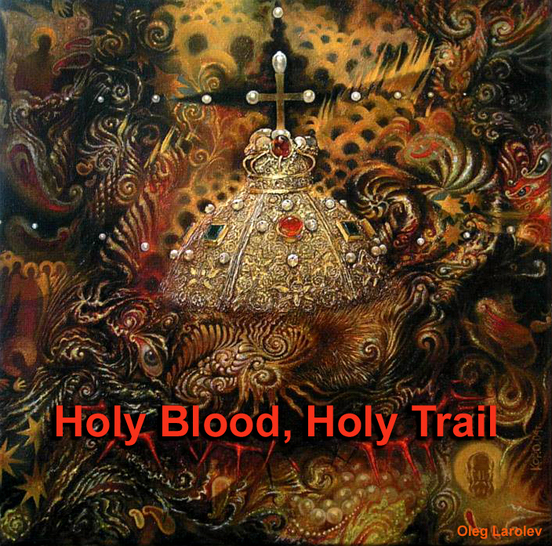
Genealogy and Genetic Genealogy are
now the second most popular subject online. The trail back through history is
contained in the lineage of our own descent. Large numbers of people are
discovering their Colonial histories and following their ancestors back to the
homelands. Around the globe, some were never transplanted; others never forgot
who they are or where they are from. Whatever the Grail is, we embody that.
Some deny the Sangreal, yet here we are in the flesh, following the Red Thread.
HOLY BLOOD, HOLY TRAIL
A Mystery Wrapped in a
Love Story
For those who can
trace their ancestral lines back through centuries, the Grail Trail is a golden
path back to medieval times, ancient times, & into the mists of myth and
pre-history. Follow
your Grail-Trail and see where it leads.
Underground Streams
Converge in the Vast Ocean of the Medieval Ancestral Pool
Ancestral Life
Continues Within Us
“Then turn to the dead, listen to
their lament
and accept them with love.” --C.G. Jung, The Red
Book, Chapter XV
One of the key themes
in ‘The
Lament for the Dead’
is the denial of death by contemporary, secular Western culture. Our ancestors
are not properly recognized and given their due weight – there is no real place
for the dead in our culture. Shamdasani says on p.176:
“The first task that Jung
finds himself confronted with
[as I think anyone engaged in this descent is] is reanimating the dead,
acknowledging that the dead are, and they have presences, they have effects. We turn
our eyes away from future-oriented living and to what has gone before, in the
shape of animated history, history that is not simply a record but history that
is active.”
Therefore, by denying
the dead we are denying ourselves.
Jung believed that the
foundations of personality are ancestral and universal. Because much of
genealogical best-practice includes mythic and fictional characters, the
process is best approached with a Jungian orientation, rather than as hard
historical fact, except where lines are clearly curated. In terms of collective
unconscious, genealogy has "as if" psychic reality.
Jungian and
post-Jungian practices allow us to interact with such material in a deeply
meaningful way that helps us integrate such knowledge and self-knowledge, that
enhances integration and individuation. Post-Jungians are committed to an
approach that does not focus exclusively on psychic reality but also takes into
account the realities of the outer world. Genealogy helps us adapt to both
external or internal realities. This practice raises into
conscious awareness what was formerly subconscious or unconscious -- the lives
of our direct ancestors.
Outside in the
courtyard, adjacent to the Tower, stand three stone tablets upon which, as Jung
tells it in MDR, "I chiseled the names of my
paternal ancestors." [3] The imaginal world of the ancestors, Jung's inner
fatherland, was a living presence in Jung's everyday experience. Ahnenerbe, "ancestral inheritance,"
is the ground of all subjective experience within every individual, according
to Jung. We find this idea at the epicenter of his worldview from a very early
age, in an alien part of his child-self that he called his "number two
personality" -- an elderly gentleman of the eighteenth century-allowing
him to imagine he was "living in two ages simultaneously, and being two
different persons." [4] He is an individual, yet a second heart beats in
his breast, a sacred heart that squeezes the lifeblood of the ancestors through
his veins.
"When I was working
on the stone tablets," Jung confided, "I became aware of the fateful
links between me and my ancestors .... It often seems as if there were an
impersonal karma within a family, which is passed from parents to children. It
has always seemed to me that I had to answer questions which fate had posed to
my forefathers, and which had not yet been answered, or as if I had to
complete, or perhaps continue, things which previous ages had left
unfinished." [5]
What questions did Jung's
paternal ancestors leave unanswered? What did Jung feel compelled to complete
or to continue? What was the family karma that bound Jung to a specific fate?
These questions already contain the seeds of their answers. What we must listen
for here are the assumptions behind the queries, the brand of reality that
would allow the possibility of such statements or questions in the first place.
It is an arcane reality that Jung was destined to keep alive for millions in
the twentieth century.
In a seminar he
gave in Zurich in 1925, Carl Jung expressed his belief in the idea of
"ancestor possession" -- that is, that certain hereditary units would
become activated under certain circumstances in one's life, allowing the spirit
of one's ancestor to then "take over" one's actions. Jung gave the
example of an "imaginary normal man" who, on the surface, never
indicated a capacity for leadership but in whom, when put in a position of
power, the "ancestral unit" of a leader somewhere in the family past
was awakened.
"I know no answer
to the question of whether the karma which I live is the outcome of my past
lives, or whether it is not rather the achievement of my ancestors, whose
heritage comes together in me," Jung confessed in MDR. "Am I a combination of the
lives of these ancestors and do I embody these lives again? Have I lived before
in the past as a specific personality, and did I progress so far in that life
that I am now able to seek a solution? I do not know."--Aryan Christ, Chapter 1
Full-Blooded
Genealogy
The
Red Thread
Genealogy is our map
of the unconscious -- the Land of the Dead. The Red Thread, the thread of
destiny, connects to the Source. It shows us the way, igniting imagination with
the alchemy of 'seeing', awakening the soul. The red threads of your blood link
you and your Tree to the World Tree, your history to world history and
mythology. The bloodline is also called the "underground
stream". The Red Thread is a transmission of cultural influences of
ancestors.
Walking the Labyrinth
of our lines is a deeply meditative process that arouses spirit, intuition and
gnosis from a deep sleep. It is a way of soul retrieval, uniting personal and
collective unconscious. It is a process of digging through the past,
overturning old notions. Even history looks different from inside your bloodlines. You can easily
observe your great-grandparents intermarrying over vast distances. They may
move in a single generation from eastern to western Europe, for example, or
across Europe from the Near East, or change their religion and ethnic identity.
Nothing lives as long as deep memory.
Entangled Roots
Genealogy writes you into the story of history and
genetically links you to the Cosmos. It is a legitimate form of self-therapy.
The genealogy of the soul begins in the longing for the lost other. Feeling
that 'genealogy without proofs is meaningless', some professional genealogists
want to throw out the mythic babies with the bathwater. They want to prune the
mythic and folkloric elements that link the Medieval to the Classical period
from the World Tree. It is not the Truth they seek but to control the narrative.
Stories create the
world we live in. They would remove the legendary and divine from the story of
humanity. But you cannot
remove
Isis, Enki, Adam, Woden, Arthur, or Venus from the Psyche. They abide forever
with their eternal influence, no matter how deeply buried. What the soul needs
is precisely the opposite of expunging them from the ancestral record. We need
to clarify and build on the relationships just as we find them, keeping the
webwork intact. We are entangled with all the ancestral figures of our
heritage. They reside at the nexus of their ancestors and descendents.
Archetypes are the
incorporeal blueprints of Being, self-organizing forms. The "collective
unconscious" is a vast information store containing the entire religious,
spiritual and mythological experiences of humanity. According to Jung, these
inherited ancient archetypes exist deep with the human psyche and heavily influence
our psychophysical being. Our genealogy shows how we are rooted in them, from
the Anunnaki to Zeus, and Horus to Solomon to Merlin.
You cannot expunge the
Fisher Kings, Grail Maidens, Lady of the Lake, the Serpent Scion, and Dragons.
They are not 'red herrings' in our lines, but the roots of Mystery that bind us
to Cosmos. Their appearance means we've transcended history. They are
spiritually tangible, though not literal. It is up to us to discern their
nature. The soul yearns for such deeper relationships. The archetypes embody
the foundational beliefs we carry through life. Jung called Soul the archetype
of Life.
Holographic Gods - http://holographicarchetypes.weebly.com/pantheon.html
Grail Quest &
Sangreal
Genealogy helps us
reexamine our truth, our existence. The Jungian approach includes the whole
range of emotions, but spares us from literalisms and engulfment by balancing
objective and subjective. Many archetypal themes are native to genealogical
practice:
The Hero Journey,
God-Kings, Holy Grail, Royal Wedding, Sangreal Bloodline, Merovingians, and
more. The "Grail
Bloodline"
led to the Scottish House of Stewart from the Merovingians and Desposyni. The
bloodline is arcane; it is occult -- that is, 'hidden' within the corridors of
royal descent. Thus genealogy builds a bridge between human and the divine.
There are ghosts in your genes. Your BOOK OF THE DEAD is written in your DNA.
http://drakenberg.weebly.com/
Hieros Gamos
Deciphering its
inherent meaning is a Quest for the Grail and the journey of psychological
transformation. The hierosgamos is the holy grail of sexual rites, a
psychobiological and symbolic act. Alchemy refers to the reconciliation of Sol
and Luna as The Chymical Wedding. Jung's theory of the psychic conjunction of
polarities was inspired by this teaching. Over centuries, the alchemists
generated a wide range of symbolic images as homologues (relation or
correspondence) for the anatomy of the unconscious, relating form and dynamic
function.
In biology, two things
are homologous if they bear the same relationship to one another. Homology is a
relationship between structures or DNA derived from a common ancestor.
Homologous traits of organisms are therefore explained by descent from a common
ancestor. Homology can also be described at the level of the gene. In genetics
homology can refer to both the gene (DNA) and the corresponding protein product.
What we seek is
spiritual union, sacred marriage of the gods -- found by joining the male and
female within, returning Eros to our process. They guide us into a new holistic
era. We now turn to the Feminine, which gives birth to new forms, including the
non-physical field of epigenetic and wave-genetic inheritance patterns.
The balance of
opposites is called the ‘alchemical wedding’ or mysterium coniunctionis. It was celebrated in Morganatic
marriages between human representatives of the God and Goddess that have less
to do with inheritance and succession than with renewal of community. Art that
contains the archetype, including the genealogical art, is the art that best
serves the global community. Like the Caduceus, the two intertwined
snakes, it serves as a symbol for perpetually incarnating life, healing and
wholeness.
The unification of
archetypes embodies the Self. Jung said, “The symbols of the self arise in the
depths of the body and they express its materiality every bit as much as the
structure of the perceiving consciousness. The symbol is thus a living body, corpus et anima.” (Cw 9i) Any distinction between
mind and body is an artificial dichotomy.
The Great Rite, also
called the Hieros Gamos, dates to Inanna of ancient Sumeria, around 2600 BCE,
if not before -- gods and goddesses, kings of the land and queens of
sovereignty incarnate on the earth. The hieros gamos, or sacred marriage,
is one of the earliest recorded public ceremonies in written history. The
Sumerian rites were deemed essential for the fertility of the land.
Symbols arising from the changeable coniunctio reflect the natural process of
life/death/rebirth arising from the fixed constellations.of the patriarchal
archetypes. The feminine gives birth to the Self before she can birth the
new man. Hierosgamos is the symbol of the absolute that reigns over the ego.
The myth of the Holy
Grail had to do with the Fisher King whose impotence reflected the drought, the
wasteland. Sexual union is a microcosm of the god and goddess, the two
fundamental aspects of the cosmos whose union completes the whole. Mystically,
the sexual union of male and female is the source of both immortality and personal
individuation and redemption.
No one who sets forth
on the grail quest remains unchanged. The incarnatio is a spontaneous act of
creation in the matter of the universe as the result of the today constellated
act of the conuinctio. Synchronicity is the conjunction of individual and
cosmos in a way that accelerates and deepens life in an unforeseen way that
celebrates Life. The only place of power and change is the Present.
Jung's Model
By the time he was
nineteen, Jung was convinced that his existence was somehow deeply entwined
with his ancestors and the spiritual mysteries. Jung challenges us to unite our
cultured side with the primeval ancestors, what he called “the two
million-year-old man within” at the clan and tribal level of human relationships.
Such a person would have a relationship with the animal ancestor foundation of
the psyche like an indigenous person speaks of spirit animals. We would not
exist without the strength and hard work of our ancestors. We have an overall
cellular memory of past ancestors that is local and nonlocal,
personal and universal.
Jung does not mean to
imply by this that experience as such is inherited, but rather that the brain
itself has been shaped and influenced by the remote experiences of mankind.
But,
'Although our
inheritance consists in physiological paths, it was nevertheless mental
processes in our ancestors that traced these paths. If they came to
consciousness again in the individual, they can do so only in the form of other
mental processes; and although these processes can become conscious only
through individual experience and consequently appear as individual
acquisitions, they are nevertheless pre-existent traces which are merely
"filled out" by the individual experience. Probably every "impressive"
experience is just such a break-through into an old, previously unconscious
riverbed.’
Our genealogical
ancestors link us to Source and to our Opus, the Great Work of reconnection
with spirit and soul, through nearly infinite alchemical marriages and their
offspring. Whatever we lack in our personal experience can surely be found
there in the collective root.
"Am I a combination of the lives of
these ancestors and do I embody these lives again? Have I lived before in the
past as a specific personality, and did I progress so far in that life that I
am now able to seek a solution? I do not know." (Jung, MDR).
Dr. Jung concludes the
“Liber Secundus” portion of The
Red Book with
the following words:
“An opus is needed, that one can
squander decades on, and do it out of necessity I must catch up with a piece of
the Middle Ages-within myself. We have only finished the Middle Ages of
others. I must begin early, in that period when the hermits died out.
Asceticism, inquisition, torture are close at hand and impose themselves. The
barbarian requires barbaric means of education. My I, you are a barbarian. I
want to live with you, therefore I will carry you through an utterly medieval
Hell, until you are capable of making living with you bearable. You should be
the vessel and womb of life, therefore I shall purify you. The touchstone is
being alone with oneself. This is the way” (The Red Book, Page 330).
Jung believed that
vestigial remnants, "archetypal" experiences of evolutionary
ancestors were embedded in the unconscious that affected how we behave and
think in the present. Our royal ancestors are our inner Court of last resort.
We have spiritual DNA, as well as physical, and our lot in life is to answer
the questions posed by the people who came before us.
Balancing inner and
outer realities serves to regulate both collective unconscious and collective
conscious forces (and implicitly, moral opposites of good and evil residing in
the psyche and expressed in the sentiments and acts of external reality).
"At Bollingen I am in
the midst of my true life, I am most deeply myself.
Here I am, as it were, the
"age-old son of the mother." That is how alchemy puts it, very
wisely, for the "old man" the "ancient," whom I had already
experienced as a child, is personality No. 2, who has always been and always
will be. He exists outside time and is the son of the maternal unconscious. In
my fantasies he took the form of Philemon, and he comes to life again at
Bollingen. At times I feel as if I am spread out over the landscape and inside
things, and am myself living in every tree, in the plashing of the waves, in
the clouds and the animals that come and go, in the procession of the
seasons."
~Carl Jung, Memories Dreams and Reflections.
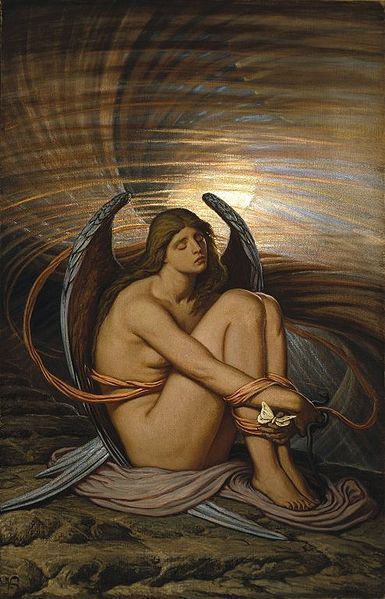
Elihu Vedder, Soul in Bondage, Brooklyn museum 1891-1892. US Public Domain via wikimedia.
References
Begg, Deike, In Search
of the Holy Grail and the Precious Blood: A Travellers' Guide.
Begg, Ean, The Cult of
the Black Virgin
Baldwin, William J.
(2003) Healing Lost Souls: Releasing Unwanted Spirits From Your
Energy Body . Charlottesville, Virginia: Hampton Roads Publishing.
Campbell, Joseph.
Myths to Live By. New York: Bantam, 1973.
-----. The Masks of
God: Creative Mythology. New York: Penguin, 1976.
Colander, David, and
Arjo Klamer. The Making of an Economist. Boulder, Colo.: Westview, 1990.
Economic Journal,
January 1991; special 100th anniversary edition.
Johnson, Robert A. He:
Understanding Masculine Psychology, Revised Edition. New York: Harper &
Row, 1989.
-----. Transformation:
Understanding the Three Levels of Masculine Consciousness. New York: Harper
& Row, 1991.
-----. The Fisher King
and the Handless Maiden. New York: Harper & Row, 1993.
Jung, Carl, THE RED
BOOK,
Jung, Emma, and
Marie-Louise von Franz. The Grail Legend. New York: G. P. Putnam's Sons, 1970.
Levy, Paul, The World
Is Psyche,
http://www.awakeninthedream.com/wordpress/the-world-is-psyche/
Loomis, Laura Hibbard,
and Roger Sherman Loomis. Medieval Romances. New York: Modern Library, 1957.
Wisman, Jon D.
"The Excessive Formalism Charge in Economics." Paper presented at the
annual meetings of the Society for the Advancement of Socio-Economics, 1993.
The Tree of Life and
the Holy Grail: Ancient and Modern Spiritual Paths and ... By Sylvia
Francke
Gnosis and Hermeticism
from Antiquity to Modern Times edited by R. van den Broek, Wouter J.
Hanegraaff 1998, State Universityof New York Press, - Karen-Claire Voss,
"Spiritual Alchemy"
http://books.google.com/books?id=0zfCrnqj_FUC&pg=PA174&lpg=PA174&dq=karen+voss,+mysterium&source=bl&ots=GA2X9sGrA2&sig=UveOue1pCUjWpXFSXGP6fR7Uc9k&hl=en&sa=X&ei=EdM9Uo9-h-mKApWqgJAI&ved=0CFYQ6AEwBA#v=onepage&q=karen%20voss%2C%20mysterium&f=false
IMAGINATION IN
MYSTICISM AND ESOTERICISM: Marsilio Ficino, Ignatius de Loyola, and Alchemy
by Karen-Claire Voss Published in Studies in Spirituality
No. 6, 1996, 106-130.
http://www.scribd.com/doc/127003294/Karen-claire-Voss-Imagination-in-Mysticism-and-Esotericism
http://www.healingtaousa.com/cgi-bin/articles.pl?rm=mode2&articleid=68
The Social Life of
Spirits Edited by Ruy Blanes and Diana Espírito Santo
Fiona Bowie's paper on
'Self, Personhood and Possession' from the Afterlife Research Centre's panel at
the IUAES conference
http://www.academia.edu/4512697/Self_Personhood_and_Possession_IUAES_2013_MANCHESTER
Building Bridges,
Dissolving Boundaries: Towards a Methodology for theEthnographic Study of the
Afterlife, Mediumship and Spiritual Beings Fiona Bowie, Wolfson College,
Oxford
Possession: Jung's
Comparative Anatomy of the Psyche By Craig E. Stephenson, 2009,
http://books.google.com/books?id=dqPAD8UDSjIC&printsec=frontcover&dq=Possession:+Jung%27s+Comparative+Anatomy+of+the+Psyche&hl=en&sa=X&ei=KbdAUqy3C-eXigLbloHgCA&ved=0CC8Q6AEwAA#v=onepage&q=Possession%3A%20Jung%27s%20Comparative%20Anatomy%20of%20the%20Psyche&f=false
The Fourth
Turning By William Strauss, Neil Howe
Archetype Revisited:
An Updated Natural History of the Self By Anthony Stevens
Journeys into
emptiness -
http://books.google.com/books?id=Pioe-Uxo3lIC&printsec=frontcover&dq=journeys+into+emptiness&hl=en&sa=X&ei=NyFDUpu4JaeCiwKjtoDACA&ved=0CE4Q6AEwAA#v=onepage&q=journeys%20into%20emptiness&f=false
'ECHOES FROM THE
GNOSIS', VOL. VIII.. BY G. R. S. MEAD, THE CHALDÆAN ORACLES, VOL. I.,
1908
http://digitalcommons.macalester.edu/cgi/viewcontent.cgi?article=1012&context=classics_honors
TO
BRING THE DEAD TO LIFE
To bring the dead
to life
Is no great magic.
Few are wholly dead:
Blow on a dead man's
embers
And a live flame will
start.
Let his forgotten
griefs be now,
And now his withered
hopes;
Subdue your pen to his
handwriting
Until it prove as
natural
To sign his name as
yours.
Limp as he limped,
Swear by the oaths he
swore;
If he wore black,
affect the same;
If he had gouty
fingers,
Be yours gouty too.
Assemble tokens
intimate of him --
A ring, a hood, a
desk:
Around these elements
then build
A home familiar to
The greedy revenant.
So grant him life, but
reckon
That the grave which
housed him
May not be empty now:
You in his spotted
garments
Shall yourself lie
wrapped.
--Robert Graves
(c)2015-2016; All Rights Reserved, Iona Miller, Sangreality Trust
iona_m@yahoo.com
Fair Use Notice
This site contains
copyrighted material the use of which has not always been specifically
authorized by the copyright owner. We are making such material available in our
efforts to advance understanding of environmental, political, human rights,
economic, democracy, scientific, and social justice issues, etc. We believe
this constitutes a 'fair use' of any such copyrighted material as provided for
in section 107 of the US Copyright Law. In accordance with Title 17 U.S.C.
Section 107, the material on this site is distributed without profit to those
who have expressed a prior interest in receiving the included information for
research and educational purposes. If you wish to use copyrighted material from
this site for purposes of your own that go beyond 'fair use', you must obtain
permission from the copyright owner.
Powered by